


Ezekiel 47:19
Bible text: King James Version (1769 Blayney text) · Public domain
Bible text: King James Version with Strong's numbers · Public domain
Bible text: Berean Standard Bible · Public domain
Bible text: American Standard Version (1901) · Public domain
Bible text: World English Bible, Messianic edition · Public domain
Bible text: Geneva Bible (1599) · Public domain
Bible text: Young's Literal Translation · Public domain
- וּפְאַתu·fe·'Atand [the] side ofH6285Conj-w ¦ N-fscNoun Singular Feminine Constructוּandפְאַת[the] side of
- נֶגֶבNe·gev[the] southH5045N-msNoun Singular Masculine Absolute
- תֵּימָנָהtei·Ma·nahsouth -wardH8486N-fs ¦ SfxNoun Singular Feminine Absoluteתֵּימָנָsouthה-ward
- מִתָּמָרmi·ta·Mar[will be] from TamarH8559Prep-m ¦ N-properNoun Proper Locationמִ[will be] fromתָּמָרTamar
- עַד'adtoH5704PrepPreposition
- מֵיmei[the] waters ofH4325N-mpcNoun Plural Masculine Construct
- מְרִיבוֹתme·ri·VotMeribathH4809N-fpcNoun Plural Feminine Construct
- קָדֵשׁka·DeshKadeshH6946N-properNoun Proper Location
- נַחֲלָהna·cha·Lah[the] wadi <towards>H5158N-ms ¦ SfxNoun Singular Masculine Absoluteנַחֲלָ[the] wadiה<towards>
- אֶל'eltoH413PrepPreposition
- הַיָּםhai·Yamthe seaH3220Art ¦ N-msNoun Singular Masculine Absoluteהַtheיָּםsea
- הַגָּדוֹלha·ga·Dol<the> greatH1419Art ¦ Adj-msAdjective Singular Masculine Absoluteהַ<the>גָּדוֹלgreat
- וְאֵתve·'Etand <obj.>H853Conj-w ¦ DirObjMParticle Object Indicatorוְandאֵת<obj.>
- פְּאַתpe·'at[the] side ofH6285N-fscNoun Singular Feminine Construct
- תֵּימָנָהtei·Ma·nahsouth -wardH8486N-fs ¦ SfxNoun Singular Feminine Absoluteתֵּימָנָsouthה-ward
- נֶגְבָּהNeg·bahsouth -wardH5045N-ms ¦ SfxNoun Singular Masculine Absoluteנֶגְבָּsouthה-ward
English is a literal word-by-word gloss of the Hebrew, not the KJV's wording. Why?
This is the original text the KJV's translators worked from — each Hebrew word with its own literal English meaning in this verse, prepared by scholars at Tyndale House, Cambridge. The KJV translates whole sentences, not word by word, so its wording differs: one Hebrew word can become several English words, and the KJV may choose “the LORD” where the gloss reads “Yahweh”. Both are faithful — they answer different questions. For the KJV's own rendering, switch to the KJV text.
Details
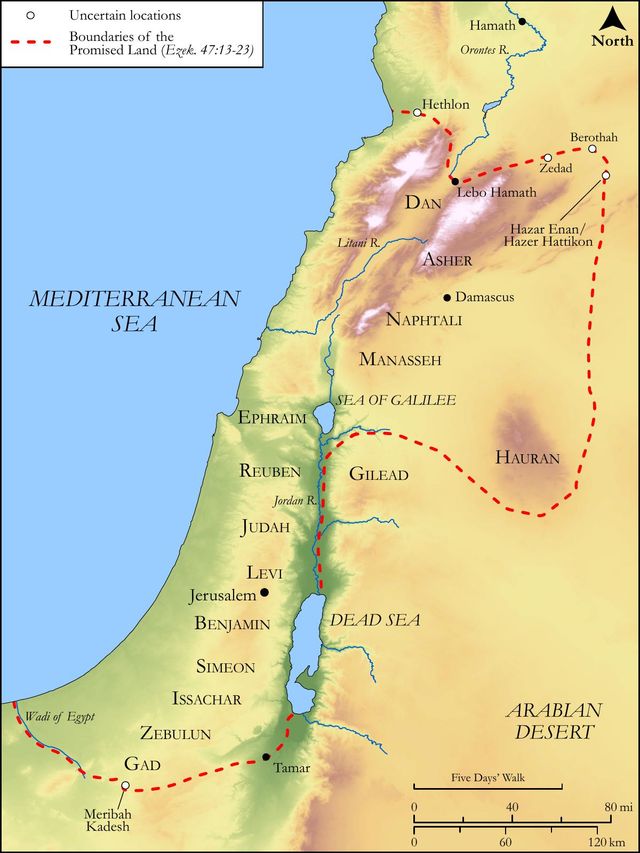
See on the biblical-era map
Study this verse
Public-domain commentary
Matthew Henry
From his Commentary on the Whole Bible. Henry comments on passages, not single verses — this entry covers Ezekiel 47:13–23.
We are now to pass from the affairs of the sanctuary to those of the state, from the city to the country. 1. The Land of Canaan is here secured to them for an inheritance (Eze 47:14): I lifted up my hand to give it unto your fathers, that is, promised it upon oath to them and their posterity. Though the possession had been a great while discontinued, yet God had not forgotten his oath which he swore to their fathers. Though God's providences may for a time seem to contradict his promises, yet the promise will certainly take place at last, for God will be ever mindful of his covenant. I lifted up my hand to give it, and therefore it shall without fail fall to you for an inheritance. Thus the heavenly Canaan is sure to all the seed, because it is what God, who cannot lie, has promised. 2. It is here circumscribed, and the bounds and limits of it are fixed, which they must not pass over to encroach upon their neighbours and which their neighbours shall not break through to encroach upon them. We had such a draught of the borders of Canaan when Joshua was to put the people in possession of it, Num 34:1, etc. That begins with the salt sea in the south, goes round and ends there. This begins with Hamath about Damascus in the north, and so goes round and ends there, Eze 47:20. Note, It is God that appoints the bounds of our habitation; and his Israel shall always have cause to say that the lines have fallen to them in pleasant places. The lake of Sodom is here called the east sea, for it, being healed by the waters of the sanctuary, it is no more to be called a salt sea, as it was in Numbers. 3. It is here ordered to be divided among the tribes of Israel, reckoning Joseph for two tribes, to make up the number of twelve, when Levi was taken out to attend the sanctuary, and had his lot adjoining to that (Eze 47:13, Eze 47:21): You shall inherit it, one as well as another, Eze 47:14. The tribes shall have an equal share, one as much as another. As the tribes returned out of Babylon, this seems unequal, because some tribes were much more numerous than the other, and indeed the most were of Judah and Benjamin and very few of the other ten tribes; but as the twelve tribes stand, in type and vision, for the gospel-church, the Israel of God, it was very equal, because we find in another vision an equal number of each of the twelve tribes sealed for the living God, just 12,000 of each, Rev 7:5, etc. And to those sealed ones these allotments did belong. It intimates likewise that all the subjects of Christ's kingdom have obtained like precious faith. Male and female, Jew and Gentile, bond and free, are all alike welcome to Christ and made partakers of him. 4. The strangers who sojourn among them, who shall beget children and be built up into families, and so help to people their country, shall have inheritance among the tribes, as if they had been native Israelites (Eze 47:22, Eze 47:23), which was by no means allowed in Joshua's division of the land. This is an act for a general naturalization, which would teach the Jews who was their neighbour, not those only of their own nation and religion, but those, whoever they were, that they had an opportunity of showing kindness to, because from them they would be willing to receive kindness. It would likewise invite strangers to come and settle among them, and put themselves under the wings of the divine Majesty. But it certainly looks at gospel-times, when the partition-wall between Jew and Gentile was taken down, and both one in Christ, in whom there is no difference, Rom 10:12. This land was a type of the heavenly Canaan, that better country (Heb 11:16), in which believing Gentiles shall have a blessed lot, as well as believing Jews, Isa 56:3.
Historical interpretation
Historical reception
1 surviving comment on this verse from the historical church.
(Verse 19.) The southern region stretches from Thamar to the waters of contradiction (or Mariboth: this word signifies contradiction or disputes). It includes Cades and the river, reaching all the way to the Great Sea. This is the southern region. According to the Book of Numbers, it is written as follows: It begins from the wilderness of Sin, near Edom, and its borders extend towards the eastern sea (some manuscripts add 'the saltiest sea'), encircling the southern region up along the ascent of Scorpio, passing through Senna and reaching south to Cadesbarne. From there, the borders extend to a village named Addar, and continue to Asemona. The boundary line then goes from Asemona to the torrent of Egypt, and ends at the shore of the Great Sea (Num. 34:3-5). This briefly signifies (so that we do not appear to have passed over the very wide stretch of Numbers by occasion of Ezekiel's exposition) to go around the wilderness of Sin, which is near Edom, and the boundary of the Red Sea, and through the ascent of Scorpions, and through Senna and Kadesh-barnea, and the courtyard of Addar, and to come from Asemona as far as the river of Egypt, which flows into the sea near the city of Rhinocorura. But truly, this boundary of the southern region, that is, the southernmost part, begins from Tamar, which is a city in the wilderness, which Solomon also built with marvelous works and is now called Palmyra; and in the Hebrew language, it is called Thamar, which in our language means "palm," as far as the waters of Meribah Kadesh, which is undoubtedly in the desert, and the river entering the Great Sea, which stretches along the coast of Egypt and Palestine, and this is the southern region to the South. Afterward, we receive the Southern region when the light from above is poured upon us, just as Abraham joined in a feast and we are intoxicated with the wine that gladdens the heart, like Joseph and his brothers. This possession begins at Thamar and extends to the waters of contradiction, a place of victory over vices. For virtue is always contradicted. Therefore, Jews opposing Paul in the preaching of the Gospel assert that it is contradicted throughout the whole world (Acts 15). And in the Gospel, we read Simeon saying: This child is destined for the falling and the rising of many in Israel, and to be a sign that will be contradicted (Luke 2:34). However, every contradiction is of holiness, which is interpreted as Kadesh, as the Psalmist says: The Lord will shake Kadesh's desert (Psalm 29:8); which originally did not have the holiness of the Lord, but it was shaken and moved to receive the guest God, who says: Upon whom will my spirit rest, if not upon the humble and quiet one who trembles at my words? (Isaiah 66:2). Beyond the deserted region of Cades, all the way to the great sea in the south, the southern region is arid, as we mentioned before; it does not have rain from the land, but rather from the sky, collected in various forms of different powers.
Continue studying Ezekiel 47:19 across the web’s major study libraries — every link below opens this exact verse, chapter, or book on the destination site.
Read & Compare
 BibleGatewayThis verse in more than 200 translations and 70 languages.
 Bible.comThe YouVersion reader — hundreds of translations, reading plans, and highlights.
 ESV.orgCrossway's official English Standard Version reader.
 NET BibleThe NET translation with 60,000+ translators' notes on every rendering decision.
 STEP BibleTyndale House's free study tool — original text, vocabulary, and scholarly resources.
 BibliaLogos Bible Software's free web reader.
 USCCBThe New American Bible (Revised Edition) with the U.S. bishops' study notes.
Commentaries
 BibleHub CommentariesDozens of classic commentaries on this verse, gathered on one page.
 StudyLightMore than 100 commentary sets — the largest collection on the web.
 BibleRefPlain-English commentary on what this verse means, verse by verse.
 Enduring WordDavid Guzik's free commentary on this chapter, widely used by Bible teachers.
 Bible Study ToolsVerse commentary alongside Greek and Hebrew study aids.
Original Language & Research
- BibleHub InterlinearThe verse word by word — original language, transliteration, and English.
- BibleHub LexiconEvery word's original-language definition and Strong's entry.
 Blue Letter BibleDeep-study tools — Strong's numbers, concordance, and word studies.
 SefariaThe Hebrew text with Rashi and centuries of Jewish commentary.
Sermons, Hymns & Audio


TrulyRandomVerse is not affiliated with these sites and doesn’t control their content. They’re linked because they’re genuinely useful.
Summary
Ezekiel 47:19 meticulously delineates the southern boundary of the land to be allotted to the tribes of Israel in the prophet's grand vision of a restored temple and a re-divided Holy Land. This verse, part of a comprehensive geographical survey, precisely outlines the southern limits, stretching from Tamar in the east to the historically significant Waters of Strife in Kadesh, and then westward along a river to the Mediterranean Sea. It underscores God's meticulous planning and unwavering faithfulness to His covenant promises regarding the land, providing a tangible framework for the eschatological restoration of Israel.
Context
ShowHideLiterary Context
This verse is deeply embedded within the climactic section of Ezekiel's prophecy, specifically chapters 40-48, which detail an elaborate vision of a new temple, its worship, and the subsequent division of the land among the twelve tribes of Israel. Following the awe-inspiring description of the miraculous, life-giving river flowing from the temple in Ezekiel 47:1-12, the narrative transitions from the divine presence to its practical implications for the restored community: the precise boundaries and allocation of the land. Verses Ezekiel 47:13-23 provide the overarching framework for the land's division, with our verse contributing to the detailed description of the southern border. This meticulous outlining emphasizes the tangible reality, divine order, and secure inheritance of the future kingdom.
Historical & Cultural Context
Ezekiel prophesied during the painful period of the Babylonian exile (c. 593-571 BC), a time of profound national despair and theological crisis for Israel. The people had lost their temple, their king, and their land, leading to existential questions about God's faithfulness and the permanence of His covenant promises. In this context, Ezekiel's vision of a new temple and a re-divided land served as a powerful, divinely inspired message of hope and comprehensive restoration. The geographical markers mentioned, such as "Tamar" and "Kadesh," were recognizable points in the ancient Near East, grounding the futuristic vision in real-world geography and making it relatable to his original audience. "The Waters of Strife in Kadesh" (Meribah-Kadesh) held significant historical weight, recalling Israel's rebellion and God's judgment during the wilderness wanderings (Numbers 20:1-13), yet here it is incorporated into the sacred boundaries of a restored land, perhaps symbolizing the redemption of past failures and the complete sovereignty of God. The "great sea" refers to the Mediterranean, the natural western boundary of the land of Israel.
Key Themes
ShowHideEzekiel 47:19 contributes significantly to several overarching themes pervasive throughout the book of Ezekiel. Foremost is the theme of Divine Order and Sovereignty, as God meticulously defines the precise boundaries of the land, demonstrating His absolute control and precise planning for His people's future. This meticulousness also highlights the theme of Future Restoration and Inheritance, assuring the exiles that God's ancient covenant promises regarding the land, first made to Abraham in Genesis 15:18-21, would indeed be fulfilled in a tangible way. The inclusion of historically significant, even problematic, locations like the Waters of Strife within these sacred boundaries subtly hints at God's profound Redemptive Power, transforming places of past rebellion into markers of future blessing and demonstrating His ability to bring order out of chaos. This detailed mapping provides a tangible expression of God's faithfulness and the secure nature of Israel's eschatological inheritance, a theme prevalent throughout Ezekiel 47.
Exposition and Analysis
ShowHideKey Word Analysis
ShowHideThis term denotes "the south (from its drought); specifically, the Negeb or southern district of Judah." Its usage here emphasizes not just a cardinal direction but a distinct geographical region known for its arid conditions. The repetition of "south" and "southward" in the verse underscores the precise and unambiguous definition of this boundary, signifying a clear and unalterable demarcation of the divinely allotted territory.
Derived from a root meaning "to quarrel," this word signifies "provocation, strife." It is directly linked to the proper noun "Meribah" (H4809), the name of two desert locations where Israel contended with God regarding water. Its inclusion as a boundary marker is profoundly significant, recalling past instances of Israel's rebellion and lack of faith. Yet, here it is integrated into the divinely ordained, peaceful future, highlighting God's sovereignty even over places marked by human contention.
This word refers to "a sea (as breaking in noisy surf) or large body of water; specifically (with the article), the Mediterranean Sea." In this context, "the great sea" unequivocally identifies the Mediterranean Sea, which historically formed the natural western boundary of the land of Israel. Its mention confirms the traditional geographical scope of the promised land, extending to its natural western limit, reinforcing the comprehensive nature of the future inheritance.
Verse Breakdown
ShowHide"And the south side southward,"
This opening phrase immediately establishes the directional focus of the boundary description. The repetition of "south" (negeb) and "southward" (teyman) is a rhetorical emphasis, underscoring the precise and unambiguous nature of this border. It leaves no room for misinterpretation regarding the orientation and the definitive start of the detailed description.
"from Tamar [even] to the waters of strife [in] Kadesh,"
This clause specifies the eastern and central points of the southern boundary. "Tamar" was likely a palm oasis or settlement in the far south-east, serving as the easternmost anchor point. The boundary then extends westward to "the waters of strife [in] Kadesh" (Meribah-Kadesh), a historically significant location from Israel's wilderness wanderings, infamous for the Israelites' contention with Moses over water (Numbers 20:13). Its inclusion highlights God's sovereignty and redemptive power, incorporating even places of past rebellion into His future, blessed plan.
"the river to the great sea."
This segment describes the westernmost portion of the southern boundary. The "river" here most likely refers to the Wadi el-Arish (often identified as the "River of Egypt"), which historically served as the southwestern border of Canaan. This river then flows into "the great sea," which is the Mediterranean Sea, marking the ultimate western extent of the divinely allotted territory. This confirms the traditional and expansive scope of the promised land.
"And [this is] the south side southward."
This concluding phrase serves as a powerful reiteration and emphatic confirmation of the entire description of the southern boundary. The repetition acts as a strong rhetorical device, sealing the definitive nature of the border and underscoring God's meticulousness, His unwavering faithfulness, and the absolute certainty of His promised inheritance.
Literary Devices
ShowHideEzekiel 47:19 employs several literary devices to convey its profound message of divine order and restoration. The primary device is Geographical Specification, where precise place names and cardinal directions are used with meticulous detail to delineate the boundaries of the land. This creates a powerful sense of realism and certainty, grounding the prophetic vision in a tangible, understandable framework for the exiles. The Repetition of "south side southward" at the beginning and end of the verse functions as an emphatic inclusio, reinforcing the definitive and unalterable nature of this particular boundary. Furthermore, the mention of "the waters of strife in Kadesh" introduces a subtle yet potent element of Allusion and Symbolism. This location, historically associated with Israel's rebellion and God's judgment, is now integrated into the blessed, restored land. This transformation symbolizes God's redemptive power, demonstrating His ability to transform even places of past failure and contention into markers of His future blessing, order, and complete sovereignty.
Theological and Thematic Connections
ShowHideEzekiel 47:19, in its precise delineation of the southern border, speaks profoundly to God's unwavering faithfulness and His unyielding commitment to His covenant promises. In a time of profound national despair and exile, this detailed geographical description offered a tangible assurance that God had not forgotten His people or His ancient pledge of land. It illustrates that God's plans are not vague aspirations but meticulously detailed blueprints, reflecting His divine order, sovereignty, and providential care over all creation and history. The inclusion of historically significant locations, even those tied to Israel's rebellion, within this future inheritance underscores God's redemptive purpose, demonstrating His capacity to incorporate and transform the past into a glorious future, ultimately for His glory and His people's blessing.
Reflection and Application
ShowHideEzekiel 47:19, while describing a physical boundary in a prophetic vision, offers profound spiritual insights for believers today. The meticulous detail of God's plan for the land reminds us that God is a God of order, purpose, and unwavering faithfulness. Just as He had a precise inheritance for Israel, He has a divine plan for our lives and for His church. This should instill in us a deep sense of security and trust, knowing that His promises are sure and His purposes will ultimately prevail, even when circumstances seem chaotic or uncertain. This verse encourages us to anchor our hope in God's sovereign control and His commitment to bringing about His perfect will. It challenges us to seek and live within the "boundaries" of His Word and His Spirit, finding peace, fruitfulness, and true freedom within His divine order, and to look forward with confident hope to the ultimate restoration He promises for all creation.
Questions for Reflection
ShowHideFAQ
ShowHideWhat is the significance of "the waters of strife in Kadesh" as a boundary marker in this future vision?
ShowHide"The waters of strife in Kadesh" refers to Meribah-Kadesh, a place of significant historical importance in Israel's wilderness journey where the Israelites quarreled with Moses and God over water (Numbers 20:1-13). Its inclusion as a boundary marker in this prophetic vision is highly symbolic and deeply significant. It suggests that even places associated with past rebellion, contention, and divine judgment are brought under God's sovereign rule and integrated into the future, blessed inheritance. This demonstrates God's profound redemptive power to transform and sanctify even the most challenging or problematic aspects of Israel's history, incorporating them into His perfect eschatological plan for peace and order. It underscores that God's restoration is comprehensive, encompassing even the scars of the past.
Christ-Centered Fulfillment
ShowHideWhile Ezekiel 47:19 describes a geographical boundary for a future, earthly Israel, its ultimate fulfillment and profound spiritual significance are found comprehensively in Christ. The concept of a divinely allotted inheritance, a land flowing with life from God's presence, points forward to the spiritual inheritance believers receive in Christ, which transcends mere physical territory. Jesus declared, "Blessed are the meek, for they shall inherit the earth", expanding the promise of land beyond a physical territory to a spiritual reality encompassing all of creation under His righteous reign. The miraculous river flowing from the temple in Ezekiel 47, bringing life and healing wherever it goes, is a powerful foreshadowing of Christ, who is the ultimate source of living water (John 7:38) and the true temple from whom all spiritual life and blessing flow (John 2:19-21). The precise boundaries, though physical in Ezekiel's vision, find their ultimate security and permanence in the new heavens and new earth, where Christ reigns supreme and His people dwell in perfect, eternal peace within His boundless kingdom (Revelation 21:1-4). Thus, Ezekiel's vision of a perfectly ordered and blessed land ultimately points to the comprehensive and eternal restoration found in the person and redemptive work of Jesus Christ, the true inheritor and giver of all spiritual blessings.