


Deuteronomy 32:51
Bible text: King James Version (1769 Blayney text) · Public domain
Bible text: King James Version with Strong's numbers · Public domain
Bible text: Berean Standard Bible · Public domain
Bible text: American Standard Version (1901) · Public domain
Bible text: World English Bible, Messianic edition · Public domain
Bible text: Geneva Bible (1599) · Public domain
Bible text: Young's Literal Translation · Public domain
- עַל'alonH5921PrepPreposition
- אֲשֶׁר'a·SherthatH834RelParticle Relative
- מְעַלְתֶּםme·'al·Temyou acted unfaithfullyH4603V-Qal-Perf-2mpVerb Qal Perfect 2nd Plural Masculine
- בִּיBiagainst <the> mePrep-b ¦ 1csSuffix Personal 1st Singular common genderבִּagainst <the>יme
- בְּתוֹךְbe·toKhin amongH8432Prep-b ¦ N-mscNoun Singular Masculine Constructבְּinתוֹךְamong
- בְּנֵיbe·Nei[the] people ofH1121N-mpcNoun Plural Masculine Construct
- יִשְׂרָאֵלYis·ra·'ElIsraelH3478N-properNoun Proper Location
- בְּמֵיbe·meiat [the] waters ofH4325Prep-b ¦ N-mpcNoun Plural Masculine Constructבְּatמֵי[the] waters of
- מְרִיבַתme·ri·VatMeribahH4809N-fscNoun Singular Feminine Construct
- קָדֵשׁka·DeshKadeshH6946N-properNoun Proper Location
- מִדְבַּרmid·bar[the] wilderness ofH4057N-mscNoun Singular Masculine Construct
- צִןTzinZinH6790N-properNoun Proper Location
- עַל'alonH5921PrepPreposition
- אֲשֶׁר'a·SherthatH834RelParticle Relative
- לֹאlo'notH3808NegParticle Negative
- קִדַּשְׁתֶּםki·dash·Temyou honored as holyH6942V-Piel-Perf-2mpVerb Piel Perfect 2nd Plural Masculine
- אוֹתִי'o·Ti<obj.> meH853DirObjM ¦ 1csParticle Object Indicatorאוֹתִ<obj.>יme
- בְּתוֹךְbe·Tokhin amongH8432Prep-b ¦ N-mscNoun Singular Masculine Constructבְּinתוֹךְamong
- בְּנֵיbe·Nei[the] people ofH1121N-mpcNoun Plural Masculine Construct
- יִשְׂרָאֵלYis·ra·'ElIsraelH3478N-properNoun Proper Location
English is a literal word-by-word gloss of the Hebrew, not the KJV's wording. Why?
This is the original text the KJV's translators worked from — each Hebrew word with its own literal English meaning in this verse, prepared by scholars at Tyndale House, Cambridge. The KJV translates whole sentences, not word by word, so its wording differs: one Hebrew word can become several English words, and the KJV may choose “the LORD” where the gloss reads “Yahweh”. Both are faithful — they answer different questions. For the KJV's own rendering, switch to the KJV text.
Details
See on the biblical-era map
Study this verse
Public-domain commentary
Matthew Henry
From his Commentary on the Whole Bible. Henry comments on passages, not single verses — this entry covers Deuteronomy 32:44–52. His three-level outline is real structure in the source text, so it is rendered as structure.
Here is, I. The solemn delivery of this song to the children of Israel, Deu 32:44, Deu 32:45. Moses spoke it to as many as could hear him, while Joshua, in another assembly, at the same time, delivered it to as many as his voice would reach. Thus coming to them from the mouth of both their governors, Moses who was laying down the government, and Joshua who was taking it up, they would see they were both in the same mind, and that, though they changed their commander, there was no change in the divine command; Joshua, as well as Moses, would be a witness against them if ever they forsook God.
II.An earnest charge to them to mind these and all the rest of the good words that Moses had said to them.
How earnestly does he long after them all, how very desirous that the word of God might make deep and lasting impressions upon them, how jealous over them with a godly jealousy, lest they should at any time let slip these great things!
1.The duties he charges upon them are, (1.) Carefully to attend to these themselves: "Set your hearts both to the laws, and to the promises and threatenings, the blessings and curses, and now at last to this song. Let the mind be closely applied to the consideration of these things; be affected with them; be intent upon your duty, and cleave to it with full purpose of heart." (2.) Faithfully to transmit these things to those that should come after them: "What interest you have in your children, or influence upon them, use it for this purpose; and command them (as your father Abraham did, Gen 18:19) to observe to do all the words of this law." Those that are good themselves cannot but desire that their children may be so likewise, and that posterity may keep up religion in their day and the entail of it may not be cut off.
2.The arguments he uses to persuade them to make religion their business and to persevere in it are,
(1.)The vast importance of the things themselves which he had charged upon them (Deu 32:47): "It is not a vain thing, because it is your life. It is not an indifferent thing, but of absolute necessity; it is not a trifle, but a matter of consequence, a matter of life and death; mind it, and you are made for ever; neglect it, and you are for ever undone." O that men were but fully persuaded of this, that religion is their life, even the life of their souls!
(2.)The vast advantage it would be of to them: Through this thing you shall prolong your days in Canaan, which is a typical promise of that eternal life which Christ has assured us those shall enter into that keep the commandments of God, Mat 19:17.
III.Orders given to Moses concerning his death.
Now that this renowned witness for God had finished his testimony, he must go up to Mount Nebo and die; in the prophecy of Christ's two witnesses there is a plain allusion to Moses and Elias (Rev 11:6), and perhaps their removal, being by martyrdom, is no less glorious than the removal either of Moses or Elias. Orders were given to Moses that self-same day, Deu 32:48. Now that he had done his work, why should he desire to live a day longer? He had indeed formerly prayed that he might go over Jordan, but now he is entirely satisfied, and, as God had bidden him, saith no more of that matter.
1.God here reminds him of the sin he had been guilty of, for which he was excluded Canaan (Deu 32:51), that he might the more patiently bear the rebuke because he had sinned, and that now he might renew his sorrow for that unadvised word, for it is good for the best of men to die repenting of the infirmities they are conscious to themselves of. It was an omission that was thus displeasing to God; he did not sanctify God, as he ought to have done, before the children of Israel, he did not carry himself with a due decorum in executing the orders he had then received.
2.He reminds him of the death of his brother Aaron (Deu 32:50), to make his own the more familiar and the less formidable. Note, It is a great encouragement to us, when we die, to think of our friends that have gone before us through that darksome valley, especially of Christ, our elder brother and great high priest.
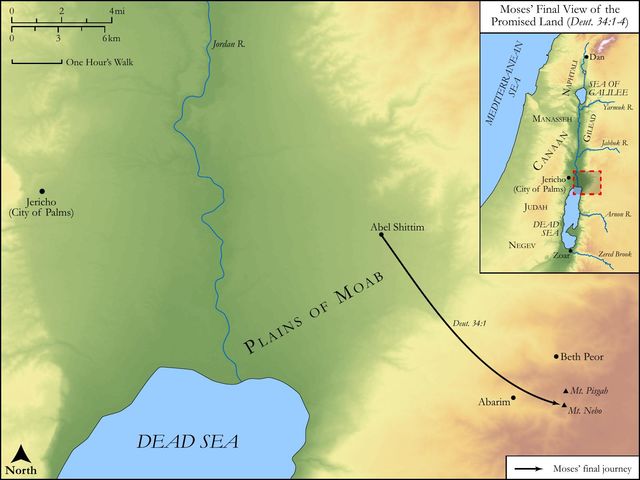
3.He sends him up to a high hill, thence to take a view of the land of Canaan and then die, Deu 32:49, Deu 32:50. The remembrance of his sin might make death terrible, but the sight God gave him of Canaan took off the terror of it, as it was a token of God's being reconciled to him, and a plain indication to him that though his sin shut him out of the earthly Canaan, yet it should not deprive him of that better country which in this world can only be seen, and that with an eye of faith. Note, Those may die with comfort and ease whenever God calls for them (notwithstanding the sins they remember against themselves) who have a believing prospect and a well-grounded hope of eternal life beyond death.
Historical interpretation
Historical reception
1 surviving comment on this verse from the historical church.
[Moses] touched the rock with his rod with doubt and thus distinguished this miracle from the rest, in which he had not doubted. He thus offended, thus deserved to hear that he should die without entering into the land of promise. For being disturbed by the murmurs of an unbelieving people, he did not hold fast that confidence which he ought to have held.
Continue studying Deuteronomy 32:51 across the web’s major study libraries — every link below opens this exact verse, chapter, or book on the destination site.
Read & Compare
 BibleGatewayThis verse in more than 200 translations and 70 languages.
 Bible.comThe YouVersion reader — hundreds of translations, reading plans, and highlights.
 ESV.orgCrossway's official English Standard Version reader.
 NET BibleThe NET translation with 60,000+ translators' notes on every rendering decision.
 STEP BibleTyndale House's free study tool — original text, vocabulary, and scholarly resources.
 BibliaLogos Bible Software's free web reader.
 USCCBThe New American Bible (Revised Edition) with the U.S. bishops' study notes.
Commentaries
 BibleHub CommentariesDozens of classic commentaries on this verse, gathered on one page.
 StudyLightMore than 100 commentary sets — the largest collection on the web.
 BibleRefPlain-English commentary on what this verse means, verse by verse.
 Enduring WordDavid Guzik's free commentary on this chapter, widely used by Bible teachers.
 Bible Study ToolsVerse commentary alongside Greek and Hebrew study aids.
Original Language & Research
- BibleHub InterlinearThe verse word by word — original language, transliteration, and English.
- BibleHub LexiconEvery word's original-language definition and Strong's entry.
 Blue Letter BibleDeep-study tools — Strong's numbers, concordance, and word studies.
 SefariaThe Hebrew text with Rashi and centuries of Jewish commentary.
Sermons, Hymns & Audio


TrulyRandomVerse is not affiliated with these sites and doesn’t control their content. They’re linked because they’re genuinely useful.
Summary
Deuteronomy 32:51 serves as a profoundly solemn divine decree, articulating the precise reason why Moses, despite his unparalleled intimacy with God and forty years of faithful leadership, was barred from entering the Promised Land. This verse directly attributes his exclusion to a specific act of unfaithfulness at the waters of Meribah-Kadesh, where he publicly failed to uphold and manifest God's unique holiness before the assembled Israelites, thereby committing a trespass against the Lord's explicit command and diminishing His glory in a pivotal moment.
Context
ShowHideLiterary Context
Deuteronomy 32:51 is strategically placed within the climactic "Song of Moses" (Deuteronomy 32:1-43), a majestic and prophetic poem that recounts God's unwavering faithfulness to Israel despite their persistent rebellion. Immediately following this epic poetic discourse, the Lord directly addresses Moses in Deuteronomy 32:48-52, commanding him to ascend Mount Nebo to behold the land of Canaan, but explicitly stating that he would not enter it. This verse, therefore, functions as God's definitive, final explanation for the conclusion of Moses' earthly ministry and his exclusion from the very land he had diligently led Israel towards for four decades. It provides a crucial narrative bridge, linking the present divine pronouncement back to the historical account detailed in Numbers 20, thereby serving as a profound theological and historical anchor for Moses' ultimate fate.
Historical & Cultural Context
The pivotal incident referenced in this verse occurred at the waters of Meribah-Kadesh, situated in the wilderness of Zin, nearing the culmination of Israel's arduous forty-year wilderness journey. The Israelites, characterized by their perpetual murmuring and rebellious spirit, once again voiced bitter complaints about the dire lack of water. In this highly volatile and exasperating environment, God explicitly instructed Moses to speak to the rock to miraculously provide water for the thirsty multitude (as recorded in Numbers 20:8). However, under immense pressure and perhaps out of profound frustration with the people's incessant grumbling, Moses tragically deviated from God's precise command. He struck the rock twice with his staff, exclaiming, "Hear now, you rebels! Shall we bring water for you out of this rock?" (as vividly recounted in Numbers 20:10). In Israel, where Moses stood between the LORD and the people, leaders were often perceived as direct conduits or mediators of divine power and authority. Moses' actions, while indeed producing water, critically failed to accurately represent God's effortless power and pristine holiness. Instead, they injected his own human frustration and seemingly appropriated credit for a divine miracle, thereby dishonoring the Lord in the sight of His people.
Key Themes
ShowHideDeuteronomy 32:51 powerfully encapsulates several foundational biblical themes that resonate throughout the Old and New Testaments. Firstly, it profoundly underscores Divine Holiness and Absolute Authority, emphasizing God's non-negotiable demand that His character be treated as uniquely sacred and utterly sovereign, especially by those who stand as His representatives. Moses' actions at Meribah diminished God's glory in the eyes of the Israelites, making it appear as though the miracle was achieved through human effort or frustration rather than God's simple, powerful word. Secondly, the verse highlights the critical importance of Exact Obedience and Unwavering Trust; God's commands are not mere suggestions or flexible guidelines, and partial obedience is, in God's eyes, still a form of disobedience. Moses' failure to follow God's precise instruction to "speak" demonstrated a profound lapse in complete trust in God's chosen method and His sufficient power. Thirdly, the verse serves as a stark and sobering lesson in Leadership Accountability, demonstrating unequivocally that even the most revered and faithful leaders, like Moses, are not exempt from God's righteous judgment for their sins. Moses, who communed with God face-to-face, faced severe and lasting consequences for a moment of impatience and what could be perceived as self-exaltation, underscoring the higher standard God holds for those entrusted with spiritual authority and public representation (compare James 3:1). Finally, it vividly illustrates the Consequences of Sin, showing that even seemingly minor acts of defiance, particularly those that publicly dishonor God, have significant and lasting repercussions, echoing the principle found in Galatians 6:7.
Exposition and Analysis
ShowHideKey Word Analysis
ShowHideThis term (H4603) signifies a breach of trust, an act of unfaithfulness, often specifically related to sacrilege or a violation of sacred duty. It implies more than a simple mistake or error in judgment; it suggests a deliberate act of unfaithfulness or a profound disrespect for God's explicit command and His holiness. In this context, Moses' action was not merely an oversight but a deep offense against God's authority and character, a violation of the trust placed in him as God's mediator.
Meaning "contention" or "strife" (H4808), this place name itself serves as a perpetual reminder of the Israelites' contentious spirit and, tragically, Moses' failure to properly mediate God's holiness amidst that strife. The name encapsulates the challenging and exasperating circumstances under which Moses sinned, yet it also highlights the gravity of his response, which mirrored the very contention he was meant to rise above.
To treat as holy, to set apart, to consecrate (H6942). The core of Moses' sin was his failure to "sanctify" God. This means he did not properly display God's unique holiness, power, and authority before the people. By striking the rock instead of speaking to it, and by exclaiming "must we fetch you water," Moses obscured God's direct agency and introduced human frustration and apparent self-reliance into a divine act, thereby failing to set God apart as uniquely sovereign, effortlessly powerful, and worthy of all reverence.
Verse Breakdown
ShowHide"Because ye trespassed against me"
This opening clause immediately establishes the direct and personal nature of the offense. The "ye" (plural) implicitly includes Aaron, who was also present and complicit in the act, though Moses is the primary focus in Deuteronomy. It underscores that the sin was not merely a procedural error or a lapse in leadership, but a direct violation of the sacred covenant relationship and a personal affront to the Lord Himself.
"among the children of Israel at the waters of Meribah-Kadesh, in the wilderness of Zin"
This specifies the exact geographical location and, crucially, the public nature of the transgression. The sin was committed "among the children of Israel," meaning it was a public spectacle that significantly impacted the people's perception of God and His chosen servant. The precise geographical markers (Meribah-Kadesh, wilderness of Zin) emphasize the historical reality and undeniable gravity of the event, rooting it firmly in Israel's wilderness journey.
"because ye sanctified me not in the midst of the children of Israel"
This is the precise nature of the trespass and the central accusation, providing the theological explanation for the severe consequence. Moses' failure was not simply disobedience to a command, but a profound failure to uphold God's holiness and unique authority before the very people he was leading. Instead of demonstrating God's effortless power through a simple word, Moses' actions—striking the rock and claiming "we" would bring water—introduced human agency, impatience, and frustration, thereby obscuring God's glory and suggesting a lack of complete faith in God's simple, sufficient command.
Literary Devices
ShowHideDeuteronomy 32:51 employs several potent literary devices to convey its solemn and weighty message. The Repetition of "because ye" at the beginning of two distinct clauses emphatically links Moses' actions directly to God's judgment, creating an undeniable cause-and-effect relationship that reinforces the divine rationale. The place name Meribah-Kadesh functions as both an Epithet and Symbol, transcending its geographical designation to become a condensed narrative of contention and a poignant reminder of the specific failure that transpired there. There is also a powerful sense of Juxtaposition between Moses' unparalleled status as God's most intimate and chosen leader and the severity of the consequence for his sin, highlighting God's absolute impartiality and the exceedingly high standards He demands of those in positions of spiritual authority. Furthermore, the verse acts as a form of Retrospection, looking back to a foundational and well-known event in Israel's history (Numbers 20), while simultaneously serving as a Foreshadowing of Moses' impending death and his exclusion from the Promised Land, thereby reinforcing the profound principle that divine justice is unwavering and its consequences are certain.
Theological and Thematic Connections
ShowHideDeuteronomy 32:51 profoundly underscores the absolute necessity of upholding God's holiness and the severe consequences of failing to do so, particularly for those in positions of spiritual leadership and public representation. Moses' sin was not merely an act of impatience or a momentary lapse; it was a public misrepresentation of God's character and power, diminishing His glory before a murmuring people. This incident highlights the profound principle that privilege and proximity to God bring with them a greater responsibility to reflect His character accurately and without blemish. God's unwavering commitment to His own glory means that any act that obscures or diminishes it, even from His most faithful and beloved servants, cannot go unaddressed. This verse serves as a timeless and sobering warning that God is not to be trifled with, and His commands, however simple or seemingly minor, are to be obeyed precisely, for they are designed to magnify His name and reveal His perfect nature.
Reflection and Application
ShowHideDeuteronomy 32:51 offers profound and enduring lessons for believers today, serving as a powerful reminder that our walk with God is not merely about avoiding overt sin, but about consistently and meticulously upholding His holiness and glory in all our actions and words. Moses' failure, though seemingly minor in the grand scheme of his faithful and extraordinary leadership, demonstrates unequivocally that God's standards are absolute and unyielding, especially for those who bear His name and represent Him to the world. We are called to embody profound reverence for God in every circumstance, trusting His methods implicitly, even when we are under immense pressure, facing intense frustration, or our patience wears thin. Our lives, particularly as leaders within our families, churches, or communities, serve as a public testimony to God's character and His divine attributes. How we respond to challenges, how we speak about God and His commands, and how faithfully we adhere to His precise instructions directly impacts how others perceive His holiness, His authority, and His trustworthiness. This verse challenges us to deeply examine our own hearts and motivations: are we truly seeking to sanctify God in the midst of those around us, or are we, like Moses, sometimes allowing our frustrations, our impatience, or our self-reliance to subtly obscure His glory and diminish His perfect sovereignty?
Questions for Reflection
ShowHideFAQ
ShowHideWas Moses' punishment too harsh for what seems like a moment of impatience?
ShowHideFrom a human perspective, it might indeed seem harsh given Moses' long, arduous, and faithful service to God and Israel. However, from God's divine perspective, the punishment was perfectly just and absolutely necessary. Moses' sin was not merely an act of impatience; it was fundamentally a failure to "sanctify" God, meaning he failed to treat God as uniquely holy and to visibly manifest His holiness before the assembled people (as explicitly stated in Numbers 20:12). God had specifically commanded Moses to speak to the rock, a method designed to clearly demonstrate His effortless power and immediate provision through His word alone. By striking the rock twice and exclaiming, "Must we fetch you water out of this rock?" (from Numbers 20:10), Moses obscured God's direct agency, injected human frustration and anger into a divine act, and implicitly took credit for the miracle. This public misrepresentation of God's character before a rebellious and impressionable people was an extremely serious offense, especially coming from a leader with Moses' unique intimacy and privileged relationship with God. God's holiness demands absolute reverence and precise obedience, particularly from those who stand as His representatives.
What does "sanctified me not" truly mean in this context?
ShowHideThe phrase "sanctified me not" (Hebrew: lo' qiddashtem oti) means that Moses and Aaron failed to treat God as holy and to visibly display His holiness before the assembled Israelites. God's command was precise and simple: "Speak to that rock before their eyes and it will pour out its water" (Numbers 20:8). This specific method would have unequivocally demonstrated God's power through His word alone, highlighting His sovereignty and the ease with which He provides. By striking the rock (an act of human effort and anger) and expressing frustration, Moses' actions implied that God's word was insufficient, or that he and Aaron were the primary agents of the miracle, thereby diminishing God's glory and unique authority in the eyes of the people. To "sanctify" God means to set Him apart as uniquely holy, utterly sovereign, and supremely worthy of all honor and reverence; Moses' actions, though they ultimately brought water, tragically failed to achieve this crucial purpose of magnifying God's name.
Christ-Centered Fulfillment
ShowHideDeuteronomy 32:51, detailing Moses' exclusion from the Promised Land due to his failure to perfectly sanctify God, powerfully foreshadows the profound need for a perfect mediator and leader who would fully uphold God's holiness and flawlessly lead His people into their ultimate, eternal rest. Moses, despite being a truly great prophet and deliverer, could not bring Israel into the physical land because of his own sin and human imperfection, highlighting the inherent inadequacy of even the greatest human leaders to perfectly fulfill God's righteous demands. This profound deficiency in Moses points directly and compellingly to Jesus Christ, the "prophet like Moses" promised in Deuteronomy 18:15. Unlike Moses, Jesus perfectly obeyed God's will in every single respect, even unto the agonizing death on the cross (Philippians 2:8). Where Moses failed to sanctify God publicly and perfectly, Jesus perfectly glorified the Father through His sinless life, His atoning death, and His triumphant resurrection, embodying divine holiness and truth in its absolute fullness (John 1:14). Through His perfect obedience and atoning sacrifice, Jesus leads His people into the true and eternal "rest" that the earthly Promised Land only served to symbolize (Hebrews 4:9-10). Moses' failure at Meribah, therefore, underscores the universal human inability to perfectly uphold God's holy standards and magnificently magnifies the perfect, sinless leadership of Christ, who alone can bring us into God's presence and our eternal inheritance.