


Numbers 20:8
- קַחkachtakeH3947V-Qal-Imp-2msVerb Qal Imperative 2nd Singular Masculine
- אֶת'et<obj.>H853DirObjMParticle Object Indicator
- הַמַּטֶּהha·ma·Tehthe rodH4294Art ¦ N-msNoun Singular Masculine Absoluteהַtheמַּטֶּהrod
- וְהַקְהֵלve·hak·Heland assembleH6950Conj-w ¦ V-Hiphil-Imp-2msVerb Hiphil Imperative 2nd Singular Masculineוְandהַקְהֵלassemble
- אֶת'et<obj.>H853DirObjMParticle Object Indicator
- הָעֵדָהha·'e·Dahthe congregationH5712Art ¦ N-fsNoun Singular Feminine Absoluteהָtheעֵדָהcongregation
- אַתָּה'a·TahyouH859Pro-2msPronoun Personal 2nd Singular Masculine
- וְאַהֲרֹןve·'a·ha·Ronand AaronH175Conj-w ¦ N-proper-mNoun Proper MasculineוְandאַהֲרֹןAaron
- אָחִיךָ'a·Chi·khayour brotherH251N-msc ¦ 2msNoun Singular Masculine Constructאָחִיbrotherךָyour
- וְדִבַּרְתֶּםve·di·bar·Temand you will speakH1696Conj-w ¦ V-Piel-ConsecPerf-2mpVerb Piel Consecutive Perfect 2nd Plural Masculineוְandדִבַּרְתֶּםyou will speak
- אֶל'eltoH413PrepPreposition
- הַסֶּלַעha·Se·la'the rockH5553Art ¦ N-msNoun Singular Masculine Absoluteהַtheסֶּלַעrock
- לְעֵינֵיהֶםle·'ei·nei·Hemto their eyesH5869Prep-l ¦ N-fdc ¦ 3mpNoun Dual Feminine Constructלְtoעֵינֵיeyesהֶםtheir
- וְנָתַןve·na·Tanand it will giveH5414Conj-w ¦ V-Qal-ConsecPerf-3msVerb Qal Consecutive Perfect 3rd Singular Masculineוְandנָתַןit will give
- מֵימָיוmei·Mavits waterH4325N-mpc ¦ 3msNoun Plural Masculine Constructמֵימָיwaterוits
- וְהוֹצֵאתָve·ho·tze·Taand you will bring outH3318Conj-w ¦ V-Hiphil-ConsecPerf-2msVerb Hiphil Consecutive Perfect 2nd Singular Masculineוְandהוֹצֵאתָyou will bring out
- לָהֶםla·Hemfor <the> themPrep-l ¦ 3mpSuffix Personal 3rd Plural Masculineלָfor <the>הֶםthem
- מַיִםma·yimwaterH4325N-mpNoun Plural Masculine Absolute
- מִןminfromH4480PrepPreposition
- הַסֶּלַעha·Se·la'the rockH5553Art ¦ N-msNoun Singular Masculine Absoluteהַtheסֶּלַעrock
- וְהִשְׁקִיתָve·hish·ki·Taand you will give drink toH8248Conj-w ¦ V-Hiphil-ConsecPerf-2msVerb Hiphil Consecutive Perfect 2nd Singular Masculineוְandהִשְׁקִיתָyou will give drink to
- אֶת'et<obj.>H853DirObjMParticle Object Indicator
- הָעֵדָהha·'e·Dahthe congregationH5712Art ¦ N-fsNoun Singular Feminine Absoluteהָtheעֵדָהcongregation
- וְאֶתve·'Etand <obj.>H853Conj-w ¦ DirObjMParticle Object Indicatorוְandאֶת<obj.>
- בְּעִירָםbe·'i·Ramtheir livestockH1165N-msc ¦ 3mpNoun Singular Masculine Constructבְּעִירָlivestockםtheir
English is a literal word-by-word gloss of the Hebrew, not the KJV's wording. Why?
This is the original text the KJV's translators worked from — each Hebrew word with its own literal English meaning in this verse, prepared by scholars at Tyndale House, Cambridge. The KJV translates whole sentences, not word by word, so its wording differs: one Hebrew word can become several English words, and the KJV may choose “the LORD” where the gloss reads “Yahweh”. Both are faithful — they answer different questions. For the KJV's own rendering, switch to the KJV text.
Details
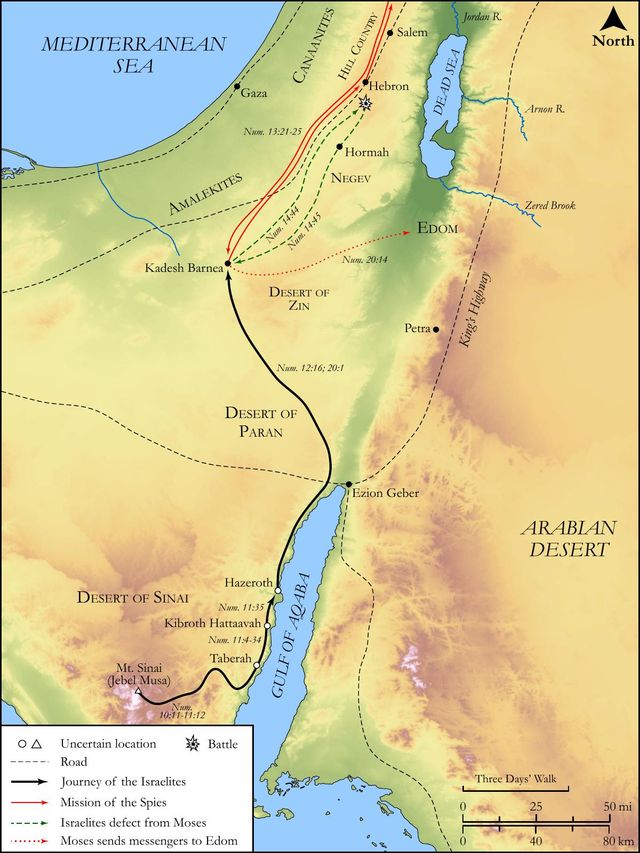
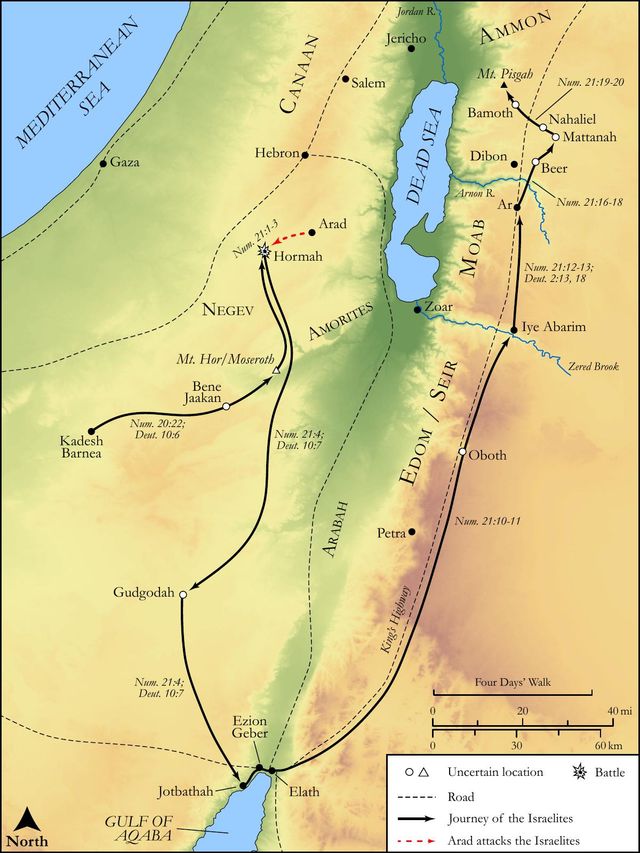
See on the biblical-era maps
Study this verse
Public-domain commentary
Matthew Henry
From his Commentary on the Whole Bible. Henry comments on passages, not single verses — this entry covers Numbers 20:1–13. His four-level outline is real structure in the source text, so it is rendered as structure.
After thirty-eight years' tedious marches, or rather tedious rests, in the wilderness, backward towards the Red Sea, the armies of Israel now at length set their faces towards Canaan again, and had come not far off from the place where they were when, by the righteous sentence of divine Justice, they were made to begin their wanderings. Hitherto they had been led about as in a maze or labyrinth, while execution was doing upon the rebels that were sentenced; but they were now brought into the right way again: they abode in Kadesh (Num 20:1), not Kadesh-barnea, which was near the borders of Canaan, but another Kadesh on the confines of Edom, further off from the land of promise, yet in the way to it from the Red Sea, to which they had been hurried back. Now,
I.Here dies Miriam, the sister of Moses and Aaron, and as it should seem older than either of them.
She must have been so if she was that sister that was set to watch Moses when he was put into the ark of bulrushes, Exo 2:4. Miriam died there, Exo 2:1. She was a prophetess, and had been an instrument of much good to Israel, Mic 6:4. When Moses and Aaron with their rod went before them, to work wonders for them, Miriam with her timbrel went before them in praising God for these wondrous works (Exo 15:20), and therein did them real service; yet she had once been a murmurer (Num 12:1), and must not enter Canaan.
II.Here there is another Meribah.
one place we met with before of that name, in the beginning of their march through the wilderness, which was so called because of the chiding of the children of Israel, Exo 17:7. And now we have another place, at the latter end of their march, which bears the same name for the same reason: This is the water of Meribah, Num 20:13. What was there done was here re-acted.
1.There was no water for the congregation, Num 20:2. The water out of the rock of Rephidim had followed them while there was need of it; but it is probable that for some time they had been in a country where they were supplied in an ordinary way, and when common providence supplied them it was fit that the miracle should cease. But in this place it fell out that there was no water, or not sufficient for the congregation. Note, We live in a wanting world, and, wherever we are, must expect to meet with some inconvenience or other. It is a great mercy to have plenty of water, a mercy which if we found the want of we should own the worth of.
2.Hereupon they murmured, mutinied (Num 20:2), gathered themselves together, and took up arms against Moses and Aaron. They chid with them (Num 20:3), spoke the same absurd and brutish language that their fathers had done before them.
(1.)They wished they had died as malefactors by the hands of divine justice, rather than thus seem for a while neglected by the divine mercy: Would God that we had died when our brethren died before the Lord! Instead of giving God thanks, as they ought to have done, for sparing them, they not only despise the mercy of their reprieve, but quarrel with it, as if God had done them a great deal of wrong in giving them their lives for a prey, and snatching them as brands out of the burning. But they need not wish that they had died with their brethren, they are here taking the ready way to die like their brethren in a little while. Woe unto those that desire the day of the Lord, Amo 5:18.
(2.)They were angry that they were brought out of Egypt, and led through this wilderness, Num 20:4, Num 20:5. They quarrelled with Moses for that which they knew was the Lord's doing; they represented that as an injury which was the greatest favour that ever was done to any people. They prefer slavery before liberty, the house of bondage before the land of promise; and though, the present want was of water only, yet, now that they are disposed to find fault, it shall be looked upon as an insufferable hardship put upon them that they have not vines and figs. It was an aggravation of their crime, [1.] that they had smarted so long for the discontents and distrusts of their fathers. They had borne their whoredoms now almost forty years in the wilderness (Num 14:33); and yet they ventured in the same steps, and, as is charged upon Belshazzar, humbled not their hearts, though they knew all this, Dan 5:22. [2.] That they had had such long and constant experience of God's goodness to them, and of the tenderness and faithfulness of Moses and Aaron. [3.] That Miriam was now lately dead; and, having lost one of their leaders, they ought to have been more respectful to those that were left; but, as if they were resolved to provoke God to leave them as sheep without any shepherd, they grow outrageous against them: instead of condoling with Moses and Aaron for the death of their sister, they add affliction to their grief.
3.Moses and Aaron made them no reply, but retired to the door of the tabernacle to know God's mind in this case, Num 20:6. There they fell on their faces, as formerly on the like occasion, to deprecate the wrath of God and to entreat direction from him. Here is no mention of any thing they said; they knew that God heard the murmurings of the people, and before him they humbly prostrate themselves, making intercessions with groanings that cannot be uttered. There they lay waiting for orders Speak, Lord, for thy servants hear.
4.God appeared, to determine the matter; not on his tribunal of justice, to sentence the rebels according to their deserts; no, he will not return to destroy Ephraim (Hos 11:9), will not always chide; see Gen 8:21. But he appeared,
(1.)On his throne of glory, to silence their unjust murmuring (Num 20:6): The glory of the Lord appeared, to still the tumult of the people, by striking an awe upon them. Note, A believing sight of the glory of the Lord would be an effectual check to our lusts and passions, and would keep our mouths as with a bridle.
(2.)On his throne of grace, to satisfy their just desires. It was requisite that they should have water, and therefore, thought the manner of their petitioning for it was irregular and disorderly, yet God did not take that advantage against them to deny it to them, but gave immediate orders for their supply, Num 20:8. Moses must a second time in God's name command water out of a rock for them, to show that God is as able as ever to supply his people with good things, even in their greatest straits an in the utmost failure of second causes. Almighty power can bring water out of a rock, has done it, and can again, for his arm is not shortened. Lest it should be thought that there was something peculiar in the former rock itself, some secret spring which nature hid before in it, God here bids him broach another, and does not, as then, direct him which he must apply to, but lets him make use of which he pleased, or the first he came to; all alike to Omnipotence.
[1.]God bids him take the rod, that famous rod with which he summoned the plagues of Egypt, and divided the sea, that, having that in his hand, both he and the people might be reminded of the great things God had formerly done for them, and might be encouraged to trust in him now. This rod, it seems, was kept in the tabernacle (Num 20:9), for it was the rod of God, the rod of his strength, as the gospel is called (Psa 110:2), perhaps in allusion to it.
[2.]God bids him gather the assembly, not the elders only, but the people, to be witnesses of what was done, that by their own eyes they might be convinced and made ashamed of their unbelief. There is no fallacy in God's works of wonder, and therefore they shun not the light, nor the inspection and enquiry of many witnesses.
[3.]He bids him speak to the rock, which would do as it was bidden, to shame the people who had been so often spoken to, and would not hear nor obey. Their hearts were harder than this rock, not so tender, not so yielding, not so obedient.
[4.]He promises that the rock should give forth water (Num 20:8), and it did so (Num 20:11): The water came out abundantly. This is an instance, not only of the power of God, that he could thus fetch honey out of the rock, and oil out of the flinty rock, but of his mercy and grace, that he would do it for such a provoking people. This was a new generation (most of the old stock were by this time worn off), yet they were as bad as those that went before them; murmuring ran in the blood, yet the entail of the divine favour was not cut off, but in this instance of it the divine patience shines as brightly as the divine power. He is God and not man, in sparing and pardoning; nay, he not only here gave them the drink which they drank of in common with their beasts (Num 20:8, Num 20:11), but in it he made them to drink spiritual drink, which typified spiritual blessings, for that rock was Christ.
5.Moses and Aaron acted improperly in the management of this matter, so much so that God in displeasure told them immediately that they should not have the honour of bringing Israel into Canaan, Num 20:10-12.
(1.)This is a strange passage of story, yet very instructive.
[1.]It is certain that God was greatly offended, and justly, for he is never angry without cause. Though they were his servants, and had obtained mercy to be faithful, though they were his favourites, and such as he had highly honoured, yet for something they thought, or said, or did, upon this occasion, he put them under the disgrace and mortification of dying, as other unbelieving Israelites did, short of Canaan. And no doubt the crime deserved the punishment.
[2.]Yet it is uncertain what it was in this management that was so provoking to God. The fault was complicated. First, They did not punctually observe their orders, but in some things varied from their commission; God bade them speak to the rock, and they spoke to the people, and smote the rock, which at this time they were not ordered to do, but they thought speaking would not do. When, in distrust of the power of the word, we have recourse to the secular power in matters of pure conscience, we do, as Moses here, smite the rock to which we should only speak, Secondly, They assumed too much of the glory of this work of wonder to themselves: Must we fetch water? as if it were done by some power or worthiness of theirs. Therefore it is charged upon them (Num 20:12) that they did not sanctify God, that is, they did not give him that glory of this miracle which was due unto his name. Thirdly, Unbelief was the great transgression (Num 20:12): You believed me not; nay, it is called rebelling against God's commandment, Num 27:14. The command was to bring water out of the rock, but they rebelled against this command, by distrusting it, and doubting whether it would take effect or no. They speak doubtfully: Must we fetch water? And probably they did in some other ways discover an uncertainty in their own minds whether water would come or no for such a rebellious generation as this was. And perhaps they the rather questioned it, though God had promised it, because the glory of the Lord did not appear before them upon this rock, as it had done upon the rock in Rephidim, Exo 17:6. They would not take God's word without a sign. Dr. Lightfoot's notion of their unbelief is that they doubted whether now at last, when the forty years had expired, they should enter Canaan, and whether they must not for the murmurings of the people be condemned to another period of toil, because a new rock was now opened for their supply, which they took for an indication of their longer stay. And, if so, justly were they kept out of Canaan themselves, while the people entered at the time appointed. Fourthly, They said and did all in heat and passion; this is the account given of the sin (Psa 106:33): They provoked his spirit, so that he spoke unadvisedly with his lips. It was in his passion that he called them rebels. It is true they were so; God had called them so; and Moses afterwards, in the way of a just reproof (Deu 9:24), calls them so without offence; but now it came from a provoked spirit, and was spoken unadvisedly: it was too much like Raca, and Thou fool. His smiting the rock twice (it should seem, not waiting at all for the eruption of the water upon the first stroke) shows that he was in a heat. The same thing said and done with meekness may be justifiable which when said and done in anger may be highly culpable; see Jam 1:20. Fifthly, That which aggravated all the rest, and made it the more provoking, was that it was public, before the eyes of the children of Israel, to whom they should have been examples of faith, and hope, and meekness. We find Moses guilty of sinful distrust, Num 11:22, Num 11:23. That was private between God and him, and therefore was only checked. But his was public; it dishonoured God before Israel, as if he grudged them his favours, and discouraged the people's hope in God, and therefore this was severely punished, and the more because of the dignity and eminency of those that offended.
(2.)From the whole we may learn,
[1.]That the best of men have their failings, even in those graces that they are most eminent for. The man Moses was very meek, and yet here he sinned in passion; wherefore let him that thinks he stands take heed lest he fall.
[2.]That God judges not as man judges concerning sins; we might think that there was not much amiss in what Moses said and did, yet God saw cause to animadvert severely upon it. He knows the frame of men's spirits, what temper they are of, and what temper they are in upon particular occasions, and from what thoughts and intents words and actions do proceed; and we are sure that therefore his judgment is according to truth, when it agrees not with ours. [3.] that God not only takes notice of, and is displeased with, the sins of his people, but that the nearer any are to him the more offensive are their sins, Amo 3:2. It should seem, the Psalmist refers to this sin of Moses and Aaron (Psa 99:8): Thou wast a God that forgavest them, though thou tookest vengeance on their inventions. As many are spared in this life and punished in the other, so many are punished in this life and saved in the other. [4.] That, when our heart is hot within us, we are concerned to take heed that we offend not with our tongue. Yet, [5.] It is an evidence of the sincerity of Moses, and his impartiality in writing, that he himself left this upon record concerning himself, and drew not a veil over his own infirmity, by which it appeared that in what he wrote, as well as what he did, he sought God's glory more than his own.
Lastly, The place is hereupon called Meribah, Num 20:13. It is called Meribah-Kadesh (Deu 32:51), to distinguish it from the other Meribah. It is the water of strife; to perpetuate the remembrance of the people's sin, and Moses's, and yet of God's mercy, who supplied them with water, and owned and honoured Moses notwithstanding. Thus he was sanctified in the, as the Holy One of Israel, so he is called when his mercy rejoices against judgment, Hos 11:9. Moses and Aaron did not sanctify God as they ought in the eyes of Israel (Num 20:12), but God was sanctified in them; for he will not be a loser in his honour by any man. If he be not glorified by us, he will be glorified upon us.
Continue studying Numbers 20:8 across the web’s major study libraries — every link below opens this exact verse, chapter, or book on the destination site.
Read & Compare
 BibleGatewayThis verse in more than 200 translations and 70 languages.
 Bible.comThe YouVersion reader — hundreds of translations, reading plans, and highlights.
 ESV.orgCrossway's official English Standard Version reader.
 NET BibleThe NET translation with 60,000+ translators' notes on every rendering decision.
 STEP BibleTyndale House's free study tool — original text, vocabulary, and scholarly resources.
 BibliaLogos Bible Software's free web reader.
 USCCBThe New American Bible (Revised Edition) with the U.S. bishops' study notes.
Commentaries
 BibleHub CommentariesDozens of classic commentaries on this verse, gathered on one page.
 StudyLightMore than 100 commentary sets — the largest collection on the web.
 BibleRefPlain-English commentary on what this verse means, verse by verse.
 Enduring WordDavid Guzik's free commentary on this chapter, widely used by Bible teachers.
 Bible Study ToolsVerse commentary alongside Greek and Hebrew study aids.
Original Language & Research
- BibleHub InterlinearThe verse word by word — original language, transliteration, and English.
- BibleHub LexiconEvery word's original-language definition and Strong's entry.
 Blue Letter BibleDeep-study tools — Strong's numbers, concordance, and word studies.
 SefariaThe Hebrew text with Rashi and centuries of Jewish commentary.
Sermons, Hymns & Audio


TrulyRandomVerse is not affiliated with these sites and doesn’t control their content. They’re linked because they’re genuinely useful.
Summary
Numbers 20:8 records God's precise and pivotal instruction to Moses and Aaron at Kadesh, commanding them to gather the Israelite assembly and verbally address a specific rock to miraculously provide water for the murmuring people and their livestock. This divine directive, given amidst the community's renewed complaints, underscores God's unwavering faithfulness to His covenant promises while simultaneously setting the stage for Moses' fateful act of disobedience, which would have profound and lasting consequences for his and Aaron's leadership and their entry into the Promised Land.
Context
ShowHideLiterary Context
Numbers 20:8 is situated within a critical narrative segment (Numbers 20:1-13) that marks a significant turning point in the Israelites' wilderness wanderings. The chapter opens with the arrival of the Israelites at Kadesh, followed by the death of Miriam, Moses' sister, signaling the passing of the older generation. Immediately, the community, facing a severe water shortage, begins to quarrel with Moses and Aaron, echoing their persistent complaints throughout the wilderness journey, as seen in earlier instances like the murmuring at Marah or for food in Exodus 16. God's instruction in verse 8 is His divine response to this renewed rebellion, serving as a test of Moses' obedience and a profound demonstration of His continued provision. The subsequent verses (Numbers 20:9-11) vividly describe Moses' fateful deviation from this precise command, leading directly to the severe divine judgment articulated in Numbers 20:12, where both Moses and Aaron are tragically forbidden from entering the Promised Land. This incident, often referred to as the "waters of Meribah" (meaning "contention"), serves as a crucial narrative link, bridging the experiences of the wilderness generation with the new generation poised to inherit Canaan.
Historical & Cultural Context
This pivotal event unfolds approximately 38 years after the Exodus from Egypt, near the culmination of the Israelites' forty-year wilderness sojourn. Kadesh (often identified with Kadesh-barnea) was a vital oasis and a strategically important encampment site located in the Wilderness of Zin, bordering Edom and the southern reaches of Canaan. It had previously served as the base for the ill-fated reconnaissance mission into Canaan (Numbers 13), highlighting its significance. The arid desert environment meant that water scarcity was not merely an inconvenience but a recurring, life-threatening crisis for the massive Israelite population and their extensive livestock. This constant need for water made its miraculous provision by God an extraordinary act of grace and power, essential for their very survival. Culturally, leaders were expected to secure basic necessities for their people, and Moses and Aaron, as God's divinely appointed mediators, bore the immense burden of the people's frustration and complaints, underscoring the immense pressure and profound responsibility inherent in their leadership roles.
Key Themes
ShowHideNumbers 20:8 powerfully contributes to several overarching themes woven throughout the book of Numbers and the broader Pentateuch. Firstly, it profoundly underscores the theme of Divine Provision and Faithfulness, demonstrating God's steadfast commitment to His covenant people, even in the face of their persistent grumbling, rebellion, and profound lack of faith (Psalm 105:41). Secondly, it highlights the critical importance of Specific Obedience to God's precise commands, particularly for those entrusted with leadership. The explicit instruction to "speak" to the rock, rather than to strike it as in the past (Exodus 17:6), becomes the central point of contention and the basis for the subsequent divine judgment. Thirdly, the passage implicitly addresses the profound theme of the Sanctity of God's Name and Holiness, as Moses' disobedience is later judged as a failure to "sanctify" God in the eyes of the Israelites (Numbers 20:12). Finally, it emphatically emphasizes Leadership Accountability, illustrating that even the most revered and divinely chosen leaders are held to an exceptionally high standard of obedience and must accurately represent God's character and commands before His people.
Exposition and Analysis
ShowHideKey Word Analysis
ShowHideThis refers to the staff Moses carried, which had become a powerful and recognizable symbol of God's authority and miraculous power throughout the Exodus and wilderness narratives. It was the instrument used to perform signs before Pharaoh (Exodus 7:9-12), to part the Red Sea (Exodus 14:16), and to strike the rock at Rephidim (Exodus 17:5-6). Its presence here signifies that the power to perform the miracle resided not in Moses himself, but in God working through this designated instrument, demonstrating divine authorization.
This verb, meaning "to speak," "to declare," or "to command," carries crucial significance in this context. Its importance lies in its stark contrast to the earlier command at Rephidim in Exodus 17:6 where Moses was explicitly instructed to "strike" (Hebrew, nakah) the rock. This deliberate change in divine methodology from a physical action to a verbal declaration is central to understanding Moses' subsequent sin and its profound consequences. It implies a shift from a forceful, physical demonstration of power to a faith-based, verbal proclamation, emphasizing God's desire for His power to be demonstrated through a simple, obedient word.
This term denotes a craggy, prominent rock formation or cliff, often implying a strong or fortified place. In the biblical narrative, the rock becomes a recurring symbol of divine provision and, significantly, a type or prefigurement of Christ (1 Corinthians 10:4). The instruction to speak to this specific rock implies that God had already designated the source of the water, and the miracle would manifest through it, highlighting God's pre-ordained plan and sovereignty.
Verse Breakdown
ShowHide"Take the rod, and gather thou the assembly together, thou, and Aaron thy brother"
God issues a clear directive to Moses to take the rod, a potent symbol of divine authority, and to assemble the entire congregation of Israel, including his brother Aaron. This public gathering was essential, emphasizing that the impending miracle was intended to be a clear, visible demonstration of God's power and unwavering faithfulness to the entire community, thereby validating Moses and Aaron's leadership as divinely appointed and sustained.
"and speak ye unto the rock before their eyes"
This is the precise, critical, and ultimately violated command. Moses and Aaron are instructed to address the rock verbally, not physically, in the full view of the assembled Israelites. This public, verbal declaration would underscore that the water flowed forth by God's word and power, not through human effort or force, serving as a powerful testimony to God's supreme sovereignty and the efficacy of His spoken command.
"and it shall give forth his water, and thou shalt bring forth to them water out of the rock"
God promises a direct and immediate miraculous outcome: the rock itself will yield water. The phrasing indicates that the water is inherent to the rock's response to God's command, mediated through Moses' obedient word. This highlights God's direct agency in providing for His people's needs, demonstrating His ability to command creation.
"so thou shalt give the congregation and their beasts drink."
The ultimate purpose of this divine intervention is profoundly practical and life-sustaining: to quench the desperate thirst of both the people and their animals. This underscores God's compassionate care not only for His covenant people but also for all creation under His dominion, and His unwavering commitment to sustaining His community throughout their arduous wilderness journey.
Literary Devices
ShowHideNumbers 20:8 employs several significant literary devices that enrich its theological impact. Symbolism is profoundly present, with "the rod" representing God's delegated authority and miraculous power, and "the rock" serving as a recurring symbol of divine provision and, ultimately, a profound prefigurement of Christ. The "water" itself is symbolic of life, sustenance, and spiritual blessing. A crucial Contrast is established between this command and the previous instruction at Rephidim (Exodus 17:6), where Moses was told to strike the rock. This deliberate shift from a physical, forceful action to a verbal command highlights a progression in God's dealings with His people and the representation of His power. The narrative relies heavily on Divine Command/Instruction, where God's explicit, precise, and non-negotiable words form the central directive, setting the stage for the subsequent test of obedience and its consequences. The public nature of the command ("before their eyes") emphasizes the Witness aspect, where the entire assembly is to observe God's power and Moses' response, making the act a public declaration of divine authority and human accountability.
Theological and Thematic Connections
ShowHideNumbers 20:8 is a pivotal text for understanding the nature of divine authority, the critical importance of precise obedience, and God's consistent, yet sovereignly adaptable, provision. Theologically, it asserts God's absolute sovereignty over creation, as He commands inanimate objects to yield life-sustaining resources. It also underscores the profound principle that God's methods are as important as His promises; His holiness and character demand that His commands be followed exactly, especially by those who represent Him. The shift from striking to speaking the rock carries immense typological significance, foreshadowing Christ's once-for-all sacrifice and the subsequent availability of living water through faith and declaration rather than repeated "striking." Moses' failure to obey perfectly serves as a stark and sobering reminder that even the greatest and most revered leaders are held to a high standard of accountability before God, and that human frustration, impatience, or self-exaltation can tragically obscure the divine glory.
Reflection and Application
ShowHideNumbers 20:8 offers profound and enduring lessons for contemporary believers, challenging us to deeply consider the nature of our obedience to God's specific instructions. While God's provision is unfailing and His faithfulness constant, His methods may indeed change, and our trust must be anchored solely in His word, not in our past experiences, preferred ways of doing things, or personal inclinations. For those in positions of leadership, whether in the church, family, or community, this passage serves as a sobering reminder of the exceptionally high standard of accountability. Our actions, even those seemingly small deviations from God's precise commands, can have significant and far-reaching consequences for how God's character and holiness are perceived by others. We are called to represent God faithfully and accurately, allowing His glory to be magnified through our humble, precise, and faith-filled obedience, rather than through our own strength, ingenuity, or frustrated impatience. Just as the rock was to give forth water by a simple word, we are powerfully reminded that God's miraculous power is often manifested not through human striving or forceful exertion, but through simple faith and the humble declaration of His truth.
Questions for Reflection
ShowHideFAQ
ShowHideWhy was Moses commanded to "speak" to the rock this time, instead of "striking" it as he did previously?
ShowHideThe change in divine command from striking (as in Exodus 17:6) to speaking is profoundly significant. The first striking of the rock at Rephidim typologically symbolized Christ being smitten "once for all" for our sins (Hebrews 9:26-28). To strike the rock a second time would have implied that the first striking was insufficient or that Christ needed to be crucified again. God's instruction to "speak" represented a new phase of interaction: after the initial "striking" (Christ's death), living water (symbolizing the Holy Spirit and spiritual life) is now available simply by speaking in faith, by asking, or by declaring God's word (John 7:37-39). Moses' failure to obey this specific instruction was a failure to properly represent this unfolding theological truth and God's holiness.
What is the significance of "the rod" in this verse?
ShowHideThe rod Moses was instructed to take was not just an ordinary staff; it was "the rod of God" (Exodus 4:20), which had become a powerful and recognized symbol of God's delegated authority and miraculous power throughout the Exodus narrative. It was used to perform signs before Pharaoh, to part the Red Sea, and to bring forth water from the rock at Rephidim. Its inclusion in this command signifies that the miracle was to be performed by God's power, through His chosen instrument, and under His specific direction, not by Moses' own strength or will. It served as a visible sign of divine authorization.
How does this event relate to God's faithfulness despite Israel's constant complaining?
ShowHideThis incident at Meribah (meaning "quarrel" or "contention") is another powerful example of God's unwavering faithfulness, patience, and enduring grace with His rebellious people. Despite the Israelites' persistent murmuring, quarreling, and profound lack of faith, which had characterized their entire wilderness journey, God still chose to provide for their immediate and desperate need for water. This highlights His covenantal commitment and His immutable character as a God who provides for His people even when they are undeserving, demonstrating His boundless grace and mercy (Psalm 78:15-16).
Christ-Centered Fulfillment
ShowHideThe incident at the waters of Meribah, particularly the instruction in Numbers 20:8, finds its profound Christ-centered fulfillment in the New Testament. The Apostle Paul explicitly identifies the rock from which Israel drank in the wilderness as a type of Christ, stating, "and all drank the same spiritual drink; for they drank from the spiritual rock that accompanied them, and that rock was Christ" (1 Corinthians 10:4). The first striking of the rock at Rephidim (Exodus 17:6) powerfully foreshadowed the crucifixion of Jesus, who was "smitten" for our transgressions, providing the living water of salvation through His once-for-all sacrifice. Therefore, God's command in Numbers 20:8 to "speak" to the rock, rather than strike it again, carries immense theological weight. It signifies that after Christ's perfect and complete sacrifice on the cross, the "living water" (symbolizing the Holy Spirit and eternal life) is now freely available to all who simply believe and "speak" or ask in faith. Jesus Himself declared, "If anyone is thirsty, let him come to me and drink. Whoever believes in me, as the Scripture has said, streams of living water will flow from within him" (John 7:37-38). Moses' disobedience in striking the rock a second time therefore not only dishonored God's holiness by failing to follow His precise instructions, but also tragically obscured this glorious truth, misrepresenting the finished work of Christ and the new way of accessing His abundant provision through simple faith and declaration.