


1 Kings 13:21
Bible text: King James Version (1769 Blayney text) · Public domain
Bible text: King James Version with Strong's numbers · Public domain
Bible text: Berean Standard Bible · Public domain
Bible text: American Standard Version (1901) · Public domain
Bible text: World English Bible, Messianic edition · Public domain
Bible text: Geneva Bible (1599) · Public domain
Bible text: Young's Literal Translation · Public domain
- וַיִּקְרָאvai·yik·Ra'and he called outH7121Conj-w ¦ V-Qal-ConsecImperf-3msVerb Qal Consecutive Imperfect 3rd Singular Masculineוַandיִּקְרָאhe called out
- אֶל'eltoH413PrepPreposition
- אִישׁ'ish[the] man ofH376N-mscNoun Singular Masculine Construct
- הָאֱלֹהִיםha·'E·lo·Him<the> GodH430Art ¦ N-mpNoun Plural Masculine Absoluteהָ<the>אֱלֹהִיםGod
- אֲשֶׁר'a·SherwhoH834RelParticle Relative
- בָּאba'he had comeH935V-Qal-Perf-3msVerb Qal Perfect 3rd Singular Masculine
- מִיהוּדָהmi·hu·Dahfrom JudahH3063Prep-m ¦ N-properNoun Proper LocationמִfromיהוּדָהJudah
- לֵאמֹרle·Mor<to> sayingH559Prep-l ¦ V-Qal-InfVerb Qal Infinitive Constructלֵ<to>אמֹרsaying
- כֹּהkohthusH3541AdvAdverb
- אָמַר'a·Marhe saysH559V-Qal-Perf-3msVerb Qal Perfect 3rd Singular Masculine
- יְהוָהYah·wehYahwehH3068N-properNoun Proper Title
- יַעַןYa·'anbecauseH3282ConjConjunction
- כִּיkiforH3588PrtParticle Conditional
- מָרִיתָma·Ri·tayou have been disobedient toH4784V-Qal-Perf-2msVerb Qal Perfect 2nd Singular Masculine
- פִּיpi[the] mouth ofH6310N-mscNoun Singular Masculine Construct
- יְהוָהYah·wehYahwehH3068N-properNoun Proper Title
- וְלֹאve·Lo'and notH3808Conj-w ¦ NegParticle Negativeוְandלֹאnot
- שָׁמַרְתָּsha·Mar·tayou have keptH8104V-Qal-Perf-2msVerb Qal Perfect 2nd Singular Masculine
- אֶת'et<obj.>H853DirObjMParticle Object Indicator
- הַמִּצְוָהha·mitz·Vahthe commandH4687Art ¦ N-fsNoun Singular Feminine Absoluteהַtheמִּצְוָהcommand
- אֲשֶׁר'a·SherwhichH834RelParticle Relative
- צִוְּךָtzi·ve·Khahe commanded youH6680V-Piel-Perf-3ms ¦ 2msVerb Piel Perfect 3rd Singular Masculineצִוְּhe commandedךָyou
- יְהוָהYah·wehYahwehH3068N-properNoun Proper Title
- אֱלֹהֶיךָ'e·lo·Hei·khayour GodH430N-mpc ¦ 2msNoun Plural Masculine ConstructאֱלֹהֶיGodךָyour
English is a literal word-by-word gloss of the Hebrew, not the KJV's wording. Why?
This is the original text the KJV's translators worked from — each Hebrew word with its own literal English meaning in this verse, prepared by scholars at Tyndale House, Cambridge. The KJV translates whole sentences, not word by word, so its wording differs: one Hebrew word can become several English words, and the KJV may choose “the LORD” where the gloss reads “Yahweh”. Both are faithful — they answer different questions. For the KJV's own rendering, switch to the KJV text.
Details
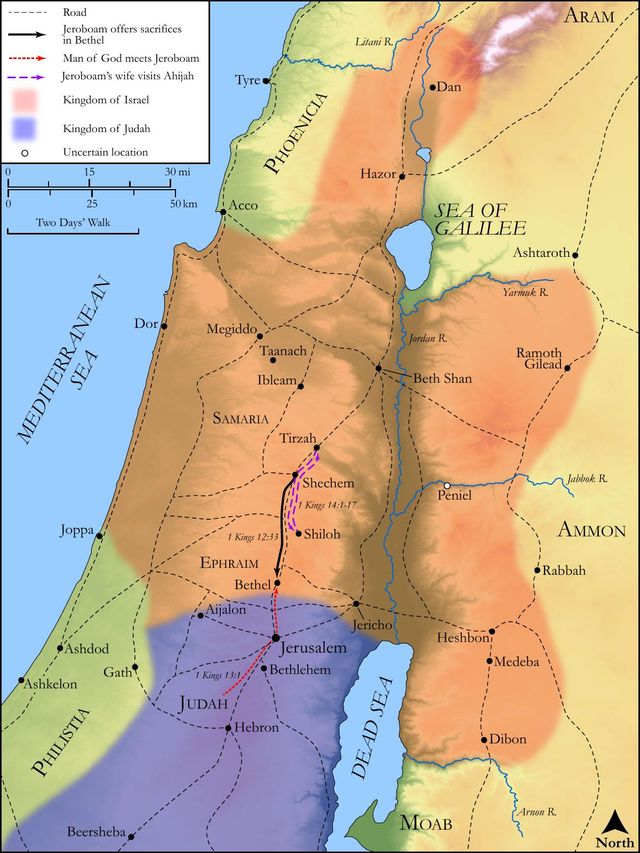
See on the biblical-era maps

Study this verse
Public-domain commentary
Matthew Henry
From his Commentary on the Whole Bible. Henry comments on passages, not single verses — this entry covers 1 Kings 13:11–22. His two-level outline is real structure in the source text, so it is rendered as structure.
The man of God had honestly and resolutely refused the king's invitation, though he promised him a reward; yet he was over-persuaded by an old prophet to come back with him, and dine in Beth-el, contrary to the command given him. Here we find how dearly his dinner cost him. Observe with wonder,
I.The old prophet's wickedness.
I cannot but call him a false prophet and a bad man, it being much easier to believe that from one of such a bad character should be extorted a confirmation of what the man of God said (as we find, Kg1 13:32) than that a true prophet, and a good man, should tell such a deliberate lie as he did, and father it upon God. A good tree could never bring forth such corrupt fruit. Perhaps he was trained up among the sons of the prophets, in one of Samuel's colleges not far off, whence he retained the name of a prophet, but, growing worldly and profane, the spirit of prophecy had departed from him. If he had been a good prophet he would have reproved Jeroboam's idolatry, and not have suffered his sons to attend his altars, as, it should seem, they did. Now,
1.Whether he had any good design in fetching back the man of God is not certain. One may hope that he did it in compassion to him, concluding he wanted refreshment, and out of a desire to be better acquainted with him and more fully to understand his errand than he could from the report of his sons; yet his sons having told him all that passed, and particularly that the prophet was forbidden to eat or drink there, which he had openly told Jeroboam, I suppose it was done with a bad design, to draw him into a snare, and so to expose him; for false prophets have ever been the worst enemies to the true prophets, usually aiming to destroy them, but sometimes, as here, to debauch them and draw them from their duty. Thus they gave the Nazarites wine to drink (Amo 2:12), that they might glory in their fall. But,
2.It is certain that he took a very bad method to bring him back. When the man of God had told him, "I may not, and therefore I will not, return to eat bread with thee" (his resolutions concurring with the divine command, Kg1 13:16, Kg1 13:17), he wickedly pretended that he had an order from heaven to fetch him back. He imposed upon him by asserting his quondam character as a prophet: I am a prophet also as thou art; he pretended he had a vision of an angel that sent him on this errand. But it was all a lie; it was a banter upon prophecy, and profane in the highest degree. When this old prophet is spoken of (Kg2 23:18) he is called the prophet that came out of Samaria, whereas there was no such place as Samaria till long after, Kg1 16:24. Therefore I take it he is so called there, though he was of Beth-el, because he was like those who were afterwards the prophets of Samaria, who caused God's people Israel to err, Jer 23:13.
II.The good prophet's weakness, in suffering himself to be thus imposed upon:
He went back with him, Kg1 13:19. He that had resolution enough to refuse the invitation of the king, who promised him a reward, could not resist the insinuations of one that pretended to be a prophet. God's people are more in danger of being drawn from their duty by the plausible pretences of divinity and sanctity than by external inducements; we have therefore need to beware of false prophets, and not believe every spirit.
III.The proceedings of divine justice hereupon; and here we may well wonder that the wicked prophet, who told the lie and did the mischief, went unpunished, while the holy man of God, that was drawn by him into sin, was suddenly and severely punished for it. What shall we make of this! The judgments of God are unfathomable. The deceived and the deceiver are his, and he giveth not account of any of his matters. Certainly there must be a judgment to come, when these things will be called over again, and when those that sinned most and suffered least, in this world, will receive according to their works. 1. The message delivered to the man of God was strange. His crime is recited, Kg1 13:21, Kg1 13:22. It was, in one word, disobedience to an express command. Judgment is given upon it: Thy carcase shall not come to the sepulchre of thy fathers, that is, "Thou shalt never reach thy own house, but shalt be a carcase quickly, nor shall thy dead body be brought to the place of thy fathers' sepulchres, to be interred." 2. Yet it was more strange that the old prophet himself should be the messenger. Of this we can give no account but that God would have it so, as he spoke to Balaam by his ass and read Saul his doom by the devil in Samuel's likeness. We may think God designed hereby, (1.) To startle the lying prophet, and make him sensible of his sin. The message could not but affect him the more when he himself had the delivering of it, and had so strong an impression made upon his spirit by it that he cried out, as one in an agony, Kg1 13:21. He had reason to think, if he must die for his disobedience in a small matter who sinned by surprise, of how much sorer punishment he should be thought worthy who had belied an angel of God and cheated a man of God by a deliberate forgery. If this were done to the green tree, what shall be done to the dry? Perhaps it had a good effect upon him. Those who preach God's wrath to others have hard hearts indeed if they fear it not themselves. (2.) To put the greater mortification upon the prophet that was deceived, and to show what those must expect who hearken to the great deceiver. Those that yield to him as a tempter will be terrified by him as a tormentor; whom he now fawns upon he will afterwards fly upon, and whom he now draws into sin he will do what he can to drive to despair.
Continue studying 1 Kings 13:21 across the web’s major study libraries — every link below opens this exact verse, chapter, or book on the destination site.
Read & Compare
 BibleGatewayThis verse in more than 200 translations and 70 languages.
 Bible.comThe YouVersion reader — hundreds of translations, reading plans, and highlights.
 ESV.orgCrossway's official English Standard Version reader.
 NET BibleThe NET translation with 60,000+ translators' notes on every rendering decision.
 STEP BibleTyndale House's free study tool — original text, vocabulary, and scholarly resources.
 BibliaLogos Bible Software's free web reader.
 USCCBThe New American Bible (Revised Edition) with the U.S. bishops' study notes.
Commentaries
 BibleHub CommentariesDozens of classic commentaries on this verse, gathered on one page.
 StudyLightMore than 100 commentary sets — the largest collection on the web.
 BibleRefPlain-English commentary on what this verse means, verse by verse.
 Enduring WordDavid Guzik's free commentary on this chapter, widely used by Bible teachers.
 Bible Study ToolsVerse commentary alongside Greek and Hebrew study aids.
Original Language & Research
- BibleHub InterlinearThe verse word by word — original language, transliteration, and English.
- BibleHub LexiconEvery word's original-language definition and Strong's entry.
 Blue Letter BibleDeep-study tools — Strong's numbers, concordance, and word studies.
 SefariaThe Hebrew text with Rashi and centuries of Jewish commentary.
Sermons, Hymns & Audio


TrulyRandomVerse is not affiliated with these sites and doesn’t control their content. They’re linked because they’re genuinely useful.
Summary
This verse records the solemn pronouncement of divine judgment delivered by the old prophet of Bethel against the unnamed man of God from Judah. Having been deceived by the old prophet into disobeying a direct command from the LORD, the man of God now hears his fate declared: he has "disobeyed the mouth of the LORD" and failed to keep the specific commandment given to him. This pivotal moment underscores the absolute gravity of divine commands and the severe consequences of even seemingly minor deviations from God's explicit instructions.
Context
ShowHideLiterary Context
1 Kings 13:21 is the grim climax of a brief but intensely dramatic narrative found in 1 Kings 13. The chapter opens with the man of God from Judah delivering a powerful prophecy against King Jeroboam's idolatrous altar at Bethel, immediately confirmed by a miraculous sign and the withering and restoration of Jeroboam's hand (1 Kings 13:1-6). Crucially, the LORD had given the man of God an explicit, non-negotiable command: he was not to eat or drink in Bethel, nor return by the same way (1 Kings 13:9). However, an old prophet living in Bethel, hearing of these events, actively sought out the man of God and, through a deliberate lie, persuaded him to return to his home and eat and drink (1 Kings 13:11-19). Verse 21 occurs immediately after the man of God has eaten, revealing the old prophet, now supernaturally compelled by the LORD, as the messenger of judgment against the very man he deceived. This sets the stage for the tragic fulfillment of the judgment in the subsequent verses (1 Kings 13:23-24).
Historical & Cultural Context
The events of 1 Kings 13 take place early in the divided monarchy, shortly after the schism between Judah and Israel. King Jeroboam I, fearing that continued worship at Jerusalem would lead his people back to Rehoboam, established alternative worship centers at Bethel and Dan, complete with golden calves (1 Kings 12:26-33). This act of religious innovation, directly violating Mosaic law, was a profound spiritual rebellion. Prophets played a critical role in ancient Israel, serving as God's direct messengers, often challenging kings and religious establishments. Their authority stemmed entirely from the accuracy and divine origin of their words. The cultural expectation was that a true prophet's word was the word of God, and disobedience to it was disobedience to God Himself. The setting of Bethel, once a holy place associated with Jacob's vision (Genesis 28:10-22), had become a center of Jeroboam's idolatry, making the man of God's mission there particularly significant as a direct confrontation with false worship.
Key Themes
ShowHideThis chapter, and specifically verse 21, powerfully illustrates several key themes. The most prominent is the absolute necessity of obedience to God's explicit commands. The man of God's initial powerful ministry is overshadowed by his single act of disobedience, highlighting that even a prophet's anointing does not exempt him from accountability. Another theme is the unwavering integrity of God's word and judgment. Despite the deception, God's original command remains binding, and His judgment is executed, even through an unlikely and morally compromised messenger. The narrative also explores the theme of spiritual discernment; the man of God failed to test the old prophet's word against the clear, previously received word from the LORD, a principle emphasized in passages like Deuteronomy 13:1-5. Finally, the story serves as a stark warning against compromise and the dangers of listening to voices that contradict God's clear revelation, even if those voices claim divine authority.
Exposition and Analysis
ShowHideKey Word Analysis
ShowHideFrom a primitive root meaning "to be (causatively, make) bitter (or unpleasant); (figuratively) to rebel (or resist; causatively, to provoke)." This verb signifies rebellion, defiance, or being contentious. It implies a deliberate act of resistance against authority, rather than a mere oversight or mistake. In this context, it emphasizes that the man of God's failure was not simply a lapse in judgment but a direct contravention of a known divine directive, implying a willful turning away from God's specific instruction.
The word "mouth" (H6310, peh) refers to the mouth as the means of blowing, but also figuratively to speech, edge, or portion. Combined with "LORD" (H3068, Yᵉhôvâh), this idiomatic phrase emphasizes the direct, personal, and authoritative nature of God's command. It signifies that the instruction came straight from God's own utterance, leaving no room for ambiguity or misinterpretation regarding its divine origin and binding force. It highlights that the man of God's transgression was against God's very word, not merely a general principle or a human suggestion.
From a root meaning "to constitute, enjoin," this term (H4687, mitsvâh) refers to a specific divine injunction or precept, or collectively, the Law. It denotes a clear, concrete instruction that God has given, which requires a corresponding act of obedience. The use of "commandment" here underscores that the man of God's failure was not a vague spiritual principle but a precise, actionable order that he consciously failed to uphold.
Verse Breakdown
ShowHide"And he cried unto the man of God that came from Judah, saying,"
This clause establishes the speaker (the old prophet) and the recipient (the man of God from Judah), setting the scene for the pronouncement. The verb "cried" (וַיִּקְרָא, vayyiqra') suggests a solemn, perhaps even urgent, declaration, indicating the gravity of the message about to be delivered. It's a dramatic reversal, as the deceiver now becomes the unwilling instrument of divine judgment.
"Thus saith the LORD,"
This is the prophetic formula, authenticating the message as directly from God. It indicates that the old prophet is not speaking his own words or thoughts, but is under divine compulsion, delivering a message that is not his own. This adds immense weight and undeniable authority to the judgment that follows, making it clear that this is God's verdict, not a human accusation.
"Forasmuch as thou hast disobeyed the mouth of the LORD,"
This is the first charge against the man of God. It directly states his primary offense: a willful act of rebellion or defiance against a command that came directly and explicitly from God Himself. The phrase "mouth of the LORD" highlights the supreme authority and clarity of the original instruction, making the disobedience all the more egregious.
"and hast not kept the commandment which the LORD thy God commanded thee,"
This clause reiterates and reinforces the first charge, emphasizing the failure to uphold a specific, divinely issued instruction. "Not kept" (לֹא שָׁמַרְתָּ, lo shamar'ta) implies a failure to guard, observe, or fulfill the command. The repetition underscores the seriousness of the transgression and leaves no doubt as to the nature of the man of God's sin: a direct and conscious breach of God's explicit word.
Literary Devices
ShowHideThe narrative of 1 Kings 13:21 employs several potent literary devices. Irony is profoundly present, as the very prophet who orchestrated the man of God's disobedience is now compelled by God to pronounce the judgment against him. This highlights God's sovereign control, using even compromised individuals to fulfill His righteous purposes. There is also clear foreshadowing in this verse; the declaration of disobedience and the specific nature of the judgment (implied by the severity of the charge) immediately precede the tragic death of the man of God by a lion, which serves as the physical manifestation of God's word. Furthermore, the narrative employs contrast between the man of God's initial faithfulness and powerful prophetic ministry and his ultimate failure due to a single act of disobedience. This stark contrast serves to underscore the absolute seriousness of God's commands and the high standard of obedience expected, especially from those in positions of spiritual authority.
Theological and Thematic Connections
ShowHide1 Kings 13:21 stands as a stark testament to the unwavering nature of God's commands and the absolute seriousness with which He regards obedience. The man of God's initial success and divine anointing did not exempt him from the consequences of direct disobedience. This incident serves as a powerful warning that even those who perform great works for God must remain vigilant in their personal walk of obedience. It underscores the principle that God's word, once clearly given, cannot be overridden by subsequent, contradictory claims, even if they appear to be from a divine source. True spiritual discernment demands testing all messages against the established truth of God's revelation.
Reflection and Application
ShowHideThe tragic account of the man of God from Judah offers profound and sobering lessons for believers today. It compels us to examine the integrity of our own obedience to God's clear Word. In a world saturated with competing voices and claims, this narrative reminds us that our ultimate authority must always be the explicit commands of the LORD, as revealed in Scripture. We are called to cultivate a deep spiritual discernment, testing every spirit and every message against the unchanging truth of God's revelation, rather than relying on subjective feelings, external pressures, or even the seemingly spiritual pronouncements of others that contradict what God has already clearly spoken. The story challenges us to consider that even a single act of disobedience, particularly to a clear command, can have devastating consequences, not only for ourselves but potentially for our witness and ministry. It calls us to a life of unwavering faithfulness, understanding that our walk with God is defined by our willingness to humbly and consistently obey His voice above all others.
Questions for Reflection
ShowHideFAQ
ShowHideWhy was the man of God punished so severely for what seemed like a simple act of eating and drinking, especially since he was deceived?
ShowHideThe severity of the punishment highlights the absolute gravity of disobeying a direct, explicit command from the LORD, especially for a prophet who was a direct messenger of God. The issue was not merely eating and drinking, but a direct breach of God's "mouth" and "commandment" (1 Kings 13:21). While he was deceived by the old prophet (1 Kings 13:18), the ultimate responsibility for obedience rested with the man of God. He had received a clear, unambiguous word from God himself, and he failed to test the old prophet's contradictory message against that original divine instruction. This underscores the principle that God holds His servants to a high standard of faithfulness to His revealed will, and that even deception does not fully absolve one from the consequences of disobedience to a known command.
Christ-Centered Fulfillment
ShowHideThe tragic narrative of the man of God from Judah, marked by his fatal disobedience, finds its ultimate contrast and fulfillment in the perfect obedience of Jesus Christ. Where the man of God failed to keep the commandment from the "mouth of the LORD," Jesus perfectly embodied the Word of God, declaring, "I always do what pleases him" (John 8:29). Unlike the man of God who succumbed to temptation, Jesus resisted every allure, even in the wilderness, by quoting and upholding the very Word of God (Matthew 4:1-11). The judgment pronounced in 1 Kings 13:21 points to the universal consequence of sin, which is death (Romans 6:23), a fate the man of God experienced. However, Jesus, the true Lamb of God, willingly took upon Himself the judgment for humanity's disobedience, dying on the cross to fulfill the righteous requirements of God's law and to offer salvation to all who believe (Romans 5:19; 2 Corinthians 5:21). Thus, the story of the disobedient prophet serves as a somber backdrop, illuminating the unparalleled and life-giving obedience of Christ, through whom we find forgiveness and the power to obey God's voice.