


1 Kings 13:9
Bible text: King James Version (1769 Blayney text) · Public domain
Bible text: Berean Standard Bible · Public domain
Bible text: American Standard Version (1901) · Public domain
Bible text: World English Bible, Messianic edition · Public domain
Bible text: Geneva Bible (1599) · Public domain
Bible text: Young's Literal Translation · Public domain
- כִּיkiforH3588PrtParticle Conditional
- כֵןkhenthusH3651AdvAdverb
- צִוָּהtzi·Vahhe commandedH6680V-Piel-Perf-3msVerb Piel Perfect 3rd Singular Masculine
- אֹתִי'o·Ti<obj.> meH853DirObjM ¦ 1csParticle Object Indicatorאֹתִ<obj.>יme
- בִּדְבַרbid·Varby [the] word ofH1697Prep-b ¦ N-mscNoun Singular Masculine Constructבִּbyדְבַר[the] word of
- יְהוָהYah·wehYahwehH3068N-properNoun Proper Title
- לֵאמֹרle·Mor<to> sayingH559Prep-l ¦ V-Qal-InfVerb Qal Infinitive Constructלֵ<to>אמֹרsaying
- לֹאlo'notH3808NegParticle Negative
- תֹאכַלTo·khalyou must eatH398V-Qal-Imperf-2msVerb Qal Imperfect 2nd Singular Masculine
- לֶחֶםLe·chembreadH3899N-msNoun Singular Masculine Absolute
- וְלֹאve·Lo'and notH3808Conj-w ¦ NegParticle Negativeוְandלֹאnot
- תִשְׁתֶּהtish·tehyou must drinkH8354V-Qal-Imperf-2msVerb Qal Imperfect 2nd Singular Masculine
- מָּיִםMa·yimwaterH4325N-mpNoun Plural Masculine Absolute
- וְלֹאve·Lo'and notH3808Conj-w ¦ NegParticle Negativeוְandלֹאnot
- תָשׁוּבta·Shuvyou must returnH7725V-Qal-Imperf-2msVerb Qal Imperfect 2nd Singular Masculine
- בַּדֶּרֶךְba·De·rekhby the wayH1870Prep-b ¦ N-csNoun Singular common gender Absoluteבַּby theדֶּרֶךְway
- אֲשֶׁר'a·SherwhichH834RelParticle Relative
- הָלָכְתָּha·La·khe·tayou wentH1980V-Qal-Perf-2msVerb Qal Perfect 2nd Singular Masculine
English is a literal word-by-word gloss of the Hebrew, not the KJV's wording. Why?
This is the original text the KJV's translators worked from — each Hebrew word with its own literal English meaning in this verse, prepared by scholars at Tyndale House, Cambridge. The KJV translates whole sentences, not word by word, so its wording differs: one Hebrew word can become several English words, and the KJV may choose “the LORD” where the gloss reads “Yahweh”. Both are faithful — they answer different questions. For the KJV's own rendering, switch to the KJV text.
Details
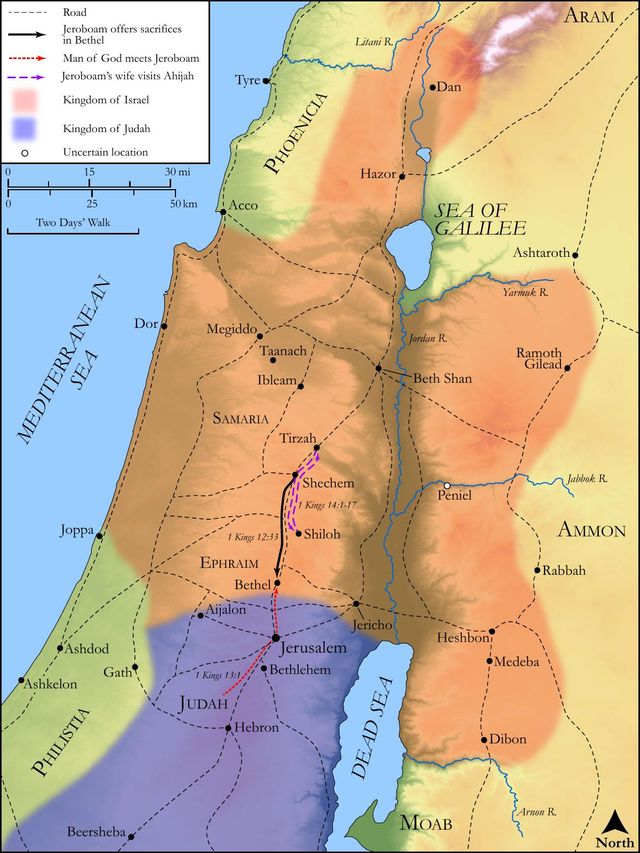
See on the biblical-era maps

Study this verse
Public-domain commentary
Matthew Henry
From his Commentary on the Whole Bible. Henry comments on passages, not single verses — this entry covers 1 Kings 13:1–10. His two-level outline is real structure in the source text, so it is rendered as structure.
Here is, I. A messenger sent to Jeroboam, to signify to him God's displeasure against his idolatry, Kg1 13:1. The army of Judah that aimed to ruin him was countermanded, and might not draw a sword against him (Kg1 12:24); but a prophet of Judah is, instead thereof, sent to reclaim him from his evil way, and is sent in time, while he is but dedicating his altar, before his heart is hardened by the deceitfulness of his sin; for God delights not in the death of sinners, but would rather they would burn and live. How bold was the messenger that durst attack the king in his pride and interrupt the solemnity he was proud of! Those that go on God's errand must not fear the face of man; they know who will bear them out. How kind was he that sent him to warn Jeroboam of the wrath of God revealed from heaven against his ungodliness and unrighteousness!
II.The message delivered in God's name, not whispered, but cried with a loud voice, denoting both the prophet's courage, that he was neither afraid nor ashamed to own it, and his earnestness, that he desired to be heard and heeded by all that were present, who were not a few, on this great occasion. It was directed, not to Jeroboam nor to the people, but to the altar, the stones of which would sooner hear and yield than those who were mad upon their idols and deaf to divine calls. Yet, in threatening the altar, God threatened the founder and worshippers, to whom it was as dear as their own souls, and who might conclude, "If God's wrath fasten upon the lifeless guiltless altar, how shall we escape?" That which was foretold concerning the altar (Kg1 13:2) was that, in process of time, a prince of the house of David, Josiah by name, should pollute this altar by sacrificing the idolatrous priests themselves upon it, and burning the bones of dead men. Let Jeroboam know and be sure,
1.That the altar he now consecrated should be desecrated. Idolatrous worship will not continue, but the word of the Lord will endure for ever.
2.That the priests of the high places he now made should themselves be made sacrifices to the justice of God, and the first and only sacrifices upon this altar that would be pleasing to him. If the offering be such as is an abomination to God, it will follow, of course, that the offerers must themselves fall under his wrath, which will abide upon them, since it is not otherwise transmitted.
3.That this should be done by a branch of the house of David. That family which he and his kingdom had despised and treacherously deserted should recover so much power as to demolish that altar which he thought to establish; so that right and truth should at length prevail, both in civil and sacred matters, notwithstanding the present triumphs of those that were given to change the fear both of God and the king. It was about 356 years ere this prediction was fulfilled, yet it was spoken of as sure and nigh at hand, for a thousand years with God are but as one day. Nothing more contingent and arbitrary than the giving of names to persons, yet Josiah was here named above 300 years before he was born. Nothing future is hidden from God. There are names in the book of the divine prescience (Phi 4:3), names written in heaven.
III.A sign is given for the confirming of the truth of this prediction, that the altar should be shaken to pieces by an invisible power and the ashes of the sacrifice scattered (Kg1 13:3), which came to pass immediately, Kg1 13:5. This was,
1.A proof that the prophet was sent of God, who confirmed the word with this sign following, Mar 16:20.
2.A present indication of God's displeasure against these idolatrous sacrifices. How could the gift be acceptable when the altar that should sanctify it was an abomination?
3.It was a reproach to the people, whose hearts were harder than these stones and rent not under the word of the Lord.
4.It was a specimen of what should be done to it in the accomplishment of this prophecy by Josiah; it was now rent, in token of its being then ruined.
IV.Jeroboam's hand withered, which he stretched out to seize or smite the man of God, Kg1 13:4.
Instead of trembling at the message, as he might well have done, he assaulted him that brought it, in defiance of the wrath of which he was warned and contempt of that grace which sent him the warning. Rebuke a sinner and he will hate thee, and do thee a mischief if he can; yet God's prophets must rather expose themselves than betray their trust: he that employs them will protect them, and restrain the wrath of man, as he did Jeroboam's here by withering his hand, so that he could neither hurt the prophet nor draw it in to help himself. When his hand was stretched out to burn incense to his calves it was not withered; but, when it is stretched out against a prophet, he shall have no use of it till he humble himself. Of all the wickedness of the wicked there is none more provoking to God than their malicious attempts against his prophets, of whom he has said, Touch them not, do them no harm. As this was a punishment of Jeroboam, and answering to the sin, so it was the deliverance of the prophet. God has many ways of disabling the enemies of his church from executing their mischievous purposes. Jeroboam's inability to pull in his hand made him a spectacle to all about him, that they might see and fear. If God, in justice, harden the hearts of sinners, so that the hand they have stretched out in sin they cannot pull in again by repentance, that is a spiritual judgment, represented by this, and much more dreadful.
V.The sudden healing of the hand that was suddenly dried up, upon his submission, Kg1 13:6.
That word of God which should have touched his conscience humbled him not, but this which touched his bone and his flesh brings down his proud spirit. He looks for help now,
1.Not from his calves, but from God only, from his power and his favour. He wounded, and no hand but his can make whole.
2.Not by his own sacrifice or incense, but by the prayer and intercession of the prophet, whom he had just now threatened and aimed to destroy. The time may come when those that hate the preaching would be glad of the prayers of faithful ministers. "Pray to the Lord thy God," says Jeroboam; "thou hast an interest in him; improve it for me." But observe, He did not desire the prophet to pray that his sin might be pardoned, and his heart changed, only that his hand might be restored; thus Pharaoh would have Moses to pray that God would take away this death only (Exo 10:17), not this sin. The prophet, as became a man of God, renders good for evil, upbraids not Jeroboam with his impotent malice, nor triumphs in his submission, but immediately addresses himself to God for him. Those only are entitled to the blessing Christ pronounced on the persecuted that learn of him to pray for their persecutors, Mat 5:10, Mat 5:44. When the prophet thus honoured God, by showing himself of a forgiving spirit, God put this further honour upon him, that at his word he recalled the judgment and by another miracle healed the withered hand, that by the goodness of God Jeroboam might be led to repentance, and, if he were not broken by the judgment, yet might be melted by the mercy. With both he seemed affected for the present, but the impressions wore off.
VI.The prophet's refusal of Jeroboam's kind invitation, in which observe,
1.That God forbade his messenger to eat or drink in Beth-el (Kg1 13:9), to show his detestation of their execrable idolatry and apostasy from God, and to teach us not to have fellowship with the works of darkness, lest we have infection from them or give encouragement to them. He must not turn back the same way, but deliver his message, as it were, in transitu - as he passes along. He shall not seem to be sent on purpose (they were unworthy such a favour), but as if he only called by the way, his spirit being stirred, like Paul's at Athens, as he passed and saw their devotions. God would, by this command, try his prophet, as he did Ezekiel, whether he would not be rebellious, like that rebellious house, Eze 2:8.
2.That Jeroboam was so affected with the cure of his hand that though we read not of his thanksgivings to God for the mercy, or of his sending an offering to the altar at Jerusalem in acknowledgment of it, yet he was willing to express his gratitude to the prophet and pay him for his prayers, Kg1 13:7. Favours to the body will make even graceless men seem grateful to good ministers.
3.That the prophet, though hungry and weary, and perhaps poor, in obedience to the divine command refused both the entertainment and the reward proffered him. He might have supposed his acceptance of it would give him an opportunity of discoursing further with the king, in order to his effectual reformation, now that he was convinced; yet he will not think himself wiser than God, but, like a faithful careful messenger, hastens home when he has done his errand. Those have little learned the lessons of self-denial that cannot forbear one forbidden meal.
Continue studying 1 Kings 13:9 across the web’s major study libraries — every link below opens this exact verse, chapter, or book on the destination site.
Read & Compare
 BibleGatewayThis verse in more than 200 translations and 70 languages.
 Bible.comThe YouVersion reader — hundreds of translations, reading plans, and highlights.
 ESV.orgCrossway's official English Standard Version reader.
 NET BibleThe NET translation with 60,000+ translators' notes on every rendering decision.
 STEP BibleTyndale House's free study tool — original text, vocabulary, and scholarly resources.
 BibliaLogos Bible Software's free web reader.
 USCCBThe New American Bible (Revised Edition) with the U.S. bishops' study notes.
Commentaries
 BibleHub CommentariesDozens of classic commentaries on this verse, gathered on one page.
 StudyLightMore than 100 commentary sets — the largest collection on the web.
 BibleRefPlain-English commentary on what this verse means, verse by verse.
 Enduring WordDavid Guzik's free commentary on this chapter, widely used by Bible teachers.
 Bible Study ToolsVerse commentary alongside Greek and Hebrew study aids.
Original Language & Research
- BibleHub InterlinearThe verse word by word — original language, transliteration, and English.
- BibleHub LexiconEvery word's original-language definition and Strong's entry.
 Blue Letter BibleDeep-study tools — Strong's numbers, concordance, and word studies.
 SefariaThe Hebrew text with Rashi and centuries of Jewish commentary.
Sermons, Hymns & Audio


TrulyRandomVerse is not affiliated with these sites and doesn’t control their content. They’re linked because they’re genuinely useful.
Summary
1 Kings 13:9 records the unnamed man of God's direct and unwavering declaration to King Jeroboam, explaining the precise divine mandate he received from the LORD. This command explicitly forbade him from partaking of food or water in Bethel and from returning to Judah by the same route he had traveled. This verse is pivotal, not only highlighting the prophet's initial, exemplary obedience to God's specific and non-negotiable instructions but also setting the stage for the tragic consequences that unfold later in the chapter due to a subsequent lapse in adherence to this very divine word.
Context
ShowHideLiterary Context
This verse immediately follows a divinely orchestrated confrontation between the man of God and King Jeroboam at the idolatrous altar in Bethel. Sent from Judah, the prophet had boldly delivered a prophecy against Jeroboam's newly established cultic practices, declaring that a future king from the house of David (Josiah) would desecrate the altar. A miraculous sign accompanied this prophecy: the altar split, and its ashes poured out. When Jeroboam attempted to seize the prophet, his hand withered, and he was unable to retract it. Only through the man of God's prayer was Jeroboam's hand restored. In gratitude, Jeroboam invited the prophet to his house for refreshment and a reward. Verse 9 is the prophet's firm refusal, rooted in a specific, non-negotiable divine command. This refusal underscores the prophet's initial integrity and the absolute nature of the Lord's instructions, especially in the context of Jeroboam's egregious sin of establishing golden calves for worship, as detailed in 1 Kings 12:28. The prophet's strict adherence here highlights the gravity of his mission and the spiritual defilement of Bethel.
Historical & Cultural Context
The events of 1 Kings 13 occur shortly after the division of the united kingdom of Israel into two separate entities: the northern kingdom of Israel (under Jeroboam) and the southern kingdom of Judah (under Rehoboam). Jeroboam, fearing that his subjects would return to Jerusalem to worship at the Temple, established new centers of worship at Bethel and Dan, complete with golden calves, to prevent their allegiance from shifting back to the Davidic dynasty in Judah (1 Kings 12:26-33). This act was a direct violation of the Mosaic Law and a profound act of apostasy. Bethel, once a sacred site associated with Jacob's vision (Genesis 28:10-22), was now a hub of idolatry. In this context, the man of God's mission was a direct divine challenge to Jeroboam's illegitimate religious system. The norm of offering hospitality to travelers was strong in Israel, making the prophet's refusal, though divinely commanded, a socially striking act that emphasized the gravity of his mission and the spiritual defilement of Bethel.
Key Themes
ShowHideThe primary theme highlighted in this verse is Absolute Obedience to Divine Command. The prophet's emphasis that his actions are not his own choice, but "charged me by the word of the LORD," underscores the necessity of strict and unquestioning adherence to God's specific instructions. This narrative also introduces the theme of Separation and Purity in Ministry. The prohibitions against eating, drinking, and returning the same way symbolize a call to separation from the corrupt environment of Bethel and from any potential compromise with Jeroboam's idolatrous kingdom. It emphasizes the purity and integrity required of God's messengers, who must not partake in the defilement of the land or its people. Furthermore, the verse subtly introduces the theme of The Seriousness of God's Word and its Consequences. The severity of the command, and the dire consequences for its eventual violation, underscore the profound seriousness with which God regards His own pronouncements. It implies a test of the prophet's faithfulness and integrity in carrying out a difficult mission, foreshadowing the tragic events that dramatically illustrate the consequences of failing to uphold God's specific commands.
Exposition and Analysis
ShowHideKey Word Analysis
ShowHideThis verb (H6680, צָוָה, tsâvâh) means "to command, to appoint, to enjoin." It conveys a strong, authoritative, and binding instruction, indicating that the directive is not merely advice or a suggestion, but a direct, non-negotiable imperative from God Himself. The use of this word emphasizes the divine origin and absolute authority behind the prohibitions, underscoring that the prophet's actions were not based on personal preference but divine imperative.
This noun (H1697, דָבָר, dâbâr) refers to a "word, matter, or thing." In this context, "the word of the LORD" (H3068, יְהֹוָה, Yᵉhôvâh) signifies a direct, authoritative revelation from God, emphasizing its infallibility and the weight of its implications. In the prophetic tradition, "the word of the LORD" is the ultimate authority, demanding unquestioning obedience from those who receive it, as it embodies God's very will and purpose.
This noun (H1870, דֶּרֶךְ, derek) refers to a "road or path," but figuratively, it denotes a "course of life or mode of action." The command not to return by the same way is not merely a logistical instruction but carries symbolic weight, signifying a complete break from the defiled environment and a refusal to revisit or be influenced by the corrupt practices of Bethel. It emphasizes a distinct and unswerving adherence to God's prescribed path.
Verse Breakdown
ShowHide"For so was it charged me by the word of the LORD"
This opening clause unequivocally establishes the divine origin and absolute authority of the command. The prophet asserts that his actions are not of his own volition or wisdom but are a direct, non-negotiable instruction from Yahweh. This highlights the prophet's initial faithfulness and the supreme authority of God over all human kings and kingdoms, including Jeroboam's apostate regime. It underscores that the prophet is merely an obedient messenger, bound by the divine imperative.
"saying, Eat no bread, nor drink water"
This specifies the first set of prohibitions, which carry profound theological and symbolic significance. These are not arbitrary restrictions but represent a complete spiritual and physical separation from the apostate northern kingdom. In Scripture, sharing a meal was a sign of fellowship, covenant, and often, dependence. By forbidding this, God commanded the prophet to maintain absolute spiritual and physical distinction, preventing any perceived endorsement of or compromise with the idolatry prevalent in Bethel. It signifies a refusal to partake in the defilement of the land.
"nor turn again by the same way that thou camest"
This is the third and final prohibition, emphasizing a complete and irreversible break from the mission's context. Returning by the same path might imply lingering, a potential for further interaction, or a failure to fully disengage from the place of idolatry. It symbolizes a clean break, a refusal to revisit or be influenced by the corrupt environment, and a direct, unswerving return to the place of origin. This directive underscores the finality and distinctiveness of his divine assignment, ensuring no lingering contamination or compromise.
Literary Devices
ShowHideThe narrative of the man of God in 1 Kings 13, particularly this verse, employs several potent literary devices. Foreshadowing is prominently featured, as the strictness and specificity of the divine command in verse 9 subtly hint at the dire consequences that will inevitably befall the prophet when he eventually disobeys it. This precise detailing of the prohibitions builds dramatic tension, making the later failure all the more tragic and impactful. Symbolism is also heavily utilized; the "bread" and "water" symbolize not just physical sustenance but also spiritual communion, fellowship, and the purity required for divine service, while the "way" represents the path of one's journey and, metaphorically, one's spiritual trajectory or integrity. The refusal to eat, drink, or return by the same way thus symbolizes complete spiritual separation and uncompromising integrity in the face of widespread apostasy. Furthermore, an element of Dramatic Irony is present, as the reader is made acutely aware of the precise divine command, setting up the tragic fall of the prophet when he is deceived by the old prophet, thereby highlighting the devastating consequences of even seemingly minor disobedience to a clear divine word.
Theological and Thematic Connections
ShowHideThe unwavering stance of the man of God in 1 Kings 13:9 profoundly underscores the supreme importance of absolute and uncompromised obedience to God's explicit commands. This is not merely about following rules, but about recognizing God's authority, trusting His wisdom, and maintaining spiritual purity in the face of temptation or worldly compromise. The narrative serves as a stark reminder that even when God's servants perform great acts of faith, a single act of disobedience to a clear divine directive can have devastating consequences. It teaches that God's word is precise and demands precise adherence, particularly for those entrusted with His message. Our faithfulness is ultimately a reflection of our reverence for the God who speaks.
Reflection and Application
ShowHideThe man of God's initial obedience in 1 Kings 13:9 presents a powerful challenge for believers today. In a world constantly tempting us to compromise our convictions, to seek comfort over consecration, or to prioritize social acceptance over divine mandate, this verse calls us to radical, uncompromising adherence to God's revealed will. It reminds us that our spiritual integrity is paramount, especially when serving God in environments hostile to His truth. Just as the prophet was forbidden from partaking in the defiled hospitality of Bethel, we too are called to discern and distance ourselves from influences, relationships, or practices that might compromise our faith or dilute our witness. The tragic outcome of the prophet's story (though not yet revealed in this verse) serves as a sober warning: even after significant acts of faithfulness, a lapse in obedience to a clear command can lead to severe spiritual consequences. Our faithfulness is not measured by our past successes but by our ongoing, moment-by-moment adherence to God's word, trusting that His ways are always best, even when they seem counter-intuitive or socially inconvenient.
Questions for Reflection
ShowHideFAQ
ShowHideWhy were the commands so specific and strict for the man of God?
ShowHideThe commands were specific and strict to emphasize the absolute authority of the LORD and the profound spiritual defilement of Jeroboam's idolatrous cult in Bethel. By forbidding the prophet from eating, drinking, or returning by the same path, God was ensuring that His messenger maintained complete separation and purity, preventing any form of compromise or perceived endorsement of the apostasy. It was a test of the prophet's unwavering obedience and a symbolic act demonstrating God's complete rejection of Jeroboam's false worship. This strictness highlighted the gravity of the prophetic mission and the seriousness with which God views obedience to His word, especially in the face of widespread rebellion against Him, as seen in Deuteronomy 13:1-5.
What is the significance of not returning by the same way?
ShowHideNot returning by the same way symbolizes a complete and irreversible break from the place and context of the divine mission. It signifies that the prophet was to have no lingering connection, no potential for further interaction, and no opportunity for the defilement of Bethel to follow him back. It underscored the finality and distinctiveness of his assignment, ensuring that his journey was solely for the purpose of delivering God's message and then immediately disengaging from the corrupted environment. This directive emphasized a thorough separation, preventing any spiritual or physical contamination from the idolatrous practices he had just condemned, much like the instructions given for cleansing rituals in Leviticus 14:40-42. It also served as a physical manifestation of a spiritual principle: once God's work is done in a place of defilement, one must not look back or linger.
Christ-Centered Fulfillment
ShowHideThe man of God's initial, albeit ultimately flawed, obedience in 1 Kings 13:9 points forward to the perfect obedience of Jesus Christ, the ultimate Prophet and Messenger of God. Unlike the man of God who eventually succumbed to temptation, Jesus consistently fulfilled every command of His Father without deviation or compromise. When tempted in the wilderness to turn stones into bread, Jesus declared, "Man shall not live by bread alone, but by every word that proceedeth out of the mouth of God" (Matthew 4:4), perfectly embodying the spirit of the command to the man of God to abstain from defiled sustenance. He never sought His own will but always the will of the Father who sent Him (John 6:38). Jesus' entire life was a journey of perfect obedience, culminating in His willingness to go to the cross, declaring, "Not my will, but thine, be done" (Luke 22:42). He maintained absolute separation from the world's corruption, yet engaged with its brokenness to bring redemption. In Christ, we see the flawless fulfillment of what it means to be "charged by the word of the LORD," for He is the living Word (John 1:1), perfectly embodying and executing the divine will, ensuring that His mission of salvation was completed without any compromise or turning back from the path set before Him (Hebrews 12:2).