


Deuteronomy 32:50
Bible text: King James Version (1769 Blayney text) · Public domain
Bible text: King James Version with Strong's numbers · Public domain
Bible text: Berean Standard Bible · Public domain
Bible text: American Standard Version (1901) · Public domain
Bible text: World English Bible, Messianic edition · Public domain
Bible text: Geneva Bible (1599) · Public domain
Bible text: Young's Literal Translation · Public domain
- וּמֻתu·Mutand dieH4191Conj-w ¦ V-Qal-Imp-2msVerb Qal Imperative 2nd Singular Masculineוּandמֻתdie
- בָּהָרba·Haron the mountainH2022Prep-b ¦ N-msNoun Singular Masculine Absoluteבָּon theהָרmountain
- אֲשֶׁר'a·SherwhereH834RelParticle Relative
- אַתָּה'a·TahyouH859Pro-2msPronoun Personal 2nd Singular Masculine
- עֹלֶה'o·Leh[are] about to go upH5927V-Qal-Prtcpl-msVerb Qal Participle Singular Masculine Absolute
- שָׁמָּהSha·mahthere towardsH8033Adv ¦ SfxAdverbשָׁמָּthereהtowards
- וְהֵאָסֵףve·he·'a·Sefand be gatheredH622Conj-w ¦ V-Niphal-Imp-2msVerb Niphal Imperative 2nd Singular Masculineוְandהֵאָסֵףbe gathered
- אֶל'eltoH413PrepPreposition
- עַמֶּיךָ'a·Mei·khayour people<s>H5971N-mpc ¦ 2msNoun Plural Masculine Constructעַמֶּיpeople<s>ךָyour
- כַּאֲשֶׁרka·'a·Sherjust asH834Prep-k ¦ RelParticle Relativeכַּjustאֲשֶׁרas
- מֵתmethe diedH4191V-Qal-Perf-3msVerb Qal Perfect 3rd Singular Masculine
- אַהֲרֹן'a·ha·RonAaronH175N-proper-mNoun Proper Masculine
- אָחִיךָ'a·Chi·khayour brotherH251N-msc ¦ 2msNoun Singular Masculine Constructאָחִיbrotherךָyour
- בְּהֹרbe·Horon HorH2023Prep-b ¦ N-properNoun Proper LocationבְּonהֹרHor
- הָהָרha·Harthe mountainH2022Art ¦ N-msNoun Singular Masculine Absoluteהָtheהָרmountain
- וַיֵּאָסֶףvai·ye·'A·sefand he was gatheredH622Conj-w ¦ V-Niphal-ConsecImperf-3msVerb Niphal Consecutive Imperfect 3rd Singular Masculineוַandיֵּאָסֶףhe was gathered
- אֶל'eltoH413PrepPreposition
- עַמָּיו'a·Mavhis people<s>H5971N-mpc ¦ 3msNoun Plural Masculine Constructעַמָּיpeople<s>וhis
English is a literal word-by-word gloss of the Hebrew, not the KJV's wording. Why?
This is the original text the KJV's translators worked from — each Hebrew word with its own literal English meaning in this verse, prepared by scholars at Tyndale House, Cambridge. The KJV translates whole sentences, not word by word, so its wording differs: one Hebrew word can become several English words, and the KJV may choose “the LORD” where the gloss reads “Yahweh”. Both are faithful — they answer different questions. For the KJV's own rendering, switch to the KJV text.
Details
See on the biblical-era map
Study this verse
Public-domain commentary
Matthew Henry
From his Commentary on the Whole Bible. Henry comments on passages, not single verses — this entry covers Deuteronomy 32:44–52. His three-level outline is real structure in the source text, so it is rendered as structure.
Here is, I. The solemn delivery of this song to the children of Israel, Deu 32:44, Deu 32:45. Moses spoke it to as many as could hear him, while Joshua, in another assembly, at the same time, delivered it to as many as his voice would reach. Thus coming to them from the mouth of both their governors, Moses who was laying down the government, and Joshua who was taking it up, they would see they were both in the same mind, and that, though they changed their commander, there was no change in the divine command; Joshua, as well as Moses, would be a witness against them if ever they forsook God.
II.An earnest charge to them to mind these and all the rest of the good words that Moses had said to them.
How earnestly does he long after them all, how very desirous that the word of God might make deep and lasting impressions upon them, how jealous over them with a godly jealousy, lest they should at any time let slip these great things!
1.The duties he charges upon them are, (1.) Carefully to attend to these themselves: "Set your hearts both to the laws, and to the promises and threatenings, the blessings and curses, and now at last to this song. Let the mind be closely applied to the consideration of these things; be affected with them; be intent upon your duty, and cleave to it with full purpose of heart." (2.) Faithfully to transmit these things to those that should come after them: "What interest you have in your children, or influence upon them, use it for this purpose; and command them (as your father Abraham did, Gen 18:19) to observe to do all the words of this law." Those that are good themselves cannot but desire that their children may be so likewise, and that posterity may keep up religion in their day and the entail of it may not be cut off.
2.The arguments he uses to persuade them to make religion their business and to persevere in it are,
(1.)The vast importance of the things themselves which he had charged upon them (Deu 32:47): "It is not a vain thing, because it is your life. It is not an indifferent thing, but of absolute necessity; it is not a trifle, but a matter of consequence, a matter of life and death; mind it, and you are made for ever; neglect it, and you are for ever undone." O that men were but fully persuaded of this, that religion is their life, even the life of their souls!
(2.)The vast advantage it would be of to them: Through this thing you shall prolong your days in Canaan, which is a typical promise of that eternal life which Christ has assured us those shall enter into that keep the commandments of God, Mat 19:17.
III.Orders given to Moses concerning his death.
Now that this renowned witness for God had finished his testimony, he must go up to Mount Nebo and die; in the prophecy of Christ's two witnesses there is a plain allusion to Moses and Elias (Rev 11:6), and perhaps their removal, being by martyrdom, is no less glorious than the removal either of Moses or Elias. Orders were given to Moses that self-same day, Deu 32:48. Now that he had done his work, why should he desire to live a day longer? He had indeed formerly prayed that he might go over Jordan, but now he is entirely satisfied, and, as God had bidden him, saith no more of that matter.
1.God here reminds him of the sin he had been guilty of, for which he was excluded Canaan (Deu 32:51), that he might the more patiently bear the rebuke because he had sinned, and that now he might renew his sorrow for that unadvised word, for it is good for the best of men to die repenting of the infirmities they are conscious to themselves of. It was an omission that was thus displeasing to God; he did not sanctify God, as he ought to have done, before the children of Israel, he did not carry himself with a due decorum in executing the orders he had then received.
2.He reminds him of the death of his brother Aaron (Deu 32:50), to make his own the more familiar and the less formidable. Note, It is a great encouragement to us, when we die, to think of our friends that have gone before us through that darksome valley, especially of Christ, our elder brother and great high priest.
3.He sends him up to a high hill, thence to take a view of the land of Canaan and then die, Deu 32:49, Deu 32:50. The remembrance of his sin might make death terrible, but the sight God gave him of Canaan took off the terror of it, as it was a token of God's being reconciled to him, and a plain indication to him that though his sin shut him out of the earthly Canaan, yet it should not deprive him of that better country which in this world can only be seen, and that with an eye of faith. Note, Those may die with comfort and ease whenever God calls for them (notwithstanding the sins they remember against themselves) who have a believing prospect and a well-grounded hope of eternal life beyond death.
Historical interpretation
Historical reception
1 surviving comment on this verse from the historical church.
Let’s take a look at this text too: “Climb the mountain and die.” The bodily death of Moses stood for the death of his doubting, but on the mountain. What marvelous mysteries! When this has been definitely explained and understood, how much sweeter it is to the taste than manna! Doubting was born at the rock, died on the mountain.
Continue studying Deuteronomy 32:50 across the web’s major study libraries — every link below opens this exact verse, chapter, or book on the destination site.
Read & Compare
 BibleGatewayThis verse in more than 200 translations and 70 languages.
 Bible.comThe YouVersion reader — hundreds of translations, reading plans, and highlights.
 ESV.orgCrossway's official English Standard Version reader.
 NET BibleThe NET translation with 60,000+ translators' notes on every rendering decision.
 STEP BibleTyndale House's free study tool — original text, vocabulary, and scholarly resources.
 BibliaLogos Bible Software's free web reader.
 USCCBThe New American Bible (Revised Edition) with the U.S. bishops' study notes.
Commentaries
 BibleHub CommentariesDozens of classic commentaries on this verse, gathered on one page.
 StudyLightMore than 100 commentary sets — the largest collection on the web.
 BibleRefPlain-English commentary on what this verse means, verse by verse.
 Enduring WordDavid Guzik's free commentary on this chapter, widely used by Bible teachers.
 Bible Study ToolsVerse commentary alongside Greek and Hebrew study aids.
Original Language & Research
- BibleHub InterlinearThe verse word by word — original language, transliteration, and English.
- BibleHub LexiconEvery word's original-language definition and Strong's entry.
 Blue Letter BibleDeep-study tools — Strong's numbers, concordance, and word studies.
 SefariaThe Hebrew text with Rashi and centuries of Jewish commentary.
Sermons, Hymns & Audio


TrulyRandomVerse is not affiliated with these sites and doesn’t control their content. They’re linked because they’re genuinely useful.
Summary
Deuteronomy 32:50 delivers a solemn divine decree to Moses, commanding him to ascend Mount Nebo where he will die and "be gathered unto his people." This verse poignantly draws a parallel between Moses' impending fate and that of his brother Aaron, who similarly died on Mount Hor and was "gathered unto his people." Serving as the profound conclusion to the prophetic "Song of Moses," this passage sets the stage for the final, pivotal events of Moses' remarkable life, marking the transition of leadership to Joshua as Israel stands on the precipice of entering the long-awaited Promised Land.
Context
ShowHideLiterary Context
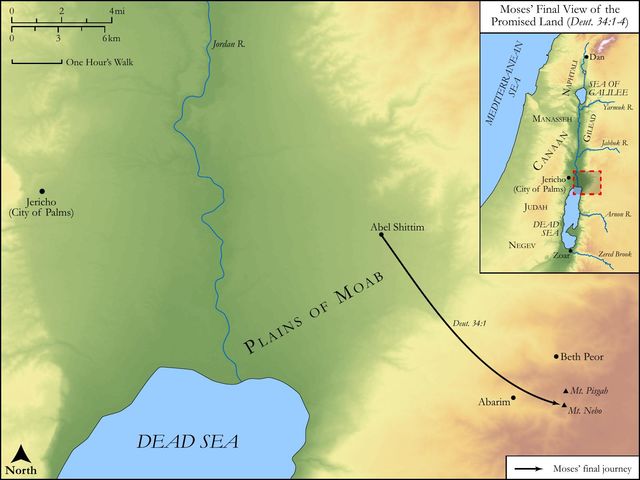
This verse immediately follows God's explicit instruction to Moses in Deuteronomy 32:49 to ascend Mount Abarim, specifically Mount Nebo, in the land of Moab. It functions as the direct, personal application of the divine sovereignty and covenant consequences that have been extensively detailed in the preceding "Song of Moses" (Deuteronomy 32:1-43), a powerful poetic and prophetic discourse that served as a covenant lawsuit, a historical review of Israel's journey, and a stern warning against future apostasy. The song concludes with a promise of God's ultimate vengeance and compassion, making Moses' death command the immediate, somber, and deeply personal culmination of his earthly ministry. This verse thus transitions the narrative from Moses' final public pronouncements to the intimate details of his departure, preparing the reader for the final blessing of Israel and the subsequent account of his death and burial in Deuteronomy 34.
Historical & Cultural Context
At this critical juncture in Israel's history, the nation is encamped on the plains of Moab, poised to finally enter the land of Canaan after forty arduous years of wilderness wandering. Moses, now 120 years old, has faithfully served as their unparalleled leader and mediator, yet he is forbidden from entering the Promised Land himself. This prohibition stems directly from his act of disobedience at the waters of Meribah (Numbers 20:12), where he struck the rock instead of speaking to it as commanded by God, thereby failing to sanctify God in the eyes of the people. The explicit parallel drawn with Aaron's death on Mount Hor (Numbers 20:22-29), also linked to the Meribah incident, powerfully underscores a consistent divine principle of accountability, even for the most revered and privileged leaders. The phrase "gathered unto thy people" is a deeply rooted biblical idiom for death, signifying a peaceful passing and joining the collective of deceased ancestors, implying continuity beyond physical life rather than mere annihilation.
Key Themes
ShowHideDeuteronomy 32:50 profoundly illustrates several core theological and narrative themes central to the book of Deuteronomy and the Pentateuch as a whole. Firstly, it highlights Divine Sovereignty over Life and Death, unequivocally demonstrating that God alone determines the timing and circumstances of every individual's end, even for His most dedicated servants. Moses' death on Mount Nebo was not a random event but a divinely ordained and integral part of God's sovereign plan for Israel's transition into the land. Secondly, it powerfully underscores the Consequences of Disobedience, emphasizing that even figures as significant and intimately connected to God as Moses and Aaron face profound repercussions for failing to fully obey God's commands. This serves as a stark and enduring lesson to all of Israel, and to believers throughout history, about the paramount importance of holiness and complete obedience to God's word (Deuteronomy 32:51). Thirdly, the verse touches upon the Nature of Biblical Death, using the idiom "gathered unto thy people" to convey a communal aspect of death within the ancient Israelite worldview, suggesting a continuity of identity and fellowship with departed kin beyond the physical realm. Finally, it sets the stage for Leadership Transition, as Moses' death was a divinely necessary step for Joshua to assume leadership and guide the Israelites into the long-awaited Promised Land, marking a crucial new chapter in Israel's redemptive history and demonstrating God's faithfulness to His covenant promises through successive generations.
Exposition and Analysis
ShowHideKey Word Analysis
ShowHideThis primitive root signifies the cessation of physical life, emphasizing the finality and certainty of Moses' earthly existence. In the context of a direct divine command, it highlights God's absolute authority over life and death, even for His chosen leaders. It is not a suggestion but a definitive decree, underscoring the serious consequence of Moses' prior disobedience and the unyielding nature of divine judgment. The term implies a divinely appointed end, rather than an accidental or natural passing.
This root means "to gather for any purpose," and in this context, it is used euphemistically for death. When combined with "unto thy people," it forms a common biblical idiom for a peaceful passing, implying that the deceased joins their deceased ancestors. It speaks to a communal aspect of death within the ancient Israelite worldview, suggesting a continuation of identity within the collective of the dead, rather than mere annihilation. It contrasts with a violent or untimely death.
Derived from a root meaning "to congregate," this word refers to a people as a congregated unit, specifically a tribe or nation, and collectively, troops or attendants. In the phrase "gathered unto thy people," it refers to one's deceased kinsfolk and ancestors, emphasizing the familial and communal dimension of death. It suggests a continuity of relationship and identity within the lineage, even beyond the grave, reinforcing the idea of a shared destiny with those who have gone before.
Verse Breakdown
ShowHide"And die in the mount whither thou goest up"
This clause constitutes a direct, imperative command from God to Moses, specifying both the act of death and its precise location. The "mount whither thou goest up" refers to Mount Nebo (part of the Abarim range), as commanded in Deuteronomy 32:49. This highlights the divine orchestration of Moses' death, emphasizing that it is not an accidental or purely natural occurrence but a decreed event, intricately tied to his prophetic mission, his prior accountability for disobedience, and God's sovereign plan for Israel's future.
"and be gathered unto thy people"
This phrase explains the nature of Moses' death, using a common biblical euphemism. As elaborated in the key word analysis, it signifies a peaceful passing and the joining of one's deceased ancestors. It underscores the communal aspect of death in the ancient Israelite worldview, where one's identity continued within the lineage of the departed, implying a state of rest and reunion rather than utter cessation.
"as Aaron thy brother died in mount Hor"
This clause introduces a crucial and explicit parallel between Moses' impending death and that of his older brother, Aaron. Aaron's death on Mount Hor (Numbers 20:22-29) was also divinely ordained and related to a similar act of disobedience at Meribah. The comparison underscores the principle of divine accountability, demonstrating that God's standards apply consistently to even the highest spiritual leaders, and establishes a pattern for leadership transition within God's redemptive plan.
"and was gathered unto his people"
This final clause reiterates the euphemism for death, confirming that Aaron's passing was of the same nature as Moses' impending one—a peaceful joining of his ancestors. It reinforces the parallel drawn between the two brothers, emphasizing the consistent application of this idiom and the shared destiny of God's servants in their mortality.
Literary Devices
ShowHideDeuteronomy 32:50 is rich with several potent literary devices that amplify its theological and narrative impact. The most prominent is Parallelism, specifically a comparative parallelism that explicitly links the deaths of Moses and Aaron. The structure "as Aaron thy brother died in mount Hor, and was gathered unto his people" directly mirrors the description of Moses' own impending death, emphasizing a shared divine decree and consequence for their respective acts of disobedience. This parallelism powerfully highlights the consistency of God's justice and sovereignty, even over His most favored servants. The phrase "gathered unto thy people" is a classic Euphemism for death, softening the stark reality of physical cessation while conveying the communal and peaceful aspect of passing on. This avoids a blunt or morbid declaration, instead using a culturally understood idiom that suggests continuity. Furthermore, the verse functions as a Divine Decree and Prophecy, as God directly commands and foretells Moses' death, demonstrating His absolute control over human destiny and the meticulous nature of His divine plan. This direct address imbues the passage with immense authority and solemnity. Finally, the verse serves as a form of Foreshadowing, setting the stage for the detailed account of Moses' death and burial in Deuteronomy 34, thereby building anticipation for the solemn culmination of his earthly journey and the subsequent transition of leadership.
Theological and Thematic Connections
ShowHideDeuteronomy 32:50 stands as a profound theological statement on divine sovereignty, human accountability, and the nature of mortality within God's redemptive plan. It unequivocally declares that God is the ultimate arbiter of life and death, even for His most faithful and indispensable servants. Moses, despite his unparalleled intimacy with God and his pivotal role in Israel's history as lawgiver and mediator, is not exempt from the consequences of his disobedience at Meribah. This highlights a crucial theological principle: God's holiness and justice are absolute, demanding reverence and complete obedience from all, regardless of position or privilege. The explicit parallel with Aaron reinforces that this is a consistent divine pattern, demonstrating that even the highest spiritual offices do not grant immunity from divine judgment for sin. Furthermore, the concept of being "gathered unto thy people" speaks to a biblical understanding of death as a communal event, a joining of the deceased ancestors, rather than an isolated or annihilatory end, suggesting a continuity of identity within the collective of God's people. This verse thus prepares Israel for a new era under Joshua, underscoring that God's redemptive plan transcends the lifespan of any single individual leader, demonstrating His enduring faithfulness to His covenant promises through successive generations.
Reflection and Application
ShowHideDeuteronomy 32:50 offers timeless and profound lessons for believers today, prompting us to reflect deeply on God's unchanging character and our own human condition. Firstly, it confronts us with the stark reality of our own mortality and God's absolute sovereignty over every aspect of our lives, including our final breath. Just as Moses' days were numbered and divinely appointed, so too are ours. This truth should not evoke fear but rather inspire a profound sense of urgency and purpose, compelling us to live each day faithfully, obediently, and with intentionality, recognizing that our time is a precious gift from God to be stewarded for His glory. Secondly, the accountability of Moses and Aaron, despite their immense spiritual stature and unique relationship with God, serves as a powerful and humbling reminder that God's holy standards apply to everyone without exception. No one is above divine judgment, and even seemingly small acts of disobedience or a failure to sanctify God's name can have significant, far-reaching consequences. This calls us to cultivate deep humility, engage in regular self-examination, and strive for unwavering holiness and complete obedience in all areas of our lives. Finally, Moses' inability to enter the earthly Promised Land, even after decades of unparalleled faithful service, teaches us a vital lesson in trusting God's larger, often mysterious, plan, even when it involves personal sacrifice, unfulfilled earthly desires, or the completion of our earthly assignments without seeing the full fruition of our labors. Our ultimate hope and eternal inheritance are not found in temporal promises or earthly achievements, but in God's eternal kingdom and His unfailing faithfulness.
Questions for Reflection
ShowHideFAQ
ShowHideWhy was Moses forbidden from entering the Promised Land?
ShowHideMoses was forbidden from entering the Promised Land primarily due to his act of disobedience at the waters of Meribah, as recorded in Numbers 20:12. God had commanded Moses to speak to the rock to bring forth water for the thirsty Israelites, but in a moment of frustration and anger, Moses struck the rock twice with his staff. This act was seen by God as a failure to honor Him as holy before the eyes of the people, a display of self-assertion and anger rather than complete reliance on God's word and a demonstration of His power. As a direct consequence, God declared that Moses would not lead the people into the land He had promised. This divine judgment is explicitly reiterated in Deuteronomy 32:51, immediately following the verse under consideration.
What is the significance of "gathered unto thy people"?
ShowHide"Gathered unto thy people" (Hebrew: ne'esaf el-ammeka) is a common and significant biblical idiom or euphemism for death, appearing frequently throughout the Old Testament (e.g., Genesis 25:8). It signifies a peaceful and natural end to one's life, implying that the deceased joins their ancestors in the realm of the departed. While it does not provide a detailed theological explanation of the afterlife, it strongly suggests a continuity of existence beyond physical death and emphasizes a communal aspect of dying, where one becomes part of the collective of those who have gone before. This phrase contrasts with a violent or untimely death and suggests a divinely appointed and peaceful conclusion to one's earthly journey, often associated with those who died in faith.
How does Moses' death relate to leadership transition in the Bible?
ShowHideMoses' death, as divinely decreed in Deuteronomy 32:50, was a meticulously orchestrated event that was absolutely crucial for the leadership transition to Joshua. God had already clearly commissioned Joshua as Moses' successor, empowering him for the task of leading Israel into the Promised Land (Deuteronomy 31:7-8). Moses' passing cleared the way for this new leader to assume his role and guide the Israelites into the long-awaited inheritance. This transition powerfully highlights God's faithfulness to His covenant promises, demonstrating that His redemptive plans do not depend on the life or presence of any single individual, however great, but are carried forward through successive generations of leaders whom He raises up, equips, and empowers. It underscores the profound theological principle that human leaders are temporary instruments in God's hands, but God's overarching purpose and redemptive plan are eternal and continuously unfold through history.
Christ-Centered Fulfillment
ShowHideDeuteronomy 32:50, with its solemn decree of Moses' death and his exclusion from the earthly Promised Land due to disobedience, profoundly foreshadows the inherent limitations of the Old Covenant and underscores the absolute necessity of a greater, perfect mediator. Moses, the revered lawgiver, could bring Israel to the very threshold of their promised earthly inheritance, but he could not, by virtue of the Law and his own sin, lead them into it. His failure at Meribah (Numbers 20:12) serves as a powerful symbol of the Law's ultimate inability to bring humanity into God's perfect rest and eternal inheritance. The Law, given through Moses (John 1:17), serves to expose sin and reveal God's righteous standards, but it cannot ultimately save from sin's pervasive consequences or lead to true spiritual rest and fellowship with God. In striking contrast, Jesus Christ is the ultimate and perfect Joshua (whose Greek name, "Jesus," is the equivalent of "Joshua"), the one true leader who does lead His people into the true, heavenly Promised Land. Where Moses' death marked the end of his leadership and the Law's limitations in bringing full salvation, Christ's sacrificial death on the cross was the perfect, atoning sacrifice that fully satisfied the demands of the Law (Matthew 5:17) and triumphantly opened the way for all who believe to enter God's eternal rest (Hebrews 4:1-11). Moses could only view the land from afar, a poignant symbol of the Law's inability to bring ultimate access; Jesus, through His glorious resurrection and ascension, has entered the heavenly sanctuary and has gone to prepare a place for all His followers in the Father's house (John 14:2-3). He is the singular Way, the Truth, and the Life (John 14:6), the one perfect mediator who brings us into direct, unhindered fellowship with God, providing access to the ultimate spiritual inheritance that Moses, by the Law, could never fully provide. Thus, Moses' death on Mount Nebo, a consequence of sin, powerfully points forward to the atoning death of Christ, which conquered sin's power and opened the path to eternal life and true, abiding rest in God's glorious presence.