


Deuteronomy 32:47
- כִּיkiforH3588PrtParticle Conditional
- לֹאlo'notH3808NegParticle Negative
- דָבָרda·Var[is] a wordH1697N-msNoun Singular Masculine Absolute
- רֵקrek[too] emptyH7386Adj-msAdjective Singular Masculine Absolute
- הוּאhu'itH1931Pro-3msPronoun Personal 3rd Singular Masculine
- מִכֶּםmi·Kemfor youPrep-m ¦ 2mpSuffix Personal 2nd Plural Masculineמִforכֶּםyou
- כִּיkiforH3588PrtParticle Conditional
- הוּאhu'itH1931Pro-3msPronoun Personal 3rd Singular Masculine
- חַיֵּיכֶםchai·yei·Khem[is] your livesH2416N-mpc ¦ 2mpNoun Plural Masculine Constructחַיֵּי[is] livesכֶםyour
- וּבַדָּבָרu·va·da·Varand by the wordH1697Conj-w ¦ Prep-b ¦ N-msNoun Singular Masculine Absoluteוּandבַby theדָּבָרword
- הַזֶּהha·Zeh<the> thisH2088Art ¦ PrtParticle Demonstrativeהַ<the>זֶּהthis
- תַּאֲרִיכוּta·'a·Ri·khuyou will prolongH748V-Hiphil-Imperf-2mpVerb Hiphil Imperfect 2nd Plural Masculine
- יָמִיםya·MimdaysH3117N-mpNoun Plural Masculine Absolute
- עַל'alonH5921PrepPreposition
- הָאֲדָמָהha·'a·da·Mahthe landH127Art ¦ N-fsNoun Singular Feminine Absoluteהָtheאֲדָמָהland
- אֲשֶׁר'a·SherwhereH834RelParticle Relative
- אַתֶּם'a·TemyouH859Pro-2mpPronoun Personal 2nd Plural Masculine
- עֹבְרִים'oe·Rim[are] about to pass overH5674V-Qal-Prtcpl-mpVerb Qal Participle Plural Masculine Absolute
- אֶת'et<obj.>H853DirObjMParticle Object Indicator
- הַיַּרְדֵּןhai·yar·Denthe JordanH3383Art ¦ N-properNoun Proper LocationהַtheיַּרְדֵּןJordan
- שָׁמָּהSha·mahthere towardsH8033Adv ¦ SfxAdverbשָׁמָּthereהtowards
- לְרִשְׁתָּהּle·rish·Tahto take possession of itH3423Prep-l ¦ V-Qal-Inf ¦ 3fsVerb Qal Infinitive Constructלְtoרִשְׁתָּtake possession ofהּit
English is a literal word-by-word gloss of the Hebrew, not the KJV's wording. Why?
This is the original text the KJV's translators worked from — each Hebrew word with its own literal English meaning in this verse, prepared by scholars at Tyndale House, Cambridge. The KJV translates whole sentences, not word by word, so its wording differs: one Hebrew word can become several English words, and the KJV may choose “the LORD” where the gloss reads “Yahweh”. Both are faithful — they answer different questions. For the KJV's own rendering, switch to the KJV text.
Details
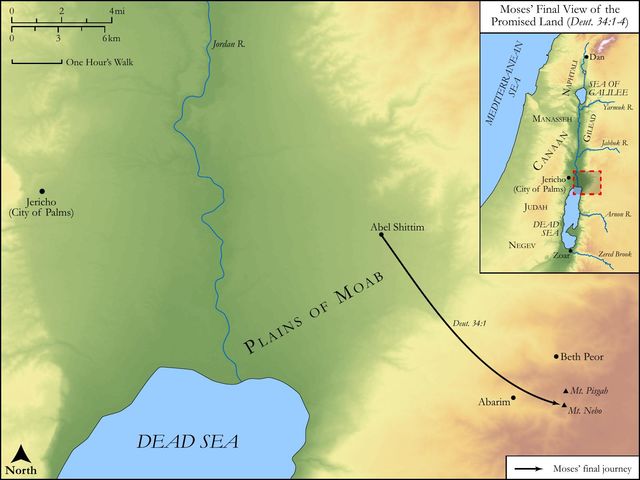
See on the biblical-era map
Study this verse
Public-domain commentary
Matthew Henry
From his Commentary on the Whole Bible. Henry comments on passages, not single verses — this entry covers Deuteronomy 32:44–52. His three-level outline is real structure in the source text, so it is rendered as structure.
Here is, I. The solemn delivery of this song to the children of Israel, Deu 32:44, Deu 32:45. Moses spoke it to as many as could hear him, while Joshua, in another assembly, at the same time, delivered it to as many as his voice would reach. Thus coming to them from the mouth of both their governors, Moses who was laying down the government, and Joshua who was taking it up, they would see they were both in the same mind, and that, though they changed their commander, there was no change in the divine command; Joshua, as well as Moses, would be a witness against them if ever they forsook God.
II.An earnest charge to them to mind these and all the rest of the good words that Moses had said to them.
How earnestly does he long after them all, how very desirous that the word of God might make deep and lasting impressions upon them, how jealous over them with a godly jealousy, lest they should at any time let slip these great things!
1.The duties he charges upon them are, (1.) Carefully to attend to these themselves: "Set your hearts both to the laws, and to the promises and threatenings, the blessings and curses, and now at last to this song. Let the mind be closely applied to the consideration of these things; be affected with them; be intent upon your duty, and cleave to it with full purpose of heart." (2.) Faithfully to transmit these things to those that should come after them: "What interest you have in your children, or influence upon them, use it for this purpose; and command them (as your father Abraham did, Gen 18:19) to observe to do all the words of this law." Those that are good themselves cannot but desire that their children may be so likewise, and that posterity may keep up religion in their day and the entail of it may not be cut off.
2.The arguments he uses to persuade them to make religion their business and to persevere in it are,
(1.)The vast importance of the things themselves which he had charged upon them (Deu 32:47): "It is not a vain thing, because it is your life. It is not an indifferent thing, but of absolute necessity; it is not a trifle, but a matter of consequence, a matter of life and death; mind it, and you are made for ever; neglect it, and you are for ever undone." O that men were but fully persuaded of this, that religion is their life, even the life of their souls!
(2.)The vast advantage it would be of to them: Through this thing you shall prolong your days in Canaan, which is a typical promise of that eternal life which Christ has assured us those shall enter into that keep the commandments of God, Mat 19:17.
III.Orders given to Moses concerning his death.
Now that this renowned witness for God had finished his testimony, he must go up to Mount Nebo and die; in the prophecy of Christ's two witnesses there is a plain allusion to Moses and Elias (Rev 11:6), and perhaps their removal, being by martyrdom, is no less glorious than the removal either of Moses or Elias. Orders were given to Moses that self-same day, Deu 32:48. Now that he had done his work, why should he desire to live a day longer? He had indeed formerly prayed that he might go over Jordan, but now he is entirely satisfied, and, as God had bidden him, saith no more of that matter.
1.God here reminds him of the sin he had been guilty of, for which he was excluded Canaan (Deu 32:51), that he might the more patiently bear the rebuke because he had sinned, and that now he might renew his sorrow for that unadvised word, for it is good for the best of men to die repenting of the infirmities they are conscious to themselves of. It was an omission that was thus displeasing to God; he did not sanctify God, as he ought to have done, before the children of Israel, he did not carry himself with a due decorum in executing the orders he had then received.
2.He reminds him of the death of his brother Aaron (Deu 32:50), to make his own the more familiar and the less formidable. Note, It is a great encouragement to us, when we die, to think of our friends that have gone before us through that darksome valley, especially of Christ, our elder brother and great high priest.
3.He sends him up to a high hill, thence to take a view of the land of Canaan and then die, Deu 32:49, Deu 32:50. The remembrance of his sin might make death terrible, but the sight God gave him of Canaan took off the terror of it, as it was a token of God's being reconciled to him, and a plain indication to him that though his sin shut him out of the earthly Canaan, yet it should not deprive him of that better country which in this world can only be seen, and that with an eye of faith. Note, Those may die with comfort and ease whenever God calls for them (notwithstanding the sins they remember against themselves) who have a believing prospect and a well-grounded hope of eternal life beyond death.
Continue studying Deuteronomy 32:47 across the web’s major study libraries — every link below opens this exact verse, chapter, or book on the destination site.
Read & Compare
 BibleGatewayThis verse in more than 200 translations and 70 languages.
 Bible.comThe YouVersion reader — hundreds of translations, reading plans, and highlights.
 ESV.orgCrossway's official English Standard Version reader.
 NET BibleThe NET translation with 60,000+ translators' notes on every rendering decision.
 STEP BibleTyndale House's free study tool — original text, vocabulary, and scholarly resources.
 BibliaLogos Bible Software's free web reader.
 USCCBThe New American Bible (Revised Edition) with the U.S. bishops' study notes.
Commentaries
 BibleHub CommentariesDozens of classic commentaries on this verse, gathered on one page.
 StudyLightMore than 100 commentary sets — the largest collection on the web.
 BibleRefPlain-English commentary on what this verse means, verse by verse.
 Enduring WordDavid Guzik's free commentary on this chapter, widely used by Bible teachers.
 Bible Study ToolsVerse commentary alongside Greek and Hebrew study aids.
Original Language & Research
- BibleHub InterlinearThe verse word by word — original language, transliteration, and English.
- BibleHub LexiconEvery word's original-language definition and Strong's entry.
 Blue Letter BibleDeep-study tools — Strong's numbers, concordance, and word studies.
 SefariaThe Hebrew text with Rashi and centuries of Jewish commentary.
Sermons, Hymns & Audio


TrulyRandomVerse is not affiliated with these sites and doesn’t control their content. They’re linked because they’re genuinely useful.
Summary
Deuteronomy 32:47 serves as a profound, culminating exhortation within Moses' valedictory address, the "Song of Moses," emphatically declaring that God's commandments are not trivial or empty, but constitute the very essence of life for the Israelites. This vital truth underpins their holistic well-being, prosperity, and the duration of their dwelling in the Promised Land, emphasizing that diligent adherence to the divine word is the indispensable prerequisite for inheriting and thriving in the land God has sworn to give them across the Jordan.
Context
ShowHideLiterary Context
Deuteronomy 32:47 stands as the powerful conclusion to Moses' epic "Song of Moses" (Deuteronomy 32:1-43), a prophetic poem recounting God's steadfast faithfulness, Israel's recurrent rebellion, divine judgment, and the ultimate promise of restoration and vindication for His people. Immediately preceding this verse, Moses issues a direct, urgent command to the nation: "Set your hearts unto all the words which I testify among you this day, which ye shall command your children to observe to do, all the words of this law" (Deuteronomy 32:46). This highlights the critical importance of internalizing, transmitting, and diligently obeying God's commands, not merely hearing them. Verse 47 then provides the profound rationale for such earnest devotion, directly linking obedience to the divine word with the nation's life, longevity, and flourishing in the Promised Land. It transitions from the poetic summary of the Song to a direct, practical application of its message.
Historical & Cultural Context
This verse is delivered at a pivotal juncture in Israel's history: on the plains of Moab, just before Moses' death and the nation's imminent entry into the Promised Land. The generation that had rebelled in the wilderness had perished, and a new generation, born in the desert, stood poised to inherit the covenant promises. In ancient Israelite thought, "life" (Hebrew: chayyim) was a holistic concept, encompassing far more than mere biological existence; it included well-being, prosperity, health, vitality, and a flourishing existence within the covenant community. The land, "whither ye go over Jordan to possess it," was not merely geographical territory but the tangible expression of God's covenant faithfulness to Abraham, Isaac, and Jacob. It was the sacred space where Israel was to live out its distinct identity as God's chosen people, a "kingdom of priests and a holy nation" (Exodus 19:6). Their ability to possess, maintain, and thrive in this land was understood to be directly contingent upon their fidelity to the covenant stipulations and their obedience to God's law.
Key Themes
ShowHideDeuteronomy 32:47 powerfully encapsulates several foundational themes woven throughout the book of Deuteronomy. First, it underscores the supremacy and life-giving power of God's Word, contrasting it sharply with "vain things" or idols that offer no true sustenance or hope. This theme is echoed throughout Deuteronomy, notably in the declaration that "man doth not live by bread only, but by every word that proceedeth out of the mouth of the Lord doth man live" (Deuteronomy 8:3). Second, it reiterates the principle of covenantal blessing and curse, where diligent obedience to God's commands leads to "prolonged days" and prosperity in the land, while disobedience inevitably results in judgment, decline, and exile. Moses explicitly lays out this choice: "I have set before you life and death, blessing and cursing: therefore choose life, that both thou and thy seed may live" (Deuteronomy 30:19). Third, it emphasizes the inheritance of the Promised Land as a central component of God's covenant with the patriarchs, highlighting the conditional nature of Israel's continued enjoyment of this divine gift. The land is a gracious provision, but its sustained possession demands ongoing faithfulness to the Giver and His instructions.
Exposition and Analysis
ShowHideKey Word Analysis
ShowHideThis term (רֵיק, H7386) denotes emptiness, futility, or worthlessness. It describes something devoid of substance, purpose, or efficacy. By emphatically stating that God's word is not a "vain thing," Moses asserts its profound reality, its inherent power, and its indispensable value for Israel's existence. It stands in stark contrast to the emptiness of human wisdom, idolatrous practices, or anything that promises life but delivers only futility.
The Hebrew word (דָּבָר, H1697) is remarkably rich and versatile, meaning "word," "matter," "affair," "decree," "report," or "thing." In this context, it refers collectively to God's words, commandments, and the entire body of divine instruction given to Israel. The phrase "this thing" encapsulates the whole of the Law and the covenant stipulations. Its broad semantic range underscores that God's communication is not merely abstract speech but concrete, impactful reality that shapes every aspect of life.
The Hebrew word (חַי, H2416), often appearing in the plural form chayyim, signifies more than mere biological existence. It encompasses a holistic concept of flourishing, vitality, prosperity, health, and abundant well-being in all dimensions—physical, social, and spiritual. The declaration "it is your life" is a powerful hyperbole, asserting that God's word is not just for life, but is the very source, essence, and sustaining power of true, abundant, and meaningful life for the individual and the nation.
Verse Breakdown
ShowHide"For it [is] not a vain thing for you;"
Moses asserts the profound, non-negotiable significance of God's law and commands. It is not something empty, trivial, or without ultimate purpose. Unlike the fleeting promises of idols or the hollow philosophies of humanity, God's word possesses ultimate substance, truth, and efficacy for their existence and well-being. This clause directly refutes any notion that the divine commands are burdensome, irrelevant, or futile.
"because it [is] your life:"
This is a powerful, almost hyperbolic, declaration of the law's vital importance. The commandments are not external rules imposed from without, but are intrinsically linked to the very essence of Israel's existence and their ability to flourish. To embrace God's word is to embrace life in its fullest, most abundant sense—a life characterized by prosperity, health, divine favor, and true purpose. Conversely, to reject it is to choose spiritual and national decay.
"and through this thing ye shall prolong [your] days in the land,"
This clause explicitly states the direct, tangible consequence of adhering to God's word. Obedience to the divine instructions leads to a lengthened, stable, and prosperous stay in the Promised Land. This is a clear covenantal promise, where fidelity to God's instructions ensures the nation's continued enjoyment of their inheritance and a long, secure national existence, free from exile or premature destruction.
"whither ye go over Jordan to possess it."
This final phrase grounds the promise in the immediate historical reality of the Israelites. They are literally on the cusp of entering Canaan, the land promised to their forefathers. The ability to successfully "possess" (meaning to inherit, take hold of, and maintain control over) and thrive in this inheritance is directly tied to their faithful obedience to the life-giving word of God, underscoring the conditional nature of their dwelling in the land.
Literary Devices
ShowHideDeuteronomy 32:47 employs several potent Literary Devices to convey its urgent and profound message. The most prominent is Contrast, setting God's word apart from anything "vain" or empty, thereby elevating its supreme and indispensable value. This is immediately followed by powerful Hyperbole and Metaphor in the declaration "it is your life," which is not to be taken literally as the physical act of living, but as the ultimate source and essence of true, abundant, and flourishing existence. This phrase also functions as a Merism, encompassing all aspects of holistic well-being. The verse also utilizes Covenant Language, linking obedience directly to blessings (prolonged days in the land), which is a hallmark of the Deuteronomic covenant and its "blessings and curses" framework. The overall structure of the verse presents a clear Conditional Promise, where the desired outcome (prolonged days in the land) is explicitly contingent upon the condition (receiving and obeying God's word as life).
Theological and Thematic Connections
ShowHideDeuteronomy 32:47 articulates a foundational biblical truth: God's word is not a mere set of arbitrary rules but the very source and sustenance of life itself. This principle resonates throughout Scripture, establishing a direct correlation between heeding divine instruction and experiencing true flourishing, both individually and corporately. For ancient Israel, this meant a tangible, prosperous existence in the Promised Land. Theologically, it profoundly underscores God's benevolent desire for His people's well-being, demonstrating that His commands are given out of love for their benefit, rather than as burdensome impositions. This verse also foreshadows the wisdom tradition, where wisdom (often equated with adherence to God's law) is personified as the very path to life, a concept beautifully articulated in Proverbs and other wisdom literature.
Reflection and Application
ShowHideDeuteronomy 32:47 offers a timeless principle that transcends its immediate historical context, speaking powerfully to believers today. While the specific promise of "prolonged days in the land" was for ancient Israel's physical inheritance and national longevity, the underlying spiritual truth remains profoundly relevant: God's Word is the essence of our spiritual life and the fount of true wisdom. In a world constantly seeking fulfillment in fleeting pleasures, empty philosophies, and self-help fads, this verse calls us to recognize the enduring, life-giving power of divine truth. Embracing and diligently living by biblical principles leads to a richer, more purposeful existence, guarding us against spiritual emptiness, moral confusion, and guiding us through life's myriad complexities. It reminds us that our true well-being—our "life"—is found not in human endeavors, material possessions, or worldly accolades, but in humbly heeding, internalizing, and obeying the instructions of our Creator, who desires our abundant and flourishing life in every sense. This verse challenges us to re-evaluate our priorities and deepen our commitment to God's living Word as our ultimate guide and sustenance.
Questions for Reflection
ShowHideFAQ
ShowHideWas the promise of "prolonging days in the land" purely physical, or does it have a spiritual dimension for believers today?
ShowHideWhile the immediate promise in Deuteronomy 32:47 was indeed a physical and national blessing for ancient Israel—ensuring their longevity and prosperity in the land of Canaan as a direct consequence of their obedience to the covenant—it also carries profound spiritual implications that extend to believers today. For Israel, physical life in the land was a tangible manifestation of God's covenant faithfulness and their flourishing relationship with Him. For New Testament believers, while we are not under the Mosaic covenant's specific land promises, the underlying principle remains: God's Word is the source of spiritual life and vitality. As Jesus taught in John 6:63, "It is the spirit that quickeneth; the flesh profiteth nothing: the words that I speak unto you, they are spirit, and they are life." Adhering to God's Word leads to spiritual flourishing, a deeper relationship with Him, and the experience of abundant life (John 10:10). While it doesn't guarantee physical longevity in the same way, it assures spiritual vitality, true wisdom, and eternal life in Christ.
Christ-Centered Fulfillment
ShowHideDeuteronomy 32:47, with its declaration that God's word "is your life," finds its ultimate and most profound fulfillment in the person and work of Jesus Christ. He is the living Word of God, through whom all things were made and in whom is life (John 1:1-4). Moses' exhortation for Israel to cling to the written law for life foreshadows the coming of the one who perfectly embodies that law and offers life itself. Jesus Himself affirmed this very principle when He quoted Deuteronomy 8:3 during His temptation, declaring, "Man shall not live by bread alone, but by every word that proceedeth out of the mouth of God" (Matthew 4:4). More than just words about life, Jesus is "the way, the truth, and the life" (John 14:6). Through His perfect obedience to the Father's will, His atoning sacrifice on the cross, and His glorious resurrection, He provides not merely a prolonged stay in a physical land, but eternal life and an imperishable inheritance for all who believe (1 Peter 1:3-5). Thus, the life promised in Deuteronomy 32:47 is fully realized in the person and redemptive work of Christ, who gives spiritual life now and secures our eternal dwelling in the heavenly land.