


Deuteronomy 32:49
- עֲלֵה'a·Lehgo upH5927V-Qal-Imp-2msVerb Qal Imperative 2nd Singular Masculine
- אֶל'eltoH413PrepPreposition
- הַרhar[the] mountain ofH2022N-mscNoun Singular Masculine Construct
- הָעֲבָרִיםha·'a·va·Rimthe AbarimH5682Art ¦ N-properNoun Proper LocationהָtheעֲבָרִיםAbarim
- הַזֶּהha·Zeh<the> thisH2088Art ¦ PrtParticle Demonstrativeהַ<the>זֶּהthis
- הַרhar[the] mountain ofH2022N-mscNoun Singular Masculine Construct
- נְבוֹne·VoNeboH5015N-properNoun Proper Location
- אֲשֶׁר'a·SherwhichH834RelParticle Relative
- בְּאֶרֶץbe·'E·retz[is] in [the] land ofH776Prep-b ¦ N-fscNoun Singular Feminine Constructבְּ[is] inאֶרֶץ[the] land of
- מוֹאָבmo·'AvMoabH4124N-properNoun Proper Location
- אֲשֶׁר'a·SherwhichH834RelParticle Relative
- עַל'al[is] onH5921PrepPreposition
- פְּנֵיpe·Nei[the] face ofH6440N-mpcNoun Plural Masculine Construct
- יְרֵחוֹye·re·ChoJerichoH3405N-properNoun Proper Location
- וּרְאֵהu·re·'Ehand seeH7200Conj-w ¦ V-Qal-Imp-2msVerb Qal Imperative 2nd Singular Masculineוּandרְאֵהsee
- אֶת'et<obj.>H853DirObjMParticle Object Indicator
- אֶרֶץ'E·retz[the] land ofH776N-fscNoun Singular Feminine Construct
- כְּנַעַןke·Na·'anCanaanH3667N-properNoun Proper Location
- אֲשֶׁר'a·SherwhichH834RelParticle Relative
- אֲנִי'a·NiIH589Pro-1csPronoun Personal 1st Singular common gender
- נֹתֵןno·Ten[am] about to giveH5414V-Qal-Prtcpl-msVerb Qal Participle Singular Masculine Absolute
- לִבְנֵיliv·Neito [the] people ofH1121Prep-l ¦ N-mpcNoun Plural Masculine Constructלִtoבְנֵי[the] people of
- יִשְׂרָאֵלYis·ra·'ElIsraelH3478N-properNoun Proper Location
- לַאֲחֻזָּהla·'a·chu·Zahto a possessionH272Prep-l ¦ N-fsNoun Singular Feminine Absoluteלַtoאֲחֻזָּהa possession
English is a literal word-by-word gloss of the Hebrew, not the KJV's wording. Why?
This is the original text the KJV's translators worked from — each Hebrew word with its own literal English meaning in this verse, prepared by scholars at Tyndale House, Cambridge. The KJV translates whole sentences, not word by word, so its wording differs: one Hebrew word can become several English words, and the KJV may choose “the LORD” where the gloss reads “Yahweh”. Both are faithful — they answer different questions. For the KJV's own rendering, switch to the KJV text.
Details
See on the biblical-era map
Study this verse
Public-domain commentary
Matthew Henry
From his Commentary on the Whole Bible. Henry comments on passages, not single verses — this entry covers Deuteronomy 32:44–52. His three-level outline is real structure in the source text, so it is rendered as structure.
Here is, I. The solemn delivery of this song to the children of Israel, Deu 32:44, Deu 32:45. Moses spoke it to as many as could hear him, while Joshua, in another assembly, at the same time, delivered it to as many as his voice would reach. Thus coming to them from the mouth of both their governors, Moses who was laying down the government, and Joshua who was taking it up, they would see they were both in the same mind, and that, though they changed their commander, there was no change in the divine command; Joshua, as well as Moses, would be a witness against them if ever they forsook God.
II.An earnest charge to them to mind these and all the rest of the good words that Moses had said to them.
How earnestly does he long after them all, how very desirous that the word of God might make deep and lasting impressions upon them, how jealous over them with a godly jealousy, lest they should at any time let slip these great things!
1.The duties he charges upon them are, (1.) Carefully to attend to these themselves: "Set your hearts both to the laws, and to the promises and threatenings, the blessings and curses, and now at last to this song. Let the mind be closely applied to the consideration of these things; be affected with them; be intent upon your duty, and cleave to it with full purpose of heart." (2.) Faithfully to transmit these things to those that should come after them: "What interest you have in your children, or influence upon them, use it for this purpose; and command them (as your father Abraham did, Gen 18:19) to observe to do all the words of this law." Those that are good themselves cannot but desire that their children may be so likewise, and that posterity may keep up religion in their day and the entail of it may not be cut off.
2.The arguments he uses to persuade them to make religion their business and to persevere in it are,
(1.)The vast importance of the things themselves which he had charged upon them (Deu 32:47): "It is not a vain thing, because it is your life. It is not an indifferent thing, but of absolute necessity; it is not a trifle, but a matter of consequence, a matter of life and death; mind it, and you are made for ever; neglect it, and you are for ever undone." O that men were but fully persuaded of this, that religion is their life, even the life of their souls!
(2.)The vast advantage it would be of to them: Through this thing you shall prolong your days in Canaan, which is a typical promise of that eternal life which Christ has assured us those shall enter into that keep the commandments of God, Mat 19:17.
III.Orders given to Moses concerning his death.
Now that this renowned witness for God had finished his testimony, he must go up to Mount Nebo and die; in the prophecy of Christ's two witnesses there is a plain allusion to Moses and Elias (Rev 11:6), and perhaps their removal, being by martyrdom, is no less glorious than the removal either of Moses or Elias. Orders were given to Moses that self-same day, Deu 32:48. Now that he had done his work, why should he desire to live a day longer? He had indeed formerly prayed that he might go over Jordan, but now he is entirely satisfied, and, as God had bidden him, saith no more of that matter.
1.God here reminds him of the sin he had been guilty of, for which he was excluded Canaan (Deu 32:51), that he might the more patiently bear the rebuke because he had sinned, and that now he might renew his sorrow for that unadvised word, for it is good for the best of men to die repenting of the infirmities they are conscious to themselves of. It was an omission that was thus displeasing to God; he did not sanctify God, as he ought to have done, before the children of Israel, he did not carry himself with a due decorum in executing the orders he had then received.
2.He reminds him of the death of his brother Aaron (Deu 32:50), to make his own the more familiar and the less formidable. Note, It is a great encouragement to us, when we die, to think of our friends that have gone before us through that darksome valley, especially of Christ, our elder brother and great high priest.
3.He sends him up to a high hill, thence to take a view of the land of Canaan and then die, Deu 32:49, Deu 32:50. The remembrance of his sin might make death terrible, but the sight God gave him of Canaan took off the terror of it, as it was a token of God's being reconciled to him, and a plain indication to him that though his sin shut him out of the earthly Canaan, yet it should not deprive him of that better country which in this world can only be seen, and that with an eye of faith. Note, Those may die with comfort and ease whenever God calls for them (notwithstanding the sins they remember against themselves) who have a believing prospect and a well-grounded hope of eternal life beyond death.
Historical interpretation
Historical reception
1 surviving comment on this verse from the historical church.
The great Moses, who previously had hidden himself from Pharaoh and had withdrawn into Midian for fear of him when he received the commandment “Return into Egypt,” did not fear to do so. And again, when he was bidden to go up into the mountain Abarim and die, he delayed not through cowardice but even joyfully proceeded there.
Continue studying Deuteronomy 32:49 across the web’s major study libraries — every link below opens this exact verse, chapter, or book on the destination site.
Read & Compare
 BibleGatewayThis verse in more than 200 translations and 70 languages.
 Bible.comThe YouVersion reader — hundreds of translations, reading plans, and highlights.
 ESV.orgCrossway's official English Standard Version reader.
 NET BibleThe NET translation with 60,000+ translators' notes on every rendering decision.
 STEP BibleTyndale House's free study tool — original text, vocabulary, and scholarly resources.
 BibliaLogos Bible Software's free web reader.
 USCCBThe New American Bible (Revised Edition) with the U.S. bishops' study notes.
Commentaries
 BibleHub CommentariesDozens of classic commentaries on this verse, gathered on one page.
 StudyLightMore than 100 commentary sets — the largest collection on the web.
 BibleRefPlain-English commentary on what this verse means, verse by verse.
 Enduring WordDavid Guzik's free commentary on this chapter, widely used by Bible teachers.
 Bible Study ToolsVerse commentary alongside Greek and Hebrew study aids.
Original Language & Research
- BibleHub InterlinearThe verse word by word — original language, transliteration, and English.
- BibleHub LexiconEvery word's original-language definition and Strong's entry.
 Blue Letter BibleDeep-study tools — Strong's numbers, concordance, and word studies.
 SefariaThe Hebrew text with Rashi and centuries of Jewish commentary.
Sermons, Hymns & Audio


TrulyRandomVerse is not affiliated with these sites and doesn’t control their content. They’re linked because they’re genuinely useful.
Summary
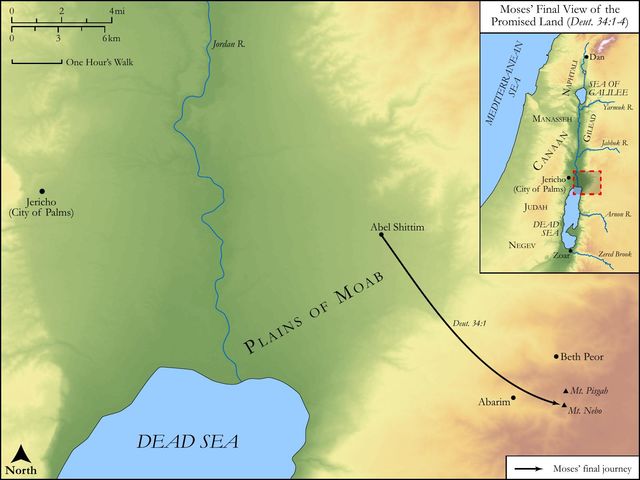
Deuteronomy 32:49 records God's final, poignant command to Moses, instructing him to ascend Mount Nebo, a peak within the Abarim mountain range, strategically situated in the land of Moab directly opposite Jericho. From this elevated vantage point, Moses is to behold the entirety of the land of Canaan, which the Lord, in His unwavering faithfulness, was about to bestow upon the children of Israel as their promised possession. This divine directive serves as a solemn prelude to Moses' death, marking a bittersweet culmination of his lifelong ministry, as he is granted a panoramic glimpse of the inheritance he tirelessly led his people towards, yet is personally barred from entering due to his earlier disobedience.
Context
ShowHideLiterary Context
Deuteronomy 32:49 immediately follows the profound "Song of Moses" (Deuteronomy 32:1-43), a majestic poetic oracle that powerfully recounts God's steadfast faithfulness to Israel despite their persistent rebellion and warns of the consequences of apostasy. The song concludes with a renewed affirmation of divine vengeance against Israel's adversaries and the promise of atonement for His land and people. The narrative then transitions abruptly to this direct divine command to Moses, serving as a solemn and deeply personal epilogue to his prophetic utterances. This verse precisely sets the stage for Moses' final blessing of the tribes in Deuteronomy 33 and his subsequent death and burial in Deuteronomy 34, thereby marking the poignant conclusion of the Pentateuch and the imminent transfer of leadership to Joshua.
Historical & Cultural Context
The historical setting is the plains of Moab, east of the Jordan River, at the culmination of Israel's forty years of wilderness wandering. The Israelites, now a new generation, stand poised on the threshold of the Promised Land, Canaan—a territory solemnly sworn to their patriarchal ancestors Abraham, Isaac, and Jacob centuries earlier (e.g., Genesis 12:7). Mount Nebo, a prominent peak within the Abarim mountain range, is geographically ideal, offering a sweeping, unobstructed panorama across the Jordan Valley into the heartland of Canaan. This precise geographical detail is not incidental; it underscores the tangible reality of the promised inheritance. Culturally, the concept of a "possession" or "inheritance" (ʼăchuzzâh) was profoundly significant in ancient Near Eastern societies, inextricably linked to family lineage, divine grant, and legal ownership. For Israel, this land transcended mere territory; it was a sacred divine gift, the tangible fulfillment of a covenant, and the sacred space where they would fully embody their identity as God's chosen people.
Key Themes
ShowHideThis verse encapsulates several profound and interconnected themes central to the theological tapestry of Deuteronomy and the broader Pentateuch. It powerfully illustrates divine sovereignty and command, as God directly dictates Moses' final actions, demonstrating His absolute control over human destiny and the meticulous fulfillment of His redemptive plans. The theme of consequences for disobedience is starkly present; Moses' exclusion from the land, though granted a poignant glimpse, is a direct and unyielding consequence of his sin at Meribah (Numbers 20:12). Simultaneously, it highlights God's unwavering faithfulness to His covenant promises, particularly concerning the land. Despite Israel's persistent failures and Moses' personal transgression, God's promise to give Canaan to "the children of Israel for a possession" remains steadfast, underscoring that God's covenant is ultimately grounded in His immutable character, not human merit. This pivotal transition also foreshadows the critical theme of new leadership under Joshua, who would successfully lead the people into the land, demonstrating God's consistent provision for His people even when foundational figures depart (Joshua 1:2-3).
Exposition and Analysis
ShowHideKey Word Analysis
ShowHideThis term refers to a mountain range located predominantly in Moabite territory, east of the Jordan River. The name itself, derived from a root meaning "to cross over" or "regions beyond," aptly describes its position as a natural boundary or a vantage point from which one looks across to another land. Its specific mention here provides the broader geographical context for Mount Nebo, emphasizing the precise, divinely appointed location from which Moses would observe the Promised Land.
A specific, prominent peak within the Abarim range, traditionally identified as Jebel en-Neba. Its significance is paramount not only for its elevation and unparalleled panoramic views but primarily as the sacred site of Moses' death and burial. Its designation in this verse marks the solemn culmination of Moses' earthly journey and his extraordinary ministry, serving as a place of both final vision and ultimate departure.
This feminine passive participle denotes "something seized," specifically referring to an "inheritance" or "hereditary possession," particularly of land. It is a robust legal and theological term, emphasizing that the land of Canaan is not something Israel earns through conquest or strength, but rather a gratuitous gift, a divine endowment passed down through generations according to God's immutable covenant promise to Abraham (e.g., Genesis 15:18). It profoundly underscores the unmerited nature of God's gift and the secure, divinely sanctioned claim Israel would have over the land.
Verse Breakdown
ShowHide"Get thee up into this mountain Abarim, [unto] mount Nebo"
This opening phrase constitutes a direct, imperative command from God to Moses, signifying divine authority and Moses' immediate, unquestioning obedience. The precise naming of "Abarim" and "Mount Nebo" pinpoints the exact geographical location for this momentous event, underscoring the intentionality and specificity of God's plan for Moses' final earthly moments.
"which [is] in the land of Moab, that [is] over against Jericho;"
This clause provides crucial geographical orientation, firmly situating Mount Nebo on the eastern side of the Jordan River within the "land of Moab." The phrase "over against Jericho" vividly describes its commanding vantage point, directly opposite the strategically vital city of Jericho on the western side of the Jordan, within the very heart of Canaan. This detail emphasizes the clear, unobstructed, and comprehensive view Moses would be afforded of the land.
"and behold the land of Canaan"
This is the core purpose of Moses' ascent. He is commanded not to enter, but specifically to "behold"—to gaze upon, to see with his own eyes, to fully apprehend—the land he had faithfully led the Israelites towards for four decades. This act of seeing, without physical entry, is a profound demonstration of both God's compassionate mercy (granting him this final glimpse) and the unyielding consequences of his sin at Meribah.
"which I give unto the children of Israel for a possession:"
This concluding declaration powerfully reaffirms God's unwavering covenant faithfulness and absolute sovereignty. The land is explicitly stated as a divine gift ("I give"), emphatically clarifying that it is not a conquest earned by Israel's might or merit. The term "possession" (ʼăchuzzâh) underscores its nature as an enduring, hereditary inheritance, divinely bestowed upon the "children of Israel," thereby emphasizing the unbroken continuity of God's covenant promises to the patriarchs and their descendants.
Literary Devices
ShowHideDeuteronomy 32:49 employs several potent literary devices to convey its profound theological and narrative weight. The most prominent is Divine Command, as God issues a direct, imperative instruction to Moses, highlighting His absolute sovereignty and Moses' role as a faithful, albeit flawed, servant. The verse also utilizes extensive Geographical Specificity, meticulously naming "Abarim," "Mount Nebo," "land of Moab," "Jericho," and "land of Canaan." This precision grounds the spiritual and theological significance of the moment in a tangible, verifiable reality, emphasizing the literal fulfillment of God's promises. Furthermore, there is profound Irony and Pathos in Moses being allowed to see the Promised Land but not enter it. This visual access without physical entry serves as a powerful Symbolism of the Law's inherent limitation—its inability to bring people into the fullness of God's rest—thereby foreshadowing the need for a greater leader and a deeper, spiritual inheritance. The concluding phrase "which I give unto the children of Israel for a possession" also functions as a Reaffirmation of Covenant, echoing earlier divine promises and underscoring the steadfastness and immutability of God's word.
Theological and Thematic Connections
ShowHideDeuteronomy 32:49 is a pivotal verse that masterfully encapsulates the enduring tension between divine promise and human failing, while ultimately affirming God's unfailing faithfulness. It serves as a powerful reminder that God's overarching redemptive plans will be accomplished, regardless of individual human limitations or even disobedience. Moses, the venerable lawgiver and foundational mediator of the Old Covenant, stands at the precipice, granted a vision of the culmination of God's physical promises to Israel, yet tragically unable to participate in their full earthly realization. This highlights the profound severity of sin, even for God's most intimate servants, but also the boundless grace that allows for a glimpse of the inheritance. The land is presented as a "possession" (ʼăchuzzâh), emphasizing its nature as a divine gift, not a reward for merit, pointing to the broader theological truth that all true blessings, whether physical or spiritual, flow from God's sovereign grace and immutable covenant commitment.
Reflection and Application
ShowHideDeuteronomy 32:49 offers a profound and multi-layered lesson in God's absolute sovereignty, the sober consequences of disobedience, and the enduring, immutable nature of His promises. Moses' poignant experience on Mount Nebo serves as a sobering reminder that even the most devoted and influential servants of God are held accountable for their actions, and sin, even seemingly minor acts of rebellion or unbelief, carries significant and often far-reaching consequences. Yet, in His profound mercy, God still granted Moses a final, sweeping vision of the land, a testament to His compassion and unwavering faithfulness to His covenant. For us today, this narrative can be a powerful call to walk in diligent obedience, recognizing that while God's ultimate redemptive purposes will prevail, our personal choices profoundly impact our journey and immediate participation in His blessings. It also encourages us to cultivate an unshakeable trust in God's steadfastness, knowing that even when human leaders falter or circumstances appear bleak, God's promises of an ultimate inheritance remain eternally secure, calling us to look beyond immediate limitations to the greater, eternal hope and rest He has prepared for His people.
Questions for Reflection
ShowHideFAQ
ShowHideWhy was Moses not allowed to enter the Promised Land, despite leading Israel for 40 years?
ShowHideMoses was barred from entering the Promised Land due to his act of disobedience at the waters of Meribah, as vividly recorded in Numbers 20:7-12. God had specifically commanded him to speak to the rock to bring forth water, but in a moment of frustration with the Israelites' persistent grumbling, Moses struck the rock twice. This seemingly minor act, in God's eyes, demonstrated a profound lack of faith in His specific instructions and, more critically, misrepresented God's holiness and power before the gathered people. God declared that because Moses did not "believe Me, to hallow Me in the eyes of the children of Israel," he would not be the one to bring them into the promised land. This serves as a stark and enduring reminder that even the greatest leaders are held accountable for their obedience, and God's holiness must always be honored above all.
What is the significance of Mount Nebo and the Abarim range?
ShowHideMount Nebo is a specific and prominent peak within the broader Abarim mountain range, located strategically east of the Jordan River in what is modern-day Jordan. Its profound significance lies primarily in its intimate association with Moses' final moments. From its summit, Moses was granted an extraordinary panoramic view of the entirety of the Promised Land, encompassing regions from Gilead to Dan, all of Naphtali, the land of Ephraim and Manasseh, all the land of Judah, and the Negeb, and the Plain of the Valley of Jericho (Deuteronomy 34:1-3). It is also the sacred place where Moses died and was subsequently buried by the Lord Himself (Deuteronomy 34:5-6). Thus, Nebo represents both the tangible culmination of God's covenant promise to Israel and the poignant, divinely ordained end of Moses' extraordinary earthly ministry.
Christ-Centered Fulfillment
ShowHideDeuteronomy 32:49, while a deeply poignant moment in the life of Moses, finds its ultimate and most profound Christ-centered fulfillment in the person and redemptive work of Jesus Christ. Moses, the venerable lawgiver and faithful servant, could only lead Israel to the very edge of the physical Promised Land; he could not, due to the limitations of the Law and his own sin, bring them into its full rest. This serves as a powerful theological foreshadowing, revealing the truth that the Law, though holy and good, ultimately reveals sin and points to the inherent need for a greater deliverer, as it cannot grant ultimate access to God's promised spiritual inheritance. Jesus, however, is the superior Moses, the one who truly leads His people into the promised, eternal rest. Unlike Moses, who saw the land but could not enter, Jesus not only perfectly beheld the spiritual inheritance but triumphantly entered it through His perfectly obedient life, His atoning death on the cross, and His glorious resurrection, thereby opening the way for all who believe. He is the true Lamb of God who takes away the sin of the world (John 1:29), fulfilling and superseding the sacrificial system of the Old Covenant. Through saving faith in Him, believers receive not merely a physical land, but a spiritual and eternal inheritance—eternal life, adoption as beloved children of God, and unhindered access to God's very presence (Ephesians 1:11; Hebrews 4:1-11). Moses' view from Nebo pointed to a temporary, physical possession; Christ's perfect work grants us an enduring, heavenly one, a "better country" (Hebrews 11:16), secured by His perfect obedience and ultimate sacrifice, allowing us to truly enter into God's eternal rest.