


Judges 18:11
Bible text: King James Version (1769 Blayney text) · Public domain
Bible text: Berean Standard Bible · Public domain
Bible text: American Standard Version (1901) · Public domain
Bible text: World English Bible, Messianic edition · Public domain
Bible text: Geneva Bible (1599) · Public domain
Bible text: Young's Literal Translation · Public domain
- וַיִּסְעוּvai·yis·'Uand they set outH5265Conj-w ¦ V-Qal-ConsecImperf-3mpVerb Qal Consecutive Imperfect 3rd Plural Masculineוַandיִּסְעוּthey set out
- מִשָּׁםmi·Shamfrom thereH8033Prep-m ¦ AdvAdverbמִfromשָּׁםthere
- מִמִּשְׁפַּחַתmi·mish·Pa·chatof [the] tribe ofH4940Prep-m ¦ N-fscNoun Singular Feminine Constructמִofמִּשְׁפַּחַת[the] tribe of
- הַדָּנִיha·da·Nithe Danite[s]H1839Art ¦ N-msNoun Gentilic Singular Masculine AbsoluteהַtheדָּנִיDanite[s]
- מִצָּרְעָהmi·tza·re·'Ahfrom ZorahH6881Prep-m ¦ N-properNoun Proper LocationמִfromצָּרְעָהZorah
- וּמֵאֶשְׁתָּאֹלu·me·'esh·ta·'Oland from EshtaolH847Conj-w ¦ Prep-m ¦ N-properNoun Proper LocationוּandמֵfromאֶשְׁתָּאֹלEshtaol
- שֵׁשׁsheshsixH8337N-csNoun Singular common gender Absolute
- מֵאוֹתme·'othundred<s>H3967N-fpNoun Plural Feminine Absolute
- אִישׁ'IshmanH376N-msNoun Singular Masculine Absolute
- חָגוּרcha·GurgirdedH2296V-Qal-PassPrtcpl-msVerb Qal Participle Passive Singular Masculine Absolute
- כְּלֵיke·Leiweapons ofH3627N-mpcNoun Plural Masculine Construct
- מִלְחָמָהmil·cha·MahwarH4421N-fsNoun Singular Feminine Absolute
English is a literal word-by-word gloss of the Hebrew, not the KJV's wording. Why?
This is the original text the KJV's translators worked from — each Hebrew word with its own literal English meaning in this verse, prepared by scholars at Tyndale House, Cambridge. The KJV translates whole sentences, not word by word, so its wording differs: one Hebrew word can become several English words, and the KJV may choose “the LORD” where the gloss reads “Yahweh”. Both are faithful — they answer different questions. For the KJV's own rendering, switch to the KJV text.
Details
See on the biblical-era maps
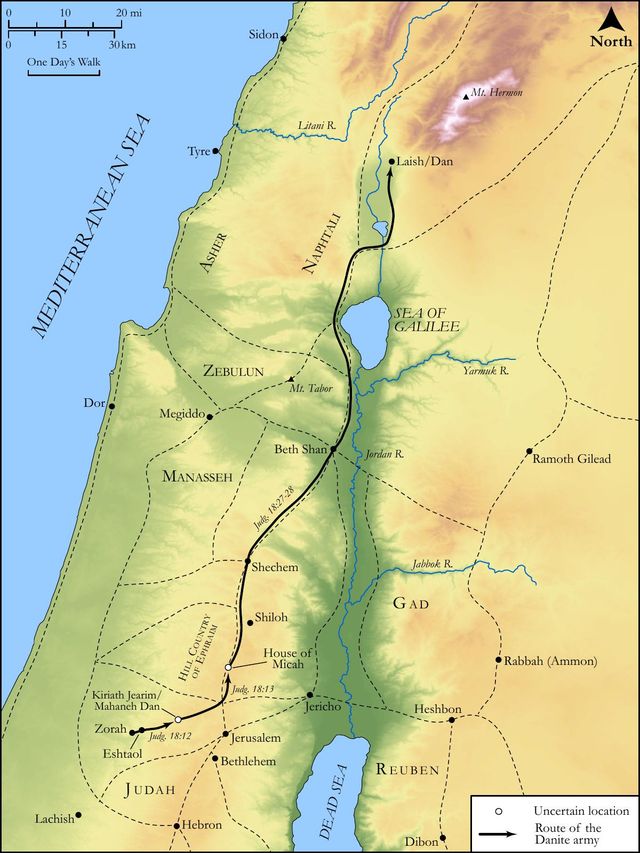
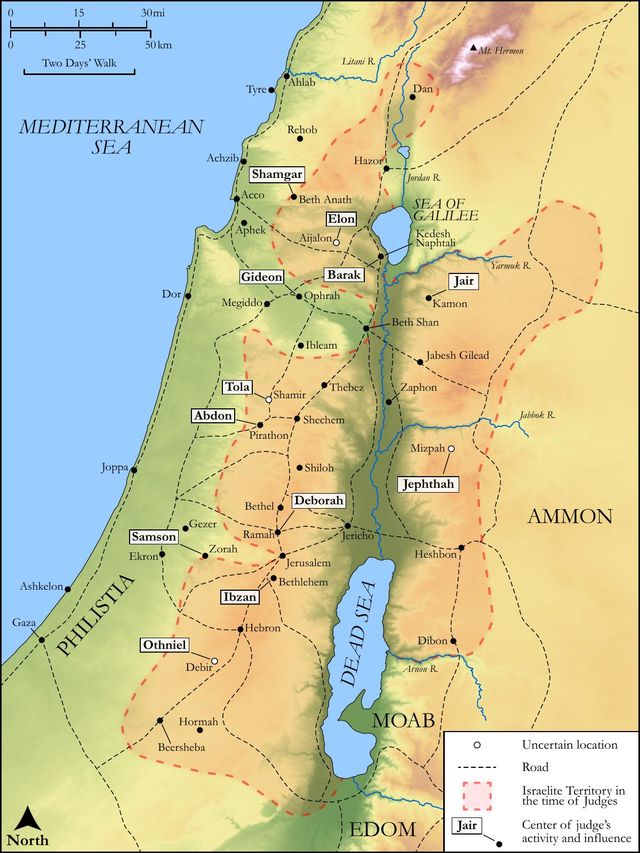
Study this verse
Public-domain commentary
Matthew Henry
From his Commentary on the Whole Bible. Henry comments on passages, not single verses — this entry covers Judges 18:7–13. His three-level outline is real structure in the source text, so it is rendered as structure.
Here is, I. The observation which the spies made upon the city of Laish, and the posture of its inhabitants, Jdg 18:7. Never was place so ill governed and so ill guarded, which would make it a very easy prey to the invader.
1.It was ill governed, for every man might be as bad as he would, and there was no magistrate, no heir of restraint (as the word is), that might so much as put them to shame in any thing, much less put them to death, so that by the most impudent immoralities they provoked God's wrath, and by all manner of mutual mischiefs weakened and consumed one another. See here,
(1.)What the office of magistrates is. They are to be heirs of restraint, that is, to preserve a constant entail of power, as heirs to an inheritance, in the places where they are, for the restraining of that which is evil. They are possessors of restraint, entrusted with their authority for this end, that they may check and suppress every thing that is vicious and be a terror to evil doers. It is only God's grace that can renew men's depraved minds and turn their hearts; but the magistrate's power may restrain their bad practices and tie their hands, so that the wickedness of the wicked may not be either so injurious or so infectious as otherwise it would be. Though the sword of justice cannot cut up the root of bitterness, it may cut off its branches and hinder its growth and spreading, that vice may not go without a check, for then it becomes daring and dangerous, and the community shares in the guilt.
(2.)See what method must be used for the restraint of wickedness. Sinners must be put to shame, that those who will not be restrained by the shamefulness of the sin before God and their own consciences may be restrained by the shamefulness of the punishment before men. All ways must be tried to dash sin out of countenance and cover it with contempt, to make people ashamed of their idleness, drunkenness, cheating, lying, and other sins, by making reputation always appear on virtue's side.
(3.)See how miserable, and how near to ruin, those places are that either have no magistrates or none that bear the sword to any purpose; the wicked then walk on every side, Psa 12:8. And how happy we are in good laws and a good government.
2.It was ill guarded. The people of Laish were careless, quiet, and secure, their gates left open, their walls out of repair, because under no apprehension of danger in any way, though their wickedness was so great that they had reason to fear divine vengeance every day. It was a sign that the Israelites, through their sloth and cowardice, were not now such a terror to the Canaanites as they were when they first came among them, else the city of Laish, which probably knew itself to be assigned to them, would not have been so very secure. Though they were an open and inland town, they lived secure, like the Zidonians (who were surrounded with the sea and were well fortified both by art and nature), but were far from the Zidonians, who therefore could not come in to their assistance, nor help to defend them from the danger which, by debauching their manners, they had helped to bring them into. And, lastly, they had no business with any man, which bespeaks either the idleness they affected (they followed no trade, and so grew lazy and luxurious, and utterly unable to defend themselves) or the independency they affected: they scorned to be either in subjection to or alliance with any of their neighbours, and so they had none to protect them nor bring in any aid to them. They cared for nobody and therefore nobody cared for them. Such as these were the men of Laish.
II.The encouragement which they consequently gave to their countrymen that sent them to prosecute their design upon this city, Jdg 18:8-10.
Probably the Danites had formed notions of the insuperable difficulties of the enterprise, thought it impossible ever to make themselves masters of Laish, and therefore had kept themselves so long out of the possession of it, perhaps suggesting likewise to one another, in their unbelief, that it was not a country worth going so far and running such a risk for, which jealousies the spies (and they were not, in this, evil spies) had an eye to in their report.
1.They represent the place as desirable: "If you will trust our judgments, we have seen the land, and we are agreed in our verdict upon the view, that, behold, it is very good (Jdg 18:9), better than this mountainous country into which we are here crowded by the Philistines. You need not doubt of living comfortably in it, for it is a place where there is no want of any thing," Jdg 18:10. See what a good land Canaan was, that this city which lay furthest of all northward, in the utmost corner of the country, stood on such a fruitful spot.
2.They represent it as attainable. They do not at all question but, with God's blessing, they may soon get possession of it; for the people are secure, Jdg 18:10. And the more secure always the less safe. "God has given it into your hands, and you may have it for the taking." They stir them up to the undertaking: "Arise, that we may go up against them, let us go about it speedily and resolutely." They expostulate with them for their delays, and chide them out of their sluggishness: Are you still? Be not slothful to go. Men need to be thus stirred up to mind even their interest. Heaven is a very good land, where there is no want of any thing; our God has, by the promise, given it into our hands; let us not then be slothful in making it sure, and laying hold on eternal life, but strive to enter.
III.The Danites' expedition against Laish.
This particular family of them, to whose lot that city fell, now at length make towards it, Jdg 18:11-13. The military men were but 600 in all, not a hundredth part of that tribe, for when they entered Canaan the Danites were above 64,000, Num 26:43. It was strange that none of their brethren of their own tribe, much less of any other, came in to their assistance; but it was long after Israel came to Canaan before there appeared among them any thing of a public spirit, or concern for a common interest, which was the reason why they seldom united in a common head, and this kept them low and inconsiderable. It appears (by Jdg 18:21) that these 600 were the whole number that went to settle there, for they had their families and effects with them, their little ones and cattle, so confident were they of success. The other tribes gave them a free passage through their country. Their first day's march brought them to Kirjath-jearim (Jdg 18:12), and such rare things had military encampments now become in Israel that the place where they rested that night was thence called Mahaneh-dan, the camp of Dan, and probably the place whence they began their march between Zorah and Eshtaol was called by the same name, and is meant, Jdg 13:25. The second day's march brought them to Mount Ephraim, near Micah's house (Jdg 18:13), and there we must pause awhile.
Continue studying Judges 18:11 across the web’s major study libraries — every link below opens this exact verse, chapter, or book on the destination site.
Read & Compare
 BibleGatewayThis verse in more than 200 translations and 70 languages.
 Bible.comThe YouVersion reader — hundreds of translations, reading plans, and highlights.
 ESV.orgCrossway's official English Standard Version reader.
 NET BibleThe NET translation with 60,000+ translators' notes on every rendering decision.
 STEP BibleTyndale House's free study tool — original text, vocabulary, and scholarly resources.
 BibliaLogos Bible Software's free web reader.
 USCCBThe New American Bible (Revised Edition) with the U.S. bishops' study notes.
Commentaries
 BibleHub CommentariesDozens of classic commentaries on this verse, gathered on one page.
 StudyLightMore than 100 commentary sets — the largest collection on the web.
 BibleRefPlain-English commentary on what this verse means, verse by verse.
 Enduring WordDavid Guzik's free commentary on this chapter, widely used by Bible teachers.
 Bible Study ToolsVerse commentary alongside Greek and Hebrew study aids.
Original Language & Research
- BibleHub InterlinearThe verse word by word — original language, transliteration, and English.
- BibleHub LexiconEvery word's original-language definition and Strong's entry.
 Blue Letter BibleDeep-study tools — Strong's numbers, concordance, and word studies.
 SefariaThe Hebrew text with Rashi and centuries of Jewish commentary.
Sermons, Hymns & Audio


TrulyRandomVerse is not affiliated with these sites and doesn’t control their content. They’re linked because they’re genuinely useful.
Summary
Judges 18:11 describes the organized departure of a specific contingent from the tribe of Dan, comprising six hundred well-equipped men from their ancestral towns of Zorah and Eshtaol. This verse marks the initiation of a significant, self-directed migration for a segment of the Danite tribe, driven by their failure to secure their divinely allotted inheritance in the southern Shephelah. Their armed expedition to find new territory far to the north underscores a period of profound spiritual and social fragmentation in Israel, characterized by tribal autonomy, a lack of central leadership, and a pervasive reliance on human strength rather than divine guidance or covenant faithfulness.
Context
ShowHideLiterary Context
Judges 18:11 is embedded within a pivotal narrative block (Judges 17-18) that functions as an appendix to the main historical accounts of the Book of Judges. This section vividly illustrates the chaotic spiritual and social conditions prevailing in Israel during the era when "there was no king in Israel" and "every man did that which was right in his own eyes" Judges 17:6 and Judges 21:25. Chapter 18 specifically chronicles the Danite migration, which is precipitated by their earlier failure to fully dispossess the inhabitants of their allotted land Judges 1:34. Immediately preceding this verse, five Danite spies have returned from a reconnaissance mission to Laish, a peaceful and unsuspecting city in the far north, reporting its vulnerability and suitability for conquest Judges 18:7-10. Therefore, verse 11 initiates the military phase of their plan, setting in motion the events that culminate in the violent subjugation of Laish and the establishment of a new, tragically idolatrous Danite settlement.
Historical & Cultural Context
The period of the Judges, roughly spanning from 1200 to 1000 BC, was a transitional era for Israel, characterized by a loose tribal confederacy rather than a centralized monarchy. The initial divine command to completely dispossess the Canaanites from the land was largely incomplete, leading to ongoing conflicts, cultural assimilation, and a decline in covenant fidelity. The tribe of Dan, initially allotted territory on the Mediterranean coast near the Philistine border Joshua 19:40-48, faced particularly strong and persistent opposition from the Amorites and Philistines, who "pressed them into the hill country" Judges 1:34. This historical pressure, combined with a severe lack of unified leadership and a pervasive spiritual decline, compelled a segment of the Danites to seek an alternative solution. Their decision to abandon their divinely appointed inheritance and migrate north reflects a common pattern of tribal independence and pragmatic, often violent, self-preservation characteristic of the era, rather than a reliance on God's covenant faithfulness and power.
Key Themes
ShowHideThis verse powerfully underscores several critical themes prevalent throughout the Book of Judges. Firstly, it highlights the pervasive failure to fully possess the inheritance promised by God, a recurring motif that vividly demonstrates Israel's spiritual weakness, disobedience, and lack of faith. The Danites' departure from Zorah and Eshtaol symbolizes their abandonment of a difficult, yet divinely appointed, task in favor of an easier, self-chosen path. Secondly, the emphasis on "six hundred men appointed with weapons of war" profoundly illustrates a theme of self-reliance and military might prioritized over divine guidance and trust. Instead of seeking God's help to overcome their adversaries in their original territory, the Danites deployed their own formidable strength and strategic planning. This reliance on human power foreshadows the subsequent spiritual decline and idolatry of the tribe, as their new settlement in the north quickly becomes a notorious center for pagan worship Judges 18:30-31. The narrative thus serves as a stark example of the tragic consequences when Israel, or any people, chooses to do "what was right in their own eyes" rather than adhering to God's covenant and trusting in His sovereign provision.
Exposition and Analysis
ShowHideKey Word Analysis
ShowHideTranslated as "family" or "kindred," this term (H4940) indicates that not the entire tribe of Dan migrated, but a specific clan, lineage, or extended household within it. This distinction is crucial, as it suggests a localized decision and action, rather than a unified tribal movement under a central authority. It underscores the fragmented nature of Israelite society during the Judges period, where individual clans or smaller groups often acted independently of the larger tribal or national body. This particular "family" was likely the most affected by the intense pressure in their original territory, prompting their desperate search for a new home.
Derived from the primitive root (H2296) meaning "to gird on (as a belt, armor, etc.)," this word conveys the sense of being equipped, prepared, or furnished for a specific purpose. In this context, it emphasizes the military readiness of the Danite contingent. It signifies that these men were not merely armed individuals but were professionally "girded" or "appointed" for combat, highlighting their intentional preparation for a campaign of conquest. This term underscores their proactive and self-sufficient approach to securing their future.
This word (H3627) refers to "something prepared," encompassing any apparatus, implement, utensil, or vessel, and specifically "weapon" in a military context. The phrase "weapons of war" (kᵉlîy milchâmâh) literally means "instruments of battle" or "articles of war." This detailed description highlights the professional and formidable nature of the Danite contingent. It implies that they were fully provisioned and armed not just for defense, but for an offensive campaign, reinforcing their complete reliance on their own military prowess to achieve their objectives, rather than on divine intervention or guidance.
Verse Breakdown
ShowHide"And there went from thence"
This phrase signifies the commencement of the military expedition. "Thence" refers to the initial location of this specific Danite "family," likely their encampment or towns within their original inheritance, where the decision to act upon the spies' report was finalized. It marks the physical departure and the beginning of their journey.
"of the family of the Danites"
This specifies the particular group embarking on the journey. It was a segment, a specific clan or lineage, rather than the entire tribe, indicating a localized and perhaps desperate measure taken by those most affected by the territorial pressures in their original allotment. This highlights the decentralized nature of Israelite society during the Judges period.
"out of Zorah and out of Eshtaol"
These were the primary towns within Dan's original inheritance, situated in the Shephelah, a strategic but highly contested region near the Philistine border. Their departure from these ancestral lands signifies their abandonment of their God-given inheritance due to their inability or unwillingness to dispossess the existing inhabitants, marking a profound act of self-reliance and theological compromise.
"six hundred men"
This number represents a substantial military force for the time, indicating a serious, well-resourced, and well-organized expedition. Six hundred armed men would have been a formidable contingent capable of conquering a city like Laish, which was described as peaceful and unsuspecting, reinforcing the Danites' reliance on their own numerical and military strength.
"appointed with weapons of war"
This concluding clause emphasizes the military readiness and professional equipping of these men. They were not merely armed but fully prepared for battle, underscoring their clear intent to conquer and establish themselves by force. This detail highlights their complete trust in their own military capabilities to achieve their objectives, rather than in divine assistance.
Literary Devices
ShowHideJudges 18:11 employs several significant literary devices that enrich its meaning and contribute to the broader narrative of the Book of Judges. The description of the "six hundred men appointed with weapons of war" functions as clear Foreshadowing, hinting at the violent conquest of Laish that will immediately follow. This detailed emphasis on their military readiness, while seemingly pragmatic, also serves as powerful Symbolism for the Danites' pervasive reliance on human strength, strategic planning, and self-will, rather than on divine guidance and covenant faithfulness—a central and tragic theme of the book. The entire narrative of the Danite migration, initiated by this verse, operates as a profound Irony. The Danites abandon their difficult, divinely allotted inheritance (symbolizing God's provision and command) for an "easier" path to a new territory, only to establish a new settlement that quickly becomes a notorious hub of idolatry. Their pursuit of peace and security through self-reliant military action ultimately results in profound spiritual compromise and a deeper state of moral decay, highlighting the tragic consequences of forsaking God's way for human expedience.
Theological and Thematic Connections
ShowHideThe Danite migration, initiated in Judges 18:11, serves as a profound theological statement on the devastating consequences of disobedience, self-reliance, and spiritual compromise. Their failure to fully possess their inheritance in the face of strong opposition reflects a broader pattern of Israel's unfaithfulness during the Judges period. Instead of trusting God for victory within their divinely appointed boundaries, they chose a path of least resistance, relying on their own military might to secure a new territory. This pragmatic decision, driven by convenience and a lack of faith, ultimately led to the establishment of a pagan cult in their new home, demonstrating how human solutions, when divorced from divine will, can lead to deeper spiritual bondage and idolatry. The narrative thus functions as a cautionary tale, illustrating that abandoning a difficult but God-given calling for an "easier" path often results in unforeseen spiritual costs and a profound departure from covenant faithfulness.
Reflection and Application
ShowHideThe account of the Danite migration offers a sobering mirror for contemporary believers, challenging us to critically examine our own responses to life's difficulties. We, too, are often faced with challenges in our "inheritance"—the callings, responsibilities, relationships, and even geographical locations God has sovereignly placed us in. Like the Danites, we can be tempted to abandon difficult situations or uncomfortable truths for seemingly easier, more convenient paths that promise immediate relief or worldly success. This verse challenges us to scrutinize our own tendencies towards self-reliance, prompting us to ask whether we are trusting in our own "six hundred men appointed with weapons of war"—our resources, strategic planning, intellect, connections, or even our own willpower—rather than earnestly seeking God's guidance, strength, and provision to overcome obstacles within His perfect will. The Danites' story reminds us that true security, flourishing, and spiritual integrity are found not in avoiding hardship or seeking convenience, but in persevering in God's appointed place and trusting in His unfailing provision, even when the path is arduous. To do otherwise risks spiritual compromise, the establishment of "idols" in our lives, and a profound departure from the very purpose for which we have been called.
Questions for Reflection
ShowHideFAQ
ShowHideWhy did the Danites leave their original inheritance?
ShowHideThe Danites left their original inheritance in the Shephelah (near Zorah and Eshtaol) primarily because they were unable to dispossess the Amorites and Philistines who occupied that region. Judges 1:34 explicitly states that the Amorites "pressed the children of Dan into the mountain: for they would not suffer them to come down to the valley." Faced with strong, persistent opposition and lacking the faith or unified strength to overcome it, a portion of the tribe sought a new, less contested territory. This decision reflected a pragmatic, self-reliant approach to their problem, rather than seeking divine intervention or persevering in their God-given task within the covenant promises.
What was the significance of "six hundred men" in this context?
ShowHideThe "six hundred men" represent a substantial and well-equipped military force, indicating the seriousness and scale of the Danites' expedition. In ancient warfare, a contingent of this size would have been considered formidable, capable of conquering a city or defending a territory. Their description as "appointed with weapons of war" further emphasizes their professional readiness and clear intent for conquest. This number signifies their reliance on their own strength and military prowess to achieve their objectives, rather than on divine guidance or the collective strength of the Israelite confederacy. It underscores the theme of self-reliance and human initiative that characterizes this period of Israel's history, often in contrast to God's intended way.
What happened to the Danites after this migration?
ShowHideAfter their migration, the six hundred Danite men violently conquered the peaceful city of Laish, renaming it Dan Judges 18:27-29. Tragically, this new settlement quickly became a notorious center for idolatry. They took Micah's idol and his Levite priest, Jonathan, establishing a cult that persisted throughout the period of the Judges, even until the captivity of the land Judges 18:30-31. This act of establishing idolatry in their new home was a profound spiritual compromise and a direct violation of God's covenant, illustrating the long-term, detrimental consequences of their initial decision to abandon their inheritance and rely on their own devices.
Christ-Centered Fulfillment
ShowHideThe narrative of the Danites' self-initiated migration, driven by their inability to secure their inheritance and their subsequent reliance on human might, profoundly foreshadows Israel's deeper need for a true King and a perfect Deliverer. The Danites sought rest and security through their own strength, abandoning the land God had given them for a seemingly easier path, which ultimately led to spiritual compromise and pervasive idolatry. This stands in stark contrast to the perfect obedience and ultimate sacrifice of Jesus Christ. While the Danites failed to conquer their inheritance through human means, Jesus, the true Son of God, perfectly fulfilled His Father's will, not by human weapons or strategic retreat, but by laying down His life on the cross. He is the one who truly secures our eternal inheritance, not through our own striving or military might, but through His finished work, granting us a spiritual inheritance that is "imperishable, undefiled, and unfading, kept in heaven for you" 1 Peter 1:3-5. Unlike the false rest the Danites found in their new, idolatrous territory, Christ offers genuine rest for weary souls, inviting all who labor and are heavy laden to "come to me, and I will give you rest" Matthew 11:28-30. The Danites' story is a tragic testament to the futility of human self-reliance apart from God, pointing us to the One who perfectly fulfills God's purposes, provides true security, and leads us into the promised land of eternal life.