


1 Samuel 9:17
Bible text: King James Version (1769 Blayney text) · Public domain
Bible text: Berean Standard Bible · Public domain
Bible text: American Standard Version (1901) · Public domain
Bible text: World English Bible, Messianic edition · Public domain
Bible text: Geneva Bible (1599) · Public domain
Bible text: Young's Literal Translation · Public domain
- וּשְׁמוּאֵלu·she·mu·'Eland SamuelH8050Conj-w ¦ N-proper-mNoun Proper MasculineוּandשְׁמוּאֵלSamuel
- רָאָהra·'Ahhe sawH7200V-Qal-Perf-3msVerb Qal Perfect 3rd Singular Masculine
- אֶת'et<obj.>H853DirObjMParticle Object Indicator
- שָׁאוּלsha·'UlSaulH7586N-proper-mNoun Proper Masculine
- וַיהוָהva·Yah·wehand YahwehH3068Conj-w ¦ N-properNoun Proper TitleוַandיהוָהYahweh
- עָנָהוּ'a·Na·huhe answered himH6030V-Qal-Perf-3ms ¦ 3msVerb Qal Perfect 3rd Singular Masculineעָנָhe answeredהוּhim
- הִנֵּהhi·Nehhere!H2009PrtParticle Interjection
- הָאִישׁha·'Ishthe manH376Art ¦ N-msNoun Singular Masculine Absoluteהָtheאִישׁman
- אֲשֶׁר'a·SherwhomH834RelParticle Relative
- אָמַרְתִּי'a·Mar·tiI spokeH559V-Qal-Perf-1csVerb Qal Perfect 1st Singular common gender
- אֵלֶיךָ'e·Lei·khato youH413Prep ¦ 2msPreposition Definiteאֵלֶיtoךָyou
- זֶהzehthis [one]H2088PrtParticle Demonstrative
- יַעְצֹרya'·Tzorhe will ruleH6113V-Qal-Imperf-3msVerb Qal Imperfect 3rd Singular Masculine
- בְּעַמִּיbe·'a·Miover my peopleH5971Prep-b ¦ N-msc ¦ 1csNoun Singular Masculine Constructבְּoverעַמִּpeopleיmy
English is a literal word-by-word gloss of the Hebrew, not the KJV's wording. Why?
This is the original text the KJV's translators worked from — each Hebrew word with its own literal English meaning in this verse, prepared by scholars at Tyndale House, Cambridge. The KJV translates whole sentences, not word by word, so its wording differs: one Hebrew word can become several English words, and the KJV may choose “the LORD” where the gloss reads “Yahweh”. Both are faithful — they answer different questions. For the KJV's own rendering, switch to the KJV text.
Details
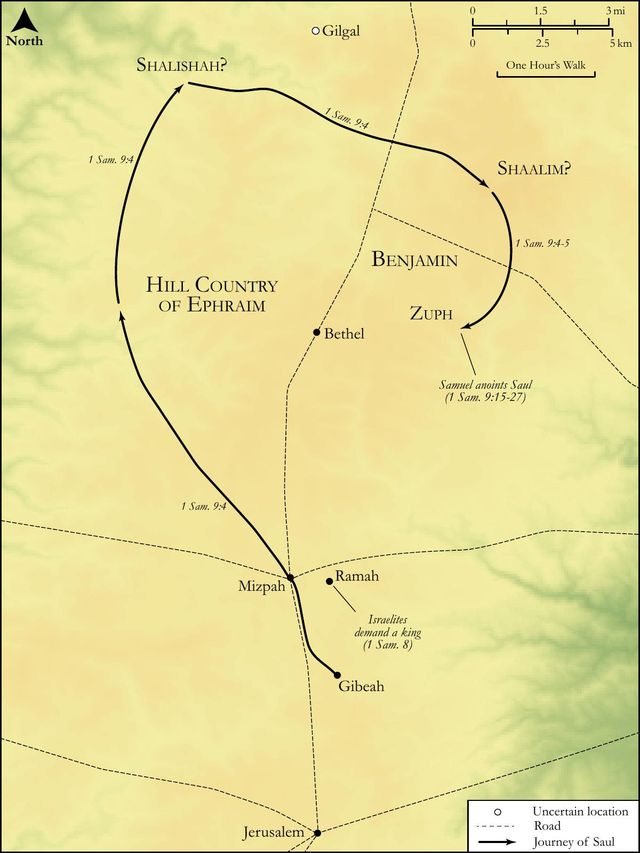
See on the biblical-era map
Study this verse
Public-domain commentary
Matthew Henry
From his Commentary on the Whole Bible. Henry comments on passages, not single verses — this entry covers 1 Samuel 9:11–17. His four-level outline is real structure in the source text, so it is rendered as structure.
Here, I. Saul, by an ordinary enquiry, is directed to Samuel, Sa1 9:11-14. Gibeah of Saul was not twenty miles from Ramah where Samuel dwelt, and was near to Mizpeh where he often judged Israel, and yet, it seems, Saul had lived so very privately, and had taken so little notice of public affairs, that he had never seen Samuel, for when he met him (Sa1 9:18) he did not know him, so that there was no cause to suspect any secret compact or collusion between them in this matter. I knew him not, says John Baptist concerning Christ, Joh 1:31. Yet I do not think it any commendation to Saul that he was a stranger to Samuel. However,
1.The maid-servants of Ramah, whom they met with at the places of drawing water, could give him and his servant intelligence concerning Samuel; and very particular they were in their directions, Sa1 9:12, Sa1 9:13. We should always be ready to give what assistance we can to those that are enquiring after God's prophets, and to further them in their enquiries. Even the maid-servants could tell them,
(1.)That there was a sacrifice that day in the high place, it being either an ordinary festival or an extraordinary day of prayer and thanksgiving, with which sacrifices were joined. The tabernacle being deprived of the ark, the altar there had not now the reputation it formerly had, nor were they confined to it, as they would be when God had again chosen a place to put his name in; and therefore now other places were allowed. Samuel had built an altar at Ramah (Sa1 7:17), and here we have him making use of that altar.
(2.)That Samuel came that day to the city, either from his circuit or from his country seat. He was such a public person that his movements were generally known.
(3.)That this was just the time of their meeting to feast before the Lord upon the sacrifice: "About this time you will find him in the street going up to the high place." They knew the hour of the solemn feast.
(4.)That the people would not eat till Samuel came, not only because he was the worthiest person, and they ought in good manners to stay for him, and he was, as some think, the maker of this feast, the sacrifice being offered at his charge and upon his account; but because, as a man of God, whoever made the feast, he must bless the sacrifice, that is, those parts of the sacrifice which they feasted upon, which may be considered,
[1.]As a common meal, and so this is an instance of the great duty of craving a blessing upon our meat before we partake of it. We cannot expect benefit from our food without that blessing, and we have no reason to expect that blessing if we do not pray for it. Thus we must give glory to God as our benefactor, and own our dependence upon him and our obligations to him. Or,
[2.]As a religious assembly. When the sacrifice was offered, which was the ceremony, Samuel blessed it, that is, he prayed over it, and offered up spiritual sacrifices with it, which were the substance; and afterwards, when the holy duties were performed, they did eat. Let the soul first be served. The feast upon the sacrifice being a sacred rite, it was requisite that it should in a particular manner be blessed, as is the Christian eucharist. They feasted in token of their reconciliation to God by virtue of the sacrifice, and their participation of the benefits of it; and Samuel blessed the feast, that is, he prayed to God to grace the solemnity with his special presence, that it might answer those great ends. Bishop Hall observes what a particular account those maid-servants could give of the usages of those sacred feasts, and infers from it that, "where there is the practice and example of piety in the better sort, there will be a reflection of it upon the meanest. It is no small advantage to live in religious places; for we shall be much to blame if all goodness fall beside us."
2.Saul and his servant followed the directions given them, and very opportunely met Samuel going to the high place, the synagogue of the city, Sa1 9:14. This seemed purely accidental, but the divine providence ordered it for the forwarding of this great event. The wise God serves very great and certain purposes by very small and casual occurrences. A sparrow falls not to the ground without our Father.
II.Samuel, by an extraordinary revelation, is informed concerning Saul. He was a seer, and therefore must see this in a way peculiar to himself.
1.God had told him, the day before, that he would, at this time, send him the man that should serve the people of Israel for such a king as they wished to have, like all the nations, Sa1 9:15, Sa1 9:16. He told him in his ear, that is, privately, by a secret whisper to his mind, or perhaps by a still small voice, some soft and gentle sounds conveyed to his ear, probably when he was praying in secret for direction in that and other affairs of the nation. He had spoken in the ears of the Lord (Sa1 8:21), and now God spoke in his ear, in token of friendship and familiarity, for he revealeth his secret to his servants the prophets, as secrets in their ear, Amo 3:7. God told him before, that it might not be a surprise to him; and perhaps it was in expectation of it that he appointed the feast and the sacrifice, for the imploring of God's blessing upon this great and important affair, though he might keep the particular occasion in his own breast, God having only told it to him in his ear. The Hebrew phrase is, He uncovered the ear of Samuel, to which some allude for the explication of the way of God's revealing himself to us; he not only speaks, but uncovers our ear. We have naturally a covering on our ears, so that we perceive not what God says (Job 33:14), but, when God will manifest himself to a soul, he uncovers the ear, says, Ephphratha, Be opened; he takes the veil from off the heart, Co2 3:16. Though God had, in displeasure, granted their request for a king, yet here he speaks tenderly of Israel; for even in wrath he remembers mercy.
(1.)He calls them again and again his people; though a peevish and provoking people, yet mine still.
(2.)He sends them a man to be captain over them, that they might not be a body without a head, and to save them out of the hand of the Philistines, which perhaps was more than many of them aimed at in desiring a king.
(3.)He does it with a gracious respect to them and to their cry: I have looked upon my people, and their cry has come unto me. He gratified them with what they cried for, as the tender mother humours the froward child, lest it should break its heart. And (as bishop Patrick observes), though he would not hear their cry to relieve them against the oppression of their kings (Sa1 8:18), yet he was so gracious as to make those kings instruments of their deliverance from the oppression of their neighbours, which was more than they had reason to expect.
2.When Saul came up towards him in the street God again whispered Samuel in the ear (Sa1 9:17): Behold the man whom I spoke to thee of! Saul being a man of unusual stature, it is natural to think that Samuel fixed his eye upon him at a distance, and perhaps looked the more wistfully towards him because the hour had now come when God would send him the man that should be king of Israel, and he fancied this might be he; but, that he might be fully satisfied, God told him expressly, That is the man that shall restrain (for magistrates are heirs of restraint) my people Israel.
Historical interpretation
Historical reception
1 surviving comment on this verse from the historical church.
And when Samuel looked at Saul, the Lord said to him, etc. When John saw Jesus coming to him, instructed by the Holy Spirit, he understood him to be the Lamb of God, the one who takes away the sins of the world, the one of whom the prophet Micah speaks: And you Bethlehem Ephrathah, you are small among the clans of Judah, out of you will come forth for me one who will be the ruler in Israel (Micah 5:2).
Continue studying 1 Samuel 9:17 across the web’s major study libraries — every link below opens this exact verse, chapter, or book on the destination site.
Read & Compare
 BibleGatewayThis verse in more than 200 translations and 70 languages.
 Bible.comThe YouVersion reader — hundreds of translations, reading plans, and highlights.
 ESV.orgCrossway's official English Standard Version reader.
 NET BibleThe NET translation with 60,000+ translators' notes on every rendering decision.
 STEP BibleTyndale House's free study tool — original text, vocabulary, and scholarly resources.
 BibliaLogos Bible Software's free web reader.
 USCCBThe New American Bible (Revised Edition) with the U.S. bishops' study notes.
Commentaries
 BibleHub CommentariesDozens of classic commentaries on this verse, gathered on one page.
 StudyLightMore than 100 commentary sets — the largest collection on the web.
 BibleRefPlain-English commentary on what this verse means, verse by verse.
 Enduring WordDavid Guzik's free commentary on this chapter, widely used by Bible teachers.
 Bible Study ToolsVerse commentary alongside Greek and Hebrew study aids.
Original Language & Research
- BibleHub InterlinearThe verse word by word — original language, transliteration, and English.
- BibleHub LexiconEvery word's original-language definition and Strong's entry.
 Blue Letter BibleDeep-study tools — Strong's numbers, concordance, and word studies.
 SefariaThe Hebrew text with Rashi and centuries of Jewish commentary.
Sermons, Hymns & Audio


TrulyRandomVerse is not affiliated with these sites and doesn’t control their content. They’re linked because they’re genuinely useful.
Summary
1 Samuel 9:17 records the pivotal moment of divine revelation where the prophet Samuel encounters Saul, the man sovereignly chosen by God to be Israel's first king. This verse captures the Lord's immediate and explicit declaration to Samuel, confirming Saul's identity and his appointed role as the future ruler over God's covenant people, thereby initiating the long-anticipated transition from a period of judgeship to a centralized monarchy in Israel's history.
Context
ShowHideLiterary Context
This verse serves as the climactic point of a carefully orchestrated divine plan and a series of seemingly coincidental human events. It immediately follows the Lord's prior, specific revelation to Samuel in 1 Samuel 9:16, where God explicitly informed the prophet that He would send a man from the land of Benjamin to be anointed as "prince" (נָגִיד, nagid) over His people. Saul, dispatched by his father Kish to search for lost donkeys, is divinely guided to Ramah, Samuel's residence. The preceding narrative in 1 Samuel 9:1-16 meticulously details Saul's journey, his encounter with Samuel's servants, and the precise timing that brings him directly before the prophet, setting the stage for this momentous identification and confirmation. This verse also directly fulfills the people's insistent demand for a king, as recorded in 1 Samuel 8.
Historical & Cultural Context
The period described in 1 Samuel marks a significant transition in ancient Israel's governance, moving from a decentralized tribal confederacy under charismatic judges to a centralized monarchy. The people, driven by a desire to be "like all the nations" and a dissatisfaction with Samuel's corrupt sons, had explicitly rejected God's direct rule through His appointed judges, a rejection detailed in 1 Samuel 8:7. Although displeasing to God, this demand was permitted within His sovereign plan. The selection of a king, particularly one from the tribe of Benjamin—a tribe that had recently suffered near annihilation due to a civil war, as recounted in Judges 20-21—would have carried significant cultural and political weight. Prophets like Samuel held immense spiritual authority, serving as God's primary spokespersons, mediating divine will, and anointing leaders, making Samuel's role in sanctioning Saul's kingship absolutely crucial for its legitimacy in the eyes of the people.
Key Themes
ShowHide1 Samuel 9:17 powerfully underscores the theme of Divine Sovereignty in the selection and appointment of leaders. Despite Israel's flawed motives for desiring a king, God remains actively involved, meticulously choosing the specific individual to reign. This demonstrates that even human choices, whether wise or unwise, operate within the larger framework of God's overarching plan and purpose for His people. Another crucial theme is Prophetic Authority and Confirmation, as Samuel, God's appointed prophet, serves as the indispensable divine intermediary. The Lord's direct speech to Samuel not only validates Samuel's prophetic office but also ensures that Saul's appointment carries undeniable divine sanction. Finally, the verse marks the Inauguration of the Monarchy, signaling a momentous shift in Israel's political and social structure from a charismatic leadership of judges to a dynastic kingship, a change that would profoundly shape Israel's future history and theological understanding of leadership, as seen throughout 1 Samuel.
Exposition and Analysis
ShowHideKey Word Analysis
ShowHideThis is the personal, covenantal name of God, often rendered "Jehovah" or "Yahweh." Its use here emphasizes that the revelation is not merely a general divine pronouncement but a specific, personal communication from the self-existent and eternal God who is in covenant relationship with Israel. It underscores His active involvement and sovereign authority in choosing Israel's king.
This word denotes an individual male person. In this context, it highlights Saul's specific identity as the unique individual God had previously designated to Samuel. It is not just any man, but the particular, chosen person whom God had prepared for this momentous role, emphasizing divine precision in selection.
This primitive root means "to inclose; by analogy, to hold back; also to maintain, rule, assemble." While it can mean "to restrain" or "to withhold," in this context, the specific idiom "shall reign" (H6113 in the KJV Strong's mapping for this verse) signifies the exercise of royal power and authority. It confirms that Saul's role is not temporary but that of a formal monarch, established to maintain and rule over the nation.
Verse Breakdown
ShowHide"And when Samuel saw Saul"
This opening clause establishes the physical encounter between the prophet and the future king. Samuel's act of "seeing" Saul is not accidental but the divinely orchestrated culmination of Saul's journey and God's prior preparation of Samuel. It sets the stage for the immediate divine confirmation that follows, indicating that Samuel's initial perception is about to be clarified by revelation.
"the LORD said unto him"
This is the pivotal moment of direct divine communication. It highlights Samuel's unique role as God's prophet, receiving immediate and personal revelation. This is not Samuel's deduction or a general impression, but an explicit, audible instruction and identification from the Almighty, underscoring the divine authority behind Saul's appointment.
"Behold the man whom I spake to thee of!"
This emphatic declaration from God serves as a direct confirmation of Saul's identity to Samuel. The interjection "Behold!" (Hebrew: hinneh) draws immediate and urgent attention, emphasizing the momentous nature of the revelation. It explicitly refers back to God's prior promise to Samuel in 1 Samuel 9:16, affirming the fulfillment of that prophecy and the reliability of God's word.
"this same shall reign over my people."
This final clause unequivocally states Saul's future role and the scope of his authority. He is designated not merely as a temporary leader but as a king, and his domain is "my people"—Israel. This phrase emphasizes God's continued ownership and covenant relationship with the nation, even as a human king is installed. It also subtly introduces the inherent tension that would define Saul's reign: ruling God's people requires adherence to God's will and purposes.
Literary Devices
ShowHideThe verse employs several significant literary devices that amplify its theological weight. Divine Speech is paramount, as the direct words of the Lord to Samuel form the core of the revelation, emphasizing God's active involvement and absolute control over human affairs. The use of the emphatic interjection "Behold!" (Hebrew: hinneh) functions as a powerful Exclamation or Interjection, serving to draw immediate and urgent attention to the subject, Saul, and highlighting the momentous nature of the divine identification. There is also a strong element of Foreshadowing, as this declaration sets the stage for Saul's anointing, his subsequent reign, and the unfolding drama of Israel's monarchy, which will be detailed in the following chapters. Furthermore, the broader narrative leading up to this verse, with Saul's seemingly mundane search for lost donkeys leading him directly to Samuel, subtly employs Divine Irony or Providence, where ordinary circumstances are divinely orchestrated to fulfill extraordinary and predetermined purposes.
Theological and Thematic Connections
ShowHide1 Samuel 9:17 stands as a profound testament to God's absolute sovereignty over human history and the appointment of leaders. Even when His people demand a king out of flawed motives, effectively rejecting His direct rule, God does not abandon them. Instead, He works within their choices, demonstrating His ability to raise up and position individuals according to His divine plan. This verse highlights that all authority, even human kingship, ultimately derives from God. It underscores the tension between human desire and divine will, showing that God can use both to advance His purposes. The identification of Saul as the one "whom I spake to thee of" reinforces the reliability of God's prophetic word and Samuel's crucial role as a faithful mediator of that word, ensuring that the establishment of the monarchy is divinely sanctioned, not merely a human political maneuver.
Reflection and Application
ShowHideThis pivotal moment in 1 Samuel 9:17 profoundly reminds us that God is intimately involved in the affairs of humanity, even in the seemingly mundane or politically charged decisions of nations and individuals. Saul was found not through a grand, intentional search for a king, but while looking for lost donkeys, yet God had already prepared Samuel for his arrival. This teaches us to recognize God's hand in unexpected places and to trust in His sovereign orchestration, even when circumstances appear ordinary or our own plans seem to be going awry. It calls us to discern God's will and purpose in the leaders He raises up, whether in government, the church, or our communities, understanding that their authority, ultimately, is permitted or appointed by Him. It also challenges us to critically examine our own desires for leadership and control, ensuring they align with God's perfect plan rather than merely our own preferences or worldly expectations. Our prayer should be for God's will to be done through those He places in authority.
Questions for Reflection
ShowHideFAQ
ShowHideWhy did God choose Saul, a Benjamite, if the eternal kingship was later established in Judah through David?
ShowHideWhile the eternal Davidic covenant would later establish the kingship firmly in the tribe of Judah (as seen in 2 Samuel 7), God initially chose Saul from Benjamin for several significant reasons. Firstly, it directly fulfilled the immediate demand of the people for a king "like all the nations," demonstrating God's condescension to their request, even if it wasn't His ultimate ideal for their governance. Saul's impressive physical stature and appearance (as described in 1 Samuel 9:2) fit the popular, worldly image of a king. Secondly, choosing a king from a smaller, less prominent tribe like Benjamin, rather than a dominant one like Judah or Ephraim, might have initially helped to mitigate tribal jealousies and foster a sense of unity among the disparate tribes. It also highlights that God's choices are not limited by human expectations or tribal prominence, but by His sovereign design. Saul's subsequent failure due to disobedience (detailed in 1 Samuel 15) would then powerfully pave the way for God to establish a king "after His own heart" from Judah, highlighting the conditional nature of the first covenant with Saul and the unconditional, eternal nature of the later one with David.
Christ-Centered Fulfillment
ShowHideWhile Saul's kingship was a human institution, granted in response to Israel's flawed demand for a king, it ultimately served as a crucial foreshadowing of the perfect and eternal kingship of Jesus Christ. Saul, initially chosen for his outward appearance and perceived strength, quickly proved to be a king who failed to obey God's commands, ultimately leading to his rejection and tragic demise (as seen in 1 Samuel 15 and 1 Samuel 31). This flawed human monarchy, initiated in 1 Samuel 9:17, served to highlight Israel's desperate need for a truly righteous, obedient, and eternal King. Jesus, the true Son of David, is the King chosen not by human demand or outward appearance, but by God's eternal decree (as prophesied in Isaiah 9:6-7 and perfectly fulfilled in Luke 1:32-33). He is the ultimate "man whom I spake to thee of," the Lamb of God who takes away the sin of the world (as proclaimed in John 1:29), and the One who truly reigns over God's people, not with a temporal scepter but with eternal authority and perfect justice (as described in Revelation 19:16). Unlike Saul, whose reign ended in failure and rejection, Christ's kingdom is everlasting, bringing salvation, righteousness, and true peace to all who believe in Him (as promised in Hebrews 1:8).