


Nehemiah 13:25
- וָאָרִיבva·'a·Rivand I contendedH7378Conj-w ¦ V-Qal-ConsecImperf-1csVerb Qal Consecutive Imperfect 1st Singular common genderוָandאָרִיבI contended
- עִמָּם'i·Mamwith themH5973Prep ¦ 3mpPrepositionעִמָּwithםthem
- וָאֲקַלְלֵםva·'a·ka·Lemand I cursed themH7043Conj-w ¦ V-Piel-ConsecImperf-1cs ¦ 3mpVerb Piel Consecutive Imperfect 1st Singular common genderוָandאֲקַלְלֵI cursedםthem
- וָאַכֶּהva·'a·Kehand I struckH5221Conj-w ¦ V-Hiphil-ConsecImperf-1csVerb Hiphil Consecutive Imperfect 1st Singular common genderוָandאַכֶּהI struck
- מֵהֶםme·Hemsome of <the> themPrep-m ¦ 3mpSuffix Personal 3rd Plural Masculineמֵsome of <the>הֶםthem
- אֲנָשִׁים'a·na·ShimmenH582N-mpNoun Plural Masculine Absolute
- וָאֶמְרְטֵםva·'em·re·Temand I pulled out beard theirH4803Conj-w ¦ V-Qal-ConsecImperf-1cs ¦ 3mpVerb Qal Consecutive Imperfect 1st Singular common genderוָandאֶמְרְטֵI pulled out beardםtheir
- וָאַשְׁבִּיעֵםva·'ash·bi·'Emand I made take an oath themH7650Conj-w ¦ V-Hiphil-ConsecImperf-1cs ¦ 3mpVerb Hiphil Consecutive Imperfect 1st Singular common genderוָandאַשְׁבִּיעֵI made take an oathםthem
- בֵּאלֹהִיםbe·lo·Himby GodH430Prep-b ¦ N-mpNoun Plural Masculine AbsoluteבֵּbyאלֹהִיםGod
- אִם'imifH518PrtParticle Conditional
- תִּתְּנוּti·te·Nuyou will giveH5414V-Qal-Imperf-2mpVerb Qal Imperfect 2nd Plural Masculine
- בְנֹתֵיכֶםve·no·tei·Khemyour daughtersH1323N-fpc ¦ 2mpNoun Plural Feminine Constructבְנֹתֵיdaughtersכֶםyour
- לִבְנֵיהֶםliv·nei·Hemto their sonsH1121Prep-l ¦ N-mpc ¦ 3mpNoun Plural Masculine Constructלִtoבְנֵיsonsהֶםtheir
- וְאִםve·'imand ifH518Conj-w ¦ PrtParticle Conditionalוְandאִםif
- תִּשְׂאוּtis·'Uyou will takeH5375V-Qal-Imperf-2mpVerb Qal Imperfect 2nd Plural Masculine
- מִבְּנֹתֵיהֶםmi·be·No·tei·Hemany of their daughtersH1323Prep-m ¦ N-fpc ¦ 3mpNoun Plural Feminine Constructמִany ofבְּנֹתֵיdaughtersהֶםtheir
- לִבְנֵיכֶםliv·nei·Khemfor your sonsH1121Prep-l ¦ N-mpc ¦ 2mpNoun Plural Masculine Constructלִforבְנֵיsonsכֶםyour
- וְלָכֶםve·la·Khemand for <the> yourselvesConj-w ¦ Prep-l ¦ 2mpSuffix Personal 2nd Plural Masculineוְandלָfor <the>כֶםyourselves
English is a literal word-by-word gloss of the Hebrew, not the KJV's wording. Why?
This is the original text the KJV's translators worked from — each Hebrew word with its own literal English meaning in this verse, prepared by scholars at Tyndale House, Cambridge. The KJV translates whole sentences, not word by word, so its wording differs: one Hebrew word can become several English words, and the KJV may choose “the LORD” where the gloss reads “Yahweh”. Both are faithful — they answer different questions. For the KJV's own rendering, switch to the KJV text.
Details
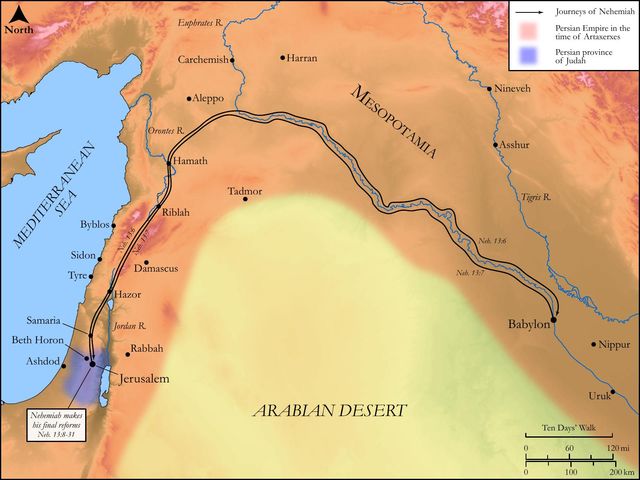
See on the biblical-era map
Study this verse
Public-domain commentary
Matthew Henry
From his Commentary on the Whole Bible. Henry comments on passages, not single verses — this entry covers Nehemiah 13:23–31. His three-level outline is real structure in the source text, so it is rendered as structure.
We have here one instance more of Nehemiah's pious zeal for the purifying of his countrymen as a peculiar people to God; that was the thing he aimed at in the use of his power, not the enriching of himself. See here,
I.How they had corrupted themselves by marrying strange wives.
This was complained of in Ezra's time, and much done towards a reformation, Ezr 9:1-15 and 10. But, when the unclean spirit is cast out, if a watchful eye be not kept upon him, he will re-enter; so he did here. Though in Ezra's time those that had married strange wives were forced to put them away, which could not but occasion trouble and confusion in families, yet others would not take warning. Nitimur in vetitum - we still lean towards what is forbidden. Nehemiah, like a good governor, enquired into the state of the families of those that were under his charge, that he might reform what was amiss in them, and so heal the streams by healing the springs.
1.He enquired whence they had their wives, and found that many of the Jews had married wives of Ashdod, of Ammon, and of Moab (Neh 13:23), either because they were fond of what was far-fetched or because they hoped by these alliances to strengthen and enrich themselves. See how God by the prophet reproves this, Mal 2:11. Judah has dealt treacherously, and broken covenant with God, the covenant made in Ezra's time with reference to this very thing; he has profaned the holiness of the Lord by marrying the daughter (that is, the worshipper) of a strange god.
2.He talked with the children, and found they were children of strangers, for their speech betrayed them. The children were bred up with their mothers, and learned of them and their nurses and servants to speak, so that they could not speak the Jews' language, could not speak it at all, or not readily, or not purely, but half in the speech of Ashdod, or Ammon, or Moab, according as the country was which the mother was a native of. Observe,
(1.)Children, in their childhood, learn much of their mothers. Partus sequitur ventrem - they are prone to imitate their mothers.
(2.)If either side be bad, the corrupt nature will incline the children to take after that, which is a good reason why Christians should not be unequally yoked.
(3.)In the education of children great care should be taken about the government of their tongues, that they learn not the language of Ashdod, any impious or impure talk, any corrupt communication.
II.What course Nehemiah took to purge out this corruption, when he discovered how much it had prevailed.
1.He showed them the evil of it, and the obligation he lay under to witness against it. He did not seek an occasion against them, but this was an iniquity to be punished by the judge, and which he must by no means connive at (Neh 13:27): "Shall we hearken to you, who endeavour to palliate and excuse it? No, it is an evil, a great evil, it is a transgression against our God, to marry strange wives, and we must do our utmost to put a stop to it. You beg that they may not be divorced from you, but we cannot hearken to you, for there is no other remedy to clear us from the guilt and prevent infection." (1.) He quotes a precept, to prove that it was in itself a great sin; and makes them swear to that precept: You shall not give your daughters unto their sons, etc., which is taken from Deu 7:3. When we would reclaim people from sin we must show them the sinfulness of it in the glass of the commandment. (2.) He quotes a precedent, to show the pernicious consequences of it, which made it necessary to be animadverted upon by the government (Neh 13:26): Did not Solomon king of Israel sin by these things? The falls of great and good men are recorded in order that we may take warning by them to shun the temptations which they were overcome by. Solomon was famous for wisdom; there was no king like him for it; yet, when he married strange wives, his wisdom could not secure him from their snares, nay, it departed from him, and he did very foolishly. He was beloved of God, but his marrying strange wives threw him out of God's favour, and went near to extinguish the holy fire of grace in his soul: he was king over all Israel; but his doing this occasioned the loss of ten of his twelve tribes. You plead that you can marry strange wives and yet retain the purity of Israelites; but Solomon himself could not; even him did outlandish women cause to sin. Therefore let him that thinks he stands take heed lest he fall when he runs upon such a precipice.
2.He showed himself highly displeased at it, that he might awaken them to a due sense of the evil of it: He contended with them, Neh 13:25. They offered to justify themselves in what they did, but he showed them how frivolous their excuses were, and argued it warmly with them. When he had silenced them he cursed them, that is, he denounced the judgments of God against them, and showed them what their sin deserved. He then picked out some of them that were more obstinate than the rest, and fit to be made examples, and smote them (that is, ordered them to be beaten by the proper officers according to the law, Deu 25:2, Deu 25:3), to which he added this further mark of infamy that he plucked off their hair, or cut or shaved it off; for it may so be understood. Perhaps they had prided themselves in their hair, and therefore he took it off to deform and humble them, and put them to shame; it was, in effect, to stigmatize them, at least for a time. Ezra, in this case, had plucked off his own hair, in holy sorrow for the sin; Nehemiah plucked off their hair, in a holy indignation at the sinners. See the different tempers of wise, and good, and useful men, and the divers graces, as well as divers gifts, of the same Spirit.
3.He obliged them not to take any more such wives, and separated those whom they had taken: He cleansed them from all strangers, both men and women (Neh 13:30), and made them promise with an oath that they would never do so again, Neh 13:25. Thus did he try all ways and means to put a stop to this mischief and to prevent another relapse into this disease.
4.He took particular care of the priests' families, that they might not lie under this stain, this guilt. He found, upon enquiry, that a branch of the high priest's own family, one of his grandsons, had married a daughter of Sanballat, that notorious enemy of the Jews (Neh 2:10; Neh 4:1), and so had, in effect, twisted interests with the Samaritans, Neh 13:28. How little love had that man either to God or his country who could make himself in duty and interest a friend to him that was a sworn enemy to both. It seems this young priest would not put away his wife, and therefore Nehemiah chased him from him, deprived him, degraded him, and made him for ever incapable of the priesthood. Josephus says that this expelled priest was Manasseh, and that when Nehemiah drove him away he went to his father-in-law Sanballat, who built him a temple upon Mount Gerazim, like that at Jerusalem, and promised him he should be high priest in it, and that then was laid the foundation of the Samaritans' pretensions, which continued warm to our Saviour's time. Joh 4:20, Our fathers worshipped in this mountain. When Nehemiah had thus expelled one that had forfeited the honour of the priesthood he again posted the priests and Levites every one in his business, Neh 13:30. It was no loss to them to part with one that was the scandal of their cloth; the work would be done better without him. When Judas had gone out Christ said, Now is the Son of Man glorified, Joh 13:30, Joh 13:31. Here are Nehemiah's prayers on this occasion. (1.) He prays, Remember them, O my God! Neh 13:29. "Lord, convince and convert them; put them in mind of what they should be and do, that they may come to themselves." Or, "Remember them to reckon with them for their sin; remember it against them." If we take it so, this prayer is a prophecy that God would remember it against them. Those that defile the priesthood despise God, and shall be lightly esteemed. Perhaps they were too many and too great for him to deal with. "Lord" (says he), "deal thou with them; take the work into thy own hands." (2.) He prays, Remember me, O my God! Neh 13:31. The best services done to the public have sometimes been forgotten by those for whom they were done (Ecc 9:15); therefore Nehemiah refers it to God to recompense him, takes him for his paymaster, and then doubts not but he shall be well paid. This may well be the summary of our petitions; we need no more to make us happy than this: Remember me, O my God! for good.
Continue studying Nehemiah 13:25 across the web’s major study libraries — every link below opens this exact verse, chapter, or book on the destination site.
Read & Compare
 BibleGatewayThis verse in more than 200 translations and 70 languages.
 Bible.comThe YouVersion reader — hundreds of translations, reading plans, and highlights.
 ESV.orgCrossway's official English Standard Version reader.
 NET BibleThe NET translation with 60,000+ translators' notes on every rendering decision.
 STEP BibleTyndale House's free study tool — original text, vocabulary, and scholarly resources.
 BibliaLogos Bible Software's free web reader.
 USCCBThe New American Bible (Revised Edition) with the U.S. bishops' study notes.
Commentaries
 BibleHub CommentariesDozens of classic commentaries on this verse, gathered on one page.
 StudyLightMore than 100 commentary sets — the largest collection on the web.
 BibleRefPlain-English commentary on what this verse means, verse by verse.
 Enduring WordDavid Guzik's free commentary on this chapter, widely used by Bible teachers.
 Bible Study ToolsVerse commentary alongside Greek and Hebrew study aids.
Original Language & Research
- BibleHub InterlinearThe verse word by word — original language, transliteration, and English.
- BibleHub LexiconEvery word's original-language definition and Strong's entry.
 Blue Letter BibleDeep-study tools — Strong's numbers, concordance, and word studies.
 SefariaThe Hebrew text with Rashi and centuries of Jewish commentary.
Sermons, Hymns & Audio


TrulyRandomVerse is not affiliated with these sites and doesn’t control their content. They’re linked because they’re genuinely useful.
Summary
Nehemiah 13:25 powerfully depicts Governor Nehemiah's zealous and uncompromising enforcement of God's covenant law against intermarriage during his second term in Jerusalem. Confronted with the widespread spiritual compromise of Jewish men marrying women from surrounding pagan nations, Nehemiah responded with a series of drastic actions: he contended with them, pronounced curses, physically chastised some offenders, and publicly humiliated them by plucking out their hair. He then compelled them to swear a solemn oath before God, vowing to cease the forbidden practice, thereby demonstrating his unwavering commitment to the spiritual purity of the covenant community and the sanctity of divine commands.
Context
ShowHideLiterary Context
Nehemiah 13:25 is situated within the climactic final chapter of the book of Nehemiah, which records the governor's return to Jerusalem after a period in Persia and his subsequent discovery of significant covenant violations. Having previously led the people in rebuilding the wall and renewing their commitment to the Mosaic Law in Nehemiah 8-10, Nehemiah finds that the reforms have been tragically neglected in his absence. The chapter systematically addresses various breaches: the expulsion of Tobiah from the temple courts (Nehemiah 13:4-9), the neglect of tithes for the Levites (Nehemiah 13:10-14), and the desecration of the Sabbath (Nehemiah 13:15-22). The issue of intermarriage, specifically with women from Ashdod, Ammon, and Moab, is introduced as the final and perhaps most egregious offense in Nehemiah 13:23, leading directly to Nehemiah's dramatic and forceful response in verse 25, which serves as a powerful demonstration of his resolve to purify the community.
Historical & Cultural Context
This event unfolds in the post-exilic period, likely around 430-420 BC, decades after the initial return from Babylonian captivity. The Jewish community in Jerusalem was still fragile, striving to re-establish its distinct identity as God's chosen people in a pagan-dominated world. Intermarriage with surrounding nations (Ammonites, Moabites, Ashdodites) was a persistent and grave threat to Israel's spiritual purity, explicitly forbidden by the Mosaic Law (e.g., Deuteronomy 7:3-4). The profound concern was that these unions would inevitably lead to idolatry, syncretism, and the erosion of their unique covenant relationship with Yahweh, a pattern tragically evident throughout Israel's history. Nehemiah's actions, while shocking to modern sensibilities, were not entirely uncommon in the ancient Near East for public shaming and enforcing community standards. "Plucking off hair" was a severe act of public disgrace, often associated with deep humiliation, punishment, or mourning, signifying a person's utter contempt or loss of honor and dignity.
Key Themes
ShowHideNehemiah 13:25 powerfully illuminates several core themes central to the book and the broader Old Testament narrative. First, it underscores Nehemiah's Uncompromising Leadership and unwavering zeal for God's law. His decisive, even violent, actions highlight the profound gravity of the spiritual compromise he confronted and his absolute commitment to covenant faithfulness, portraying a leader who would not tolerate sin within the community. Second, the passage emphasizes the Sanctity of Marriage and Covenant Purity. The central issue Nehemiah addresses is the spiritual danger posed by intermarriage, which directly violated God's commands designed to preserve Israel's spiritual distinctiveness and prevent apostasy, echoing earlier warnings in passages like Exodus 34:15-16. Third, it vividly demonstrates the Consequences of Disobedience. Nehemiah's severe actions—cursing, smiting, and plucking hair—were public acts of shaming and physical discipline, intended to convey the severe displeasure of God and the community, and to compel immediate repentance and adherence to the divine covenant. This mirrors the earlier struggles faced by Ezra concerning the same issue in Ezra 9-10.
Exposition and Analysis
ShowHideKey Word Analysis
ShowHideThis verb signifies a vigorous disputation, a legal or judicial argument, or a vehement accusation. Nehemiah was not merely debating; he was engaging in a forceful confrontation, presenting a case against them based on the divine law, acting as a prosecutor or judge enforcing covenant stipulations. The term conveys a sense of striving or struggling against, indicating a determined and resolute opposition to their actions.
In this context, "cursed" does not imply a magical incantation but rather a powerful verbal denunciation or pronouncement of judgment. It signifies bringing into contempt or making vile. Nehemiah's words conveyed severe displeasure and the divine condemnation associated with their actions, publicly shaming them and invoking God's disfavor upon their disobedience, thereby emphasizing the gravity of their spiritual offense.
This was a highly symbolic and deeply humiliating act in ancient Near Eastern cultures, meaning "to make bald (the head)" or "pluck off (hair)." It signified public disgrace, stripping away a person's honor and dignity. For Nehemiah to physically pull out their hair underscored the extreme contempt and shame he felt for their blatant disregard of God's covenant, serving as a visceral demonstration of the severity of their sin and the community's profound disapproval.
Verse Breakdown
ShowHide"And I contended with them,"
Nehemiah initiated a direct and forceful confrontation with those who had engaged in forbidden intermarriages. This was not a gentle persuasion but a vigorous dispute, indicating his unwavering resolve to address the sin head-on and hold the offenders accountable for their covenant breach.
"and cursed them,"
Following his contention, Nehemiah pronounced a strong verbal rebuke or condemnation upon them. This "cursing" was an expression of divine displeasure and a public shaming for their covenant infidelity, signifying the gravity of their offense in God's eyes and the community's judgment.
"and smote certain of them,"
Nehemiah resorted to physical chastisement, striking some of the offenders. This was a form of corporal punishment, a severe disciplinary action intended to convey the seriousness of their transgression and to compel immediate compliance and repentance through painful consequences.
"and plucked off their hair,"
This was a public act of extreme humiliation and disgrace. By physically pulling out their hair, Nehemiah stripped them of their dignity and honor in front of the community, emphasizing the profound shame associated with their disobedience and the severity of the spiritual compromise they had introduced.
"and made them swear by God, [saying],"
After the physical and verbal confrontations, Nehemiah compelled them to take a solemn oath, invoking God as a witness and guarantor of their promise. This act elevated the commitment to a sacred level, binding them under divine judgment if they should break their word, ensuring the permanence of their repentance.
"Ye shall not give your daughters unto their sons, nor take their daughters unto your sons, or for yourselves."
This final clause states the explicit content of the oath. It directly reiterates the Mosaic prohibition against intermarriage, forbidding both the giving of Israelite daughters to foreign sons and the taking of foreign daughters for Israelite sons, or for themselves (implying the taking of multiple foreign wives or concubines). This was the core issue Nehemiah sought to rectify and prevent from recurring, safeguarding the spiritual integrity of the people.
Literary Devices
ShowHideNehemiah 13:25 employs several powerful literary devices to convey the intensity of the situation and Nehemiah's actions. The accumulation of strong, active verbs—"contended," "cursed," "smote," "plucked," "made them swear"—creates a sense of escalating intensity and urgency, emphasizing Nehemiah's forceful and comprehensive response. This sequence of actions can be seen as a form of climax, building to the ultimate objective of securing a covenant oath. The extreme nature of Nehemiah's physical discipline, particularly "plucked off their hair," functions as a vivid hyperbole to underscore the gravity of the spiritual offense in the eyes of God and the community. The act of "plucking off their hair" is rich in symbolism, representing public disgrace, humiliation, and the stripping away of honor, serving as a visceral visual metaphor for the spiritual defilement caused by intermarriage. Furthermore, the final clause, "Ye shall not give your daughters unto their sons, nor take their daughters unto your sons, or for yourselves," exhibits clear parallelism, reiterating the prohibition in a balanced and emphatic manner, reinforcing the absolute nature of the command. The entire passage also serves as a powerful testament to Nehemiah's zeal, portraying him as a fierce and uncompromising guardian of the covenant.
Theological and Thematic Connections
ShowHideNehemiah 13:25 underscores the profound theological truth that God's people are called to be distinct and holy, set apart for His purposes. The prohibition against intermarriage was not merely a social or ethnic boundary but a spiritual one, designed to safeguard Israel's unique covenant relationship with Yahweh and prevent the insidious infiltration of idolatry and pagan practices. Nehemiah's extreme actions reflect the seriousness with which God views spiritual compromise and the purity of His worship. The integrity of the family unit, and by extension the nation, was seen as foundational to their spiritual health and their ability to fulfill their role as a light to the nations. This passage serves as a stark reminder that disobedience to God's clear commands, especially those concerning spiritual separation and worship, carries severe consequences and demands decisive action to restore righteousness within the community.
Reflection and Application
ShowHideWhile Nehemiah's physical methods of discipline are not to be directly emulated by believers today, the underlying principles of zeal for God's truth, uncompromising stand against sin, and the protection of spiritual purity remain profoundly relevant. This passage challenges us to examine the areas in our own lives and communities where compromise with worldly values might be subtly eroding our devotion to God. It calls for a fervent commitment to God's Word, ensuring that our relationships, decisions, and lifestyle choices align with biblical principles, particularly concerning marriage and family. We are reminded that spiritual health often depends on maintaining clear boundaries against influences that could draw us away from Christ and into spiritual apathy or idolatry. The solemn oath Nehemiah extracted also emphasizes the gravity of our commitments before God, urging us to take our vows—whether in marriage, baptism, or church membership—with utmost seriousness and integrity, recognizing that our fidelity impacts not only ourselves but the purity of the wider Christian community.
Questions for Reflection
ShowHideFAQ
ShowHideWas Nehemiah's violence justified?
ShowHideNehemiah's actions, including physical violence and public shaming, must be understood within their specific historical and cultural context. In ancient Near Eastern societies, such methods were sometimes employed by authorities to enforce laws and maintain social order, especially when dealing with severe breaches of covenant that threatened the very identity and survival of the community. The sin of intermarriage was not merely a social transgression but a direct violation of God's law, threatening the spiritual identity and existence of the covenant community by inevitably leading to idolatry and apostasy. Nehemiah, acting as governor and a zealous guardian of God's covenant, saw these drastic measures as necessary to shock the people into repentance and prevent the complete spiritual corruption of Israel, a lesson learned from the nation's past failures (e.g., Numbers 25:1-9). While the New Testament calls believers to a different ethic of love, patience, and gentle instruction (e.g., 2 Timothy 2:24-25), Nehemiah's actions highlight the extreme seriousness of sin and God's unwavering demand for holiness within His people.
Why was intermarriage such a significant issue for Nehemiah and the post-exilic community?
ShowHideIntermarriage was a critical issue because it posed an existential threat to the spiritual purity and distinct identity of the Israelite community, which had just returned from exile and was striving to re-establish its covenant relationship with God. The Mosaic Law explicitly forbade marriage with people from pagan nations (e.g., Deuteronomy 7:3-4) because these unions inevitably led to the adoption of foreign gods and customs, drawing God's people into idolatry and breaking their exclusive devotion to Yahweh. History had shown this to be a consistent pattern of spiritual decline (e.g., Judges 3:5-7). For Nehemiah, allowing intermarriage was tantamount to undoing the very purpose of their return from exile—to be a holy people devoted solely to Yahweh. It was not about racial purity but about spiritual fidelity, the preservation of the covenant lineage, and the safeguarding of the monotheistic worship through which the Messiah would eventually come.
Christ-Centered Fulfillment
ShowHideNehemiah's zealous and uncompromising actions in Nehemiah 13:25, though severe, foreshadow the ultimate zeal of Christ for the purity of His people and the integrity of God's covenant. Just as Nehemiah contended against those who defiled the physical community of Israel, Jesus, with divine authority, cleansed the temple, driving out those who desecrated His Father's house, declaring, "My house shall be called a house of prayer, but you make it a den of robbers" (Matthew 21:13). While Nehemiah used physical force and public shaming to enforce external adherence to the Law, Christ's cleansing is ultimately spiritual, purifying His bride, the Church, not by physical violence but by His atoning sacrifice and the sanctifying power of His Word and Spirit. He is the true guardian of the new covenant, establishing a spiritual union where believers are called to be "equally yoked" with Him and with one another, separated from the defilements of the world (2 Corinthians 6:14-18). Through His shed blood, Jesus provides the ultimate purification, making us holy and blameless before God (Ephesians 5:25-27). He fulfills Nehemiah's zeal by perfectly upholding God's holiness and securing a people truly set apart for God's glory, not by external coercion, but by internal transformation through the Holy Spirit, enabling genuine and lasting obedience from the heart.