


Nehemiah 13:24
Bible text: King James Version (1769 Blayney text) · Public domain
Bible text: Berean Standard Bible · Public domain
Bible text: American Standard Version (1901) · Public domain
Bible text: World English Bible, Messianic edition · Public domain
Bible text: Geneva Bible (1599) · Public domain
Bible text: Young's Literal Translation · Public domain
- וּבְנֵיהֶםu·ve·nei·Hemand their childrenH1121Conj-w ¦ N-mpc ¦ 3mpNoun Plural Masculine Constructוּandבְנֵיchildrenהֶםtheir
- חֲצִיcha·TzihalfH2677N-msNoun Singular Masculine Absolute
- מְדַבֵּרme·da·Ber[were] speakingH1696V-Piel-Prtcpl-msVerb Piel Participle Singular Masculine Absolute
- אַשְׁדּוֹדִית'ash·do·DitAshdoditeH797N-fsNoun Gentilic Singular Feminine Absolute
- וְאֵינָםve·'ei·Namand not theyH369Conj-w ¦ N-msc ¦ 3mpNoun Singular Masculine Constructוְandאֵינָnotםthey
- מַכִּירִיםma·ki·Rim[were] knowingH5234V-Hiphil-Prtcpl-mpVerb Hiphil Participle Plural Masculine Absolute
- לְדַבֵּרle·da·Berto speakH1696Prep-l ¦ V-Piel-InfVerb Piel Infinitive Constructלְtoדַבֵּרspeak
- יְהוּדִיתye·hu·Dit[in] JudeanH3066N-fsNoun Gentilic Singular Feminine Absolute
- וְכִלְשׁוֹןve·khil·Shonand according to [the] language ofH3956Conj-w ¦ Prep-k ¦ N-cscNoun Singular common gender Constructוְandכִaccording toלְשׁוֹן[the] language of
- עַם'ampeopleH5971N-msNoun Singular Masculine Absolute
- וָעָםva·'Amand peopleH5971Conj-w ¦ N-msNoun Singular Masculine Absoluteוָandעָםpeople
English is a literal word-by-word gloss of the Hebrew, not the KJV's wording. Why?
This is the original text the KJV's translators worked from — each Hebrew word with its own literal English meaning in this verse, prepared by scholars at Tyndale House, Cambridge. The KJV translates whole sentences, not word by word, so its wording differs: one Hebrew word can become several English words, and the KJV may choose “the LORD” where the gloss reads “Yahweh”. Both are faithful — they answer different questions. For the KJV's own rendering, switch to the KJV text.
Details
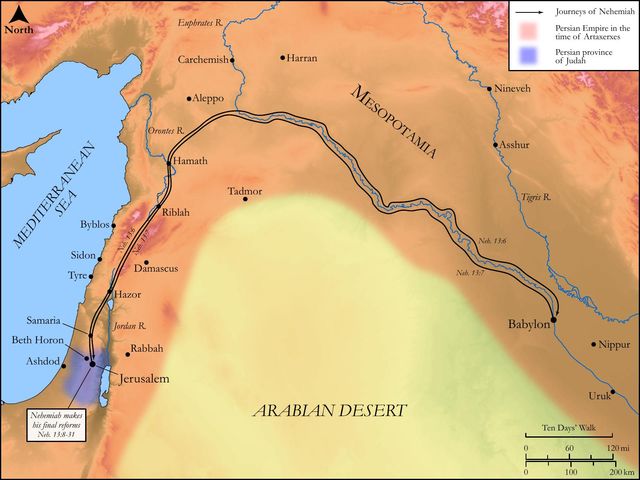
See on the biblical-era map
Study this verse
Public-domain commentary
Matthew Henry
From his Commentary on the Whole Bible. Henry comments on passages, not single verses — this entry covers Nehemiah 13:23–31. His three-level outline is real structure in the source text, so it is rendered as structure.
We have here one instance more of Nehemiah's pious zeal for the purifying of his countrymen as a peculiar people to God; that was the thing he aimed at in the use of his power, not the enriching of himself. See here,
I.How they had corrupted themselves by marrying strange wives.
This was complained of in Ezra's time, and much done towards a reformation, Ezr 9:1-15 and 10. But, when the unclean spirit is cast out, if a watchful eye be not kept upon him, he will re-enter; so he did here. Though in Ezra's time those that had married strange wives were forced to put them away, which could not but occasion trouble and confusion in families, yet others would not take warning. Nitimur in vetitum - we still lean towards what is forbidden. Nehemiah, like a good governor, enquired into the state of the families of those that were under his charge, that he might reform what was amiss in them, and so heal the streams by healing the springs.
1.He enquired whence they had their wives, and found that many of the Jews had married wives of Ashdod, of Ammon, and of Moab (Neh 13:23), either because they were fond of what was far-fetched or because they hoped by these alliances to strengthen and enrich themselves. See how God by the prophet reproves this, Mal 2:11. Judah has dealt treacherously, and broken covenant with God, the covenant made in Ezra's time with reference to this very thing; he has profaned the holiness of the Lord by marrying the daughter (that is, the worshipper) of a strange god.
2.He talked with the children, and found they were children of strangers, for their speech betrayed them. The children were bred up with their mothers, and learned of them and their nurses and servants to speak, so that they could not speak the Jews' language, could not speak it at all, or not readily, or not purely, but half in the speech of Ashdod, or Ammon, or Moab, according as the country was which the mother was a native of. Observe,
(1.)Children, in their childhood, learn much of their mothers. Partus sequitur ventrem - they are prone to imitate their mothers.
(2.)If either side be bad, the corrupt nature will incline the children to take after that, which is a good reason why Christians should not be unequally yoked.
(3.)In the education of children great care should be taken about the government of their tongues, that they learn not the language of Ashdod, any impious or impure talk, any corrupt communication.
II.What course Nehemiah took to purge out this corruption, when he discovered how much it had prevailed.
1.He showed them the evil of it, and the obligation he lay under to witness against it. He did not seek an occasion against them, but this was an iniquity to be punished by the judge, and which he must by no means connive at (Neh 13:27): "Shall we hearken to you, who endeavour to palliate and excuse it? No, it is an evil, a great evil, it is a transgression against our God, to marry strange wives, and we must do our utmost to put a stop to it. You beg that they may not be divorced from you, but we cannot hearken to you, for there is no other remedy to clear us from the guilt and prevent infection." (1.) He quotes a precept, to prove that it was in itself a great sin; and makes them swear to that precept: You shall not give your daughters unto their sons, etc., which is taken from Deu 7:3. When we would reclaim people from sin we must show them the sinfulness of it in the glass of the commandment. (2.) He quotes a precedent, to show the pernicious consequences of it, which made it necessary to be animadverted upon by the government (Neh 13:26): Did not Solomon king of Israel sin by these things? The falls of great and good men are recorded in order that we may take warning by them to shun the temptations which they were overcome by. Solomon was famous for wisdom; there was no king like him for it; yet, when he married strange wives, his wisdom could not secure him from their snares, nay, it departed from him, and he did very foolishly. He was beloved of God, but his marrying strange wives threw him out of God's favour, and went near to extinguish the holy fire of grace in his soul: he was king over all Israel; but his doing this occasioned the loss of ten of his twelve tribes. You plead that you can marry strange wives and yet retain the purity of Israelites; but Solomon himself could not; even him did outlandish women cause to sin. Therefore let him that thinks he stands take heed lest he fall when he runs upon such a precipice.
2.He showed himself highly displeased at it, that he might awaken them to a due sense of the evil of it: He contended with them, Neh 13:25. They offered to justify themselves in what they did, but he showed them how frivolous their excuses were, and argued it warmly with them. When he had silenced them he cursed them, that is, he denounced the judgments of God against them, and showed them what their sin deserved. He then picked out some of them that were more obstinate than the rest, and fit to be made examples, and smote them (that is, ordered them to be beaten by the proper officers according to the law, Deu 25:2, Deu 25:3), to which he added this further mark of infamy that he plucked off their hair, or cut or shaved it off; for it may so be understood. Perhaps they had prided themselves in their hair, and therefore he took it off to deform and humble them, and put them to shame; it was, in effect, to stigmatize them, at least for a time. Ezra, in this case, had plucked off his own hair, in holy sorrow for the sin; Nehemiah plucked off their hair, in a holy indignation at the sinners. See the different tempers of wise, and good, and useful men, and the divers graces, as well as divers gifts, of the same Spirit.
3.He obliged them not to take any more such wives, and separated those whom they had taken: He cleansed them from all strangers, both men and women (Neh 13:30), and made them promise with an oath that they would never do so again, Neh 13:25. Thus did he try all ways and means to put a stop to this mischief and to prevent another relapse into this disease.
4.He took particular care of the priests' families, that they might not lie under this stain, this guilt. He found, upon enquiry, that a branch of the high priest's own family, one of his grandsons, had married a daughter of Sanballat, that notorious enemy of the Jews (Neh 2:10; Neh 4:1), and so had, in effect, twisted interests with the Samaritans, Neh 13:28. How little love had that man either to God or his country who could make himself in duty and interest a friend to him that was a sworn enemy to both. It seems this young priest would not put away his wife, and therefore Nehemiah chased him from him, deprived him, degraded him, and made him for ever incapable of the priesthood. Josephus says that this expelled priest was Manasseh, and that when Nehemiah drove him away he went to his father-in-law Sanballat, who built him a temple upon Mount Gerazim, like that at Jerusalem, and promised him he should be high priest in it, and that then was laid the foundation of the Samaritans' pretensions, which continued warm to our Saviour's time. Joh 4:20, Our fathers worshipped in this mountain. When Nehemiah had thus expelled one that had forfeited the honour of the priesthood he again posted the priests and Levites every one in his business, Neh 13:30. It was no loss to them to part with one that was the scandal of their cloth; the work would be done better without him. When Judas had gone out Christ said, Now is the Son of Man glorified, Joh 13:30, Joh 13:31. Here are Nehemiah's prayers on this occasion. (1.) He prays, Remember them, O my God! Neh 13:29. "Lord, convince and convert them; put them in mind of what they should be and do, that they may come to themselves." Or, "Remember them to reckon with them for their sin; remember it against them." If we take it so, this prayer is a prophecy that God would remember it against them. Those that defile the priesthood despise God, and shall be lightly esteemed. Perhaps they were too many and too great for him to deal with. "Lord" (says he), "deal thou with them; take the work into thy own hands." (2.) He prays, Remember me, O my God! Neh 13:31. The best services done to the public have sometimes been forgotten by those for whom they were done (Ecc 9:15); therefore Nehemiah refers it to God to recompense him, takes him for his paymaster, and then doubts not but he shall be well paid. This may well be the summary of our petitions; we need no more to make us happy than this: Remember me, O my God! for good.
Continue studying Nehemiah 13:24 across the web’s major study libraries — every link below opens this exact verse, chapter, or book on the destination site.
Read & Compare
 BibleGatewayThis verse in more than 200 translations and 70 languages.
 Bible.comThe YouVersion reader — hundreds of translations, reading plans, and highlights.
 ESV.orgCrossway's official English Standard Version reader.
 NET BibleThe NET translation with 60,000+ translators' notes on every rendering decision.
 STEP BibleTyndale House's free study tool — original text, vocabulary, and scholarly resources.
 BibliaLogos Bible Software's free web reader.
 USCCBThe New American Bible (Revised Edition) with the U.S. bishops' study notes.
Commentaries
 BibleHub CommentariesDozens of classic commentaries on this verse, gathered on one page.
 StudyLightMore than 100 commentary sets — the largest collection on the web.
 BibleRefPlain-English commentary on what this verse means, verse by verse.
 Enduring WordDavid Guzik's free commentary on this chapter, widely used by Bible teachers.
 Bible Study ToolsVerse commentary alongside Greek and Hebrew study aids.
Original Language & Research
- BibleHub InterlinearThe verse word by word — original language, transliteration, and English.
- BibleHub LexiconEvery word's original-language definition and Strong's entry.
 Blue Letter BibleDeep-study tools — Strong's numbers, concordance, and word studies.
 SefariaThe Hebrew text with Rashi and centuries of Jewish commentary.
Sermons, Hymns & Audio


TrulyRandomVerse is not affiliated with these sites and doesn’t control their content. They’re linked because they’re genuinely useful.
Summary
Nehemiah 13:24 powerfully illustrates a profound crisis of identity and spiritual compromise within the post-exilic Jewish community. It reveals that children born of forbidden intermarriages were losing their ability to speak Hebrew, the sacred language of their heritage, instead communicating in a mixed tongue, including the language of Ashdod. This linguistic assimilation served as a stark, tangible symbol of the erosion of their distinct covenant identity and the devastating generational consequences of parental disobedience to God's commands, threatening the very spiritual fabric of the community.
Context
ShowHideLiterary Context
This pivotal verse is situated within Nehemiah's second, more intense phase of reforms, initiated after his return to Jerusalem from a temporary absence in Persia, during which he discovered significant spiritual backsliding (as detailed in Nehemiah 13:6). Having previously addressed issues like temple defilement, neglect of tithes, and Sabbath desecration, Nehemiah now confronts the deeply entrenched and pervasive problem of intermarriage with foreign women. Nehemiah 13:23 immediately precedes this verse, specifying the foreign origins of these wives (Ashdod, Ammon, Moab), setting the stage for the alarming consequence presented in Nehemiah 13:24. This verse serves as concrete evidence of the spiritual decay, directly prompting Nehemiah's zealous and forceful intervention described in Nehemiah 13:25, making it a critical piece of the narrative's escalating conflict.
Historical & Cultural Context
The post-exilic period was a crucial juncture for the returned Jewish exiles, who were tasked with rebuilding not only Jerusalem's walls and temple but, more importantly, their covenant relationship with Yahweh and their unique national and religious identity. The seventy years of Babylonian captivity were understood as divine judgment for Israel's past idolatry and assimilation. Consequently, there was a heightened emphasis on avoiding the very sins that led to their exile. The Mosaic Law explicitly prohibited intermarriage with pagan nations (e.g., Deuteronomy 7:3-4), precisely because such unions invariably led to spiritual compromise and the adoption of foreign gods and customs. In Israel, language was a fundamental carrier of culture, religion, and group identity. For the Jews, Hebrew was not merely a means of communication; it was the sacred language of the Torah, of prophecy, of prayer, and of their unique covenant with God. The Philistine city of Ashdod, mentioned here, represented a persistent pagan presence and a historical adversary of Israel, making the adoption of its language particularly egregious and symbolic of deep spiritual compromise.
Key Themes
ShowHideNehemiah 13:24 vividly illuminates several profound themes. Firstly, it underscores the loss of identity through assimilation, demonstrating how spiritual and cultural compromise directly erodes a distinct people's heritage and covenant distinctiveness. The children's inability to speak Hebrew symbolized a profound detachment from their ancestral faith, the Law, and their covenant with God. Secondly, the verse highlights the vital importance of language as a primary vehicle for transmitting faith and identity; for the Jews, losing fluency in Hebrew meant losing direct access to the sacred texts and the ability to fully participate in their religious life and heritage. Thirdly, it serves as a stark reminder of the generational consequences of disobedience, powerfully showing how the parents' sin of intermarriage directly led to their children's spiritual and cultural alienation. Finally, Nehemiah's subsequent actions, though not detailed in this specific verse, reflect his unwavering zeal for God's Law and the purity of the Israelite community, a theme consistent throughout the book of Nehemiah and also evident in Ezra's earlier reforms concerning intermarriage, as seen in Ezra 9:1-2.
Exposition and Analysis
ShowHideKey Word Analysis
ShowHideThis term refers specifically to the language spoken in Ashdod, one of the primary Philistine city-states. The Philistines were traditional adversaries of Israel, representing paganism and foreign influence. The children speaking "half in the speech of Ashdod" indicates a significant cultural and linguistic infiltration from a people hostile to Israel's God and covenant, signifying a dangerous assimilation into pagan ways.
This term denotes the Hebrew language, the ancestral tongue of the Israelites. It was the sacred language in which the Torah, the Prophets, and other holy texts were primarily written. As such, it held immense religious and cultural significance as the language of the covenant and divine revelation. The children's inability to speak it signified a profound disconnection from their spiritual roots and their unique identity as God's chosen people.
This word signifies a partial, incomplete, or mixed state. The children did not speak one foreign language entirely, but a "half" or mixed tongue, suggesting a linguistic and cultural hybridity that was neither fully Jewish nor fully pagan. This linguistic mixture paralleled their confused and corrupted spiritual and cultural identity, indicating a profound alienation from their covenant heritage.
Verse Breakdown
ShowHide"And their children spake half in the speech of Ashdod"
This opening clause immediately exposes the tangible and alarming consequence of the forbidden intermarriages. The children, born of Jewish fathers and foreign mothers, were evidently not being raised exclusively within the Jewish tradition. Their speech, a fundamental marker of cultural and religious identity, was already compromised, reflecting the pervasive influence of their pagan mothers and the surrounding foreign cultures, particularly that of the Philistines from Ashdod. The use of "half" suggests a linguistic syncretism, a blending of tongues that indicated a loss of pure identity.
"and could not speak in the Jews' language"
This is the core spiritual and cultural tragedy highlighted by the verse. The children were losing their proficiency in Hebrew, the sacred language of their covenant, their scriptures, and their unique identity as God's chosen people. This inability meant they could not fully understand or participate in the reading of the Law, the communal prayers, or the worship of Yahweh, signifying a severe spiritual disconnect and a grave threat to the transmission of faith to the next generation. It implied a profound illiteracy in the language of their own heritage.
"but according to the language of each people"
This concluding phrase clarifies that the linguistic confusion and dilution were not limited to Ashdod's dialect but encompassed various foreign tongues, depending on the specific origin of the foreign mothers (e.g., Ammonite, Moabite, Ashdodite, as enumerated in Nehemiah 13:23). This indicates a widespread problem of linguistic fragmentation and cultural dilution, underscoring the severity of the crisis Nehemiah faced. The unity, distinctiveness, and spiritual integrity of the Jewish community were being dissolved by these unholy alliances.
Literary Devices
ShowHideNehemiah 13:24 employs powerful Symbolism, where language itself becomes a profound indicator of spiritual health and identity. The "Jews' language" (Hebrew) symbolizes the purity of Israel's covenant identity, their adherence to the Law, and their unique, exclusive relationship with God. Conversely, the "speech of Ashdod" and "the language of each people" symbolize the corrupting influence of paganism, assimilation, and disobedience to divine commands. The children's inability to speak Hebrew thus symbolizes their spiritual and cultural alienation from their heritage and their God. There is also a strong element of Contrast between the sacred, unifying Hebrew and the fragmented, pagan foreign tongues, highlighting the stark choice before the community between fidelity and compromise. The phrase "could not speak" might contain a degree of Hyperbole, emphasizing a severe deficiency or unwillingness rather than absolute inability, thereby underscoring the urgency and gravity of the situation for Nehemiah and the community, driving home the devastating impact of the parents' sin.
Theological and Thematic Connections
ShowHideNehemiah 13:24 serves as a profound theological statement on the devastating consequences of spiritual compromise and the critical importance of maintaining distinctiveness for God's covenant people. The loss of language is not merely a cultural issue; it is fundamentally a spiritual one, directly linked to the parents' disobedience in intermarrying with those outside the covenant. This linguistic decay symbolizes a deeper spiritual decay, where the very means of transmitting divine truth and covenant identity to the next generation is being lost. God had called Israel to be a holy nation, set apart from the surrounding peoples, and their language was a key component of that distinctiveness, enabling them to engage with His Law and worship Him purely. The verse underscores that sin, particularly the sin of syncretism and ungodly alliances, has devastating generational repercussions, eroding the spiritual foundations of families and communities. It highlights God's unwavering expectation of fidelity and the severe cost of neglecting His clear commands for the sake of worldly conformity.
Reflection and Application
ShowHideNehemiah 13:24 offers a timeless warning and vital lessons for believers today concerning the preservation of faith across generations. Just as the Hebrew language was essential for the Israelites to understand their covenant and maintain their distinct identity, so too is the "language" of faith—encompassing biblical literacy, theological understanding, spiritual disciplines, and Christian worldview—crucial for Christians in every age. Parents bear a profound and sacred responsibility to intentionally and diligently pass on the truths of the gospel and Christian values to their children, ensuring they are deeply rooted in the "language" of Scripture, prayer, worship, and discipleship. Neglecting this foundational spiritual education can lead to future generations drifting from the faith, becoming assimilated into secular culture, and losing their distinct Christian identity, much like the children in Nehemiah's time who could not speak the "Jews' language." This verse also powerfully reminds us of the insidious dangers of ungodly compromises and cultural assimilation that dilute spiritual distinctiveness. While Christians are called to engage with the world and be a light within it, we must vigilantly guard against adopting practices, beliefs, or relationships that contradict God's Word, recognizing that such compromises often have unforeseen and profoundly detrimental generational consequences. Maintaining clear spiritual boundaries is not about isolation but about preserving the purity and power of our witness and ensuring the vibrant, authentic transmission of faith to those who come after us.
Questions for Reflection
ShowHideFAQ
ShowHideWhy was language so important to the Jews in Nehemiah's time?
ShowHideFor the Jews, language, specifically Hebrew, was far more than just a means of communication; it was deeply intertwined with their covenant identity, their history, and their unique relationship with God. Hebrew was the sacred language in which the Torah, the Prophets, and the Psalms were written. It was the language of their prayers, their worship, and their unique revelation from God. Losing Hebrew meant losing direct access to the very source of their faith and identity, making it difficult to understand God's Law, participate fully in religious life, and transmit their heritage authentically to future generations. It symbolized a break in the continuity of their covenant relationship and a profound spiritual disconnect.
What was the "speech of Ashdod" and why was its adoption by the children a problem?
ShowHideThe "speech of Ashdod" refers to the language spoken in Ashdod, one of the principal cities of the Philistines. The Philistines were a pagan people, often hostile to Israel, and their culture was antithetical to the covenant requirements of Yahweh. The adoption of this language (and other foreign tongues, as indicated by "language of each people") by the children of mixed marriages was a significant problem because it symbolized a dangerous cultural and spiritual assimilation. It indicated that the children were being raised under pagan influences, rather than exclusively within the covenant community. This linguistic compromise was a clear sign that the distinct, holy identity God intended for His people was being diluted and corrupted, threatening the very survival of their faith and their unique calling.
How does Nehemiah 13:24 relate to the spiritual development of children today?
ShowHideNehemiah 13:24 serves as a powerful cautionary tale for parents and the church today regarding the spiritual development of children. Just as Hebrew was essential for the Israelites to understand their covenant and heritage, understanding the "language" of biblical truth, Christian doctrine, and spiritual disciplines is vital for children in our time. If children are not intentionally taught the "language" of faith—through consistent biblical instruction, prayer, worship, and discipleship—they risk becoming spiritually illiterate and assimilated into the dominant secular culture. This can lead to a loss of their distinct Christian identity and a weakening of their connection to God and the church, much like the children who could not speak the "Jews' language" experienced a profound disconnect from their heritage. It underscores the critical need for parents and the church to prioritize the spiritual education and formation of the next generation, equipping them to live distinctively for Christ.
Christ-Centered Fulfillment
ShowHideNehemiah 13:24, with its lament over the loss of the "Jews' language" and the erosion of a distinct covenant identity, finds profound Christ-centered fulfillment in the new covenant. While the Old Testament emphasized a distinct linguistic and cultural identity for Israel as a physical nation, Christ ushers in a new "language" of faith and a new identity forged not in ethnicity or earthly heritage, but in Him. Jesus Christ is the ultimate "Word" of God, the perfect and complete revelation of God's heart and will, speaking to us fully where prophets and laws spoke partially (John 1:1; Hebrews 1:1-2). Through faith in Him, believers are given a new identity as "new creations" (2 Corinthians 5:17), shedding the old self and putting on the new, which is continually renewed in knowledge after the image of its Creator (Ephesians 4:22-24; Colossians 3:10). This new identity comes with a new "language"—the language of the gospel, of truth, of righteousness, and of love, which is distinct from the "language" of the world's values, compromises, and darkness (Romans 12:2). The Holy Spirit empowers believers to understand and speak this new spiritual language, enabling them to live out their distinct calling as God's people in a fallen world, no longer alienated but fully adopted into God's family through Christ's redemptive work.