


Nehemiah 13:17
- וָאָרִיבָהva·'a·Ri·vahand I contended !H7378Conj-w ¦ V-Qal-ConsecImperf-1cs ¦ SfxVerb Qal Consecutive Imperfect 1st Singular common genderוָandאָרִיבָI contendedה!
- אֵת'etwithH854PrepPreposition
- חֹרֵיcho·Rei[the] nobles ofH2715N-mpcNoun Plural Masculine Construct
- יְהוּדָהye·hu·DahJudahH3063N-properNoun Proper Location
- וָאֹמְרָהva·'o·me·Rahand I said !H559Conj-w ¦ V-Qal-ConsecImperf-1cs ¦ SfxVerb Qal Consecutive Imperfect 1st Singular common genderוָandאֹמְרָI saidה!
- לָהֶםla·Hemto themPrep-l ¦ 3mpSuffix Personal 3rd Plural Masculineלָtoהֶםthem
- מָהmahwhat?H4100InterrogPronoun Interrogative
- הַדָּבָרha·da·Var[is] the thingH1697Art ¦ N-msNoun Singular Masculine Absoluteהַ[is] theדָּבָרthing
- הָרָעha·Ra'<the> evilH7451Art ¦ Adj-msAdjective Singular Masculine Absoluteהָ<the>רָעevil
- הַזֶּהha·Zeh<the> thisH2088Art ¦ PrtParticle Demonstrativeהַ<the>זֶּהthis
- אֲשֶׁר'a·SherwhichH834RelParticle Relative
- אַתֶּם'a·TemyouH859Pro-2mpPronoun Personal 2nd Plural Masculine
- עֹשִׂים'o·Sim[are] doingH6213V-Qal-Prtcpl-mpVerb Qal Participle Plural Masculine Absolute
- וּמְחַלְּלִיםu·me·cha·le·Limand [are] profaningH2490Conj-w ¦ V-Piel-Prtcpl-mpVerb Piel Participle Plural Masculine Absoluteוּandמְחַלְּלִים[are] profaning
- אֶת'et<obj.>H853DirObjMParticle Object Indicator
- יוֹםYom[the] day ofH3117N-mscNoun Singular Masculine Construct
- הַשַּׁבָּתha·sha·Batthe sabbathH7676Art ¦ N-fsNoun Singular Feminine Absoluteהַtheשַּׁבָּתsabbath
English is a literal word-by-word gloss of the Hebrew, not the KJV's wording. Why?
This is the original text the KJV's translators worked from — each Hebrew word with its own literal English meaning in this verse, prepared by scholars at Tyndale House, Cambridge. The KJV translates whole sentences, not word by word, so its wording differs: one Hebrew word can become several English words, and the KJV may choose “the LORD” where the gloss reads “Yahweh”. Both are faithful — they answer different questions. For the KJV's own rendering, switch to the KJV text.
Details
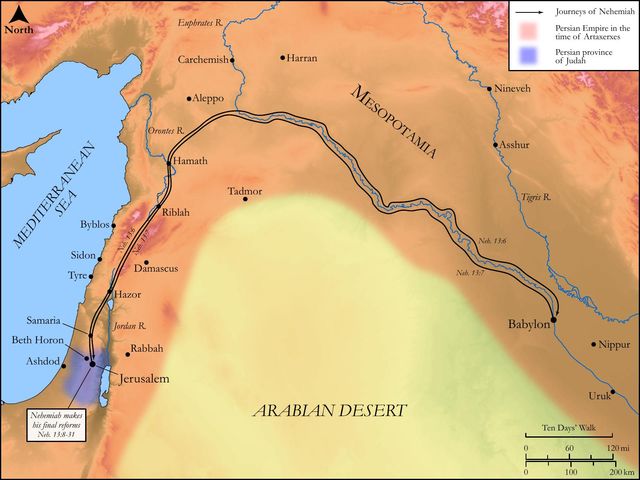
See on the biblical-era map
Study this verse
Public-domain commentary
Matthew Henry
From his Commentary on the Whole Bible. Henry comments on passages, not single verses — this entry covers Nehemiah 13:15–22. His four-level outline is real structure in the source text, so it is rendered as structure.
Here is another instance of that blessed reformation in which Nehemiah was so active. He revived sabbath-sanctification, and maintained the authority of the fourth commandment; and a very good deed this was for the house of God and the offices thereof, for, where holy time is over-looked and made nothing of, it is not strange if all holy duties be neglected. Here is,
I.A remonstrance of the abuse.
The law of the sabbath was very strict and much insisted one, and with good reason, for religion is never in the throne while sabbaths are trodden under foot. But Nehemiah discovered even in Judah, among those to whom sabbaths were given for a sign, this law wretchedly violated. His own eyes were his informers. Magistrates who are in care to discharge their duty aright will as much as may be see with their own eyes, and accomplish a diligent search to find out that which is evil. To his great grief it appeared that there was a general profanation of the sabbath, that holy day, even in Jerusalem, that holy city, which was so lately dedicated to God.
1.The husbandmen trod their wine-presses and brought home their corn on that day (Neh 13:15), through there was an express command that in earing-time, and in harvest-time, they should rest on the sabbaths (Exo 34:21), because then they might be tempted to take a greater liberty, and to fancy that God would indulge them in it.
2.The carriers loaded their asses with all manner of burdens, and made no scruple of it, though there was a particular proviso in the law for the cattle resting (Deu 5:14) and that they should bear no burden on the sabbath day, Jer 17:21.
3.The hawkers, and pedlars, and petty chapmen, that were men of Tyre, that famous trading city, sold all manner of wares on the sabbath day (Neh 13:16); and the children of Judah and Jerusalem had so little grace as to buy of them, and so encourage them in making our Father's day a day of merchandise, contrary to the law of the fourth commandment, which forbids the doing any manner of work. No wonder there was a general decay of religion and corruption of manners among this people when they forsook the sanctuary and profaned the sabbath.
II.The reformation of it.
Those that are jealous for the honour of God cannot bear to see his sabbath profaned. Observe in what method this good man proceeded in his zeal for the sabbath.
1.He testified against those who profaned it, Neh 13:15, and again Neh 13:21. He not only expressed his own dislike of it, but endeavoured to convince them that it was a great sin, and showed them the testimony of the word of God against it. He would not punish it till he had laid open the evil of it.
2.He reasoned with the rulers concerning it, took the nobles of Judah to task, and contended with them, Neh 13:17. The greatest of men are not too high to be told of their faults by those whose proper office it is to reprove them; nay, great men should be, as here, contended with in the first place, because of the influence they have upon others.
(1.)He charges them with it: You do it. They did not carry corn, nor sell fish, but,
[1.]They connived at those that did, and did not use their power to restrain them, and so made themselves guilty, as those magistrates do who bear the sword in vain.
[2.]They set a bad example in other things. If the nobles allowed themselves in sports and recreations, in idle visits and idle talk, on the sabbath day, the men of business, both in city and country, would profane it by their worldly employments, as more justifiable. We must be responsible for the sins which others are led to commit by our example.
(2.)He charges it upon them as an evil thing, for so it is, proceeding from a great contempt of God and our own souls.
(3.)He reasons the case with them (Neh 13:18), and shows them that sabbath breaking was one of the sins for which God had brought judgments upon them, and that if they did not take warning, but returned to the same sins again, they had reason to expect further judgments: You bring more wrath upon Israel by profaning the sabbath. Thus Ezra concluded, If we again break thy commandments, wilt not thou be angry with us till thou hast consumed us? Ezr 9:14.
3.He took care to prevent the profanation of the sabbath, as one that aimed only at reformation. If he could reform them, he would not punish them, and, if he should punish them, it was but that he might reform them. This is an example to magistrates to be heirs of restraint, and prudently to use the bit and bridle, that there may be no occasion for the lash.
(1.)He ordered the gates of Jerusalem to be kept shut from the evening before the sabbath to the morning after, and set his own servants (whose care, courage and honesty, he could confide in) to watch them, that no burdens should be brought in on the sabbath day, nor late the night before, nor early in the morning after, lest sabbath time should be encroached upon, Neh 13:19. Those that came in to worship in the courts of the temple were no doubt admitted to pass and repass, but none that came to sell goods; they were forced to lodge without the city (Neh 13:20), where no doubt they wished the sabbath were gone, that they might sell corn.
(2.)He threatened those who came with goods to the gates, who pressed hard for entrance, telling them that, if they came again, he would certainly lay hands on them (Neh 13:21), and this deterred them from coming any more. Note, If reformers will but put on resolution, more may be done towards the breaking of bad customs than they can imagine. Vice connived at is indeed a daring thing, and will bid defiance to counsel and reproof; but it may be made cowardly, and will be so when magistrates make themselves a terror to it. The king that sits on the throne of judgment scatters away all evil with his eyes.
(3.)He charged the Levites to take care about the due sanctifying of the sabbath, that they should cleanse themselves in the first place, and so give a good example to the people, and that they should some of them come and keep the gates, Neh 13:22. Because he and his servants must shortly return to court, he would leave this charge with some that might abide by it, that not only when he was present, but in his absence, the sabbath might be sanctified. Then there is likely to be a reformation, in this and other respects, when magistrates and ministers join their forces. The courage, zeal, and prudence of Nehemiah in this matter, are here recorded for our imitation; and we have reason to think that the cure he wrought was lasting; for, in our Saviour's time, we find the Jews in the other extreme, over-scrupulous in the ceremonial part of sabbath-sanctification.
4.He concludes this passage with a prayer (Neh 13:22), in which observe,
(1.)The petitions: Remember me (as the thief on the cross, Lord, remember me); that is enough. God's thoughts to us ward are very precious, Psa 40:5. He adds, Spare me. So far is he from thinking that what he had done did properly merit a reward in strict justice that he cries earnestly to God to spare him, as Jeremiah (Jer 15:15), Take me not away in thy long-suffering (Jer 10:24), Correct me not in anger, and (Jer 17:17), Be not a terror to me. Note, The best saints, even when they do the best actions, stand in need of sparing mercy; for there is not a just man that doeth good and sinneth not.
(2.)The plea: According to the greatness (or multitude) of thy mercies. Note, God's mercy is what we must depend upon, and not any merit of our own, when we appear before God.
Continue studying Nehemiah 13:17 across the web’s major study libraries — every link below opens this exact verse, chapter, or book on the destination site.
Read & Compare
 BibleGatewayThis verse in more than 200 translations and 70 languages.
 Bible.comThe YouVersion reader — hundreds of translations, reading plans, and highlights.
 ESV.orgCrossway's official English Standard Version reader.
 NET BibleThe NET translation with 60,000+ translators' notes on every rendering decision.
 STEP BibleTyndale House's free study tool — original text, vocabulary, and scholarly resources.
 BibliaLogos Bible Software's free web reader.
 USCCBThe New American Bible (Revised Edition) with the U.S. bishops' study notes.
Commentaries
 BibleHub CommentariesDozens of classic commentaries on this verse, gathered on one page.
 StudyLightMore than 100 commentary sets — the largest collection on the web.
 BibleRefPlain-English commentary on what this verse means, verse by verse.
 Enduring WordDavid Guzik's free commentary on this chapter, widely used by Bible teachers.
 Bible Study ToolsVerse commentary alongside Greek and Hebrew study aids.
Original Language & Research
- BibleHub InterlinearThe verse word by word — original language, transliteration, and English.
- BibleHub LexiconEvery word's original-language definition and Strong's entry.
 Blue Letter BibleDeep-study tools — Strong's numbers, concordance, and word studies.
 SefariaThe Hebrew text with Rashi and centuries of Jewish commentary.
Sermons, Hymns & Audio


TrulyRandomVerse is not affiliated with these sites and doesn’t control their content. They’re linked because they’re genuinely useful.
Summary
Nehemiah 13:17 captures a pivotal moment of confrontation where the prophet-governor Nehemiah directly challenges the "nobles of Judah" for their egregious failure to uphold the sanctity of the Sabbath day. Upon his return to Jerusalem, Nehemiah discovered a widespread spiritual decline, marked by the profanation of the Sabbath through commercial activities and a general disregard for the covenant laws. This verse encapsulates Nehemiah's righteous indignation and his unwavering commitment to restoring covenant faithfulness and the holy identity of the post-exilic Jewish community, highlighting the critical role of leadership in spiritual integrity and obedience to divine commands.
Context
ShowHideLiterary Context
Nehemiah 13 serves as an epilogue to the book, detailing Nehemiah's second tenure as governor in Jerusalem, approximately 12-13 years after his initial reforms. The preceding chapters (Nehemiah 8-Nehemiah 12) recount the joyous dedication of the wall, the public reading of the Law, and the solemn covenant renewal ceremony where the people, including the nobles, explicitly vowed to obey God's commands, particularly regarding the Sabbath and temple support (Nehemiah 10:28-39). Chapter 13 immediately follows Nehemiah's departure and subsequent return, revealing the rapid spiritual backsliding that occurred in his absence. Verses Nehemiah 13:15-16 specifically describe the Sabbath violations—people treading winepresses, bringing in sheaves, loading donkeys with produce, and selling goods on the Sabbath—setting the stage for Nehemiah's direct confrontation with the nobles in verse 17. His actions here are a continuation of his unwavering commitment to God's law and the purity of the community, mirroring his earlier efforts to rebuild the walls and restore the people's spiritual life.
Historical & Cultural Context
The post-exilic community in Jerusalem, though returned from Babylonian exile, remained under Persian imperial authority. Their identity as God's covenant people was largely defined by their adherence to the Mosaic Law, with the Sabbath being a foundational sign of that covenant (Exodus 31:13). The profanation of the Sabbath was not merely a minor infraction but a direct violation of one of the Ten Commandments (Exodus 20:8-11), a sin that had historically contributed to Israel's exile (Jeremiah 17:27). The "nobles of Judah" were the local elite, responsible for maintaining order and upholding the law. Their complicity or laxity in enforcing Sabbath observance allowed the common people and foreign merchants to disregard it, demonstrating a pervasive failure of leadership. The economic pressures and the desire for profit, even on the holy day, reflect a common human tendency to prioritize material gain over spiritual obedience, a struggle that was particularly acute in a rebuilding society still finding its footing.
Key Themes
ShowHideThis verse powerfully underscores several key themes woven throughout the book of Nehemiah. Firstly, the Sanctity of the Sabbath is paramount; it is not merely a day of rest but a holy day, a sign of Israel's unique relationship with God, and its desecration is a grave offense. Secondly, Leadership Accountability is front and center. Nehemiah understands that the spiritual health of the community hinges on the integrity and vigilance of its leaders. The nobles, by failing to enforce the Sabbath, were directly contributing to the moral decay, making them culpable. Thirdly, Covenant Faithfulness is a recurring motif. The people had recently renewed their covenant with God, explicitly vowing to keep the Sabbath (Nehemiah 10:31). Their current actions represent a profound breach of that solemn commitment, highlighting the constant human struggle between good intentions and practical obedience. Finally, Nehemiah's Zeal for God's Law and his unwavering commitment to reform, even in the face of elite opposition, exemplify righteous leadership and a deep reverence for divine commands, echoing the prophetic tradition found in books like Isaiah.
Exposition and Analysis
ShowHideKey Word Analysis
ShowHideThis verb (H7378) signifies a strong, forceful dispute, often with legal or judicial connotations. It implies more than a mere disagreement; it suggests a vigorous, perhaps even aggressive, challenge or rebuke. Nehemiah was not politely suggesting but actively engaging in a heated argument, asserting his authority and the seriousness of the offense. This word highlights the intensity of Nehemiah's passion for God's law and his willingness to confront powerful individuals directly.
This term describes something bad, morally wrong, or calamitous. When Nehemiah uses it to describe the actions of the nobles, he is not merely stating that their actions are inconvenient or misguided but that they are fundamentally wicked and harmful. This underscores the gravity of their sin in God's eyes and its potential for devastating consequences on the community, echoing the historical judgments against Israel for similar transgressions.
This word (H2490) means to make common, to defile, to violate, or to pollute something sacred. It indicates the act of treating something holy as if it were ordinary or secular. By allowing commercial activity and labor on the Sabbath, the nobles and the people were actively stripping the day of its sacred character, reducing it to any other workday, thereby dishonoring God and breaking their covenant. The use of châlal underscores the gravity of their sin—it was not just a mistake but a desecration of what God had set apart.
Verse Breakdown
ShowHide"Then I contended with the nobles of Judah"
This phrase immediately establishes Nehemiah's target and the nature of his interaction. He bypasses the common people and goes directly to the "nobles," the influential leaders and magistrates, holding them responsible for the widespread disobedience. His "contention" (as discussed above) indicates a direct, forceful, and authoritative confrontation, reflecting his deep concern and righteous anger over the spiritual laxity in Jerusalem. He understood that the rot began at the top, and effective reform required confronting those in power.
"and said unto them, What evil thing [is] this that ye do"
Nehemiah's direct address is a sharp rebuke, phrased as a rhetorical question. The term "evil thing" (Hebrew: raʻ combined with dâbâr) is a strong condemnation, implying not just a mistake but a morally reprehensible act that brings harm and displeasure to God. This question is designed to expose their culpability and awaken their conscience, challenging them to acknowledge the sinfulness of their actions. It highlights their active participation or passive allowance of the profanation, demanding an account for their moral failure.
"and profane the sabbath day?"
This final clause explicitly names the specific transgression. By linking their actions directly to the profanation of the Sabbath, Nehemiah underscores the severity of the offense. The Sabbath was a sign of the covenant and a day consecrated to God; its desecration was a direct affront to God's holiness and a betrayal of their covenant vows. This question serves as the core accusation, laying bare the spiritual negligence and covenant unfaithfulness of the nobles, reminding them of the sanctity they were violating.
Literary Devices
ShowHideNehemiah 13:17 employs several potent literary devices to convey its message and highlight the gravity of the situation. The primary device is Direct Confrontation, as Nehemiah, the protagonist, directly addresses the "nobles of Judah," setting up a clear conflict between righteous leadership and complacent authority. This immediate, face-to-face challenge underscores Nehemiah's courage and his unwavering commitment to God's law. This is immediately followed by a Rhetorical Question ("What evil thing [is] this that ye do, and profane the sabbath day?"), which is not intended to elicit an answer but to emphasize the obviousness and gravity of their sin, forcing introspection and highlighting their culpability. The phrase "evil thing" functions as Hyperbole to underscore the extreme nature of their transgression in Nehemiah's eyes, elevating the Sabbath violation beyond a minor misstep to a profound moral failing that threatens the community's spiritual integrity. Furthermore, the entire scene is rich in Symbolism, with the Sabbath itself symbolizing Israel's covenant relationship with God and their distinct identity as a holy nation. Its profanation, therefore, symbolizes a deeper spiritual decay and a breach of that sacred covenant, making Nehemiah's zealous defense of it a symbolic act of defending the very heart of their national and religious identity.
Theological and Thematic Connections
ShowHideNehemiah's zealous defense of the Sabbath in Nehemiah 13:17 is deeply rooted in Old Testament theology, particularly the understanding of the Sabbath as a foundational element of the Mosaic Covenant. The Sabbath was not merely a day off but a sacred institution, a divine command, and a perpetual sign between God and His people, signifying His sanctifying work and their distinct identity as His chosen nation. Its observance was a test of their faithfulness and a demonstration of their trust in God's provision rather than their own toil. The nobles' failure to uphold this command represented a profound spiritual compromise, demonstrating a prioritization of economic gain over divine obedience and a disregard for the very covenant they had recently affirmed. This episode highlights that true worship and covenant fidelity extend beyond ritual to practical obedience in daily life, especially concerning God's appointed times and laws, and that leaders bear a particular responsibility for upholding these standards.
Reflection and Application
ShowHideNehemiah 13:17 serves as a powerful reminder for believers today about the enduring importance of spiritual vigilance, particularly for those in positions of leadership. Nehemiah's righteous indignation against the profanation of the Sabbath underscores that God's commands are not suggestions but sacred obligations that reflect His character and His desire for our holiness. For us, while the specific legalistic observance of the Old Testament Sabbath has been transformed in Christ, the principle of setting aside time for God, for rest, and for spiritual renewal remains vital. We are called to guard against the insidious creep of worldliness and complacency that can cause us to treat sacred things as common, whether it's our time, our resources, our bodies, or our commitment to worship and community. This verse challenges us to examine where we might be compromising our faith for convenience or profit, and it calls leaders, in particular, to model unwavering commitment to God's standards, understanding that their actions (or inactions) profoundly impact the spiritual health of those they lead.
Questions for Reflection
ShowHideFAQ
ShowHideWhat was the significance of the Sabbath in ancient Israel, and why was its profanation such a serious offense?
ShowHideThe Sabbath was profoundly significant in ancient Israel, serving multiple purposes. Firstly, it was a memorial of creation, reminding Israel that God is the Creator and Sustainer of all life, who rested on the seventh day (Genesis 2:2-3). Secondly, it was a sign of the Mosaic Covenant, distinguishing Israel as God's chosen people and signifying His sanctifying presence among them (Exodus 31:13). Thirdly, it was a day of rest and liberation, especially for servants and animals, reminding them of their deliverance from slavery in Egypt (Deuteronomy 5:15). Profaning the Sabbath, therefore, was not merely breaking a rule; it was a direct affront to God's authority, a rejection of their covenant identity, and a disregard for His gracious provision. Historically, the prophets warned that Sabbath breaking was a key reason for Israel's exile (Ezekiel 20:13).
Christ-Centered Fulfillment
ShowHideWhile Nehemiah's zealous defense of the Sabbath highlights the importance of obedience to God's law, the New Testament reveals that true Sabbath rest finds its ultimate fulfillment in Jesus Christ. Jesus declared Himself to be "Lord of the Sabbath" (Matthew 12:8), demonstrating His authority over it and revealing its true purpose—to bring healing and liberation, not burdensome legalism. The Old Covenant Sabbath, a shadow of things to come, pointed forward to the spiritual rest found in Christ, who has accomplished salvation and freed us from the futile works of the law (Colossians 2:16-17). Through His finished work on the cross, believers enter into a new covenant rest, a cessation from striving to earn righteousness and a reliance on His perfect work (Hebrews 4:9-10). Thus, Nehemiah's confrontation, while righteous in its context, ultimately directs our gaze to the One who perfectly fulfilled the law and offers eternal rest to all who believe, inviting us to cease from our own works and enter into His perfect peace (Matthew 11:28-30).