


1 Samuel 9:18
Bible text: King James Version (1769 Blayney text) · Public domain
Bible text: Berean Standard Bible · Public domain
Bible text: American Standard Version (1901) · Public domain
Bible text: World English Bible, Messianic edition · Public domain
Bible text: Geneva Bible (1599) · Public domain
Bible text: Young's Literal Translation · Public domain
- וַיִּגַּשׁvai·yi·Gashand he approachedH5066Conj-w ¦ V-Qal-ConsecImperf-3msVerb Qal Consecutive Imperfect 3rd Singular Masculineוַandיִּגַּשׁhe approached
- שָׁאוּלsha·'UlSaulH7586N-proper-mNoun Proper Masculine
- אֶת'et<obj.>H853DirObjMParticle Object Indicator
- שְׁמוּאֵלshe·mu·'ElSamuelH8050N-proper-mNoun Proper Masculine
- בְּתוֹךְbe·Tokhin [the] middle ofH8432Prep-b ¦ N-mscNoun Singular Masculine Constructבְּinתוֹךְ[the] middle of
- הַשָּׁעַרha·Sha·'arthe gateH8179Art ¦ N-msNoun Singular Masculine Absoluteהַtheשָּׁעַרgate
- וַיֹּאמֶרvai·Yo·merand he saidH559Conj-w ¦ V-Qal-ConsecImperf-3msVerb Qal Consecutive Imperfect 3rd Singular Masculineוַandיֹּאמֶרhe said
- הַגִּידָהha·gi·dahtell !H5046V-Hiphil-Imp-2ms ¦ SfxVerb Hiphil Imperative 2nd Singular Masculineהַגִּידָtellה!
- נָּאna'pleaseH4994PrtParticle Interjection
- לִיLito <the> mePrep-l ¦ 1csSuffix Personal 1st Singular common genderלִto <the>יme
- אֵי'eiwhere?H335InterrogParticle Interrogative
- זֶהzehthisH2088PrtParticle Demonstrative
- בֵּיתbeit[is] [the] house ofH1004N-mscNoun Singular Masculine Construct
- הָרֹאֶהha·ro·'Ehthe seerH7203Art ¦ N-msNoun Singular Masculine Absoluteהָtheרֹאֶהseer
English is a literal word-by-word gloss of the Hebrew, not the KJV's wording. Why?
This is the original text the KJV's translators worked from — each Hebrew word with its own literal English meaning in this verse, prepared by scholars at Tyndale House, Cambridge. The KJV translates whole sentences, not word by word, so its wording differs: one Hebrew word can become several English words, and the KJV may choose “the LORD” where the gloss reads “Yahweh”. Both are faithful — they answer different questions. For the KJV's own rendering, switch to the KJV text.
Details
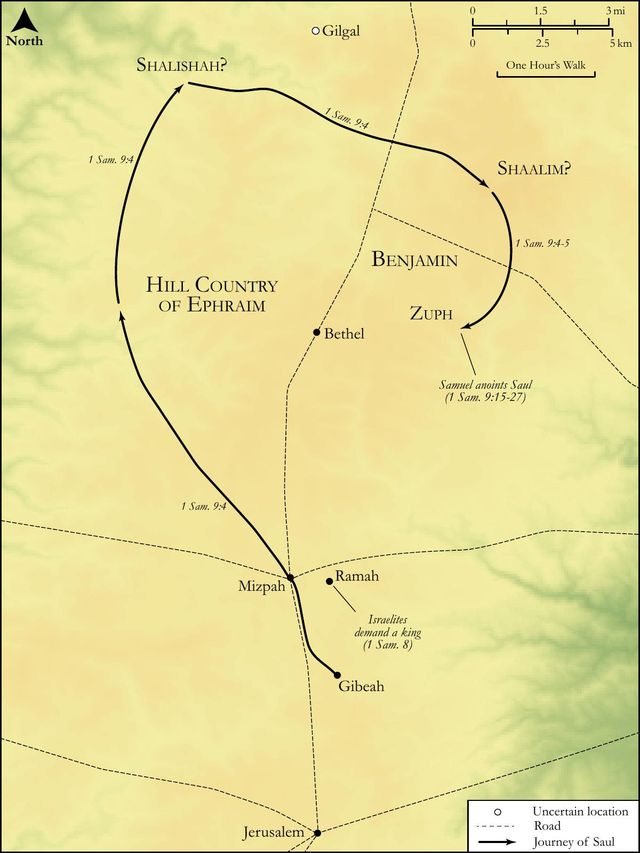
See on the biblical-era map
Study this verse
Public-domain commentary
Matthew Henry
From his Commentary on the Whole Bible. Henry comments on passages, not single verses — this entry covers 1 Samuel 9:18–27. His two-level outline is real structure in the source text, so it is rendered as structure.
Providence having at length brought Samuel and Saul together, we have here an account of what passed between them in the gate, at the feast, and in private.
I.In the gate of the city; passing through that, Saul found him (Sa1 9:18), and, little thinking that he was Samuel himself, asked him the way to Samuel's house: Tell me where the seer's house is; for there he expected to find him. See how mean a figure Samuel made, though so great a man: he took not any state, had no attendants, no ensigns of honour carried before him, nor any distinguishing habit, no, not when he went to church, but appeared, in all respects, so much a common person that Saul, though he was told he should meet him, never suspected that it was he, but, as if he looked more like a porter than a prophet, asked him the way to the seer's house. Thus is great worth oftentimes hidden under a very despicable appearance. Samuel knew that it was not the house, but the man, that he wanted, and therefore answered him, "I am the seer, the person you enquire for," Sa1 9:19. Samuel knew him before he knew Samuel; thus, though all that are called to the kingdom of glory are brought to know God, yet first they were known of him, Gal 4:9. Now,
1.Samuel obliges him to stay with him till the next day. The greatest part of this day had been spent in sacrificing, and the rest of it was to be spent in holy feasting, and therefore, "Tomorrow I will let thee go, and not sooner; now go up before me to the high place; let us pray together, and then we will talk together." Saul had nothing in his mind but to find his asses, but Samuel would take him off from that care, and dispose him to the exercises of piety; and therefore bids him go to the high place, and go before him, because, it may be, some business obliged Samuel to call by the way.
2.He satisfies him about his asses (Sa1 9:20): Set not thy mind on them, be not in further care about them; they are found. By this Saul might perceive that he was a prophet, that he could give him an answer to the enquiry which he had not yet made, and tell him what he thought; and thence he might infer, if a man of God can do this, much more doth God himself understand our thoughts afar off.
3.He surprises him with an intimation of preferment before him: "On whom is all the desire of Israel? Is it not a king that they are set upon, and there is never a man in Israel that will suit them as thou wilt." It does not appear that the country had as yet any eye upon him for the government, because they had left it wholly to God to choose for them; but such a one as he they wished for, and his advancement would be the advancement of his family and relations, as Abner, and others.
4.To this strange intimation Saul returns a very modest answer, Sa1 9:21. Samuel, he thought, did but banter him, because he was a tall man, but a very unlikely man to be a king; for, though the historian says (Sa1 9:1) his father was a mighty man of power, yet he himself speaks diminishingly of his tribe and family. "Benjamin, the youngest of Jacob's sons, when grown up to be a man, was called a little one (Gen 44:20); that tribe was diminished by the war of Gibeah; and I am a Benjamite, my family the least," probably a younger house, not in any place of honour or trust, no, not in their own tribe. Gideon had expressed himself thus, Jdg 6:15. A humble disposition is a good presage of preferment.
II.At the public feast; thither Samuel took him and his servant.
Though the advancement of Saul would be the deposing of Samuel, yet that good prophet was so far from envying him, or bearing him any ill-will for it, that he was the first and forwardest man to do him honour, in compliance with the will of God. If this be the man whom God has chosen, though he be none of Samuel's particular friends or confidants, yet he is heartily welcome to his table, nay, to his bosom. We may suppose it was no unseasonable kindness to Saul to give him a meal's meat, for it seems, by what he said (Sa1 9:7), that all their meat and money were spent. But this was not all. Samuel treats him not as a common person, but a person of quality and distinction, to prepare both him and the people for what was to follow. Two marks of honour he put upon him: - 1. He set him in the best place, as more honourable than any other of the guests, to whom he said, Give this man place, Luk 14:9. Though we may suppose the magistrates were there, who in their own city would claim precedency, yet the master of the feast made Saul and his servant too (who, if Saul was a king, must be respected as his prime minister of state) sit in the chief place, Sa1 9:22. Note, Civil respects must be paid to those who in civil things have the precedency given them by the divine providence. 2. He presented him with the best dish, which, having had notice from heaven the day before of his coming (Sa1 9:16), he had designed for him, and ordered the cook to secure for him, when he gave orders for inviting the guests and making preparation for them. And what should this precious dish be, which was so very carefully reserved for the king-elect? One would expect it should be something very nice and delicate. No, it was a plain shoulder of mutton (Sa1 9:23, Sa1 9:24). The right shoulder of the peace-offerings was to be given to the priests, who were God's receivers (Lev 7:32); the next in honour to that was the left shoulder, which probably was always allotted to those that sat at the upper end of the table, and was wont to be Samuel's mess at other times; so that his giving it to Saul now was an implicit resignation of his place to him. Some observe a significancy in this dish. The shoulder denotes strength, and the breast, which some think went with it, denotes affection: he that was king had the government upon his shoulder, for he must bear the weight of it; and the people in his bosom, for they must be dear to him.
III.What passed between them in private.
Both that evening and early the next morning Samuel communed with Saul upon the flat roof of the house, Sa1 9:25, Sa1 9:26. We may suppose Samuel now told him the whole story of the people's desire of a king, the grounds of their desire, and God's grant of it, to all which Saul, living very privately, was perhaps a stranger; he satisfied him that he was the person God had pitched upon for the government; and whereas Saul would object that Samuel was in possession, and he would not for all the world take it out of his hands, Samuel, we may suppose, gave him all the assurance he could desire of his willingness to resign. Early in the morning he sent him towards home, brought him part of the way, bade him send his servant before, that they might be private (Sa1 9:27), and there, as we find in the beginning of the next chapter, he anointed him, and therein showed him the word of the Lord, that is, gave him full satisfaction that he was the person chosen to be king, for he would not jest with that sacred rite. It is by the unction of the Holy Ghost that Christ, the great prophet, shows us the word of the Lord. Jo1 2:27, the same anointing teacheth you of all things.
Historical interpretation
Historical reception
1 surviving comment on this verse from the historical church.
Saul approached Samuel at the city gate, etc. The Lord came to John at the boundary of fulfilling the law and initiating grace. For the law and the prophets were until John; from then on the kingdom of God is preached, and everyone forces his way into it (Matt. XI). And he asks him in what humility and in what perfection of other virtues his conscience is placed, who has deserved to see so much divine contemplation before other mortals then. For the house of each individual is the conscience, in which thoughts always dwell. But he does not question him with words, but by bestowing his gifts upon him. And he, responding, reveals where his house is; for in all the virtues he practiced, he showed himself to be placed in the abode of humility; saying, "He must increase, but I must decrease" (John III). And other such things, to which Samuel's subsequent responses aptly correspond.
Continue studying 1 Samuel 9:18 across the web’s major study libraries — every link below opens this exact verse, chapter, or book on the destination site.
Read & Compare
 BibleGatewayThis verse in more than 200 translations and 70 languages.
 Bible.comThe YouVersion reader — hundreds of translations, reading plans, and highlights.
 ESV.orgCrossway's official English Standard Version reader.
 NET BibleThe NET translation with 60,000+ translators' notes on every rendering decision.
 STEP BibleTyndale House's free study tool — original text, vocabulary, and scholarly resources.
 BibliaLogos Bible Software's free web reader.
 USCCBThe New American Bible (Revised Edition) with the U.S. bishops' study notes.
Commentaries
 BibleHub CommentariesDozens of classic commentaries on this verse, gathered on one page.
 StudyLightMore than 100 commentary sets — the largest collection on the web.
 BibleRefPlain-English commentary on what this verse means, verse by verse.
 Enduring WordDavid Guzik's free commentary on this chapter, widely used by Bible teachers.
 Bible Study ToolsVerse commentary alongside Greek and Hebrew study aids.
Original Language & Research
- BibleHub InterlinearThe verse word by word — original language, transliteration, and English.
- BibleHub LexiconEvery word's original-language definition and Strong's entry.
 Blue Letter BibleDeep-study tools — Strong's numbers, concordance, and word studies.
 SefariaThe Hebrew text with Rashi and centuries of Jewish commentary.
Sermons, Hymns & Audio


TrulyRandomVerse is not affiliated with these sites and doesn’t control their content. They’re linked because they’re genuinely useful.
Summary
1 Samuel 9:18 captures the divinely orchestrated, pivotal encounter between Saul and Samuel in the public gate of Ramah. Saul, a humble young man from the tribe of Benjamin, has been fruitlessly searching for his father's lost donkeys. Guided by his servant's suggestion to consult a "man of God," he unknowingly approaches Samuel, the revered prophet and judge. Saul's seemingly mundane question about the seer's residence sets the stage for his anointing as Israel's first king, revealing God's profound sovereignty over even the most ordinary circumstances.
Context
ShowHideLiterary Context
This verse serves as the narrative climax of Saul's journey to Ramah, a journey ostensibly undertaken to find lost donkeys but divinely purposed for a far greater calling. The preceding verses (1 Samuel 9:1-17) meticulously detail Saul's humble background, his diligent but ultimately unsuccessful search, and his servant's pragmatic suggestion to consult a "man of God" known for his accurate insights. Unbeknownst to Saul, God had already revealed to Samuel the day prior (1 Samuel 9:15-16) that a man from Benjamin would arrive, whom Samuel was to anoint as prince over Israel. Thus, Saul's approach to Samuel in the gate is not a chance meeting but the precise fulfillment of divine prophecy, transitioning the narrative from Saul's personal quest to his national destiny.
Historical & Cultural Context
The "gate" (Hebrew: sha'ar) in ancient Israelite cities was far more than a mere entrance; it was the vibrant hub of community life. It functioned as the primary place for public assembly, legal judgments, commercial transactions, and social interaction. Elders, judges, and prophets often conducted their affairs there, making it a natural setting for a public figure like Samuel to be encountered. The widespread practice of consulting a "seer" or prophet for guidance, even on seemingly trivial matters like lost animals, reflected the deep-seated belief in divine intervention and the prophet's crucial role as God's intermediary. This period also marks a significant transition in Israel's governance, moving from the charismatic leadership of judges to the establishment of a monarchy, a shift largely driven by the people's demand as recorded in 1 Samuel 8.
Key Themes
ShowHideThis verse powerfully illustrates several overarching themes within 1 Samuel and the broader biblical narrative. Firstly, Divine Providence is paramount; God orchestrates seemingly random events—like lost donkeys and a chance encounter—to fulfill His sovereign purposes, demonstrating His meticulous control over all circumstances. This echoes the truth that "The heart of man plans his way, but the Lord establishes his steps" (Proverbs 16:9). Secondly, the Authority of the Prophet/Seer is highlighted through Samuel's unique role. As a "seer," he is God's designated mouthpiece, providing divine insight and direction, underscoring Israel's reliance on such figures for guidance in a time before a settled monarchy, as seen in Samuel's established prophetic office (1 Samuel 3:19-21). Lastly, the theme of God's Unexpected Choice is powerfully introduced. Saul, a seemingly ordinary man from a minor tribe, is about to be elevated to the highest position, foreshadowing God's consistent tendency to choose and empower individuals in ways that defy human expectations and social standing, a principle later articulated in God's rejection of outward appearance (1 Samuel 16:7).
Exposition and Analysis
ShowHideKey Word Analysis
ShowHideThis verb (H5066) signifies a physical approach, to "come near" or "bring near," often with a specific purpose. In this context, it describes Saul's deliberate action of approaching Samuel. While Saul's immediate purpose was to ask a question about lost donkeys, the divine purpose behind this "drawing near" was the initiation of his call to kingship. The term implies a closing of distance, setting the stage for direct communication and a divinely appointed encounter.
Derived from the primitive root (H7200) meaning "to see," this term (often ro'eh) emphasizes the prophet's unique ability to "see" or perceive divine revelation, visions, and insights that are hidden from ordinary human understanding. It is an older designation for a prophet, highlighting the visual aspect of divine communication. In Samuel's case, it underscores his unique connection to God and his role as an intermediary through whom God's will was revealed, particularly in momentous decisions like the selection of a king.
As noted in the context, the "gate" (H8179) was the nerve center of an ancient Israelite city, functioning as an "opening" or "door" to public life. It was the place where legal disputes were settled, commercial transactions took place, public announcements were made, and elders or officials would sit to offer counsel or administer justice. Saul's encounter with Samuel "in the gate" signifies a public, accessible, and somewhat official meeting, even if Saul himself was unaware of its true significance. It was a place of public life, making Samuel's presence there a natural part of his role as a public figure and judge.
Verse Breakdown
ShowHide"Then Saul drew near to Samuel in the gate"
This opening clause describes Saul's physical approach to Samuel, emphasizing the public nature of their encounter. The setting "in the gate" is crucial, as it symbolizes a place of public discourse and divine appointment, contrasting with the private anointing that is soon to follow. Saul's "drawing near" is an act of seeking, albeit for a mundane purpose, which God is about to redirect for a national calling, signifying the precise convergence of human action and divine intention.
"and said,"
This short clause simply indicates the commencement of dialogue. It bridges Saul's physical approach with his verbal inquiry, setting up the direct interaction between the two pivotal figures. The simplicity of "and said" belies the monumental significance of the words that follow, which will initiate a new era for Israel.
"Tell me, I pray thee, where the seer's house [is]."
This is Saul's direct, humble, and utterly oblivious question. He addresses Samuel as a respected "seer" but has no idea that he is speaking to the very man God has chosen to anoint him as king. The request about the "seer's house" highlights Saul's immediate, mundane concern—to find the man who can help him locate his lost donkeys—and sets up the profound divine irony of the situation, where a small personal problem leads to a monumental national destiny.
Literary Devices
ShowHideThe narrative in 1 Samuel 9:18 masterfully employs several literary devices to heighten its impact and underscore its theological message. Irony is profoundly prominent, as Saul's mundane quest for lost donkeys leads him directly to the prophet who will anoint him king, completely unbeknownst to him. His simple question about the "seer's house" stands in stark contrast to the profound destiny awaiting him, creating a powerful sense of dramatic irony for the reader. This also showcases Divine Orchestration, where God's unseen hand meticulously guides the seemingly random events of Saul's journey to converge precisely with Samuel's divine instruction, demonstrating God's sovereign control over even the smallest details of human life. The encounter itself serves as powerful Foreshadowing, setting the immediate stage for Saul's anointing in the following chapter and signaling the dramatic shift in Israel's leadership from judges to monarchy. The public setting "in the gate" also adds a layer of Symbolism, representing the public nature of Samuel's office and the impending public revelation of Saul's kingship, even though the anointing itself will be private.
Theological and Thematic Connections
ShowHide1 Samuel 9:18 beautifully illustrates the profound truth of God's active involvement in human affairs, demonstrating His ability to use the most ordinary circumstances to accomplish His extraordinary purposes. It underscores the principle of divine sovereignty, where God's plans are not contingent on human awareness or intention, but unfold according to His perfect will. Saul's mundane search for lost donkeys becomes a divinely orchestrated journey towards his destiny as king, revealing that God often works behind the scenes, guiding steps and aligning events in ways we cannot perceive. This provides immense comfort and encouragement, reminding believers that even in our daily routines and seemingly insignificant struggles, God is at work, weaving His grand design for His glory and our ultimate good.
Reflection and Application
ShowHide1 Samuel 9:18 offers profound insights for contemporary believers, challenging us to cultivate a posture of attentiveness and trust, recognizing that God is actively at work in every facet of our lives, even in the most mundane or frustrating circumstances. What might appear as a distraction, a dead end, or a trivial pursuit in our personal "search for lost donkeys" could, in fact, be a divinely orchestrated detour leading us to a greater purpose or a significant divine appointment. This verse encourages us to seek God's counsel through His Word and through spiritually mature mentors, much like Saul sought the "seer," even if we don't fully understand the bigger picture. Ultimately, it calls us to embrace openness to God's surprising ways, understanding that His plans often unfold outside our expectations, always for our good and His glory, requiring our faith and obedience even when the path is unclear.
Questions for Reflection
ShowHideFAQ
ShowHideWhy did Saul not know who Samuel was?
ShowHideSaul's ignorance of Samuel's identity, despite Samuel being a prominent judge and prophet, can be attributed to several factors. Saul was from the tribe of Benjamin, a relatively minor tribe, and he himself was not a prominent figure within it. Samuel's influence, while widespread, might have been more concentrated in certain regions or among specific families, particularly around Ramah. Furthermore, the narrative emphasizes God's sovereign orchestration. Saul's lack of prior knowledge heightens the divine irony and underscores that his encounter was not a result of his seeking out the famous prophet due to his own ambition, but rather God leading him directly to Samuel for a specific, divinely appointed purpose. This highlights God's initiative in the calling of Saul, rather than Saul's own recognition or pursuit.
What is the significance of "in the gate"?
ShowHideThe "gate" of an ancient Israelite city was a highly significant location, serving as the primary public square and administrative center. It was where legal judgments were rendered by elders and judges, business transactions were conducted, public announcements were made, and social interactions took place. For Samuel, as a judge and prophet, being "in the gate" was a natural part of his public role, making him accessible to the community for counsel and wisdom. For Saul, encountering Samuel there signifies that their meeting, though initially for a private matter (lost donkeys), was occurring in a public space, foreshadowing the public nature of Saul's impending anointing and the national implications of this divine appointment. It underscores that God's plans often unfold in the midst of ordinary, public life, not always in secluded or overtly sacred settings.
Christ-Centered Fulfillment
ShowHide1 Samuel 9:18, with its theme of divine orchestration and an unexpected encounter leading to a kingly anointing, finds profound Christ-centered fulfillment in the person and work of Jesus. Just as Saul was led by God to Samuel for a seemingly mundane reason, only to be revealed as God's chosen king, so too was Jesus's earthly life marked by divine orchestration, often unfolding through ordinary circumstances. He was not born into a royal palace but in a humble manger in Bethlehem (Luke 2:7), and grew up in the obscure town of Nazareth, prompting the skeptical question, "Can anything good come out of [Nazareth]?" (John 1:46). Yet, He was the true King, the Lamb of God who takes away the sin of the world, whose ministry began not with a grand political ascent but with calling humble fishermen and tax collectors. Jesus is the ultimate "Seer" and Prophet, the very Word of God made flesh, through whom God has spoken His final and most complete revelation (Hebrews 1:1-2). His mission was to seek and save the lost (Luke 19:10), a divine pursuit infinitely grander than lost donkeys, culminating in His anointing not with oil, but with the Holy Spirit for His ultimate sacrifice and resurrection, establishing an eternal kingdom that transcends all earthly monarchies.