


1 Samuel 9:19
Bible text: King James Version (1769 Blayney text) · Public domain
Bible text: King James Version with Strong's numbers · Public domain
Bible text: Berean Standard Bible · Public domain
Bible text: American Standard Version (1901) · Public domain
Bible text: World English Bible, Messianic edition · Public domain
Bible text: Geneva Bible (1599) · Public domain
Bible text: Young's Literal Translation · Public domain
- וַיַּעַןvai·Ya·'anand he answeredH6030Conj-w ¦ V-Qal-ConsecImperf-3msVerb Qal Consecutive Imperfect 3rd Singular Masculineוַandיַּעַןhe answered
- שְׁמוּאֵלshe·mu·'ElSamuelH8050N-proper-mNoun Proper Masculine
- אֶת'et<obj.>H853DirObjMParticle Object Indicator
- שָׁאוּלsha·'UlSaulH7586N-proper-mNoun Proper Masculine
- וַיֹּאמֶרvai·Yo·merand he saidH559Conj-w ¦ V-Qal-ConsecImperf-3msVerb Qal Consecutive Imperfect 3rd Singular Masculineוַandיֹּאמֶרhe said
- אָנֹכִי'a·no·KhiIH595Pro-1csPronoun Personal 1st Singular common gender
- הָרֹאֶהha·ro·'Eh[am] the seerH7203Art ¦ N-msNoun Singular Masculine Absoluteהָ[am] theרֹאֶהseer
- עֲלֵה'a·Lehgo upH5927V-Qal-Imp-2msVerb Qal Imperative 2nd Singular Masculine
- לְפָנַיle·fa·Nai<to> before meH6440Prep-l ¦ N-mpc ¦ 1csNoun Plural Masculine Constructלְ<to>פָנַbeforeיme
- הַבָּמָהha·ba·Mahthe high placeH1116Art ¦ N-fsNoun Singular Feminine Absoluteהַtheבָּמָהhigh place
- וַאֲכַלְתֶּםva·'a·khal·Temand you will eatH398Conj-w ¦ V-Qal-ConsecPerf-2mpVerb Qal Consecutive Perfect 2nd Plural Masculineוַandאֲכַלְתֶּםyou will eat
- עִמִּי'i·Miwith meH5973Prep ¦ 1csPreposition Definiteעִמִּwithיme
- הַיּוֹםhai·Yomthis dayH3117Art ¦ N-msNoun Singular Masculine Absoluteהַthisיּוֹםday
- וְשִׁלַּחְתִּיךָve·shi·lach·Ti·khaand I will send away youH7971Conj-w ¦ V-Piel-ConsecPerf-1cs ¦ 2msVerb Piel Consecutive Perfect 1st Singular common genderוְandשִׁלַּחְתִּיI will send awayךָyou
- בַבֹּקֶרva·Bo·kerin the morningH1242Prep-b ¦ N-msNoun Singular Masculine Absoluteבַin theבֹּקֶרmorning
- וְכֹלve·Kholand allH3605Conj-w ¦ N-msNoun Singular Masculine Absoluteוְandכֹלall
- אֲשֶׁר'a·SherthatH834RelParticle Relative
- בִּלְבָבְךָbil·va·ve·Kha[is] in your heartH3824Prep-b ¦ N-msc ¦ 2msNoun Singular Masculine Constructבִּ[is] inלְבָבְheartךָyour
- אַגִּיד'a·GidI will tellH5046V-Hiphil-Imperf-1csVerb Hiphil Imperfect 1st Singular common gender
- לָךְLakhto <the> youPrep-l ¦ 2msSuffix Personal 2nd Singular Masculineלָto <the>ךְyou
English is a literal word-by-word gloss of the Hebrew, not the KJV's wording. Why?
This is the original text the KJV's translators worked from — each Hebrew word with its own literal English meaning in this verse, prepared by scholars at Tyndale House, Cambridge. The KJV translates whole sentences, not word by word, so its wording differs: one Hebrew word can become several English words, and the KJV may choose “the LORD” where the gloss reads “Yahweh”. Both are faithful — they answer different questions. For the KJV's own rendering, switch to the KJV text.
Details
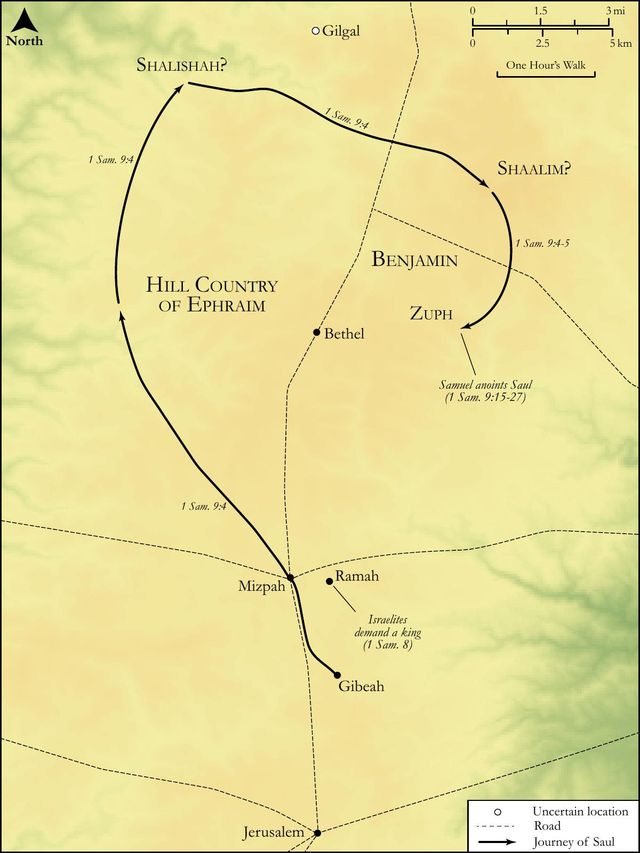
See on the biblical-era map
Study this verse
Public-domain commentary
Matthew Henry
From his Commentary on the Whole Bible. Henry comments on passages, not single verses — this entry covers 1 Samuel 9:18–27. His two-level outline is real structure in the source text, so it is rendered as structure.
Providence having at length brought Samuel and Saul together, we have here an account of what passed between them in the gate, at the feast, and in private.
I.In the gate of the city; passing through that, Saul found him (Sa1 9:18), and, little thinking that he was Samuel himself, asked him the way to Samuel's house: Tell me where the seer's house is; for there he expected to find him. See how mean a figure Samuel made, though so great a man: he took not any state, had no attendants, no ensigns of honour carried before him, nor any distinguishing habit, no, not when he went to church, but appeared, in all respects, so much a common person that Saul, though he was told he should meet him, never suspected that it was he, but, as if he looked more like a porter than a prophet, asked him the way to the seer's house. Thus is great worth oftentimes hidden under a very despicable appearance. Samuel knew that it was not the house, but the man, that he wanted, and therefore answered him, "I am the seer, the person you enquire for," Sa1 9:19. Samuel knew him before he knew Samuel; thus, though all that are called to the kingdom of glory are brought to know God, yet first they were known of him, Gal 4:9. Now,
1.Samuel obliges him to stay with him till the next day. The greatest part of this day had been spent in sacrificing, and the rest of it was to be spent in holy feasting, and therefore, "Tomorrow I will let thee go, and not sooner; now go up before me to the high place; let us pray together, and then we will talk together." Saul had nothing in his mind but to find his asses, but Samuel would take him off from that care, and dispose him to the exercises of piety; and therefore bids him go to the high place, and go before him, because, it may be, some business obliged Samuel to call by the way.
2.He satisfies him about his asses (Sa1 9:20): Set not thy mind on them, be not in further care about them; they are found. By this Saul might perceive that he was a prophet, that he could give him an answer to the enquiry which he had not yet made, and tell him what he thought; and thence he might infer, if a man of God can do this, much more doth God himself understand our thoughts afar off.
3.He surprises him with an intimation of preferment before him: "On whom is all the desire of Israel? Is it not a king that they are set upon, and there is never a man in Israel that will suit them as thou wilt." It does not appear that the country had as yet any eye upon him for the government, because they had left it wholly to God to choose for them; but such a one as he they wished for, and his advancement would be the advancement of his family and relations, as Abner, and others.
4.To this strange intimation Saul returns a very modest answer, Sa1 9:21. Samuel, he thought, did but banter him, because he was a tall man, but a very unlikely man to be a king; for, though the historian says (Sa1 9:1) his father was a mighty man of power, yet he himself speaks diminishingly of his tribe and family. "Benjamin, the youngest of Jacob's sons, when grown up to be a man, was called a little one (Gen 44:20); that tribe was diminished by the war of Gibeah; and I am a Benjamite, my family the least," probably a younger house, not in any place of honour or trust, no, not in their own tribe. Gideon had expressed himself thus, Jdg 6:15. A humble disposition is a good presage of preferment.
II.At the public feast; thither Samuel took him and his servant.
Though the advancement of Saul would be the deposing of Samuel, yet that good prophet was so far from envying him, or bearing him any ill-will for it, that he was the first and forwardest man to do him honour, in compliance with the will of God. If this be the man whom God has chosen, though he be none of Samuel's particular friends or confidants, yet he is heartily welcome to his table, nay, to his bosom. We may suppose it was no unseasonable kindness to Saul to give him a meal's meat, for it seems, by what he said (Sa1 9:7), that all their meat and money were spent. But this was not all. Samuel treats him not as a common person, but a person of quality and distinction, to prepare both him and the people for what was to follow. Two marks of honour he put upon him: - 1. He set him in the best place, as more honourable than any other of the guests, to whom he said, Give this man place, Luk 14:9. Though we may suppose the magistrates were there, who in their own city would claim precedency, yet the master of the feast made Saul and his servant too (who, if Saul was a king, must be respected as his prime minister of state) sit in the chief place, Sa1 9:22. Note, Civil respects must be paid to those who in civil things have the precedency given them by the divine providence. 2. He presented him with the best dish, which, having had notice from heaven the day before of his coming (Sa1 9:16), he had designed for him, and ordered the cook to secure for him, when he gave orders for inviting the guests and making preparation for them. And what should this precious dish be, which was so very carefully reserved for the king-elect? One would expect it should be something very nice and delicate. No, it was a plain shoulder of mutton (Sa1 9:23, Sa1 9:24). The right shoulder of the peace-offerings was to be given to the priests, who were God's receivers (Lev 7:32); the next in honour to that was the left shoulder, which probably was always allotted to those that sat at the upper end of the table, and was wont to be Samuel's mess at other times; so that his giving it to Saul now was an implicit resignation of his place to him. Some observe a significancy in this dish. The shoulder denotes strength, and the breast, which some think went with it, denotes affection: he that was king had the government upon his shoulder, for he must bear the weight of it; and the people in his bosom, for they must be dear to him.
III.What passed between them in private.
Both that evening and early the next morning Samuel communed with Saul upon the flat roof of the house, Sa1 9:25, Sa1 9:26. We may suppose Samuel now told him the whole story of the people's desire of a king, the grounds of their desire, and God's grant of it, to all which Saul, living very privately, was perhaps a stranger; he satisfied him that he was the person God had pitched upon for the government; and whereas Saul would object that Samuel was in possession, and he would not for all the world take it out of his hands, Samuel, we may suppose, gave him all the assurance he could desire of his willingness to resign. Early in the morning he sent him towards home, brought him part of the way, bade him send his servant before, that they might be private (Sa1 9:27), and there, as we find in the beginning of the next chapter, he anointed him, and therein showed him the word of the Lord, that is, gave him full satisfaction that he was the person chosen to be king, for he would not jest with that sacred rite. It is by the unction of the Holy Ghost that Christ, the great prophet, shows us the word of the Lord. Jo1 2:27, the same anointing teacheth you of all things.
Historical interpretation
Historical reception
1 surviving comment on this verse from the historical church.
And Samuel answered Saul, saying: I am the seer, etc. John responded, with the Lord bestowing heavenly gifts upon him, saying: I am the friend of the Bridegroom; I am your forerunner; I ought to be baptized by you, who, coming before me, have been made ahead of me. And indeed you will now receive baptism from me with the people of believers, together we will serve the feast of the word, and in turn, we are refreshed by the faith of the listeners. But when the splendor of your grace has shone upon all, with my role as forerunner completed, I will leave you to preach, and having joined the chorus of preceding prophets, I will take care to reveal all the mysteries of your temporal dispensation to the crowds of the faithful, indeed your members.
Continue studying 1 Samuel 9:19 across the web’s major study libraries — every link below opens this exact verse, chapter, or book on the destination site.
Read & Compare
 BibleGatewayThis verse in more than 200 translations and 70 languages.
 Bible.comThe YouVersion reader — hundreds of translations, reading plans, and highlights.
 ESV.orgCrossway's official English Standard Version reader.
 NET BibleThe NET translation with 60,000+ translators' notes on every rendering decision.
 STEP BibleTyndale House's free study tool — original text, vocabulary, and scholarly resources.
 BibliaLogos Bible Software's free web reader.
 USCCBThe New American Bible (Revised Edition) with the U.S. bishops' study notes.
Commentaries
 BibleHub CommentariesDozens of classic commentaries on this verse, gathered on one page.
 StudyLightMore than 100 commentary sets — the largest collection on the web.
 BibleRefPlain-English commentary on what this verse means, verse by verse.
 Enduring WordDavid Guzik's free commentary on this chapter, widely used by Bible teachers.
 Bible Study ToolsVerse commentary alongside Greek and Hebrew study aids.
Original Language & Research
- BibleHub InterlinearThe verse word by word — original language, transliteration, and English.
- BibleHub LexiconEvery word's original-language definition and Strong's entry.
 Blue Letter BibleDeep-study tools — Strong's numbers, concordance, and word studies.
 SefariaThe Hebrew text with Rashi and centuries of Jewish commentary.
Sermons, Hymns & Audio


TrulyRandomVerse is not affiliated with these sites and doesn’t control their content. They’re linked because they’re genuinely useful.
Summary
In 1 Samuel 9:19, the venerable prophet Samuel dramatically unveils his prophetic identity to Saul, declaring himself "the seer" and extending an immediate invitation to a sacred communal meal at the local high place. This divinely orchestrated encounter, far from accidental, serves as the immediate and climactic prelude to Samuel's anointing of Saul as Israel's inaugural king, powerfully illustrating God's meticulous providence in directing seemingly mundane events towards the fulfillment of His grand redemptive purposes and the revelation of His chosen leader for the nation.
Context
ShowHideLiterary Context
The immediate literary context of 1 Samuel 9:19 is crucial, marking the dramatic climax of Saul's seemingly mundane search for his father's lost donkeys. The preceding verses (1 Samuel 9:1-14) detail Saul and his servant's fruitless quest, leading them to the very town where Samuel resides. Just as they consider abandoning their search, the servant suggests consulting a "man of God" – Samuel – renowned for his accurate prophetic insight. Unbeknownst to Saul, God had already divinely prepared Samuel for this precise moment, revealing His intention to send a man from Benjamin to be anointed as prince over Israel (1 Samuel 9:15-17). Verse 19, therefore, is Samuel's direct, authoritative, and almost startling response to Saul's inquiry, immediately establishing his prophetic credentials and setting the stage for the private revelation and anointing that will unfold in the subsequent verses and chapter. The invitation to eat signifies not just hospitality but a sacred, covenantal act, drawing Saul into Samuel's prophetic circle and preparing him for the momentous news of his destiny.
Historical & Cultural Context
The historical and cultural backdrop of 1 Samuel is a period of profound transition for ancient Israel, moving from a decentralized tribal confederacy under the leadership of judges to a centralized monarchy. Samuel, serving as the last of the judges and a preeminent prophet, stands as the pivotal figure bridging these two eras. The nation had recently vocalized their desire for a king, effectively rejecting God's direct rule, though God, while displeased, ultimately acceded to their request (1 Samuel 8:4-9). The mention of the "high place" (Hebrew: bâmâh) in this verse is significant. These were common local sanctuaries or cultic sites, often situated on elevated ground, used for sacrifices, communal worship, and shared meals. While later biblical narratives and prophetic voices would condemn many of these sites due to their association with syncretistic practices and the eventual centralization of legitimate worship in Jerusalem (e.g., 1 Kings 3:2-3), at this early stage of Israel's history, they were acceptable and widespread forms of worship, reflecting the decentralized nature of Israelite religious practice before the construction of the Temple.
Key Themes
ShowHideThis verse powerfully encapsulates several foundational themes woven throughout the book of 1 Samuel and the broader Old Testament narrative. Firstly, Divine Providence is abundantly clear, as God meticulously orchestrates Saul's seemingly trivial search for lost donkeys into a direct appointment with Samuel, thereby fulfilling His preordained plan for Israel's leadership. This highlights God's active, unseen involvement in human affairs, guiding steps even when individuals are unaware of His ultimate purpose, a truth beautifully echoed in Proverbs 16:9 and Psalm 37:23. Secondly, Prophetic Authority and Revelation are prominently displayed. Samuel's self-declaration, "I am the seer," immediately establishes his divine credentials, which are further validated by his uncanny knowledge of "all that is in thine heart," demonstrating a supernatural insight that only a true prophet of God could possess. This prophetic revelation serves to prepare Saul for the momentous divine message Samuel is about to impart concerning his destiny. Lastly, the theme of God's Choice of King is central. This meeting is not a random occurrence but a divinely appointed encounter, serving as the direct prelude to Saul's anointing as the first king of Israel, fulfilling the people's desire for a monarch, yet simultaneously reminding them of the potential consequences and responsibilities as God had warned in 1 Samuel 8:10-18.
Exposition and Analysis
ShowHideKey Word Analysis
ShowHideMeaning "to see, literally or figuratively." This term, an older designation for a prophet, emphasizes the visual aspect of prophetic revelation, suggesting that the seer receives divine messages through visions or direct insight into God's will and hidden knowledge. As 1 Samuel 9:9 clarifies, "He that is now called a Prophet was beforetime called a Seer." Samuel's self-identification as "the seer" immediately asserts his unique access to God's foresight and his authority to reveal divine plans, particularly concerning Saul's future.
Referring to "the heart (as the most interior organ); [phrase] bethink themselves, breast, comfortably, courage, ((faint), (tender-) heart(-ed), midst, mind, [idiom] unawares, understanding." In this context, "heart" signifies the totality of a person's inner being—their thoughts, intentions, desires, and even unspoken concerns. Samuel's promise to "tell thee all that is in thine heart" demonstrates his supernatural ability to perceive Saul's deepest anxieties and questions, even those he had not yet articulated. This reveals God's omniscience working through His prophet, assuring Saul that Samuel's words are divinely inspired truth, addressing the very core of Saul's unspoken needs and uncertainties.
Verse Breakdown
ShowHide"And Samuel answered Saul, and said, I [am] the seer"
This opening declaration immediately establishes Samuel's authoritative and divinely commissioned role. Saul had approached Samuel seeking mundane information about lost donkeys, but Samuel's response transcends the ordinary. By unequivocally stating "I am the seer," Samuel reveals his true identity and, more importantly, his unique divine insight and prophetic calling. This statement positions Samuel not merely as a local wise man or a fortune-teller, but as God's appointed mouthpiece, capable of perceiving and revealing hidden divine purposes, thus preparing Saul for a revelation far greater than his initial quest.
"go up before me unto the high place; for ye shall eat with me to day"
Samuel's command directs Saul to accompany him to the "high place," a local sanctuary where sacred activities, including sacrifices and communal meals, were conducted. The invitation to share a meal is profoundly significant in ancient Israelite culture. Communal meals, especially those following sacrifices, were often associated with covenant-making, fellowship, and sacred acts, symbolizing shared communion and a deepening relationship. This invitation draws Saul into an intimate, sacred space with Samuel, signaling that the forthcoming revelation will be of profound national importance and that Saul is being brought into a special, divinely ordained relationship with the prophet and, by extension, with God Himself.
"and to morrow I will let thee go, and will tell thee all that [is] in thine heart."
This final clause provides a clear temporal framework and a powerful demonstration of Samuel's prophetic gift. Samuel indicates that Saul will spend the night, and the full, comprehensive revelation will be imparted the following day. The astonishing promise to "tell thee all that is in thine heart" is a breathtaking display of Samuel's supernatural insight. It assures Saul that Samuel knows his deepest thoughts, anxieties, and unspoken questions—likely extending beyond the lost donkeys to include his personal aspirations, concerns about Israel's future, or even his own unarticulated destiny. This divinely bestowed knowledge serves as undeniable validation of Samuel's authority and prepares Saul's mind and spirit to receive the astonishing news of his anointing as the first king of Israel.
Literary Devices
ShowHideThe passage in 1 Samuel 9:19 masterfully employs several literary devices to amplify its narrative and theological impact. Foreshadowing is prominently used, as Samuel's cryptic yet authoritative words ("I am the seer," "I will tell thee all that is in thine heart") subtly yet powerfully hint at the monumental revelation of Saul's kingship that is about to unfold, building narrative tension. The seemingly mundane search for donkeys is imbued with profound Divine Irony, as Saul's small, personal quest is divinely redirected to fulfill a national destiny, highlighting the striking contrast between human intention and divine orchestration. This also speaks directly to Divine Orchestration, where God's unseen hand is meticulously guiding every event, leading Saul directly to Samuel at the precise moment, demonstrating His sovereign and purposeful control over seemingly random occurrences. Furthermore, Samuel's declaration of knowing "all that is in thine heart" functions as a powerful moment of Supernatural Revelation, immediately establishing his credibility and preparing Saul for the extraordinary news to come, underscoring the divine source of Samuel's knowledge and authority, which transcends human understanding.
Theological and Thematic Connections
ShowHideThe encounter described in 1 Samuel 9:19 profoundly underscores the overarching theological theme of God's sovereign election and His meticulous orchestration of human events. Saul's journey, initially driven by a trivial domestic concern for lost donkeys, becomes a divinely guided pilgrimage to his predestined role as king. Samuel's prophetic insight, demonstrated by his knowledge of Saul's unspoken thoughts and the details of his journey, powerfully illustrates God's intimate knowledge of individuals and His unwavering ability to reveal His will through His chosen messengers. This passage highlights that God's grand plans are often unfolded in unexpected and humble ways, utilizing ordinary circumstances to achieve extraordinary purposes. It also emphasizes that God's chosen leaders are frequently prepared and revealed through supernatural means, not merely through human merit, ambition, or conventional political processes, reinforcing the divine prerogative in establishing leadership.
Reflection and Application
ShowHideThis profound encounter between Samuel and Saul in 1 Samuel 9:19 offers rich and enduring lessons for contemporary believers. It serves as a powerful reminder that God's sovereign hand is ceaselessly at work in our lives, often in ways we don't immediately perceive or understand. What might appear to be a frustrating detour, a mundane daily task, or even a perplexing setback, could, in God's divine economy, be precisely the path He is using to lead us to a significant divine appointment, a crucial revelation of His purpose, or a pivotal moment in our spiritual journey. We are therefore called to cultivate a spirit of profound attentiveness and unwavering trust, recognizing that God's intricate plan unfolds not always through dramatic pronouncements or clear roadmaps, but often through the quiet, subtle guidance of His Spirit in the midst of our ordinary routines. Just as Samuel possessed an uncanny knowledge of what was in Saul's heart, God knows our deepest needs, our most profound fears, and our most cherished aspirations, and He is utterly faithful to meet us and guide us according to His perfect and loving will. Our essential task is to remain open and obedient to His leading, even when the path ahead is unclear, trusting that He is meticulously orchestrating every detail of our lives for our ultimate good and for the manifestation of His glorious purposes.
Questions for Reflection
ShowHideFAQ
ShowHideWhat is the significance of Samuel calling himself "the seer"?
ShowHideThe term "seer" (Hebrew: râʼâh, from H7200) was an older, venerable title for a prophet in ancient Israel, emphasizing the visual aspect of receiving divine messages, often through visions, dreams, or direct insight into God's hidden knowledge. As explicitly stated in 1 Samuel 9:9, "He that is now called a Prophet was beforetime called a Seer." By identifying himself as "the seer," Samuel immediately asserts his unique and divinely bestowed access to God's foresight and knowledge, thereby validating his authority to speak on God's behalf and prepare Saul for the extraordinary revelation concerning his destiny. It underscores that Samuel's knowledge and pronouncements are not human conjecture but divinely inspired truth.
Why did Samuel invite Saul to eat with him at the "high place"?
ShowHideThe "high place" (Hebrew: bâmâh, from H1116) was a common local sanctuary or place of worship, often situated on a hill or elevated platform, where sacrifices and communal meals were regularly conducted. At this early stage in Israel's history, prior to the centralization of worship in Jerusalem, these sites were acceptable and widespread for religious gatherings. The invitation to eat with Samuel at the high place was highly significant. Communal meals in ancient Israel, especially those following sacrifices, often symbolized deep fellowship, covenant-making, and shared sacred space. By inviting Saul to this meal, Samuel was drawing him into an intimate, sacred encounter, preparing him for the momentous news of his anointing as king and establishing a special, divinely sanctioned relationship between the prophet and the future monarch. It served as a pre-anointing ritual, setting a solemn and sacred context for the divine revelation that was to follow.
How did Samuel know "all that is in thine heart"?
ShowHideSamuel's astonishing ability to know "all that is in thine heart" (Saul's unspoken thoughts, concerns, and perhaps even his unarticulated aspirations) is a clear and powerful demonstration of his prophetic gift and direct divine revelation. It signifies that God Himself had revealed Saul's inner state to Samuel, thereby confirming Samuel's status as a true and authentic prophet of the Lord. This supernatural insight served to unequivocally validate Samuel's authority and assure Saul that he was indeed in the presence of a man of God who spoke with divine knowledge, not human speculation. This miraculous knowledge parallels numerous instances throughout the Bible where prophets or Jesus Christ Himself demonstrate supernatural awareness of individuals' thoughts and hidden lives, such as Jesus' interaction with the Samaritan woman in John 4:17-19 or His discernment of the Pharisees' thoughts in Matthew 9:4.
Christ-Centered Fulfillment
ShowHideThe pivotal encounter in 1 Samuel 9:19 where Samuel, "the seer," unveils God's secret purpose to Saul and remarkably knows the thoughts of his heart, profoundly foreshadows the person and redemptive work of Jesus Christ. Samuel, functioning as a divinely appointed prophet and revealer of God's will, points forward to Christ as the ultimate Prophet, the very Word of God made flesh, and the full and final revelation of God Himself (Hebrews 1:1-2). Just as Samuel knew "all that is in thine heart," Jesus consistently demonstrated His divine omniscience, perfectly knowing the hearts, thoughts, and hidden lives of those He encountered, whether it was the Samaritan woman's past in John 4:17-19, Nathanael's character under the fig tree in John 1:48, or the Pharisees' malicious schemes in Matthew 12:25. Samuel's instrumental role in anointing Saul as king, a leader chosen by God to shepherd His people, powerfully anticipates Christ as the true and eternal King, the one whom God the Father Himself has anointed to reign forever over a spiritual kingdom that knows no end (Psalm 2:6 and fulfilled in Luke 1:32-33). The divine orchestration of Saul's mundane search for donkeys leading directly to his kingship speaks to God's meticulous and sovereign plan, a plan that supremely culminates in Christ's redemptive work, where seemingly ordinary circumstances—like a humble birth and a criminal's death—lead to the extraordinary and eternal salvation of humanity through the cross and resurrection (Philippians 2:8-11). Ultimately, Samuel's prophetic office, his revelation of God's chosen king, and his supernatural insight find their perfect, complete, and glorious fulfillment in Jesus, the Son of God, who is the ultimate Seer, the King of Kings, and the one who fully reveals the Father's heart and His eternal plan for salvation and reconciliation (Colossians 1:15-20).