


1 Samuel 9:20
Bible text: King James Version (1769 Blayney text) · Public domain
Bible text: King James Version with Strong's numbers · Public domain
Bible text: Berean Standard Bible · Public domain
Bible text: American Standard Version (1901) · Public domain
Bible text: World English Bible, Messianic edition · Public domain
Bible text: Geneva Bible (1599) · Public domain
Bible text: Young's Literal Translation · Public domain
- וְלָאֲתֹנוֹתve·la·'a·to·Notand to the she-assesH860Conj-w ¦ Prep-l ¦ N-fpNoun Plural Feminine Absoluteוְandלָto theאֲתֹנוֹתshe-asses
- הָאֹבְדוֹתha·'oe·Dotwhich were lostH6Art ¦ V-Qal-Prtcpl-fpVerb Qal Participle Plural Feminine Absoluteהָwhichאֹבְדוֹתwere lost
- לְךָle·Khaof youPrep-l ¦ 2msSuffix Personal 2nd Singular Masculineלְofךָyou
- הַיּוֹםhai·yOmthis dayH3117Art ¦ N-msNoun Singular Masculine Absoluteהַthisיּוֹםday
- שְׁלֹשֶׁתshe·Lo·shet[the] threeH7969N-cscNoun Singular common gender Construct
- הַיָּמִיםhai·ya·Mimthe daysH3117Art ¦ N-mpNoun Plural Masculine Absoluteהַtheיָּמִיםdays
- אַל'almay notH408NegParticle Negative
- תָּשֶׂםTa·semyou setH7760V-Qal-Imperf-2msVerb Qal Imperfect 2nd Singular Masculine
- אֶת'et<obj.>H853DirObjMParticle Object Indicator
- לִבְּךָli·be·Khayour heartH3820N-msc ¦ 2msNoun Singular Masculine Constructלִבְּheartךָyour
- לָהֶםla·Hemto <the> themPrep-l ¦ 3mpSuffix Personal 3rd Plural Masculineלָto <the>הֶםthem
- כִּיkiforH3588PrtParticle Conditional
- נִמְצָאוּnim·Tza·'uthey have been foundH4672V-Niphal-Perf-3cpVerb Niphal Perfect 3rd Plural common gender
- וּלְמִיu·le·Miand [belongs] to whom?H4310Conj-w ¦ Prep-l ¦ InterrogPronoun Interrogativeוּandלְ[belongs] toמִיwhom?
- כָּלkoleveryH3605N-mscNoun Singular Masculine Construct
- חֶמְדַּתchem·Dat<the> desirable thing ofH2532N-fscNoun Singular Feminine Construct
- יִשְׂרָאֵלYis·ra·'ElIsraelH3478N-properNoun Proper Location
- הֲלוֹאha·Lo'¿ notH3808Interrog ¦ NegParticle Negativeהֲ¿לוֹאnot
- לְךָle·Khato youPrep-l ¦ 2msSuffix Personal 2nd Singular Masculineלְtoךָyou
- וּלְכֹלu·le·Kholand to allH3605Conj-w ¦ Prep-l ¦ N-mscNoun Singular Masculine Constructוּandלְtoכֹלall
- בֵּיתbeit[the] house ofH1004N-mscNoun Singular Masculine Construct
- אָבִיךָ'a·Vi·khayour fatherH1N-msc ¦ 2msNoun Singular Masculine Constructאָבִיfatherךָyour
English is a literal word-by-word gloss of the Hebrew, not the KJV's wording. Why?
This is the original text the KJV's translators worked from — each Hebrew word with its own literal English meaning in this verse, prepared by scholars at Tyndale House, Cambridge. The KJV translates whole sentences, not word by word, so its wording differs: one Hebrew word can become several English words, and the KJV may choose “the LORD” where the gloss reads “Yahweh”. Both are faithful — they answer different questions. For the KJV's own rendering, switch to the KJV text.
Details
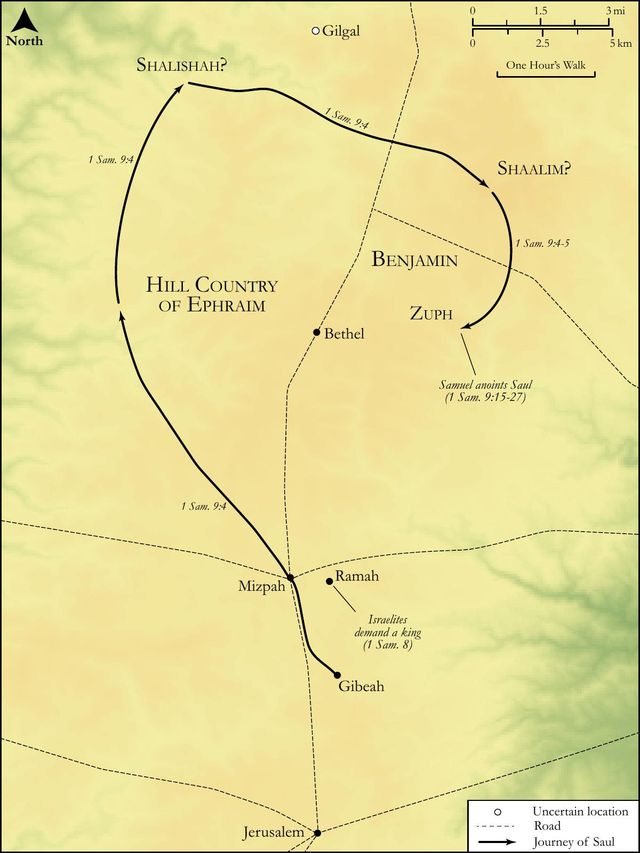
See on the biblical-era map
Study this verse
Public-domain commentary
Matthew Henry
From his Commentary on the Whole Bible. Henry comments on passages, not single verses — this entry covers 1 Samuel 9:18–27. His two-level outline is real structure in the source text, so it is rendered as structure.
Providence having at length brought Samuel and Saul together, we have here an account of what passed between them in the gate, at the feast, and in private.
I.In the gate of the city; passing through that, Saul found him (Sa1 9:18), and, little thinking that he was Samuel himself, asked him the way to Samuel's house: Tell me where the seer's house is; for there he expected to find him. See how mean a figure Samuel made, though so great a man: he took not any state, had no attendants, no ensigns of honour carried before him, nor any distinguishing habit, no, not when he went to church, but appeared, in all respects, so much a common person that Saul, though he was told he should meet him, never suspected that it was he, but, as if he looked more like a porter than a prophet, asked him the way to the seer's house. Thus is great worth oftentimes hidden under a very despicable appearance. Samuel knew that it was not the house, but the man, that he wanted, and therefore answered him, "I am the seer, the person you enquire for," Sa1 9:19. Samuel knew him before he knew Samuel; thus, though all that are called to the kingdom of glory are brought to know God, yet first they were known of him, Gal 4:9. Now,
1.Samuel obliges him to stay with him till the next day. The greatest part of this day had been spent in sacrificing, and the rest of it was to be spent in holy feasting, and therefore, "Tomorrow I will let thee go, and not sooner; now go up before me to the high place; let us pray together, and then we will talk together." Saul had nothing in his mind but to find his asses, but Samuel would take him off from that care, and dispose him to the exercises of piety; and therefore bids him go to the high place, and go before him, because, it may be, some business obliged Samuel to call by the way.
2.He satisfies him about his asses (Sa1 9:20): Set not thy mind on them, be not in further care about them; they are found. By this Saul might perceive that he was a prophet, that he could give him an answer to the enquiry which he had not yet made, and tell him what he thought; and thence he might infer, if a man of God can do this, much more doth God himself understand our thoughts afar off.
3.He surprises him with an intimation of preferment before him: "On whom is all the desire of Israel? Is it not a king that they are set upon, and there is never a man in Israel that will suit them as thou wilt." It does not appear that the country had as yet any eye upon him for the government, because they had left it wholly to God to choose for them; but such a one as he they wished for, and his advancement would be the advancement of his family and relations, as Abner, and others.
4.To this strange intimation Saul returns a very modest answer, Sa1 9:21. Samuel, he thought, did but banter him, because he was a tall man, but a very unlikely man to be a king; for, though the historian says (Sa1 9:1) his father was a mighty man of power, yet he himself speaks diminishingly of his tribe and family. "Benjamin, the youngest of Jacob's sons, when grown up to be a man, was called a little one (Gen 44:20); that tribe was diminished by the war of Gibeah; and I am a Benjamite, my family the least," probably a younger house, not in any place of honour or trust, no, not in their own tribe. Gideon had expressed himself thus, Jdg 6:15. A humble disposition is a good presage of preferment.
II.At the public feast; thither Samuel took him and his servant.
Though the advancement of Saul would be the deposing of Samuel, yet that good prophet was so far from envying him, or bearing him any ill-will for it, that he was the first and forwardest man to do him honour, in compliance with the will of God. If this be the man whom God has chosen, though he be none of Samuel's particular friends or confidants, yet he is heartily welcome to his table, nay, to his bosom. We may suppose it was no unseasonable kindness to Saul to give him a meal's meat, for it seems, by what he said (Sa1 9:7), that all their meat and money were spent. But this was not all. Samuel treats him not as a common person, but a person of quality and distinction, to prepare both him and the people for what was to follow. Two marks of honour he put upon him: - 1. He set him in the best place, as more honourable than any other of the guests, to whom he said, Give this man place, Luk 14:9. Though we may suppose the magistrates were there, who in their own city would claim precedency, yet the master of the feast made Saul and his servant too (who, if Saul was a king, must be respected as his prime minister of state) sit in the chief place, Sa1 9:22. Note, Civil respects must be paid to those who in civil things have the precedency given them by the divine providence. 2. He presented him with the best dish, which, having had notice from heaven the day before of his coming (Sa1 9:16), he had designed for him, and ordered the cook to secure for him, when he gave orders for inviting the guests and making preparation for them. And what should this precious dish be, which was so very carefully reserved for the king-elect? One would expect it should be something very nice and delicate. No, it was a plain shoulder of mutton (Sa1 9:23, Sa1 9:24). The right shoulder of the peace-offerings was to be given to the priests, who were God's receivers (Lev 7:32); the next in honour to that was the left shoulder, which probably was always allotted to those that sat at the upper end of the table, and was wont to be Samuel's mess at other times; so that his giving it to Saul now was an implicit resignation of his place to him. Some observe a significancy in this dish. The shoulder denotes strength, and the breast, which some think went with it, denotes affection: he that was king had the government upon his shoulder, for he must bear the weight of it; and the people in his bosom, for they must be dear to him.
III.What passed between them in private.
Both that evening and early the next morning Samuel communed with Saul upon the flat roof of the house, Sa1 9:25, Sa1 9:26. We may suppose Samuel now told him the whole story of the people's desire of a king, the grounds of their desire, and God's grant of it, to all which Saul, living very privately, was perhaps a stranger; he satisfied him that he was the person God had pitched upon for the government; and whereas Saul would object that Samuel was in possession, and he would not for all the world take it out of his hands, Samuel, we may suppose, gave him all the assurance he could desire of his willingness to resign. Early in the morning he sent him towards home, brought him part of the way, bade him send his servant before, that they might be private (Sa1 9:27), and there, as we find in the beginning of the next chapter, he anointed him, and therein showed him the word of the Lord, that is, gave him full satisfaction that he was the person chosen to be king, for he would not jest with that sacred rite. It is by the unction of the Holy Ghost that Christ, the great prophet, shows us the word of the Lord. Jo1 2:27, the same anointing teacheth you of all things.
Historical interpretation
Historical reception
3 surviving comments on this verse. Each one is dated, so this reads as a timeline rather than a list.
Am I not the son of Jemini from the least tribe of Israel? etc. And the Lord chose content among proud lineages, poor parents, and humble in spirit, from whom He would be born; and He speaks of Himself: I do not seek my own glory (John VIII). And beautifully Saul is called the son of Jemini, that is, of my right hand, because Christ Himself from the power of His divinity created for Himself the substance of man, which He would assume being born from a virgin; as it is read elsewhere: Wisdom has built herself a house (Prov. IX). Beautifully from the latest family among all the families of the tribe of Benjamin, that is, the sons of the right hand. For the Son of the right hand is Christ God, to whose tribe all the elect belong; but the more humble anyone is among the saints, the closer they are as if by kinship; for even Christ as a man, though higher in majesty, is superior to all the saints in the virtue of humility.
And as for the donkeys you lost three days ago, do not be anxious, etc. And concerning the souls which began to perish in the third period of the world, that is, at the beginning of the nascent world, rejoice, because by my preaching they have already learned to repent and hope for the kingdom of heaven. Understand the three periods: before the law, under the law, and under grace.
And whose shall be the best of Israel? etc. And who will be the giver and author of the grace I preach, if not you? To whom it is most rightly confessed that all things whatever the Father has belong. For the best of Israel are the gifts of heavenly joys, which he ministers to the house of his Father who is in heaven.
Continue studying 1 Samuel 9:20 across the web’s major study libraries — every link below opens this exact verse, chapter, or book on the destination site.
Read & Compare
 BibleGatewayThis verse in more than 200 translations and 70 languages.
 Bible.comThe YouVersion reader — hundreds of translations, reading plans, and highlights.
 ESV.orgCrossway's official English Standard Version reader.
 NET BibleThe NET translation with 60,000+ translators' notes on every rendering decision.
 STEP BibleTyndale House's free study tool — original text, vocabulary, and scholarly resources.
 BibliaLogos Bible Software's free web reader.
 USCCBThe New American Bible (Revised Edition) with the U.S. bishops' study notes.
Commentaries
 BibleHub CommentariesDozens of classic commentaries on this verse, gathered on one page.
 StudyLightMore than 100 commentary sets — the largest collection on the web.
 BibleRefPlain-English commentary on what this verse means, verse by verse.
 Enduring WordDavid Guzik's free commentary on this chapter, widely used by Bible teachers.
 Bible Study ToolsVerse commentary alongside Greek and Hebrew study aids.
Original Language & Research
- BibleHub InterlinearThe verse word by word — original language, transliteration, and English.
- BibleHub LexiconEvery word's original-language definition and Strong's entry.
 Blue Letter BibleDeep-study tools — Strong's numbers, concordance, and word studies.
 SefariaThe Hebrew text with Rashi and centuries of Jewish commentary.
Sermons, Hymns & Audio


TrulyRandomVerse is not affiliated with these sites and doesn’t control their content. They’re linked because they’re genuinely useful.
Summary
1 Samuel 9:20 marks a pivotal moment where the prophet Samuel, guided by divine revelation, subtly yet profoundly redirects Saul's attention from a mundane concern—the search for lost asses—to his extraordinary, divinely appointed destiny. Samuel assures Saul that his animals are found, then shifts the conversation to the deeper, national yearning of Israel for a king, revealing that Saul, and his father's house, are the very objects of this collective desire, thereby foreshadowing his imminent anointing as Israel's first monarch.
Context
ShowHideLiterary Context
This verse is strategically placed within the narrative of Saul's initial, divinely orchestrated encounter with Samuel. The preceding verses establish Samuel's prophetic foresight, as God had already revealed to him the day before that a man from the land of Benjamin would arrive whom Samuel was to anoint as prince over Israel (1 Samuel 9:15-17). Saul, oblivious to this divine plan, has been diligently searching for his father's lost asses, a seemingly trivial errand that serves as the providential vehicle for his fateful meeting with the prophet. Samuel's words in verse 20 immediately follow his hospitable welcome of Saul and his servant, setting the stage for the dramatic disclosure of Saul's destiny, which culminates in his private anointing in 1 Samuel 10:1 and subsequent public confirmation.
Historical & Cultural Context
The broader historical backdrop is Israel's critical transition from a decentralized tribal confederacy, loosely governed by judges, to a centralized monarchy. The people, yearning for stability and conformity with surrounding nations, had explicitly demanded a king (1 Samuel 8:5). While this request displeased Samuel, God permitted it as a concession to their desire, albeit with stern warnings about the inherent dangers and burdens of kingship (1 Samuel 8:7-18). Prophets like Samuel held a unique and authoritative position in Israelite society, serving as God's direct spokesmen and often acting as "seers" consulted for both spiritual guidance and practical matters, such as finding lost items. The act of anointing, which would follow this revelation, was a sacred ritual signifying divine election, empowerment, and the conferral of authority, making Samuel's subtle preparation of Saul for this momentous event culturally appropriate and deeply significant.
Key Themes
ShowHide1 Samuel 9:20 powerfully illuminates several profound theological themes. Divine Providence is paramount, showcasing God's meticulous orchestration of seemingly insignificant events—like lost asses—to fulfill His grand, sovereign purposes, specifically the appointment of Israel's first king. The verse also underscores God's Sovereign Election, as He chooses Saul, an individual from the smallest tribe and a humble family (1 Samuel 9:21), demonstrating that His choices are not based on human merit or prominence but on His divine will. It further highlights the Transition of Leadership, marking the epochal shift from the era of judges to the establishment of the monarchy. Finally, it subtly introduces the complex theme of Israel's National Desire, revealing that the people's longing for a king, though born from a flawed motivation, is being addressed through God's chosen instrument, setting the stage for the complexities of human leadership under divine sovereignty.
Exposition and Analysis
ShowHideKey Word Analysis
ShowHideThis word (H860) specifically refers to a female donkey, often valued for its docility and utility. In ancient Israel, asses were crucial for agricultural labor, transportation, and served as a significant form of wealth. The loss of such animals, especially for three days, would represent a considerable economic burden and a source of deep anxiety for a family like Kish's. Samuel's immediate mention and resolution of this seemingly mundane concern not only establishes his prophetic credibility but also serves as a providential bridge, drawing Saul into a conversation that will reveal his far greater destiny.
The verb "found" (H4672) signifies to come forth to, appear, or exist, and transitively, to attain or acquire. Here, Samuel's declaration that the asses "are found" immediately alleviates Saul's primary concern, demonstrating divine knowledge. More profoundly, this act of "finding" functions as a symbolic and rhetorical device. It underscores God's meticulous involvement in even the trivial details of life, showing that He is capable of resolving Saul's immediate, earthly problem, thereby preparing Saul to receive the far more significant revelation concerning his divine appointment as king. The resolution of the small problem foreshadows the divine solution to the nation's larger "problem" of leadership.
This feminine noun (H2532) denotes something precious, delightful, or deeply longed for. It implies more than a casual wish; it signifies a profound yearning, a coveting, or an object of national aspiration. Samuel's rhetorical question, "And on whom is all the desire of Israel?", uses this term to refer to the deep-seated national longing for a king, a desire explicitly articulated by the people. By identifying Saul as the object of this "desire," Samuel reveals that Saul is the divinely chosen answer to Israel's collective aspiration for a leader, thereby focusing the nation's hope, consciously or unconsciously, upon him by divine decree.
Verse Breakdown
ShowHide"And as for thine asses that were lost three days ago, set not thy mind on them; for they are found."
Samuel immediately addresses Saul's most pressing concern, demonstrating his prophetic insight and alleviating Saul's anxiety. The detail "three days ago" emphasizes the duration of Saul's fruitless search, highlighting the precision of Samuel's divine knowledge and the providential timing of their meeting. This opening statement serves as a disarming and trust-building gesture, confirming Samuel's supernatural awareness and preparing Saul to receive a far weightier pronouncement that transcends his immediate, mundane worries. It subtly underscores God's meticulous care even in seemingly minor details of life.
"And on whom [is] all the desire of Israel?"
This is a potent rhetorical question, skillfully employed by Samuel to redirect Saul's focus from his personal anxieties to the profound national aspiration of Israel. Samuel is shifting the conversation from lost animals to the deep-seated yearning of the entire nation for a king, a desire that had been explicitly articulated to Samuel (e.g., 1 Samuel 8:5). This question serves to heighten the dramatic tension and sets the stage for the astonishing revelation of Saul's destiny, prompting Saul to ponder the true object of Israel's collective hope.
"[Is it] not on thee, and on all thy father's house?"
This is the direct, declarative, and profoundly surprising answer to Samuel's rhetorical question, delivered with undeniable prophetic authority. Samuel unequivocally identifies Saul as the divinely chosen object of Israel's national desire, the one appointed by God to be their king. The inclusion of "all thy father's house" signifies that this elevation would bring not only personal honor to Saul but also prominence and distinction to his entire family. This statement marks the moment Saul begins to grasp the extraordinary, unexpected destiny awaiting him, transitioning from a humble searcher of lost animals to the divinely appointed leader of a nation.
Literary Devices
ShowHide1 Samuel 9:20 is rich with literary artistry that enhances its profound theological message. Dramatic Irony is powerfully at play, as the reader is privy to God's pre-revealed plan for Saul (1 Samuel 9:15-17), while Saul himself remains completely unaware, preoccupied with the mundane task of finding lost asses. This creates a compelling tension between Saul's immediate reality and his impending divine destiny. The seemingly trivial search for animals functions as potent Symbolism, representing the unexpected and often humble circumstances through which God orchestrates His grand purposes. The lost asses are not merely objects but catalysts, divinely employed to lead Saul directly to his anointing. Furthermore, Samuel's use of a Rhetorical Question ("And on whom [is] all the desire of Israel?"), immediately followed by his direct and startling answer, "[Is it] not on thee, and on all thy father's house?", serves to emphasize and highlight the surprising revelation, drawing both Saul and the reader into the profound significance of the moment. There is also clear Foreshadowing, as Samuel's words definitively predict Saul's future role as king, setting the narrative trajectory for his anointing and the subsequent account of his reign.
Theological and Thematic Connections
ShowHideThis verse powerfully illustrates the profound theme of divine providence, demonstrating how God meticulously orchestrates even the most mundane and seemingly random events to fulfill His sovereign purposes. Saul's search for lost asses, a trivial domestic concern, becomes the precise and divinely appointed means by which he is led directly to Samuel and his destiny as Israel's first king. This highlights God's active and meticulous involvement in every detail of life, guiding individuals and nations towards His preordained plans. It also underscores God's characteristic choice of the unexpected and the humble, as Saul, from the smallest tribe and a relatively obscure family, is elevated to the highest position of national leadership. The "desire of Israel" for a king, though stemming from human impatience and a desire to conform to surrounding nations, is nevertheless met by God's provision, albeit with a king of His choosing and according to His timing. This inherent tension between human desire and divine election is a recurring and significant theme throughout biblical history, particularly in the unfolding narrative of Israel's monarchy.
Reflection and Application
ShowHide1 Samuel 9:20 offers profound encouragement and a powerful challenge for believers today, reminding us that God is perpetually at work in every facet of our lives, even amidst our frustrations, anxieties, and seemingly insignificant concerns. Just as He sovereignly used Saul's lost asses to precisely guide him toward his divine destiny, God often employs our everyday challenges, unexpected detours, or even perceived setbacks as integral stepping stones toward His grander, often unseen, purpose for us. This verse calls us to cultivate a deep spiritual attentiveness, recognizing God's providential hand in circumstances that might otherwise appear random or burdensome. It challenges us to trust implicitly in His sovereign orchestration, knowing that He can transform our mundane tasks into moments of divine encounter and our anxieties into opportunities for profound revelation. We are invited to release our grip on our own limited agendas and embrace the unexpected paths He lays before us, confident that His perfect will is unfolding, even when we cannot yet discern the full scope of His magnificent design.
Questions for Reflection
ShowHideFAQ
ShowHideWhy were the lost asses so important to Saul and his family?
ShowHideIn ancient Israel, asses were highly valuable working animals, indispensable for agriculture, transportation, and as a tangible form of wealth. Losing them for three days, as described in the narrative, would represent a significant financial and practical burden for a family like Kish's. Saul's diligence in searching for them, even traveling a considerable distance across various regions, underscores the economic importance of these animals and his deep sense of responsibility to his father. This seemingly mundane concern ironically became the divinely appointed vehicle to lead him directly to Samuel and his destiny as Israel's first king.
What does "all the desire of Israel" mean in this context?
ShowHide"All the desire of Israel" refers to the nation's deep-seated and collective longing for a king, a desire they had explicitly expressed to Samuel in 1 Samuel 8:5. While God had historically been their true King, the people yearned for a visible, human monarch to lead them, "like all the other nations." Samuel's statement in 1 Samuel 9:20 indicates that Saul is the divinely chosen answer to this national yearning, the one upon whom God has placed the responsibility of leading His people as their first king. It signifies that Saul is the object of Israel's national aspiration for leadership, albeit one chosen by God's sovereign will rather than purely by human criteria.
Did Saul immediately understand what Samuel was saying?
ShowHideWhile the text does not explicitly detail Saul's immediate comprehension, his response in 1 Samuel 9:21—"Am I not a Benjamite, of the smallest of the tribes of Israel? And my family the least of all the families of the tribe of Benjamin? Why then do you speak to me in this way?"—strongly suggests a mix of profound humility, genuine disbelief, and perhaps a dawning, overwhelming realization. He clearly grasps the magnitude of Samuel's words, but his humble background and the obscurity of his family make the idea of him being the "desire of Israel" seem utterly preposterous. It likely took time, the subsequent anointing, and the accompanying signs for the full weight of the prophecy and his new identity to settle upon him.
Christ-Centered Fulfillment
ShowHideWhile 1 Samuel 9:20 introduces Saul as the initial "desire of Israel" for a king, chosen by God to meet the nation's yearning for a visible monarch, his reign ultimately proved flawed, temporary, and tragically ended in disobedience and rejection. This narrative powerfully foreshadows the profound and enduring need for a perfect, eternal King. The "desire of Israel" for a human monarch, though granted by God, ultimately pointed to a deeper, more profound longing for the ultimate Anointed One—the Messiah. Saul's anointing by Samuel, though significant for its time, pales in comparison to the eternal anointing of Jesus Christ, who is truly the King of kings and Lord of lords (Revelation 19:16). Unlike Saul, who was chosen from a humble tribe but eventually succumbed to pride and disobedience, Jesus, though born in similarly humble circumstances in Bethlehem (Micah 5:2), perfectly fulfilled all righteousness and established an everlasting kingdom that will never be destroyed (Luke 1:32-33). The seemingly mundane event of lost asses leading Saul to his temporary throne finds its ultimate parallel in Christ, who came not to be served, but to serve and to seek and save the lost (Luke 19:10; Mark 10:45). Jesus is the true "desire of Israel" and indeed, the desire of all nations, the one in whom all God's promises find their resounding "Yes" and "Amen" (2 Corinthians 1:20), bringing about an eternal kingdom far surpassing any earthly monarchy.