


John 4:29
Bible text: King James Version (1769 Blayney text) · Public domain
Bible text: Berean Standard Bible · Public domain
Bible text: American Standard Version (1901) · Public domain
Bible text: World English Bible, Messianic edition · Public domain
Bible text: Geneva Bible (1599) · Public domain
Bible text: Young's Literal Translation · Public domain
- δεῦτεdeuteComeG1205INJInterjection
- ἴδετεidetedo seeG1492V-2AAM-2PVerb 2nd Aorist Active Imperative 2nd Plural
- ἄνθρωπονanthrōpona manG444N-ASMNoun Accusative Singular Masculine
- ὃςhoswhoG3739R-NSMRelative pronoun Nominative Singular Masculine
- εἶπένeipentoldG2036V-2AAI-3SVerb 2nd Aorist Active Indicative 3rd Singular
- μοιmoimeG3165P-1DSPersonal pronoun Dative 1st Singular
- πάνταpantaall thingsG3956A-APNAdjective Accusative Plural Neuter
- ὅσαhosaas much asG3745K-APNCorrelative pronoun Accusative Plural Neuter
- ἐποίησα·epoiēsaI didG4160V-AAI-1SVerb Aorist Active Indicative 1st Singular
- μήτιmētisurely not everG3385PRT-NNegative Particle Negative
- οὗτόςhoutosthisG3778D-NSMDemonstrative pronoun Nominative Singular Masculine
- ἐστινestinisG1510V-PAI-3SVerb Present Active Indicative 3rd Singular
- ὁhotheG3588T-NSMDefinite article Nominative Singular Masculine
- χριστός;christosChrist?G5547N-NSM-TNoun Nominative Singular Masculine Title
English is a literal word-by-word gloss of the Greek, not the KJV's wording. Why?
This is the original text the KJV's translators worked from — each Greek word with its own literal English meaning in this verse, prepared by scholars at Tyndale House, Cambridge. The KJV translates whole sentences, not word by word, so its wording differs: one Greek word can become several English words, and the KJV may choose “charity” where the gloss reads “love”. Both are faithful — they answer different questions. For the KJV's own rendering, switch to the KJV text.
Details
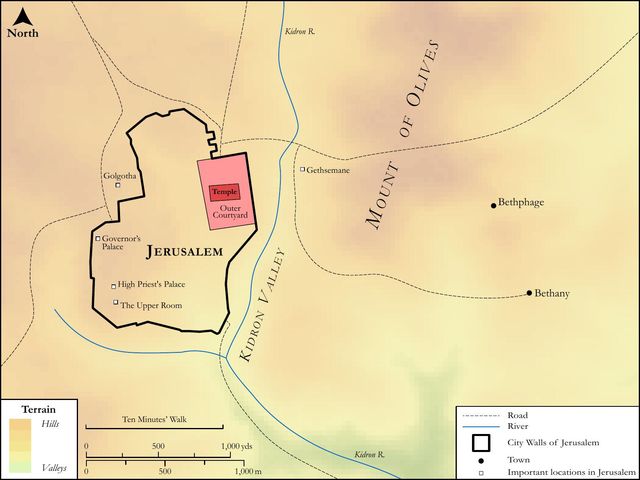
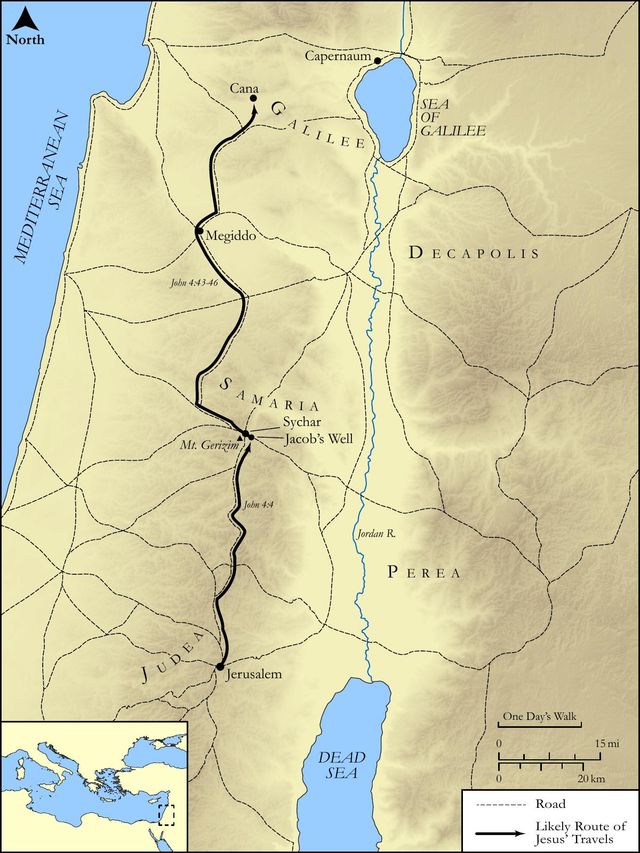
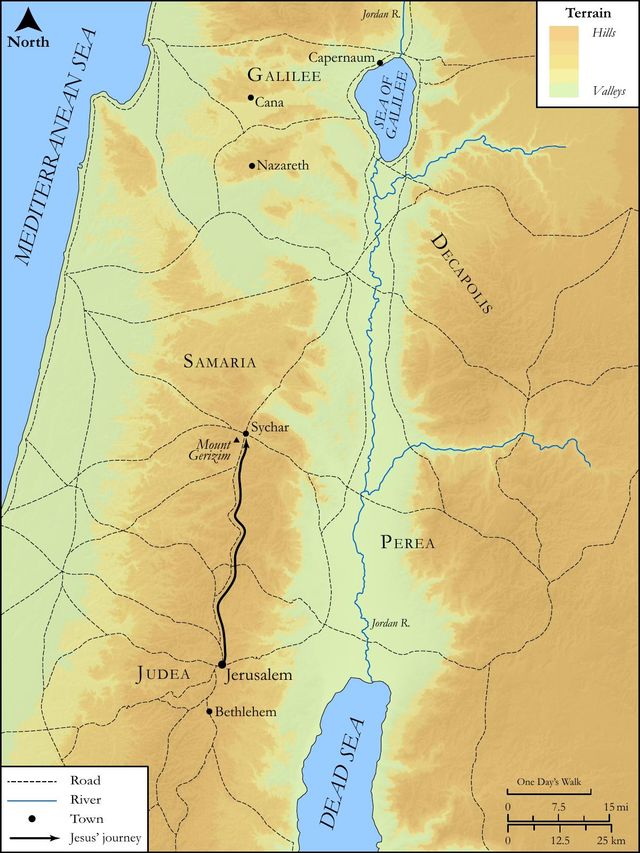
See on the biblical-era maps
Study this verse
Public-domain commentary
Matthew Henry
From his Commentary on the Whole Bible. Henry comments on passages, not single verses — this entry covers John 4:27–42. His four-level outline is real structure in the source text, so it is rendered as structure.
We have here the remainder of the story of what happened when Christ was in Samaria, after the long conference he had with the woman.
I.The interruption given to this discourse by the disciples' coming.
It is probable that much more was said than is recorded; but just when the discourse was brought to a head, when Christ had made himself known to her as the true Messiah, then came the disciples. The daughters of Jerusalem shall not stir up nor awake my love till he please.
1.They wondered at Christ's converse with this woman, marvelled that he talked thus earnestly (as perhaps they observed at a distance) with a woman, a strange woman alone (he used to be more reserved), especially with a Samaritan woman, that was not of the lost sheep of the house of Israel; they thought their Master should be as shy of the Samaritans as the other Jews were, at least that he should not preach the gospel to them. They wondered he should condescend to talk with such a poor contemptible woman, forgetting what despicable men they themselves were when Christ first called them into fellowship with himself.
2.Yet they acquiesced in it; they knew it was for some good reason, and some good end, of which he was not bound to give them an account, and therefore none of them asked, What seekest thou? or, Why talkest thou with her? Thus, when particular difficulties occur in the word and providence of God, it is good to satisfy ourselves with this in general, that all is well which Jesus Christ saith and doeth. Perhaps there was something amiss in their marveling that Christ talked with the woman: it was something like the Pharisees being offended at his eating with publicans and sinners. But, whatever they thought, they said nothing. If thou hast thought evil at any time, lay thy hand upon thy mouth, to keep that evil thought from turning into an evil word, Prov. xxx. 32; Ps. xxxix. 1-3.
The notice which the woman gave to her neighbours of the extraordinary person she had happily met with, v. 28, 29. Observe here,
1.How she forgot her errand to the well, v. 28. Therefore, because the disciples were come, and broke up the discourse, and perhaps she observed they were not pleased with it, she went her way. She withdrew, in civility to Christ, that he might have leisure to eat his dinner. She delighted in his discourse, but would not be rude; every thing is beautiful in its season. She supposed that Jesus, when he had dined, would go forward in his journey, and therefore hastened to tell her neighbours, that they might come quickly. Yet a little while is the light with you. See how she improved time; when one good work was done, she applied herself to another. When opportunities of getting good cease, or are interrupted, we should seek opportunities of doing good; when we have done hearing the word, then is a time to be speaking of it. Notice is taken of her leaving her water-pot or pail.
(1.)She left it in kindness to Christ, that he might have water to drink; he turned water into wine for others, but not for himself. Compare this with Rebecca's civility to Abraham's servant (Gen. xxiv. 18), and see that promise, Matt. x. 42.
(2.)She left it that she might make the more haste into the city, to carry thither these good tidings. Those whose business it is to publish the name of Christ must not encumber or entangle themselves with any thing that will retard or hinder them therein. When the disciples are to be made fishers of men they must forsake all.
(3.)She left her water-pot, as one careless of it, being wholly taken up with better things. Note, Those who are brought to the knowledge of Christ will show it by a holy contempt of this world and the things of it. And those who are newly acquainted with the things of God must be excused, if at first they be so taken up with the new world into which they are brought that the things of this world seem to be for a time wholly neglected. Mr. Hildersham, in one of his sermons on this verse, from this instance largely justifies those who leave their worldly business on week-days to go to hear sermons.
2.How she minded her errand to the town, for her heart was upon it. She went into the city, and said to the men, probably the aldermen, the men in authority, whom, it may be, she found met together upon some public business; or to the men, that is, to every man she met in the streets; she proclaimed it in the chief places of concourse: Come, see a man who told me all things that ever I did. Is not this the Christ? Observe,
(1.)How solicitous she was to have her friends and neighbours acquainted with Christ. When she had found that treasure, she called together her friends and neighbours (as Luke xv. 9), not only to rejoice with her, but to share with her, knowing there was enough to enrich herself and all that would partake with her. Note, They that have been themselves with Jesus, and have found comfort in him, should do all they can to bring others to him. Has he done us the honour to make himself known to us? Let us do him the honour to make him known to others; nor can we do ourselves a greater honour. This woman becomes an apostle. Quæ scortum fuerat egressa, regreditur magistra evangelica—She who went forth a specimen of impurity returns a teacher of evangelical truth, saith Aretius. Christ had told her to call her husband, which she thought was warrant enough to call every body. She went into the city, the city where she dwelt, among her kinsfolks and acquaintance. Though every man is my neighbour that I have opportunity of doing good to, yet I have most opportunity, and therefore lie under the greatest obligations, to do good to those that live near me. Where the tree falls, there let it be made useful.
(2.)How fair and ingenuous she was in the notice she gave them concerning this stranger she had met with.
[1.]She tells them plainly what induced her to admire him: He has told me all things that ever I did. No more is recorded than what he told her of her husbands; but it is not improbable that he had told her of more of her faults. Or, his telling her that which she knew he could not by any ordinary means come to the knowledge of convinced her that he could have told her all that she ever did. If he has a divine knowledge, it must be omniscience. He told her that which none knew but God and her own conscience. Two things affected her:—First, the extent of his knowledge. We ourselves cannot tell all things that ever we did (many things pass unheeded, and more pass away and are forgotten); but Jesus Christ knows all the thoughts, words, and actions, of all the children of men; see Heb. iv. 13. He hath said, I know thy works. Secondly, The power of his word. This made a great impression upon her, that he told her her secret sins with such an unaccountable power and energy that, being told of one, she is convinced of all, and judged of all. She does not say, "Come, see a man that has told me strange things concerning religious worship, and the laws of it, that has decided the controversy between this mountain and Jerusalem, a man that calls himself the Messias;" but, "Come see a man that has told me of my sins." She fastens upon that part of Christ's discourse which one would think she would have been most shy of repeating; but experimental proofs of the power of Christ's word and Spirit are of all others the most cogent and convincing; and that knowledge of Christ into which we are led by the conviction of sin and humiliation is most likely to be sound and saving.
[2.]She invites them to come and see him of whom she had conceived so high an opinion. Not barely, "Come and look upon him" (she does not invite them to him as a show), but, "Come and converse with him; come and hear his wisdom, as I have done, and you will be of my mind." She would not undertake to manage the arguments which had convinced her, in such a manner as to convince others; all that see the evidence of truth themselves are not able to make others see it; but, "Come, and talk with him, and you will find such a power in his word as far exceeds all other evidence." Note, Those who can do little else towards the conviction and conversion of others may and should bring them to those means of grace which they themselves have found effectual. Jesus was now at the town's end. "Now come see him." When opportunities of getting the knowledge of God are brought to our doors we are inexcusable if we neglect them; shall we not go over the threshold to see him whose day prophets and kings desired to see?
[3.]She resolves to appeal to themselves, and their own sentiments upon the trial. Is not this the Christ? She does not peremptorily say, "He is the Messiah," how clear soever she was in her own mind, and yet she very prudently mentions the Messiah, of whom otherwise they would not have thought, and then refers it to themselves; she will not impose her faith upon them, but only propose it to them. By such fair but forcible appeals as these men's judgments and consciences are sometimes taken hold of ere they are aware.
(3.)What success she had in this invitation: They went out of the city, and came to him, v. 30. Though it might seem very improbable that a woman of so small a figure, and so ill a character, should have the honour of the first discovery of the Messiah among the Samaritans, yet it pleased God to incline their hearts to take notice of her report, and not to slight it as an idle tale. Time was when lepers were the first that brought tidings to Samaria of a great deliverance, 2 Kings vii. 3, &c. They came unto him; did not send for him into the city to them, but in token of their respect to him, and the earnestness of their desire to see him, they went out to him. Those that would know Christ must meet him where he records his name.
III.Christ's discourse with his disciples while the woman was absent, v.
31-38. See how industrious our Lord Jesus was to redeem time, to husband every minute of it, and to fill up the vacancies of it. When the disciples were gone into the town, his discourse with the woman was edifying, and suited to her case; when she was gone into the town, his discourse with them was no less edifying, and suited to their case; it were well if we could thus gather up the fragments of time, that none of it may be lost. Two things are observable in this discourse:—
1.How Christ expresses the delight which he himself had in his work. His work was to seek and save that which was lost, to go about doing good. Now with this work we here find him wholly taken up. For,
(1.)He neglected his meat and drink for his work. When he sat down upon the well, he was weary, and needed refreshment; but this opportunity of saving souls made him forget his weariness and hunger. And he minded his food so little that,
[1.]His disciples were forced to invite him to it: They prayed him, they pressed him, saying, Master, eat. It was an instance of their love to him that they invited him, lest he should be faint and sick for want of some support; but it was a greater instance of his love to souls that he needed invitation. Let us learn hence a holy indifference even to the needful supports of life, in comparison with spiritual things.
[2.]He minded it so little that they suspected he had had meat brought him in their absence (v. 33): Has any man brought him aught to eat? He had so little appetite for his dinner that they were ready to think he had dined already. Those that make religion their business will, when any of its affairs are to be attended, prefer them before their food; as Abraham's servant, that would not eat till he had told his errand (Gen. xxiv. 33), and Samuel, that would not sit down till David was anointed, 1 Sam. xvi. 11.
(2.)He made his work his meat and drink. The work he had to do among the Samaritans, the prospect he now had of doing good to many, this was meat and drink to him; it was the greatest pleasure and satisfaction imaginable. Never did a hungry man, or an epicure, expect a plentiful feast with so much desire, nor feed upon its dainties with so much delight, as our Lord Jesus expected and improved an opportunity of doing good to souls. Concerning this he saith,
[1.]That it was such meat as the disciples knew not of. They did not imagine that he had any design or prospect of planting his gospel among the Samaritans; this was a piece of usefulness they never thought of. Note, Christ by his gospel and Spirit does more good to the souls of men than his own disciples know of or expect. This may be said of good Christians too, who live by faith, that they have meat to eat which others know not of, joy with which a stranger does not intermeddle. Now this word made them ask, Has any man brought him aught to eat? so apt were even his own disciples to understand him after a corporal and carnal manner when he used similitudes.
[2.]That the reason why his work was his meat and drink was because it was his Father's work, his Father's will: My meat is to do the will of him that sent me, v. 34. Note, First, The salvation of sinners is the will of God, and the instruction of them in order thereunto is his work. See 1 Tim. ii. 4. There is a chosen remnant whose salvation is in a particular manner his will. Secondly, Christ was sent into the world on this errand, to bring people to God, to know him and to be happy in him. Thirdly, He made this work his business and delight. When his body needed food, his mind was so taken up with this that he forgot both hunger and thirst, both meat and drink. Nothing could be more grateful to him than doing good; when he was invited to meat he went, that he might do good, for that was his meat always. Fourthly, He was not only ready upon all occasions to go to his work, but he was earnest and in care to go through it, and to finish his work in all the parts of it. He resolved never to quit it, nor lay it down, till he could say, It is finished. Many have zeal to carry them out at first, but not zeal to carry them on to the last; but our Lord Jesus was intent upon finishing his work. Our Master has herein left us an example, that we may learn to do the will of God as he did; 1. With diligence and close application, as those that make a business of it. 2. With delight and pleasure in it, as in our element. 3. With constancy and perseverance; not only minding to do, but aiming to finish, our work.
2.See here how Christ, having expressed his delight in his work, excites his disciples to diligence in their work; they were workers with him, and therefore should be workers like him, and make their work their meat, as he did. The work they had to do was to preach the gospel, and to set up the kingdom of the Messiah. Now this work he here compares to harvest work, the gathering in of the fruits of the earth; and this similitude he prosecutes throughout the discourse, v. 35-38. Note, gospel time is harvest time, and gospel work harvest work. The harvest is before appointed and expected; so was the gospel. Harvest time is busy time; all hands must be then at work: every one must work for himself, that he may reap of the graces and comforts of the gospel: ministers must work for God, to gather in souls to him. Harvest time is opportunity, a short and limited time, which will not last always; and harvest work is work that must be done then or not at all; so the time of the enjoyment of the gospel is a particular season, which must be improved for its proper purposes; for, once past, it cannot be recalled. The disciples were to gather in a harvest of souls for Christ. Now he here suggests three things to them to quicken them to diligence:—
(1.)That it was necessary work, and the occasion for it very urgent and pressing (v. 35): You say, It is four months to harvest; but I say, The fields are already white. Here is,
[1.]A saying of Christ's disciples concerning the corn-harvest; there are yet four months, and then comes harvest, which may be taken either generally—"You say, for the encouragement of the sower at seed-time, that it will be but four months to the harvest." With us it is but about four months between the barley-sowing and the barley-harvest, probably it was so with them as to other grain; or, "Particularly, now at this time you reckon it will be four months to next harvest, according to the ordinary course of providence." The Jews' harvest began at the Passover, about Easter, much earlier in the year than ours, by which it appears that this journey of Christ from Judea to Galilee was in the winter, about the end of November, for he travelled all weathers to do good. God has not only promised us a harvest every year, but has appointed the weeks of harvest; so that we know when to expect it, and take our measures accordingly.
[2.]A saying of Christ's concerning the gospel harvest; his heart was as much upon the fruits of his gospel as the hearts of others were upon the fruits of the earth; and to this he would lead the thoughts of his disciples: Look, the fields are already white unto the harvest. First, Here in this place, where they now were, there was harvest work for him to do. They would have him to eat, v. 31. "Eat!" saith he, "I have other work to do, that is more needful; look what crowds of Samaritans are coming out of the town over the fields that are ready to receive the gospel;" probably there were many now in view. People's forwardness to hear the word is a great excitement to ministers' diligence and liveliness in preaching it. Secondly, In other places, all the country over, there was harvest work enough for them all to do. "Consider the regions, think of the state of the country, and you will find there are multitudes as ready to receive the gospel as a field of corn that is fully ripe is ready to be reaped." The fields were now made white to the harvest, 1. By the decree of God revealed in the prophecies of the Old Testament. Now was the time when the gathering of the people should be to Christ ( Gen. xlix. 10), when great accessions should be made to the church and the bounds of it should be enlarged, and therefore it was time for them to be busy. It is a great encouragement to us to engage in any work for God, if we understand by the signs of the times that this is the proper season for that work, for then it will prosper. 2. By the disposition of men. John Baptist had made ready a people prepared for the Lord, Luke i. 17. Since he began to preach the kingdom of God every man pressed into it, Luke xvi. 16. This, therefore, was a time for the preachers of the gospel to apply themselves to their work with the utmost vigour, to thrust in their sickle, when the harvest was ripe, Rev. xiv. 15. It was necessary to work now, pity that such a season should be let slip. If the corn that is ripe be not reaped, it will shed and be lost, and the fowls will pick it up. If souls that are under convictions, and have some good inclinations, be not helped now, their hopeful beginnings will come to nothing, and they will be a prey to pretenders. It was also easy to work now; when the people's hearts are prepared the work will be done suddenly, 2 Chron. xxix. 36. It cannot but quicken ministers to take pains in preaching the word when they observe that people take pleasure in hearing it.
(2.)That it was profitable and advantageous work, which they themselves would be gainers by (v. 36): "He that reapeth receiveth wages, and so shall you." Christ has undertaken to pay those well whom he employs in his work; for he will never do as Jehoiakim did, who used his neighbour's service without wages (Jer. xxii. 13), or those who by fraud kept back the hire of those particularly who reaped their corn-fields, Jam. v. 4. Christ's reapers, though they cry to him day and night, shall never have cause to cry against him, nor to say they served a hard Master. He that reapeth, not only shall but does receive wages. There is a present reward in the service of Christ, and his work is its own wages.
[1.]Christ's reapers have fruit: He gathereth fruit unto life eternal; that is, he shall both save himself and those that hear him, 1 Tim. iv. 16. If the faithful reaper save his own soul, that is fruit abounding to his account, it is fruit gathered to life eternal; and if, over and above this, he be instrumental to save the souls of others too, there is fruit gathered. Souls gathered to Christ are fruit, good fruit, the fruit that Christ seeks for (Rom. i. 13); it is gathered for Christ (Cant. viii. 11, 12); it is gathered to life eternal. This is the comfort of faithful ministers, that their work has a tendency to the eternal salvation of precious souls.
[2.]They have joy: That he that sows and they that reap may rejoice together. The minister who is the happy instrument of beginning a good work is he that sows, as John Baptist; he that is employed to carry it on and perfect it is he that reaps: and both shall rejoice together. Note, First, Though God is to have all the glory of the success of the gospel, yet faithful ministers may themselves take the comfort of it. The reapers share in the joy of harvest, though the profits belong to the master, 1 Thess. ii. 19. Secondly, Those ministers who are variously gifted and employed should be so far from envying one another that they should rather mutually rejoice in each other's success and usefulness. Though all Christ's ministers are not alike serviceable, nor alike successful, yet, if they have obtained mercy of the Lord to be faithful, they shall all enter together into the joy of their Lord at last.
(3.)That it was easy work, and work that was half done to their hands by those that were gone before them: One soweth, and another reapeth, v. 37, 38. This sometimes denotes a grievous judgment upon him that sows, Mic. vi. 15; Deut. xxviii. 30, Thou shalt sow, and another shall reap; as Deut. vi. 11, Houses full of all good things, which thou filledst not. So here. Moses, and the prophets, and John Baptist, had paved the way to the gospel, had sown the good seed which the New-Testament ministers did in effect but gather the fruit of. I send you to reap that whereon you bestowed, in comparison, no labour. Isa. xl. 3-5.
[1.]This intimates two things concerning the Old-Testament ministry:—First, That it was very much short of the New-Testament ministry. Moses and the prophets sowed, but they could not be said to reap, so little did they see of the fruit of their labours. Their writings have done much more good since they left us than ever their preaching did. Secondly, That it was very serviceable to the New-Testament ministry, and made way for it. The writings of the prophets, which were read in the synagogues every sabbath day, raised people's expectations of the Messiah, and so prepared them to bid him welcome. Had it not been for the seed sown by the prophets, this Samaritan woman could not have said, We know that Messias cometh. The writings of the Old Testament are in some respects more useful to us than they could be to those to whom they were first written, because better understood by the accomplishment of them. See 1 Pet. i. 12; Heb. iv. 2; Rom. xvi. 25, 26.
[2.]This also intimates two things concerning the ministry of the apostles of Christ. First, That it was a fruitful ministry: they were reapers that gathered in a great harvest of souls to Jesus Christ, and did more in seven years towards the setting up of the kingdom of God among men than the prophets of the Old Testament had done in twice so many ages. Secondly, That it was much facilitated, especially among the Jews, to whom they were first sent, by the writings of the prophets. The prophets sowed in tears, crying out, We have laboured in vain; the apostles reaped in joy, saying, Thanks be to God, who always causeth us to triumph. Note, From the labours of ministers that are dead and gone much good fruit may be reaped by the people that survive them and the ministers that succeed them. John Baptist, and those that assisted him, had laboured, and the disciples of Christ entered into their labours, built upon their foundation, and reaped the fruit of what they sowed. See what reason we have to bless God for those that are gone before us, for their preaching and their writing, for what they did and suffered in their day, for we are entered into their labours; their studies and services have made our work the easier. And when the ancient and modern labourers, those that came into the vineyard at the third hour and those that came in at the eleventh, meet in the day of account, they will be so far from envying one another the honour of their respective services that both they that sowed and they that reaped shall rejoice together; and the great Lord of thee harvest shall have the glory of all.
IV.The good effect which this visit Christ made to the Samaritans (en passant) had upon them, and the fruit which was now presently gathered among them, v. 39-42. See what impressions were made on them,
1.By the woman's testimony concerning Christ; though a single testimony, and of one of no good report, and the testimony no more than this, He told me all that ever I did, yet it had a good influence upon many. One would have thought that his telling the woman of her secret sins would have made them afraid of coming to him, lest he should tell them also of their faults; but they will venture that rather than not be acquainted with one who they had reason to think was a prophet. And two things they were brought to:—
(1.)To credit Christ's word (v. 39): Many of the Samaritans of that city believed on him for the saying of the woman. So far they believed on him that they took him for a prophet, and were desirous to know the mind of God from him; this is favourably interpreted as believing on him. Now observe,
[1.]Who they were that believed: Many of the Samaritans, who were not of the house of Israel. Their faith was not only an aggravation of the unbelief of the Jews, from whom better might have been expected, but an earnest of the faith of the Gentiles, who would welcome that which the Jews rejected.
[2.]Upon what inducement they believed: For the saying of the woman. See here, First, How God is sometimes pleased to use very weak and unlikely instruments for the beginning and carrying on of a good work. A little maid directed a great prince to Elisha, 2 Kings v. 2. Secondly, How great a matter a little fire kindles. Our Saviour, by instructing one poor woman, spread instruction to a whole town. Let not ministers be either careless in their preaching, or discouraged in it, because their hearers are few and mean; for, by doing good to them, good may be conveyed to more, and those that are more considerable. If they teach every man his neighbour, and every man his brother, a great number may learn at second hand. Philip preached the gospel to a single gentleman in his chariot upon the road, and he not only received it himself, but carried it into his country, and propagated it there. Thirdly, See how good it is to speak experimentally of Christ and the things of God. This woman could say little of Christ, but what she did say she spoke feelingly: He told me all that ever I did. Those are most likely to do good that can tell what God has done for their souls, Ps. lxvi. 16.
(2.)They were brought to court his stay among them (v. 40): When they were come to him they besought him that he would tarry with them. Upon the woman's report, they believed him to be a prophet, and came to him; and, when they saw him, the meanness of his appearance and the manifest poverty of his outward condition did not lessen their esteem of him and expectations from him, but still they respected him as a prophet. Note, There is hope of those who are got over the vulgar prejudices that men have against true worth in a low estate. Blessed are they that are not offended in Christ at the first sight. So far were they from being offended in him that they begged he would tarry with them;
[1.]That they might testify their respect to him, and treat him with the honour and kindness due to his character. God's prophets and ministers are welcome guests to all those who sincerely embrace the gospel; as to Lydia, Acts xvi. 15.
[2.]That they might receive instruction from him. Those that are taught of God are truly desirous to learn more, and to be better acquainted with Christ. Many would have flocked to one that would tell them their fortune, but these flocked to one that would tell them their faults, tell them of their sin and duty. The historian seems to lay an emphasis upon their being Samaritans; as Luke x. 33; xvii. 16. The Samaritans had not that reputation for religion which the Jews had; yet the Jews, who saw Christ's miracles, drove him from them: while the Samaritans, who saw not his miracles, nor shared in his favours, invited him to them. The proof of the gospel's success is not always according to the probability, nor what is experienced according to what is expected either way. The Samaritans were taught by the custom of their country to be shy of conversation with the Jews. There were Samaritans that refused to let Christ go through their town (Luke ix. 53), but these begged him to tarry with them. Note, It adds much to the praise of our love to Christ and his word if it conquers the prejudices of education and custom, and sets light by the censures of men. Now we are told that Christ granted their request.
First, He abode there. Though it was a city of the Samaritans nearly adjoining to their temple, yet, when he was invited, he tarried there; though he was upon a journey, and had further to go, yet, when he had an opportunity of doing good, he abode there. That is no real hindrance which will further our account. Yet he abode there but two days, because he had other places to visit and other work to do, and those two days were as many as came to the share of this city, out of the few days of our Saviour's sojourning upon earth.
Secondly, We are told what impressions were made upon them by Christ's own word, and his personal converse with them (v. 41, 42); what he said and did there is not related, whether he healed their sick or no; but it is intimated, in the effect, that he said and did that which convinced them that he was the Christ; and the labours of a minister are best told by the good fruit of them. Their hearing of him had a good effect, but now their eyes saw him; and the effect was, 1. That their number grew (v. 41): Many more believed: many that would not be persuaded to go out of the town to him were yet wrought upon, when he came among them, to believe in him. Note, It is comfortable to see the number of believers; and sometimes the zeal and forwardness of some may be a means to provoke many, and to stir them up to a holy emulation, Rom. xi. 14. 2. That their faith grew. Those who had been wrought upon by the report of the woman now saw cause to say, Now we believe, not because of thy saying, v. 42. Here are three things in which their faith grew:—(1.) In the matter of it, or that which they did believe. Upon the testimony of the woman, they believed him to be a prophet, or some extraordinary messenger from heaven; but now that they have conversed with him they believe that he is the Christ, the Anointed One, the very same that was promised to the fathers and expected by them, and that, being the Christ, he is the Saviour of the world; for the work to which he was anointed was to save his people from their sins. They believed him to be the Saviour not only of the Jews, but of the world, which they hoped would take them in, though Samaritans, for it was promised that he should be Salvation to the ends of the earth, Isa. xlix. 6. (2.) In the certainty of it; their faith now grew up to a full assurance: We know that this is indeed the Christ; alethos—truly; not a pretended Christ, but a real one; not a typical Saviour, as many under the Old Testament, but truly one. Such an assurance as this of divine truths is what we should labour after; not only, We think it probable, and are willing to suppose that Jesus may be the Christ, but, We know that he is indeed the Christ. (3.) In the ground of it, which was a kind of spiritual sensation and experience: Now we believe, not because of thy saying, for we have heard him ourselves. They had before believed for her saying, and it was well, it was a good step; but now they find further and much firmer footing for their faith: "Now we believe because we have heard him ourselves, and have heard such excellent and divine truths, accompanied with such commanding power and evidence, that we are abundantly satisfied and assured that this is the Christ." This is like what the queen of Sheba said of Solomon (1 Kings x. 6, 7): The one half was not told me. The Samaritans, who believed for the woman's saying, now gained further light; for to him that hath shall be given; he that is faithful in a little shall be trusted with more. In this instance we may see how faith comes by hearing. [1.] Faith comes to the birth by hearing the report of men. These Samaritans, for the sake of the woman's saying, believed so far as to come and see, to come and make trial. Thus the instructions of parents and preachers, and the testimony of the church and our experienced neighbours, recommend the doctrine of Christ to our acquaintance, and incline us to entertain it as highly probable. But, [2.] Faith comes to its growth, strength, and maturity, by hearing the testimony of Christ himself; and this goes further, and recommends his doctrine to our acceptance, and obliges us to believe it as undoubtedly certain. We were induced to look into the scriptures by the saying of those who told us that in them they had found eternal life; but when we ourselves have found it in them too, have experienced the enlightening, convincing, regenerating, sanctifying, comforting, power of the word, now we believe, not for their saying, but because we have searched them ourselves: and our faith stands not in the wisdom of men, but in the power of God, 1 Cor. ii. 5; 1 John v. 9, 10.
Historical interpretation
Four Centuries of Reception
5 surviving comments on this verse. Each one is dated, so this reads as a timeline rather than a list.
Select a marker to jump to its quote. Markers stagger vertically where authors wrote within a few decades of each other.
So kindled was she by His words, that she left her water pot and the purpose for which she came, ran into the city, and drew all the people to Jesus. "Come," she saith, "see a Man which told me all things that ever I did."
Observe her zeal and wisdom. She came to draw water, and when she had lighted upon the true Well, she after that despised the material one; teaching us even by this trifling instance when we are listening to spiritual matters to overlook the things of this life, and make no account of them. For what the Apostles did, that, after her ability, did this woman also. They when they were called, left their nets; she of her own accord, without the command of any, leaves her water pot, and winged by joy performs the office of Evangelists. And she calls not one or two, as did Andrew and Philip, but having aroused a whole city and people, so brought them to Him.
Observe too how prudently she speaks; she said not, "Come and see the Christ," but with the same condescension by which Christ had netted her she draws the men to Him; "Come," she saith, "see a Man who told me all that ever I did." She was not ashamed to say that He "told me all that ever I did." Yet she might have spoken otherwise, "Come, see one that prophesieth"; but when the soul is inflamed with holy fire, it looks then to nothing earthly, neither to glory nor to shame, but belongs to one thing alone, the flame which occupieth it.
"Is not this the Christ?" Observe again here the great wisdom of the woman; she neither declared the fact plainly, nor was she silent, for she desired not to bring them in by her own assertion, but to make them to share in this opinion by hearing Him; which rendered her words more readily acceptable to them. Yet He had not told all her life to her, only from what had been said she was persuaded as to the rest. Nor did she say, "Come, believe," but, "Come, see"; a gentler expression than the other, and one which more attracted them. Seest thou the wisdom of the woman? She knew, she knew certainly that having but tasted that Well, they would be affected in the same manner as herself. Yet any one of the grosser sort would have concealed the reproof which Jesus had given; but she parades her own life, and brings it forward before all men, so as to attract and capture all.
(Hom. xxxiv. 1) As the Apostles, on being called, left their nets, so does she leave her waterpot, to do the work of an Evangelist, by calling not one person, but a whole city: She went her way into the city, and saith to the men, Come, see a man which told me all things that ever I did: is not this the Christ?
(Hom. xxxiv. 1) She was not prevented by shame-facedness from spreading about what had been said to her. For the soul, when it is once kindled by the divine flame, regards neither glory, nor shame, nor any other earthly thing, only the flame which consumes it. But she did not wish them to trust to her own report only, but to come and judge of Christ for themselves. Come, see a man, she says. She does not say, Come and believe, but, Come and see; which is an easier matter. For well she knew that if they only tasted of that well, they would feel as she did.
(Hom. xxxiv. 1) She then neither openly preaches Christ, nor wholly omits Him, but says, Is not this the Christ? This wakened their attention, Then they went out of the city, and came unto Him.
Throwing her burden away, to make known Christ, "she ran to the city, and says to those men. Come, and see a man that told me all things that ever I did." Step by step, lest those men should get angry and indignant, and should persecute her. "Is this Christ?"
O wondrous change! O truly great and God-befitting Might, translucent with unspeakable marvel! Skilful workwoman unto doctrine, and initiater is she, who understood none of the things that were said at first, and therefore rightly heard, Go, call thy husband and come hither. For see how skilfully she conversed with the Samaritans. She does not say at once that she has found the Christ, nor does she introduce Jesus at first into her account. For rightly would she have been rejected, as far surpassing the measure of words befitting her, finding her hearers not ignorant of her habits. She first then prepares the way for this wonder, and having first astonished them with the miracle, makes the way smoother, so to say, to the faith. Come and see, she wisely says; all but crying aloud with more earnest voice, Sight alone will suffice to belief, and will assure those present with its more note-worthy marvels. For He Who knoweth the hidden things, and hath this great and God-befitting dignity, how shall He not speed with prosperous course to the fulfilment of those things which He willeth?
It is only by degrees, however, that she comes to the preaching of Christ. First she calls Him a man, not Christ; for fear those who heard her might be angry, and refuse to come.
Continue studying John 4:29 across the web’s major study libraries — every link below opens this exact verse, chapter, or book on the destination site.
Read & Compare
 BibleGatewayThis verse in more than 200 translations and 70 languages.
 Bible.comThe YouVersion reader — hundreds of translations, reading plans, and highlights.
 ESV.orgCrossway's official English Standard Version reader.
 NET BibleThe NET translation with 60,000+ translators' notes on every rendering decision.
 STEP BibleTyndale House's free study tool — original text, vocabulary, and scholarly resources.
 BibliaLogos Bible Software's free web reader.
 USCCBThe New American Bible (Revised Edition) with the U.S. bishops' study notes.
Commentaries
 BibleHub CommentariesDozens of classic commentaries on this verse, gathered on one page.
 StudyLightMore than 100 commentary sets — the largest collection on the web.
 BibleRefPlain-English commentary on what this verse means, verse by verse.
 Enduring WordDavid Guzik's free commentary on this chapter, widely used by Bible teachers.
 Bible Study ToolsVerse commentary alongside Greek and Hebrew study aids.
Original Language & Research
- BibleHub InterlinearThe verse word by word — original language, transliteration, and English.
- BibleHub LexiconEvery word's original-language definition and Strong's entry.
 Blue Letter BibleDeep-study tools — Strong's numbers, concordance, and word studies.
 CNTR CollationThe earliest Greek manuscripts of this verse, collated letter by letter.
Sermons, Hymns & Audio


TrulyRandomVerse is not affiliated with these sites and doesn’t control their content. They’re linked because they’re genuinely useful.
Summary
John 4:29 captures the Samaritan woman's immediate and profound transformation after her encounter with Jesus at Jacob's Well. Overwhelmed by His supernatural insight into her past, she rushes back to her town, not with shame, but with an urgent, compelling invitation to her community to "Come, see a man," culminating in the pivotal question, "is not this the Christ?" This verse marks her transition from a private seeker to a public herald, demonstrating the irresistible power of divine revelation and the dawning recognition of Jesus' messianic identity.
Context
ShowHideLiterary Context
This verse serves as the climactic turning point in the extended narrative of Jesus' encounter with the Samaritan woman, detailed in John 4:1-42. Following Jesus' revelation of her personal history in John 4:16-18, the woman's initial skepticism and theological questions give way to profound conviction. Her immediate departure from the well, leaving her waterpot behind as mentioned in John 4:28, signifies the overwhelming urgency of her discovery. This verse is the direct catalyst for the subsequent events, where many Samaritans come to believe in Jesus because of her testimony, as recorded in John 4:39-42.
Historical & Cultural Context
The interaction between Jesus and the Samaritan woman was culturally revolutionary. Jews and Samaritans had deep-seated ethnic and religious animosity, stemming from historical conflicts and differing views on proper worship, as highlighted in John 4:9 and John 4:20. Furthermore, a Jewish man speaking to a Samaritan woman, especially one with her social standing (implied by her multiple husbands), was highly unconventional. Her public testimony, despite her past, demonstrates the universal reach of Jesus' ministry and the power of personal transformation to overcome societal stigmas. The expectation of the Messiah, or "Christ," was prevalent among both Jews and Samaritans, though their understanding of His role might have differed.
Key Themes
ShowHideJohn 4:29 powerfully encapsulates several key themes central to the Gospel of John. It highlights Divine Revelation, as Jesus' supernatural knowledge of the woman's life serves as undeniable proof of His unique identity, transcending mere human understanding. This personal revelation leads directly to Messianic Recognition, as the woman moves from identifying Jesus as a prophet to questioning if He is the long-awaited Christ. The verse also underscores the theme of Urgent Witness and Evangelism, portraying the woman as an immediate and unashamed evangelist, demonstrating that a genuine encounter with Jesus naturally compels one to share the good news. Finally, it reinforces the theme of Breaking Down Barriers, as Jesus' ministry extends beyond traditional boundaries to embrace the lowly and unexpected, foreshadowing the universal scope of the gospel message found throughout John's Gospel, such as in John 3:16.
Exposition and Analysis
ShowHideKey Word Analysis
ShowHideThis imperative verb is an urgent summons, literally meaning "come hither!" or "come here!" It conveys a strong sense of invitation and immediacy, reflecting the woman's profound conviction and her desire for others to experience what she has. It's not a casual suggestion but a pressing call to action, urging her fellow townspeople to personally encounter the source of her revelation.
This verb signifies speaking or saying, often with the nuance of declaring or proclaiming. In this context, it emphasizes the authoritative and revelatory nature of Jesus' words. He didn't merely guess or deduce; He "told" her, implying a direct, accurate, and divinely-sourced disclosure of her hidden life, which was the basis of her conviction.
This is the Greek equivalent of the Hebrew "Messiah" (Mashiach), meaning "Anointed One." It refers to the long-awaited deliverer, king, and savior prophesied in the Old Testament. The woman's question, "is not this the Christ?", reveals a dawning realization of Jesus' ultimate identity, moving beyond prophet to the very fulfillment of Israel's deepest hopes. Her use of this term indicates a significant leap in her understanding of who Jesus is.
Verse Breakdown
ShowHide"Come, see a man,"
This is an urgent, direct invitation from the Samaritan woman to her townspeople. It's a call to observe and experience, not just to hear. The phrase "a man" is intentionally understated, contrasting with the profound revelation she has just received, creating a sense of intrigue and mystery that compels her audience to investigate.
"which told me all things that ever I did:"
This clause serves as the powerful evidence for her claim. The phrase "all things that ever I did" highlights Jesus' supernatural knowledge, encompassing the intimate and hidden details of her life, particularly her past relationships. This divine insight was the irrefutable proof for her, demonstrating that Jesus possessed more than human wisdom; He had divine omniscience.
"is not this the Christ?"
This is a rhetorical question, designed not for an answer from her audience, but to prompt them to consider the undeniable conclusion she has reached. The question implies a strong affirmative, conveying her newfound belief that Jesus is indeed the Messiah. It's a bold declaration cloaked in an inquiry, inviting her community to share in her dawning conviction and messianic hope.
Literary Devices
ShowHideThe verse powerfully employs several literary devices. The most prominent is the Rhetorical Question, "is not this the Christ?". This question is not posed to elicit information but to provoke thought and guide the audience to a specific conclusion. It acts as a powerful persuasive tool, inviting the listeners to consider the overwhelming evidence (Jesus' supernatural knowledge) and arrive at the same conviction as the woman. The phrase "Come, see a man" functions as an Exclamation or urgent Call to Action, conveying the woman's profound excitement and the immediacy of her desire to share her discovery. The contrast between the simple description "a man" and the profound claim "the Christ" creates Irony and Antithesis, subtly highlighting the extraordinary nature of Jesus, who appears ordinary yet possesses divine attributes. Finally, the entire verse serves as a powerful Personal Testimony, showcasing the transformative power of an encounter with Jesus and the natural overflow of conviction into evangelism.
Theological and Thematic Connections
ShowHideJohn 4:29 is a pivotal verse that bridges personal revelation with public proclamation, illustrating how a genuine encounter with Christ compels an immediate and unashamed witness. The woman's testimony highlights the unique way Jesus reveals Himself, not through abstract theology, but through intimate knowledge of an individual's life, leading to a profound conviction of His divine identity. Her question, "is not this the Christ?", is the natural outpouring of a heart awakened to the truth, demonstrating that the recognition of Jesus as Messiah is a deeply personal yet universally significant theological truth. Her willingness to share this, despite her past, underscores the transformative power of grace and the universal call to evangelism.
Reflection and Application
ShowHideThe Samaritan woman's response to Jesus offers a profound model for contemporary faith and evangelism. Her immediate, uninhibited testimony, despite her past and societal standing, reminds us that the most powerful witness often stems from a personal encounter with Jesus' transformative power. We don't need to be theological experts; our story of what Jesus has done in our lives is a compelling and undeniable truth. This verse challenges us to move beyond intellectual assent to a vibrant, urgent faith that naturally overflows into sharing the good news. It encourages us to embrace our own stories, recognizing that Jesus' grace covers our past and empowers us to be His witnesses, inviting others to "come and see" for themselves the One who knows all things and offers living water.
Questions for Reflection
ShowHideFAQ
ShowHideWhy did the woman emphasize that Jesus "told me all things that ever I did"?
ShowHideThe woman emphasized this because it was the irrefutable evidence of Jesus' divine knowledge and, consequently, His true identity. No ordinary man could have known the intimate details of her life, particularly her past relationships, as revealed in John 4:16-18. This revelation bypassed any need for theological debate or intellectual persuasion; it was a direct, supernatural insight that went straight to her heart and mind, convincing her that Jesus was more than a prophet—He was the Anointed One, the Christ. Her testimony was powerful precisely because it was based on an undeniable, personal experience of Jesus' omniscience.
Christ-Centered Fulfillment
ShowHideThe Samaritan woman's dawning realization in John 4:29 serves as a powerful foreshadowing of Christ's universal mission and identity. Her question, "is not this the Christ?", points directly to Jesus as the fulfillment of Old Testament prophecies concerning the Messiah, the Anointed One who would bring salvation. Jesus' ability to "tell her all things that ever I did" reveals His divine omniscience, a characteristic of God Himself, confirming His unique relationship with the Father as described in John 1:1-3. Her immediate and unashamed testimony, which leads many Samaritans to believe in Him, anticipates the Great Commission given to His disciples in Matthew 28:19-20 and the Spirit-empowered witness in Acts 1:8. Ultimately, her journey from an overlooked woman seeking water to a fervent evangelist proclaiming the "Saviour of the world" in John 4:42 beautifully illustrates how Jesus, the Christ, breaks down all barriers—ethnic, social, and moral—to offer living water and new life to all who believe in Him, fulfilling His purpose as the light of the world in John 8:12.