


1 Samuel 14:16
Bible text: King James Version (1769 Blayney text) · Public domain
Bible text: Berean Standard Bible · Public domain
Bible text: American Standard Version (1901) · Public domain
Bible text: World English Bible, Messianic edition · Public domain
Bible text: Geneva Bible (1599) · Public domain
Bible text: Young's Literal Translation · Public domain
- וַיִּרְאוּvai·yir·'Uand they sawH7200Conj-w ¦ V-Qal-ConsecImperf-3mpVerb Qal Consecutive Imperfect 3rd Plural Masculineוַandיִּרְאוּthey saw
- הַצֹּפִיםha·tzo·Fimthe watchmenH6822Art ¦ V-Qal-Prtcpl-mpVerb Qal Participle Plural Masculine Absoluteהַtheצֹּפִיםwatchmen
- לְשָׁאוּלle·sha·'Ulof SaulH7586Prep-l ¦ N-proper-mNoun Proper MasculineלְofשָׁאוּלSaul
- בְּגִבְעַתbe·giv·'Atat Gibeah ofH1390Prep-b ¦ N-fscNoun Singular Feminine ConstructבְּatגִבְעַתGibeah of
- בִּנְיָמִןbin·ya·MinBenjaminH1144N-proper-mNoun Proper Masculine
- וְהִנֵּהve·hi·Nehand there!H2009Conj-w ¦ PrtParticle Interjectionוְandהִנֵּהthere!
- הֶהָמוֹןhe·ha·Monthe multitudeH1995Art ¦ N-msNoun Singular Masculine Absoluteהֶtheהָמוֹןmultitude
- נָמוֹגna·Mogit melted awayH4127V-Niphal-Perf-3msVerb Niphal Perfect 3rd Singular Masculine
- וַיֵּלֶךְvai·Ye·lekhand it wentH1980Conj-w ¦ V-Qal-ConsecImperf-3msVerb Qal Consecutive Imperfect 3rd Singular Masculineוַandיֵּלֶךְit went
- וַהֲלֹםva·ha·Lomand hereH1988Conj-w ¦ AdvAdverbוַandהֲלֹםhere
English is a literal word-by-word gloss of the Hebrew, not the KJV's wording. Why?
This is the original text the KJV's translators worked from — each Hebrew word with its own literal English meaning in this verse, prepared by scholars at Tyndale House, Cambridge. The KJV translates whole sentences, not word by word, so its wording differs: one Hebrew word can become several English words, and the KJV may choose “the LORD” where the gloss reads “Yahweh”. Both are faithful — they answer different questions. For the KJV's own rendering, switch to the KJV text.
Details
See on the biblical-era map
Study this verse
Public-domain commentary
Matthew Henry
From his Commentary on the Whole Bible. Henry comments on passages, not single verses — this entry covers 1 Samuel 14:16–23. His three-level outline is real structure in the source text, so it is rendered as structure.
We have here the prosecution and improvement of the wonderful advantages which Jonathan and his armour-bearer gained against the Philistines.
I.The Philistines were, by the power of God, set against one another.
They melted away like snow before the sun, and went on beating down one another (Sa1 14:16), for (Sa1 14:20) every man's sword was against his fellow. When they fled for fear, instead of turning back upon those that chased them, they reckoned those only their enemies that stood in their way, and treated them accordingly. The Philistines were very secure, because all the swords and spears were in their hands. Israel had none except what Saul and Jonathan had. But now God showed them the folly of that confidence, by making their own swords and spears the instruments of their own destruction, and more fatal in their own hands than if they had been in the hands of Israel. See the like done, Jdg 7:22; Ch2 20:23.
II.The Israelites were hereby animated against them.
1.Notice was soon taken of it by the watchmen of Saul, those that stood sentinel at Gibeah, Sa1 14:16. They were aware that the host of the enemy was in great confusion, and that a great slaughter was made among them, and yet, upon search, they found none of their own forces absent, but only Jonathan and his servant (Sa1 14:17), which no doubt greatly animated them, and assured them that it could be no other than the Lord's doing, when there was no more of man's doing than what those two could do against a great host.
2.Saul began to enquire of God, but soon desisted. His spirit had not come down so far as to allow him to consult Samuel, though, it is probable, he was near him; for we read (Sa1 13:15) that he had come to Gibeah of Benjamin; but he called for the ark (Sa1 14:18), desiring to know whether it would be safe for him to attack the Philistines, upon the disorder they perceived them to be in. Many will consult God about their safety that would never consult him about their duty. But, perceiving by his scouts that the noise in the enemy's camp increased, he commanded the priest that officiated to break off abruptly: "Withdraw thy hand (Sa1 14:19), consult no more, wait no longer for an answer." He was very unwise indeed if (as some think) he forbade him to lift up his hands in prayer; for when Joshua was actually engaged with Amalek Moses continued still to lift up his hands. It is rather a prohibition to his enquiring of the Lord, either,
(1.)Because now he thought he did not need an answer, the case was plain enough. And yet the more evident it was that God did all the more reason he had to enquire whether he would give him leave to do any thing. Or,
(2.)Because now he would not stay for it; he was in such haste to fight a falling enemy that he would not stay to make and end of his devotions, nor hear what answer God would give him. A little thing will divert a vain and carnal mind from religious exercises. He that believeth will not make haste, such haste as this, nor reckon any business so urgent as not to allow time to take God along with him.
3.He, and all the little force he had, made a vigorous attack upon the enemy; and all the people were cried together (so the word is, Sa1 14:20), for want of the silver trumpets wherewith God appointed them to sound an alarm in the day of battle, Num 10:9. They summoned them together by shouting, and their number was not so great but that they might soon be got together. And now they seem bold and brave when the work is done to their hands. Our Lord Jesus had conquered our spiritual enemies, routed and dispersed them, so that we are cowards indeed if we will not stand to our arms when it is only to pursue the victory and to divide the spoil.
4.Every Hebrew, even those from whom one would least have expected it, now turned his hand against the Philistines.
(1.)Those that had deserted and gone over to the enemy, and were among them, now fought against them, Sa1 14:21. Some think, they were such as had been taken prisoners by them, and now they were goads in their sides. It rather seems that they went in to them voluntarily, but, now that they saw them falling, recovered the hearts of Israelites, and did valiantly for their country.
(2.)Those that had fled their colours, and hid themselves in the mountains, returned to their posts, and joined in with the pursuers (Sa1 14:22), hoping by their great zeal and officiousness, now that the danger was over and the victory sure, to atone for their former cowardice. It was not much to their praise to appear now, but it would have been more their reproach if they had not appeared. Those that are remiss and faint-hearted indeed that will not act in the cause of God when they see it victorious, as well as righteous. Thus all hands were at work against the Philistines, and every Israelite slew as many as he could, without sword or spear; yet it is said (Sa1 14:23), it was the Lord that saved Israel that day. He did it by them, for without him they could do nothing. Salvation is of the Lord.
Historical interpretation
Twelve Centuries of Reception
2 surviving comments on this verse. Each one is dated, so this reads as a timeline rather than a list.
Select a marker to jump to its quote. Markers stagger vertically where authors wrote within a few decades of each other.
And the watchmen of Saul look forth, etc. Those who have ascended the watchtower of holy Scripture look forth beyond others, and they are on the hill of the sons of the right hand, that is, established in the lofty citadel of heavenly deeds, and distinguished by evident pure knowledge and simple action, and they are the first to see the impending ruin and the flight of the wicked. For it is not for all Catholics, upon reading the books of heretics or pagans, to immediately recognize what error is contained in them; upon hearing the wiles of dialecticians, to immediately discern with the keenness of a sharp mind the ruinous snares of deceptions; but for those who, by long meditation on the Scriptures or by the merit of virtues, have exercised their senses for the discernment of good and evil; the feet of many almost slipped, and their steps were nearly poured out, because they were jealous of the sinners, seeing the peace of sinners. But that most noble watchman marvelously ascending to the hill of the son of the right hand, saw the ungodly exalted and lifted high above the cedars of Lebanon (Psalm 72). And I passed by, he said, and behold, he was not; and I sought him, and his place was not found (Psalm 36). And this is for the watchmen placed in Gibeah to see the multitude laid low, which those situated below and not yet ascending the peak of perfect knowledge, thought to stand in prosperity and to live in safety; the wise foresee the certain punishment of those living in wickedness.
The one perfectly divine thing, the one glimpse of God's paradise given on earth, is to fight a losing battle - and not lose it.
Continue studying 1 Samuel 14:16 across the web’s major study libraries — every link below opens this exact verse, chapter, or book on the destination site.
Read & Compare
 BibleGatewayThis verse in more than 200 translations and 70 languages.
 Bible.comThe YouVersion reader — hundreds of translations, reading plans, and highlights.
 ESV.orgCrossway's official English Standard Version reader.
 NET BibleThe NET translation with 60,000+ translators' notes on every rendering decision.
 STEP BibleTyndale House's free study tool — original text, vocabulary, and scholarly resources.
 BibliaLogos Bible Software's free web reader.
 USCCBThe New American Bible (Revised Edition) with the U.S. bishops' study notes.
Commentaries
 BibleHub CommentariesDozens of classic commentaries on this verse, gathered on one page.
 StudyLightMore than 100 commentary sets — the largest collection on the web.
 BibleRefPlain-English commentary on what this verse means, verse by verse.
 Enduring WordDavid Guzik's free commentary on this chapter, widely used by Bible teachers.
 Bible Study ToolsVerse commentary alongside Greek and Hebrew study aids.
Original Language & Research
- BibleHub InterlinearThe verse word by word — original language, transliteration, and English.
- BibleHub LexiconEvery word's original-language definition and Strong's entry.
 Blue Letter BibleDeep-study tools — Strong's numbers, concordance, and word studies.
 SefariaThe Hebrew text with Rashi and centuries of Jewish commentary.
Sermons, Hymns & Audio


TrulyRandomVerse is not affiliated with these sites and doesn’t control their content. They’re linked because they’re genuinely useful.
Summary
In 1 Samuel 14:16, the watchmen of King Saul, stationed at Gibeah of Benjamin, witness an astonishing and divinely orchestrated event: the vast Philistine army, previously a formidable threat, inexplicably disintegrates into utter chaos, with soldiers turning their weapons upon one another. This pivotal moment marks a dramatic turning point in the battle, revealing God's supernatural intervention in response to Jonathan's audacious faith, transforming a seemingly insurmountable Philistine advantage into a scene of self-destructive panic and rout, ultimately securing a miraculous deliverance for Israel.
Context
ShowHideLiterary Context
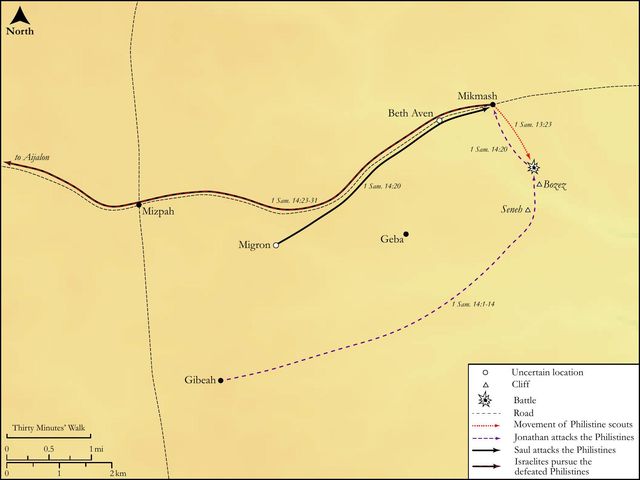
The narrative of 1 Samuel 14 unfolds amidst a period of severe Philistine oppression over Israel, a situation compounded by King Saul's spiritual decline and military paralysis. While Saul and his demoralized army are encamped at Gibeah, his son Jonathan, demonstrating profound and unconventional faith, takes matters into his own hands. Without informing his father, Jonathan, accompanied only by his armor-bearer, embarks on a daring, two-man assault against a Philistine garrison at Michmash. This audacious act, fueled by Jonathan's conviction that "there is no restraint to the LORD to save by many or by few", results in the slaying of about twenty Philistines. This initial, seemingly insignificant strike, however, is divinely amplified, sending a tremor of panic through the entire Philistine camp and setting the stage for the chaotic scene observed by Saul's watchmen in verse 16, which marks the full manifestation of God's intervention.
Historical & Cultural Context
At this point in Israel's history, the Philistines represented the dominant regional power, possessing a significant technological advantage due to their monopoly on iron weaponry, which they deliberately withheld from the Israelites (1 Samuel 13:19-22). This strategic disadvantage left Israel's army poorly equipped and frequently demoralized. The Philistines had established garrisons throughout Israelite territory, exerting control and demanding tribute, effectively subjugating the nascent Israelite monarchy. Gibeah of Benjamin, Saul's hometown and capital, was strategically located on a ridge overlooking the Wadi Suweinit, a natural defensive position that also served as a critical chokepoint for Philistine incursions into the central highlands. The Philistine army mentioned here was likely a large, well-organized force, intended to decisively crush any burgeoning Israelite rebellion under Saul, whose kingship was still relatively new and untested. The cultural context underscores the profound importance of divine intervention in warfare for Israel, as their military strength often paled in comparison to their enemies, making God's direct action their primary hope for deliverance.
Key Themes
ShowHideThis pivotal moment in 1 Samuel 14 powerfully illustrates several overarching themes central to the book and broader biblical narrative. Firstly, Divine Intervention is paramount; what began as a small, audacious act by Jonathan is supernaturally amplified by God, demonstrating His ability to deliver His people regardless of the odds. The Philistine rout is not merely a consequence of human strategy but a direct act of divine power, highlighting God's active involvement in the affairs of His people. Secondly, the Power of Faith is vividly displayed through Jonathan's unwavering trust in God's capacity to save "by many or by few" (1 Samuel 14:6). His courage and obedience serve as the catalyst for God's miraculous intervention, underscoring that genuine faith can ignite divine response. Lastly, the theme of Confusion Among the Enemy is prominent, as the Philistine multitude "melted away" and began "beating down one another." This self-destructive panic is a recurring motif in biblical accounts where God fights for Israel, seen similarly in the defeat of the Midianites by Gideon (Judges 7:22) and the Ammonites and Moabites in Jehoshaphat's time (2 Chronicles 20:23). This motif emphasizes God's sovereign ability to turn an enemy's strength into their own undoing.
Exposition and Analysis
ShowHideKey Word Analysis
ShowHideThis word refers to a "noise, tumult, crowd," or "abundance." In this context, it emphasizes the sheer numerical superiority and formidable presence of the Philistine army. The subsequent description of this vast "multitude" melting away highlights the dramatic and supernatural nature of their disintegration, transforming a powerful, intimidating force into a chaotic, self-destructive mob.
This primitive root means "to melt," "soften," "flow down," "disappear," or figuratively, "to fear" or "faint." Here, it vividly conveys a rapid, almost liquid-like disintegration of the Philistine forces, signifying a complete loss of cohesion, morale, and military discipline. It suggests a sudden, internal collapse rather than an orderly retreat, emphasizing the supernatural nature of their panic, as if their resolve and structure were dissolving under an unseen force.
A primitive root meaning "to strike down," "hammer," "stamp," "conquer," or "disband." In this verse, it describes the extreme disarray and self-destructive chaos that had gripped the Philistine army. It indicates that in their divinely induced panic and confusion, they were unable to distinguish friend from foe, actively attacking and killing their own comrades. This internal conflict rendered them militarily ineffective and highlights the depth of the divine confusion that had fallen upon them, turning their strength against themselves.
Verse Breakdown
ShowHide"And the watchmen of Saul in Gibeah of Benjamin looked"
This opening clause establishes the perspective from which the miraculous event is observed. Saul's watchmen, stationed at a strategic vantage point in Gibeah, are the first to witness the unfolding chaos. Their observation is crucial as it provides objective, external confirmation of the Philistines' disarray, validating the divine intervention that began with Jonathan's small act. It also sets up the dramatic irony, as Saul is unaware of Jonathan's actions, yet his men are seeing the direct result of God's hand at work.
"and, behold, the multitude melted away"
The interjection "behold" (וְהִנֵּה, wəhinnēh) draws immediate attention to the astonishing nature of what is seen. The "multitude" refers to the vast Philistine army, which had previously instilled fear in Israel. The phrase "melted away" (from the root mûwg) graphically portrays a sudden, inexplicable disintegration of their ranks, as if their collective strength and resolve were dissolving like wax. This signifies a supernatural panic, a loss of all military order and cohesion, rather than a tactical retreat.
"and they went on beating down [one another]"
This final clause describes the horrifying consequence of the Philistines' internal collapse. The phrase "beating down [one another]" (from the root hâlam) depicts a scene of utter self-destruction. In their divinely induced confusion, the Philistine soldiers turned their weapons on their own comrades, mistaking them for enemies. This internal slaughter not only decimated their numbers but also completely incapacitated their ability to fight, marking the decisive turning point in the battle and confirming God's direct hand in their defeat.
Literary Devices
ShowHideThe description in 1 Samuel 14:16 employs several powerful literary devices to convey the dramatic and supernatural nature of the Philistine rout. The phrase "the multitude melted away" is a striking example of Imagery and Metaphor, portraying the Philistine army not as a cohesive fighting force but as something dissolving and losing all form, like wax before a fire or snow in the sun. This vivid image emphasizes the suddenness and completeness of their internal collapse. The subsequent "beating down [one another]" uses Hyperbole to underscore the extreme and self-destructive chaos that gripped the enemy camp; while perhaps not every soldier literally struck another, the phrase powerfully conveys a state of total disarray where friendly fire and internal conflict dominated, rendering them utterly ineffective. Furthermore, this event serves as a significant Motif within the biblical narrative, where God causes confusion and internal strife among Israel's enemies as a means of divine deliverance, a pattern seen previously in the book of Judges and later in Chronicles, reinforcing the theological message that God fights for His people.
Theological and Thematic Connections
ShowHideThe scene in 1 Samuel 14:16 profoundly illustrates God's sovereign power to intervene in human affairs, demonstrating that His methods are often unexpected and His strength is made perfect in weakness. This divine confusion among the Philistines is a powerful theological statement: God does not always require Israel's military might or conventional strategy to secure victory; rather, He can turn the enemy's own strength and numbers against themselves. It underscores the principle that true victory belongs to the Lord, and human reliance on numbers or conventional warfare is secondary to divine favor and intervention. This event serves as a testament to God's faithfulness to His covenant people, even when their leaders, like Saul, falter. It highlights that God's plan of salvation and deliverance will not be thwarted, and He will act decisively to protect His purposes and His people, often in ways that defy human expectation.
Reflection and Application
ShowHideThe dramatic events of 1 Samuel 14:16 offer profound lessons for contemporary believers, reminding us that the God of Israel remains active and powerful in our lives. Just as Jonathan's seemingly insignificant act of faith ignited a divine response that shattered a formidable enemy, so too can our small acts of obedience and trust unleash God's mighty power in our personal battles and the broader spiritual warfare we face. This passage challenges us to look beyond overwhelming odds and human limitations, cultivating a radical dependence on God's supernatural intervention. It encourages us to step out in faith, even when circumstances seem dire or our resources meager, knowing that God delights in using the weak things of the world to confound the strong. When we face "multitudes" of challenges – whether personal struggles, spiritual attacks, or societal pressures – we are called to remember that God can cause confusion among our adversaries and bring about unexpected deliverance, turning chaos into victory for His glory. This narrative invites us to pray with bold expectation, believing that God can turn any situation on its head for the sake of His kingdom and His people.
Questions for Reflection
ShowHideFAQ
ShowHideWhat caused the Philistine army to "melt away" and turn on one another?
ShowHideThe text strongly implies divine intervention as the primary cause. While Jonathan's initial strike created a localized panic, the widespread, self-destructive chaos described in 1 Samuel 14:16 goes beyond natural military confusion. It is explicitly stated in the preceding verse that there was "a great trembling in the camp, in the field, and among all the people; the garrison and the raiding party also trembled; and the earth quaked. So it was a trembling from God" (1 Samuel 14:15). This is understood as a supernatural "panic from God," a direct act of God causing terror and disarray among His enemies. This is a recurring motif in the Old Testament, where God fights for Israel by causing their adversaries to turn on themselves, as seen in the accounts of Gideon and Jehoshaphat.
Why were Saul's watchmen the first to observe this, and what does it say about Saul's leadership?
ShowHideSaul's watchmen were positioned at Gibeah, a strategic vantage point atop a hill, making them ideally situated to observe the Philistine camp and the surrounding terrain. Their observation highlights Saul's passivity and reliance on conventional military intelligence, contrasting sharply with Jonathan's proactive faith and audacious obedience. While Jonathan was initiating the divine breakthrough that would lead to Israel's deliverance, Saul remained encamped, waiting for intelligence and attempting to discern God's will through the ark of the covenant (though he later abandoned this when the chaos became evident). This scene subtly underscores Saul's diminishing spiritual sensitivity and his inability to discern God's hand at work, a growing theme in his reign that ultimately led to his rejection as king (1 Samuel 15:23).
Christ-Centered Fulfillment
ShowHideThe dramatic scene of the Philistine multitude melting away and turning on themselves in 1 Samuel 14:16 finds its ultimate Christ-centered fulfillment in the person and work of Jesus. Just as God delivered Israel through the seemingly insignificant act of Jonathan and his armor-bearer, Christ, in His humility and apparent weakness on the cross, achieved the greatest victory over humanity's true enemies: sin, death, and the devil. The confusion and self-destruction witnessed among the Philistines prefigure the spiritual defeat of the powers of darkness, which were disarmed and triumphed over by Christ's sacrifice (Colossians 2:15). Jesus, the true Lamb of God, did not come with an earthly army but conquered through His self-giving love, turning the enemy's perceived victory (the crucifixion) into their ultimate undoing. His resurrection is the definitive sign that the "multitude" of spiritual adversaries has "melted away" and been "beaten down" before His sovereign power, ensuring that all who are "in Christ" are delivered from the dominion of darkness and brought into His marvelous light (Colossians 1:13). Thus, Jonathan's victory points forward to the infinitely greater and eternal triumph accomplished by our Lord Jesus Christ, who has secured lasting peace and true freedom for His people.