


2 Kings 6:8
Bible text: King James Version (1769 Blayney text) · Public domain
Bible text: Berean Standard Bible · Public domain
Bible text: American Standard Version (1901) · Public domain
Bible text: World English Bible, Messianic edition · Public domain
Bible text: Geneva Bible (1599) · Public domain
Bible text: Young's Literal Translation · Public domain
- וּמֶלֶךְu·Me·lekhand [the] king ofH4428Conj-w ¦ N-mscNoun Singular Masculine Constructוּandמֶלֶךְ[the] king of
- אֲרָם'a·RamAramH758N-properNoun Proper Location
- הָיָהha·Yahhe wasH1961V-Qal-Perf-3msVerb Qal Perfect 3rd Singular Masculine
- נִלְחָםnil·ChamfightingH3898V-Niphal-Prtcpl-msVerb Niphal Participle Singular Masculine Absolute
- בְּיִשְׂרָאֵלbe·Yis·ra·'Elagainst IsraelH3478Prep-b ¦ N-properNoun Proper LocationבְּagainstיִשְׂרָאֵלIsrael
- וַיִּוָּעַץvai·yi·va·'Atzand he consultedH3289Conj-w ¦ V-Niphal-ConsecImperf-3msVerb Niphal Consecutive Imperfect 3rd Singular Masculineוַandיִּוָּעַץhe consulted
- אֶל'el<to>H413PrepPreposition
- עֲבָדָיו'a·va·Davhis servantsH5650N-mpc ¦ 3msNoun Plural Masculine Constructעֲבָדָיservantsוhis
- לֵאמֹרle·Mor<to> sayingH559Prep-l ¦ V-Qal-InfVerb Qal Infinitive Constructלֵ<to>אמֹרsaying
- אֶל'el[will be] toH413PrepPreposition
- מְקוֹםme·Koma place ofH4725N-mscNoun Singular Masculine Construct
- פְּלֹנִיpe·lo·Nia certain oneH6423N-mscNoun Singular Masculine Construct
- אַלְמֹנִי'al·mo·Nia certain oneH492N-msNoun Singular Masculine Absolute
- תַּחֲנֹתִיta·cha·no·Timy encampmentsH8466N-cs ¦ 1csNoun Singular common gender Absoluteתַּחֲנֹתִencampmentsיmy
English is a literal word-by-word gloss of the Hebrew, not the KJV's wording. Why?
This is the original text the KJV's translators worked from — each Hebrew word with its own literal English meaning in this verse, prepared by scholars at Tyndale House, Cambridge. The KJV translates whole sentences, not word by word, so its wording differs: one Hebrew word can become several English words, and the KJV may choose “the LORD” where the gloss reads “Yahweh”. Both are faithful — they answer different questions. For the KJV's own rendering, switch to the KJV text.
Details
See on the biblical-era map
Study this verse
Public-domain commentary
Matthew Henry
From his Commentary on the Whole Bible. Henry comments on passages, not single verses — this entry covers 2 Kings 6:8–12. His two-level outline is real structure in the source text, so it is rendered as structure.
Here we have Elisha, with his spirit of prophecy, serving the king, as before helping the sons of the prophets; for that, as other gifts, is given to every man to profit withal; and, whatever abilities any man has of doing good, he is by them made a debtor both to the wise and unwise. Observe here,
I.How the king of Israel was informed by Elisha of all the designs and motions of his enemy, the king of Syria, more effectually than he could have been by the most vigilant and faithful spies. If the king of Syria, in a secret council of war, determined in which place to make an inroad upon the coasts of Israel, where he thought it would be the greatest surprise and they would be least able to make resistance, before his forces could receive his orders the king of Israel had notice of them from Elisha, and so had opportunity of preventing the mischief; and many a time, Kg2 6:8-10. See here,
1.That the enemies of God's Israel are politic in their devices, and restless in their attempts, against him. They shall not know, nor see, till we come in the midst among them, and slay them, Neh 4:11.
2.All those devices are known to God, even those that are deepest laid. He knows not only what men do, but what they design, and has many ways of countermining them.
3.It is a great advantage to us to be warned of our danger, that we may stand upon our guard against it. The work of God's prophets is to give us warning; if, being warned, we do not save ourselves, it is our own fault, and our blood will be upon our own head. The king of Israel would regard the warnings Elisha gave him of his danger by the Syrians, but not the warnings he gave him of his danger by his sins. Such warnings are little heeded by the most; they will save themselves from death, but not from hell.
II.How the king of Syria resented this.
He suspected treachery among his senators, and that his counsels were betrayed, Kg2 6:11. But one of his servants, that had heard, by Naaman and others, of Elisha's wondrous works, concludes it must needs be he that gave this intelligence to the king of Israel, Kg2 6:12. What could not he discover who could tell Gehazi his thoughts? Here a confession of the boundless knowledge, as before of the boundless power, of Israel's God, is extorted from Syrians. Nothing done, said, thought, by any person, in any place, at any time, is out of the reach of God's cognizance.
Continue studying 2 Kings 6:8 across the web’s major study libraries — every link below opens this exact verse, chapter, or book on the destination site.
Read & Compare
 BibleGatewayThis verse in more than 200 translations and 70 languages.
 Bible.comThe YouVersion reader — hundreds of translations, reading plans, and highlights.
 ESV.orgCrossway's official English Standard Version reader.
 NET BibleThe NET translation with 60,000+ translators' notes on every rendering decision.
 STEP BibleTyndale House's free study tool — original text, vocabulary, and scholarly resources.
 BibliaLogos Bible Software's free web reader.
 USCCBThe New American Bible (Revised Edition) with the U.S. bishops' study notes.
Commentaries
 BibleHub CommentariesDozens of classic commentaries on this verse, gathered on one page.
 StudyLightMore than 100 commentary sets — the largest collection on the web.
 BibleRefPlain-English commentary on what this verse means, verse by verse.
 Enduring WordDavid Guzik's free commentary on this chapter, widely used by Bible teachers.
 Bible Study ToolsVerse commentary alongside Greek and Hebrew study aids.
Original Language & Research
- BibleHub InterlinearThe verse word by word — original language, transliteration, and English.
- BibleHub LexiconEvery word's original-language definition and Strong's entry.
 Blue Letter BibleDeep-study tools — Strong's numbers, concordance, and word studies.
 SefariaThe Hebrew text with Rashi and centuries of Jewish commentary.
Sermons, Hymns & Audio


TrulyRandomVerse is not affiliated with these sites and doesn’t control their content. They’re linked because they’re genuinely useful.
Summary
Second Kings 6:8 introduces a pivotal moment in the ongoing military tensions between the northern kingdom of Israel and Aram-Damascus (Syria). This verse meticulously details the Syrian king's strategic initiative: convening with his trusted advisors to secretly determine a precise location for a military encampment, with the clear intent of ambushing Israelite forces. It serves as the narrative springboard for a dramatic display of divine omniscience and prophetic insight through Elisha, ultimately underscoring the absolute futility of human schemes when confronted with God's sovereign knowledge and unwavering protective care over His chosen people.
Context
ShowHideLiterary Context
This verse emerges directly after a series of remarkable demonstrations of Elisha's prophetic power and God's provision, including the miraculous feeding of a hundred men and the recovery of a lost axe head from the Jordan River (2 Kings 6:1-7). These preceding narratives firmly establish Elisha's unique authority and his intimate relationship with the divine, thereby preparing the reader for the even more profound display of supernatural insight that begins in 2 Kings 6:8. The Syrian king's clandestine consultation in this verse is the direct catalyst for Elisha's subsequent revelation of these secret plans to the king of Israel (2 Kings 6:9-10), leading to the Syrian king's bewildered frustration and the eventual miraculous blinding of his army (2 Kings 6:11-23). Consequently, 2 Kings 6:8 functions as a crucial narrative pivot, shifting the focus from Elisha's individual miracles to his vital role in national defense, thereby showcasing God's active and direct involvement in the political and military affairs of His people.
Historical & Cultural Context
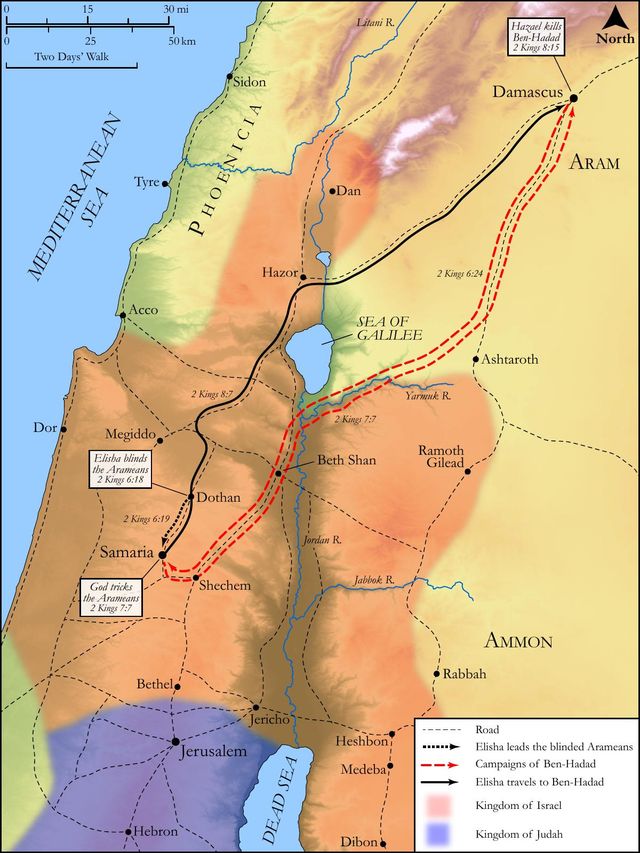
The period of the divided monarchy was characterized by frequent and often brutal conflicts between the northern kingdom of Israel and Aram-Damascus, a formidable Aramean state situated to Israel's northeast. The Syrian king referenced here is widely understood to be Ben-Hadad II or potentially his successor, Hazael, both of whom frequently engaged in military campaigns against Israel, often involving raids, sieges, and attempts to secure territorial advantage. Ancient warfare heavily relied on strategic positioning, ambushes, and effective intelligence gathering. Kings would routinely gather their inner circle of military commanders and trusted advisors to meticulously devise battle plans, identify optimal ambush sites, and coordinate troop movements. This practice, precisely depicted in 2 Kings 6:8, was a standard and indispensable aspect of the military operations of the kings of that day, underscoring the king's diligent efforts to secure victory through human cunning and foresight.
Key Themes
ShowHideThis verse introduces and reinforces several profound themes that resonate throughout the broader narrative of 2 Kings and the entire Old Testament. Firstly, it highlights the theme of human strategy and conflict, emphasizing the meticulous planning and military efforts undertaken by earthly powers. The Syrian king's "counsel with his servants" underscores the reliance on human wisdom and tactical expertise in warfare. Secondly, and more profoundly, it subtly introduces the overarching theme of divine omniscience and sovereignty. While the king believes his plans are shrouded in secrecy, the subsequent narrative unequivocally reveals that God is fully aware of every detail, thereby frustrating the king's intentions. This powerfully foreshadows God's ultimate control over all human affairs, demonstrating that even the most carefully laid human plans are ultimately subject to His divine purpose, a truth eloquently articulated in Proverbs 19:21: "Many are the plans in a person's heart, but it is the LORD's purpose that prevails." Finally, the verse serves as a crucial foreshadowing of prophetic intervention. It meticulously sets the stage for Elisha's supernatural knowledge of the Syrian king's every move, even his most secret counsel, thereby demonstrating God's active protection of Israel through His chosen prophet, a theme central to the ministry of Elisha throughout 2 Kings 6.
Exposition and Analysis
ShowHideKey Word Analysis
ShowHideThis term refers to a monarch, a ruler who holds supreme authority over a kingdom. In this context, it emphasizes the Syrian king's position of power and his role as the initiator of military aggression against Israel. The king's actions here are not impulsive but are the result of deliberate regal decision-making, reflecting the typical exercise of power among the kings of that day. The very nature of a "king" implies strategic leadership, military command, and the responsibility for national security and expansion.
This primitive root signifies "to feed on," but figuratively, it means "to consume" or, by implication, "to battle" (as destruction). In this verse, it clearly denotes active military engagement, indicating that the Syrian king was not merely contemplating hostility but was actively conducting campaigns against Israel. The use of this verb underscores the ongoing, violent conflict between the two nations, setting the immediate backdrop of national tension and military threat that necessitates the king's strategic actions.
This verb means "to advise," "to consult," or "to deliberate." Here, it describes the Syrian king's deliberate and collaborative process of seeking strategic advice from his trusted military and political advisors. It implies a thorough, rational, and human-centric approach to problem-solving and warfare. The king is not acting impulsively but engaging in a calculated effort to gain an advantage over his enemy. The significance of yâʻats here lies in the stark contrast it provides with the divine knowledge that is about to be revealed, highlighting the limitations of human wisdom versus divine omniscience.
Verse Breakdown
ShowHide"¶ Then the king of Syria warred against Israel,"
This opening clause establishes the prevailing state of armed conflict between the two nations. The "¶" symbol, a common KJV convention, indicates a new paragraph, often marking a significant shift in narrative or subject. The verb "warred" (Hebrew: lâcham) denotes active, aggressive military engagement, not merely a state of hostility. This sets the immediate backdrop of national tension and military threat, providing the crucial context for the king's subsequent strategic actions and underscoring the severity of the situation for Israel.
"and took counsel with his servants,"
This phrase details the Syrian king's method of operation and his reliance on collaboration. Rather than acting unilaterally, he engaged in a formal consultation process with his trusted advisors or military commanders. "Servants" (Hebrew: ʻebed) in this context refers to high-ranking officials, loyal subordinates, or members of his royal court. This consultation underscores the king's dependence on human intelligence, strategic planning, and collaborative decision-making, reflecting a common and crucial practice in the courts of the kings of Israel and Syria, where vital military decisions were made collectively within the royal court.
"saying, In such and such a place [shall be] my camp."
This final clause reveals the specific outcome of the king's counsel: the identification of a particular, undisclosed location for a military encampment or ambush. The phrase "in such and such a place" (Hebrew: pᵉlônîy 'almônîy mâqôwm) is an idiomatic expression signifying an unspecified, secret, or designated location, deliberately left vague to emphasize its clandestine nature. The purpose of this secret camp was undoubtedly to launch a surprise attack or set an ambush against Israelite forces, highlighting the element of deception and tactical advantage that the Syrian king sought to employ.
Literary Devices
ShowHideThe primary literary device at play in 2 Kings 6:8 is Foreshadowing. The verse, by meticulously detailing the Syrian king's secret strategic planning, sets the stage for the dramatic revelation that these very plans are known to Elisha, thereby powerfully foreshadowing the prophet's supernatural intervention and God's omniscience. This creates significant narrative tension, as the reader is made aware that the king's meticulous efforts are about to be thwarted by a higher, divine power. Closely related is Irony: the king believes his counsel is absolutely secret and his plans are foolproof, yet the very act of meticulously planning in secret ironically highlights the ultimate futility of human wisdom when confronted with divine knowledge. The king's elaborate efforts to gain an advantage are rendered utterly useless before they are even put into action, creating a profound sense of dramatic irony that underscores God's absolute sovereignty over human affairs and military endeavors.
Theological and Thematic Connections
ShowHideThis verse, though seemingly a simple statement of military strategy, acts as a profound theological pivot, introducing the foundational truth of God's omniscience and His active, sovereign involvement in the affairs of nations and individuals. The Syrian king's secret counsel, meticulously designed to be hidden from his enemy, is utterly transparent to the God of Israel. This highlights the irrefutable principle that no human plan, no matter how clandestine, meticulously crafted, or strategically brilliant, can escape the all-seeing eye of the Almighty. It serves as a powerful and comforting reminder that God is not merely a distant observer but an active participant in history, capable of revealing, thwarting, or redirecting any scheme that opposes His divine will or threatens His people. This divine oversight provides immense comfort and profound reassurance to believers, demonstrating that even when powerful adversaries plot in secret, God's protective hand is at work, and His knowledge far surpasses any human intelligence or strategy.
Reflection and Application
ShowHideFor believers today, 2 Kings 6:8, particularly when understood within its broader context of divine revelation and protection, offers profound reassurance and practical guidance for navigating a complex world. It serves as a powerful reminder that our God is omniscient, knowing all things—even the most hidden intentions and secret schemes of those who might oppose us, whether on a global, communal, or personal level. In a world often characterized by hidden agendas, intricate political maneuvering, and personal challenges that can feel overwhelming and beyond our control, this passage encourages us to place our trust not in human foresight, our own ability to discern threats, or our capacity to outmaneuver adversaries, but in God's perfect knowledge and sovereign control. It underscores that no plan or plot against God's people can ultimately succeed without His permission or outside of His ultimate, redemptive purpose. This truth should inspire a deep and abiding sense of peace and confidence, knowing that our ultimate security rests not on our vigilance alone, but on the unfailing watchfulness of our Heavenly Father. It calls us to live with an active awareness of God's constant presence and His active involvement in every detail of our lives, trusting that He will either reveal what needs to be known, thwart what needs to be stopped, or empower us to navigate challenges with His divine wisdom and strength.
Questions for Reflection
ShowHideFAQ
ShowHideWho was the king of Syria mentioned in 2 Kings 6:8, and what was the nature of his conflict with Israel?
ShowHideThe specific king of Syria (Aram-Damascus) is not explicitly named in 2 Kings 6:8, but based on the historical context of the period of the divided monarchy and the broader narrative of 2 Kings, he is most commonly identified as Ben-Hadad II or possibly his successor, Hazael. These kings frequently led aggressive military campaigns against the northern kingdom of Israel, often involving raids, sieges, and attempts to expand their territory or assert regional dominance. The conflict was a long-standing and often brutal struggle for regional power, control over vital trade routes, and access to resources. The nature of the conflict in this particular verse specifically points to strategic military operations, where the Syrian king was attempting to gain a tactical advantage through clandestine movements and ambushes. This episode highlights the Syrian king's aggressive posture and his reliance on tactical cunning to overcome Israel, setting the stage for God's divine intervention.
Christ-Centered Fulfillment
ShowHideThe seemingly mundane military strategy of the Syrian king in 2 Kings 6:8, meticulously planned in secret, finds its profound Christ-centered fulfillment in the ultimate triumph of God's divine plan over all human and demonic schemes. Just as the Syrian king's secret camp was known to God and revealed through Elisha, so too were all the plots and machinations against God's ultimate redemptive purpose for humanity known to Him from eternity past. The crucifixion of Jesus, while meticulously planned by human authorities (e.g., the Sanhedrin, Pilate) and seemingly a victory for the forces of darkness, was in fact the predetermined counsel and plan of God (as proclaimed in Acts 2:23 and Acts 4:27-28). Every secret meeting of the Sanhedrin, every betrayal by Judas, every political maneuver by Pilate—all were within the perfect knowledge and sovereign control of God, ultimately serving to accomplish the salvation of the world. In Christ, we see the complete embodiment of God's omniscience, for in Him "are hidden all the treasures of wisdom and knowledge" (Colossians 2:3). He is the ultimate "camp" or refuge for His people, a spiritual fortress against whom "the gates of Hades shall not prevail" (Matthew 16:18), signifying the futility of all spiritual and earthly opposition to His church. The futile plans of the Syrian king thus foreshadow the ultimate futility of all human and spiritual opposition to God's Christ, whose kingdom is eternal, whose victory is assured not by human strategy, but by divine decree, perfect love, and the power of His resurrection (Romans 8:37-39).