


2 Kings 6:9
Bible text: King James Version (1769 Blayney text) · Public domain
Bible text: Berean Standard Bible · Public domain
Bible text: American Standard Version (1901) · Public domain
Bible text: World English Bible, Messianic edition · Public domain
Bible text: Geneva Bible (1599) · Public domain
Bible text: Young's Literal Translation · Public domain
- וַיִּשְׁלַחvai·yish·Lachand he sentH7971Conj-w ¦ V-Qal-ConsecImperf-3msVerb Qal Consecutive Imperfect 3rd Singular Masculineוַandיִּשְׁלַחhe sent
- אִישׁ'ish[the] man ofH376N-mscNoun Singular Masculine Construct
- הָאֱלֹהִיםha·'E·lo·Him<the> GodH430Art ¦ N-mpNoun Plural Masculine Absoluteהָ<the>אֱלֹהִיםGod
- אֶל'eltoH413PrepPreposition
- מֶלֶךְMe·lekh[the] king ofH4428N-mscNoun Singular Masculine Construct
- יִשְׂרָאֵלYis·ra·'ElIsraelH3478N-properNoun Proper Location
- לֵאמֹרle·Mor<to> sayingH559Prep-l ¦ V-Qal-InfVerb Qal Infinitive Constructלֵ<to>אמֹרsaying
- הִשָּׁמֶרhi·Sha·mertake careH8104V-Niphal-Imp-2msVerb Niphal Imperative 2nd Singular Masculine
- מֵעֲבֹרme·'a·Vorfrom passing byH5674Prep-m ¦ V-Qal-InfVerb Qal Infinitive Constructמֵfromעֲבֹרpassing by
- הַמָּקוֹםha·ma·Komthe placeH4725Art ¦ N-msNoun Singular Masculine Absoluteהַtheמָּקוֹםplace
- הַזֶּהha·Zeh<the> thisH2088Art ¦ PrtParticle Demonstrativeהַ<the>זֶּהthis
- כִּיkiforH3588PrtParticle Conditional
- שָׁםshamthereH8033AdvAdverb
- אֲרָם'a·RamAramH758N-properNoun Proper Location
- נְחִתִּיםne·chi·Tim[is] descendingH5185N-mpNoun Plural Masculine Absolute
English is a literal word-by-word gloss of the Hebrew, not the KJV's wording. Why?
This is the original text the KJV's translators worked from — each Hebrew word with its own literal English meaning in this verse, prepared by scholars at Tyndale House, Cambridge. The KJV translates whole sentences, not word by word, so its wording differs: one Hebrew word can become several English words, and the KJV may choose “the LORD” where the gloss reads “Yahweh”. Both are faithful — they answer different questions. For the KJV's own rendering, switch to the KJV text.
Details
See on the biblical-era map
Study this verse
Public-domain commentary
Matthew Henry
From his Commentary on the Whole Bible. Henry comments on passages, not single verses — this entry covers 2 Kings 6:8–12. His two-level outline is real structure in the source text, so it is rendered as structure.
Here we have Elisha, with his spirit of prophecy, serving the king, as before helping the sons of the prophets; for that, as other gifts, is given to every man to profit withal; and, whatever abilities any man has of doing good, he is by them made a debtor both to the wise and unwise. Observe here,
I.How the king of Israel was informed by Elisha of all the designs and motions of his enemy, the king of Syria, more effectually than he could have been by the most vigilant and faithful spies. If the king of Syria, in a secret council of war, determined in which place to make an inroad upon the coasts of Israel, where he thought it would be the greatest surprise and they would be least able to make resistance, before his forces could receive his orders the king of Israel had notice of them from Elisha, and so had opportunity of preventing the mischief; and many a time, Kg2 6:8-10. See here,
1.That the enemies of God's Israel are politic in their devices, and restless in their attempts, against him. They shall not know, nor see, till we come in the midst among them, and slay them, Neh 4:11.
2.All those devices are known to God, even those that are deepest laid. He knows not only what men do, but what they design, and has many ways of countermining them.
3.It is a great advantage to us to be warned of our danger, that we may stand upon our guard against it. The work of God's prophets is to give us warning; if, being warned, we do not save ourselves, it is our own fault, and our blood will be upon our own head. The king of Israel would regard the warnings Elisha gave him of his danger by the Syrians, but not the warnings he gave him of his danger by his sins. Such warnings are little heeded by the most; they will save themselves from death, but not from hell.
II.How the king of Syria resented this.
He suspected treachery among his senators, and that his counsels were betrayed, Kg2 6:11. But one of his servants, that had heard, by Naaman and others, of Elisha's wondrous works, concludes it must needs be he that gave this intelligence to the king of Israel, Kg2 6:12. What could not he discover who could tell Gehazi his thoughts? Here a confession of the boundless knowledge, as before of the boundless power, of Israel's God, is extorted from Syrians. Nothing done, said, thought, by any person, in any place, at any time, is out of the reach of God's cognizance.
Continue studying 2 Kings 6:9 across the web’s major study libraries — every link below opens this exact verse, chapter, or book on the destination site.
Read & Compare
 BibleGatewayThis verse in more than 200 translations and 70 languages.
 Bible.comThe YouVersion reader — hundreds of translations, reading plans, and highlights.
 ESV.orgCrossway's official English Standard Version reader.
 NET BibleThe NET translation with 60,000+ translators' notes on every rendering decision.
 STEP BibleTyndale House's free study tool — original text, vocabulary, and scholarly resources.
 BibliaLogos Bible Software's free web reader.
 USCCBThe New American Bible (Revised Edition) with the U.S. bishops' study notes.
Commentaries
 BibleHub CommentariesDozens of classic commentaries on this verse, gathered on one page.
 StudyLightMore than 100 commentary sets — the largest collection on the web.
 BibleRefPlain-English commentary on what this verse means, verse by verse.
 Enduring WordDavid Guzik's free commentary on this chapter, widely used by Bible teachers.
 Bible Study ToolsVerse commentary alongside Greek and Hebrew study aids.
Original Language & Research
- BibleHub InterlinearThe verse word by word — original language, transliteration, and English.
- BibleHub LexiconEvery word's original-language definition and Strong's entry.
 Blue Letter BibleDeep-study tools — Strong's numbers, concordance, and word studies.
 SefariaThe Hebrew text with Rashi and centuries of Jewish commentary.
Sermons, Hymns & Audio


TrulyRandomVerse is not affiliated with these sites and doesn’t control their content. They’re linked because they’re genuinely useful.
Summary
Second Kings 6:9 captures a crucial moment in the ongoing conflict between Israel and Aram (Syria), powerfully illustrating the prophet Elisha's supernatural insight and divine intervention. Through Elisha, God supernaturally reveals the hidden ambush plans of the Syrian king to the King of Israel, enabling him to avoid imminent danger. This verse profoundly underscores God's active and intimate protection over His people, His absolute omniscience, and the indispensable role of His chosen messenger in safeguarding the nation against its adversaries.
Context
ShowHideLiterary Context
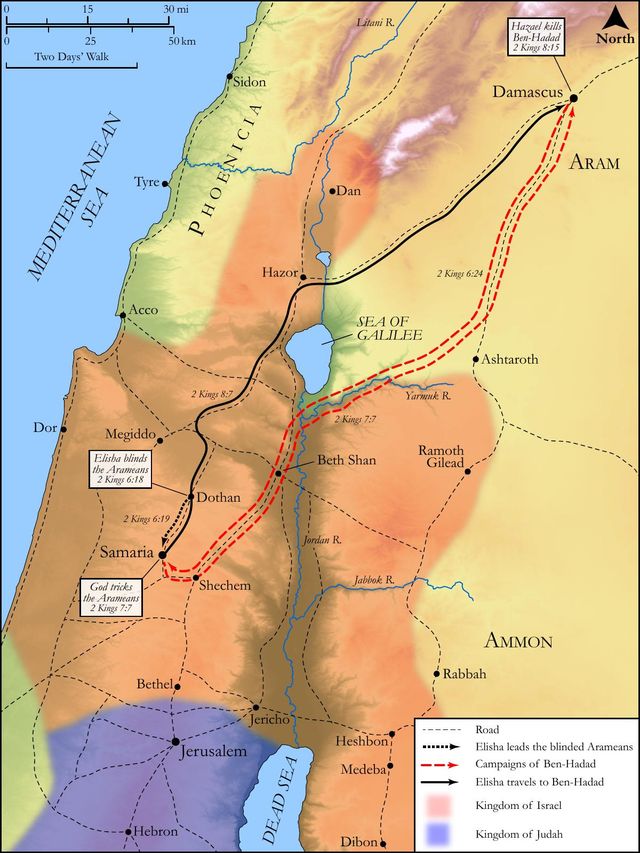
This verse is intricately woven into a remarkable narrative in 2 Kings 6, a chapter that consistently showcases Elisha's extraordinary prophetic power and God's providential care for Israel. The chapter begins by establishing Elisha's miraculous capabilities, such as making an ax head float for the sons of the prophets (2 Kings 6:1-7), thereby setting the stage for his even more astounding interventions in national affairs. The immediate narrative then shifts to the escalating military tension between Aram and Israel. The King of Aram repeatedly attempts to ambush the King of Israel, but Elisha, supernaturally endowed with knowledge of these secret plans, consistently warns the Israelite king, thwarting every single attempt. 2 Kings 6:9 is one specific instance within this series of divine intelligence reports that utterly baffle the Syrian monarch. This continuous frustration leads the Syrian king to suspect a spy within his own ranks, as detailed in 2 Kings 6:11, before discovering that "Elisha, the prophet that is in Israel, telleth the king of Israel the words that thou speakest in thy bedchamber." This entire sequence vividly demonstrates God's direct, active, and sovereign involvement in the geopolitical affairs of His covenant people.
Historical & Cultural Context
The period of the Divided Kingdom saw frequent and often brutal conflicts between the northern kingdom of Israel and its powerful northern neighbor, Aram (Syria), often under the leadership of King Ben-hadad II. These were not mere border skirmishes but significant existential threats, with Aram consistently seeking to assert dominance, raid Israelite territory for plunder, and expand its influence. Ambushes were a highly effective and common military tactic in ancient warfare, relying heavily on surprise, intimate knowledge of terrain, and precise timing. Typically, the King of Israel, as the supreme military leader, would rely on human intelligence, scouts, and spies to anticipate enemy movements. However, in this particular account, the source of his intelligence is entirely supernatural, highlighting a unique and extraordinary aspect of Israel's relationship with God. The concept of a "man of God" (prophet) serving as a divine intelligence agent, providing strategic and life-saving warnings, was not entirely unique to Elisha, but his consistent and precise foreknowledge of enemy movements was particularly striking, demonstrating God's active involvement in the nation's defense, transcending conventional military strategies and human limitations.
Key Themes
ShowHide2 Kings 6:9 powerfully contributes to several overarching themes within the book of 2 Kings and the broader prophetic literature. Firstly, it preeminently exemplifies Divine Omniscience and Sovereignty, showcasing God's absolute and exhaustive knowledge of all things, even the most secret enemy plans, and His supreme control over human affairs and national destinies. Secondly, the verse profoundly underscores Divine Protection and Providence, revealing God's active, personal, and meticulous care for His people, using extraordinary means to safeguard them from harm. This echoes the broader biblical promise of God as a shield and protector, as seen in the themes found throughout Psalm 91. Thirdly, it highlights the Authority and Efficacy of Prophetic Ministry. Elisha, as the "man of God," is not merely a spiritual guide but a direct, authoritative instrument of God's will, whose words carry divine authority and have tangible, life-saving consequences. His ministry demonstrates that true power resides with God, who works powerfully through His chosen servants to accomplish His purposes, even in military and political spheres, mirroring the potent ministry of Elijah in 1 Kings 17.
Exposition and Analysis
ShowHideKey Word Analysis
ShowHideThis venerable title, combining H376 (ʼîysh, "man") and H430 (ʼĕlôhîym, "God"), is frequently applied to Elisha (and Elijah before him). It denotes a person uniquely chosen, called, and empowered by God Himself. It signifies someone who stands in a special, intimate relationship with the Almighty, acting as His direct representative, spokesman, and instrument on earth. In this specific context, the title emphasizes that Elisha's astonishing knowledge and inherent authority are not his own, but are divinely sourced, lending absolute credibility, urgency, and divine weight to his warning. The title powerfully highlights his prophetic office and the direct, unobstructed channel of communication he has with God.
shâmar, meaning "to hedge about (as with thorns), i.e., guard; generally, to protect, attend to, etc." In this imperative form, it carries a profound sense of urgency, caution, and vigilance. It is a direct, emphatic command to be on guard, to take heed, and to actively protect oneself from a known and imminent danger. This imperative implies a necessity for immediate and decisive action on the part of the King of Israel, emphasizing that the warning is not merely informative but prescriptive, demanding a response of careful avoidance and strategic circumvention.
Verse Breakdown
ShowHide"And the man of God sent unto the king of Israel, saying,"
This opening clause establishes the divine origin and authoritative nature of the message. Elisha, identified by his weighty title, acts as God's direct messenger, initiating communication with the highest authority in the land. The act of "sending" implies a deliberate, urgent, and official communication, underscoring the gravity and critical importance of the intelligence being conveyed, signaling a matter of national security and divine intervention.
"Beware that thou pass not such a place;"
This is the core, actionable instruction of Elisha's warning. The indefinite "such a place" suggests either that Elisha is referring to a specific, previously identified location known to the king, or that the king would immediately understand the precise location from the context of Elisha's continuous stream of warnings. The imperative "Beware" (as analyzed above) conveys the critical importance of avoiding this particular spot due to the imminent and concealed danger. It is a precise, actionable instruction for the king's immediate safety and strategic maneuver.
"for thither the Syrians are come down."
This final clause provides the crucial justification and intelligence behind the warning. The Syrians (Aramaeans), Israel's persistent adversaries, have strategically positioned themselves in that specific location, undoubtedly for an ambush. The phrase "come down" suggests movement from a higher vantage point or from their own territory into Israelite land, implying a descent into a specific, perhaps concealed, area designed for a surprise attack. This divinely revealed intelligence gives the King of Israel a decisive and invaluable advantage, enabling him to circumvent the enemy's trap and preserve his life and forces.
Literary Devices
ShowHideThe passage employs several effective literary devices to enhance its impact and convey its theological message. Divine Intervention is the overarching and most prominent theme, as God supernaturally reveals hidden enemy plans through His prophet, demonstrating His active, intimate, and sovereign involvement in human affairs and national security. The repeated warnings throughout 2 Kings 6 create a powerful sense of Repetition, which serves to emphasize God's consistent protection and Elisha's unique, unparalleled prophetic gift. There is also a strong element of Dramatic Irony at play, as the reader is made privy to Elisha's divine source of information, while the Syrian king remains utterly bewildered and frustrated, unable to comprehend how his secret plans are continually foiled. This irony highlights the vast disparity between limited human cunning and boundless divine omniscience. Furthermore, Elisha's role as a divine protector and guide serves as a form of Foreshadowing, pointing to the ultimate divine protection and guidance that God offers His people, a theme that finds its ultimate culmination in the person and redemptive work of Jesus Christ.
Theological and Thematic Connections
ShowHideThis verse profoundly illustrates the biblical truth of God's omniscience and His active, meticulous providence over His people. It reveals a God who is neither distant nor detached but intimately involved in the affairs of nations, even to the extent of exposing secret military strategies to protect His chosen ones. Elisha's role as a divine intelligence agent underscores the multifaceted nature of prophetic ministry, extending beyond spiritual guidance to practical, life-saving intervention in the temporal realm. This narrative serves as a powerful testament to God's unwavering commitment to His covenant people, demonstrating that His watchful eye and protective hand are always upon them, actively thwarting the plans of their adversaries. It reinforces the profound idea that human wisdom, military might, and cunning are ultimately futile against the sovereign will, perfect knowledge, and protective power of the Almighty.
Reflection and Application
ShowHideThe account in 2 Kings 6:9 offers profound and enduring lessons for believers today. Just as God supernaturally revealed the hidden dangers to the King of Israel, He continues to be intimately aware of every hidden scheme, potential pitfall, and unseen adversary that we face, whether from spiritual forces, human malice, or the inherent complexities of life. This verse serves as a powerful reminder of God's constant, watchful eye and His deep, abiding desire to protect us. While we may not receive direct prophetic warnings about physical ambushes in the same manner, God provides abundant guidance and discernment through His inspired Word, the indwelling Holy Spirit who illuminates truth, and the wise counsel of fellow believers. We are called to cultivate a posture of profound attentiveness to God's voice, trusting that He will reveal what we need to know for our safety, spiritual well-being, and navigation through life's myriad challenges. This divine foresight offers immense peace and security, assuring us that we are never truly alone or without guidance in a world full of unseen dangers. Our ultimate security and peace rest not in our own vigilance or cleverness, but in God's sovereign knowledge and unwavering protective care.
Questions for Reflection
ShowHideFAQ
ShowHideHow did Elisha know the Syrian king's secret plans?
ShowHideElisha knew the Syrian king's secret plans through direct divine revelation. He was uniquely identified as "the man of God," a prophet through whom the Lord communicated directly and intimately. As 2 Kings 6:12 explicitly states, when the Syrian king's servants suggested a spy within their ranks, one of them clarified, "None, my lord, O king; but Elisha, the prophet that is in Israel, telleth the king of Israel the words that thou speakest in thy bedchamber." This indicates that God supernaturally revealed the king's most private and strategic conversations to Elisha, demonstrating God's boundless omniscience and His active, protective involvement in the affairs of His people.
What is the significance of Elisha being called "the man of God" in this context?
ShowHideThe title "man of God" (Hebrew: ʼîysh ʼĕlôhîym) is profoundly significant as it designates Elisha as a divinely appointed, authorized, and empowered messenger. It emphasizes that his knowledge, authority, and actions are not derived from his own human capabilities or intelligence but are directly from God Himself. In this specific context, it serves to assure the King of Israel that the warning he receives is not mere human intelligence, speculation, or rumor, but a reliable, authoritative, and infallible word from the Lord. It powerfully underscores the divine source of Israel's protection and the prophet's crucial role as God's faithful and potent instrument in the world.
Christ-Centered Fulfillment
ShowHideThe protective and omniscient work of God, powerfully manifested through Elisha in 2 Kings 6:9, finds its ultimate, most profound, and perfect fulfillment in the person and ministry of Jesus Christ. While Elisha, as a "man of God," received revelation from God, Jesus is the very Word of God made flesh, the complete and final revelation of God to humanity. He possesses inherent, not delegated, omniscience, knowing not only the plans of earthly kings but the deepest thoughts, intentions, and secrets of every heart (John 2:25). Just as Elisha warned the King of Israel of physical ambushes, Jesus, the Good Shepherd, continually warns His sheep of far greater spiritual dangers, providing infallible guidance and perfect protection from the insidious schemes of the true adversary, Satan, who comes only to steal, kill, and destroy (John 10:10). He is the ultimate protector, promising with divine authority that no one, not even the most powerful spiritual foe, can snatch His sheep out of His hand (John 10:28). The divine foresight, sovereign control, and protective care demonstrated through Elisha are perfectly and eternally embodied in Christ, who not only warns of danger but has already triumphed decisively over sin, death, and the ultimate enemy through His cross and resurrection, securing eternal safety, peace, and victory for all who believe in Him (Colossians 2:15).