


2 Kings 6:12
Bible text: King James Version (1769 Blayney text) · Public domain
Bible text: King James Version with Strong's numbers · Public domain
Bible text: Berean Standard Bible · Public domain
Bible text: American Standard Version (1901) · Public domain
Bible text: World English Bible, Messianic edition · Public domain
Bible text: Geneva Bible (1599) · Public domain
Bible text: Young's Literal Translation · Public domain
- וַיֹּאמֶרvai·Yo·merand he saidH559Conj-w ¦ V-Qal-ConsecImperf-3msVerb Qal Consecutive Imperfect 3rd Singular Masculineוַandיֹּאמֶרhe said
- אַחַד'a·ChadoneH259N-fsNoun Singular Feminine Absolute
- מֵעֲבָדָיוme·'a·va·Davfrom his servantsH5650Prep-m ¦ N-mpc ¦ 3msNoun Plural Masculine Constructמֵfromעֲבָדָיservantsוhis
- לוֹאLo'noH3808NegParticle Negative
- אֲדֹנִי'a·do·Nimy O lordH113N-msc ¦ 1csNoun Singular Masculine ConstructאֲדֹנִO lordיmy
- הַמֶּלֶךְha·Me·lekhthe kingH4428Art ¦ N-msNoun Singular Masculine Absoluteהַtheמֶּלֶךְking
- כִּיkiforH3588PrtParticle Conditional
- אֱלִישָׁע'e·li·Sha'ElishaH477N-proper-mNoun Proper Masculine
- הַנָּבִיאha·na·Vi'the prophetH5030Art ¦ N-msNoun Singular Masculine Absoluteהַtheנָּבִיאprophet
- אֲשֶׁר'a·SherwhoH834RelParticle Relative
- בְּיִשְׂרָאֵלbe·Yis·ra·'El[is] in IsraelH3478Prep-b ¦ N-properNoun Proper Locationבְּ[is] inיִשְׂרָאֵלIsrael
- יַגִּידya·Gidhe tellsH5046V-Hiphil-Imperf-3msVerb Hiphil Imperfect 3rd Singular Masculine
- לְמֶלֶךְle·Me·lekhto [the] king ofH4428Prep-l ¦ N-mscNoun Singular Masculine Constructלְtoמֶלֶךְ[the] king of
- יִשְׂרָאֵלYis·ra·'ElIsraelH3478N-properNoun Proper Location
- אֶת'et<obj.>H853DirObjMParticle Object Indicator
- הַדְּבָרִיםha·de·va·Rimthe wordsH1697Art ¦ N-mpNoun Plural Masculine Absoluteהַtheדְּבָרִיםwords
- אֲשֶׁר'a·SherwhichH834RelParticle Relative
- תְּדַבֵּרte·da·Beryou speakH1696V-Piel-Imperf-2msVerb Piel Imperfect 2nd Singular Masculine
- בַּחֲדַרba·cha·Darin [the] chamber ofH2315Prep-b ¦ N-mscNoun Singular Masculine Constructבַּinחֲדַר[the] chamber of
- מִשְׁכָּבֶךָmish·ka·Ve·khayour lying downH4904N-msc ¦ 2msNoun Singular Masculine Constructמִשְׁכָּבֶlying downךָyour
English is a literal word-by-word gloss of the Hebrew, not the KJV's wording. Why?
This is the original text the KJV's translators worked from — each Hebrew word with its own literal English meaning in this verse, prepared by scholars at Tyndale House, Cambridge. The KJV translates whole sentences, not word by word, so its wording differs: one Hebrew word can become several English words, and the KJV may choose “the LORD” where the gloss reads “Yahweh”. Both are faithful — they answer different questions. For the KJV's own rendering, switch to the KJV text.
Details
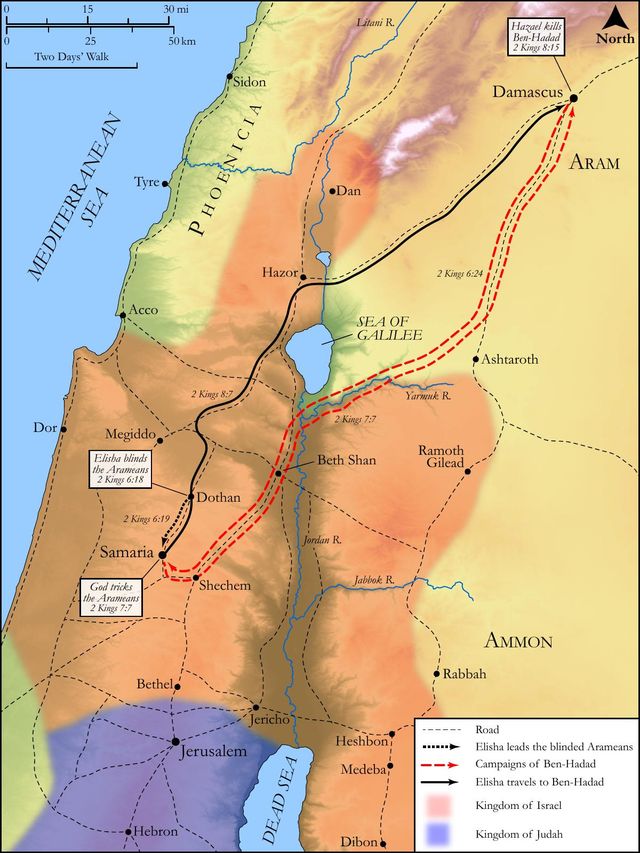
See on the biblical-era map
Study this verse
Public-domain commentary
Matthew Henry
From his Commentary on the Whole Bible. Henry comments on passages, not single verses — this entry covers 2 Kings 6:8–12. His two-level outline is real structure in the source text, so it is rendered as structure.
Here we have Elisha, with his spirit of prophecy, serving the king, as before helping the sons of the prophets; for that, as other gifts, is given to every man to profit withal; and, whatever abilities any man has of doing good, he is by them made a debtor both to the wise and unwise. Observe here,
I.How the king of Israel was informed by Elisha of all the designs and motions of his enemy, the king of Syria, more effectually than he could have been by the most vigilant and faithful spies. If the king of Syria, in a secret council of war, determined in which place to make an inroad upon the coasts of Israel, where he thought it would be the greatest surprise and they would be least able to make resistance, before his forces could receive his orders the king of Israel had notice of them from Elisha, and so had opportunity of preventing the mischief; and many a time, Kg2 6:8-10. See here,
1.That the enemies of God's Israel are politic in their devices, and restless in their attempts, against him. They shall not know, nor see, till we come in the midst among them, and slay them, Neh 4:11.
2.All those devices are known to God, even those that are deepest laid. He knows not only what men do, but what they design, and has many ways of countermining them.
3.It is a great advantage to us to be warned of our danger, that we may stand upon our guard against it. The work of God's prophets is to give us warning; if, being warned, we do not save ourselves, it is our own fault, and our blood will be upon our own head. The king of Israel would regard the warnings Elisha gave him of his danger by the Syrians, but not the warnings he gave him of his danger by his sins. Such warnings are little heeded by the most; they will save themselves from death, but not from hell.
II.How the king of Syria resented this.
He suspected treachery among his senators, and that his counsels were betrayed, Kg2 6:11. But one of his servants, that had heard, by Naaman and others, of Elisha's wondrous works, concludes it must needs be he that gave this intelligence to the king of Israel, Kg2 6:12. What could not he discover who could tell Gehazi his thoughts? Here a confession of the boundless knowledge, as before of the boundless power, of Israel's God, is extorted from Syrians. Nothing done, said, thought, by any person, in any place, at any time, is out of the reach of God's cognizance.
Continue studying 2 Kings 6:12 across the web’s major study libraries — every link below opens this exact verse, chapter, or book on the destination site.
Read & Compare
 BibleGatewayThis verse in more than 200 translations and 70 languages.
 Bible.comThe YouVersion reader — hundreds of translations, reading plans, and highlights.
 ESV.orgCrossway's official English Standard Version reader.
 NET BibleThe NET translation with 60,000+ translators' notes on every rendering decision.
 STEP BibleTyndale House's free study tool — original text, vocabulary, and scholarly resources.
 BibliaLogos Bible Software's free web reader.
 USCCBThe New American Bible (Revised Edition) with the U.S. bishops' study notes.
Commentaries
 BibleHub CommentariesDozens of classic commentaries on this verse, gathered on one page.
 StudyLightMore than 100 commentary sets — the largest collection on the web.
 BibleRefPlain-English commentary on what this verse means, verse by verse.
 Enduring WordDavid Guzik's free commentary on this chapter, widely used by Bible teachers.
 Bible Study ToolsVerse commentary alongside Greek and Hebrew study aids.
Original Language & Research
- BibleHub InterlinearThe verse word by word — original language, transliteration, and English.
- BibleHub LexiconEvery word's original-language definition and Strong's entry.
 Blue Letter BibleDeep-study tools — Strong's numbers, concordance, and word studies.
 SefariaThe Hebrew text with Rashi and centuries of Jewish commentary.
Sermons, Hymns & Audio


TrulyRandomVerse is not affiliated with these sites and doesn’t control their content. They’re linked because they’re genuinely useful.
Summary
This pivotal verse unveils the extraordinary spiritual insight of the prophet Elisha, demonstrating God's active involvement in protecting His people, Israel, against their enemies. It reveals that Elisha, through divine revelation, possessed knowledge of the most private and secret plans of the Aramean king, specifically the words spoken in his bedchamber, thereby enabling the king of Israel to thwart repeated ambushes. This moment sets the stage for a dramatic display of divine power and prophetic knowledge, underscoring God's omnipresence and His unwavering commitment to safeguarding His chosen nation.
Context
ShowHideLiterary Context
This verse is embedded within a broader narrative in 2 Kings 6:8-23 that highlights the ongoing military conflict between Aram (Syria) and Israel. The Aramean king, Ben-Hadad, repeatedly attempts to ambush the Israelite army, only to find his plans mysteriously foiled each time. His frustration culminates in 2 Kings 6:11, where he suspects a traitor among his own servants. Verse 12 is the crucial response from one of his servants, identifying Elisha as the supernatural source of Israel's uncanny foresight. This revelation directly leads to the Aramean king's decision to send a large army to Dothan to capture Elisha, setting the stage for the dramatic display of God's protection through blinded Aramean soldiers and Elisha's subsequent mercy, as detailed in 2 Kings 6:13-23. The immediate context emphasizes the divine nature of Elisha's intelligence and foreshadows the miraculous events that follow.
Historical & Cultural Context
The period of the Divided Monarchy saw frequent conflicts between the northern kingdom of Israel and its powerful neighbor, Aram (Syria), often centered around control of trade routes and strategic territories. Kings of that day, like Ben-Hadad, would indeed hold private councils and discuss military strategies in the most secure and private chambers of their palaces, such as their "bedchamber," to prevent leaks. The idea that such private conversations could be known to an enemy would be utterly baffling and terrifying, suggesting either unparalleled espionage or, as revealed here, supernatural intervention. Prophets in Israel, like Elisha, held a unique and powerful position, often acting as God's direct spokespersons, influencing national policy, and even intervening in military affairs, as seen with Elisha's counsel to kings. Their authority derived from their direct access to divine revelation, a concept central to Israelite faith.
Key Themes
ShowHideThis verse powerfully contributes to several overarching themes in 2 Kings. It primarily underscores Divine Omniscience and Revelation, asserting that God knows all things, even the most private thoughts and secret plans of kings. Through Elisha, God revealed these hidden strategies, proving that no human scheme, however secret, can thwart His purposes, echoing the biblical truth of God's intimate knowledge of human thoughts and words and His ability to reveal deep and hidden things. Concurrently, the passage highlights God's Protection of His People, as Elisha's supernatural intelligence served as an impenetrable shield for the King of Israel and his army, preventing them from falling into Aramean traps, thus demonstrating God actively intervening in history to safeguard His chosen nation. Finally, it emphasizes The Power and Role of the Prophet, showcasing Elisha as God's chosen representative wielding immense spiritual authority and insight, far surpassing human intelligence or military strategy. His role here is a testament to the significance of prophetic ministry in ancient Israel, where prophets served as conduits for God's direct communication and intervention, often revealing God's will and providing guidance in times of national crisis, as articulated in Amos 3:7.
Exposition and Analysis
ShowHideKey Word Analysis
ShowHideThis term designates an individual who speaks on behalf of God, serving as a divinely appointed messenger. The emphasis here is not merely on Elisha's personal wisdom but on his established role as an instrument through whom God's omniscience is manifested. He is "the prophet that is in Israel," signifying his unique and recognized position as God's primary voice in the nation, distinct from any human spy or informant.
Derived from a primitive root meaning "to front," "to stand boldly out opposite," and by implication "to manifest" or "to announce." The imperfect tense implies a continuous or repeated action, indicating that Elisha was consistently revealing the Aramean king's plans. This is not a one-off event but a pattern of divine intervention, underscoring the reliability and consistency of God's revelation through His prophet.
Literally "chamber of lying down" or "bedroom," this phrase signifies the most private, secure, and intimate space within a dwelling. The use of this specific term powerfully underscores the miraculous and supernatural nature of Elisha's knowledge. It was not merely public knowledge or overheard gossip, but secrets spoken in the presumed safety of absolute privacy, demonstrating God's ability to penetrate even the most guarded and intimate human spaces.
Verse Breakdown
ShowHide"And one of his servants said, None, my lord, O king:"
This opening clause immediately dispels the Aramean king's suspicion of internal treachery. The servant's direct and unequivocal denial sets the stage for the truly astonishing revelation that follows, highlighting the king's bewilderment and the servant's understanding that the source of the leaks was not human.
"but Elisha, the prophet that [is] in Israel,"
This identifies the true source of the intelligence. The servant explicitly names Elisha, emphasizing his identity as "the prophet," a title that immediately signals a supernatural, divine connection. The phrase "that is in Israel" further clarifies his location and allegiance, making it clear he is not an Aramean spy but a figure operating within the enemy nation, yet with access to secrets beyond human means.
"telleth the king of Israel"
This clause specifies the recipient of Elisha's divine intelligence – the king of Israel. It highlights the direct and practical impact of Elisha's prophetic ministry: providing strategic information that directly benefits Israel's security and military operations, thus demonstrating God's active protection of His people.
"the words that thou speakest in thy bedchamber."
This is the most astounding part of the revelation. It emphasizes the absolute secrecy and privacy of the Aramean king's plans. The "bedchamber" represents the most guarded and intimate space, where one would expect complete confidentiality. The fact that Elisha knew these "words" underscores the supernatural, omniscient nature of the source of his information, which could only be God Himself.
Literary Devices
ShowHideThe passage employs several potent literary devices to amplify its message. Irony is prominent, as the Aramean king, seeking a human traitor in his most private spaces, is confronted with the revelation that the "spy" is a prophet empowered by an omnipresent God who transcends all physical barriers. This creates a dramatic contrast between human efforts at secrecy and divine transparency. There is also an element of hyperbole in the servant's statement, not in the sense of exaggeration, but in emphasizing the seemingly impossible nature of Elisha's knowledge, thereby underscoring the miraculous. The description of Elisha knowing "the words that thou speakest in thy bedchamber" functions as a powerful metonymy for God's complete and intimate knowledge of all human thoughts and plans, regardless of their secrecy. Furthermore, the entire episode serves as a foreshadowing of God's continued intervention and protection for Elisha and Israel, leading directly into the miraculous events at Dothan in 2 Kings 6:13-23.
Theological and Thematic Connections
ShowHideThe revelation of Elisha's supernatural knowledge in 2 Kings 6:12 serves as a profound theological statement about God's absolute sovereignty and omniscience. It asserts that no human scheme, no matter how cunningly devised or secretly planned, can escape the all-seeing eye of the Almighty. This divine attribute is not merely theoretical; it is actively deployed for the protection and guidance of God's people. The passage powerfully illustrates that God is intimately involved in the affairs of nations and individuals, orchestrating events behind the scenes and revealing what is hidden to accomplish His purposes. It reinforces the biblical truth that God is the ultimate strategist, whose wisdom and knowledge far surpass any human intelligence or military might.
Reflection and Application
ShowHideFor believers today, 2 Kings 6:12 offers immense comfort and profound reassurance: God is aware of every plot, every challenge, and every hidden adversary, even those concealed from human sight and knowledge. This narrative encourages us to cultivate a deep trust in His divine foresight and protection, knowing that He works on our behalf, even when we are unaware of the unseen battles being waged. It reminds us that spiritual battles often occur in unseen realms, and just as Elisha had supernatural insight, believers are called to rely not on human cunning or power, but on spiritual discernment and God's wisdom, accessed through prayer and His Word, in navigating life's challenges. The story fosters a reliance on God's supernatural intervention for guidance and safety, urging us to recognize that our ultimate security rests not in our own defenses or strategies, but in the all-knowing and all-powerful God who watches over His own.
Questions for Reflection
ShowHideFAQ
ShowHideHow did Elisha know what the Aramean king said in his bedchamber?
ShowHideElisha knew through direct divine revelation. The text clearly indicates that this was not a result of human espionage, eavesdropping, or any natural means. The servant's statement, "but Elisha, the prophet that [is] in Israel, telleth the king of Israel the words that thou speakest in thy bedchamber," points to Elisha's unique role as God's prophet. God, being omniscient, knows all things, even the most private thoughts and conversations. He chose to reveal these specific details to Elisha to protect His people, Israel, from the Aramean ambushes, demonstrating His active involvement in their affairs. This is a testament to God's supernatural power and His ability to transcend all human barriers and secrecy, as seen in other instances of prophetic insight throughout the Old Testament, such as Daniel's interpretation of Nebuchadnezzar's dream.
Does God still reveal "secret" information to His people today, like He did to Elisha?
ShowHideWhile God's character and omniscience remain unchanged, the mode of revelation has shifted with the completion of the biblical canon and the coming of Christ. God primarily reveals His will and truth to believers today through His inspired Word, the Bible, and through the indwelling Holy Spirit, who illuminates Scripture and grants wisdom and discernment. While God may, in His sovereignty, grant specific insights or warnings for His purposes, the primary means of knowing His will is not through direct, extra-biblical "bedchamber" revelations in the same manner as Old Testament prophets. Instead, believers are called to walk by faith, relying on the principles and promises found in Scripture, and to trust in God's overarching providence and protection, knowing that all things work together for good for those who love Him.
Christ-Centered Fulfillment
ShowHideThe divine omniscience and protective intervention demonstrated through Elisha in 2 Kings 6:12 find their ultimate and most profound fulfillment in Jesus Christ. While Elisha was a conduit for God's knowledge, Jesus is the embodiment of divine omniscience, "knowing all men" and having no need for anyone to testify about man, for He himself knew what was in man. His knowledge extended beyond mere words to the very thoughts and intentions of hearts, as seen when He perceived the thoughts of the scribes or knew the Samaritan woman's past. Furthermore, the protection offered to Israel through Elisha's insight foreshadows the ultimate spiritual protection and deliverance found in Christ. He is the Good Shepherd who lays down His life for His sheep, ensuring that no one can snatch them out of His hand. The prophetic office, exemplified by Elisha, culminates in Jesus, who is the ultimate Prophet, Priest, and King, the Word made flesh, through whom God has spoken His final and complete revelation to humanity (Hebrews 1:1-2). Thus, the temporary, specific revelation to Elisha points forward to the eternal, comprehensive revelation and protection offered universally through Christ.