


2 Kings 6:11
Bible text: King James Version (1769 Blayney text) · Public domain
Bible text: King James Version with Strong's numbers · Public domain
Bible text: Berean Standard Bible · Public domain
Bible text: American Standard Version (1901) · Public domain
Bible text: World English Bible, Messianic edition · Public domain
Bible text: Geneva Bible (1599) · Public domain
Bible text: Young's Literal Translation · Public domain
- וַיִּסָּעֵרvai·yi·sa·'Erand it was enragedH5590Conj-w ¦ V-Niphal-ConsecImperf-3msVerb Niphal Consecutive Imperfect 3rd Singular Masculineוַandיִּסָּעֵרit was enraged
- לֵבlev[the] heart ofH3820N-mscNoun Singular Masculine Construct
- מֶלֶךְMe·lekh[the] king ofH4428N-mscNoun Singular Masculine Construct
- אֲרָם'a·RamAramH758N-properNoun Proper Location
- עַל'alonH5921PrepPreposition
- הַדָּבָרha·da·Varthe matterH1697Art ¦ N-msNoun Singular Masculine Absoluteהַtheדָּבָרmatter
- הַזֶּהha·Zeh<the> thisH2088Art ¦ PrtParticle Demonstrativeהַ<the>זֶּהthis
- וַיִּקְרָאvai·yik·Ra'and he calledH7121Conj-w ¦ V-Qal-ConsecImperf-3msVerb Qal Consecutive Imperfect 3rd Singular Masculineוַandיִּקְרָאhe called
- אֶל'eltoH413PrepPreposition
- עֲבָדָיו'a·va·Davhis servantsH5650N-mpc ¦ 3msNoun Plural Masculine Constructעֲבָדָיservantsוhis
- וַיֹּאמֶרvai·Yo·merand he saidH559Conj-w ¦ V-Qal-ConsecImperf-3msVerb Qal Consecutive Imperfect 3rd Singular Masculineוַandיֹּאמֶרhe said
- אֲלֵיהֶם'a·lei·Hemto themH413Prep ¦ 3mpPrepositionאֲלֵיtoהֶםthem
- הֲלוֹאha·lO'¿ notH3808Interrog ¦ NegParticle Negativeהֲ¿לוֹאnot
- תַּגִּידוּta·Gi·duwill you tellH5046V-Hiphil-Imperf-2mpVerb Hiphil Imperfect 2nd Plural Masculine
- לִיLito mePrep-l ¦ 1csSuffix Personal 1st Singular common genderלִtoיme
- מִיmiwho?H4310InterrogPronoun Interrogative
- מִשֶּׁלָּנוּmi·she·La·nufrom [those] who [belong] to usPrep-m ¦ Rel-s ¦ Prep-l ¦ 1cpSuffix Personal 1st Plural common genderמִfromשֶּׁ[those] whoלָּ[belong] toנוּus
- אֶל'el[is] toH413PrepPreposition
- מֶלֶךְMe·lekh[the] king ofH4428N-mscNoun Singular Masculine Construct
- יִשְׂרָאֵלYis·ra·'ElIsraelH3478N-properNoun Proper Location
English is a literal word-by-word gloss of the Hebrew, not the KJV's wording. Why?
This is the original text the KJV's translators worked from — each Hebrew word with its own literal English meaning in this verse, prepared by scholars at Tyndale House, Cambridge. The KJV translates whole sentences, not word by word, so its wording differs: one Hebrew word can become several English words, and the KJV may choose “the LORD” where the gloss reads “Yahweh”. Both are faithful — they answer different questions. For the KJV's own rendering, switch to the KJV text.
Details
See on the biblical-era map
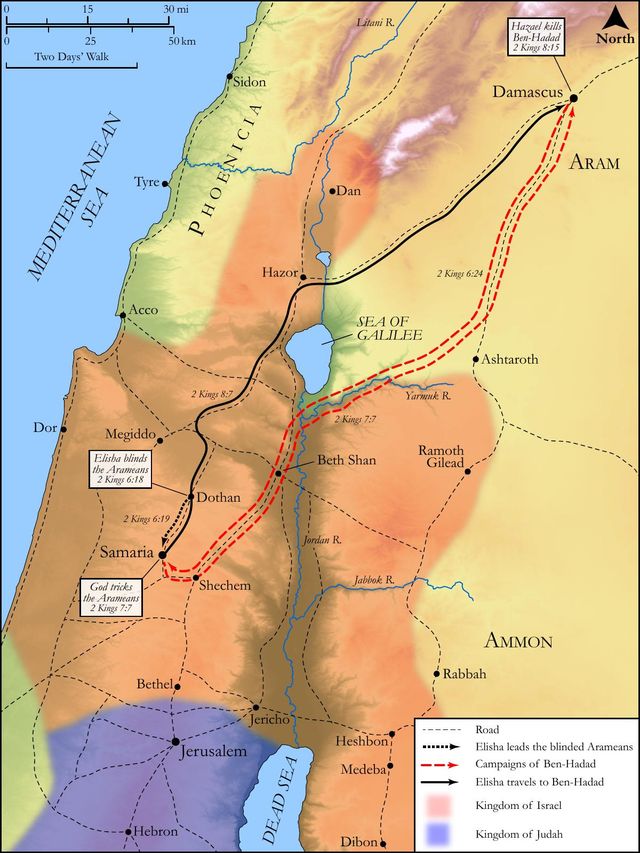
Study this verse
Public-domain commentary
Matthew Henry
From his Commentary on the Whole Bible. Henry comments on passages, not single verses — this entry covers 2 Kings 6:8–12. His two-level outline is real structure in the source text, so it is rendered as structure.
Here we have Elisha, with his spirit of prophecy, serving the king, as before helping the sons of the prophets; for that, as other gifts, is given to every man to profit withal; and, whatever abilities any man has of doing good, he is by them made a debtor both to the wise and unwise. Observe here,
I.How the king of Israel was informed by Elisha of all the designs and motions of his enemy, the king of Syria, more effectually than he could have been by the most vigilant and faithful spies. If the king of Syria, in a secret council of war, determined in which place to make an inroad upon the coasts of Israel, where he thought it would be the greatest surprise and they would be least able to make resistance, before his forces could receive his orders the king of Israel had notice of them from Elisha, and so had opportunity of preventing the mischief; and many a time, Kg2 6:8-10. See here,
1.That the enemies of God's Israel are politic in their devices, and restless in their attempts, against him. They shall not know, nor see, till we come in the midst among them, and slay them, Neh 4:11.
2.All those devices are known to God, even those that are deepest laid. He knows not only what men do, but what they design, and has many ways of countermining them.
3.It is a great advantage to us to be warned of our danger, that we may stand upon our guard against it. The work of God's prophets is to give us warning; if, being warned, we do not save ourselves, it is our own fault, and our blood will be upon our own head. The king of Israel would regard the warnings Elisha gave him of his danger by the Syrians, but not the warnings he gave him of his danger by his sins. Such warnings are little heeded by the most; they will save themselves from death, but not from hell.
II.How the king of Syria resented this.
He suspected treachery among his senators, and that his counsels were betrayed, Kg2 6:11. But one of his servants, that had heard, by Naaman and others, of Elisha's wondrous works, concludes it must needs be he that gave this intelligence to the king of Israel, Kg2 6:12. What could not he discover who could tell Gehazi his thoughts? Here a confession of the boundless knowledge, as before of the boundless power, of Israel's God, is extorted from Syrians. Nothing done, said, thought, by any person, in any place, at any time, is out of the reach of God's cognizance.
Continue studying 2 Kings 6:11 across the web’s major study libraries — every link below opens this exact verse, chapter, or book on the destination site.
Read & Compare
 BibleGatewayThis verse in more than 200 translations and 70 languages.
 Bible.comThe YouVersion reader — hundreds of translations, reading plans, and highlights.
 ESV.orgCrossway's official English Standard Version reader.
 NET BibleThe NET translation with 60,000+ translators' notes on every rendering decision.
 STEP BibleTyndale House's free study tool — original text, vocabulary, and scholarly resources.
 BibliaLogos Bible Software's free web reader.
 USCCBThe New American Bible (Revised Edition) with the U.S. bishops' study notes.
Commentaries
 BibleHub CommentariesDozens of classic commentaries on this verse, gathered on one page.
 StudyLightMore than 100 commentary sets — the largest collection on the web.
 BibleRefPlain-English commentary on what this verse means, verse by verse.
 Enduring WordDavid Guzik's free commentary on this chapter, widely used by Bible teachers.
 Bible Study ToolsVerse commentary alongside Greek and Hebrew study aids.
Original Language & Research
- BibleHub InterlinearThe verse word by word — original language, transliteration, and English.
- BibleHub LexiconEvery word's original-language definition and Strong's entry.
 Blue Letter BibleDeep-study tools — Strong's numbers, concordance, and word studies.
 SefariaThe Hebrew text with Rashi and centuries of Jewish commentary.
Sermons, Hymns & Audio


TrulyRandomVerse is not affiliated with these sites and doesn’t control their content. They’re linked because they’re genuinely useful.
Summary
Second Kings 6:11 powerfully captures the escalating frustration and profound bewilderment of the Syrian king, likely Ben-Hadad II, as his meticulously planned military ambushes against Israel are consistently thwarted. Unbeknownst to him, the source of his repeated failures is not internal treachery, but the divine omniscience of God, supernaturally revealed to Israel's prophet Elisha, who warns the Israelite king of every Syrian maneuver. This verse vividly portrays the king's desperate search for a human explanation for what is, in fact, a supernatural intervention, highlighting the inherent futility of human schemes when they contend with the sovereign will of God.
Context
ShowHideLiterary Context
This verse is intricately woven into a series of dramatic narratives showcasing the miraculous ministry of the prophet Elisha, emphasizing God's active and direct involvement in the affairs of His people, Israel, and their adversaries. Immediately preceding 2 Kings 6:8-10, which detail a recurring pattern: the king of Syria attempts to ambush the king of Israel, only for his secret plans to be mysteriously exposed. Each time the Syrian army would lie in wait at a specific, chosen location, the king of Israel, forewarned by Elisha, would skillfully avoid the trap, saving his army and his life. This consistent and inexplicable pattern of failure directly precipitates the Syrian king's "sore troubled" state in 2 Kings 6:11, as he grapples with the incomprehensible revelation of his most confidential military strategies. The narrative flow expertly builds the king's paranoia and his subsequent desperate attempt to identify a perceived "traitor," setting the stage for the dramatic confrontation with Elisha in the verses that follow.
Historical & Cultural Context
The historical backdrop for this account is the turbulent period of the Divided Monarchy, specifically during the reign of King Joram (or Jehoram) in the northern kingdom of Israel. This era was characterized by frequent and often brutal conflicts between Israel and the powerful Aramean kingdom of Damascus (Syria), often led by kings bearing the dynastic name Ben-Hadad. These were intense regional power struggles for territorial control, resources, and political dominance. Warfare of this kind relied heavily on intelligence gathering, elements of surprise, and strategic positioning. For a king's secret battle plans to be consistently compromised was not merely a tactical setback but a profound military and political humiliation, strongly suggesting a severe breach of security within his most trusted inner circle. The king's immediate assumption of a traitor reflects the common anxieties and deep-seated suspicions prevalent within ancient royal courts, where loyalty was paramount and betrayal a constant, existential threat. His act of calling "his servants" signifies summoning his high-ranking officials, trusted advisors, and military commanders—precisely the individuals who would be privy to such sensitive and confidential information.
Key Themes
ShowHide2 Kings 6:11 powerfully contributes to several overarching theological and narrative themes within the book of 2 Kings and the broader biblical metanarrative. Firstly, it profoundly underscores the theme of Divine Omniscience and Sovereignty. God is not a distant, passive observer but an intimately active participant in human history, possessing complete knowledge of even the most secret counsels and intentions of kings and nations, as affirmed in Psalm 33:10-11. Secondly, it highlights Prophetic Authority and Divine Intercession. Elisha, as God's chosen instrument, stands as a testament to God's power working through His faithful prophets, enabling them to reveal divine knowledge and actively protect His covenant people. This echoes the profound principle articulated in Amos 3:7. Thirdly, the verse starkly contrasts Human Frustration with Divine Purpose. The Syrian king's "sore troubled" heart and his utter inability to comprehend the situation vividly illustrate the ultimate futility of human efforts when they inadvertently or directly oppose God's protective hand over His people. This narrative serves as a powerful affirmation of God's Unwavering Protection of His People, demonstrating His steadfast commitment to Israel, even amidst overwhelming military threats, reinforcing the comforting truth that the Lord is a shield for all who take refuge in Him.
Exposition and Analysis
ShowHideKey Word Analysis
ShowHideThis term, while literally referring to the physical organ, is used here figuratively to denote the king's inner being—his mind, intellect, will, and emotions. The Strong's definition highlights its wide figurative use for "feelings, the will and even the intellect." Thus, the king's "heart" being "sore troubled" indicates a deep-seated mental and emotional turmoil, a profound agitation of his entire inner self, as he struggles to comprehend the inexplicable failures.
Derived from a root meaning "to rush upon" or "to toss," this verb signifies a state of violent internal agitation, akin to being caught in a tempest or whirlwind. The Strong's definition includes "be (toss with) tempest(-uous), be sore, troubled." It describes not mere annoyance but a profound, almost violent, state of mental distress, confusion, and vexation, as the king's mind is violently "tossed" by the inexplicable events.
This primitive root means "to front," "to stand boldly out opposite," and causatively, "to manifest" or "to announce." The Strong's definition specifies "to expose, predict, explain, praise; bewray, ... certify, declare(-ing), denounce, expound, ... plainly, profess, rehearse, report, shew (forth), speak, ... tell, utter." The king's demand, "Will ye not shew me," is a forceful imperative for his servants to "declare," "expose," or "reveal" the perceived traitor, indicating his desperate need for a clear, public manifestation of the truth.
This is the symbolic name given to Jacob, meaning "he will rule as God," and subsequently refers to his posterity, the nation of Israel. In this context, it refers to the northern kingdom, the target of the Syrian king's military campaigns. The king's question implies a betrayal of loyalty from within his own ranks, aligning someone with the interests of this rival nation, Israel.
Verse Breakdown
ShowHide"Therefore the heart of the king of Syria was sore troubled for this thing"
This opening clause establishes a direct causal link between the preceding narrative and the king's internal state. The "thing" refers to the continuous and inexplicable failures of the Syrian king's ambush attempts against Israel, as detailed in 2 Kings 6:8-10. The king's "heart," encompassing his intellect and emotions, was profoundly agitated and perplexed, unable to rationally account for how his secret plans were consistently being exposed, leading to deep vexation and suspicion.
"and he called his servants, and said unto them"
In his state of profound distress and confusion, the king convenes his most trusted advisors and military leaders. This action reflects both his absolute royal authority and his desperate need for immediate answers. He is seeking counsel and demanding information from those who would be privy to his most sensitive strategic plans, indicating his firm belief that the problem lies within his own confidential intelligence network, a breach of trust from within his inner circle.
"Will ye not shew me which of us [is] for the king of Israel?"
This rhetorical question, powerfully posed as a direct and authoritative demand, reveals the king's immediate and logical conclusion: there must be a traitor among his most trusted inner circle. Unable to conceive of a supernatural explanation for the repeated failures, he assumes human betrayal. His question is laden with intense suspicion, paranoia, and a veiled threat, implying that someone in the room is disloyal and actively working against him for the benefit of the enemy, the king of Israel.
Literary Devices
ShowHideThe passage in 2 Kings 6:11 masterfully employs several potent Literary Devices to heighten its dramatic impact and theological significance. Most prominent is Dramatic Irony, where the audience (and the Israelite king and Elisha) possesses crucial knowledge—the true reason for the Syrian king's thwarted plans is God's divine intervention through Elisha—while the Syrian king himself remains utterly oblivious, mistakenly attributing his failures to human treachery. This creates a compelling tension and underscores the king's profound misunderstanding of the spiritual forces actively at play. There is also a strong element of Foreshadowing, as the king's desperate inquiry and his desire to uncover the "traitor" directly set the stage for the revelation of Elisha's involvement in the subsequent verses, leading to the Syrian army's ill-fated attempt to capture the prophet. The description of the king's "sore troubled" heart also exemplifies Pathos, effectively evoking a sense of his intense frustration, confusion, and psychological torment, even as the reader understands the divine hand orchestrating his predicament.
Theological and Thematic Connections
ShowHideThe profound vexation of the Syrian king in 2 Kings 6:11 serves as a powerful and enduring testament to God's active sovereignty over all nations and His unwavering, meticulous commitment to His covenant people. It illustrates with striking clarity that no human scheme, however cunningly devised, and no military might, however formidable, can ultimately prevail against the divine will. God's omniscience extends even to the most secret war councils of adversaries, and He can frustrate the plans of the wicked with effortless ease, often through unseen means. This narrative underscores the profound reality that while human leaders strategize and armies mobilize, the true, ultimate power resides with the Lord, who orchestrates events according to His divine purpose, often using His prophets as instruments of His revelation and protection. It is a vivid demonstration that God is not confined by human limitations or military might, but works in ways often incomprehensible to the natural mind, ensuring the fulfillment of His purposes.
Reflection and Application
ShowHideThe scene depicted in 2 Kings 6:11 offers profound comfort and a significant challenge for believers today. It serves as a powerful reminder that even when we face overwhelming opposition, seemingly insurmountable obstacles, or inexplicable setbacks, God is actively at work behind the scenes, often in ways unseen and unknown to our adversaries. Like the Syrian king, those who oppose God's purposes are frequently baffled by the inexplicable thwarting of their plans, unaware that a divine hand is meticulously orchestrating events. For us, this narrative means we can rest securely in the assurance that our God is utterly sovereign over all circumstances, knowing every detail of our lives, every intention of our enemies, and every strategic move against us. We are called to trust implicitly in His unseen protection, knowing with unwavering confidence that if God is for us, who can be against us? This narrative encourages us to look beyond the visible struggles and to recognize the invisible, powerful hand of God, who is constantly working all things for the ultimate good of those who love Him and are called according to His purpose. It also serves as a sobering reminder for those who oppose God, demonstrating that their efforts are ultimately futile against His unchallengeable power and infinite wisdom.
Questions for Reflection
ShowHideFAQ
ShowHideWho was the King of Syria mentioned in this verse?
ShowHideWhile the text does not explicitly name him in 2 Kings 6:11, biblical scholars generally identify him as Ben-Hadad II. He was a prominent Aramean king who frequently engaged in military conflict with Israel during the reigns of Israelite kings like Ahab, Joram (Jehoram), and Jehu. His repeated military campaigns against the northern kingdom of Israel are a significant feature of this period, as detailed throughout the book of 2 Kings.
Why was the King of Syria "sore troubled"?
ShowHideThe king was "sore troubled" because his meticulously planned military campaigns and ambush strategies against Israel were consistently failing, and he could not comprehend the reason for these repeated failures. Time and again, he would set a trap for the Israelite army, only for them to mysteriously avoid it, as if forewarned. He concluded that there must be a traitor within his own trusted inner circle, leaking his secret plans to the king of Israel. He was entirely unaware that the true source of the "leaks" was the prophet Elisha, who was supernaturally informed by God of all the Syrian king's intentions, as vividly described in 2 Kings 6:8-10.
What happened immediately after this verse?
ShowHideFollowing the king's desperate inquiry and accusation of treachery, one of his servants reveals the astonishing truth: it is not a traitor, but Elisha, the prophet in Israel, who is exposing their plans (2 Kings 6:12). Driven by this revelation, the Syrian king then dispatches a large and formidable army to Dothan to capture Elisha (2 Kings 6:13-14). This leads to the dramatic account of Elisha's servant seeing the chariots of fire, and Elisha miraculously blinding the Syrian army and leading them, disoriented, into the heart of Samaria, the capital of Israel (2 Kings 6:15-23).
Christ-Centered Fulfillment
ShowHideThe profound frustration of the Syrian king, baffled by an unseen, supernatural power consistently thwarting his meticulously laid schemes, profoundly points to the ultimate and absolute sovereignty of God, fully and perfectly revealed in Jesus Christ. Just as the prophet Elisha, empowered by the Spirit of God, knew the secret counsels of the Syrian king and supernaturally protected Israel, so too does Christ embody the perfect omniscience, unchallengeable authority, and protective power of God. He is the divine King against whom no earthly kingdom, no human conspiracy, and no spiritual power can ultimately prevail, for He has disarmed the powers and authorities, making a public spectacle of them, triumphing over them by the cross. The futility of the Syrian king's efforts against God's chosen people foreshadows the ultimate, decisive defeat of all spiritual and human opposition to Christ's eternal kingdom. Jesus knows the hearts and intentions of all men with perfect clarity (John 2:24-25), and His plans for His church cannot be thwarted by any "gates of hell" (Matthew 16:18). He is the true and good shepherd who intimately knows His sheep and protects them from every enemy, ensuring that no one can snatch them out of His hand. Thus, the bewildered Syrian king stands as a timeless illustration of the world's inherent inability to comprehend or overcome the divine wisdom and power that is fully and gloriously manifest in our Lord Jesus Christ, the ultimate protector, sovereign King, and victorious Head of His church.