


Daniel 6:16
Bible text: King James Version (1769 Blayney text) · Public domain
Bible text: King James Version with Strong's numbers · Public domain
Bible text: Berean Standard Bible · Public domain
Bible text: American Standard Version (1901) · Public domain
Bible text: World English Bible, Messianic edition · Public domain
Bible text: Geneva Bible (1599) · Public domain
Bible text: Young's Literal Translation · Public domain
- בֵּאדַיִןbe·Da·yin<in> thenH116Prep-b ¦ AdvAdverbבֵּ<in>אדַיִןthen
- מַלְכָּאmal·Ka'king theH4430N-cs ¦ ArtNoun Singular common gender Definiteמַלְכָּkingאthe
- אֲמַר'a·Marhe saidH560V-Peal-Perf-3msVerb Peal Perfect 3rd Singular Masculine
- וְהַיְתִיוve·hay·Tivand they broughtH858Conj-w ¦ V-Haphel-Perf-3mpVerb Haphel Perfect 3rd Plural Masculineוְandהַיְתִיוthey brought
- לְדָנִיֵּאלle·Da·ni·Yel<obj.> DanielH1841Prep-l ¦ N-proper-mNoun Proper Masculineלְ<obj.>דָנִיֵּאלDaniel
- וּרְמוֹu·re·Moand they threw [him]H7412Conj-w ¦ V-Peal-Perf-3mpVerb Peal Perfect 3rd Plural Masculineוּandרְמוֹthey threw [him]
- לְגֻבָּאle·gu·Ba'to den theH1358Prep-l ¦ N-cs ¦ ArtNoun Singular common gender Definiteלְtoגֻבָּdenאthe
- דִּיdiofH1768ConjConjunction
- אַרְיָוָתָא'ar·ya·va·Ta'lions theH744N-fs ¦ ArtNoun Singular Feminine Definiteאַרְיָוָתָlionsאthe
- עָנֵה'a·Neh[was] replyingH6032V-Peal-Prtcpl-msVerb Peal Participle Singular Masculine Absolute
- מַלְכָּאmal·Ka'king theH4430N-cs ¦ ArtNoun Singular common gender Definiteמַלְכָּkingאthe
- וְאָמַרve·'a·Marand [was] sayingH560Conj-w ¦ V-Qal-Prtcpl-msVerb Qal Participle Singular Masculine Absoluteוְandאָמַר[was] saying
- לְדָנִיֵּאלle·da·ni·Yelto DanielH1841Prep-l ¦ N-proper-mNoun Proper MasculineלְtoדָנִיֵּאלDaniel
- אֱלָהָךְ'e·la·Hakhyour GodH426N-csc ¦ 2msNoun Singular common gender ConstructאֱלָהָGodךְyour
- דִּיdiwhomH1768ConjConjunction
- אַנְתְּ'an·tahyouH607Pro-2msPronoun Personal 2nd Singular Masculine
- פָּלַחpa·lach[are] paying reverenceH6399V-Peal-Prtcpl-msVerb Peal Participle Singular Masculine Absolute
- לֵהּlehto himPrep-l ¦ 3msSuffix Personal 3rd Singular Masculineלֵtoהּhim
- בִּתְדִירָאbit·di·Ra'in <the> continuanceH8411Prep-b ¦ N-cs ¦ ArtNoun Singular common gender Definiteבִּinתְדִירָ<the>אcontinuance
- הוּאhu'heH1932Pro-3msPronoun Personal 3rd Singular Masculine
- יְשֵׁיזְבִנָּךְye·shei·ze·vi·Nakhmay he deliver youH7804V-Shaphel-Imperf-3ms ¦ 2msVerb Shaphel Imperfect 3rd Singular Masculineיְשֵׁיזְבִנָּmay he deliverךְyou
English is a literal word-by-word gloss of the Hebrew, not the KJV's wording. Why?
This is the original text the KJV's translators worked from — each Hebrew word with its own literal English meaning in this verse, prepared by scholars at Tyndale House, Cambridge. The KJV translates whole sentences, not word by word, so its wording differs: one Hebrew word can become several English words, and the KJV may choose “the LORD” where the gloss reads “Yahweh”. Both are faithful — they answer different questions. For the KJV's own rendering, switch to the KJV text.
Details
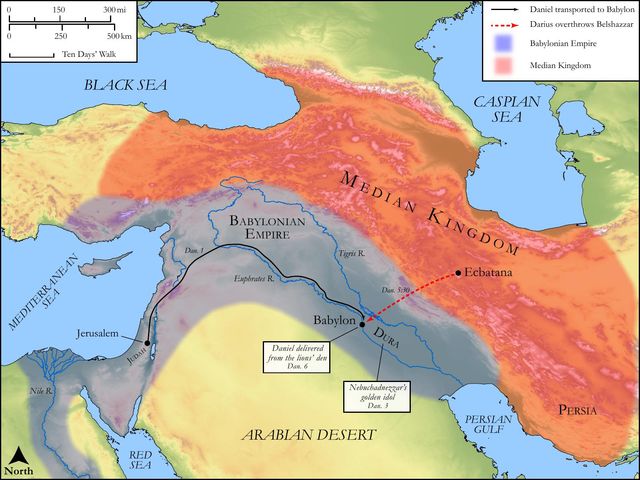
See on the biblical-era map
Study this verse
Public-domain commentary
Matthew Henry
From his Commentary on the Whole Bible. Henry comments on passages, not single verses — this entry covers Daniel 6:11–17.
Here is 1. Proof made of Daniel's praying to his God, notwithstanding the late edict to the contrary (Dan 6:11): These men assembled; the came tumultuously together, so the word is, the same that was used Dan 6:6, borrowed from Psa 2:1, Why do the heathen rage? They came together to visit Daniel, perhaps under pretence of business, at that time which they knew to be his usual hour of devotion; and, if they had not found him so engaged, they would have upbraided him with his faint-heartedness and distrust of his God, but (which they rather wished to do) they found him on his knees praying and making supplication before his God. For his love they are his adversaries; but, like his father David, he gives himself unto prayer, Psa 109:4. 2. Complaint made of it to the king. When they had found occasion against Daniel concerning the law of his God they lost no time, but applied to the king (Dan 6:12), and having appealed to his whether there was not such a law made, and gained from him a recognition of it, and that it was so ratified that it might not be altered, they proceeded to accuse Daniel, Dan 6:13. They so describe him, in the information they give, as to exasperate the king and incense him the more against him: "He is of the children of the captivity of Judah; he is of Judah, that despicable people, and now a captive in a despicable state, that can call nothing his own but what he has by the king's favour, and yet he regards not thee, O king! nor the decree that thou hast signed." Note, It is no new thing for that which is done faithfully, in the conscience towards God, to be misrepresented as done obstinately and in contempt of the civil powers, that is, for the best saints to be reproached as the worst men. Daniel regarded God, and therefore prayed, and we have reason to think prayed for the king and his government, yet this is construed as not regarding the king. That excellent spirit which Daniel was endued with, and that established reputation which he had gained, could not protect him from these poisonous darts. They do not say, He makes his petition to his God, lest Darius should take notice of that to his praise, but only, He makes his petition, which is the thing the law forbids. 3. The great concern the king was in hereupon. He now perceived that, whatever they pretended, it was not to honour him, but in spite to Daniel, that they had proposed that law, and now he is sorely displeased with himself for gratifying them in it, Dan 6:14. Note, When men indulge a proud vain-glorious humour, and please themselves with that which feeds it, they know not what vexations they are preparing for themselves; their flatterers may prove their tormentors, and are but spreading a net for their feet. Now, the king sets his heart to deliver Daniel; both by argument and by authority he labours till the going down of the sun to deliver him, that is, to persuade his accusers not to insist upon his prosecution. Note, We often do that, through inconsideration, which afterwards we see cause a thousand times to wish undone again, which is a good reason why we should ponder the path of our feet, for then all our ways will be established. 4. The violence with which the prosecutors demanded judgment, Dan 6:15. We are not told what Daniel said; the king himself is his advocate, he needs not plead his own cause, but silently commits himself and it to him that judges righteously. But the prosecutors insist upon it that the law must have its course; it is a fundamental maxim in the constitution of the government of the Medes and Persians, which had now become the universal monarchy, that no decree or statute which the king establishes may be changed. The same we find Est 1:19; Est 8:8. The Chaldeans magnified the will of their king, by giving him a power to make and unmake laws at his pleasure, to slay and keep alive whom he would. The Persians magnified the wisdom of their king, by supposing that whatever law he solemnly ratified it was so well made that there could be no occasion to alter it, or dispense with it, as if any human foresight could, in framing a law, guard against all inconveniences. But, if this maxim be duly applied to Daniel's case (as I am apt to think it is not, but perverted), while it honours the king's legislative power it hampers his executive power, and incapacitates him to show that mercy which upholds the throne, and to pass acts of indemnity, which are the glories of a reign. Those who allow not the sovereign's power to dispense with a disabling statute, yet never question his power to pardon an offence against a penal statute. But Darius is denied this power. See what need we have to pray for princes that God would give them wisdom, for they are often embarrassed with great difficulties, even the wisest and best are. 5. The executing of the law upon Daniel. The king himself, with the utmost reluctance, and against his conscience, signs the warrant for his execution; and Daniel, that venerable grave man, who carried such a mixture of majesty and sweetness in his countenance, who had so often looked great upon the bench, and at the council-board, and greater upon his knees, who had power with God and man, and had prevailed, is brought, purely for worshipping his God, as if he had been one of the vilest of malefactors, and thrown into the den of lions, to be devoured by them, Dan 6:16. One cannot think of it without the utmost compassion to the gracious sufferer and the utmost indignation at the malicious prosecutors. To make sure work, the stone laid upon the mouth of the den is sealed, and the king (an over-easy man) is persuaded to seal it with his own signet (Dan 6:17), that unhappy signet with which he had confirmed the law that Daniel falls by. But his lords cannot trust him, unless they add their signets too. Thus, when Christ was buried, his adversaries sealed the stone that was rolled to the door of his sepulchre. 6. The encouragement which Darius gave to Daniel to trust in God: Thy God whom thou servest continually, he will deliver thee, Dan 6:16. Here (1.) He justifies Daniel from guilt, owning all his crime to be serving his God continually, and continuing to do so even when it was made a crime. (2.) He leaves it to God to free him from punishment, since he could not prevail to do it: He will deliver thee. He is sure that his God can deliver him, for he believes him to be an almighty God, and he has reason to think he will do it, having heard of his delivering Daniel's companions in a like case from the fiery furnace, and concluding him to be always faithful to those who approve themselves faithful to him. Note, Those who serve God continually he will continually preserve, and will bear them out in his service.
Historical interpretation
Three Centuries of Reception
5 surviving comments on this verse. Each one is dated, so this reads as a timeline rather than a list.
Select a marker to jump to its quote. Markers stagger vertically where authors wrote within a few decades of each other.
For what shall we say? Was Daniel cast into the den of lions by those who feared God? Were Ananias and Azarias and Mishael shut up in a furnace of fire by those who observed the great and glorious worship of the Most High? Far from us be such a thought! Who, then, were they that did such things? The hateful, and those full of all wickedness, were roused to such a pitch of fury that they inflicted torture on those who served God with a holy and blameless purpose [of heart], not knowing that the Most High is the defender and protector of all such as with a pure conscience venerate his all-excellent name.… But they who with confidence endured [these things] are now heirs of glory and honor and have been exalted and made illustrious by God in their memorial for ever and ever.
From Syria even to Rome I fight with beasts: not that I am devoured by brute beasts, for these, as you know, by the will of God, spared Daniel, but by beasts in the shape of people, in whom the merciless wild beast himself lies hid and pricks and wounds me day by day. But none of these hardships "move me, neither count I my life dear unto myself," in such a way as to love it better than the Lord. Wherefore I am prepared for [encountering] fire, wild beasts, the sword or the cross, so that only I may see Christ my Savior and God, who died for me. I therefore, a prisoner of Christ, who is driven along by land and sea, exhort you: "stand fast in the faith," and be steadfast, "for the just shall live by faith"; be unwavering, for "the Lord causes those to dwell in a house that are of one and the same character."
Let not, therefore, any one that works signs and wonders judge any one of the faithful who is not granted the same: for the gifts of God that are bestowed by him through Christ are various; and one person receives one gift and another another.… For neither did the wise Daniel, who was delivered from the mouths of the lions, nor the three children, who were delivered from the furnace of fire, despise the rest of their fellow Israelites: for they knew that they had not escaped these terrible miseries by their own might but by the power of God did they both work miracles and were delivered from miseries. Wherefore let none of you exalt himself against his brother, though he is a prophet or though he is a worker of miracles.
Lord, who fulfilled your promises made by the prophets, and had mercy on Zion and compassion on Jerusalem, by exalting the throne of David, your servant … by the birth of Christ, who was born of his seed according to the flesh, of a virgin alone; please, O Lord God, accept the prayers that proceed from the lips of your people which are of the Gentiles, which call on you in truth, as you accepted the gifts of the righteous in their generations. In the first place you respected the sacrifice of Abel … of Ezra at the return; of Daniel in the den of lions; of Jonah in the whale’s belly.
Verse 16. "Then the king gave order, and they brought Daniel and cast him into the pit of lions. And the king said to Daniel: 'Thy God whom thou dost ever serve will Himself deliver thee.'" He gives way to the crowd and dares not to withhold from his plotting adversaries the death of his friend, and he commits to the power of God the purpose which he himself was unable to attain. Nor does he use the language of doubt, so as to say, "If He be able to deliver thee"; but rather he speaks with boldness and confidence and says, "The God whom thou dost ever serve shall Himself deliver thee." He had heard, of course, that three youths who were of a lower rank than Daniel himself had triumphed over the flames of Babylon. He had heard that many secrets had been revealed to Daniel, and therefore regarded him highly, and held him, captive though he was, in the greatest honor.
Continue studying Daniel 6:16 across the web’s major study libraries — every link below opens this exact verse, chapter, or book on the destination site.
Read & Compare
 BibleGatewayThis verse in more than 200 translations and 70 languages.
 Bible.comThe YouVersion reader — hundreds of translations, reading plans, and highlights.
 ESV.orgCrossway's official English Standard Version reader.
 NET BibleThe NET translation with 60,000+ translators' notes on every rendering decision.
 STEP BibleTyndale House's free study tool — original text, vocabulary, and scholarly resources.
 BibliaLogos Bible Software's free web reader.
 USCCBThe New American Bible (Revised Edition) with the U.S. bishops' study notes.
Commentaries
 BibleHub CommentariesDozens of classic commentaries on this verse, gathered on one page.
 StudyLightMore than 100 commentary sets — the largest collection on the web.
 BibleRefPlain-English commentary on what this verse means, verse by verse.
 Enduring WordDavid Guzik's free commentary on this chapter, widely used by Bible teachers.
 Bible Study ToolsVerse commentary alongside Greek and Hebrew study aids.
Original Language & Research
- BibleHub InterlinearThe verse word by word — original language, transliteration, and English.
- BibleHub LexiconEvery word's original-language definition and Strong's entry.
 Blue Letter BibleDeep-study tools — Strong's numbers, concordance, and word studies.
 SefariaThe Hebrew text with Rashi and centuries of Jewish commentary.
Sermons, Hymns & Audio


TrulyRandomVerse is not affiliated with these sites and doesn’t control their content. They’re linked because they’re genuinely useful.
Summary
Daniel 6:16 encapsulates the dramatic culmination of King Darius's internal conflict and the unyielding nature of Medo-Persian law. Despite the king's profound respect and affection for Daniel, the immutable decree compelled him to command Daniel's casting into the den of lions. Yet, in a remarkable display of desperate hope or nascent faith, Darius utters a powerful declaration, expressing his conviction that Daniel's God, whom he served with unwavering devotion, would indeed deliver him from this certain demise. This pivotal moment not only sets the stage for a miraculous divine intervention but also highlights the clash between human authority and divine sovereignty.
Context
ShowHideLiterary Context
Daniel 6:16 serves as the narrative climax of the chapter, immediately following King Darius's agonizing but ultimately futile efforts to rescue Daniel from the consequences of the malicious decree (compare Daniel 6:14-15). The preceding verses meticulously detail the conspiracy hatched by Daniel's jealous administrative rivals, who exploited his unwavering devotion to God by crafting an unalterable law forbidding prayer to anyone but the king for thirty days (see Daniel 6:6-9). Daniel's deliberate and public continuation of his daily prayers, even with his windows open towards Jerusalem, directly defied this decree, powerfully demonstrating his supreme allegiance to God over human authority (as seen in Daniel 6:10). The king's reluctant command to cast Daniel into the den underscores the inescapable nature of Medo-Persian law, thereby setting the stage for a divine intervention that would transcend all human limitations and legal constraints.
Historical & Cultural Context
The Medo-Persian Empire, under King Darius (often identified as Darius the Mede, possibly a viceroy or a historical figure associated with Cyrus's conquest of Babylon), was renowned for its highly organized administration and, crucially, its unchangeable laws. Once a decree was signed by the king and sealed, it became immutable, even for the monarch himself, as explicitly stated in Daniel 6:8. This legal rigidity is a critical element in the narrative, highlighting the king's powerlessness despite his personal desire to save Daniel. Lions were kept in specially constructed dens, often as a form of royal entertainment, a symbol of power, or as a brutal method of execution for those who defied imperial authority. The act of casting someone into such a den was a public spectacle designed to assert the king's absolute power and the finality of his judgment. Daniel's situation was not merely a legal predicament but a profound cultural and political statement, orchestrated by his adversaries to eliminate him through a perceived act of insubordination.
Key Themes
ShowHideThis verse powerfully contributes to several overarching themes within the Book of Daniel and broader biblical theology. First, it exemplifies Faithfulness Under Persecution, showcasing Daniel's unyielding commitment to God even when faced with a death sentence. His steadfastness in prayer, despite the decree, is a profound testament to his priority of divine obedience over personal safety (as highlighted in Daniel 6:10). Second, the king's declaration, "Thy God whom thou servest continually, he will deliver thee," introduces the theme of Divine Sovereignty and Deliverance. This statement, coming from a pagan king, foreshadows God's miraculous intervention and underscores His ultimate authority over human rulers and their seemingly unchangeable laws. It powerfully echoes earlier deliverances in Daniel, such as Shadrach, Meshach, and Abednego in the fiery furnace (compare Daniel 3:17), reinforcing God's power to save His faithful servants. Finally, the narrative highlights the Impact of Godly Living, demonstrating how Daniel's consistent righteousness and integrity profoundly influenced King Darius, leading him to acknowledge and even hope in the power of Daniel's God.
Exposition and Analysis
ShowHideKey Word Analysis
ShowHideThis term (H1358) refers to a pit, specifically one "cut out" for wild animals. It emphasizes the grim reality of Daniel's predicament—a deep, inescapable pit where lions were kept, designed for certain death. The use of this specific term highlights the King's full awareness of the lethal nature of the punishment and the finality of the human judgment.
This word (H6399) means "to serve or worship." When coupled with "continually" (Aramaic, tᵉdîyrâ' H8411, meaning "constantly" or "permanence"), it paints a vivid picture of Daniel's unwavering, habitual, and lifelong devotion to God. It's not a sporadic act but a deeply ingrained pattern of worship and obedience that King Darius himself had observed and recognized as a defining characteristic of Daniel's life.
This term (H7804) means "to leave" or, causatively, "to free" or "to rescue." It signifies a supernatural intervention, a release from bondage or peril. The king's use of this word expresses a desperate hope and an almost prophetic utterance, acknowledging that only a divine power, beyond human capability or law, could extricate Daniel from such a dire and seemingly inescapable situation.
Verse Breakdown
ShowHide"Then the king commanded, and they brought Daniel, and cast [him] into the den of lions"
This clause describes the king's reluctant but legally bound action. Despite his personal anguish and his strenuous efforts to save Daniel, the unchangeable nature of the Medo-Persian law forced him to issue the command. The act of casting Daniel into the den signifies the finality of the human judgment and the seemingly inescapable nature of Daniel's fate, underscoring the severity of the situation.
"[Now] the king spake and said unto Daniel"
This transition highlights the king's direct, personal address to Daniel at this critical, life-or-death moment. It's not merely a detached command but a deeply personal interaction, revealing the king's emotional investment, his profound respect for Daniel, and perhaps his own spiritual wrestling. The words that follow are not a casual remark but a significant, almost desperate, declaration uttered just before the execution.
"Thy God whom thou servest continually, he will deliver thee"
This is the heart of the verse, a profound statement from a pagan monarch. It acknowledges Daniel's consistent and unwavering devotion to his God and expresses a belief, or at least a fervent hope, in the power of that God to intervene miraculously. This declaration elevates the narrative from a simple account of persecution to a powerful testament of divine power, setting the expectation for God's miraculous intervention and demonstrating His sovereignty over human decrees.
Literary Devices
ShowHideDaniel 6:16 employs several potent literary devices that enrich its meaning and impact. Foreshadowing is prominently featured, as King Darius's declaration, "Thy God whom thou servest continually, he will deliver thee," directly anticipates the miraculous deliverance that unfolds in the subsequent verses. This statement functions almost as a prophetic utterance from an unexpected source, building suspense and highlighting the king's recognition of Daniel's God. There is also a strong element of Irony: the very law designed to entrap Daniel and assert human authority ultimately becomes the stage for a magnificent display of divine power, humbling the king and exalting God. Furthermore, the king's words can be seen as a form of Divine Declaration through a Human Agent, where a pagan ruler, perhaps unwittingly, becomes a mouthpiece for the truth of God's power and faithfulness, underscoring the theme of God's sovereignty over all earthly powers and His ability to use anyone to declare His truth.
Theological and Thematic Connections
ShowHideDaniel 6:16 is a pivotal verse that underscores the profound theological truth of God's unwavering faithfulness to His devoted servants and His ultimate sovereignty over human affairs. Despite the seemingly insurmountable power of human law and the certainty of death, King Darius's declaration points to a higher authority—the God whom Daniel served continually. This moment highlights that even in the darkest valleys, when human efforts fail, divine intervention is not only possible but often the very means by which God's glory is most powerfully displayed. It teaches us that our consistent walk with God, marked by unwavering devotion, can serve as a powerful witness, even to those outside the faith, and can set the stage for God to display His glory in miraculous ways that transcend human logic and limitations.
Reflection and Application
ShowHideDaniel 6:16 serves as a powerful reminder of the call to unwavering faithfulness in the face of adversity and the profound impact of a consistent walk with God. Daniel's commitment to God was so evident that even a pagan king, bound by the very laws he enacted, acknowledged it and expressed hope for divine intervention. For believers today, this verse challenges us to examine the consistency of our own devotion. Are we serving Him "continually," or only when it is convenient, safe, or socially acceptable? When faced with pressures to compromise our faith, whether from societal norms, professional demands, or personal fears, Daniel's example encourages us to prioritize obedience to God above all else, trusting that He is sovereign over every circumstance. It cultivates a deep-seated confidence that even when human solutions fail and the "den of lions" seems inevitable, our God is capable of delivering us—not always from the trial, but always through it, for His glory and our ultimate good.
Questions for Reflection
ShowHideFAQ
ShowHideWhy did King Darius, who seemed to like Daniel, still cast him into the den of lions?
ShowHideKing Darius was bound by the unchangeable nature of Medo-Persian law. Once a decree was signed and sealed by the king, it became immutable and could not be altered, even by the king himself (as explicitly stated in Daniel 6:8). Despite his deep distress and his earnest efforts to find a legal loophole or a way to rescue Daniel (as seen in Daniel 6:14), the legal system of his empire, which he himself had ratified, compelled him to enforce the punishment. This highlights the absolute authority of the law in that culture and the king's powerlessness to overturn it once enacted, thereby setting the stage for God's miraculous intervention.
What is the significance of King Darius's statement, "Thy God whom thou servest continually, he will deliver thee"?
ShowHideThis statement is highly significant for several profound reasons. First, it serves as a powerful acknowledgment of Daniel's consistent and unwavering devotion to his God, testifying to Daniel's godly character and profound influence even on a pagan monarch. Second, coming from a pagan king, it demonstrates a remarkable recognition of the power of Daniel's God, even if it was born out of desperation, awe, or a nascent understanding. Third, and most importantly, it functions as a prophetic declaration, expressing a deep hope and perhaps even a conviction that Daniel's God would indeed intervene. It sets the expectation for the miraculous deliverance that follows, powerfully emphasizing God's sovereignty over human decrees, earthly powers, and even the natural order.
Does this verse promise that God will always deliver His faithful servants from physical harm?
ShowHideWhile Daniel 6:16 describes a miraculous physical deliverance, it does not guarantee that God will always deliver His faithful servants from physical harm or death in every circumstance. The Bible presents numerous examples of faithful individuals who suffered martyrdom (e.g., Stephen in Acts 7:54-60 or the martyrs mentioned in Hebrews 11:35-38). The promise is not always physical rescue, but rather God's unwavering faithfulness to His people, whether through miraculous preservation, strength to endure suffering, or ultimate deliverance into His eternal presence. The primary message is God's sovereignty, His profound ability to act powerfully, and His commitment to working all things for His greater purposes and the ultimate good of His people (as affirmed in Romans 8:28).
Christ-Centered Fulfillment
ShowHideDaniel 6:16, with its dramatic declaration of deliverance and the subsequent miraculous preservation, powerfully foreshadows the ultimate deliverance wrought by Jesus Christ for all humanity. Daniel's descent into the den of lions, a place of certain death, and his subsequent miraculous emergence unharmed by the power of God, profoundly echo the burial of Christ and His glorious resurrection. Just as Daniel was placed in a tomb-like pit and emerged victorious over the jaws of death by the power of God, so too was Christ laid in a tomb, only to conquer death and emerge triumphant on the third day, fulfilling the prophecy that God would not allow His Holy One to see corruption (as proclaimed in Acts 2:27). Daniel's unwavering faithfulness, even unto death, points to the perfect obedience of Jesus, who faithfully served His Father even to the point of death on the cross (as described in Philippians 2:8). The king's hopeful words, "Thy God whom thou servest continually, he will deliver thee," find their ultimate and most profound fulfillment in the Father's raising of Jesus from the dead, demonstrating that God is indeed the ultimate Deliverer, not only from physical peril but decisively from the spiritual death and bondage of sin (as we see in Colossians 1:13-14). Through Christ, believers are delivered from the "den" of sin and death, receiving eternal life and the glorious promise of resurrection (as Jesus declares in John 11:25-26).