


Old Testament · Major Prophets · Book 26 of 66
Ezekiel
A priest among the captives in Babylon sees the glory of the LORD leave the temple before Jerusalem falls, and return to a temple shown him in vision.
- 48 chapters
- 1,273 verses
- About 3 hours to read
- The Babylonian Exile, c. 605–538 BC
Ezekiel was a priest, carried to Babylon with king Jehoiachin, and his book counts its years from “our captivity” (Ezekiel 40:1). In the fifth year, by the river Chebar, he saw the glory that had once filled the temple in Jerusalem: “This was the appearance of the likeness of the glory of the LORD” (1:28). In a later vision he watches the glory leave the defiled house and stand “upon the mountain which is on the east side of the city” (11:23). At the end he sees it come back “by the way of the gate whose prospect is toward the east” (43:4), and the book’s last words name the city “The LORD is there” (48:35).
Between those visions the book turns once. Until Jerusalem falls, Ezekiel warns that it will. When a man who escaped brings word, “The city is smitten” (33:21), the warnings give way to promises: a shepherd, a new heart, breath for dry bones. One sentence runs through judgment and promise alike, over Israel and over the nations: “they shall know that I am the LORD.”
A new heart also will I give you, and a new spirit will I put within you: and I will take away the stony heart out of your flesh, and I will give you an heart of flesh.
Ezekiel 36:26 KJV
Before you read
- Who wrote it
- Ezekiel the priest, the son of Buzi (Ezekiel 1:3). The book speaks in his voice, “I was among the captives by the river of Chebar” (1:1), and the LORD names him again: “Thus Ezekiel is unto you a sign” (24:24).
- When it was written
- The visions are dated by “king Jehoiachin’s captivity” (Ezekiel 1:2), from its fifth year to its twenty-seventh (29:17), about 593 to 571 BC. The “thirtieth year” of 1:1 is that fifth year, counted another way.
Many, as Jerome reports; Gregory the Dialogist The thirtieth year is Ezekiel’s own age. Gregory saw in it the age at which the Lord came to the Jordan, where the heavens were opened, as they were opened to Ezekiel by the Chebar.
Grounds Gregory the Dialogist 604 · Homilies on Ezekiel, Book 1, Homily 2Jerome 420 · Commentary on EzekielEzekiel 1:1
Jerome The years are counted from the reign of Josiah, when the book of the law was found in the temple, to the fifth year of Jehoiachin’s captivity.
Grounds Jerome 420 · Commentary on Ezekiel2 Kings 22:8
- Where
- “The land of the Chaldeans by the river Chebar” (Ezekiel 1:3), at Telabib among the captives (3:15), where the elders came to sit before him (8:1). In visions he is taken to Jerusalem (8:3) and set on “a very high mountain” in the land of Israel (40:2).
How Ezekiel is laid out
8 movements · 187 passages · 1,273 verses
Glory by the river Chebar
Chapters 1–3 · 65 verses
By the river Chebar the heavens open, and Ezekiel sees four living creatures, wheels full of eyes, and above them a throne bearing the likeness of a man. He is sent to a rebellious house, eats a roll written with lamentations, and is made a watchman. Then he is bound and made dumb, to speak only when God opens his mouth.
13 passages
- 1:1–3 Setting the Scene: Ezekiel's Call
- 1:4–14 The Storm and the Living Creatures
- 1:15–21 The Wheels and Their Movement
- 1:22–25 The Firmament Above the Creatures
- 1:26–28 The Throne and the Glory of God
- 2:1–2 Ezekiel Commissioned by the Spirit
- 2:3–5 Mission to Rebellious Israel
- 2:6–8 Do Not Fear the Rebellious House
- 2:9–10 The Scroll of Judgment
- 3:1–11 The Prophet Internalizes the Word
- 3:12–15 Ezekiel Transported to the Exiles
- 3:16–21 The Watchman's Mandate
- 3:22–27 The Prophet Confined and Silenced
Signs of the siege
Chapters 4–7 · 75 verses
Ezekiel acts out what is coming. He lays siege to Jerusalem drawn on a tile, lies on his left side three hundred and ninety days and on his right side forty for the iniquity of Israel and Judah, and eats bread by weight. He shaves his head and divides the hair in three. Over the land of Israel he cries, “An end, the end is come.”
15 passages
- 4:1–3 The Symbolic Siege of Jerusalem
- 4:4–8 Bearing the Sins of Israel and Judah
- 4:9–15 Bread of Famine and Defilement
- 4:16–17 The Severity of the Coming Famine
- 5:1–4 The Symbolic Act of Shaving and Dividing Hair
- 5:5–7 Jerusalem's Unique Status and Condemnation
- 5:8–12 God Declares Unprecedented Judgment
- 5:13–17 The Fulfillment of Divine Wrath
- 6:1–7 Prophecy Against the Mountains of Israel
- 6:8–10 The Promise of a Remnant
- 6:11–14 Prophetic Action and Comprehensive Judgment
- 7:1–4 The Finality of Judgment Declared
- 7:5–13 The Imminence of the Day of Trouble
- 7:14–22 Desolation, Famine, and Worthless Wealth
- 7:23–27 The Siege and Collapse of Authority
The glory leaves the temple
Chapters 8–11 · 76 verses
In the sixth year Ezekiel is carried in visions to Jerusalem. In the temple he sees the image of jealousy, elders offering incense to idols portrayed on the wall, women weeping for Tammuz and men worshipping the sun. Those who sigh over the abominations are marked; the rest are slain. The glory rises from the threshold and stands on the mountain east of the city.
15 passages
- 8:1–4 Ezekiel's Visionary Journey to Jerusalem
- 8:5–6 The Abomination of the Image of Jealousy
- 8:7–13 The Secret Idolatry of the Elders
- 8:14–15 Women Weeping for Tammuz
- 8:16–18 Men Worshipping the Sun and the Fury Declared
- 9:1–2 The Executioners Are Summoned
- 9:3–4 The Mark of Preservation
- 9:5–7 The Judgment Commences
- 9:8–11 Ezekiel Intercedes for Israel
- 10:1–7 The Command to Scatter Fire
- 10:8–17 Description of the Cherubim and Wheels
- 10:18–22 The Glory of the Lord Departs
- 11:1–13 Judgment on Jerusalem's Wicked Leaders
- 11:14–21 Promise of Restoration for the Exiles
- 11:22–25 The Glory of the Lord Departs
Parables of a falling city
Chapters 12–19 · 215 verses
Ezekiel carries his stuff out through a wall, a sign of the king’s flight. He condemns prophets who cry Peace where there is none. Jerusalem is a vine fit for the fire, and a foundling the LORD clothed and married, who played the harlot. Her king breaks his oath to Babylon. The proverb of sour grapes is refused: each soul answers for its own sin.
8 chapters
The bloody city
Chapters 20–24 · 188 verses
In the seventh year the elders come to enquire and hear Israel’s history as one long rebellion, spared only for the LORD’s name. A sword is sharpened; the king of Babylon divines at the parting of the way. Jerusalem, the bloody city, is judged, and shown as Aholibah, worse than her sister Samaria. As the siege begins, Ezekiel’s wife dies, and he may not mourn.
Against the nations
Chapters 25–32 · 197 verses
Ammon, Moab, Edom and the Philistines are judged for their scorn and vengeance at Judah’s fall. Tyre is mourned as a laden ship that sinks; its prince, who said “I am a God,” is brought down, and its king is lamented as one who was in Eden. Egypt, a staff of reed to Israel, goes down with Pharaoh to the pit.
8 chapters
Life from the dead
Chapters 33–39 · 197 verses
Ezekiel is set again as watchman. In the twelfth year a fugitive brings word that the city is smitten, and his mouth is opened. The LORD will search for his scattered sheep and set over them one shepherd, his servant David. He will cleanse Israel and give a new heart, raise dry bones by his breath, join two sticks into one kingdom, and overthrow Gog.
The temple and the river
Chapters 40–48 · 260 verses
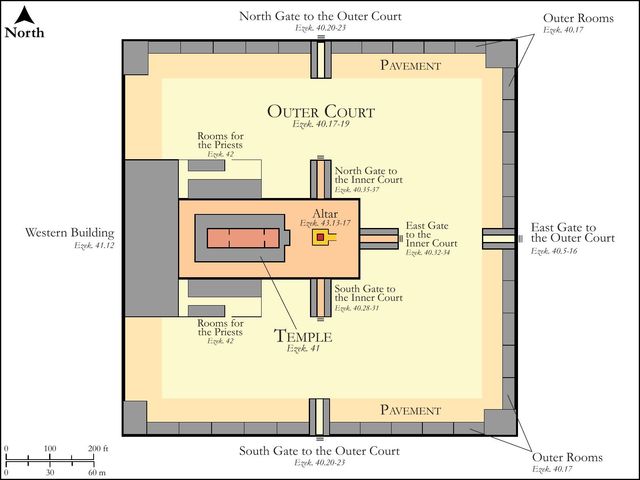
In the twenty-fifth year Ezekiel is set on a very high mountain and shown a temple, measured by a man with a reed. The glory of the LORD returns by the east gate and fills the house. Laws for priests, prince and offerings follow. A river flows from the threshold to heal the sea, the tribes receive the land, and the city is named “The LORD is there.”
9 chapters
- 40 The Vision of the New Temple Begins
- 41 Dimensions of the Temple Building
- 42 The Northern Chambers Described
- 43 The Return of God's Glory
- 44 The Closed East Gate
- 45 Division of the Holy Land Portion
- 46 Regulations for the East Gate
- 47 The River Flowing from the Temple
- 48 The Division of the Land: Northern Tribes
The words Ezekiel turns on
Glory leaves in 10–11 and returns in 43; idols and the sword fill the judgments; spirit gives life in 36–37; measure fills 40–47.
What Ezekiel teaches
yâdaʻ · know
They shall know that I am the LORD
The sentence “they shall know that I am the LORD,” or a form of it, stands in more than sixty verses. It ends the judgments on Israel, who will know “that I have not said in vain that I would do this evil unto them” (6:10), and the oracles on Ammon, Tyre and Egypt (25:5; 26:6; 29:6). It ends the promises too: “ye shall know that I am the LORD, when I have opened your graves” (37:13). In judgment and in mercy the LORD makes himself known as he is, and his name, not Israel’s worth, is the reason given: “I do not this for your sakes, O house of Israel, but for mine holy name’s sake” (36:22).
shûwb · turn
Turn yourselves, and live
The captives had a proverb: “The fathers have eaten sour grapes, and the children’s teeth are set on edge” (18:2). With it they said they were bearing their fathers’ sins. The LORD forbids it: “all souls are mine … the soul that sinneth, it shall die” (18:4). Chapter 18 follows three generations, a righteous man, his violent son, and a grandson who “seeth all his father’s sins … and doeth not such like” (18:14), and judges each by his own ways. The wicked who turns lives; the righteous who turns away dies. The chapter ends with an appeal: “I have no pleasure in the death of him that dieth, saith the Lord GOD: wherefore turn yourselves, and live ye” (18:32). The watchman’s charge applies the same rule to the prophet (33:7–9).
rûwach · spirit, breath
A new heart and a new spirit
In chapter 18 the command is “make you a new heart and a new spirit” (18:31). Chapter 36 promises it as God’s gift: “A new heart also will I give you, and a new spirit will I put within you” (36:26), and “I will put my spirit within you, and cause you to walk in my statutes” (36:27). Augustine put it plainly: God promises that he will cause them to do those things that he commands to be done.
Chapter 37 shows it. One Hebrew word, rûwach, serves as breath, wind and spirit. The bones come together and are covered with flesh, “but there was no breath in them” (37:8), until the prophet calls, “Come from the four winds, O breath” (37:9). The LORD explains: “I … shall put my spirit in you, and ye shall live” (37:13–14).
miqdâsh · sanctuary
A sanctuary for evermore
The LORD promised to “set my sanctuary in the midst of them for evermore” (37:26), and chapters 40–48 show it measured and filled with his glory. Christians have read it in two ways. Some look for this temple in a kingdom still to come on the earth. They point to its exact measures, the tribes’ portions, and the promise to “dwell in the midst of the children of Israel for ever” (43:7); Tertullian held that a kingdom is promised to us upon the earth
, and that Ezekiel knew of its city. Others read it of Christ, his church and the new creation, as Jerome did: We liken this to the church of Christ
. They set its river (47:1–12) beside the living water of John 7:38–39 and the river of Revelation 22:1–2, in a city with “no temple therein” (Revelation 21:22).
Christ in Ezekiel
Ezekiel 34 indicts the shepherds of Israel who fed themselves and not the flock (Ezekiel 34:2), and then gives two promises. The LORD himself will search out his sheep: “I will seek that which was lost, and bring again that which was driven away” (34:16). And he will “set up one shepherd over them … even my servant David” (34:23), though David had long been dead. Augustine pointed to the dates: it is a prophecy of Christ coming to people from the seed of David
. Jesus took both promises on himself. He came “to seek and to save that which was lost” (Luke 19:10), and he said, “I am the good shepherd: the good shepherd giveth his life for the sheep” (John 10:11).
Chapter 36 joins clean water to God’s Spirit: “Then will I sprinkle clean water upon you” and “I will put my spirit within you” (36:25–27). Jesus told Nicodemus that a man must be “born of water and of the Spirit” (John 3:5), and asked him, “Art thou a master of Israel, and knowest not these things?” (John 3:10).
People
By how many verses name them
- EzekielA son of Buzi2
- Pharaoh11
- Gog7
- AholibahA sister of Oholah5
- AholahA sister of Oholibah4
- DavidSon of Jesse4
- NebuchadrezzarFather of Belshazzar4
- ZadokA son of Ahitub; father of Ahimaaz4
19 more are named.
Places
97 named
- EgyptIsrael’s staff of reed, judged with Pharaoh in chapters 29–3244
- JerusalemJudged in chapters 4–24; its fall is reported in 33:2126
- BabylonWhose king besieges Jerusalem and bears God’s sword against the nations15
- TyreThe merchant city of the sea, mourned as a sunken ship12
- ChebarThe river in Chaldea where Ezekiel lived among the captives8
- EdenThe garden of God, recalled in the laments for Tyre and Egypt6
- EdomJudged for its perpetual hatred of Israel (25:12–14; chapter 35)6
- SamariaAholah of chapter 23, Jerusalem’s elder sister in sin6
Where Ezekiel reaches
The passages it leans on, and the ones that lean on it
The faces of man, lion, ox and eagle, seen again in the four beasts round the throne.
Ezekiel 3:1–3 Jeremiah 15:16 Revelation 10:9–10
The prophet eats the word given him, sweet as honey in the mouth; for John it is bitter in the belly.
Ezekiel 18:2–4 Jeremiah 31:29–30
The proverb of sour grapes, set aside by both prophets: each soul dies for its own iniquity.
A mark on the foreheads of God’s servants before judgment falls.
Ezekiel 47:1–12 Revelation 22:1–2
Waters from the sanctuary and trees whose leaves are for medicine; John sees the river of life and leaves for healing.
Books Ezekiel links to most
The Church Fathers on Ezekiel
1,186 quotations from 56 writers before AD 800 · the ten most quoted, in date order
- Tertullian220
- Origen253
- Ambrose397
- Chrysostom407
- Jerome420
- Augustine430
- John Cassian435
- Theodoret458
- Caesarius542
- Gregory604
Jerome read the four living creatures as the four Gospels, joined wing to wing.
The Gospels are joined to each other. They stick together, and they run hither and thither in different ways in the whole circle of their flight. And they do not have an end to their flight, nor do they ever rise above and fall down, but they always move to higher places.
Augustine on what the heart of flesh means.
For by the heart of flesh and the fleshy tables is not meant a carnal understanding: but as flesh feels, whereas a stone cannot, the insensibility of stone signifies an unintelligent heart, and the sensibility of flesh signifies an intelligent heart.
Chrysostom on the good shepherd, set against the shepherds of chapter 34.
Christ showed that he was different from those who neglect the flock when it is being preyed on by wolves, since he did not neglect them and even laid down his life for them so that the sheep might not perish.
Gregory of Nyssa on the valley of dry bones as a sight of the resurrection.
Ezekiel, with prophetic spirit, has surpassed all time and space and with his power of prediction has stood at the very moment of the resurrection. Seeing the future as already present, he has brought it before our eyes in his description.
Keep studying
Articles