


Ezekiel 40:2
Bible text: King James Version (1769 Blayney text) · Public domain
Bible text: King James Version with Strong's numbers · Public domain
Bible text: Berean Standard Bible · Public domain
Bible text: American Standard Version (1901) · Public domain
Bible text: World English Bible, Messianic edition · Public domain
Bible text: Geneva Bible (1599) · Public domain
Bible text: Young's Literal Translation · Public domain
- בְּמַרְאוֹתbe·mar·'otin visions ofH4759Prep-b ¦ N-fpcNoun Plural Feminine Constructבְּinמַרְאוֹתvisions of
- אֱלֹהִים'E·lo·HimGodH430N-mpNoun Plural Masculine Absolute
- הֱבִיאַנִיhe·vi·'A·nihe brought meH935V-Hiphil-Perf-3ms ¦ 1csVerb Hiphil Perfect 3rd Singular Masculineהֱבִיאַhe broughtנִיme
- אֶל'eltoH413PrepPreposition
- אֶרֶץ'E·retz[the] land ofH776N-fscNoun Singular Feminine Construct
- יִשְׂרָאֵלYis·ra·'ElIsraelH3478N-properNoun Proper Location
- וַיְנִיחֵנִיvay·ni·Che·niand he set down meH5117Conj-w ¦ V-Hiphil-ConsecImperf-3ms ¦ 1csVerb Hiphil Consecutive Imperfect 3rd Singular Masculineוַandיְנִיחֵhe set downנִיme
- אֶל'eltoH413PrepPreposition
- הַרhara mountainH2022N-msNoun Singular Masculine Absolute
- גָּבֹהַּga·Vo·ahhighH1364Adj-msAdjective Singular Masculine Absolute
- מְאֹדme·'OdveryH3966Adj-msAdjective Numerical Singular Masculine Absolute
- וְעָלָיוve·'a·Lavand [was] on itH5921Conj-w ¦ Prep ¦ 3msPrepositionוְandעָלָי[was] onוit
- כְּמִבְנֵהke·miv·nehlike [the] structure ofH4011Prep-k ¦ N-mscNoun Singular Masculine Constructכְּlikeמִבְנֵה[the] structure of
- עִיר'ira cityH5892N-fsNoun Singular Feminine Absolute
- מִנֶּגֶבmi·Ne·gevfrom [the] southH5045Prep-m ¦ N-msNoun Singular Masculine Absoluteמִfromנֶּגֶב[the] south
English is a literal word-by-word gloss of the Hebrew, not the KJV's wording. Why?
This is the original text the KJV's translators worked from — each Hebrew word with its own literal English meaning in this verse, prepared by scholars at Tyndale House, Cambridge. The KJV translates whole sentences, not word by word, so its wording differs: one Hebrew word can become several English words, and the KJV may choose “the LORD” where the gloss reads “Yahweh”. Both are faithful — they answer different questions. For the KJV's own rendering, switch to the KJV text.
Details
See on the biblical-era map
Study this verse
Public-domain commentary
Matthew Henry
From his Commentary on the Whole Bible. Henry comments on passages, not single verses — this entry covers Ezekiel 40:1–4.
We have here a very short and ready way taken for the dividing of the land among the twelve tribes, not so tedious and so far about as the way that was taken in Joshua's time; for in the distribution of spiritual and heavenly blessings there is not that danger of murmuring and quarrelling that there is in the participation of the temporal blessings. When God gave to the labourers every one his penny those that were uneasy at it were soon put to silence with, May I not do what I will with my own? And such is the equal distribution here among the tribes. In this distribution of the land we may observe, 1. That it differs very much from the division of it in Joshua's time, and agrees not with the order of their birth, nor with that of their blessing by Jacob or Moses. Simeon here is not divided in Jacob, nor is Zebulun a haven of ships, a plain intimation that it is not so much to be understood literally as spiritually, though the mystery of it is very much hidden from us. In gospel times old things have passed away; behold, all things have become new. The Israel of God is cast into a new method. 2. That the tribe of Dan, which was last provided for in the first division of Canaan (Jos 19:40), is first provided for here, Eze 48:1. Thus in the gospel the last shall be first, Mat 19:30. God, in the dispensation of his grace, does not follow the same method that he does in the disposals of his providence. But Dan had now his portion thereabouts where he had only one city before, northward, on the border of Damascus, and furthest of all from the sanctuary, because that tribe had revolted to idolatry. 3. That all the ten tribes that were carried away by the king of Assyria, as well as the two tribes that were long afterwards carried to Babylon, have their allotment in this visionary land, which some think had its accomplishment in the particular persons and families of those tribes who returned with Judah and Benjamin, of which we find many instances in Ezra and Nehemiah; and it is probable that there were returns of many more afterwards at several times, which are not recorded; and the Jews having Galilee, and other parts, that had been the possessions of the ten tribes, put into their hands, in common with them, they enjoyed them. Grotius says, If the ten tribes had repented and returned to God, as the chief fathers of Judah and Benjamin did, and the priests and Levites (Ezr 1:5), they would have fared as those two tribes did, but they forfeited the benefit of this glorious prophecy by sin. However, we believe it has its designed accomplishment in the establishment and enlargement of the gospel church, and the happy settlement of all those who are Israelites indeed in the sure and sweet enjoyment of the privileges of the new covenant, in which there is enough for all and enough for each. 4. That every tribe in this visionary distribution had its particular lot assigned it by a divine appointment; for it was never the intention of the gospel to pluck up the hedge of property and lay all in common; it was in a way of charity, not of legal right, that the first Christians had all things common (Act 2:44), and many precepts of the gospel suppose that every man should know his own. We must not only acknowledge, but acquiesce in, the hand of God appointing us our lot, and be well pleased with it, believing it fittest for us. He shall choose our inheritance for us, Psa 47:4. 5. That the tribes lay contiguous. By the border of one tribe was the portion of another, all in a row, in exact order, so that, like stones in an arch, they fixed, and strengthened, and wedged in one another. Behold how good and how pleasant a thing it is for brethren thus to dwell together! It was a figure of the communion of churches and saints under the gospel-government; thus, though they are many, yet they are one, and should hold together in holy love and mutual assistance. 6. That the lot of Reuben, which before lay at a distance beyond Jordan, now lies next to Judah, and next but one to the sanctuary; for the scandal he lay under, for which he was told he should not excel, began by this time to wear off. What has turned to the reproach of any person or people ought not to be remembered for ever, but should at length be kindly forgotten. 7. That the sanctuary was in the midst of them. There were seven tribes to the north of it and the Levites, the prince's, and the city's portion, with that of five tribes more, to the south of it; so that it was, as it ought to be, in the heart of the kingdom, that it might diffuse its benign influences to the whole, and might be the centre of their unity. The tribes that lay most remote from each other would meet there in a mutual acquaintance and fellowship. Those of the same parish or congregation, though dispersed, and having no occasion otherwise to know each other, yet by meeting statedly to worship God together should have their hearts knit to each other in holy love. 8. That where the sanctuary was the priests were: For them, even for the priests, shall this holy oblation be, Eze 48:10. As, on the one hand, this denotes honour and comfort to ministers, that what is given for their support and maintenance is reckoned a holy oblation to the Lord, so it intimates their duty, which is that, since they are appointed and maintained for the service of the sanctuary, they ought to attend continually to this very thing, to reside on their cures. Those that live upon the altar must serve at the altar, not take the wages to themselves and devolve the work upon others; but how can they serve the altar, his altar they live upon, if they do not live near it? 9. Those priests had the priests' share of these lands that had approved themselves faithful to God in times of trial (Eze 48:11): It shall be for the sons of Zadok, who, it seems, had signalized themselves in some critical juncture, and went not astray when the children of Israel, and the other Levites, went astray. God will put honour upon those who keep their integrity in times of general apostasy, and he has special favours in reserve for them. Those are swimming upwards, and so they will find at last, that are swimming against the stream. 10. The land which was appropriated to the ministers of the sanctuary might by no means be alienated. It was in the nature of the first-fruits of the land, and was therefore holy to the Lord; and, though the priests and Levites had both the use of it and the inheritance of it to them and their heirs, yet they might not sell it nor exchange it, Eze 48:14. It is sacrilege to convert that to other uses which is dedicated to God. 11. The land allotted for the city and its suburbs is called a profane place (Eze 48:15), or common; not but that the city was a holy city above other cities, for the Lord was there, but, in comparison with the sanctuary, it was a profane place. Yet it is too often true in the worst sense that great cities, even those which, like this, have the sanctuary near them, are profane places, and it ought to be deeply lamented. It was the complaint of old, From Jerusalem has profaneness gone forth into all the land, Jer 23:15. 12. The city is made to be exactly square, and the suburbs extending themselves equally on all sides, as the Levites' cities did in the first division of the land (Eze 48:16, Eze 48:17), which, never being literally fulfilled in any city, intimates that it is to be understood spiritually of the beauty and stability of the gospel church, that city of the living God, which is formed according to the wisdom and counsel of God, and is made firm and immovable by his promise. 13. Whereas, before, the inhabitants of Jerusalem were principally of Judah and Benjamin, in whose tribe it lay, now the head city lies not in the particular lot of any of the tribes, but those that serve the city, and bear office in it, shall serve it out of all the tribes of Israel, Eze 48:19. The most eminent men must be picked out of all the tribes of Israel for the service of the city, because many eyes were upon it, and there was great resort to it from all parts of the nation and from other nations. Those that live in the city are said to serve the city, for, wherever we are, we must study to be serviceable to the place, some way or other, according as our capacity is. They must not come out of the tribes of Israel to the city to take their ease, and enjoy their pleasures, but to serve the city, to do all the good they can there, and in so doing they would have a good influence upon the country too. 14. Care was taken that those who applied themselves to public business in the city, as well as in the sanctuary, should have an honourable comfortable maintenance; lands are appointed, the increase whereof shall be food unto those that serve the city, Eze 48:18. Who goes a warfare at his own charges? Magistrates, that attend the service of the state, as well as ministers, that attend the service of the church, should have all due encouragement and support in so doing; and for this cause pay we tribute also. 15. The prince had a lot for himself, suited to the dignity of his high station (Eze 48:21); we took an account of it before, ch. 45. He was seated near the sanctuary, where the testimony of Israel was, and near the city, where the thrones of judgment were, that he might be a protection to both and might see the that duty of both was carefully and faithfully done; and herein he was a minister of God for good to the whole community. Christ is the church's prince, that defends it on every side, and creates a defense; nay, he is himself a defence upon all its glory and encompasses it with his favour. 16. As Judah had his lot next the sanctuary on one side, so Benjamin had, of all the tribes, his lot nearest to it on the other side, which honour was reserved for those who adhered to the house of David and the temple at Jerusalem when the other ten tribes went astray from both. It is enough if treachery and apostasy, upon repentance, he pardoned, but constancy and fidelity shall be rewarded and preferred.
Historical interpretation
Three Centuries of Reception
7 surviving comments on this verse. Each one is dated, so this reads as a timeline rather than a list.
Select a marker to jump to its quote. Markers stagger vertically where authors wrote within a few decades of each other.
(Chapter XL - Verses 1 onwards) 'In the twenty-fifth year of our exile (or captivity), at the beginning of the year (or in the first month), on the tenth day of the month, fourteen years after the city was struck down (or captured): on that very day, the hand of the Lord was upon me, and He brought me there. In visions (or in a vision) of God, He brought me to the land of Israel, and set me down on a very high mountain, on which was like a city-building, facing southward (or from the south).' And he brought me there: and behold a man, whose appearance was like the appearance of brass (or shining brass); and a line of flax (or masons' line) was in his hand, and a measuring reed in his hand. And he stood in the gate: and he said to me, Son of man, see with your eyes, and hear with your ears, and set your heart upon all that I shall show you (or set in your heart all that I shall show you): for you have been brought (or entered) here for this purpose, and declare (or show) to the house of Israel all that you see. If, in the fifth year of captivity or exile of King Joachin, in the fourth month, in the fifth day of the month, the heavens were opened to the prophet Ezekiel by the river Chebar, and he saw visions of God; and now it is said that in the twenty-fifth year of the same captivity or exile of Jehoiachin, at the beginning of the year, in the tenth month, the hand of the Lord came upon him, and he was brought to the land of Israel and placed on a very high mountain, where he could see the city under construction, facing south; then there is no doubt that his entire prophecy was composed over a period of nineteen years, nine months, and five days of the twentieth year. But if, according to Theodotion, who interpreted in that place where we have placed [it], at the beginning of the year, it is understood that on the new year, the tenth month (however, the new year is called the seventh month among the Hebrews, which has the name Tishri, that is, on the Kalends of the seventh month, there is the sound of trumpets, and on the tenth day of the same month, there is the day of fasting and atonement; but on the fifteenth day, when the whole circle of the moon is completed, there are the days of the booths), it is understood that on the tenth day of the Day of Atonement, the building of the city as shown to Ezekiel, the prophet. And just as he demonstrated the restoration of the people, or rather the revival in the bones of the valley under the image of the resurrection, so now the Lord promises the restoration of the city that was destroyed by the Babylonians fourteen years ago, under its description, just as the type of captivity and destruction that he had shown through the boiling pot from the face of the North, and the truth of the prophecy was confirmed by the work, so the truth of the future edification would be proven by the faith in past events and the prediction. Nor is this said of that time, as some ignorant Jews want, when under Zerubbabel and under Jesus, son of Josedech, the high priest, the temple was built, with the prophets Haggai and Zechariah prophesying. For this temple that is now described, and the order of the priesthood, and the division of the land and fertility, is much more magnificent than what Solomon built. But the temple that was built under Zerubbabel was so small, and compared to the previous one was nothing: those who had seen the previous temple, and then saw this one, would wail and testify their sorrow with tears, and the clamor of the mourners would be much louder than the sound of trumpets. Read the book of Ezra. Furthermore, what is added, in the fourteenth year after the city was struck (or captured), according to mystical understanding, it signifies fourteen generations: which completed from David to the birth of Christ, the restoration of the city is promised by him, about whom it is written: He will build my city and bring back the captivity of my people. And again: He came to proclaim release to the captives and sight to the blind, saying to those who were in chains, come out, and to those who were in darkness, be revealed. But the hand of the Lord came upon him, so that Israel in the flesh, who was situated in Babylon, would come to the land in spirit. And he would not be placed on a high mountain in a vision, but in the visions of God, on an exceedingly high mountain, about which Isaiah and Micah prophesied: Come, let us go up to the mountain of the Lord, to the house of the God of Jacob (Isa. II, 3; Mic. IV, 2). For it is exceedingly high, in comparison to the other mountains, about which the prophet testifies, saying: I lift up my eyes to the mountains, from where will my help come? (Ps. CXX, 1). And in another place: Mountains are around it, and the Lord is around His people (Ps. CXXIV, 2). Concerning this it is also said by Isaiah: Ascend to a high mountain, you who bring good news to Zion (Isa. XL, 9). On this mountain, the city's building is shown, according to the Septuagint and Aquila, from the region, and opposite the north, from where the prophet came to the land of Israel; but according to Theodotion and Symmachus, it faces south, where there is full light, and the sun of righteousness is positioned at the highest point of the sky. And in the Song of Songs it says: Rise up, O north wind, and come, O south wind, blow upon my garden, that its spices may flow out. (Song 4:16) For the harsh north wind is driven away by the breath of the Lord, lest the warmth of love grow cold and the flowers wither. But when it is said, 'Like the structure of a city, not truly a city, but a likeness of a city is shown,' it refers to the city about which it is written: Glorious things are said of you, O city of God. (Psalm 87:2) This is Jerusalem, built as a city, whose unity itself is in that very city, and in it the great Lord is greatly praised, in the city of our God, on his holy mountain. (Psalm 48). And in the towers of this city, God is known when he will receive it. As it is said elsewhere: The streams of the river gladden the city of God (Ps. 46:4). And: A city set on a hill cannot be hidden (Matt. 5:14), as spoken in Isaiah: I am a solid city, a city under attack (Isa. 23). It did not say that it is conquered, but under attack: it is built on a rock and is not shaken by any storm. It follows: And he led me there, as it is understood, by the hand of God. There, however, that is, to the building of the city, so that he might show me all the things that were inside. And behold, he says, a man, whose appearance or vision was like a shining bronze, specifically the one of whom it is written: Behold a man, the Rising Sun is his name (Zach. VI, 12). But he did not have the appearance of amber, as is said at the beginning of this volume, nor was he girded with a golden belt, as is stated in the Book of Revelation (Apoc. I): but he had the appearance of bronze, according to the Hebrew. For this material is more resonant than all metals and resounds with a far-reaching sound. Hence, in the Book of Daniel, the kingdom of Alexander and the Greeks is symbolized by an image made of gold, silver, bronze, and iron (Daniel. II); in order to represent the eloquence of the Greek language: through which it is clear that they still need teaching, who have not yet fully understood the mysteries of spiritually building the temple. There was also a line made of twine in his hand, as it is written in Zechariah (Zech. II), that he had a measuring line to measure the width and length of the city. And the workers of masonry, either the angels who served under God's command, or Moses, and all the prophets and apostles who build the city of God, and are helpers or ministers of the Lord's will. Hence, the Apostle Paul also said: We are God's field, God's building (1 Cor. III, 9). And what follows: And the pen of measurement in his hand signifies prophetic grace, of which it is written in the forty-fourth psalm: My tongue is the pen of a swift scribe (Psalm 44:2). And concerning John the prophet and the baptist: What did you go out to the desert to see? A reed shaken by the wind (Matthew 11:7). Those who desire to imitate this reed, are those who write iniquity, and to whom the prophet curses: Rebuke the beasts of the reed (Psalm 68:31). But he was standing at the gate; for through him we enter the Father, and without him we cannot enter the city of God, so that it may receive the worthy and cast out the unworthy. There is also judgment at the gate. Hence the prophet says: They hate those who correct at the gate (Isa. 29:21). And in another place: He will not be put to shame when he speaks with his enemies at the gate (Ps. 127:5). This man spoke to the prophet, in whose hand was a cord, and whose appearance was like bronze, and he held a reed in his hand. He spoke to Ezekiel, a true architect, whom Paul the apostle imitated, saying: Like a wise architect, I have laid the foundation (I Cor. III, 10). But he calls the wise architect, to distinguish him from the foolish one, and he is called an unworthy shepherd in Zechariah; but he spoke the following: Son of man, see with your eyes, and hear with your ears (Zech. XI): not with the eyes of the flesh, but with the spirit; not with the ears of the body, but with the soul. Lift up, he says, your eyes, and see that the fields are already white for harvest (John 4:35). And: He who has ears to hear, let him hear (Luke 8:8). The construction of the city is visible, and the order of the ceremonies and priests, and the description of the land can be heard. But it is not enough to command to see with the eyes and hear with the ears; but he added: And place your heart in all things; or, place in your heart all that I will show you. For nothing is of benefit to have seen and heard, unless you place those things that you have seen and heard in the treasure of memory. When, however, he says, 'all things that I will show you', he makes the listener attentive, and he prepares the eyes of the heart, so that he may hold in his memory those things that are to be shown to him, for you have been brought here so that all things may be shown to you. With this, he shows specifically that nothing is sweeter than theory and knowledge, which the prophet desires, saying: 'One thing I have asked of the Lord, this I will seek after, that I may dwell in the house of the Lord all the days of my life.' In order to see the delight of the Lord, and to visit His temple (Psalm 26:4, 5). Hence he joins and speaks: Lord, I have loved the beauty of your house and the dwelling place of your glory. Proclaim, he says, all that you see to the house of Israel, so that those who cannot see for themselves may learn through you what is shown to you by the Lord. But to the house of Israel are those who contemplate God with their mind, such as Nathanael, who earnestly sought Christ, and deserved to hear: Behold, a true Israelite, in whom there is no deceit (John 1:47).
Upon which there was as it were the building of a city facing toward the South. It should be noted that it does not say, "Upon which there was a building," but "as it were a building," so that it might clearly be shown that all these things were said not of a corporeal but of a spiritual city's building. For he who declares that he saw not a building but as it were a building directs the hearts of his hearers to a spiritual construction, as is said through the Psalmist: "Jerusalem which is built as a city." For since that vision of inner peace is constructed from the congregation of holy citizens, the heavenly Jerusalem is built as a city. Yet while in this land of pilgrimage she is struck with scourges, beaten with tribulations, her stones are daily squared. And this is the city, namely the holy Church, which though destined to reign in heaven still labors on earth. To whose citizens Peter says: "And you as living stones are built up." And Paul says: "You are God's field, God's building." Which city indeed already has here in the conduct of the saints its great building. For in a building stone bears stone, because stone is placed upon stone; and he who bears another is borne by another. So therefore, so in holy Church each one both bears another and is borne by another. For neighbors mutually tolerate one another, so that through them the building of charity may rise. Hence Paul admonishes, saying: "Bear one another's burdens, and so you will fulfill the law of Christ." Declaring the power of which law, he says: "Love is the fulfillment of the law." For if I neglect to bear you in your conduct, and you disdain to tolerate me in my conduct, whence does the building of charity rise between us, whom mutual love does not join together through patience? Moreover in a building, as we said before, the stone that bears is borne, because just as I now tolerate the conduct of those who are still unpolished in the way of life of good work, so I too was tolerated by those who preceded me in the fear of the Lord and bore me, so that having been borne I might learn to bear. But they too were borne by their elders. However the stones that are placed at the top and at the end of the structure are indeed borne by others, but they bear no others at all, because those who will be born at the end of the Church, that is at the extremity of the world, are indeed tolerated by their elders, so that their conduct may be shaped to good works; but since none follow them who might progress through them, they bear no stones of the faithful structure upon themselves. Now therefore some are borne by us, but we were borne by others. Yet the foundation bears the entire weight of the structure, because our Redeemer alone tolerates the conduct of all together. Of whom Paul says: "For no one can lay another foundation besides that which has been laid, which is Christ Jesus." The foundation bears the stones and is not borne by the stones, because our Redeemer tolerates all our faults, but in him there was no evil that needed to be tolerated. Hence it is well said now: "He set me down upon an exceedingly high mountain, upon which there was as it were the building of a city," because he alone sustains our conduct and faults, who bears the entire structure of holy Church. Who says through the voice of the prophet concerning those still living perversely: "I have grown weary enduring." Yet the Lord does not grow weary by enduring, whose power of divinity no weariness touches; but, speaking in human words, he calls his very patience toward us labor.
And he brought me in there.
He enters the building of the heavenly city who considers by imitating the ways of the good in holy Church. For to enter the building upon the mountain is to consider with love how the elect of holy Church, established on the summit of virtues, advance in the Lord. For this one leads a life bound by marriage, is content with his own possessions, does not seize what belongs to others, bestows whatever he is able from his own goods upon the needy, and does not neglect to weep for the sins without which daily life cannot be led by married people. For because that very domestic care disturbs his mind, he stirs himself to tears. But that one has already abandoned all things that are of the world, desires to have nothing of it, is nourished by the exercise of contemplation alone, rejoices with weeping in hope of heavenly rewards, transcends even those things which are permitted to be possessed, seeks to have daily intimacy with the Lord; no care of the passing world disturbs his mind; he always expands his mind in expectation of heavenly joys. But another has already abandoned all things of this world, and his mind is lifted up to the contemplation of heavenly things; yet nevertheless, for the edification of many, holding a position of governance, he who does not succumb to passing things out of desire is sometimes turned back to them out of compassion for his neighbors, so that from care for them he may show mercy to the needy; he preaches the word of life to his hearers, ministers things necessary for souls and bodies alike. And he who on his own account already soars by contemplation to heavenly desire, still toils in temporal affairs for the advancement and benefit of his neighbors. Therefore whoever in holy Church diligently strives to consider, so that he may advance either in the life of the good who are married, or in the citadel of the continent who abandon all things that are of this world, or even in the height of preachers, has already entered the building of the city set on a mountain. For he who neglects to consider the life of better persons in order to advance still stands outside the structure. And if he admires the honor which holy Church now holds in the world, he gazes upon the building as if from outside and is amazed. And because he is intent only on external things, he has not entered within.
"The hand of the Lord came upon me, and brought me there in visions of God: He brought me into the land of Israel, and set me down upon a very high mountain, upon which there was as it were the structure of a city facing toward the South."
The building of this city certainly cannot be understood according to the letter. For shortly afterward he adds that this same building was measured with a reed of six cubits and a palm, while the gate of the same building was measured at fourteen cubits, and he reports that the fronts of this gate are sixty cubits. All of these things cannot stand according to the letter. For how is the whole building together measured with a reed, that is, six cubits and a palm, while the gates of the building extend to fourteen cubits, and the fronts of the gates to sixty cubits? For the gate is in the city, and the fronts are in the gates. And no reasoning permits it to be accepted that what contains is less than what is contained. Moreover, in Sacred Scripture, even those things which can be understood according to history must often be understood spiritually, so that both faith may be held in the truth of the history, and spiritual understanding may be grasped from the mysteries of allegory. Just as we also know what the Psalmist says: "For I shall see your heavens, the works of your fingers, the moon and stars, which you have established." For behold, in the outward description the word of reason stands, because both the heavens are the works of God, and the moon and stars were created and established by him. But if the Psalmist asserts this according to outward works alone, and not also according to mystical understanding, he who professed that the heavens are the works of God, when about to speak of the moon and stars, why did he not also enumerate the sun equally, which we know is his work? For if he was speaking according to the letter alone, when about to speak of the lesser light, he ought first to have spoken of the greater light, so that he might report that the sun was established first, and afterward the moon and stars. But because he was speaking according to mystical understanding, so that we should understand the moon as the holy Church, and the stars as all the saints, he did not wish to name the sun, because indeed he was speaking to that eternal Sun himself, of whom it is written: "But for you who fear the Lord, the sun of justice shall rise." Of whom the reprobate will say at the end: "The sun of justice has not risen for us." Therefore by saying, "The moon and stars which you have established," and yet being silent about the sun which was made, he indicated that he spoke to that Sun who not only made the sun and moon and stars corporally, but also made the moon of the Church and the stars of all the saints spiritually. If therefore, when something is lacking to history, we are led by clear reason to the understanding of allegory, how much more should those things be understood spiritually in which, according to the reasoning of the letter, nothing historical sounds? "The hand of the Lord came upon me, and brought me there in the visions of the Lord." For the hand signifies the power of might, while the visions signify the very revelation which he had received. For the hand in vision is power in contemplation. By which words what does he openly indicate, except that he speaks nothing about the city which he had seen according to the letter? For he speaks spiritually about that which he contemplates spiritually.
And it should be noted that the prophet saw that same city which he beheld inclining toward the South. For those who are devoted to sacred eloquence recognize that the south wind is customarily placed as a type of the Holy Spirit; just as, on the contrary, the devil is often designated by the North wind, because the former relaxes with heat, and the latter constricts with cold. And the Truth says: Iniquity shall abound, and the charity of many shall grow cold. The prophet also asserts concerning Judea, saying: As a cistern makes its water cold, so has she made her malice cold. Hence the devil, as the same prophet attests, is reported to have said: I will sit upon the mountain of the Testament, in the sides of the North. But on the contrary, this city inclines toward the Southern part, because the grace of the Holy Spirit relaxes the torpor of the mind. Hence the Psalmist says: Turn again, O Lord, our captivity, as a torrent in the South. For our captivity, which had remained sluggish in following God due to the coldness of torpor, is relaxed through the heat of the Holy Spirit, so that it may run into the love of God. Whence it is also now said that the city which is established on the mountain inclines toward the South, because the Church of the elect opens her thoughts in the breath of the Holy Spirit, and, descending from every summit of her pride, conceives the warmth of love in God, in whom she believes, so that nothing pleases her except to be submitted to His grace, to be warmed by His love, to be always filled by the gift of His breath. Whence also the contemplator, inflamed with mighty love, was saying: My soul shall exult in the Lord, and shall delight in His salvation. For He who in Latin is called "the Savior," the same in Hebrew is called Jesus. Therefore the prophet, because he was contemplating His ways and miracles and also the mystery of our redemption through the spirit of prophecy, declares that he exults in the Lord and delights in Jesus, because from that source he had conceived joy in his mind from which he burned strongly through love. Let us therefore consider, if the minds of the spiritual fathers were delighted in Him who had not yet come, but was foreseen, how great is the guilt of one who does not love His ways, His examples, His admonitions, after He came and accomplished redemption. Therefore this city is said to incline toward the South, as if it were openly said that that former city, namely the Synagogue, stood toward the North in her unbelievers, which hardened in the coldness of unbelief. But Holy Church, which conceived the charity of faith, inclines toward the South through warmth, and leans as it were upon the warm wind, because she rejoices not in confidence in herself, but in the gift of spiritual grace.
And he set me upon a mountain exceedingly high. What then does the high mountain signify except the Mediator of God and men, the man Christ Jesus? Who is indeed from the earth, but beyond the earth, because the flesh of our same Redeemer has its matter from below, but excels in the heights by his power. It would have been insufficient to call him high unless he added exceedingly, because he is not only man, but from that same conception of humanity which was assumed by him, God-man, not only man beyond men, but man made even above the angels. For concerning him it is said through Isaiah: In that day the fruit of the earth shall be sublime. For our Creator, because he was incarnate for us, was made the fruit of the earth for us. But now the fruit of the earth is sublime, because man born on earth reigns above the angels in heaven, because according to the voice of David and Paul, He has subjected all things under his feet. For in that he subjected all things to him, he left nothing not subject to him. Therefore this mountain is both high and exceedingly so, because even if he is from earth through the substance of humanity, nevertheless he is incomprehensible from the height of divinity. For hence it is that when the prophet Isaiah foresaw that the same Lord was to come in the flesh, raised up by the spirit of prophecy, he said: And it shall be in the last days that the mountain of the house of the Lord shall be prepared on the summit of the mountains. For the house of the Lord was the Israelite people. Therefore he was called the mountain of the house of the Lord, who deigned to become incarnate from the Israelite people. Moreover there were in that same people holy men who might rightly be called mountains, because through the merit of their life they drew near to heavenly things. But the incarnate Only-begotten was not equal to these mountains, because by his divinity he transcends the nature, life, and merits of all. Whence also rightly he is called a mountain above the summit of mountains, because he was found to be exalted by his divinity even above the peaks of the saints, so that those who had advanced greatly in God could scarcely touch his footprints from the summit of their thought. He therefore who there is called the mountain above the summit of mountains, here is declared to be the mountain exceedingly high.
Ezekiel was caught away supranaturally by the action of revelation, and he came to Jerusalem; and in a divine revelation he was a beholder the renewal that was to come. It is likewise with purity of soul. Some, going by the well-trodden road of the law through keeping the commandments in a life of many labours, enter into purity of soul by sweat and blood; and there are others who are vouchsafed purity of soul by the gift of grace. It is a marvellous thing that we are not permitted to ask in prayer for the purity that is granted us by grace and so to reject the active and laborious manner of life.
Continue studying Ezekiel 40:2 across the web’s major study libraries — every link below opens this exact verse, chapter, or book on the destination site.
Read & Compare
 BibleGatewayThis verse in more than 200 translations and 70 languages.
 Bible.comThe YouVersion reader — hundreds of translations, reading plans, and highlights.
 ESV.orgCrossway's official English Standard Version reader.
 NET BibleThe NET translation with 60,000+ translators' notes on every rendering decision.
 STEP BibleTyndale House's free study tool — original text, vocabulary, and scholarly resources.
 BibliaLogos Bible Software's free web reader.
 USCCBThe New American Bible (Revised Edition) with the U.S. bishops' study notes.
Commentaries
 BibleHub CommentariesDozens of classic commentaries on this verse, gathered on one page.
 StudyLightMore than 100 commentary sets — the largest collection on the web.
 BibleRefPlain-English commentary on what this verse means, verse by verse.
 Enduring WordDavid Guzik's free commentary on this chapter, widely used by Bible teachers.
 Bible Study ToolsVerse commentary alongside Greek and Hebrew study aids.
Original Language & Research
- BibleHub InterlinearThe verse word by word — original language, transliteration, and English.
- BibleHub LexiconEvery word's original-language definition and Strong's entry.
 Blue Letter BibleDeep-study tools — Strong's numbers, concordance, and word studies.
 SefariaThe Hebrew text with Rashi and centuries of Jewish commentary.
Sermons, Hymns & Audio


TrulyRandomVerse is not affiliated with these sites and doesn’t control their content. They’re linked because they’re genuinely useful.
Summary
Ezekiel 40:2 initiates the prophet's most extensive and detailed vision, a profound divine transport that brings him into the devastated land of Israel. Here, he is supernaturally positioned upon an exceedingly high mountain, from which he perceives the initial outline or "frame" of a city to the south. This pivotal verse sets the stage for the meticulous revelation of a new temple and its surrounding sacred precincts, symbolizing God's precise, glorious, and unwavering plan for future restoration, renewed presence, and the re-establishment of holiness among His people.
Context
ShowHideLiterary Context
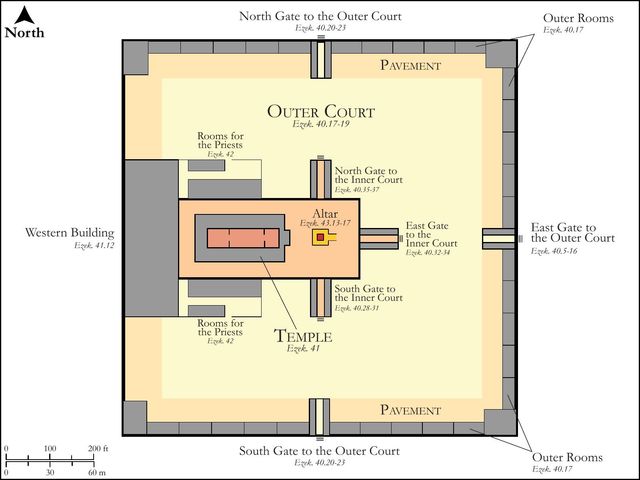
Ezekiel 40:2 marks a dramatic and hopeful turning point in the book of Ezekiel, transitioning sharply from prophecies of judgment, destruction, and exile (chapters Ezekiel 1-32) and the immediate aftermath of Jerusalem's fall (chapters Ezekiel 33-39) to an extended vision of restoration and future glory. This verse stands within the opening vision of the final major section of the book, chapters Ezekiel 40-48, which meticulously detail a new temple, its ordinances, and the re-division of the land. The preceding chapters, particularly Ezekiel 36-37, have already laid the theological groundwork for this restoration, promising a new heart, a new spirit, and the resurrection of the nation, making the detailed architectural vision here a concrete and tangible manifestation of those divine promises.
Historical & Cultural Context
The vision described in Ezekiel 40 is precisely dated to the 25th year of Ezekiel's exile, which corresponds to 573 BC, a somber fourteen years after Jerusalem's catastrophic destruction in 586 BC. This period was one of profound despair, disillusionment, and spiritual questioning for the Jewish exiles living in Babylon. Their beloved temple, the very heart of their religious, national, and covenantal identity, lay in ruins, and their homeland was desolate. The people undoubtedly questioned God's faithfulness, the validity of His covenant, and their future as a distinct people. In this context of shattered hopes and national trauma, Ezekiel's vision served as a powerful, divinely orchestrated counter-narrative, offering a tangible blueprint of God's unwavering commitment to His covenant and His meticulous plan to dwell among His people once more. The highly detailed nature of the vision would have provided immense comfort, assurance, and a renewed sense of purpose, demonstrating that God had not abandoned them but was actively and precisely planning their glorious future.
Key Themes
ShowHideThis foundational verse introduces several crucial and interconnected themes that permeate the remainder of Ezekiel's prophecy. First, Divine Revelation and Guidance is paramount, as Ezekiel is emphatically "brought" and "set" by God, emphasizing the supernatural origin, divine control, and absolute authoritative nature of the vision, much like his initial call and commissioning in Ezekiel 1:1-3. Second, the Restoration of God's Presence is central; the vision begins with Ezekiel in "the land of Israel," signifying the re-establishment of God's intimate relationship with His chosen people within their promised land, a stark and hopeful contrast to the divine departure and abandonment described earlier in Ezekiel 10-11. Third, the motif of the "very high mountain" underscores Divine Encounter and Prominence, a common biblical setting for significant revelations and covenant renewals, such as Moses receiving the Law on Mount Sinai. Finally, the "frame of a city" introduces the profound theme of God's Meticulous Design and Order for the future, hinting at the detailed architectural plans for the new temple and its surrounding sacred space that will meticulously unfold in the subsequent chapters, assuring the exiles of God's purposeful and precise plan for their future.
Exposition and Analysis
ShowHideKey Word Analysis
ShowHideMeaning "a vision" or "a mirror." This word powerfully emphasizes that Ezekiel's experience was not a mere dream, a subjective hallucination, or a mental construct, but a direct, objective, and divinely granted perception of spiritual realities. It implies a clear, unveiled sight, as if looking into a mirror, where God Himself is revealing the future with precision and clarity. This term signifies the authoritative, supernatural, and undeniable origin of the entire prophecy that follows, establishing its divine authenticity.
Meaning "elevated," "lofty," or "exceeding." When paired with "mountain" and intensified by "very" (Hebrew, mᵉʼôd'), it creates a superlative sense of elevation, indicating a position of immense prominence and an ideal, unobstructed vantage point. The "very high mountain" is not merely a topographical feature but a symbolic location, signifying a place uniquely suited for profound divine revelation and for viewing God's grand, overarching, and transcendent plans from an elevated, comprehensive perspective.
Meaning "a building" or "a frame." This crucial word suggests an initial outline, a foundational structure, or a precise blueprint rather than a fully constructed edifice. It implies precision, intentionality, and a pre-planned design, indicating that what Ezekiel sees is not a chaotic ruin but a divinely ordained architectural plan in its nascent stage. This "frame" sets the expectation for the meticulous measurements and detailed descriptions of the temple and city that will fill the subsequent chapters, highlighting God's ordered and purposeful design for His future dwelling place and the sacred community surrounding it.
Verse Breakdown
ShowHide"In the visions of God brought he me into the land of Israel,"
This opening clause immediately establishes the supernatural and divine origin of Ezekiel's experience. He is not merely dreaming or imagining, but is actively and supernaturally transported by divine power ("brought he me") into the geographical, spiritual, and covenantal heartland of his people ("the land of Israel"). This emphasizes that the ensuing revelation is directly from God, is absolutely authoritative, and pertains specifically to the restoration of His covenant people in their promised land, signaling a dramatic and hopeful shift from judgment to future divine intervention and renewal.
"and set me upon a very high mountain,"
The divine agent ("he," referring to God or a divine messenger) then precisely places Ezekiel on a remarkably elevated peak. This "very high mountain" serves as both a strategic and symbolic vantage point. Biblically, high mountains are often sacred sites of profound divine encounter, revelation, and a place from which to survey vast landscapes or future events (e.g., Mount Sinai, the Mount of Transfiguration). Here, it prepares Ezekiel to receive a comprehensive, panoramic, and divinely authorized view of God's future plans for His people and their dwelling place.
"by which [was] as the frame of a city on the south."
From this uniquely elevated position, Ezekiel's gaze is directed southward, where he perceives not a completed, inhabited city, but its "frame" or initial blueprint. The phrase "as the frame of a city" (or "structure of a city" in other translations) implies an architectural outline, a precise design, or a foundational layout rather than a fully built metropolis. This meticulous detail sets the stage for the exhaustive measurements and detailed descriptions of the temple and its surrounding complex that will unfold in the subsequent chapters, indicating God's detailed, orderly, and intentional plan for His future dwelling place and the sacred community that will be centered around it.
Literary Devices
ShowHideEzekiel 40:2 is rich with Visionary Literature, a defining characteristic of apocalyptic writing, where the prophet is supernaturally transported to witness divine realities that transcend normal human perception. This immediately signals that the subsequent chapters are not literal historical accounts but symbolic and prophetic revelations of God's future purposes. Symbolism is also profoundly prominent; the "very high mountain" serves as a powerful symbol of divine encounter, elevated perspective, and a place of transcendent revelation, often associated with God's dwelling, authority, and the establishment of His kingdom. The "frame of a city" functions as a Metaphor for a divine blueprint or architectural plan, signifying God's meticulous design, precise intentionality, and ordered purpose for the future. Furthermore, the constant emphasis on "brought he me" and "set me" highlights Divine Agency, underscoring that the entire experience is initiated, controlled, and guided by God Himself, lending absolute authority, certainty, and divine imprimatur to the prophecy.
Theological and Thematic Connections
ShowHideEzekiel 40:2 profoundly underscores God's unwavering faithfulness, His sovereign commitment to His covenant promises, and His meticulous attention to detail, even in the darkest hours of Israel's exile. It reveals that God's plans for restoration are not vague hopes but precisely designed realities, demonstrating His active, purposeful, and redemptive involvement in the future of His people. The vision of a new temple and city, beginning with this initial "frame," speaks powerfully to God's ultimate desire to re-establish His glorious and holy presence among humanity, a presence that brings order, holiness, life, and flourishing. This divine blueprint assures believers that God's ultimate purpose is to dwell with His people, transforming their desolate circumstances into a vibrant, ordered community centered on His holiness and glory.
Reflection and Application
ShowHideEzekiel 40:2 offers a profound and enduring anchor of hope for believers navigating periods of desolation, uncertainty, or perceived abandonment. Just as God revealed a detailed blueprint for restoration to Ezekiel in the midst of Israel's exile and despair, so too does He continue to work out His sovereign purposes in our individual lives and in the broader world, often unseen, even when circumstances seem bleak, chaotic, or utterly ruined. This verse reminds us that God's plans are always precise, intentional, and ultimately aimed at bringing His glorious and transformative presence into our midst. It invites us to trust implicitly in His sovereign design, to look beyond immediate difficulties and the apparent ruins of our present circumstances to the larger, divinely orchestrated future, and to find profound comfort in the knowledge that even when our spiritual "temples" feel ruined or our lives are in "exile," God is meticulously preparing a place for His dwelling, characterized by perfect order, profound holiness, and vibrant, renewed life. Our sacred task, then, is to remain faithful, to seek His vision with open hearts, and to actively participate in the ongoing construction of His eternal kingdom.
Questions for Reflection
ShowHideFAQ
ShowHideWhat is the significance of Ezekiel being brought to a "very high mountain"?
ShowHideThe "very high mountain" in Ezekiel 40:2 holds profound symbolic and practical significance. Firstly, it provides a panoramic and unobstructed vantage point, allowing Ezekiel to survey the vastness and intricate layout of the future temple complex and city that will be revealed in meticulous detail. Secondly, mountains in biblical narrative are consistently depicted as sacred sites of profound divine encounter, covenant renewal, and authoritative revelation, such as Mount Sinai where Moses received the Law, or the Mount of Transfiguration where Jesus' divine glory was revealed. This elevated position signifies closeness to God, a place of spiritual clarity, and a privileged setting for receiving authoritative divine communication, underscoring the sacred, transcendent, and divinely ordained nature of the entire vision.
What does "as the frame of a city" imply about the vision?
ShowHideThe phrase "as the frame of a city" (KJV) or "structure of a city" (ESV/NIV) from Ezekiel 40:2 implies that Ezekiel is seeing an initial outline, a foundational blueprint, or a precise architectural design rather than a fully constructed, inhabited city. This detail is crucial because the subsequent chapters (Ezekiel 40-42) delve into extremely meticulous measurements and detailed descriptions of the temple's various parts. The "frame" suggests God's precise, intentional, and ordered plan for the future, indicating that the vision is not a vague promise but a detailed, divinely engineered design for a restored sanctuary and its surrounding sacred space, emphasizing God's meticulous attention to holiness, order, and His desire for a perfectly structured dwelling place among His people.
Christ-Centered Fulfillment
ShowHideEzekiel's grand vision of a new temple and city, initiated by his supernatural transport to a "very high mountain" and the initial sight of a "frame of a city," finds its ultimate and glorious fulfillment in the person and work of Jesus Christ. While the detailed architectural plans in Ezekiel 40-48 were never literally realized in post-exilic Israel, they served as a powerful prophetic symbol pointing to a greater, spiritual, and eternal reality. Christ Himself is the true and ultimate Temple, the perfect dwelling place of God among humanity. As John 1:14 profoundly declares, "the Word became flesh and dwelt among us," literally "tabernacled" among us, embodying God's full presence and glory. Through His atoning sacrifice on the cross and His victorious resurrection, Jesus inaugurated the new covenant, making all believers living stones in a spiritual temple (1 Peter 2:5), with Christ Himself as the foundational cornerstone (Ephesians 2:19-22). The "frame of a city" foreshadows the New Jerusalem, the eternal dwelling of God with His redeemed people, where there is no longer a need for a physical temple building because "the Lord God Almighty and the Lamb are its temple" (Revelation 21:22). Thus, Ezekiel's vision, though rooted in a specific historical context, ultimately directs our gaze to the person and work of Christ, who perfectly embodies God's presence, establishes the eternal city, and ensures that God's glory fully resides with His people forever.