


Ezekiel 48:11
- לַכֹּהֲנִיםla·ko·ha·Nimto the priestsH3548Prep-l ¦ N-mpNoun Plural Masculine Absoluteלַto theכֹּהֲנִיםpriests
- הַמְקֻדָּשׁham·ku·Dashthe consecrated [one]H6942Art ¦ V-Pual-PassPrtcpl-msVerb Pual Participle Passive Singular Masculine Absoluteהַtheמְקֻדָּשׁconsecrated [one]
- מִבְּנֵיmi·be·Neifrom [the] sons ofH1121Prep-m ¦ N-mpcNoun Plural Masculine Constructמִfromבְּנֵי[the] sons of
- צָדוֹקtza·DokZadokH6659N-proper-mNoun Proper Masculine
- אֲשֶׁר'a·SherwhoH834RelParticle Relative
- שָׁמְרוּsha·me·Ruthey keptH8104V-Qal-Perf-3cpVerb Qal Perfect 3rd Plural common gender
- מִשְׁמַרְתִּיmish·mar·Timy chargeH4931N-fsc ¦ 1csNoun Singular Feminine Constructמִשְׁמַרְתִּchargeיmy
- אֲשֶׁר'a·SherwhoH834RelParticle Relative
- לֹאlo'notH3808NegParticle Negative
- תָעוּta·'Uthey went astrayH8582V-Qal-Perf-3cpVerb Qal Perfect 3rd Plural common gender
- בִּתְעוֹתbit·'Otwhen went astrayH8582Prep-b ¦ V-Qal-InfVerb Qal Infinitive Constructבִּwhenתְעוֹתwent astray
- בְּנֵיbe·Nei[the] people ofH1121N-mpcNoun Plural Masculine Construct
- יִשְׂרָאֵלYis·ra·'ElIsraelH3478N-properNoun Proper Location
- כַּאֲשֶׁרka·'a·Sherjust asH834Prep-k ¦ RelParticle Relativeכַּjustאֲשֶׁרas
- תָּעוּta·'Uthey went astrayH8582V-Qal-Perf-3cpVerb Qal Perfect 3rd Plural common gender
- הַלְוִיִּםhal·vi·Yimthe LevitesH3881Art ¦ N-mpNoun Gentilic Plural Masculine AbsoluteהַtheלְוִיִּםLevites
English is a literal word-by-word gloss of the Hebrew, not the KJV's wording. Why?
This is the original text the KJV's translators worked from — each Hebrew word with its own literal English meaning in this verse, prepared by scholars at Tyndale House, Cambridge. The KJV translates whole sentences, not word by word, so its wording differs: one Hebrew word can become several English words, and the KJV may choose “the LORD” where the gloss reads “Yahweh”. Both are faithful — they answer different questions. For the KJV's own rendering, switch to the KJV text.
Details
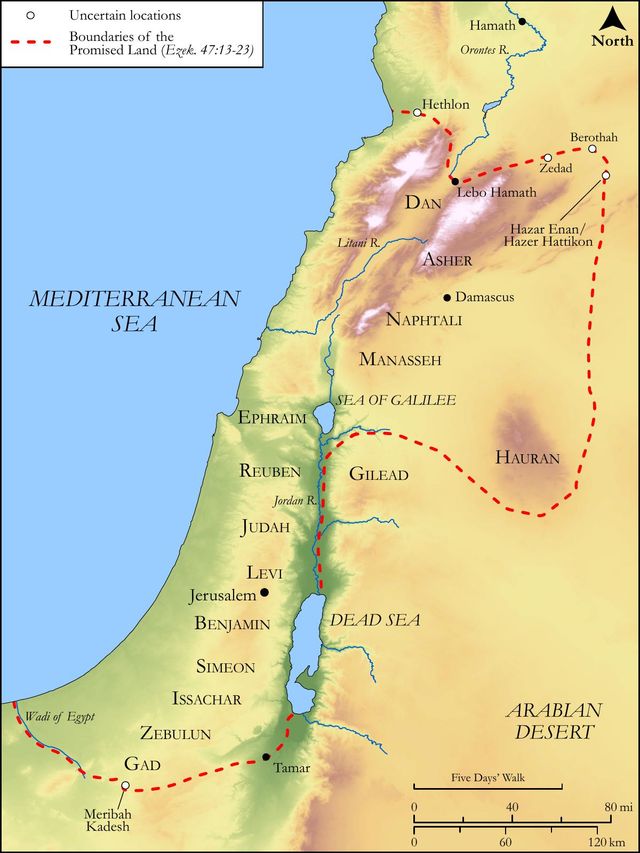
See on the biblical-era map
Study this verse
Historical interpretation
Historical reception
1 surviving comment on this verse from the historical church.
(Verse 10 and following) These will be the firstfruits of the sanctuary for the priests: towards the north, a length of twenty-five thousand [cubits], and towards the sea, a width of ten thousand [cubits]; but also towards the east, a width of ten thousand [cubits], and towards the south, a length of twenty-five thousand [cubits]. And the sanctuary of the Lord will be in the midst of it. It will be a sanctuary for the priests from the descendants of Zadok, who have kept my statutes and have not strayed as the children of Israel strayed, as the Levites strayed. And there will be offerings from the first fruits of the land of the Holy of Holies, according to the boundary of the Levites. The four offerings of the sanctuary are described, which do not pertain to the common people or the lower class Levites, but specifically to the worship of the priests: namely the offerings of the North, West, East, and South. And the order of their arrangement is described in parts, as we leave behind the cold of the North and come to the West: so that our vices may perish and we may then move to the East, where the sun of justice rises for us, and finally come to the South, where the light is most bright and perfect. And both from the North to the sea and from the East to the South, let there be twenty-five thousand in length and ten thousand in width: so that the same measure of length and width is preserved everywhere. However, the sanctuary, that is, the Temple of the Lord, will be in the midst of the firstfruits of the priests, and it will be surrounded on all sides by an equal wall. And what he had said, 'These shall be the firstfruits of the sanctuary of the priests,' was to prevent all the priests from claiming the possession of this place and the special ceremonies to be observed by a common name, specifically stating: 'The sanctuary shall be for the priests of the sons of Zadok,' which means 'righteous.' This is said of him: 'The Lord is righteous, and he loves righteousness; his face beholds the upright' (Psalm 11:7). Regarding this, Sadoc, the Septuagint writes Sadduc. This Sadoc speaks in the Gospel: For the Father judgeth no man, but hath given all judgment unto the Son (John 5:22). And concerning this, under the name of Solomon, the Prophet sings mystically: Give thy judgment to the king, O God, and thy justice to the king's son (Psalm 71:1). But those priests of the Lord shall possess the sanctuary, and shall keep the ceremonies thereof: who have not erred when the children of Israel and the Levites erred, of whom it was discoursed in the foregoing. They do not offer victims, but being content with the privilege of their name and the humility of their error, they always speak from the heart: I acknowledge my wickedness, and my sin is always before me (Psalm 50:4). Let him hear this priestly order, and, overcome by the fury of the Arian persecution, and subsequently submitting his neck to the power of the true faith, so that he may not lack resources, if he is not expelled from the temple, let him hold a certain shadow and image of his former name, and let him not, lying on his back, belch out delights, as if he were immaculate and pure, let him not belch forth the nausea of his ignorance and barbaric babbling from his lofty throne. They shall be, he says, the first fruits from the first fruits of the earth, that is, for the priests: and those who did not go astray, when the sons of Israel and the Levites went astray. But the first crop from the first crops, like the tenth of the tithes, and the holy of holies, according to the boundary of the Levites: for indeed the Levites have the precincts of the priests, but they cannot hold the center, that is, the middle of it, and the actual possession.
Continue studying Ezekiel 48:11 across the web’s major study libraries — every link below opens this exact verse, chapter, or book on the destination site.
Read & Compare
 BibleGatewayThis verse in more than 200 translations and 70 languages.
 Bible.comThe YouVersion reader — hundreds of translations, reading plans, and highlights.
 ESV.orgCrossway's official English Standard Version reader.
 NET BibleThe NET translation with 60,000+ translators' notes on every rendering decision.
 STEP BibleTyndale House's free study tool — original text, vocabulary, and scholarly resources.
 BibliaLogos Bible Software's free web reader.
 USCCBThe New American Bible (Revised Edition) with the U.S. bishops' study notes.
Commentaries
 BibleHub CommentariesDozens of classic commentaries on this verse, gathered on one page.
 StudyLightMore than 100 commentary sets — the largest collection on the web.
 BibleRefPlain-English commentary on what this verse means, verse by verse.
 Enduring WordDavid Guzik's free commentary on this chapter, widely used by Bible teachers.
 Bible Study ToolsVerse commentary alongside Greek and Hebrew study aids.
Original Language & Research
- BibleHub InterlinearThe verse word by word — original language, transliteration, and English.
- BibleHub LexiconEvery word's original-language definition and Strong's entry.
 Blue Letter BibleDeep-study tools — Strong's numbers, concordance, and word studies.
 SefariaThe Hebrew text with Rashi and centuries of Jewish commentary.
Sermons, Hymns & Audio


TrulyRandomVerse is not affiliated with these sites and doesn’t control their content. They’re linked because they’re genuinely useful.
Summary
Ezekiel 48:11 delineates the specific land allocation and distinguished status within the visionary temple and land distribution for the priests descended from Zadok. This verse underscores their unique privilege, granted because of their unwavering faithfulness to God's divine charge, even when the broader community of Israel and other Levites had strayed into disobedience and idolatry. It powerfully illustrates a divine principle of discernment, honoring and setting apart those who demonstrate steadfast commitment to God amidst widespread spiritual decline and compromise.
Context
ShowHideLiterary Context
Ezekiel 48:11 is deeply embedded within the culminating section of Ezekiel's prophetic work, specifically chapters 40-48, which present an elaborate, visionary blueprint for a restored temple, a renewed covenant, and the meticulous reordering of the land of Israel. This grand finale provides precise architectural plans, measurements, and regulations for the new sanctuary, culminating in a highly organized distribution of the land among the twelve tribes. Chapter 48, in particular, focuses on this final division, with a significant portion dedicated to the "holy oblation" or sacred district at the very heart of the land. This sacred area encompasses the temple itself, the priests' designated portion, and the Levites' portion. Verse 11 specifically carves out a distinct and highly privileged role for the Zadokite priests within this sacred allocation, building upon earlier distinctions and commands made in the temple vision, particularly in Ezekiel 44:15-16.
Historical & Cultural Context
The book of Ezekiel was composed during the traumatic period of the Babylonian exile (circa 593-571 BC), a time of profound national and spiritual devastation for the Israelite people. The glorious temple in Jerusalem had been utterly destroyed, the monarchy abolished, and the populace deported from their homeland. In this crucible of despair, Ezekiel's visions served as a potent source of hope for future restoration, yet they also delivered a stern and unsparing critique of Israel's past failures. The sharp distinction drawn between the Zadokite priests and other Levites (as well as the broader Israelite community) directly reflects a historical reality of pervasive priestly corruption and unfaithfulness that significantly contributed to Israel's downfall. Many priests had actively participated in idolatry and woefully neglected their sacred duties, as vividly detailed in passages like Ezekiel 8 and Ezekiel 22:26. The Zadokites, however, represented a specific priestly lineage that had historically demonstrated remarkable loyalty, tracing their fidelity back to Zadok, who faithfully served King David and remained steadfast during Absalom's rebellion, as recorded in 2 Samuel 15:24-29. Consequently, this verse is not merely a futuristic blueprint but a divine pronouncement of both judgment and reward, firmly rooted in historical fidelity.
Key Themes
ShowHideThis verse powerfully contributes to several overarching theological and narrative themes found throughout Ezekiel and the broader prophetic tradition. Firstly, it emphatically highlights Divine Justice and Reward for Faithfulness, demonstrating God's meticulous discernment between those who serve Him faithfully and those who stray. The Zadokites' steadfastness is explicitly contrasted with the widespread apostasy of the rest of Israel and the Levites, underscoring that unwavering obedience garners unique divine blessings. Secondly, it profoundly emphasizes the theme of Purity and Holiness in Worship. The vision of the new temple is characterized by an absolute and non-negotiable demand for holiness. This verse ensures that only those priests who have maintained their sanctification and integrity will be permitted to serve in the most sacred capacities, thereby safeguarding the sanctity of God's holy presence. Lastly, it speaks directly to the Accountability of Spiritual Leadership. The clear and deliberate distinction drawn between the faithful Zadokites and the unfaithful Levites serves as a potent reminder that those entrusted with spiritual authority are held to a higher standard by God, and their actions carry profound consequences for their relationship with Him and their designated role in His kingdom. This theme resonates deeply with other prophetic calls for righteous leadership, such as those articulated in Malachi 2:1-9.
Exposition and Analysis
ShowHideKey Word Analysis
ShowHideThis primitive root signifies "to be (causatively, make, pronounce or observe as) clean (ceremonially or morally)." In the context of priests, it denotes being set apart, consecrated, or made holy for sacred service. It implies not only an initial ritual purity but also an ongoing state of moral uprightness and dedication, which is absolutely essential for approaching God in the temple. The Zadokite priests were not merely designated; they actively maintained their consecrated status through their faithful conduct.
Derived from the root meaning "watch" or "guard," mishmereth refers to a specific duty, responsibility, or trust that is to be carefully observed, protected, or guarded. For the priests, this "charge" encompassed all their sacred duties, the divine ordinances, and the meticulous care of the sanctuary. The Zadokites "kept" this charge, indicating their diligent observance and unwavering protection of their divinely appointed mandate.
This primitive root describes the act of vacillating, reeling, or straying, both literally and figuratively. It conveys the idea of wandering from the right path, erring, being deceived, or becoming morally lost. The repeated use of this word in the verse powerfully emphasizes the widespread spiritual deviation and unfaithfulness of the children of Israel and the Levites, thereby highlighting the stark and remarkable contrast with the Zadokites' unwavering fidelity.
Verse Breakdown
ShowHide"[It shall be] for the priests that are sanctified of the sons of Zadok"
This clause precisely identifies the recipients of the special privilege and land allocation: the priests who are both "sanctified" (set apart and maintained in holiness) and belong to the specific lineage of Zadok. The "sanctified" status here points not just to their initial consecration but to their continued state of holiness and separation for God's service, which they upheld through their faithful conduct.
"which have kept my charge"
This explains the foundational reason for their unique distinction and reward. These priests actively, diligently, and consistently guarded, observed, and fulfilled the responsibilities, commands, and ordinances that God had entrusted to them. Their obedience was not passive but an intentional and enduring commitment to their divine duties.
"which went not astray when the children of Israel went astray"
This phrase powerfully underscores the exceptional nature of the Zadokites' faithfulness. It sharply contrasts their steadfastness and adherence to God's path with the widespread apostasy, idolatry, and disobedience that characterized the general population of Israel, emphasizing that their loyalty was maintained even when the surrounding spiritual environment was deeply compromised and corrupt.
"as the Levites went astray"
This final clause further refines the distinction, setting the Zadokites apart even from the broader Levitical order. While all Levites were consecrated for various aspects of temple service, many had failed in their specific duties and succumbed to the same spiritual wandering and unfaithfulness as the rest of Israel, particularly by participating in idolatry or neglecting proper worship. This highlights that the Zadokites alone remained faithful among their priestly brethren.
Literary Devices
ShowHideThe primary literary device prominently featured in Ezekiel 48:11 is Contrast. The verse sharply distinguishes the "sons of Zadok" from both "the children of Israel" and "the Levites," highlighting their unique and unwavering faithfulness against a pervasive backdrop of widespread spiritual deviation and apostasy. This stark contrast serves to underscore the exceptional nature of the Zadokites' loyalty and to divinely justify their privileged position and land allocation within the visionary temple. Additionally, there is a notable element of Repetition with the phrase "went astray," which emphasizes the pervasive and tragic nature of unfaithfulness among the Israelites and the Levites, making the Zadokites' steadfast adherence to God's "charge" all the more remarkable and commendable. The verse also employs Metonymy, where the phrase "sons of Zadok" serves as a concise representation for the entire priestly lineage descended from Zadok, thereby encapsulating their collective character, historical fidelity, and the divine recognition of their steadfastness.
Theological and Thematic Connections
ShowHideEzekiel 48:11 powerfully articulates God's unwavering commitment to covenant faithfulness and His righteous discernment among His people. It reveals a profound truth: God not only expects obedience but also meticulously remembers, honors, and rewards those who remain steadfastly loyal to Him, especially during times of widespread apostasy and spiritual compromise. This divine principle transcends the specific historical context of the Zadokite priesthood, teaching that true spiritual authority, divine favor, and proximity to God are predicated on a life of consistent devotion and adherence to His commands, rather than mere lineage, inherited position, or outward ritual. The verse foreshadows a future where God's holy presence will be meticulously guarded and served by those who genuinely honor Him, emphasizing the indispensable necessity of a pure, consecrated, and faithful people for true and acceptable worship.
Reflection and Application
ShowHideEzekiel 48:11 serves as a profound challenge and a deep encouragement for believers in every generation, particularly in our contemporary world often characterized by compromise, shifting moral standards, and spiritual apathy. This verse powerfully reminds us of God's unchanging and supreme value for unwavering faithfulness. It calls each of us to a searching examination of our own lives: are we diligently "keeping His charge," guarding the sacred truths of His Word, and remaining steadfast in our walk with Him, even when those around us "go astray" or when cultural pressures demand conformity? This is not merely about outward performance or ritualistic adherence, but about an inward commitment of the heart that translates into consistent, Spirit-empowered obedience. For those in spiritual leadership, whether in the church or in the home, the verse offers a sober warning and sets a high standard, emphasizing that God holds His leaders to a greater accountability. Our calling as believers, a "royal priesthood" in Christ, means we are all set apart for God's service. Our faithfulness, particularly when it stands in stark contrast to the prevailing culture, is not overlooked but is deeply honored by God, leading to true intimacy, profound purpose, and eternal reward in His glorious presence.
Questions for Reflection
ShowHideFAQ
ShowHideWho were the "sons of Zadok" and why were they singled out for such a privileged position?
ShowHideThe "sons of Zadok" refer to the priestly lineage descended from Zadok, who served as a high priest during the reigns of King David and King Solomon. They were singled out in Ezekiel's visionary blueprint for the restored temple because, unlike many other Levites and the general population of Israel, they had consistently remained faithful to God and His commands during periods of widespread apostasy and idolatry. Ezekiel 44:15 explicitly states, "But the priests the Levites, the sons of Zadok, that kept the charge of my sanctuary when the children of Israel went astray from me, they shall come near to me to minister unto me." This verse in Ezekiel 48:11 is a direct consequence and fulfillment of that earlier divine declaration, granting them a uniquely privileged position and land allocation in the restored temple because of their proven historical and consistent loyalty to God.
What does it mean for the Zadokite priests to "keep my charge" in this specific context?
ShowHideTo "keep my charge" (Hebrew: shamar mishmereth) signifies diligently guarding, observing, and faithfully fulfilling the sacred duties, responsibilities, and divine ordinances entrusted by God. For the priests, this encompassed a wide array of duties, including maintaining the purity and sanctity of the sanctuary, performing sacrifices correctly according to the Law, teaching God's law to the people, and leading the community in worship. It implies an active, intentional, and consistent obedience to God's covenant requirements, especially in stark contrast to those who neglected, corrupted, or abandoned their sacred duties. It is fundamentally about being a faithful and trustworthy steward of a divine trust.
Christ-Centered Fulfillment
ShowHideEzekiel 48:11, with its profound emphasis on a faithful priesthood set apart for holy and distinguished service, finds its ultimate, perfect, and eternal fulfillment in the person and work of Jesus Christ. While the Zadokite priests were indeed distinguished by their relative faithfulness amidst a fallen and wayward people, their service, like all Old Testament priesthood, was ultimately temporary, typological, and imperfect, always pointing forward to a greater, more perfect reality. Jesus is the Great High Priest who is truly "sanctified" (set apart and perfectly holy) not by ritual consecration or ancestral lineage, but by His very divine nature and His absolutely spotless life (Hebrews 7:26). He alone perfectly "kept God's charge," never once "going astray" even when humanity in its entirety had wandered far into the depths of sin and rebellion (1 Peter 2:22). His perfect obedience, culminating in His sacrificial death on the cross, constitutes the ultimate act of faithfulness, fulfilling all the righteous requirements of the Law and providing a perfect, once-for-all sacrifice for the sins of the world (Philippians 2:8). Through His finished work on the cross, believers are now graciously made part of a "royal priesthood" (1 Peter 2:9), empowered to draw near to God not based on their own imperfect and fluctuating faithfulness, but solely on the perfect, enduring, and all-sufficient faithfulness of Christ, who ever lives to intercede for us at the right hand of the Father (Hebrews 7:25). Thus, the prophetic vision of a pure, dedicated, and divinely honored priesthood is fully realized in Christ, who is both the perfect Priest and the gracious means by which all believers can now offer spiritual sacrifices acceptable to God.