


Ezekiel 40:46
Bible text: King James Version (1769 Blayney text) · Public domain
Bible text: King James Version with Strong's numbers · Public domain
Bible text: Berean Standard Bible · Public domain
Bible text: American Standard Version (1901) · Public domain
Bible text: World English Bible, Messianic edition · Public domain
Bible text: Geneva Bible (1599) · Public domain
Bible text: Young's Literal Translation · Public domain
- וְהַלִּשְׁכָּהve·ha·lish·Kahand the roomH3957Conj-w ¦ Art ¦ N-fsNoun Singular Feminine Absoluteוְandהַtheלִּשְׁכָּהroom
- אֲשֶׁר'a·SherwhichH834RelParticle Relative
- פָּנֶיהָpa·Nei·haits faceH6440N-mpc ¦ 3fsNoun Plural Masculine Constructפָּנֶיfaceהָits
- דֶּרֶךְDe·rekh[is] [the] direction ofH1870N-cscNoun Singular common gender Construct
- הַצָּפוֹןha·tza·Fonthe northH6828Art ¦ N-fsNoun Singular Feminine Absoluteהַtheצָּפוֹןnorth
- לַכֹּהֲנִיםla·Ko·ha·Nim[is] for the priestsH3548Prep-l ¦ N-mpNoun Plural Masculine Absoluteלַ[is] for theכֹּהֲנִיםpriests
- שֹׁמְרֵיsho·me·Rei[who] keepH8104V-Qal-Prtcpl-mpVerb Qal Participle Plural Masculine Construct
- מִשְׁמֶרֶתmish·Me·ret<of> [the] charge ofH4931N-fscNoun Singular Feminine Construct
- הַמִּזְבֵּחַha·miz·Be·achthe altarH4196Art ¦ N-msNoun Singular Masculine Absoluteהַtheמִּזְבֵּחַaltar
- הֵמָּהHe·mahtheyH1992Pro-3mpPronoun Personal 3rd Plural Masculine
- בְנֵיve·nei[are] [the] sons ofH1121N-mpcNoun Plural Masculine Construct
- צָדוֹקtza·DokZadokH6659N-proper-mNoun Proper Masculine
- הַקְּרֵבִיםha·ke·re·Vim<the> approachingH7131Art ¦ Adj-mpAdjective Plural Masculine Absoluteהַ<the>קְּרֵבִיםapproaching
- מִבְּנֵיmi·be·neifrom [the] sons ofH1121Prep-m ¦ N-mpcNoun Plural Masculine Constructמִfromבְּנֵי[the] sons of
- לֵוִיle·ViLeviH3878N-proper-mNoun Proper Masculine
- אֶל'eltoH413PrepPreposition
- יְהוָהYah·wehYahwehH3068N-properNoun Proper Title
- לְשָׁרְתוֹle·sha·re·Toto serve himH8334Prep-l ¦ V-Piel-Inf ¦ 3msVerb Piel Infinitive Constructלְtoשָׁרְתserveוֹhim
English is a literal word-by-word gloss of the Hebrew, not the KJV's wording. Why?
This is the original text the KJV's translators worked from — each Hebrew word with its own literal English meaning in this verse, prepared by scholars at Tyndale House, Cambridge. The KJV translates whole sentences, not word by word, so its wording differs: one Hebrew word can become several English words, and the KJV may choose “the LORD” where the gloss reads “Yahweh”. Both are faithful — they answer different questions. For the KJV's own rendering, switch to the KJV text.
Details
See on the biblical-era map
Study this verse
Public-domain commentary
Matthew Henry
From his Commentary on the Whole Bible. Henry comments on passages, not single verses — this entry covers Ezekiel 40:39–49. His two-level outline is real structure in the source text, so it is rendered as structure.
In these verses we have an account,
I.Of the tables that were in the porch of the gates of the inner court.
We find no description of the altars of burnt-offerings in the midst of that court till Eze 43:13. But, because the one altar under the law was to be exchanged for a multitude of tables under the gospel, here is early notice taken of the tables, at our entrance into the inner court; for till we come to partake of the table of the Lord we are but professors at large; our admission to that is our entrance into the inner court. But in this gospel-temple we meet with no altar till after the glory of the Lord has taken possession of it, for Christ is our altar, that sanctifies every gift. Here were eight tables provided, whereon to slay the sacrifices, Eze 40:41. We read not of any tables for this purpose either in the tabernacle or in Solomon's temple. But here they are provided, to intimate the multitude of spiritual sacrifices that should be brought to God's house in gospel-times, and the multitude of hands that should be employed in offering up those sacrifices. Here were the shambles for the altar; here were the dressers on which they laid the flesh of the sacrifice, the knives with which they cut it up, and the hooks on which they hung it up, that it might be ready to be offered on the altar (Eze 40:43), and there also they washed the burnt-offerings (Eze 40:38), to intimate that before we draw near to God's altar we must have every thing in readiness, must wash our hands, our hearts, those spiritual sacrifices, and so compass God's altar.
II.The use that some of the chambers mentioned before were put to.
1.Some were for the singers, Eze 40:44. It should seem they were first provided for before any other that attended this temple-service, to intimate, not only that the singing of psalms should still continue a gospel-ordinance, but that the gospel should furnish all that embrace it with abundant matter for joy and praise, and give them occasion to break forth into singing, which is often foretold concerning gospel times, Psa 96:1; Psa 98:1. Christians should be singers. Blessed are those that dwell in God's house, they will be still praising him.
2.Others of them were for the priests, both those that kept the charge of the house, to cleanse it, and to see that none came into it to pollute it, and to keep it in good repair (Eze 40:45), and those that kept the charge of the altar (Eze 40:46), that came near to the Lord to minister to him. God will find convenient lodging for all his servants. Those that do the work of his house shall enjoy the comforts of it.
III.Of the inner court, the court of the priests, which was fifty yards square, Eze 40:47.
The altar that was before the house was placed in the midst of this court, over-against the three gates, and, standing in a direct line with the three gates of the outer court, when the gates were set open all the people in the outer court might through them be spectators of the service done at the altar. Christ is both our altar and our sacrifice, to whom we must look with an eye of faith in all our approaches to God, and he is salvation in the midst of the earth (Psa 74:12), to be looked unto from all quarters.
IV.Of the porch of the house.
The temple is called the house, emphatically, as if no other house were worthy to be called so. Before this house there was a porch, to teach us not to rush hastily and inconsiderately into the presence of God, but gradually, that is, gravely, and with solemnity, passing first through the outer court, then the inner, then the porch, ere we enter into the house. Between this porch and the altar was a place where the priests used to pray, Joe 2:17. In the porch, besides the posts on which the doors were hung, there were pillars, probably for state and ornament, like Jachin and Boaz - He will establish; in him is strength, Eze 40:49. In the gospel church every thing is strong and firm, and every thing ought to be kept in its place and to be done decently and in order.
Historical interpretation
Two Centuries of Reception
5 surviving comments on this verse. Each one is dated, so this reads as a timeline rather than a list.
Select a marker to jump to its quote. Markers stagger vertically where authors wrote within a few decades of each other.
(Vers. 44 seqq.) «And outside the front gate of the cantor's treasury in the inner courtyard, which was on the side of the gate facing the north, their faces were towards the south: one on the side of the eastern gate, which faced the way of the north. And he said to me: This is the treasury that faces the southern way of the priests, who keep watch in the temple's guardrooms. Furthermore, the treasury that faces the way of the north will be for the priests who serve at the altar: these are the sons of Zadok who come near from the sons of Levi to the Lord, to minister to Him. And he measured the porch of the temple by the length of one hundred cubits, and the width of one hundred cubits, square: and the altar that was before the temple: and he brought me into the porch of the temple, and he measured the porch five cubits on this side, and five cubits on that side: and the breadth of the gate three cubits on this side, and three cubits on that side. And the length of the porch was twenty cubits, and the breadth eleven cubits, and there were steps to it: and pillars before the gates one on this side, and another on that side. Regarding the treasuries, the Seventy translated them as exedrae. And what we called exedrae, or the treasuries of the singers, was omitted by them. And again, after the measurement of the vestibule of five cubits on this side and five cubits on that side, they added from their own, and the width of the gate was fourteen cubits, whereas in the Hebrew it is only mentioned as a width of twelve cubits, and the width of the gate on this side was three cubits, and on that side was three cubits. I have reminded the reader not to be confused by the diversity of translations, but to be satisfied with the Hebrew truth in this particular place, especially when it comes to the measurements of the temple. Therefore, after the wall, which the Seventy translated as the περίβολον, which surrounded the whole temple in a square circuit, we read that the prophet was introduced into the inner courtyard, and then to the north, and to the south, and to the Eastern Gate, and again to the north: concerning which, as we were able, we have spoken, and in the diversity of which, either of names or of measurements, the past discourse showed what seemed to us: the meaning of which the testimony of the Savior briefly shows, saying: In my Father's house there are many mansions (John 14:2). After completing these things, he enters the temple, that is, the Holy of Holies, of which it is now said, and within the inner gate, the treasuries, or the singing halls. To them is given this command: Sing to the Lord a new song (Psalm 95:1). They cry out with the angels: Glory to God in the highest, and on earth peace to people of good will (Luke 2:14). This inner courtyard was situated on the side of the gate that faced the North, the South, and the East, so that the singers of the Lord, and those who are engaged in the ministry of angels, may always remember by which steps they have reached the highest, and diligently understand the mysteries of each place. Finally, that man whose pen and cord were in his hand, having led the prophet into the inner courtyard which overlooked the southern road, spoke these words: 'This is the treasury or council chamber; and as Theodotius set it up, the chamber, which is separated for the dwelling of the priests, is for the observation of the temple guards. Furthermore, the treasury which overlooks the northern road will belong to the priests who stand guard at the service of the altar.' In which it should be noted that the priests to whom the custody of the temple has been entrusted dwell in the treasury, which faces the south, where the fullest light is. But those who stand guard at the ministry of the altar, where victims are offered for sin, should be in the treasury facing the north, for those who come from the north and offer victims for sins, desiring to receive and save them. Both of these, serving the Lord in their respective duties, are called the sons of Zadok, which means righteous or justifying. For God, the Almighty, whose name is written: The Lord is righteous and loves justice; His face has seen equity (Psalm 11: 8). But these are the sons of Sadoc of the sons of Levi, which is interpreted as 'assumed'. And they themselves are assumed by the Lord, so that they may approach Him, and never is it said of Moses alone: Moses approached the Lord; but also all who serve and minister to Him are said to draw near to the Lord. But this man who introduced Ezekiel into the inner courtyard, and so to speak, into the Holy of Holies, measured the courtyard itself, in which there were two chambers or treasuries assigned to the guards of the temple or the dwelling places of the altar, and he found it to be two hundred cubits in length and breadth: so that the priests of God who serve in the ministry, who had entered through a narrow and tight path, may have wide walkways and dwell in a perfect and complete number of virtues. And in the very courtyard there was an altar in front of the face of the temple, so that the prayers of the saints never ceased before God. Moreover, the aforementioned man led Ezekiel into the vestibule, or πρόπυλον of the temple, which measured five cubits on each side, for the one who was brought in had been trained in divine understanding and knew neither right nor left, but entered by the royal way. The width of the gate itself, which was the entrance to the vestibule of the temple, was three cubits on each side. In the elegant observance of the Holy Scriptures, it is not said from the right or the left, lest anything be named left in the Holy of Holies, but from this side and that side, that is, from both sides. And immediately the discerning reader understands that the number three relates to the mystery of the Trinity, which is the gate for those who approach God, for the Father is in the Son, and the Son is in the Father, and the Holy Spirit is in both. This number three is the gate for those who, after baptism in the Trinity, come to salvation. But what follows, the length of the vestibule is twenty cubits, and the width is eleven cubits, seems to raise the question of how the dual number, which refers to two decades, and the eleventh, which seems to have one less, can be said to complete the sacred number twelve in the temple vestibule. Most people solve this problem in the following way: Although the priests are holy and placed in the service of the temple, and offer daily sacrifices to Christ, because they dwell in this mortal and fragile body, subject to sickness and vice, they have the number twenty and eleven. Where was it that the Apostle said, 'Wretched man that I am, who will deliver me from this body of death' (Rom. VII, 24)? Not that we believe, according to the most savage heresy, that bodies are to be destroyed; but that it is our desire to be clothed upon, not stripped, and to receive immortality with this mortal, and to put on incorruption with this corruptible. However, what follows, 'And it was ascended by eight steps' (I Cor. XV), that is, to the inner gate, presents a great difficulty for those who know the Hebrew language. Finally, Symmachus, whom we have followed in this place, set out eight degrees: Seventy, ten; Theodotion and the second edition of Aquila, eleven; but the first edition set no number, but simply said, and the degrees by which it was ascended to it: so that either according to the custom of the previous gates, we understand eight degrees, as Symmachus understood, or certainly those which the inner gate had, whose number Scripture did not say (for which in Hebrew it is placed, Urob (), that is, breadth, Aste (), Esre (). But if it is read in this way, eleven signifies; but if we read 'Esre,' which means ten, without the final 's,' it does not signify ten but a pronoun (which). To experts in the Hebrew language, these may seem like delusions; but now we are not writing about controversies or speeches in which the composition of words is commonly used, but about explanations and commentaries on Hebrew books. But let us return to our task. The number eight or ten, which is a perfect number, or eleven, about which we have already spoken, is ascended to the gate of the holy ones, on the front of which there were columns, one on this side and another on that side. He did not say 'two' so as not to incur the number dual, but 'one and one', which is a perfect number, and imitates the unity of God. These, however, were two columns, of which it is also said in the Apocalypse: 'He who conquers, I will make him a pillar in the temple of my God, and he shall go out no more' (Rev. 3:12). And Peter and John are called the pillars of the Church (Gal. 2), through whom we enter into the Holy of Holies, and by whose teaching our entrance to Christ is made.
But we must carefully inquire who those are who minister to the Lord. For not all who read, not all who preach, not all who give of their own possessions, not all who chastise the body through abstinence of the flesh, minister to the Lord. For those who by reading and preaching seek their own glory, by giving away what they have and wasting the body in abstinence, desire to receive praises from men, minister to themselves, not to the Lord. Against which the Lord says through the Psalmist: "He who walks in the immaculate way, he ministered to me." For he has a stain on the way who in the good work he does sets before himself the reward of earthly glory, who seeks to receive his reward in this world, and defiles in the sight of God the appearance of the good work with the stain of depraved intention. For perhaps someone intent on the pursuit of discipline burns with zeal, cuts off the faults of offenders, yet if he is led to do these things not from love of almighty God but by his own zeal, in these matters he ministers to himself, not to the Lord. Another, lest he seem harsh, tolerates gently many things that are wickedly perpetrated. This one therefore, because he does not wish to be seen as severe for the Lord, through his pursuit of leniency ministers to himself, not to the Lord. It remains therefore that whether we labor in the ministry of the word, or give our goods to the needy, or tame the flesh through abstinence, or are moved by zeal, or sometimes gently tolerate evil things through patience, we must most carefully examine our intention, so that everything we do, we do not with our own zeal but the Lord's, lest in those things we do we minister rather to ourselves than to the Lord. For they did not minister to the Lord but to themselves, of whom Paul said: "All seek the things that are their own, not the things that are of Jesus Christ." But the same Paul with his chosen brothers hastened not to minister to himself but to the Lord, both in living and dying, saying: "None of us lives for himself, and none dies for himself. For whether we live, we live for the Lord; whether we die, we are the Lord's." For the saints neither live nor die for themselves. They do not live for themselves, because through everything they do, they pant after spiritual gains, and by praying, preaching, and persisting in holy works, they desire to multiply the citizens of the heavenly fatherland. They do not at all die for themselves, because in the sight of men they glorify God by their death, to whom they hasten to arrive even by dying. Let us therefore consider in the death of the saints not how great was their reproach from unbelievers, but how great praise of the Lord grew in the hearts of the faithful. If they had sought their own praise, they would certainly have feared to suffer so many reproaches in death. But "none of us lives for himself, and none dies for himself," because they sought their own glory neither in living nor in dying. Let us see if that first shepherd of the Church himself, who did not live for himself, died for himself. Let his companion John be consulted, and let him speak from the Lord's words about the death of that same shepherd: "This he said signifying by what death he would glorify God." Therefore he did not die for himself who glorified God in his death. Let us learn therefore, my brothers, to examine our intention in everything we do with careful inquiry, and not to seek our own things, if we wish to minister to almighty God.
But in this matter a question arises, since it was said above that the treasury chambers had their fronts toward the Southern way, by what reasoning is it now said that the treasury chamber which looks toward the southern way belongs to the priests who keep watch in the guardianship of the temple, and the treasury chamber which looks toward the way of the North belongs to the priests who keep watch at the ministry of the altar. For if both fronts extended toward the Southern way, how is it now said that one looks toward the southern and the other toward the way of the North? But in these words we recognize that the treasury chamber of the priests who keep watch in the guardianship of the temple had been positioned so that it looked only toward the southern way; but the treasury chamber of the priests who keep watch at the ministry of the altar was so situated in the court that it extended both toward the Southern way and toward the face of the North, so that it might both look toward the southern way together with the treasury chamber of the priests who keep watch in the guardianship of the temple, and yet the treasury chamber of the priests who keep watch at the ministry of the altar, apart from the treasury chamber of those same priests, might see the way of the North. But what is this, dearest brothers? What mystical meaning can we perceive in these words, except what the spiritual hearer already understands according to the things that have been set forth above: that the priests of the greater order, who keep watch in the guardianship of the temple, look only toward the southern way, because, occupied solely with spiritual pursuits, they always attend carefully to those things that pertain to the love of God; but the priests of the lesser order, who preside over examining the sins of those who transgress, also turn their eyes toward the way of the North, so that they may see what cold of torpor exists in the mind of sinners, and by bringing these through words of correction all the way to the groans of repentance, they may, as it were, burn flesh upon the altar of the Lord? Let them also look toward the southern way together with the great priests, because, as far as concerns themselves, they burn with the fire of charity and are kindled with the flames of the love of God. But because they frequently correct the sins of transgressors, they also turn their eyes back toward the way of the North.
But concerning both orders of priests it is added: These are the sons of Zadok, who approach from the sons of Levi to the Lord to minister to Him.
Zadok in Latin means just. But who is just, except Him to whom it is said: You are just, Lord, and Your judgment is right? And who are the sons of the just, except those of whom it is written: But as many as believed in Him, He gave them power to become sons of God? Now Levi is interpreted as taken up. But who has been taken up by the Lord, except the faithful people, who through the sacraments of faith have been separated from the faithless? Therefore all who perseveringly devote themselves to spiritual activities are sons of the just. And from the sons of the people taken up they approach the Lord to minister to Him, because from those same faithful ones are chosen those who come to the ministry of almighty God and devote themselves to heavenly studies for the instruction of the people.
There are moreover priests of a lesser order who keep watch for the ministry of the altar, who namely investigate carefully the sins of those who transgress in aid of their superiors, and correct the life of carnal men, and bring them to the point where through the laments of penance they set ablaze, as it were, the flesh in sacrifice which they had previously permitted to live in sin. For those who preside over the holy Churches are not able to do all things by themselves. But while they themselves are occupied with spiritual matters, if any wicked and carnal deeds are committed, they entrust these to others to be examined and corrected. Through whom, when the carnal life is corrected and those making progress arrive at the pursuit of abstinence and prayer, the flesh is now set ablaze, as it were, upon the altar, so that in the sight of the almighty Lord a sacrifice may give forth fragrance from that very source whence formerly sin was displeasing.
Continue studying Ezekiel 40:46 across the web’s major study libraries — every link below opens this exact verse, chapter, or book on the destination site.
Read & Compare
 BibleGatewayThis verse in more than 200 translations and 70 languages.
 Bible.comThe YouVersion reader — hundreds of translations, reading plans, and highlights.
 ESV.orgCrossway's official English Standard Version reader.
 NET BibleThe NET translation with 60,000+ translators' notes on every rendering decision.
 STEP BibleTyndale House's free study tool — original text, vocabulary, and scholarly resources.
 BibliaLogos Bible Software's free web reader.
 USCCBThe New American Bible (Revised Edition) with the U.S. bishops' study notes.
Commentaries
 BibleHub CommentariesDozens of classic commentaries on this verse, gathered on one page.
 StudyLightMore than 100 commentary sets — the largest collection on the web.
 BibleRefPlain-English commentary on what this verse means, verse by verse.
 Enduring WordDavid Guzik's free commentary on this chapter, widely used by Bible teachers.
 Bible Study ToolsVerse commentary alongside Greek and Hebrew study aids.
Original Language & Research
- BibleHub InterlinearThe verse word by word — original language, transliteration, and English.
- BibleHub LexiconEvery word's original-language definition and Strong's entry.
 Blue Letter BibleDeep-study tools — Strong's numbers, concordance, and word studies.
 SefariaThe Hebrew text with Rashi and centuries of Jewish commentary.
Sermons, Hymns & Audio


TrulyRandomVerse is not affiliated with these sites and doesn’t control their content. They’re linked because they’re genuinely useful.
Summary
Ezekiel 40:46 describes a specific chamber within the visionary temple, designated for a select group of priests—the sons of Zadok from the tribe of Levi. This chamber, oriented toward the north, served as their dedicated space for preparing to fulfill their sacred duty: guarding the charge of the altar and drawing near to the Lord to minister to Him. The verse underscores the meticulous divine order governing the temple's structure and personnel, highlighting the unique faithfulness and privileged role of the Zadokite priesthood in the restored worship of God.
Context
ShowHideLiterary Context
Ezekiel 40:46 is intricately woven into the expansive and highly detailed vision of a new temple, which forms the core of Ezekiel chapters 40-48. This monumental vision commences in Ezekiel 40:1-4, where the prophet is divinely transported to a very high mountain and presented with a city-like structure. The preceding verses, particularly Ezekiel 40:17-45, meticulously detail the outer and inner courts, their gates, and various chambers, including those designated for preparing sacrifices. Verse 46 precisely focuses on one of these chambers, identifying its specific purpose and the particular priestly lineage appointed to it. This precise allocation of space and duty powerfully reinforces the overarching theme of divine order and the profound sanctity of the temple's operations, setting the stage for further revelations about the temple's functions and the priesthood, such as the detailed regulations for the priests found in Ezekiel 44.
Historical & Cultural Context
Ezekiel's prophetic vision unfolds during the Babylonian exile, a period of immense national trauma for Israel following the catastrophic destruction of Jerusalem and Solomon's Temple in 586 BC. This historical backdrop is paramount; the vision of a new, perfect temple served as a potent message of hope, restoration, and the enduring presence of God among His people, even in their displacement and despair. Culturally, the concept of a central sanctuary and a consecrated priesthood was absolutely foundational to Israelite identity and their covenantal worship. The distinct recognition of the "sons of Zadok" within the broader Levitical priesthood carried significant historical weight. Zadok, a descendant of Aaron through Eleazar, had demonstrated unwavering loyalty to King David during Absalom's rebellion, as recorded in 2 Samuel 15:24-29. He was subsequently confirmed as the chief priest by King Solomon, replacing Abiathar, as detailed in 1 Kings 2:35. This historical faithfulness distinguished his lineage, and in Ezekiel's vision, they are uniquely designated for the most sacred duties, emphasizing a renewed standard of purity, integrity, and loyalty essential for post-exilic worship.
Key Themes
ShowHideThis verse significantly contributes to several overarching themes pervasive throughout Ezekiel's prophecy. First, it powerfully illustrates Divine Order and Holiness, a central and recurring motif within the temple vision. Every dimension, every gate, and every chamber, including the one described in Ezekiel 40:46, is meticulously measured and assigned a specific function, underscoring God's precise and unyielding design for pure worship. Second, the verse highlights the Restoration of True Worship, offering a divine blueprint for how God's people would properly approach Him in the future, standing in stark contrast to the defilement and idolatry that led to the first temple's destruction. The explicit emphasis on the Zadokite priests, historically renowned for their faithfulness, signals a divine intention for a return to righteous and uncompromised leadership in the sanctuary. Third, it underscores the Importance of a Consecrated Priesthood. The Zadokites are given the solemn and profound responsibility as "keepers of the charge of the altar" and those who "come near to the LORD to minister unto him," signifying their unique access and critical responsibility in mediating God's presence and maintaining the sacrificial system. This theme is further developed and explicitly commended in Ezekiel 44:15-16, where their fidelity during Israel's apostasy is highlighted.
Exposition and Analysis
ShowHideKey Word Analysis
ShowHideThis term refers to a room within a building, which could serve various purposes such as storage, eating, or lodging. In the context of the temple vision, these chambers are meticulously designed and allocated for specific functions related to the sacred service, emphasizing the organized and purposeful nature of the divine sanctuary.
Literally meaning "one officiating," this term designates a consecrated individual appointed to mediate between God and humanity, primarily through sacrifices, rituals, and instruction in divine law. In the Old Testament, priests were exclusively from the tribe of Levi, specifically descendants of Aaron. Here, the term is further qualified by "sons of Zadok," indicating a specific, distinguished, and faithful lineage within the broader priestly class.
This word denotes a watch, custody, or the act of keeping. It encompasses a duty, office, or ordinance. In this verse, "keepers of the charge of the altar" signifies their solemn responsibility to guard, maintain, and execute the proper rituals and functions associated with the altar, ensuring its sanctity and the purity of the sacrificial system. It implies a sacred trust, a prescribed set of duties, and a vigilant oversight.
Meaning "to approach" or "to draw near," this term carries profound theological weight in the context of divine worship. It describes the unique privilege and access granted to these priests to enter into God's immediate presence and perform their sacred service. This "drawing near" is not merely physical proximity but implies a consecrated, intimate relationship and an authorized right to function in the most holy aspects of the temple service, unlike the general populace or other Levites.
Verse Breakdown
ShowHide"And the chamber whose prospect [is] toward the north [is] for the priests"
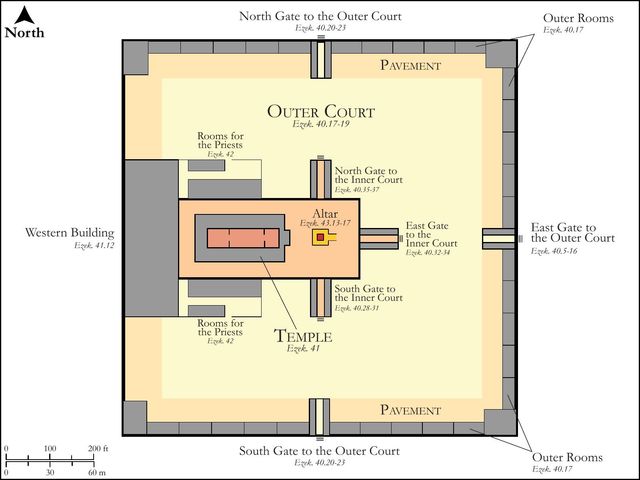
This clause establishes the precise physical location and the primary beneficiaries of this specific room within the visionary temple. The "chamber" (lishkâh, H3957) is a designated space, likely intended for preparation, storage, or lodging for the priests. Its orientation "toward the north" (tsâphôwn, H6828) is a meticulous architectural detail within Ezekiel's divinely revealed blueprint, signifying divine order and intentionality in every aspect of the sanctuary. This room is explicitly allocated to "the priests" (kôhên, H3548), setting them apart for their sacred duties and emphasizing their unique role.
"the keepers of the charge of the altar"
This phrase precisely defines the specific, weighty role and responsibility of these designated priests. They are entrusted with the "charge" (mishmereth, H4931) of the "altar" (mizbêach, H4196), which served as the central place of sacrifice, atonement, and communion in the temple. Their duty encompasses guarding its sanctity, ensuring the proper execution of all procedures for offerings, and meticulously maintaining its ritual purity. This highlights their critical and indispensable function in the entire sacrificial system.
"these [are] the sons of Zadok among the sons of Levi"
This crucial clause identifies the specific priestly lineage authorized for this elevated and sacred duty. While all priests were indeed "sons of Levi" (Lêvîy, H3878), this verse explicitly distinguishes the "sons of Zadok" (Tsâdôwq, H6659). This distinction is paramount, as the Zadokites were historically renowned for their unwavering faithfulness and loyalty, particularly during periods of widespread apostasy. Consequently, they are granted a privileged and exclusive position in Ezekiel's vision, as further detailed and commended in Ezekiel 44:15-16.
"which come near to the LORD to minister unto him"
This final clause elucidates the ultimate privilege and profound purpose of the Zadokite priests. The phrase "come near" (qârêb, H7131) signifies their unique and consecrated access to the divine presence, an intimacy and proximity not granted to the general populace or even other Levites. Their sacred role is "to minister" (shârath, H8334) to "the LORD" (Yᵉhôvâh, H3068), emphasizing direct, consecrated service and worship. This highlights the profound spiritual significance of their office, as they facilitate the nation's relationship with God through their pure and dedicated service.
Literary Devices
ShowHideEzekiel 40:46 masterfully employs several literary devices to convey its profound theological message regarding divine order and priestly consecration. Precision and Detail are paramount, evident in the meticulous description of the chamber's orientation ("toward the north") and the exact genealogical identification of the priests ("the sons of Zadok among the sons of Levi"). This architectural and genealogical precision underscores the divine order and the absolute necessity of strict adherence to God's revealed will for worship. The phrase "keepers of the charge of the altar" functions as a form of Metonymy, where "charge" stands for the sacred duties, responsibilities, and the very sanctity associated with the altar, thereby emphasizing the immense weight and solemnity of their office. Furthermore, the explicit naming of the "sons of Zadok" serves as a powerful form of Symbolism, where their historical faithfulness and unwavering loyalty become a potent symbol of the purity, integrity, and devotion required for those who would "come near to the LORD to minister unto him." This specific lineage represents the ideal of priestly devotion, standing in stark contrast to the unfaithful priests who had previously defiled the temple and led the people astray.
Theological and Thematic Connections
ShowHideEzekiel 40:46 is a profound statement about God's unwavering demand for holiness, order, and faithfulness in worship, particularly as mediated through a consecrated priesthood. The explicit distinction and elevation of the Zadokite priests underscore a principle of divine selection based on proven faithfulness and ritual purity, setting an exceptionally high standard for those privileged to approach God. This visionary blueprint, given to a people in exile, offered not merely hope but a precise plan for a restored and purified relationship with God, where access to His awesome presence was meticulously guarded and facilitated by those deemed righteous and loyal. It powerfully points to the unchanging nature of God's desire for pure worship and reverent service, emphasizing that proximity to the divine presence necessitates a corresponding level of consecration, integrity, and absolute adherence to His commands.
Reflection and Application
ShowHideEzekiel 40:46, though describing a specific historical and eschatological temple, offers timeless and profound principles for contemporary believers. The meticulous detail in God's design and the emphasis on the Zadokite priests' faithfulness serve as a powerful reminder that God values order, purity, and unwavering loyalty in our service to Him. Under the New Covenant, we are called to be a "royal priesthood," with direct and unhindered access to God through the finished work of Christ. This extraordinary privilege comes with the profound responsibility to approach God with reverence, integrity, and a sincere heart, understanding that our entire lives are intended to be acts of worship. Just as the Zadokites were "keepers of the charge of the altar," we are now entrusted with the "charge" of upholding God's truth, living holy lives that reflect His character, and ministering to Him through our daily walk and our service to others. Our "chamber" of preparation might be our quiet time in prayer, our diligent study of Scripture, or our participation in the community of faith, where we equip ourselves to draw near to God and serve Him faithfully in a world that desperately needs His light and truth.
Questions for Reflection
ShowHideFAQ
ShowHideWhat is the significance of the "sons of Zadok" in Ezekiel's vision?
ShowHideThe "sons of Zadok" hold immense significance in Ezekiel's temple vision because they represent the faithful, loyal, and uncorrupted priestly line. Historically, Zadok was a priest who demonstrated unwavering steadfastness and loyalty to King David during Absalom's treacherous rebellion, unlike Abiathar, as recorded in 2 Samuel 15:24-29. As a direct consequence of this faithfulness, King Solomon later confirmed Zadok as the chief priest, replacing Abiathar, a pivotal event detailed in 1 Kings 2:35. In Ezekiel's visionary blueprint for the restored temple, given during the profound trauma of the Babylonian exile, the Zadokites are explicitly distinguished from other Levites and are granted the exclusive and sacred privilege of serving directly at the altar and "coming near to the LORD" (Ezekiel 44:15-16). This highlights God's divine commendation of their faithfulness during Israel's widespread apostasy and His clear intention to restore a pure, consecrated, and unblemished priesthood in the future temple, emphasizing that intimate access to God's holy presence is reserved for those who maintain holiness, integrity, and unwavering loyalty.
Christ-Centered Fulfillment
ShowHideEzekiel 40:46, with its meticulous details concerning the Zadokite priests and their privileged, consecrated access to the altar, finds its ultimate, profound, and climactic fulfillment in the person and work of Jesus Christ. The Old Testament priesthood, including the distinguished and faithful line of Zadok, served as a divine foreshadowing of the perfect, eternal High Priest who was to come. While the Zadokites were chosen for their faithfulness and their unique ability to "come near to the LORD to minister unto him," their access was still inherently limited by human frailty, sin, and the recurring need for repeated animal sacrifices. Jesus, however, is the Great High Priest "after the order of Melchizedek" (Hebrews 5:6), whose priesthood is not only eternal but also perfectly efficacious and without blemish. Through His singular, once-for-all sacrifice on the cross, He not only perfectly fulfilled the entire Old Testament sacrificial system but also tore the veil, opening the way for all believers to "draw near with confidence to the throne of grace" (Hebrews 4:16). The "charge of the altar" is now eternally fulfilled in Christ, who is simultaneously the spotless Lamb of God and the perfect Priest, and His perfect righteousness is graciously imputed to all who believe. Consequently, believers in Christ are now considered a "royal priesthood" (1 Peter 2:9), empowered to offer spiritual sacrifices and minister directly to God, having been brought into an intimacy and access with the Father that far surpasses the limited access of the Zadokite priests. The vision of a perfectly ordered temple and a consecrated priesthood in Ezekiel thus beautifully points forward to the new covenant reality where Christ Himself is the true temple, and all who are in Him share in His perfect priestly access to God.