


Ezekiel 48:21
Bible text: King James Version (1769 Blayney text) · Public domain
Bible text: King James Version with Strong's numbers · Public domain
Bible text: Berean Standard Bible · Public domain
Bible text: American Standard Version (1901) · Public domain
Bible text: World English Bible, Messianic edition · Public domain
Bible text: Geneva Bible (1599) · Public domain
Bible text: Young's Literal Translation · Public domain
- וְהַנּוֹתָרve·ha·no·Tarand <the> [what] remainsH3498Conj-w ¦ Art ¦ V-Niphal-Prtcpl-msVerb Niphal Participle Singular Masculine Absoluteוְandהַ<the>נּוֹתָר[what] remains
- לַנָּשִׂיאla·na·Si'[will belong] to the princeH5387Prep-l ¦ N-msNoun Singular Masculine Absoluteלַ[will belong] to theנָּשִׂיאprince
- מִזֶּהmi·Zehfrom thisH2088Prep-m ¦ PrtParticle Demonstrativeמִfromזֶּהthis
- וּמִזֶּהu·mi·Zehand from thisH2088Conj-w ¦ Prep-m ¦ PrtParticle Demonstrativeוּandמִfromזֶּהthis
- לִתְרוּמַתlit·ru·matof [the] contribution ofH8641Prep-l ¦ N-fscNoun Singular Feminine Constructלִofתְרוּמַת[the] contribution of
- הַקֹּדֶשׁha·Ko·desh<the> holinessH6944Art ¦ N-msNoun Singular Masculine Absoluteהַ<the>קֹּדֶשׁholiness
- וְלַאֲחֻזַּתve·la·'a·chu·Zatand of [the] possession ofH272Conj-w ¦ Prep-l ¦ N-fscNoun Singular Feminine Constructוְandלַofאֲחֻזַּת[the] possession of
- הָעִירha·'Irthe cityH5892Art ¦ N-fsNoun Singular Feminine Absoluteהָtheעִירcity
- אֶל'eltoH413PrepPreposition
- פְּנֵיpe·Nei[the] face ofH6440N-mpcNoun Plural Masculine Construct
- חֲמִשָּׁהcha·mi·Shah[the] fiveH2568Adj-csAdjective Numerical Singular common gender Absolute
- וְעֶשְׂרִיםve·'es·Rimand twentyH6242Conj-w ¦ Adj-mpAdjective Numerical Plural Masculine Absoluteוְandעֶשְׂרִיםtwenty
- אֶלֶף'E·lefthousand [cubits]H505Adj-csAdjective Numerical Singular common gender Absolute
- תְּרוּמָהte·ru·Maha contributionH8641N-fsNoun Singular Feminine Absolute
- עַד'adtoH5704PrepPreposition
- גְּבוּלge·Vul[the] border ofH1366N-mscNoun Singular Masculine Construct
- קָדִימָהka·di·Maheast -wardH6921N-ms ¦ SfxNoun Singular Masculine Absoluteקָדִימָeastה-ward
- וְיָמָּהve·Ya·mahand west -wardH3220Conj-w ¦ N-ms ¦ SfxNoun Singular Masculine Absoluteוְandיָמָּwestה-ward
- עַל'alonH5921PrepPreposition
- פְּנֵיPe·nei[the] face ofH6440N-mpcNoun Plural Masculine Construct
- חֲמִשָּׁהcha·mi·ShahfiveH2568Adj-csAdjective Numerical Singular common gender Absolute
- וְעֶשְׂרִיםve·'es·Rimand twentyH6242Conj-w ¦ Adj-mpAdjective Numerical Plural Masculine Absoluteוְandעֶשְׂרִיםtwenty
- אֶלֶף'e·lefthousand [cubits]H505Adj-csAdjective Numerical Singular common gender Absolute
- עַל'alonH5921PrepPreposition
- גְּבוּלge·Vul[the] border ofH1366N-mscNoun Singular Masculine Construct
- יָמָּהYa·mahwest -wardH3220N-ms ¦ SfxNoun Singular Masculine Absoluteיָמָּwestה-ward
- לְעֻמַּתle·'u·Mat<to> close toH5980Prep-l ¦ N-fscNoun Singular Feminine Constructלְ<to>עֻמַּתclose to
- חֲלָקִיםcha·la·Kim[the] portionsH2506N-mpNoun Plural Masculine Absolute
- לַנָּשִׂיאla·na·Si'[will belong] to the princeH5387Prep-l ¦ N-msNoun Singular Masculine Absoluteלַ[will belong] to theנָּשִׂיאprince
- וְהָיְתָהve·ha·ye·Tahand it will beH1961Conj-w ¦ V-Qal-ConsecPerf-3fsVerb Qal Consecutive Perfect 3rd Singular Feminineוְandהָיְתָהit will be
- תְּרוּמַתte·ru·Mat[the] contribution ofH8641N-fscNoun Singular Feminine Construct
- הַקֹּדֶשׁha·Ko·desh<the> holinessH6944Art ¦ N-msNoun Singular Masculine Absoluteהַ<the>קֹּדֶשׁholiness
- וּמִקְדַּשׁu·mik·Dashand [the] sanctuary ofH4720Conj-w ¦ N-mscNoun Singular Masculine Constructוּandמִקְדַּשׁ[the] sanctuary of
- הַבַּיִתha·Ba·yitthe houseH1004Art ¦ N-msNoun Singular Masculine Absoluteהַtheבַּיִתhouse
- בְּתוֹכוֹbe·to·khoin [the] middle of itH8432Prep-b ¦ N-msc ¦ 3msNoun Singular Masculine Constructבְּinתוֹכ[the] middle ofוֹit
English is a literal word-by-word gloss of the Hebrew, not the KJV's wording. Why?
This is the original text the KJV's translators worked from — each Hebrew word with its own literal English meaning in this verse, prepared by scholars at Tyndale House, Cambridge. The KJV translates whole sentences, not word by word, so its wording differs: one Hebrew word can become several English words, and the KJV may choose “the LORD” where the gloss reads “Yahweh”. Both are faithful — they answer different questions. For the KJV's own rendering, switch to the KJV text.
Details
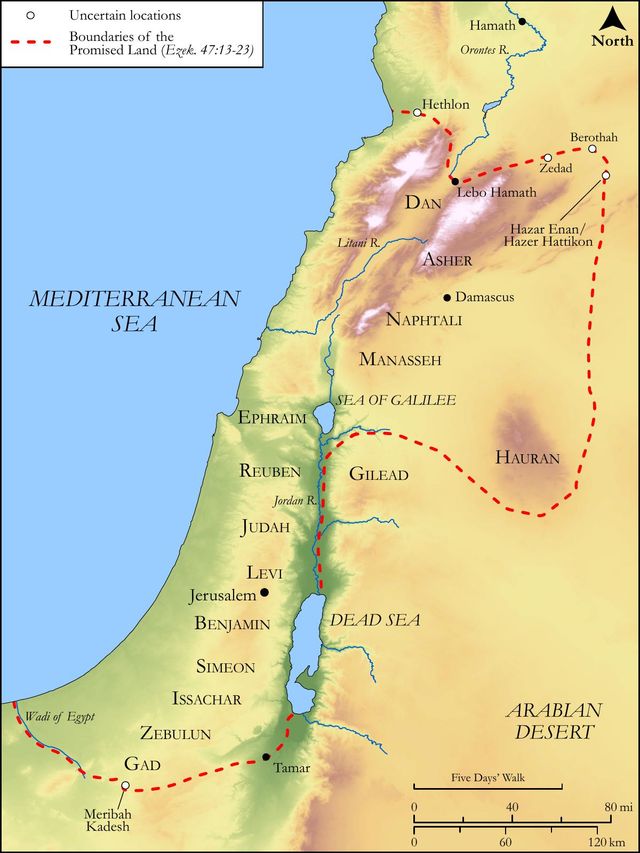
See on the biblical-era map
Study this verse
Historical interpretation
Historical reception
1 surviving comment on this verse from the historical church.
(Verse 21, 22.) But what remains will belong to the prince on all sides, either from here or from there ((The Vulgate is silent whether from here or from there)) as the firstfruits of the sanctuary and the possession of the city, bordering (or facing) twenty-five thousand firstfruits to the eastern boundary, and also from the sea ((The Vulgate says to the sea)) bordering (or facing) twenty-five thousand to the boundary of the sea. Similarly, in the areas belonging to the prince, there will be the firstfruits of the sanctuary and the sanctuary of the temple in its midst. There will also be possession of the Levites, and possession of the city in the middle of the prince's territory, between the boundary of Judah and the boundary of Benjamin, and it will belong to the prince. There has been much discussion about this prince above, and that he would receive only as much as one tribe. But now we learn something else, that whatever is left from all the tribes, only he shall receive it: so that there is no tribe that does not offer gifts to the prince: not from elsewhere, but from the firstfruits which serve the temple and the sanctuary and the delegated parts of the city. For this is what he says: From the east boundary to the western boundary, and from the northern boundary to the southern boundary, the firstfruits will belong to the seven and a half tribes. Within these firstfruits will be the city and its surrounding suburbs, as well as the sanctuary of the temple in the middle of the city. As for the land assigned to the Levites and the rest of the city, it will be considered as belonging to the prince. The area next to the firstfruits and the city, in the tribe of Judah, will be the western portion of the seven tribes. The eastern portion, in the tribe of Benjamin, will also belong to the prince. Since the sacraments of Holy Scripture are wondrous and should be contemplated more than spoken (Dan. XXXII). In the former division of the land beyond the Jordan by Moses, the land was divided among the two tribes of Reuben and Gad, and the half tribe of Manasseh (Joshua, XIII). But beyond the Jordan, by Joshua the son of Nun and Eleazar the son of Aaron, Judah possessed the south (Joshua, XV); and Ephraim and the half tribe of Manasseh possessed the north (Joshua, XVIII). Afterwards, with the spies sent to each tribe and a description of the land brought to Joshua and Eleazar, Benjamin received possession next to Judah from the south, and next to Ephraim and half the tribe of Manasseh. The second tribe, Simeon, received an inheritance within the tribe of Judah, so that what is written about Levi and Simeon would be fulfilled: I will divide them in Jacob, and scatter them in Israel (Gen. XLIX, 7). The third tribe, Zebulun, received Galilee, which includes Mount Tabor. On the fourth day, Isachar, where Jezreel is located, to the Jordan. On the fifth day, Aser, up to Mount Carmel, which overlooks the Great Sea, and Tyre and Sidon. On the sixth day, Nephthali, in Galilee and up to the Jordan, where Tiberias, which was once called Chenereth, is located. On the seventh day, Dan up to Joppa, where the towers of Ailon, Selebi, and Emmaus are located, which is now called Nicopolis: although we will later read that they took the city of Lesem in the tribe of Dan, which is now called Paneas. When these things are so, and there is such a difference between the previous description of the tribes and the one now held, let us consider how both in the current description and in the past, the tribe of Judah and Benjamin, the city, and the Temple have been located. In the previous description, Judah was to the south, and Benjamin to the north: but now it is the opposite, with Judah to the north and Benjamin to the south: after them, the second is Simeon, the third is Issachar, and the fourth is Zebulun, the fifth is Gad: namely, five tribes, as it is said in the following verses; for it is written:
Continue studying Ezekiel 48:21 across the web’s major study libraries — every link below opens this exact verse, chapter, or book on the destination site.
Read & Compare
 BibleGatewayThis verse in more than 200 translations and 70 languages.
 Bible.comThe YouVersion reader — hundreds of translations, reading plans, and highlights.
 ESV.orgCrossway's official English Standard Version reader.
 NET BibleThe NET translation with 60,000+ translators' notes on every rendering decision.
 STEP BibleTyndale House's free study tool — original text, vocabulary, and scholarly resources.
 BibliaLogos Bible Software's free web reader.
 USCCBThe New American Bible (Revised Edition) with the U.S. bishops' study notes.
Commentaries
 BibleHub CommentariesDozens of classic commentaries on this verse, gathered on one page.
 StudyLightMore than 100 commentary sets — the largest collection on the web.
 BibleRefPlain-English commentary on what this verse means, verse by verse.
 Enduring WordDavid Guzik's free commentary on this chapter, widely used by Bible teachers.
 Bible Study ToolsVerse commentary alongside Greek and Hebrew study aids.
Original Language & Research
- BibleHub InterlinearThe verse word by word — original language, transliteration, and English.
- BibleHub LexiconEvery word's original-language definition and Strong's entry.
 Blue Letter BibleDeep-study tools — Strong's numbers, concordance, and word studies.
 SefariaThe Hebrew text with Rashi and centuries of Jewish commentary.
Sermons, Hymns & Audio


TrulyRandomVerse is not affiliated with these sites and doesn’t control their content. They’re linked because they’re genuinely useful.
Summary
Ezekiel 48:21 meticulously delineates the land allocation for the "prince" within the visionary new Israel, positioning his extensive territory immediately adjacent to the "holy oblation"—the consecrated central district housing the temple and its associated priestly and Levitical areas. This verse specifies the prince's portion extending eastward and westward, mirroring the dimensions of the sacred oblation, thereby emphasizing his integral yet subordinate role in the divinely ordered future kingdom, with the sanctuary of God's house remaining at its absolute center as the organizing principle of the entire restored community.
Context
ShowHideLiterary Context
Ezekiel 48:21 is situated within the concluding chapters (Ezekiel 40-48) of the prophet Ezekiel's grand vision, which describes a meticulously ordered temple and the reallocation of the land of Israel in a future, restored state. Following the architectural blueprints of the temple (Ezekiel 40-Ezekiel 43) and the regulations for its worship and priesthood (Ezekiel 44-Ezekiel 47), chapter 48 meticulously outlines the division of the land among the twelve tribes. This specific verse focuses on the portion designated for the civil leader, the "prince," establishing his boundaries relative to the "holy oblation" (or "holy portion"), which is the central, consecrated land dedicated to God, housing the temple, priests, and Levites. The verse's detailed measurements and directional references underscore the highly systematic and divinely ordained nature of this future arrangement, ensuring that the prince's authority and territory are clearly defined and subservient to the sanctity of God's dwelling.
Historical & Cultural Context
Ezekiel prophesied during the Babylonian exile (597-538 BC), a period of profound national trauma for Israel. The destruction of Jerusalem and its temple, along with the loss of their land and sovereignty, led to deep despair. Ezekiel's elaborate vision, therefore, served as a powerful message of hope and restoration, promising a future where God's presence would return to a purified temple and a reordered land. In Israel, land ownership and distribution were fundamental to identity, social structure, and economic stability. The meticulous detail in Ezekiel's land division reflects a divine re-establishment of order and justice, contrasting sharply with the chaotic and unjust land practices that contributed to Israel's downfall. The concept of a "prince" (Hebrew: nasi) distinct from the problematic kings of the past, with clearly defined boundaries and responsibilities, also addresses historical abuses of power, ensuring that future leadership would operate within divine parameters, prioritizing the sanctity of God's worship.
Key Themes
ShowHideThis verse powerfully contributes to several overarching themes within Ezekiel's prophecy. Firstly, it highlights Divine Order and Precision, demonstrating God's meticulous plan for the future, where every aspect of the land, its inhabitants, and its leadership is arranged with exactitude around the centrality of His presence. This contrasts with the disorder and injustice that characterized pre-exilic Israel. Secondly, it elaborates on the Role and Boundaries of the Prince, presenting a civil leader (distinct from the kings of old) whose authority is substantial but strictly circumscribed by the sacred space. His land allocation, being adjacent to the holy oblation, signifies his responsibility to uphold and protect the sanctity of the temple and its worship, preventing the abuses of power seen in previous eras (as noted in Ezekiel 45:7). Thirdly, and most importantly, the verse reiterates the Centrality of the Sanctuary, emphasizing that "the sanctuary of the house [shall be] in the midst thereof." This theme, echoing God's desire to dwell among His people from the wilderness tabernacle (e.g., Exodus 25:8) to the New Jerusalem (e.g., Revelation 21:3), underscores that God's presence and worship are the foundational and organizing principle of this restored kingdom, with all other elements revolving around it.
Exposition and Analysis
ShowHideKey Word Analysis
ShowHideProperly, an exalted one, i.e., a king or sheik; also a rising mist. In Ezekiel, this term denotes a civil leader, distinct from the Davidic kings of old. This distinction is crucial, as the nasi in Ezekiel's vision is presented without the dynastic succession or the abuses of power that characterized previous monarchies. His role is to serve and protect the sacred order, not to dominate it.
A present (as offered up), especially in sacrifice or as tribute; a gift, heave offering, or offering. In this context, it refers specifically to the "holy oblation" (Hebrew: terumah qodesh), a consecrated land portion set apart for God's dwelling, the temple, and the support of the priests and Levites. It signifies something lifted up or set apart for sacred use, emphasizing its dedication to God and its separation from common or profane use.
A consecrated thing or place, especially, a palace, sanctuary (whether of Jehovah or of idols) or asylum. Here, it refers to the sacred precinct of the temple, the very dwelling place of God. Its placement "in the midst thereof" highlights its supreme importance and centrality to the entire land division and the life of the restored community.
Verse Breakdown
ShowHide"And the residue [shall be] for the prince"
This clause introduces the specific allocation of land for the civil leader, the "prince," indicating the remaining territory surrounding the sacred portion and the city's possession.
"on the one side and on the other of the holy oblation, and of the possession of the city"
This specifies the geographical placement of the prince's land, confirming that it borders both the sacred portion (the "holy oblation") and the city's territory, signifying his proximity and responsibility to both the divine and civil centers.
"over against the five and twenty thousand of the oblation toward the east border, and westward over against the five and twenty thousand toward the west border, over against the portions for the prince"
This provides the precise dimensions and orientation of the prince's land. It stretches eastward and westward, matching the 25,000-cubit (or reed) length of the holy oblation. The repetition of "five and twenty thousand" underscores the meticulous planning and exactitude of the divine blueprint. The phrase "over against the portions for the prince" serves to reinforce the designated area.
"and it shall be the holy oblation"
This concluding statement clarifies that the overall area, including the prince's land and the sacred portion, is considered part of the larger "holy oblation" in a broader sense, emphasizing the sanctity that pervades the entire designated territory.
"and the sanctuary of the house [shall be] in the midst thereof"
This final declaration powerfully reiterates the absolute centrality of the temple ("the sanctuary of the house") within this entire arrangement. The temple is the heart of the restored land and community, the focal point around which all other elements are organized.
Literary Devices
ShowHideEzekiel 48:21 is rich in Precision and Detailing, a hallmark of Ezekiel's later chapters. The repeated measurements ("five and twenty thousand") and specific directional indicators ("east border," "west border") create an impression of meticulous divine planning and absolute order, leaving no room for ambiguity or human caprice. This numerical exactitude serves to underscore the divine authority behind the vision and the certainty of its fulfillment. The phrase "in the midst thereof" is a powerful use of Symbolism, representing the absolute Centrality of God's presence and worship. The entire structure of the land, including the prince's allocation, is organized around the sanctuary, symbolizing that all aspects of the restored community—its leadership, its land, its people—are to revolve around and be sustained by the divine presence. There is also an element of Repetition with the recurring "five and twenty thousand" and the emphasis on the "holy oblation," reinforcing the importance and permanence of these divinely ordained elements.
Theological and Thematic Connections
ShowHideEzekiel 48:21 profoundly illustrates the theological principle of God's sovereign ordering of His kingdom, where every element, from the land to its leadership, is meticulously arranged around His sacred presence. The prince's portion, substantial yet clearly defined and adjacent to the holy oblation, signifies a leadership that is both empowered and constrained by divine parameters. This vision speaks to a future where human authority is rightly aligned with divine purpose, serving to protect and facilitate worship rather than exploiting it. The repeated emphasis on the sanctuary's centrality underscores that true flourishing for God's people is found when His dwelling place and His glory are the undisputed heart of their existence, providing the ultimate source of order, justice, and blessing.
Reflection and Application
ShowHideEzekiel 48:21, though part of a highly detailed prophetic vision, offers profound principles for contemporary reflection and application. It calls us to consider the centrality of God's presence in our own lives, communities, and even our leadership structures. Just as the sanctuary was to be "in the midst" of the restored land, so too should God's Spirit and His Word be at the core of our personal decisions, family life, church ministries, and societal engagement. This verse challenges leaders, whether in the church, home, or workplace, to recognize that their authority is a stewardship, to be exercised with integrity and a primary focus on honoring God and facilitating His purposes, rather than pursuing self-aggrandizement. The meticulous order also reminds us that God is a God of justice and equity, desiring that all resources and responsibilities be managed with wisdom and fairness, preventing the abuses that plagued ancient Israel. Ultimately, it invites us to envision a life and a world where God's glory is the organizing principle, leading to true peace and flourishing.
Questions for Reflection
ShowHideFAQ
ShowHideWhat is the "holy oblation" mentioned in Ezekiel 48:21?
ShowHideThe "holy oblation" (Hebrew: terumah qodesh) refers to a large, consecrated block of land precisely measured and set apart in Ezekiel's visionary temple and land distribution. This sacred portion is dedicated exclusively to God and serves as the dwelling place for the temple, the priests, and the Levites. It is distinct from the tribal allotments and the city's possession, signifying its supreme sanctity and its role as the spiritual heart of the restored land. Its dimensions are consistently described as 25,000 cubits (or reeds) by 25,000 cubits, emphasizing its significant size and its central importance (see Ezekiel 45:1-6).
Who is the "prince" in Ezekiel's vision, and what is his role?
ShowHideThe "prince" (Hebrew: nasi) in Ezekiel's vision is a civil leader, distinct from the kings of pre-exilic Israel. Unlike the Davidic kings, who often abused their power and led the people into idolatry, the nasi in Ezekiel's prophecy is presented as a righteous, non-dynastic figure whose primary role is to uphold justice, administer the land fairly, and ensure the proper functioning of the temple worship. His land allocation, as described in Ezekiel 48:21, is substantial but clearly defined and borders the holy oblation, signifying his responsibility to protect the sanctity of the temple and its operations, rather than interfering with them. He is a steward of God's order, not an absolute ruler.
Christ-Centered Fulfillment
ShowHideEzekiel 48:21, with its meticulous focus on the centrality of the sanctuary and the righteous ordering of the land around it, finds its ultimate fulfillment in Jesus Christ and the New Covenant. While Ezekiel's vision describes a physical temple and land, it foreshadows the spiritual reality of God dwelling among His people in a new and perfect way through Christ. Jesus is the true and ultimate sanctuary, the very embodiment of God's presence among humanity, as declared in John 1:14 where "the Word became flesh and dwelt among us." Furthermore, the meticulous order and righteous leadership of the "prince" in Ezekiel's vision point to Christ as the perfect King and High Priest, who not only embodies divine justice but also perfectly mediates God's presence to His people. He is the one who truly takes away the sin of the world (John 1:29), making us a holy temple in whom God dwells by His Spirit (Ephesians 2:21-22). In the New Jerusalem, the ultimate fulfillment of Ezekiel's restored city, there is no need for a physical temple, "for the Lord God Almighty and the Lamb are its temple" (Revelation 21:22). Thus, the vision of the sanctuary in the midst is fully realized in Christ, who is the center of all things, establishing a kingdom where God's presence is not confined to a building but indwells His people, led by the perfect and eternal Prince of Peace (Isaiah 9:6).