


Hosea 1:11
Bible text: King James Version (1769 Blayney text) · Public domain
Bible text: King James Version with Strong's numbers · Public domain
Bible text: Berean Standard Bible · Public domain
Bible text: American Standard Version (1901) · Public domain
Bible text: World English Bible, Messianic edition · Public domain
Bible text: Geneva Bible (1599) · Public domain
Bible text: Young's Literal Translation · Public domain
- וְנִקְבְּצוּVe·nik·be·tzuand they will be gatheredH6908Conj-w ¦ V-Niphal-ConsecPerf-3cpVerb Niphal Consecutive Perfect 3rd Plural common genderוְandנִקְבְּצוּthey will be gathered
- בְּנֵיbe·nei[the] people ofH1121N-mpcNoun Plural Masculine Construct
- יְהוּדָהye·hu·DahJudahH3063N-properNoun Proper Location
- וּבְנֵיu·ve·neiand [the] people ofH1121Conj-w ¦ N-mpcNoun Plural Masculine Constructוּandבְנֵי[the] people of
- יִשְׂרָאֵלYis·ra·'ElIsraelH3478N-properNoun Proper Location
- יַחְדָּוyach·DavtogetherH3162AdvAdverb
- וְשָׂמוּve·sa·Muand they will appointH7760Conj-w ¦ V-Qal-ConsecPerf-3cpVerb Qal Consecutive Perfect 3rd Plural common genderוְandשָׂמוּthey will appoint
- לָהֶםla·Hemfor themselvesPrep-l ¦ 3mpSuffix Personal 3rd Plural Masculineלָforהֶםthemselves
- רֹאשׁrosha chiefH7218N-msNoun Singular Masculine Absolute
- אֶחָד'e·ChadoneH259Adj-fsAdjective Numerical Singular Feminine Absolute
- וְעָלוּve·'a·Luand they will go upH5927Conj-w ¦ V-Qal-ConsecPerf-3cpVerb Qal Consecutive Perfect 3rd Plural common genderוְandעָלוּthey will go up
- מִןminfromH4480PrepPreposition
- הָאָרֶץha·'A·retzthe landH776Art ¦ N-fsNoun Singular Feminine Absoluteהָtheאָרֶץland
- כִּיkiforH3588PrtParticle Conditional
- גָדוֹלga·Dol[will be] greatH1419Adj-msAdjective Singular Masculine Absolute
- יוֹםYom[the] day ofH3117N-mscNoun Singular Masculine Construct
- יִזְרְעֶאלyiz·re·'ElJezreelH3157N-properNoun Proper Location
English is a literal word-by-word gloss of the Hebrew, not the KJV's wording. Why?
This is the original text the KJV's translators worked from — each Hebrew word with its own literal English meaning in this verse, prepared by scholars at Tyndale House, Cambridge. The KJV translates whole sentences, not word by word, so its wording differs: one Hebrew word can become several English words, and the KJV may choose “the LORD” where the gloss reads “Yahweh”. Both are faithful — they answer different questions. For the KJV's own rendering, switch to the KJV text.
Details
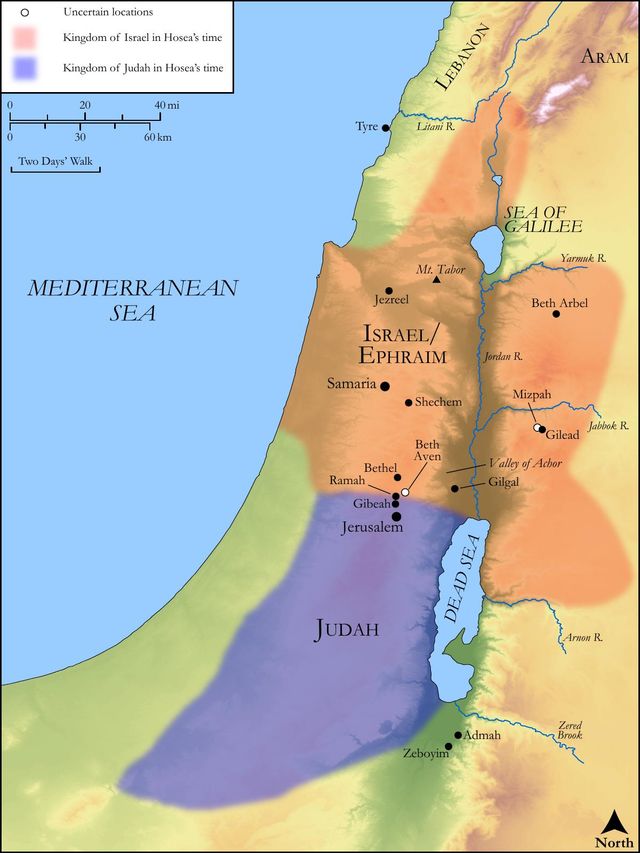
See on the biblical-era map
Study this verse
Public-domain commentary
Matthew Henry
From his Commentary on the Whole Bible. Henry comments on passages, not single verses — this entry covers Hosea 1:8–11. His four-level outline is real structure in the source text, so it is rendered as structure.
We have here a prediction,
I.Of the rejection of Israel for a time, which is signified by the name of another child that Hosea had by his adulterous spouse, Hos 1:8, Hos 1:9. And still we must observe that those children whose names carried these direful omens in them to Israel were all children of whoredoms (Hos 1:2), all born of the harlot that Hosea married, to intimate that the ruin of Israel was the natural product of the sin of Israel. If they had not first revolted from God, they would never have been rejected by him; God never leaves any till they first leave him. Here is,
1.The birth of this child: When she had weaned her daughter, she conceived and bore a son. Notice is taken of the delay of the birth of this child, which was to carry in its name a certain presage of their utter rejection, to intimate God's patience with them, and his unwillingness to proceed to extremity. Some think that her bearing another son signifies that people's persisting in their wickedness; lust still conceived and brought forth sin. They added to do evil (so the Chaldee paraphrase expounds it); they were old in adulteries, and obstinate.
2.The name given him: Call him Lo-ammi - Not my people. When they were told that God would no more have mercy on them they regarded it not, but buoyed up themselves with this conceit, that they were God's people, whom he could not but have mercy on. And therefore he plucks that staff from under them, and disowns all relation to them: You are not my people, and I will not be your God. "I will not be yours (so the word it); I will be in no relation to you, will have nothing to do with you; I will not be your King, your Father, your patron and protector." We supply it very well with that which includes all, "I will not be your God; I will not be to you what I have been, nor what you vainly expect I should be, nor what I would have been if you had kept close to me." Observe, "You are not my people; you do not act as becomes my people; you are not observant of me and obedient to me, as my people should be; you are not my people, but the people of this and the other dunghill-deity; and therefore I will not own you for my people, will not protect you, will not put in any claim to you, not demand you, not deliver you out of the hands of those that have seized you; let them take you; you are none of mine. You will not have me to be your God, but pay your homage to the pretenders, and therefore I will not be your God; you shall have no interest in me, shall expect no benefit from me." Note, Our being taken into covenant with God is owing purely to him and to his grace, for then it begins on his side: I will be to them a God, and then they shall be to me a people; we love him because he first loved us. But our being cast out of covenant is owing purely to ourselves and our own folly. The breach is on man's side: You are not my people, and therefore I will not be your God; if God hate any, it is because they first hated him. This was fulfilled in Israel when they were utterly taken away into the land of Assyria, and their place knew them no more. They were no longer God's people, for they lost the knowledge and worship of him; no prophets were sent to them, no promises made to them, as were to the two tribes in their captivity; nay, they were no longer a people, but, for aught that appears, were mingled with the nations into which they were carried, and lost among them.
II.Of the reduction and restoration of Israel in the fulness of time.
Here, as before, mercy is remembered in the midst of wrath; the rejection, as it shall not be total, so it shall not be final (Hos 1:10, Hos 1:11): Yet the number of the children of Israel shall be as the sand of the sea. See how the same hand that wounded is stretched forth to heal, and how tenderly he that has torn binds up; though God cause grief by his threatenings, yet he will have compassion, and will gather with everlasting kindness. They are very precious promises which are here made concerning the Israel of God, and which may be of use to us now.
1.Some think that these promises had their accomplishment in the return of the Jews out of their captivity in Babylon, when many of the ten tribes joined themselves to Judah, and took the benefit of the liberty which Cyrus proclaimed, came up in great numbers out of the several countries into which they were dispersed, to their own land, appointed Zerubbabel their head, and coalesced into one people, whereas before they had been two distinct nations. And in their own land, where God had by his prophets disowned and rejected them as none of his, he would by his prophets own them and appear for them as his children; and from all parts of the country they should come up to the temple to worship. And we have reason to think that, though this promise has a further reference, yet it was graciously intended and piously used for the support and comfort of the captives in Babylon, as giving them a general assurance of mercy which God had in store for them and their land; their nation could not be destroyed so long as this blessing was in it, was in reserve for it.
2.Some think that these promises will not have their accomplishment, at least not in full, till the general conversion of the Jews in the latter days, which is expected yet to come, when the vast incredible numbers of Jews, that are now dispersed as the sand of the sea, shall be brought to embrace the faith of Christ and be incorporated in the gospel-church. Then, and not till then, God will own them as his people, his children, even there where they had lain under the dismal tokens of their rejection. The Jewish doctors look upon this promise as not having had its accomplishment yet. But,
3.It is certain that this promise had its accomplishment in the setting up of the kingdom of Christ, by the preaching of the gospel, and the bringing in both of Jews and Gentiles to it, for to this these words are applied by St. Paul (Rom 9:25, Rom 9:26), and by St. Peter when he writes to the Jews of the dispersion, Pe1 2:10. Israel here is the gospel-church, the spiritual Israel (Gal 6:16), all believers who follow the steps, and inherit the blessing of faithful Abraham, who is the father of all that believe, whether Jews or Gentiles, Rom 4:11, Rom 4:12. Now let us see what is promised concerning this Israel.
(1.)That it shall greatly multiply, and the numbers of it be increased; it shall be as the sand of the sea, which cannot be measured nor numbered. Though Israel according to the flesh be diminished and made few, the spiritual Israel shall be numerous, shall be innumerable. In the vast multitudes that by the preaching of the gospel have been brought to Christ, both in the first ages of Christianity and ever since, this promise is fulfilled, thousands out of every tribe in Israel, and out of other nations, a multitude which no man can number, Rev 7:4, Rev 7:9; Gal 4:27. In this the promise made to Abraham, when God called him Abraham the high father of a multitude, had its full accomplishment (Gen 17:5), and that Gen 22:17. Some observe that they are here compared to the sand of the sea, not only for their numbers, but as the sand of the sea serves for a boundary to the waters, that they shall not overflow the earth, so the Israelites indeed are a wall of defence to the places where they live, to keep off judgments. God can do nothing against Sodom while Lot is there.
(2.)That God will renew his covenant with the gospel-Israel, and will incorporate it a church to himself, by as full and ample a charter as that whereby the Old Testament church was incorporated; nay, and its privileges shall be much greater: "In the place where it was said unto them, You are not my people, there shall you be again admitted into covenant, and owned as my people." The abandoned Gentiles in their respective places, and the rejected Jews in theirs, shall be favoured and blessed. There, where the fathers were cast off for their unbelief, the children, upon their believing, shall be taken in. This is a blessed resurrection, the making of those the people of God that were not a people. Nay, but the privilege is enlarged; now it is not only, You are my people, as formerly, but You are the sons of the living God, whether by birth you were Jews or Gentiles. Israel under the law was God's son, his first-born, but then they were as children under age; now, under the gospel, they have grown up both to greater understanding and greater liberty, Gal 4:1, Gal 4:2. Note,
[1.]It is the unspeakable privilege of all believers that they have the living God for their Father, the ever-living God, and may look upon themselves as his children by grace and adoption.
[2.]The sonship of believers shall be owned and acknowledged; it shall be said to them, for their comfort and satisfaction, nay, and it shall be said for their honour in the hearing of the world, You are the sons of the living God. Let not the saints disquiet themselves; let not others despise them; for, sooner or later, there shall be a manifestation of the children of God, and all the world shall be made to know their excellency and the value God has for them.
[3.]It will add much to their comfort, very much to their honour, when they are dignified with the tokens of God's favour in that very place where they had long lain under the tokens of his displeasure. This speaks comfort to the believing Gentiles, that they need not go up to Jerusalem, to be received and owned as God's children; no, they may stay where they are, and in that place, though it be in the remotest corner of the earth, in that place where they were at a distance, where it was said to them, "You are not God's people," but are separated from them (Isa 56:3, Isa 56:6), even there, without leaving their country and kindred, they may by faith receive the Spirit of adoption, witnessing with their spirits that "they are the children of God."
(3.)That those who had been at variance should be happily brought together (Hos 1:11): Then shall the children of Judah and the children of Israel be gathered together. This uniting of Judah and Israel, those two kingdoms that were now so much at variance, biting and devouring one another, is mentioned only as a specimen, or one instance, of the happy effect of the setting up of Christ's kingdom in the world, the bringing of those that had been at the greatest enmity one against another to a good understanding one of another and a good affection one to another. This was literally fulfilled when the Galileans, who inhabited that part of the country which belonged to the ten tribes, and probably for the most part descended from them, so heartily joined with those that were probably called Jews (that were of Judea) in following Christ and embracing his gospel; and his first disciples were partly Jews and partly Galileans. The first that were blessed with the light of the gospel were of the land of Zebulun and Naphtali (Mat 4:15); and, though there was no good-will at all between the Jews and the Galileans, yet, upon their believing in Christ, they were happily consolidated, and there were no remains of the former disaffection they had to one another; nay, when the Samaritans believed, though between them and the Jews there was a much greater enmity, yet in Christ there was a perfect unanimity, Act 8:14. Thus Judah and Israel were gathered together; yet this was but a type of the much more celebrated coalition between Jews and Gentiles, when, by the death of Christ, the partition-wall of the ceremonial law was taken down. See Eph 2:14-16. Christ died, to gather together in one all the children of God that were scattered abroad, Joh 11:51; Eph 1:10.
(4.)That Jesus Christ should be the centre of unity to all God's spiritual Israel. They shall all agree to appoint to themselves one head, which can be no other than he whom God has appointed, even Christ. Note, Jesus Christ is the head of the church, the one only head of it, not only a head of government, as of the body politic, but a head of vital influence, as of the natural body. To believe in Christ is to appoint him to ourselves for our head, that is, to consent to God's appointment, and willingly commit ourselves to his guidance and government; and this in concurrence and communion with all good Christians that make him their head; so that, though they are many, yet in him they are one, and so become one with each other. Qui conveniunt in aliquo tertio inter se conveniunt - Those who agree with a third agree with each other.
(5.)That, having appointed Christ for their head, they shall come up out of the land; they shall come, some of all sorts, from all parts, to join themselves to the church, as, under the Jewish economy, they came up from all corners of the land of Israel to Jerusalem, to worship (Psa 122:4), Thither the tribes go up, to which there is a plain allusion in that prophecy of the accession of the Gentiles to the church (Isa 2:3), Come, and let us go up to the mountain of the Lord. It denotes not a local remove (for they are said to be in the same place, Hos 1:10), but a change of their mind, a spiritual ascent to Christ. They shall come up from the earth (so it may be read); for those who have given up themselves to Christ as their head take their affections off from this earth, and the things of it, to set them upon things above (Col 3:1, Col 3:2); for they are not of the world (Joh 15:19), but have their conversation in heaven. They shall come up out of the land, though it be the land of their nativity; they shall, in affection, come out from it, that they may follow the Lamb withersoever he goes. Thus the learned Dr. Pocock takes it.
(6.)That, when all this comes to pass, great shall be the day of Jezreel. Though great is the day of Jezreel's affliction (so some understand it), yet great shall be the day of Jezreel's glory. This shall be Israel's day; the day shall be their own, after their enemies have long had their day. Israel is here called Jezreel, the seed of God, the holy seed (Isa 6:13), the substance of the land. This seed is now sown in the earth, and buried under the clods; but great shall be its day when the harvest comes. Great was the church's day when there were added to it daily such as should be saved; then did the Almighty do great things for it.
Historical interpretation
Thirteen Centuries of Reception
3 surviving comments on this verse. Each one is dated, so this reads as a timeline rather than a list.
Select a marker to jump to its quote. Markers stagger vertically where authors wrote within a few decades of each other.
“They come up out of the land,” namely, they will live the life of the saints as well, “for great is the day of Jezreel.” Indeed, great is the day of Christ, when he will raise to life all the dead. In fact, he will descend from heaven and sit on his glorious throne. “And he will give everyone according to his works.” Therefore if one wishes to understand by “day” the time of the visitation—when the remission of sins is given by Christ to the Greeks, the Judaeans and those who have sinned against him—this will not deviate from the true words. For David too indicated the time of the coming of our Savior by saying, “This is the day that the Lord has made; let us be glad and rejoice in it.”
One head: viz., Christ.-- Ibid.
Great is the day of Jezrahel: That is, of the seed of God; for Jezrahel signifies the seed of God.
Continue studying Hosea 1:11 across the web’s major study libraries — every link below opens this exact verse, chapter, or book on the destination site.
Read & Compare
 BibleGatewayThis verse in more than 200 translations and 70 languages.
 Bible.comThe YouVersion reader — hundreds of translations, reading plans, and highlights.
 ESV.orgCrossway's official English Standard Version reader.
 NET BibleThe NET translation with 60,000+ translators' notes on every rendering decision.
 STEP BibleTyndale House's free study tool — original text, vocabulary, and scholarly resources.
 BibliaLogos Bible Software's free web reader.
 USCCBThe New American Bible (Revised Edition) with the U.S. bishops' study notes.
Commentaries
 BibleHub CommentariesDozens of classic commentaries on this verse, gathered on one page.
 StudyLightMore than 100 commentary sets — the largest collection on the web.
 BibleRefPlain-English commentary on what this verse means, verse by verse.
 Enduring WordDavid Guzik's free commentary on this chapter, widely used by Bible teachers.
 Bible Study ToolsVerse commentary alongside Greek and Hebrew study aids.
Original Language & Research
- BibleHub InterlinearThe verse word by word — original language, transliteration, and English.
- BibleHub LexiconEvery word's original-language definition and Strong's entry.
 Blue Letter BibleDeep-study tools — Strong's numbers, concordance, and word studies.
 SefariaThe Hebrew text with Rashi and centuries of Jewish commentary.
Sermons, Hymns & Audio


TrulyRandomVerse is not affiliated with these sites and doesn’t control their content. They’re linked because they’re genuinely useful.
Summary
Hosea 1:11 stands as a beacon of hope and divine promise within a book largely dedicated to prophecies of judgment against Israel's unfaithfulness. This verse foretells a future, glorious reunification of the divided kingdoms of Judah and Israel, predicting their gathering under a single, unified leadership and their prosperous return to the land. It culminates in the declaration that "great shall be the day of Jezreel," transforming a name initially associated with scattering and divine judgment into a symbol of God's ultimate intention to sow His people in blessing and fruitfulness.
Context
ShowHideLiterary Context
Hosea 1:11 marks a dramatic shift in tone from the preceding verses. Chapters 1-3 introduce Hosea's prophetic ministry through the symbolic narrative of his marriage to Gomer, a harlot, and the naming of their children. The first two children, Jezreel and Lo-Ruhamah, symbolize God's impending judgment and withdrawal of mercy from Israel. Specifically, Hosea 1:4 declares that God will "punish the house of Jehu for the blood of Jezreel," signaling the end of the Northern Kingdom's dynasty. However, the immediate preceding verse, Hosea 1:10, provides the crucial pivot, reversing the earlier judgments by promising that "where it was said to them, 'You are not my people,' it shall be said to them, 'Children of the living God.'" Verse 11 builds directly on this reversal, extending the promise of restoration from a spiritual re-adoption to a physical and political reunification, setting the stage for the broader themes of restoration found in later chapters of Hosea, such as Hosea 2:23.
Historical & Cultural Context
The book of Hosea was delivered during the tumultuous latter half of the 8th century BCE, primarily to the Northern Kingdom of Israel (Ephraim) before its fall to Assyria in 722 BCE. At this time, the kingdom was plagued by political instability, idolatry, and oppression, having long been separated from the Southern Kingdom of Judah since the division under Rehoboam in 1 Kings 12. The name "Jezreel" itself held significant historical weight; the Valley of Jezreel was a fertile plain but also a site of numerous battles and political intrigue, including Jehu's bloody coup (2 Kings 9-10). The cultural context was one of deep religious syncretism, with the worship of Baal intertwined with the worship of Yahweh. The prophecy of reunification ("children of Judah and the children of Israel") directly addresses the centuries-long schism, envisioning a future where the political and spiritual fragmentation is healed, a concept deeply resonant with the longing for a unified, secure nation under God's favor.
Key Themes
ShowHideHosea 1:11 encapsulates several profound themes central to the book and broader Old Testament prophecy. Firstly, it highlights God's Sovereignty over History, demonstrating His ability to reverse judgments and bring about His redemptive purposes despite human failure. Secondly, the theme of Divine Faithfulness and Covenant Love (Hesed) shines through; even after declaring "not my people" (Hosea 1:9), God's enduring love leads Him to promise restoration. Thirdly, the verse powerfully introduces the theme of Reversal and Transformation, particularly evident in the reinterpretation of "Jezreel." What was once a symbol of scattering and judgment (Hosea 1:4) becomes a promise of God's re-sowing for blessing and fruitfulness (Hosea 2:23). Finally, the prophecy of "one head" points to the overarching theme of Messianic Hope and Unified Leadership, anticipating a future righteous ruler who will bring together God's scattered people, a hope echoed in prophecies like Ezekiel 37:22.
Exposition and Analysis
ShowHideKey Word Analysis
ShowHideFrom a root meaning "to build," this word signifies a son, but in its widest sense, it refers to descendants, members of a family, or a nation. Here, it emphasizes the familial and national identity of "Judah" and "Israel" as distinct yet related entities, highlighting their shared lineage as God's chosen people, despite their historical division.
A numeral meaning "united" or "one." Its use here stresses the singular, unified nature of the future leadership and the people themselves. It implies a complete overcoming of the historical schism between the Northern and Southern Kingdoms, moving from two separate entities to a single, cohesive unit.
Literally meaning "the head" (as the most easily shaken part), this word is used figuratively to denote the chief, leader, or principal part. In this context, "one head" refers to a singular, supreme leader who will govern the reunited people, signifying a return to centralized authority and unified direction under a righteous ruler.
This adjective means "great" in any sense, implying magnitude, importance, or significance. When applied to "the day of Jezreel," it elevates this future event to a momentous, divinely orchestrated occasion of immense importance and positive impact, signifying a powerful and glorious intervention by God.
While literally meaning a 24-hour period, "day" can also refer to a figurative "space of time defined by an associated term." Here, "the day of Jezreel" indicates a specific, significant period or event when God's redemptive purposes concerning Jezreel (and thus, Israel) will be powerfully realized, marking a pivotal moment in salvation history.
Derived from roots meaning "to sow" and "God," this name literally means "God will sow." Hosea masterfully employs its dual connotation. While initially signifying God's scattering or judgment (as in the bloodshed at Jezreel and the dispersion of Israel), in this verse, it is dramatically reversed to mean God's re-sowing of His people in the land, not for judgment, but for fruitfulness, growth, and blessing. The "great day of Jezreel" thus becomes a powerful symbol of divine reversal and restoration.
Verse Breakdown
ShowHide"Then shall the children of Judah and the children of Israel be gathered together"
This clause prophesies the future reunification of the two long-divided kingdoms. "Judah" represents the Southern Kingdom, and "Israel" (or Ephraim) represents the Northern Kingdom. Their being "gathered together" speaks to a physical and spiritual re-collection, reversing the scattering and division that characterized their history since the time of Rehoboam. It envisions an end to the schism and a restoration of national unity under God.
"and appoint themselves one head"
This phrase signifies the establishment of a singular, unified leadership over the reunited people. The act of "appointing themselves" suggests a willing recognition and acceptance of this leader, who is understood to be a messianic figure, a righteous king who will rule over all twelve tribes. This points to a divinely ordained, yet humanly embraced, authority that brings cohesion and direction.
"and they shall come up out of the land"
This phrase can be interpreted in several ways, all pointing to restoration. It could refer to a return from exile, a "coming up" from the lands of their dispersion back to their homeland. Alternatively, it might signify a flourishing within the land, a rising to prominence and prosperity, or even a coming forth from the "land" of spiritual barrenness into a place of blessing. In any interpretation, it denotes a reversal of their previous state of decline or subjugation.
"for great [shall be] the day of Jezreel"
This concluding statement provides the reason and the glorious culmination of the prophecy. The "day of Jezreel" is declared "great," signifying a momentous, divinely significant event. While "Jezreel" initially symbolized judgment and scattering (God scatters), here it is transformed into a symbol of God's re-sowing His people in blessing, fruitfulness, and restoration. This "great day" represents the time when God's ultimate purpose for His people—unity, prosperity, and blessing—will be fully realized.
Literary Devices
ShowHideHosea 1:11 masterfully employs several literary devices to convey its profound message of hope and transformation. The most prominent is Symbolism, particularly with the name "Jezreel." Initially introduced as a symbol of judgment and scattering in Hosea 1:4, here it undergoes a dramatic Reversal of meaning. The "great day of Jezreel" transforms the valley of bloodshed into a place of divine re-sowing and blessing, illustrating God's power to turn curses into blessings. This Irony underscores God's redemptive plan. The phrase "one head" functions as a Metonymy or Synecdoche, where "head" represents the unified leadership or the single ruler, pointing towards a future messianic king. The entire verse is a powerful Prophecy, a divine declaration of future events that transcends the immediate historical context of Israel's division and impending exile, offering a vision of ultimate restoration and unity. The use of "children of Judah and the children of Israel" also employs Merism, encompassing the entirety of God's people, both Northern and Southern Kingdoms, emphasizing their complete reunification.
Theological and Thematic Connections
ShowHideHosea 1:11 is a profound theological statement on God's unwavering faithfulness and His ultimate redemptive purposes. Despite Israel's persistent unfaithfulness, leading to division and judgment, God's covenant love (hesed) prevails, ensuring a future of restoration and unity. This verse underscores the biblical theme of God's ability to reverse human failure and bring about His sovereign plan. It speaks to the deep longing for unity within God's people, a unity that transcends historical divisions and finds its ultimate expression in a singular, righteous head. The transformation of "Jezreel" from a symbol of scattering to one of sowing for blessing powerfully illustrates God's capacity for redemption and His promise to bring life and fruitfulness even out of desolation. This promise of a "great day" points to a climactic divine intervention, a day of ultimate triumph and restoration for God's chosen people.
Reflection and Application
ShowHideHosea 1:11 offers a timeless message of profound hope and encouragement for believers today. It reminds us that even when our lives or communities are marked by division, brokenness, or the consequences of past failures, God's ultimate plan is always for restoration, unity, and flourishing. Just as God promised to gather the scattered children of Judah and Israel under one head, He continually works to bring His people together, healing divides and fostering a shared identity in Him. This verse encourages us to trust in God's sovereign ability to transform our "Jezreel" moments—those times of scattering, pain, or judgment—into seasons of His abundant sowing, where new life, fruitfulness, and blessing emerge. It challenges us to look beyond present circumstances and cling to the assurance that God's great day of redemption will indeed come, bringing ultimate unity and joy.
Questions for Reflection
ShowHideFAQ
ShowHideWhat is the significance of "Jezreel" in this verse, given its earlier meaning in Hosea?
ShowHideThe name "Jezreel" (Hebrew: Yizrᵉʻêʼl) is central to the prophetic message of Hosea, and its meaning undergoes a dramatic transformation within the book. In Hosea 1:4, "Jezreel" is associated with judgment and scattering, referencing the bloodshed committed by Jehu in the Valley of Jezreel and symbolizing God's impending judgment and dispersion of the Northern Kingdom of Israel. However, in Hosea 1:11 and later in Hosea 2:23, the meaning is powerfully reversed. Here, "Jezreel" (meaning "God will sow") signifies God's intention to re-sow His people in the land, not for scattering, but for fruitfulness, blessing, and restoration. The "great day of Jezreel" thus becomes a symbol of God's redemptive power to turn judgment into ultimate blessing and purpose, bringing forth new life and unity.
Who is the "one head" referred to in this prophecy?
ShowHideThe "one head" refers to a singular, unified leader who will rule over the reunited children of Judah and Israel. While the immediate historical context might suggest a future Davidic king, the long-term prophetic fulfillment points unmistakably to a messianic figure. This "one head" is ultimately Jesus Christ, the promised Son of David, who gathers all of God's people—both Jew and Gentile—into one body under His supreme authority. Prophecies like Ezekiel 37:22 explicitly speak of "one king" over the reunited nation, and the New Testament reveals this king to be Christ, who is the head of the church (Ephesians 1:22).
Has this prophecy of reunification been fulfilled, and if so, when?
ShowHideThe prophecy of the children of Judah and Israel being gathered together under one head has a multi-layered fulfillment. Historically, there was a partial return from exile where some from both kingdoms reunited, particularly after the Babylonian captivity. However, a complete and lasting reunification of all twelve tribes under one king has not yet occurred in the literal, political sense within Israel's history. The ultimate and most profound fulfillment is found in Jesus Christ. He is the "one head" who gathers all believers, both Jewish and Gentile, into one spiritual body, the Church (Ephesians 2:14-16). This spiritual unity in Christ foreshadows and guarantees a future eschatological fulfillment where all of God's people will be perfectly united under His reign in the new heavens and new earth (Revelation 21:1-4).
Christ-Centered Fulfillment
ShowHideHosea 1:11 finds its ultimate and most glorious fulfillment in Jesus Christ. The prophecy of the "children of Judah and the children of Israel" being "gathered together" and appointing "one head" directly anticipates the messianic work of Jesus. He is the promised "one head," the true King from the line of David, who brings together not only the scattered tribes of Israel but also incorporates the Gentiles into God's unified family. As the Good Shepherd, Jesus declares His mission to gather His sheep, stating, "I have other sheep that are not of this fold; I must bring them also, and they will listen to my voice. So there will be one flock and one shepherd" (John 10:16). The division between Judah and Israel, symbolic of all human divisions, is ultimately broken down by Christ's sacrificial death on the cross, creating "one new humanity in place of the two" (Ephesians 2:14-16). The "great day of Jezreel," where God sows His people for blessing, culminates in Christ's resurrection and the outpouring of the Holy Spirit, through whom believers are "sown" into the kingdom of God, bearing fruit for His glory (Galatians 3:28). Thus, the hope of Hosea 1:11 is realized in the person and work of Jesus, who is the unifying Head of His church, gathering all who believe into one body, destined for eternal life in His presence.