


Zechariah 10:6
- וְגִבַּרְתִּיve·gi·bar·Tiand I will make strongH1396Conj-w ¦ V-Piel-ConsecPerf-1csVerb Piel Consecutive Perfect 1st Singular common genderוְandגִבַּרְתִּיI will make strong
- אֶת'et<obj.>H853DirObjMParticle Object Indicator
- בֵּיתbeit[the] house ofH1004N-mscNoun Singular Masculine Construct
- יְהוּדָהye·hu·DahJudahH3063N-properNoun Proper Location
- וְאֶתve·'Etand <obj.>H853Conj-w ¦ DirObjMParticle Object Indicatorוְandאֶת<obj.>
- בֵּיתbeit[the] house ofH1004N-mscNoun Singular Masculine Construct
- יוֹסֵףyo·SefJosephH3130N-proper-mNoun Proper Masculine
- אוֹשִׁיעַ'o·Shi·a'I will saveH3467V-Hiphil-Imperf-1csVerb Hiphil Imperfect 1st Singular common gender
- וְהוֹשְׁבוֹתִיםve·ho·she·vo·Timand I will restore themH7725Conj-w ¦ V-Hiphil-ConsecPerf-1cs ¦ 3mpVerb Hiphil Consecutive Perfect 1st Singular common genderוְandהוֹשְׁבוֹתִיI will restoreםthem
- כִּיkiforH3588PrtParticle Conditional
- רִחַמְתִּיםri·cham·TimI have compassion on themH7355V-Piel-Perf-1cs ¦ 3mpVerb Piel Perfect 1st Singular common genderרִחַמְתִּיI have compassion onםthem
- וְהָיוּve·ha·Yuand they will beH1961Conj-w ¦ V-Qal-ConsecPerf-3cpVerb Qal Consecutive Perfect 3rd Plural common genderוְandהָיוּthey will be
- כַּאֲשֶׁרka·'a·Sherjust asH834Prep-k ¦ RelParticle Relativeכַּjustאֲשֶׁרas
- לֹאlo'notH3808NegParticle Negative
- זְנַחְתִּיםze·nach·TimI had rejected themH2186V-Qal-Perf-1cs ¦ 3mpVerb Qal Perfect 1st Singular common genderזְנַחְתִּיI had rejectedםthem
- כִּיKiforH3588PrtParticle Conditional
- אֲנִי'a·NiIH589Pro-1csPronoun Personal 1st Singular common gender
- יְהוָהYah·weh[am] YahwehH3068N-properNoun Proper Title
- אֱלֹהֵיהֶם'e·lo·hei·Hemtheir GodH430N-mpc ¦ 3mpNoun Plural Masculine ConstructאֱלֹהֵיGodהֶםtheir
- וְאֶעֱנֵםve·'e·'e·Nemand I will answer themH6030Conj-w ¦ V-Qal-ConjImperf-1cs ¦ 3mpVerb Qal Conjunction+Imperfect 1st Singular common genderוְandאֶעֱנֵI will answerםthem
English is a literal word-by-word gloss of the Hebrew, not the KJV's wording. Why?
This is the original text the KJV's translators worked from — each Hebrew word with its own literal English meaning in this verse, prepared by scholars at Tyndale House, Cambridge. The KJV translates whole sentences, not word by word, so its wording differs: one Hebrew word can become several English words, and the KJV may choose “the LORD” where the gloss reads “Yahweh”. Both are faithful — they answer different questions. For the KJV's own rendering, switch to the KJV text.
Details
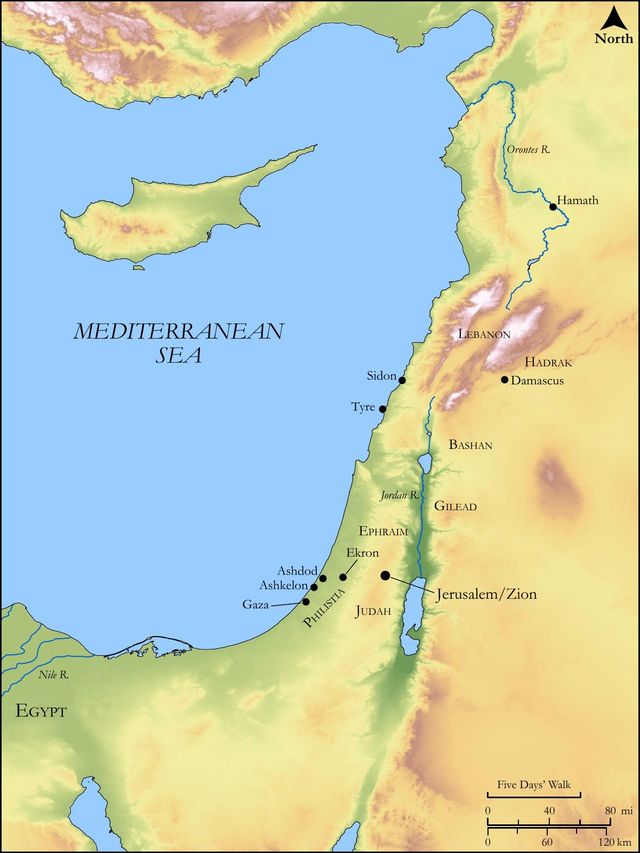
See on the biblical-era map
Study this verse
Public-domain commentary
Matthew Henry
From his Commentary on the Whole Bible. Henry comments on passages, not single verses — this entry covers Zechariah 10:5–12. His three-level outline is real structure in the source text, so it is rendered as structure.
Here are divers precious promises made to the people of God, which look further than to the state of the Jews in the latter days of their church, and have certain reference to the spiritual Israel of God, the gospel-church, and all true believers.
I.They shall have God's favour and presence, and shall be owned and accepted of him.
This is the foundation of all the rest: The Lord is with them, Zac 10:5. He espouses their cause, takes their part, is on their side; and, if he be for them, who can be against them? Again (Zac 10:6), I have mercy upon them. All their dignity and joy are owing purely to God's mercy; and mercy, as it supposes misery, so it excludes merit. They had been cast off, the effect of which could not but be misery; they had been justly cast off, and therefore could pretend to merit nothing at God's hand but wrath and the curse; yet it is promised, They shall be as though I had not cast them off. The transgressions of their fathers, for which they had been rejected, shall not only not be visited upon them, but shall not be so much as remembered against them. God will be as perfectly reconciled to them as if he had never contended with them, and the falling out of these lovers shall rather be the renewing than the weakening of love. They shall have such a full assurance of God's being reconciled to them, and upon that shall be so well reconciled to themselves, that they shall be as easy as if they had never been cast off; and their condition, after their restoration to the divine favour, shall be so very happy that there shall not remain the least scar from the wounds which were given them by their being cast off. Such favour does God show to returning repenting sinners, who were by nature at a distance, and children of wrath; such fellowship are they admitted into, and such freedom does he use with them, that they are as though they had never been cast off.
1.The covenant they are admitted into is the same that ever it was: I am the Lord their God, according to the original contract, the covenant made with their fathers.
2.The communion they are admitted into is the same that ever it was: I will hear them. They shall be as welcome as ever to speak to him, and as sure as ever to receive from him an answer of peace; for, as he never did, so he never will, say to Jacob's seed, Seek you me in vain.
II.They shall be victorious over their enemies, that would draw them from either their duty to God or their comfort in God (Zac 10:5):
They shall be as mighty men, that are both strong in body and bold in spirit, men of vigour, men of valour, effective men. Those of Ephraim, as well as those of Judah, shall be like a mighty man (Zac 10:7), that dares to go about a difficult enterprise and is able to go through with it. They shall, as mighty men, tread down their enemies in the battle, as the dirt that is thrown out of the houses is trodden with other dirt in the mire of the streets. And they shall therefore fight, because the Lord is with them. Some would argue that they may therefore sit still, and do nothing, because the Lord is with them, who can and will do all. No; God's gracious presence with us to help us must not supersede, but quicken and animate, our endeavours to help ourselves; and we must therefore work out our salvation with fear and trembling, because it is God that works in us both to will and to do. They shall fight with readiness and resolution because, if God be with them, they are sure to be conquerors, more than conquerors. For then the riders on horses shall be confounded. The cavalry of the enemies shall be routed, and put into disorder, by the infantry of the Jews. The preachers of the gospel of Christ went forth to war a good warfare; they charged bravely, because God was with them; and the riders on horses that opposed them were confounded, for God chose the weak and foolish things of the world to confound the wise and mighty. But whence have they all this might? How come they to be so able, so active? It is in the Lord, and in the power of his might, that they are so (Zac 10:6): I will strengthen the house of Judah, and so I will save the house of Joseph. Note, God saves us by strengthening us, and works out our happiness by working in us to do our duty. And thus we are engaged to the utmost diligence in using the strength God gives us; and yet, when all is done, God must have the glory of all. God is our strength, and so becomes both our song and our salvation.
III.Those of them that are dispersed shall be gathered together into one body (Zac 10:6):
I will bring them again to place them, bring them from other lands to place them in their own land. This was a token of their being perfectly restored to all their other ancient privileges - they shall be restored to the possession of their own land. This was fulfilled when the children of God that were scattered abroad were by faith in Christ incorporated in the gospel-chruch, and Jews and Gentiles became one fold, Joh 10:16. In order to this (Zac 10:8) I will hiss for them, or, rather, whistle for them, as the shepherd with his pipe calls his sheep together, that know his voice; and so I will gather them. The preaching of the gospel was, as it were, God's hissing for souls to come to Jesus Christ, his calling in his scattered sheep to the green pastures. I will gather them, for I have redeemed them. Note, Those whom Christ has redeemed by his blood God will gather by his grace, as a hen gathers her brood under her wings. This promise is enlarged upon Zac 10:10, I will bring them again also out of the land of Egypt. Some think this was literally fulfilled when Ptolemaeus Philadelphus king of Egypt sent 120,000 Jews out of his country into their own land, as was the promise of gathering them out of Assyria by Alexander the son of Antiochus Epiphanes. But it has its spiritual accomplishment in the gathering in of precious souls out of a bondage worse than that in Egypt or Assyria, and the bringing of them into the glorious liberties of the children of God and their enjoyments, which are as the beautiful fruitful pastures in the land of Gilead and Lebanon. All the land of promise is theirs, even Gilead, the utmost border of it eastward, and Lebanon, the utmost border northward. But how shall this be? How shall a people so dispersed be got together? How shall those that are set at such a distance from their own country be brought to it again? It is true the difficulties seem insuperable, but they shall be got over as easily, as effectually as those that lay in the way of their deliverance out of Egypt and their entrance into Canaan: He shall pass through the sea with affliction, as of old through the Red Sea, to the sore affliction of Pharaoh and his hosts, or to the sore affliction of the sea, the waves whereof he shall smite, so that it shall be driven back, as when the sea saw and fled, Psa 114:3. And all the deeps of the river (all the rivers, though ever so deep) shall dry up, as Jordan did, to make way for Israel's passage into that good land which God had given them. Does the pride of Assyria stand in the way of their deliverance? He shall give check to it who sets bounds to the proud waves of the sea, and it shall be brought down. Does the sceptre of Egypt oppose it? That shall depart away, so that it shall not be able to obstruct the gathering in of God's Israel when his time shall come for the doing of it. When the gospel-chruch was to be gathered out of all nations by the preaching of the gospel great opposition was given to it by the enraged combined powers of earth and hell. Insuperable difficulties seemed to be in the way of it. But, by a divine power going along with the doctrine of Christ, it became mighty to the pulling down of strong holds, and the conversion and salvation of thousands. Then the sea fled, and Jordan was driven back at the presence of the Lord.
IV.They shall greatly multiply, and the church, that new world, shall be replenished (Zac 10:8):
They shall increase as they have increased formerly in Egypt, and great additions shall be made to their numbers, as in the days of David and Solomon. When God gathers his redeemed ones to himself they shall help to gather in others with them, and their motion homeward shall be like that of a snow-ball. Crescit eundo - The further it goes the larger it grows by accretion. I will gather them, and they shall increase. Note, The church of Christ is a growing body, as long as it is in the present state of minority, till it comes to the measure of the stature of the fulness of Christ. There are added to it daily such as shall be saved.
1.It shall spread to distant places. It shall fill Canaan, even to the lands of Gilead and Lebanon, so that no more place, no more room, shall be found for it there, Zac 10:10. In Judah only God had been known, and his name was great in Israel only; here only he revealed his statutes and judgments. But in gospel-times that place shall be much too strait; the church's tent must be enlarged, and its cords lengthened: Then I will sow them among the people, Zac 10:9. Their scattering shall be like the scattering of seed in the ground, not to bury it, but to increase it, that it may bring forth much fruit. The Jews are said to be dispersed into every nation under heaven (Act 2:5); and, as it was their troubles that dispersed some of them, so perhaps others transplanted themselves into colonies because the land of Israel was too strait for them; and many were natives of other nations, but proselyted to the Jewish religion. Now these were sown among the people, Hos 2:23. And this contributed very much to the spreading of the gospel. The Jews that came from all parts to worship at Jerusalem fetched thence the gospel light and fire to their own countries, as those Acts 2, and the eunuch, Acts 8. And their own synagogues in the several cities of the Gentiles were the first receptacles of the apostles and their preaching, wherever they came. Thus when God sowed them among the people, that they might not get hurt by the Gentiles, but do good to them, he took care that they should remember him, and make mention of his name in far countries; and, by keeping up the knowledge of God among them as he had revealed himself in the Old Testament, they would be the more ready to admit the knowledge of Christ as he has revealed himself in the New Testament.
2.It shall last to future ages. The church shall not be res unius aetatis - a temporary thing, but a seed in it shall serve the Lord, Zac 10:7. Yea, their children shall see it and be glad; and they shall live with their children, and turn again, Zac 10:9. Converts to Christ shall have their children about them, whom they shall teach the knowledge of the Lord, and bring with them when they turn again to the holy land and the way of holiness. It was said to those to whom the gospel was first preached, The promise is to you and to your children, Act 2:39. They shall be so sown among the people as never to be extirpated. Christ's family upon earth shall never be extinct, nor his purchased possession lost for want of heirs.
V.God himself will be both their strength and their song.
1.In him they shall be comforted, and shall have abundant satisfaction (Zac 10:7): Their heart shall rejoice as through wine; for Christ's love, which is their joy, is better than wine. They shall be like a mighty man, and their heart shall rejoice. When we resolutely resist, and so overcome, our spiritual enemies, then our hearts shall rejoice. But we ruin our own joy if our resistance be feeble and we yield to the temptations of Satan. Their heart shall rejoice, and then they shall be as a mighty man; for the joy of the Lord will be our strength. And with their graces their joys shall be propagated: Their children shall see it and be glad, and their hearts also shall rejoice in the Lord. It is good to acquaint children betimes with the delights of religion, and to make the services of it as pleasant as may be to them, that, learning betimes to rejoice in the Lord, they may with purpose of heart cleave to him.
2.By him they shall be carried on with vigour, and enlargement of heart, in his service (Zac 10:12): I will strengthen them in the Lord, strengthen them for their walk and work, as well as for their warfare. It is the God of Israel that gives strength and power unto his people, that strengthens all their powers and faculties for spiritual performances, above what they are by nature and against what they are by the corruption of nature. Now observe,
(1.)How they are thus enabled and invigorated for their duty: I the Lord will strengthen them in the Lord, in the Messiah, who is Jehovah our strength, as well as Jehovah our righteousness. Strength is treasured up for us in Christ, and from him it is communicated to us. It is through Christ strengthening us that we can do all things, and without him we can do nothing. His strength is commanded him for this purpose, Psa 68:28.
(2.)What good use they shall make of this strength given unto them: They shall walk up and down in his name. If God strengthen us, we must bestir ourselves, must walk up and down in all the duties of the Christian life, must be active and busy in the work of God, must walk up and down as industrious men do, losing no time, and letting slip no opportunity. But still we must walk up and down in the name of Christ, must do all by warrant from him and in dependence on him, with an eye to his word as our rule and his glory as our end. To us to live must be Christ; and, whatever we do in word or deed, we must do all in the name of the Lord Jesus, that we receive not the strengthening grace of God in vain. See Psa 80:17, Psa 80:18.
Historical interpretation
Historical reception
1 surviving comment on this verse from the historical church.
(Vers. 6, 7.) And the riders on horses will be put to shame, and I will strengthen the house of Judah and save the house of Joseph. I will restore them because I have compassion on them, and they shall be as though I had not rejected them, for I am the Lord their God and I will answer them. They shall be like mighty warriors of Ephraim, and their hearts shall rejoice as with wine. Their children shall see it and be glad; their hearts shall exult in the Lord. LXX: And the riders on horses will be put to shame, and I will strengthen the house of Judah and save the house of Joseph. I will cause them to dwell, for I have loved them. And they shall be as when I had not cast them off, for I am the Lord their God, and I will hear them: and they shall be as valiant men in battle, and their heart shall rejoice as with wine, and their children shall see it and be glad, and their heart shall rejoice in the Lord. And they have expounded these things twice according to the higher sense, so as to either relate them as already done under the Maccabees, or as about to be transacted under Christ in the last age. And the sense is this: When Judas, who was set as a goodly horse in battle, shall tread down the adversaries as mire, and with the Lord fighting with him shall overcome: then all the horsemen of Greece shall fall, and the house of Juda and the house of Israel shall be saved together, (for he calls that the house of Joseph, that is, of the ten tribes) and I will convert them out of their captivity, wherein they were, and they shall be as they were before, when I had not cast them off: for I am the Lord their God, and I will hear them calling upon me. And Ephraim, who are now held captive, will later be released, and they will come to such great joy that you would think they are drunk with wine. And their children will witness the triumphs of their fathers, and they will rejoice in the Lord, for it is through Him that they have achieved victory. Let us look for the history of when Judah and Israel fought together against the Greeks, or when Ephraim returned from captivity in Assyria, when, according to Ezekiel (Chapter 37), the two rods, that is, Judah and Ephraim, were joined together and united as one staff. Which can be explained according to the tropology. When the Almighty Lord visits his flock, the house of Judah, then the riders of the horses will be confounded, of whom it is written: Let us sing to the Lord, for he has triumphed gloriously; the horse and its rider he has thrown into the sea (Exodus 15:1). It is also sung by the voice of the Psalmist: At your rebuke, O God of Jacob, both rider and horse fell asleep (Psalm 76:7). And the choir of saints repeats: Some trust in chariots, and some in horses: but we will call upon the name of our God. They are bound, and have fallen: but we are risen, and are set upright (Ps. XIX, 8, 9). The Egyptian king relied on this cavalry; and he was thrown into the sea, like lead immersed in the depths (Exod. XV), and by his example he learned that what is written is true: A deceitful horse leads to salvation (Ps. XXXII, 17). We have interpreted these chariots and charioteers as representing the four disturbances that, unless controlled by the good reins, the charioteers are led to precipices. But there is another charioteer, of whom Elisha speaks: 'My father, my father, the chariot of Israel and its charioteer' (2 Kings 2:12). Then God says to strengthen the house of Judah and the house of Joseph (1 Kings 12:16), so that, just as they were divided during the reign of Jeroboam, they will be united under the rule of Christ, and there will be one shepherd and one flock. And Judas and Joseph are given different names because they both represent a single understanding of the Savior, since Joseph provided grain to the hungry people in Egypt (Gen. XLII seqq.): and the Lord satisfied the hunger of the world with his presence. And he will convert them and have mercy on them, and they will be one as they were before he cast them out. Take all of this as a lesson in persecution, when, with all hope lost, the Lord heard his servants. And they shall be like the strong ones of Ephraim, who at first were weak and feeble, but later became strong and worthy of their name. For Ephraim means abundance. And their hearts shall rejoice when they drink the wine that is pressed from the vine of Sorec. And their children, of whom the Apostle Paul speaks, my little children, for whom I am in labor again until Christ is formed in you (Galatians 4:19). And Peter, the chief of the apostles, says: As obedient children, do not be conformed to the former ways (1 Peter 1:14). And in the Psalm we read: Come, children, listen to me, I will teach you the fear of the Lord (Ps. 33:12). Therefore, these children will rejoice and be glad, and their heart will rejoice in the Lord.
Continue studying Zechariah 10:6 across the web’s major study libraries — every link below opens this exact verse, chapter, or book on the destination site.
Read & Compare
 BibleGatewayThis verse in more than 200 translations and 70 languages.
 Bible.comThe YouVersion reader — hundreds of translations, reading plans, and highlights.
 ESV.orgCrossway's official English Standard Version reader.
 NET BibleThe NET translation with 60,000+ translators' notes on every rendering decision.
 STEP BibleTyndale House's free study tool — original text, vocabulary, and scholarly resources.
 BibliaLogos Bible Software's free web reader.
 USCCBThe New American Bible (Revised Edition) with the U.S. bishops' study notes.
Commentaries
 BibleHub CommentariesDozens of classic commentaries on this verse, gathered on one page.
 StudyLightMore than 100 commentary sets — the largest collection on the web.
 BibleRefPlain-English commentary on what this verse means, verse by verse.
 Enduring WordDavid Guzik's free commentary on this chapter, widely used by Bible teachers.
 Bible Study ToolsVerse commentary alongside Greek and Hebrew study aids.
Original Language & Research
- BibleHub InterlinearThe verse word by word — original language, transliteration, and English.
- BibleHub LexiconEvery word's original-language definition and Strong's entry.
 Blue Letter BibleDeep-study tools — Strong's numbers, concordance, and word studies.
 SefariaThe Hebrew text with Rashi and centuries of Jewish commentary.
Sermons, Hymns & Audio


TrulyRandomVerse is not affiliated with these sites and doesn’t control their content. They’re linked because they’re genuinely useful.
Summary
Zechariah 10:6 pronounces a profound divine promise of restoration and reunification for the divided kingdoms of Israel, represented by Judah and Joseph. God declares His sovereign intention to strengthen and save His people, bringing them back to their land and reversing the consequences of their past exile. This comprehensive restoration is rooted not in their merit, but in God's boundless mercy and His unwavering commitment as their covenant God who hears and responds to their needs.
Context
ShowHideLiterary Context
Zechariah 10 seamlessly continues the prophetic vision initiated in chapter 9, which portrays the LORD as the ultimate deliverer and shepherd of His people, contrasting His true leadership with the inadequacy of human leaders and false diviners. Chapter 9 concludes with a promise of God's blessing and military victory for Judah and Ephraim, setting the stage for the explicit declaration of restoration in chapter 10. Zechariah 10:1-5 calls the people to seek rain from the LORD, not idols, and laments the failure of their human shepherds. Verse 6 then shifts from lament to a direct, emphatic promise of divine intervention, forming the theological bedrock for the subsequent prophecies of ingathering and strength in Zechariah 10:7-12. This verse is pivotal in transitioning from the immediate post-exilic concerns to a grand, eschatological vision of Israel's complete restoration and unity under God's sovereign hand, echoing themes found throughout the prophetic books.
Historical & Cultural Context
The prophecy of Zechariah was delivered to the Jewish exiles who had returned to Jerusalem from Babylon, around 520-518 BC. At this time, the "house of Judah" (the southern kingdom) had experienced a partial return, but the "house of Joseph" (representing the ten northern tribes, often called Israel or Ephraim) had been scattered by the Assyrians centuries earlier and had not returned as a distinct entity. The division between these two "houses" dated back to the schism after Solomon's reign (c. 931 BC), leading to centuries of animosity and separate destinies. Culturally, the people were still grappling with the spiritual failures that led to their exile, including idolatry and reliance on false prophets. The promise of reunification and a reversal of their "cast off" status would have been a radical and deeply comforting message, speaking to a long-held national longing for wholeness and security in their ancestral land, a hope often expressed in the Psalms.
Key Themes
ShowHideZechariah 10:6 contributes significantly to several overarching themes within the book and broader biblical theology. Firstly, it highlights Divine Initiative and Sovereignty, emphasizing that God Himself will act ("I will strengthen," "I will save," "I will bring them again"). Secondly, it underscores God's Unwavering Mercy and Compassion, as His actions are explicitly "for I have mercy upon them," revealing that His restoration is not earned but freely given. Thirdly, the verse powerfully advances the theme of Reunification and Restoration of All Israel, explicitly bridging the ancient divide between Judah and Joseph, a theme central to many post-exilic prophecies, such as Ezekiel's vision of the two sticks. Finally, it affirms God's Personal Engagement and Responsiveness, declaring, "I am the LORD their God, and will hear them," assuring His people of His attentive and active presence in their lives. This promise of God's hearing is a foundational aspect of the covenant relationship, as seen in Deuteronomy 4:7.
Exposition and Analysis
ShowHideKey Word Analysis
ShowHideMeaning "to be strong; by implication, to prevail, act insolently." In this context, it signifies God's active impartation of power and resilience to His people, enabling them to overcome weakness and opposition. It implies a divine empowerment that leads to victory and stability.
Meaning "to be open, wide or free, i.e. (by implication) to be safe; causatively, to free or succor." This word denotes comprehensive deliverance, not just from physical danger but from the consequences of sin and exile. It encompasses rescue, preservation, and the bringing of salvation, highlighting God's role as the ultimate deliverer.
Meaning "to push aside, i.e.; reject, forsake, fail." This term vividly describes the severity of God's judgment and the people's experience of abandonment during exile. The promise that they will be "as though I had not cast them off" signifies a complete reversal of this state, a profound act of divine reconciliation and restoration to full favor.
Verse Breakdown
ShowHide"And I will strengthen the house of Judah,"
This clause declares God's sovereign intent to empower the southern kingdom. "Strengthen" implies not just physical might but internal resilience, moral fortitude, and spiritual vitality, enabling them to stand firm and thrive.
"and I will save the house of Joseph,"
This extends the promise of divine intervention to the northern kingdom, represented by Joseph (or Ephraim). "Save" encompasses deliverance from their scattered state, from oppression, and from the spiritual maladies that led to their downfall, bringing them into a state of safety and wholeness.
"and I will bring them again to place them;"
This signifies a literal and spiritual regathering. God promises to reverse the exile, bringing His scattered people back to their land and re-establishing them securely. "To place them" suggests not just return, but re-settlement, stability, and a renewed sense of belonging and purpose in their covenant land.
"for I have mercy upon them:"
This pivotal phrase reveals the underlying motivation for God's actions. His restoration is not based on the people's merit or worthiness, but solely on His inherent character of compassion and loving-kindness (Hebrew, racham). It is a declaration of unconditional grace.
"and they shall be as though I had not cast them off:"
This powerful statement describes the radical nature of God's restoration. The effects of their past judgment and rejection will be so thoroughly undone that it will be as if the exile and divine displeasure never occurred. It speaks to a profound healing and a complete renewal of their relationship with God, erasing the memory of their past disgrace.
"for I [am] the LORD their God, and will hear them."
This final clause grounds the entire promise in God's covenant identity and faithfulness. "The LORD their God" (H3068 Yᵉhôvâh H430 ʼĕlôhîym) emphasizes His personal, covenantal relationship with Israel. The assurance "will hear them" signifies His attentive presence and His active responsiveness to their prayers and needs, confirming His ongoing engagement and commitment to His people.
Literary Devices
ShowHideZechariah 10:6 employs several powerful Literary Devices to convey its message of hope and restoration. Parallelism is evident in the symmetrical structure "I will strengthen the house of Judah, and I will save the house of Joseph," which highlights God's equitable and comprehensive action towards both parts of His divided people. The phrase "house of Judah" and "house of Joseph" functions as Metonymy, where a part (the "house" or lineage) stands for the whole (the southern and northern kingdoms, respectively), symbolizing the entire nation of Israel. The declaration "they shall be as though I had not cast them off" uses Hyperbole or Figurative Language to emphasize the completeness and profound nature of God's forgiveness and restoration; it is not a literal erasure of history, but a divine act so thorough that the past judgment is effectively nullified in its impact on their future relationship with God. Finally, the repeated use of "I will" ("I will strengthen," "I will save," "I will bring them again") is a form of Divine Fiat or Declarative Language, underscoring God's absolute sovereignty, unwavering resolve, and the certainty of His promised actions.
Theological and Thematic Connections
ShowHideZechariah 10:6 stands as a powerful testament to God's enduring covenant faithfulness and His sovereign initiative in the restoration of His people. It reveals a God whose mercy transcends human failure, actively intervening to reverse judgment and bring about wholeness. The promise of reuniting Judah and Joseph speaks to the divine desire for unity within His people, a theme that finds its ultimate fulfillment in the New Testament church. This verse assures believers that God's compassion is the driving force behind His redemptive acts, and that He remains intimately involved with His people, listening to their cries and responding with power and grace. It underscores that true strength and salvation come only from the LORD, not from human efforts or false deities.
Reflection and Application
ShowHideZechariah 10:6 offers profound encouragement for believers navigating personal struggles and collective challenges. It reminds us that even when we feel "cast off" by circumstances, our own failings, or the consequences of sin, God's mercy is capable of a radical reversal. His promise to "strengthen" and "save" applies to our spiritual and emotional well-being, assuring us that He can restore what feels broken and empower us for what lies ahead. This verse invites us to abandon reliance on "false shepherds" or worldly solutions and instead turn to the LORD, knowing that He is our true source of help. The assurance that God "will hear them" should ignite a vibrant prayer life, fostering confidence that our petitions do not fall on deaf ears, but are met by a God who is attentive and responsive. Furthermore, the reunification of Judah and Joseph serves as a powerful call to pursue unity and reconciliation within the body of Christ, bridging divides and working towards a harmonious fellowship that reflects God's heart for His people.
Questions for Reflection
ShowHideFAQ
ShowHideWhat is the significance of mentioning "the house of Judah" and "the house of Joseph" together in this prophecy?
ShowHideThe mention of "the house of Judah" and "the house of Joseph" (representing the northern kingdom, often called Ephraim or Israel) together is profoundly significant because it addresses the centuries-old division of the Israelite monarchy. After the reign of Solomon, the kingdom split into two: Judah in the south and Israel (led by the tribe of Ephraim, Joseph's son) in the north. The northern kingdom was conquered by Assyria in 722 BC, and its people were largely scattered and assimilated. Judah later went into Babylonian exile. By promising to strengthen and save both "houses," Zechariah 10:6 prophesies a future, comprehensive reunification of all twelve tribes of Israel, healing the ancient schism and bringing together the entire covenant people under God's sovereign hand. This theme of national unity and restoration is a recurring motif in post-exilic prophecy, as seen in Ezekiel 37.
Christ-Centered Fulfillment
ShowHideZechariah 10:6 finds its ultimate and most profound fulfillment in Jesus Christ, who embodies the very essence of God's promise to "strengthen," "save," and "bring them again." As the Good Shepherd, Jesus is the one who gathers His scattered sheep, not merely the physical descendants of Judah and Joseph, but all who believe in Him, uniting them into one flock under one Shepherd. His atoning sacrifice on the cross is the ultimate act of God's "mercy," through which humanity, once "cast off" by sin, is brought back into full fellowship with God, as if the separation had never occurred. Through Christ, the spiritual division between Jew and Gentile is overcome, creating one new humanity reconciled to God. He is "the LORD their God" who not only hears but perfectly intercedes for His people, guaranteeing that God's ears are always open to those who approach Him through the Son. Thus, the comprehensive restoration and unity promised in Zechariah 10:6 are realized in the person and work of Jesus, who brings about the spiritual Israel, a people strengthened, saved, and eternally welcomed into God's presence.