


Zechariah 13:9
Bible text: King James Version (1769 Blayney text) · Public domain
Bible text: King James Version with Strong's numbers · Public domain
Bible text: Berean Standard Bible · Public domain
Bible text: American Standard Version (1901) · Public domain
Bible text: World English Bible, Messianic edition · Public domain
Bible text: Geneva Bible (1599) · Public domain
Bible text: Young's Literal Translation · Public domain
- וְהֵבֵאתִיve·he·ve·Tiand I will bringH935Conj-w ¦ V-Hiphil-ConsecPerf-1csVerb Hiphil Consecutive Perfect 1st Singular common genderוְandהֵבֵאתִיI will bring
- אֶת'et<obj.>H853DirObjMParticle Object Indicator
- הַשְּׁלִשִׁיתha·she·li·Shitthe third [part]H7992Art ¦ Adj-fsAdjective Numerical Position Singular Feminine Absoluteהַtheשְּׁלִשִׁיתthird [part]
- בָּאֵשׁba·'Eshin the fireH784Prep-b ¦ N-csNoun Singular common gender Absoluteבָּin theאֵשׁfire
- וּצְרַפְתִּיםu·tze·raf·Timand I will refine themH6884Conj-w ¦ V-Qal-ConsecPerf-1cs ¦ 3mpVerb Qal Consecutive Perfect 1st Singular common genderוּandצְרַפְתִּיI will refineםthem
- כִּצְרֹףkitz·Rofas refinesH6884Prep-k ¦ V-Qal-InfVerb Qal Infinitive Constructכִּasצְרֹףrefines
- אֶת'et<obj.>H853DirObjMParticle Object Indicator
- הַכֶּסֶףha·Ke·sef<the> silverH3701Art ¦ N-msNoun Singular Masculine Absoluteהַ<the>כֶּסֶףsilver
- וּבְחַנְתִּיםu·ve·chan·Timand I will test themH974Conj-w ¦ V-Qal-ConsecPerf-1cs ¦ 3mpVerb Qal Consecutive Perfect 1st Singular common genderוּandבְחַנְתִּיI will testםthem
- כִּבְחֹןkiv·Chonas testsH974Prep-k ¦ V-Qal-InfVerb Qal Infinitive Constructכִּasבְחֹןtests
- אֶת'et<obj.>H853DirObjMParticle Object Indicator
- הַזָּהָבha·za·Hav<the> goldH2091Art ¦ N-msNoun Singular Masculine Absoluteהַ<the>זָּהָבgold
- הוּאhu'itH1931Pro-3msPronoun Personal 3rd Singular Masculine
- יִקְרָאyik·Ra'it will callH7121V-Qal-Imperf-3msVerb Qal Imperfect 3rd Singular Masculine
- בִשְׁמִיvish·Mion my nameH8034Prep-b ¦ N-msc ¦ 1csNoun Singular Masculine Constructבִonשְׁמִnameיmy
- וַאֲנִיVa·'a·niand IH589Conj-w ¦ Pro-1csPronoun Personal 1st Singular common genderוַandאֲנִיI
- אֶעֱנֶה'e·'e·NehI will answerH6030V-Qal-Imperf-1csVerb Qal Imperfect 1st Singular common gender
- אֹתוֹ'o·To<obj.> itH853DirObjM ¦ 3msParticle Object Indicatorאֹת<obj.>וֹit
- אָמַרְתִּי'a·Mar·tiI will sayH559V-Qal-Perf-1csVerb Qal Perfect 1st Singular common gender
- עַמִּי'a·Mi[is] my peopleH5971N-msc ¦ 1csNoun Singular Masculine Constructעַמִּ[is] peopleיmy
- הוּאHu'itH1931Pro-3msPronoun Personal 3rd Singular Masculine
- וְהוּאve·Hu'and itH1931Conj-w ¦ Pro-3msPronoun Personal 3rd Singular Masculineוְandהוּאit
- יֹאמַרyo·Marit will sayH559V-Qal-Imperf-3msVerb Qal Imperfect 3rd Singular Masculine
- יְהוָהYah·wehYahwehH3068N-properNoun Proper Title
- אֱלֹהָי'e·lo·Hai[is] my GodH430N-mpc ¦ 1csNoun Plural Masculine Constructאֱלֹהָ[is] Godיmy
English is a literal word-by-word gloss of the Hebrew, not the KJV's wording. Why?
This is the original text the KJV's translators worked from — each Hebrew word with its own literal English meaning in this verse, prepared by scholars at Tyndale House, Cambridge. The KJV translates whole sentences, not word by word, so its wording differs: one Hebrew word can become several English words, and the KJV may choose “the LORD” where the gloss reads “Yahweh”. Both are faithful — they answer different questions. For the KJV's own rendering, switch to the KJV text.
Details
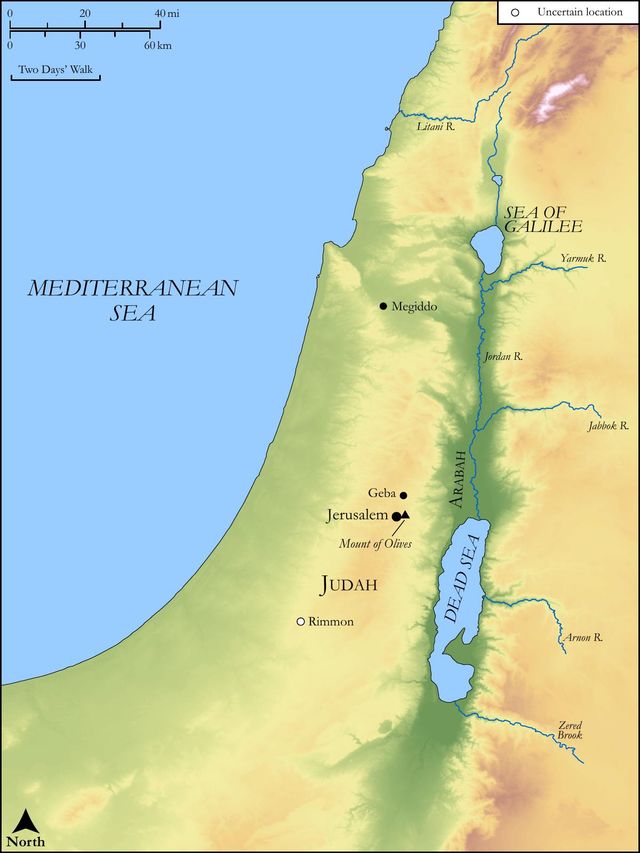
See on the biblical-era map
Study this verse
Public-domain commentary
Matthew Henry
From his Commentary on the Whole Bible. Henry comments on passages, not single verses — this entry covers Zechariah 13:7–9. His three-level outline is real structure in the source text, so it is rendered as structure.
Here is a prophecy,
I.Of the sufferings of Christ, of him who was to be pierced, and was to be the fountain opened.
Awake, O sword! against my Shepherd, Zac 13:7. These are the words of God the Father, giving order and commission to the sword of his justice to awake against his Son, when he had voluntarily made his soul an offering for sin; for it pleased the Lord to bruise him and put him to grief; and he was stricken, smitten of God, and afflicted, Isa 53:4, Isa 53:10. Observe,
1.How he calls him. "As God, he is my fellow;" for he thought it no robbery to be equal with God. He and the Father are one. He was from eternity by him, as one brought up with him, and, in the work of man's redemption, he was his elect, in whom his soul delighted, and the counsel of peace was between them both. "As Mediator, he is my Shepherd, that great and good Shepherd that undertook to feed the flock," Zac 11:7. He is the Shepherd that was to lay down his life for the sheep.
2.How he uses him: Awake, O sword! against him. If he will be a sacrifice, he must be slain, for without the shedding of blood, the life-blood, there was no remission. men thrust him through as the good Shepherd (compare Zac 13:3), that he might purchase the flock of God with his own blood, Act 20:28. It is not a charge given to a rod to correct him, but to a sword to slay him; for Messiah the prince must be cut off, but not for himself, Dan 9:26. It is not the sword of war that receives this charge, that he may die in the bed of honour, but the sword of justice, that he may die as a criminal, upon an ignominious tree. This sword must awake against him; he having no sin of his own to answer for, the sword of justice had nothing to say to him of itself, till, by particular order from the Judge of all, it was warranted to brandish itself against him. he was the Lamb slain from the foundation of the world, in the decree and counsel of God; but the sword designed against him had long slumbered, till now at length it is called upon to awake, not, "Awake, and smite him; strike home; not with a drowsy blow, but an awakened one;" for God spared not his own Son.
II.Of the dispersion of the disciples thereupon:
Smite the Shepherd, and the sheep shall be scattered. This our Lord Jesus himself declares to have been fulfilled when all his disciples were offended because of him in the night wherein he was betrayed, Mat 26:31; Mar 14:27. They all forsook him and fled. The smiting of the Shepherd is the scattering of the sheep. They were scattered every one to his own, and left him alone, Joh 16:32. Herein they were like timorous sheep; yet the Shepherd thus provided for their safety, for he said, If you seek me, let these go their way. Some make another application of this; Christ was the Shepherd of the Jewish nation; he was smitten; they themselves smote him, and therefore they were justly scattered abroad, and dispersed among the nations, and remain so at this day. These words, I will turn my hand upon the little ones, may be understood either as a threatening (as Christ suffered, so shall his disciples, they shall drink of the cup that he drank of and be baptized with the baptism that he was baptized with) or as a promise that God would gather Christ's scattered disciples together again, and he should give them the meeting in Galilee. Though the little ones among Christ's soldiers may be dispersed, they shall rally again; the lambs of his flock, though frightened by the beasts of prey, shall recover themselves, shall be gathered in his arms and laid in his bosom. Sometimes, when the sheep are scattered and lost in the wilderness, yet the little ones, which, it was feared, would be a prey (Num 14:31), are brought in, are brought home, and God turns his hand upon them.
III.Of the rejection and ruin of the unbelieving Jews (Zac 13:8); and this word has, and shall have, its accomplishment, in the destruction of the corrupt and hypocritical part of the church. It shall come to pass that in all the land of Israel two parts shall be cut off and die. The Roman army laid the country waste, and slew at least two-thirds of the Jews. Some understand by the cutting off, and dying, or two parts in all the earth, the abolishing of heathenism and Judaism, that Christianity, the third part, might be left to reign alone. The Jewish worship was quite taken away by the destruction of Jerusalem and the temple. And, some time after, Pagan idolatry was in a manner extirpated, when the empire became Christian.
IV.Of the reformation and preservation of the chosen remnant, those of them that believed, and the Christian church in general (Zac 13:9):
The third part shall be left. When Jerusalem and Judea were destroyed, all the Christians in that country, having among them the warning Christ gave them to flee to the mountains, shifted for their own safety, and were sheltered in a city called Pella, on the other side Jordan. We have here first the trials and then the triumphs of the Christian church, and of all the faithful members of it.
1.Their trials: I will bring that third part through the fire of affliction. and will refine and try them as silver and gold are refined and tried. This was fulfilled in the persecutions of the primitive church, the fiery trial which tried the people of God then, Pe1 4:12. Those whom God sets apart for himself must pass through a probation and purification in this world; they must be tried that their faith may be found to praise and honour (Pe1 1:6, Pe1 1:7), as Abraham's faith was when it was tried by the command given him to offer up Isaac, Now know I that thou fearest me. They must be tried, that both those that are perfect and those that are not may be made manifest. They must be refined from their dross; their corruption must be purged out; they must be brightened and bettered.
2.Their triumphs.
(1.)Their communion with God is their triumph: They shall call on my name, and I will hear them. They write to God by prayer, and receive from him answers of peace, and thus keep up a comfortable communion with him. This honour have all his saints.
(2.)Their covenant with God is their triumph: "I will say, It is my people, whom I have chosen and loved, and will own; and they shall say, the Lord is my God, and a God all-sufficient to me; and in me they shall boast every day and all the day long. This God is our God for ever and ever."
Historical interpretation
Two Centuries of Reception
2 surviving comments on this verse. Each one is dated, so this reads as a timeline rather than a list.
Select a marker to jump to its quote. Markers stagger vertically where authors wrote within a few decades of each other.
These cases occur in persecutions more than at other times (for it is then that we are approved or condemned, humbled or corrected). Their general occurrence is permitted or commanded by him at whose will they happen even partially; by him, I mean, who says, “I am he who makes peace and creates evil”—that is, war, for that is the antithesis of peace. But what other war has our peace than persecution? If in its issues persecution emphatically brings either life or death, either wounds or healing, you have the author too of this. “I will smite and heal, I will make alive and put to death.” “I will burn them,” he says, “as gold is burned; and I will try them,” he says, “as silver is tried,” for when the flame of persecution is consuming us, then the steadfastness of our faith is proved. These will be the fiery darts of the devil, by which faith gets a ministry of burning and kindling; yet by the will of God. As to this I do not know who can doubt, unless it be persons with frivolous and frigid faith, which seizes upon those who with trembling assemble together in the church. For you say, seeing we assemble without order, and assemble at the same time, and flock in large numbers to the church, the heathen are led to make inquiry about us, and we are alarmed lest we awaken their anxieties. Do you not know that God is Lord of all? And if it is God’s will, then you shall suffer persecution; but if it is not, the heathen will be still. Believe it most surely, if indeed you believe in that God without whose will not even the sparrow, which a penny can buy, falls to the ground. But we, I think, are better than many sparrows.
(Verse 7 and following) "I will raise up a spear against my shepherd, and against the man who is my associate," says the Lord of hosts. Strike the shepherd, and the sheep will be scattered, and I will turn my hand against the little ones. And they shall be in all the land, says the Lord, two parts in it shall be cut off and perish, and the third part shall be left. And I will bring the third part through the fire, and will refine them as silver is refined, and will test them as gold is tested. He will call my name, and I will answer him: I will say, 'You are my people,' and he will say, 'The Lord is my God.' Zechariah: Sword, rise against my shepherd, and against the man who is my associate, says the Lord Almighty. Strike the shepherd, and the sheep will be scattered; I will raise my hand against the shepherds. On that day, says the Lord, two-thirds will be cut off and perish, and one-third will be left. I will bring the one-third through the fire, and I will refine them as one refines silver, and I will test them as one tests gold. He himself will call upon my name, and I will answer him; I will say, 'This is my people,' and he will say, 'The Lord is my God.' Regarding the sword that the LXX translated as 'ῥομφαία' in Hebrew as 'Areb,' we found that Aquila and Symmachus translated it as 'μάχαιρα,' meaning sword or blade. And as for the phrase we translated as 'cohaerent mihi,' which means 'adhering to me,' Aquila interpreted it as 'contribulem meum,' meaning 'my fellow countryman,' and Symmachus translated it as 'populi mei,' meaning 'my people' in Hebrew 'Amithi.' The LXX translated it as 'civem ejus,' which means 'his fellow citizen,' and Theodotio translated it as 'proximum ejus,' meaning 'his neighbor.' At the end of the sentence, they read 'Jod' instead of 'Vau,' which are only different in size. If 'Jod' is read, it signifies 'my.' If 'Vau' is read, it signifies 'his.' But I marvel at certain individuals who wish to diminish this prophecy (which the evangelist Matthew related to the Lord and Savior after his disciples fled during his passion, and then he said it was fulfilled) with allegorical interpretations, and while they desire to appear to know more than others, they do not hold to the rule of truth. For the evangelist Matthew reports: Then Jesus said to them: all of you will be offended because of me this night. For it is written: I will strike the shepherd, and the sheep of the flock will be scattered. And again: All this has happened so that the Scriptures of the Prophets might be fulfilled. Then all the disciples, leaving him, fled (Matt. XXVI, 31 et seq.). Nor should it be thought that this testimony is taken from another place, because in the Gospel God says of himself that he is the shepherd who is struck, and in the present place, we read that it is commanded with sword and spear: Strike the shepherd, and the sheep will be scattered. This is a sword and this is a spear, and a javelin, from which in the twenty-first Psalm the Lord speaks to the Father: Deliver my soul from the sword; and my only one from the hand of the dog (Psalm 21:12). Of this javelin it is also written in the prophet Amos: They shall all die by the sword, the sinners of the land (Amos 9:10). Which cannot be taken literally: for many sinners perish in shipwreck, others by poison, these are suffocated by water, those consumed by fire. But with this sword and this spear, all sinners perish (or are punished), and the dark-skinned Ethiopians, of whom Zephaniah testifies with sacred mouth, saying: But you also, Ethiopians, will be killed by my sword (Zeph. 1:12). After the good shepherd who laid down his life for his sheep (John 10:15), who spoke to the Father: Those whom you struck, they pursued, and they added to the pain of my wounds (Ps. 68:27), he was struck by the will of the Father, and the man who is united with God who said: I am in the Father, and the Father is in me (John 13:10), hung on the gibbet, and said: Father, into your hands I commend my spirit (Luke 23:46): immediately the sheep were scattered, the whole multitude of believers in Christ. And the Lord stretched out his hand, as we read in the Septuagint, to the shepherds, whom many of the Jewish rulers interpret as evil. But as it is written in Hebrew, to the children, to whom the Lord said in the Gospel: Do not be afraid, little flock (Luke, XII). And in Isaiah: Behold, I and the children, or little ones, whom God has given me (Isaiah VIII, 18). And there were two parts in all the land of the Jews and the Gentiles, who perished and failed together: for in his suffering, the voice of the Psalmist is fulfilled, saying: Save me, O Lord, for the godly one is gone (Psalm XI, 1). And: All have turned aside; they have together become useless; there is none who does good, there is not even one (Ps. XIII, 3). As the nations and the Jews were perishing, the third part of the world, that is, the third people of the Christians, suddenly increased. And it says beautifully: A third part shall be left in it, that is, on the earth: because among the Jews and the nations, those who have confessed the Lord are alone reserved for the life and habitation of the earth. Moreover, the third part, so as not to be delicate and secure in confession, is tested as silver and gold are tested by fire, which the Lord desires to burn in believers (Luke 12), and which Paul desires to fervently burn (Romans 12). And so the apostles, baptized in the fire of the Spirit of the Lord (Acts 2), speak in the psalm: For you have tested us, O God, you have tried us as silver is tried (Psalm 65:10, 11). And after a little while: We passed through fire and water, and you led us into refreshment. And in another place it is said to the believer: If you pass through fire, the flame will not burn you: because I am with you (Isaiah 43:2). But the fire does not consume, and the flame does not devour, because it is the voice of the Lord who cuts off the flame of fire (Psalm 29:7). When these little ones have been tested in this way, upon whom the Lord has turned his hand, and through their calling the whole multitude of nations has believed, then the people of believers will call Christ by his name, and with him saying: You are my people, the people will respond: You are the Lord my God. The Jews refer these things to Christ: and they contend that they will happen in the last time; but the difference between us and them is that we say that they have already been fulfilled, while they mention things that are still to be fulfilled.
Continue studying Zechariah 13:9 across the web’s major study libraries — every link below opens this exact verse, chapter, or book on the destination site.
Read & Compare
 BibleGatewayThis verse in more than 200 translations and 70 languages.
 Bible.comThe YouVersion reader — hundreds of translations, reading plans, and highlights.
 ESV.orgCrossway's official English Standard Version reader.
 NET BibleThe NET translation with 60,000+ translators' notes on every rendering decision.
 STEP BibleTyndale House's free study tool — original text, vocabulary, and scholarly resources.
 BibliaLogos Bible Software's free web reader.
 USCCBThe New American Bible (Revised Edition) with the U.S. bishops' study notes.
Commentaries
 BibleHub CommentariesDozens of classic commentaries on this verse, gathered on one page.
 StudyLightMore than 100 commentary sets — the largest collection on the web.
 BibleRefPlain-English commentary on what this verse means, verse by verse.
 Enduring WordDavid Guzik's free commentary on this chapter, widely used by Bible teachers.
 Bible Study ToolsVerse commentary alongside Greek and Hebrew study aids.
Original Language & Research
- BibleHub InterlinearThe verse word by word — original language, transliteration, and English.
- BibleHub LexiconEvery word's original-language definition and Strong's entry.
 Blue Letter BibleDeep-study tools — Strong's numbers, concordance, and word studies.
 SefariaThe Hebrew text with Rashi and centuries of Jewish commentary.
Sermons, Hymns & Audio


TrulyRandomVerse is not affiliated with these sites and doesn’t control their content. They’re linked because they’re genuinely useful.
Summary
Zechariah 13:9 powerfully depicts God's sovereign plan for the purification and restoration of a remnant of His people. Following a period of severe judgment where two-thirds are cut off, the remaining "third part" will undergo an intense, divinely orchestrated refining process, likened to the purification of silver and gold by fire. This tribulation is not for destruction but for sanctification, leading to a renewed and intimate covenant relationship where they genuinely call upon God, He hears them, and both parties affirm their profound bond: "It is my people," and "The LORD is my God."
Context
ShowHideLiterary Context
Zechariah 13:9 is situated within the latter half of the book of Zechariah (chapters 9-14), which shifts from immediate post-exilic concerns to a grander eschatological vision. This section is highly prophetic, addressing future events related to the Messiah's first and second comings, global conflicts, and the ultimate establishment of God's kingdom. Specifically, chapter 13 focuses on the purification of the land from idolatry and false prophecy, leading to a severe but redemptive judgment upon the nation. Verse 8 immediately precedes verse 9, declaring that "two parts therein shall be cut off and die; but the third shall be left therein." This sets the stage for the refining of the surviving remnant in verse 9, emphasizing that the judgment is selective and purposeful, leading to a purified people. The preceding verses also speak of the removal of false prophets and unclean spirits, indicating a comprehensive spiritual cleansing.
Historical & Cultural Context
Zechariah prophesied to the Jewish community that had returned from Babylonian exile, a people still struggling with spiritual apathy, incomplete temple rebuilding, and internal corruption. The imagery of refining metals was deeply familiar in Israel, where metallurgy was a common and vital craft. Silver and gold were refined by intense heat to separate precious metal from dross and impurities, a process requiring skill, patience, and precise temperature control. This cultural understanding made the metaphor immediately graspable: God, like a skilled refiner, would subject His people to intense heat (tribulation, suffering, judgment) not to destroy them, but to purge their spiritual impurities, idolatry, and unfaithfulness, making them pure and fit for His purposes. This process was understood as a necessary, though painful, step towards covenant faithfulness and national restoration.
Key Themes
ShowHideZechariah 13:9 encapsulates several profound themes central to the book and broader biblical theology. The primary theme is Divine Purification through Tribulation, illustrating God's active and intentional role in sanctifying His people through hardship, much like a refiner purifies precious metals. This connects to the idea of The Remnant, a consistent biblical concept (e.g., Isaiah 10:20-22) where, despite widespread apostasy and judgment, God preserves a faithful portion of His people. The verse also highlights Covenant Reaffirmation, culminating in the beautiful reciprocal declaration "It is my people: and they shall say, The LORD is my God," which echoes foundational covenant language found in passages like Exodus 6:7 and Jeremiah 30:22. Finally, the theme of Prayer and Divine Response is prominent, as the purified remnant calls on God's name, and He hears them, signifying a restored, intimate communion.
Exposition and Analysis
ShowHideKey Word Analysis
ShowHideThis primitive root means "to fuse (metal), i.e. refine (literally or figuratively); cast, (re-) fine(-er), founder, goldsmith, melt, pure, purge away, try." In Zechariah 13:9, it vividly portrays an intense process involving heat, designed to remove impurities and achieve purity. It emphasizes God's active, intentional, and thorough work of cleansing His people.
This primitive root means "to test (especially metals); generally and figuratively, to investigate; examine, prove, tempt, try (trial)." This word complements "refine" by adding the nuance of examination and proving. It suggests that God's refining process is not merely a purging but also a testing of the genuineness and strength of faith, revealing what is true and enduring.
This word refers to "a people (as a congregated unit); specifically, a tribe (as those of Israel); hence (collectively) troops or attendants; figuratively, a flock." In this context, it signifies God's chosen community, Israel, and by extension, all who are brought into covenant relationship with Him. The declaration "It is my people" underscores the restoration of a unique, intimate, and possessive bond between God and the purified remnant.
Verse Breakdown
ShowHide"And I will bring the third part through the fire,"
This clause introduces the divine agent ("I will bring") and the object of the action ("the third part"), which refers to the remnant surviving the preceding judgment (Zechariah 13:8). The "fire" is a metaphor for intense tribulation, suffering, and judgment that God orchestrates. It signifies a severe, painful, but ultimately purposeful experience designed to purify rather than destroy.
"and will refine them as silver is refined, and will try them as gold is tried:"
This segment elaborates on the purpose and nature of the "fire." Using a simile, it compares the divine process to the metallurgical refining of precious metals. Just as silver and gold are subjected to intense heat to burn away dross and impurities, so God will put His people through trials to purge their sin, idolatry, and unfaithfulness. The repetition of "refine" and "try" emphasizes the thoroughness and deliberateness of this purifying work.
"they shall call on my name, and I will hear them:"
This marks a pivotal shift to the outcome of the refining process. The purified remnant, having endured tribulation, will turn to God in genuine prayer and dependence. The promise "I will hear them" signifies God's responsive and attentive presence, indicating a restored and intimate communion between God and His people, a direct result of their purification.
"I will say, It is my people:"
This is God's affirmative declaration, a profound statement of renewed covenant ownership and affection. It signifies that the refining process has successfully produced a people truly consecrated to Him, whom He recognizes and claims as His own. This echoes foundational covenant language, reaffirming His faithfulness despite their past unfaithfulness.
"and they shall say, The LORD is my God."
This final clause completes the reciprocal covenant affirmation. The purified remnant, having experienced God's refining work and responsive presence, will wholeheartedly acknowledge Him as their sovereign God. This mutual declaration signifies a restored, deep, and authentic relationship, marked by allegiance, worship, and trust.
Literary Devices
ShowHideZechariah 13:9 is rich in literary devices that enhance its prophetic message. The most prominent is the Simile of metal refining ("as silver is refined, and will try them as gold is tried"). This imagery vividly conveys the intensity, purpose, and outcome of God's purifying work. The "fire" itself functions as a powerful Metaphor for severe tribulation and divine judgment. The verse also employs Parallelism in the refining clauses ("refine them as silver is refined, and will try them as gold is tried"), which emphasizes the thoroughness and deliberate nature of the process. Finally, the culminating covenant formula ("I will say, It is my people: and they shall say, The LORD is my God") is a classic example of Covenant Language, demonstrating a restored and reciprocal relationship between God and His purified remnant, found throughout the Old Testament.
Theological and Thematic Connections
ShowHideZechariah 13:9 profoundly illustrates God's unwavering commitment to the holiness of His people and the restoration of His covenant. It reveals that suffering and tribulation are not always punitive but can be divinely appointed means of sanctification, purging impurities and deepening faith. This refining process leads to a renewed, intimate relationship where genuine prayer is offered and graciously received, culminating in the mutual affirmation of God's ownership and the people's allegiance. This theological truth underscores God's sovereignty over all circumstances, using even the most difficult to achieve His redemptive purposes and draw His people into closer communion with Himself.
Reflection and Application
ShowHideZechariah 13:9 offers a profound spiritual lens through which to view life's challenges. It teaches us that God, in His infinite wisdom and love, often uses difficult circumstances, trials, and even suffering as instruments of spiritual growth and purification, rather than solely as punishment. When we face hardships, this verse encourages us to shift our perspective from despair to divine purpose, trusting that God is actively working to remove our spiritual dross, strengthen our faith, and draw us into a deeper, more authentic relationship with Him. This refining fire, though painful, is ultimately redemptive, leading to a state where our prayers are heard, and we truly acknowledge Him as our God, just as He unequivocally claims us as His own. It calls us to persevere with hope, knowing that the ultimate outcome of God's refining work is a purer, more intimate communion with the Lord.
Questions for Reflection
ShowHideFAQ
ShowHideWhat is the "third part" being referred to in Zechariah 13:9?
ShowHideThe "third part" refers to a faithful remnant of God's people who survive a severe judgment described in the preceding verse, Zechariah 13:8. This judgment indicates that "two parts therein shall be cut off and die," implying a widespread sifting or testing. The "third part" is the divinely preserved and purified minority that endures the tribulation and is brought into a renewed covenant relationship with God. This concept of a remnant is a recurring theme throughout biblical prophecy, signifying God's faithfulness to His promises even amidst widespread apostasy.
How does God "refine" and "try" His people today?
ShowHideGod continues to "refine" and "try" His people today not through literal fire, but through various forms of trials, difficulties, and spiritual discipline. These can include personal suffering, financial hardship, relational conflicts, persecution for righteousness' sake, or even the internal struggles against sin. Just as a refiner uses heat to remove impurities from metal, God uses these experiences to expose and purge sin, strengthen faith, develop perseverance, and conform believers to the image of Christ. As Romans 5:3-4 states, "suffering produces perseverance; perseverance, character; and character, hope." The goal is always purification and a deeper, more genuine relationship with Him, as seen in Hebrews 12:10-11.
Christ-Centered Fulfillment
ShowHideZechariah 13:9 finds its ultimate and most profound fulfillment in Jesus Christ and His work. He is the ultimate Refiner, the one who came "like a refiner's fire" to purify His people, as prophesied in Malachi 3:2-3. The "fire" of judgment and purification described in Zechariah points forward to the cross, where Christ Himself endured the ultimate refining fire of God's wrath against sin, becoming the spotless Lamb of God who takes away the sin of the world. Through His atoning sacrifice, He purifies a "third part"—a remnant, indeed, all who believe—cleansing them by His blood and the power of the Holy Spirit. The covenant promise, "I will say, It is my people: and they shall say, The LORD is my God," is perfectly realized in the New Covenant established through Christ's blood (Luke 22:20). Through Him, believers are adopted into God's family, becoming His people, a "chosen generation, a royal priesthood, a holy nation" (1 Peter 2:9-10). The trials and sufferings believers face are now understood as part of God's loving discipline, intended to refine their faith, making them more like Christ (Hebrews 12:5-11), ultimately leading to the full and eternal communion with God through their Lord and Savior, Jesus Christ.