


Zechariah 13:8
Bible text: King James Version (1769 Blayney text) · Public domain
Bible text: Berean Standard Bible · Public domain
Bible text: American Standard Version (1901) · Public domain
Bible text: World English Bible, Messianic edition · Public domain
Bible text: Geneva Bible (1599) · Public domain
Bible text: Young's Literal Translation · Public domain
- וְהָיָהve·ha·Yahand it will beH1961Conj-w ¦ V-Qal-ConsecPerf-3msVerb Qal Consecutive Perfect 3rd Singular Masculineוְandהָיָהit will be
- בְכָלve·kholin allH3605Prep-b ¦ N-mscNoun Singular Masculine Constructבְinכָלall
- הָאָרֶץha·'A·retzthe landH776Art ¦ N-fsNoun Singular Feminine Absoluteהָtheאָרֶץland
- נְאֻםne·'um[the] utterance ofH5002N-mscNoun Singular Masculine Construct
- יְהוָהYah·wehYahwehH3068N-properNoun Proper Title
- פִּיpia mouth ofH6310N-mscNoun Singular Masculine Construct
- שְׁנַיִםshe·Na·yimtwoH8147N-cdNoun Dual common gender Absolute
- בָּהּBahin itPrep-b ¦ 3fsSuffix Personal 3rd Singular Feminineבָּinהּit
- יִכָּרְתוּyi·ka·re·Tuthey will be cut offH3772V-Niphal-Imperf-3mpVerb Niphal Imperfect 3rd Plural Masculine
- יִגְוָעוּyig·Va·'uthey will perishH1478V-Qal-Imperf-3mpVerb Qal Imperfect 3rd Plural Masculine
- וְהַשְּׁלִשִׁיתve·ha·she·li·Shitand the third [part]H7992Conj-w ¦ Art ¦ Adj-fsAdjective Numerical Position Singular Feminine Absoluteוְandהַtheשְּׁלִשִׁיתthird [part]
- יִוָּתֶרyi·Va·terit will be leftH3498V-Niphal-Imperf-3msVerb Niphal Imperfect 3rd Singular Masculine
- בָּהּBahin itPrep-b ¦ 3fsSuffix Personal 3rd Singular Feminineבָּinהּit
English is a literal word-by-word gloss of the Hebrew, not the KJV's wording. Why?
This is the original text the KJV's translators worked from — each Hebrew word with its own literal English meaning in this verse, prepared by scholars at Tyndale House, Cambridge. The KJV translates whole sentences, not word by word, so its wording differs: one Hebrew word can become several English words, and the KJV may choose “the LORD” where the gloss reads “Yahweh”. Both are faithful — they answer different questions. For the KJV's own rendering, switch to the KJV text.
Details
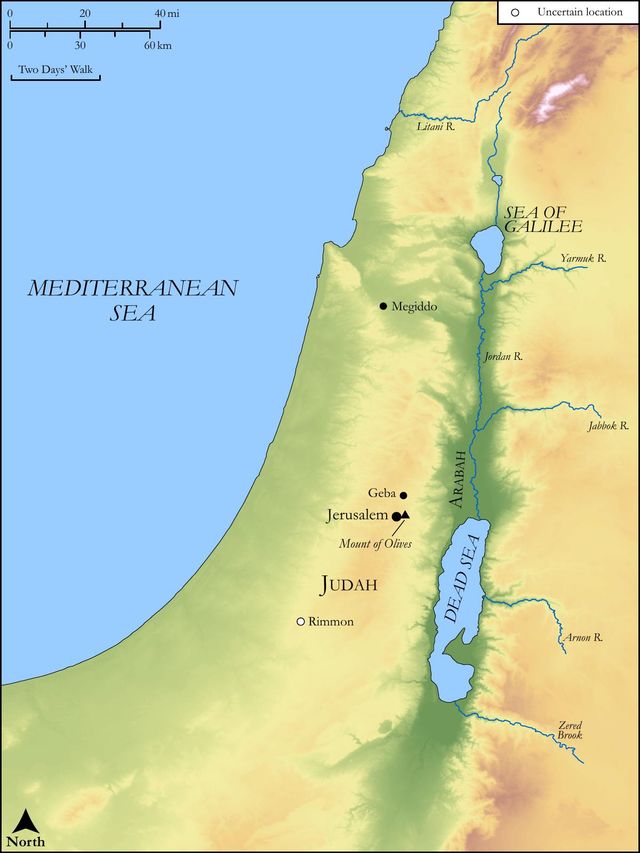
See on the biblical-era map
Study this verse
Public-domain commentary
Matthew Henry
From his Commentary on the Whole Bible. Henry comments on passages, not single verses — this entry covers Zechariah 13:7–9. His three-level outline is real structure in the source text, so it is rendered as structure.
Here is a prophecy,
I.Of the sufferings of Christ, of him who was to be pierced, and was to be the fountain opened.
Awake, O sword! against my Shepherd, Zac 13:7. These are the words of God the Father, giving order and commission to the sword of his justice to awake against his Son, when he had voluntarily made his soul an offering for sin; for it pleased the Lord to bruise him and put him to grief; and he was stricken, smitten of God, and afflicted, Isa 53:4, Isa 53:10. Observe,
1.How he calls him. "As God, he is my fellow;" for he thought it no robbery to be equal with God. He and the Father are one. He was from eternity by him, as one brought up with him, and, in the work of man's redemption, he was his elect, in whom his soul delighted, and the counsel of peace was between them both. "As Mediator, he is my Shepherd, that great and good Shepherd that undertook to feed the flock," Zac 11:7. He is the Shepherd that was to lay down his life for the sheep.
2.How he uses him: Awake, O sword! against him. If he will be a sacrifice, he must be slain, for without the shedding of blood, the life-blood, there was no remission. men thrust him through as the good Shepherd (compare Zac 13:3), that he might purchase the flock of God with his own blood, Act 20:28. It is not a charge given to a rod to correct him, but to a sword to slay him; for Messiah the prince must be cut off, but not for himself, Dan 9:26. It is not the sword of war that receives this charge, that he may die in the bed of honour, but the sword of justice, that he may die as a criminal, upon an ignominious tree. This sword must awake against him; he having no sin of his own to answer for, the sword of justice had nothing to say to him of itself, till, by particular order from the Judge of all, it was warranted to brandish itself against him. he was the Lamb slain from the foundation of the world, in the decree and counsel of God; but the sword designed against him had long slumbered, till now at length it is called upon to awake, not, "Awake, and smite him; strike home; not with a drowsy blow, but an awakened one;" for God spared not his own Son.
II.Of the dispersion of the disciples thereupon:
Smite the Shepherd, and the sheep shall be scattered. This our Lord Jesus himself declares to have been fulfilled when all his disciples were offended because of him in the night wherein he was betrayed, Mat 26:31; Mar 14:27. They all forsook him and fled. The smiting of the Shepherd is the scattering of the sheep. They were scattered every one to his own, and left him alone, Joh 16:32. Herein they were like timorous sheep; yet the Shepherd thus provided for their safety, for he said, If you seek me, let these go their way. Some make another application of this; Christ was the Shepherd of the Jewish nation; he was smitten; they themselves smote him, and therefore they were justly scattered abroad, and dispersed among the nations, and remain so at this day. These words, I will turn my hand upon the little ones, may be understood either as a threatening (as Christ suffered, so shall his disciples, they shall drink of the cup that he drank of and be baptized with the baptism that he was baptized with) or as a promise that God would gather Christ's scattered disciples together again, and he should give them the meeting in Galilee. Though the little ones among Christ's soldiers may be dispersed, they shall rally again; the lambs of his flock, though frightened by the beasts of prey, shall recover themselves, shall be gathered in his arms and laid in his bosom. Sometimes, when the sheep are scattered and lost in the wilderness, yet the little ones, which, it was feared, would be a prey (Num 14:31), are brought in, are brought home, and God turns his hand upon them.
III.Of the rejection and ruin of the unbelieving Jews (Zac 13:8); and this word has, and shall have, its accomplishment, in the destruction of the corrupt and hypocritical part of the church. It shall come to pass that in all the land of Israel two parts shall be cut off and die. The Roman army laid the country waste, and slew at least two-thirds of the Jews. Some understand by the cutting off, and dying, or two parts in all the earth, the abolishing of heathenism and Judaism, that Christianity, the third part, might be left to reign alone. The Jewish worship was quite taken away by the destruction of Jerusalem and the temple. And, some time after, Pagan idolatry was in a manner extirpated, when the empire became Christian.
IV.Of the reformation and preservation of the chosen remnant, those of them that believed, and the Christian church in general (Zac 13:9):
The third part shall be left. When Jerusalem and Judea were destroyed, all the Christians in that country, having among them the warning Christ gave them to flee to the mountains, shifted for their own safety, and were sheltered in a city called Pella, on the other side Jordan. We have here first the trials and then the triumphs of the Christian church, and of all the faithful members of it.
1.Their trials: I will bring that third part through the fire of affliction. and will refine and try them as silver and gold are refined and tried. This was fulfilled in the persecutions of the primitive church, the fiery trial which tried the people of God then, Pe1 4:12. Those whom God sets apart for himself must pass through a probation and purification in this world; they must be tried that their faith may be found to praise and honour (Pe1 1:6, Pe1 1:7), as Abraham's faith was when it was tried by the command given him to offer up Isaac, Now know I that thou fearest me. They must be tried, that both those that are perfect and those that are not may be made manifest. They must be refined from their dross; their corruption must be purged out; they must be brightened and bettered.
2.Their triumphs.
(1.)Their communion with God is their triumph: They shall call on my name, and I will hear them. They write to God by prayer, and receive from him answers of peace, and thus keep up a comfortable communion with him. This honour have all his saints.
(2.)Their covenant with God is their triumph: "I will say, It is my people, whom I have chosen and loved, and will own; and they shall say, the Lord is my God, and a God all-sufficient to me; and in me they shall boast every day and all the day long. This God is our God for ever and ever."
Historical interpretation
Historical reception
1 surviving comment on this verse from the historical church.
(Verse 7 and following) "I will raise up a spear against my shepherd, and against the man who is my associate," says the Lord of hosts. Strike the shepherd, and the sheep will be scattered, and I will turn my hand against the little ones. And they shall be in all the land, says the Lord, two parts in it shall be cut off and perish, and the third part shall be left. And I will bring the third part through the fire, and will refine them as silver is refined, and will test them as gold is tested. He will call my name, and I will answer him: I will say, 'You are my people,' and he will say, 'The Lord is my God.' Zechariah: Sword, rise against my shepherd, and against the man who is my associate, says the Lord Almighty. Strike the shepherd, and the sheep will be scattered; I will raise my hand against the shepherds. On that day, says the Lord, two-thirds will be cut off and perish, and one-third will be left. I will bring the one-third through the fire, and I will refine them as one refines silver, and I will test them as one tests gold. He himself will call upon my name, and I will answer him; I will say, 'This is my people,' and he will say, 'The Lord is my God.' Regarding the sword that the LXX translated as 'ῥομφαία' in Hebrew as 'Areb,' we found that Aquila and Symmachus translated it as 'μάχαιρα,' meaning sword or blade. And as for the phrase we translated as 'cohaerent mihi,' which means 'adhering to me,' Aquila interpreted it as 'contribulem meum,' meaning 'my fellow countryman,' and Symmachus translated it as 'populi mei,' meaning 'my people' in Hebrew 'Amithi.' The LXX translated it as 'civem ejus,' which means 'his fellow citizen,' and Theodotio translated it as 'proximum ejus,' meaning 'his neighbor.' At the end of the sentence, they read 'Jod' instead of 'Vau,' which are only different in size. If 'Jod' is read, it signifies 'my.' If 'Vau' is read, it signifies 'his.' But I marvel at certain individuals who wish to diminish this prophecy (which the evangelist Matthew related to the Lord and Savior after his disciples fled during his passion, and then he said it was fulfilled) with allegorical interpretations, and while they desire to appear to know more than others, they do not hold to the rule of truth. For the evangelist Matthew reports: Then Jesus said to them: all of you will be offended because of me this night. For it is written: I will strike the shepherd, and the sheep of the flock will be scattered. And again: All this has happened so that the Scriptures of the Prophets might be fulfilled. Then all the disciples, leaving him, fled (Matt. XXVI, 31 et seq.). Nor should it be thought that this testimony is taken from another place, because in the Gospel God says of himself that he is the shepherd who is struck, and in the present place, we read that it is commanded with sword and spear: Strike the shepherd, and the sheep will be scattered. This is a sword and this is a spear, and a javelin, from which in the twenty-first Psalm the Lord speaks to the Father: Deliver my soul from the sword; and my only one from the hand of the dog (Psalm 21:12). Of this javelin it is also written in the prophet Amos: They shall all die by the sword, the sinners of the land (Amos 9:10). Which cannot be taken literally: for many sinners perish in shipwreck, others by poison, these are suffocated by water, those consumed by fire. But with this sword and this spear, all sinners perish (or are punished), and the dark-skinned Ethiopians, of whom Zephaniah testifies with sacred mouth, saying: But you also, Ethiopians, will be killed by my sword (Zeph. 1:12). After the good shepherd who laid down his life for his sheep (John 10:15), who spoke to the Father: Those whom you struck, they pursued, and they added to the pain of my wounds (Ps. 68:27), he was struck by the will of the Father, and the man who is united with God who said: I am in the Father, and the Father is in me (John 13:10), hung on the gibbet, and said: Father, into your hands I commend my spirit (Luke 23:46): immediately the sheep were scattered, the whole multitude of believers in Christ. And the Lord stretched out his hand, as we read in the Septuagint, to the shepherds, whom many of the Jewish rulers interpret as evil. But as it is written in Hebrew, to the children, to whom the Lord said in the Gospel: Do not be afraid, little flock (Luke, XII). And in Isaiah: Behold, I and the children, or little ones, whom God has given me (Isaiah VIII, 18). And there were two parts in all the land of the Jews and the Gentiles, who perished and failed together: for in his suffering, the voice of the Psalmist is fulfilled, saying: Save me, O Lord, for the godly one is gone (Psalm XI, 1). And: All have turned aside; they have together become useless; there is none who does good, there is not even one (Ps. XIII, 3). As the nations and the Jews were perishing, the third part of the world, that is, the third people of the Christians, suddenly increased. And it says beautifully: A third part shall be left in it, that is, on the earth: because among the Jews and the nations, those who have confessed the Lord are alone reserved for the life and habitation of the earth. Moreover, the third part, so as not to be delicate and secure in confession, is tested as silver and gold are tested by fire, which the Lord desires to burn in believers (Luke 12), and which Paul desires to fervently burn (Romans 12). And so the apostles, baptized in the fire of the Spirit of the Lord (Acts 2), speak in the psalm: For you have tested us, O God, you have tried us as silver is tried (Psalm 65:10, 11). And after a little while: We passed through fire and water, and you led us into refreshment. And in another place it is said to the believer: If you pass through fire, the flame will not burn you: because I am with you (Isaiah 43:2). But the fire does not consume, and the flame does not devour, because it is the voice of the Lord who cuts off the flame of fire (Psalm 29:7). When these little ones have been tested in this way, upon whom the Lord has turned his hand, and through their calling the whole multitude of nations has believed, then the people of believers will call Christ by his name, and with him saying: You are my people, the people will respond: You are the Lord my God. The Jews refer these things to Christ: and they contend that they will happen in the last time; but the difference between us and them is that we say that they have already been fulfilled, while they mention things that are still to be fulfilled.
Continue studying Zechariah 13:8 across the web’s major study libraries — every link below opens this exact verse, chapter, or book on the destination site.
Read & Compare
 BibleGatewayThis verse in more than 200 translations and 70 languages.
 Bible.comThe YouVersion reader — hundreds of translations, reading plans, and highlights.
 ESV.orgCrossway's official English Standard Version reader.
 NET BibleThe NET translation with 60,000+ translators' notes on every rendering decision.
 STEP BibleTyndale House's free study tool — original text, vocabulary, and scholarly resources.
 BibliaLogos Bible Software's free web reader.
 USCCBThe New American Bible (Revised Edition) with the U.S. bishops' study notes.
Commentaries
 BibleHub CommentariesDozens of classic commentaries on this verse, gathered on one page.
 StudyLightMore than 100 commentary sets — the largest collection on the web.
 BibleRefPlain-English commentary on what this verse means, verse by verse.
 Enduring WordDavid Guzik's free commentary on this chapter, widely used by Bible teachers.
 Bible Study ToolsVerse commentary alongside Greek and Hebrew study aids.
Original Language & Research
- BibleHub InterlinearThe verse word by word — original language, transliteration, and English.
- BibleHub LexiconEvery word's original-language definition and Strong's entry.
 Blue Letter BibleDeep-study tools — Strong's numbers, concordance, and word studies.
 SefariaThe Hebrew text with Rashi and centuries of Jewish commentary.
Sermons, Hymns & Audio


TrulyRandomVerse is not affiliated with these sites and doesn’t control their content. They’re linked because they’re genuinely useful.
Summary
Zechariah 13:8 delivers a powerful prophetic declaration from the LORD, foretelling a severe and widespread judgment upon "all the land" of Israel. This divine pronouncement reveals that two-thirds of the population will be "cut off and die" as a consequence of this intense purification, while a faithful "third" will be preserved, destined to endure the trial and emerge as a refined remnant. The verse underscores God's sovereign hand in both judgment and preservation, setting the stage for the subsequent spiritual cleansing and restoration described in the concluding verses of the chapter.
Context
ShowHideLiterary Context
Zechariah 13:8 stands as a pivotal verse within a broader prophetic section (chapters 12-14) that shifts from the Messiah's first coming and rejection (as hinted in Zechariah 9:9 and Zechariah 11:12-13) to themes of national repentance, purification, and eschatological judgment and salvation. The preceding verses in Zechariah 13:1-6 detail a future fountain opened for sin and impurity, alongside the removal of false prophets and idolatry from the land. This radical spiritual purging, initiated by God, leads directly into the severe culling described in verse 8, which then flows into the refining fire imagery of Zechariah 13:9, where the surviving remnant is tested and purified. The verse thus serves as a grim but necessary transition, illustrating the cost of purification before the promise of restoration.
Historical & Cultural Context
Zechariah prophesied to the post-exilic community, a people who had returned from Babylonian captivity but were struggling with spiritual apathy, unfaithfulness, and the rebuilding of their temple and national identity. The concept of divine judgment and the preservation of a remnant was deeply ingrained in Israelite history and prophetic tradition, seen in events like the Flood, the Exodus, and the Babylonian Exile itself. The "land" (H776, ʼerets) typically refers to the land of Israel, emphasizing that this judgment is specifically directed at God's covenant people. The severity of the judgment—two-thirds cut off—would have resonated with historical periods of national devastation, such as the Assyrian and Babylonian invasions, but here it points to an even more intense, divinely orchestrated purification that transcends mere military defeat.
Key Themes
ShowHideThis verse powerfully contributes to several overarching themes within Zechariah and the broader prophetic corpus. Foremost is the theme of Divine Judgment and Purification, where God actively intervenes to purge sin and unfaithfulness from His people, even if it means severe loss. This is not arbitrary destruction but a purposeful act of cleansing. Closely related is the theme of The Remnant, a recurring biblical motif (e.g., Isaiah 10:20-22, Romans 9:27) where God preserves a faithful minority through periods of intense trial, ensuring the continuity of His covenant promises. Finally, the verse speaks to Suffering as Refinement, implying that the hardship endured by the surviving third is a crucible designed to purify and strengthen their faith, preparing them for a renewed relationship with God, much like a refiner's fire purifies precious metals, as seen in Malachi 3:2-3.
Exposition and Analysis
ShowHideKey Word Analysis
ShowHideFrom an unused root probably meaning to be firm; the earth (at large, or partitively a land); [idiom] common, country, earth, field, ground, land, [idiom] natins, way, [phrase] wilderness, world. Here, "all the land" (כָּל־הָאָרֶץ) specifically refers to the entire territory of Israel, signifying a comprehensive and inescapable judgment that will affect the entire nation, not just a localized region.
A primitive root; to cut (off, down or asunder); by implication, to destroy or consume; specifically, to covenant (i.e., make an alliance or bargain, originally by cutting flesh and passing between the pieces); be chewed, be con-(feder-) ate, covenant, cut (down, off), destroy, fail, feller, be freed, hew (down), make a league (covenant), [idiom] lose, perish, [idiom] utterly, [idiom] want. In this context, "cut off" (נִכְרְתוּ, nikrethu) indicates a decisive and severe termination, an excision from the community through death, highlighting the finality of this divine judgment for the unfaithful.
A primitive root; to breathe out, i.e., (by implication) expire; die, be dead, give up the ghost, perish. This word emphasizes the literal physical death that will befall the two-thirds, underscoring the severity and corporeal reality of the judgment. It signifies the complete cessation of life for those who are "cut off."
A primitive root; to jut over or exceed; by implication, to excel; (intransitively) to remain or be left; causatively, to leave, cause to abound, preserve; excel, leave (a remnant), left behind, too much, make plenteous, preserve, (be, let) remain(-der, -ing, -nant), reserve, residue, rest. The term "left" (וְנִשְׁאֲרָה, wenish'arah) is crucial, directly pointing to the concept of a "remnant." It signifies that despite the overwhelming destruction, God sovereignly preserves a portion, ensuring the continuation of His purposes through a purified people.
Verse Breakdown
ShowHide"And it shall come to pass, that in all the land,"
This opening phrase serves as a prophetic declaration, signaling a future event of significant magnitude. "In all the land" (בְּכָל־הָאָרֶץ) emphasizes the comprehensive scope of this judgment, indicating that no part of the nation of Israel will be untouched by this divine action. It speaks to a national, rather than localized, experience.
"saith the LORD,"
This authoritative interjection (נְאֻם־יְהוָה, ne'um-YHWH) authenticates the prophecy as a direct, unalterable word from God Himself. It underscores the divine origin and certainty of the impending events, removing any doubt about the source or the inevitability of the judgment. The LORD (YHWH) is the sovereign initiator and executor of this decree.
"two parts therein shall be cut off and die;"
This is the core of the judgment. The numerical precision ("two parts" or two-thirds) highlights the specific and deliberate nature of God's action. This large proportion of the population will be "cut off" (exterminated or removed) and "die" (physically perish), signifying a severe and devastating culling of the unfaithful or unpurified elements within Israel.
"but the third shall be left therein."
In stark contrast to the preceding clause, this phrase introduces the element of divine preservation and hope. Despite the widespread destruction, a "third" (הַשְּׁלִשִׁית, hashshelishit) of the population will be "left" (preserved or remain). This surviving portion represents the faithful remnant whom God sovereignly protects and purifies through the ordeal, ensuring the continuity of His covenant people.
Literary Devices
ShowHideZechariah 13:8 employs several potent literary devices to convey its message. The most prominent is Numerical Symbolism, where the precise fractions "two parts" (two-thirds) and "the third" are not merely statistical but carry symbolic weight, emphasizing the deliberate and divinely ordained nature of the judgment and the preservation of the remnant. This precision contrasts with the general language often used for widespread disaster, highlighting God's sovereign control over the outcome. There is also a strong element of Contrast or Antithesis, juxtaposing the fate of the majority ("cut off and die") with that of the minority ("shall be left"), which powerfully underscores the distinction between the judged and the preserved. The phrase "saith the LORD" functions as a Prophetic Oracle Formula, lending divine authority and certainty to the declaration. Finally, the imagery of being "cut off and die" evokes a sense of Excision or Purging, akin to pruning a vine or refining metal, which is a recurring metaphor for divine judgment and purification in prophetic literature.
Theological and Thematic Connections
ShowHideZechariah 13:8 profoundly illustrates God's unwavering commitment to the purity of His covenant people, even if it necessitates severe judgment. It reveals a God who is both just in His wrath against sin and merciful in His preservation of a faithful remnant. This divine pattern, where a significant portion is removed for unfaithfulness while a smaller, purified group endures, speaks to the ongoing process of sanctification and the ultimate triumph of God's redemptive plan. The verse foreshadows a future time when God will definitively cleanse His people, preparing them for His presence and blessing, a theme that resonates throughout biblical eschatology.
Reflection and Application
ShowHideZechariah 13:8, while a stark prophecy of judgment, offers profound insights for believers today. It reminds us that God is actively involved in the purification of His people, whether individually or corporately. We are called to recognize that trials and periods of intense suffering, though painful, can be instruments of divine refinement, purging impurities and strengthening our faith. This verse encourages us to examine our own lives for areas of unfaithfulness or compromise, knowing that God desires our holiness. Furthermore, it instills hope: even in the midst of overwhelming challenges or widespread spiritual decline, God always preserves a remnant. Our call is to strive to be part of that faithful minority, enduring through perseverance and trusting in God's ultimate plan of redemption and restoration. This understanding fosters resilience and a deeper reliance on God's sovereign hand, even when His methods are severe.
Questions for Reflection
ShowHideFAQ
ShowHideIs the "two parts" and "third" a literal prophecy, or symbolic?
ShowHideWhile prophetic numbers can sometimes be symbolic, the stark precision of "two parts" (two-thirds) and "the third" in Zechariah 13:8 is generally understood by scholars to indicate a literal and severe culling. This is not merely a vague statement of widespread destruction but a divinely ordained proportion of the population that will perish, while a specific minority will be preserved. The context of Zechariah 13-14 points to a future, intense period of tribulation and purification for Israel, which will involve significant loss of life, preparing the way for the ultimate Messianic kingdom. This literal interpretation underscores the severity and certainty of God's judgment and the miraculous nature of the remnant's preservation.
Who is "the land" referring to in this prophecy?
ShowHideIn the context of Zechariah, "the land" (הָאָרֶץ, ha'aretz) almost unequivocally refers to the land of Israel and its inhabitants. Zechariah's prophecies are primarily directed towards the post-exilic Jewish community and their future. Therefore, the judgment described in Zechariah 13:8 is specifically aimed at the people of Israel, indicating a national purification that will affect the entire nation within their historical homeland. This is consistent with the broader prophetic tradition where God's covenant dealings, both blessings and judgments, are often tied to the physical land of Israel and its people.
Christ-Centered Fulfillment
ShowHideZechariah 13:8, with its stark imagery of judgment and the preservation of a remnant, finds its ultimate Christ-centered fulfillment in the person and work of Jesus Christ. While the immediate context points to a future purification of Israel, the principle of divine judgment against sin and the preservation of a faithful few is profoundly realized through the cross. Jesus himself became the one "cut off" (Isaiah 53:8) for the sins of the world, bearing the judgment that humanity deserved. His death and resurrection establish the new covenant, where purification from sin is offered not through a physical culling, but through faith in His atoning sacrifice (Hebrews 9:22). The "third" that is "left" in Zechariah can be seen as foreshadowing the true Israel, the church, composed of both Jews and Gentiles, who are purified by Christ's blood and preserved by God's grace (Romans 9:6-8, Galatians 3:28-29). Through Christ, God's people are refined, not by perishing, but by spiritual transformation, becoming a holy remnant set apart for His glory, awaiting the final consummation of His kingdom (1 Peter 1:6-7).