


Ezekiel 43:4
Bible text: King James Version (1769 Blayney text) · Public domain
Bible text: Berean Standard Bible · Public domain
Bible text: American Standard Version (1901) · Public domain
Bible text: World English Bible, Messianic edition · Public domain
Bible text: Geneva Bible (1599) · Public domain
Bible text: Young's Literal Translation · Public domain
- וּכְבוֹדu·khe·Vodand [the] glory ofH3519Conj-w ¦ N-mscNoun Singular Masculine Constructוּandכְבוֹד[the] glory of
- יְהוָהYah·wehYahwehH3068N-properNoun Proper Title
- בָּאba'it cameH935V-Qal-Perf-3msVerb Qal Perfect 3rd Singular Masculine
- אֶל'elintoH413PrepPreposition
- הַבָּיִתha·Ba·yitthe houseH1004Art ¦ N-msNoun Singular Masculine Absoluteהַtheבָּיִתhouse
- דֶּרֶךְDe·rekh[the] way ofH1870N-cscNoun Singular common gender Construct
- שַׁעַרSha·'ar[the] gateH8179N-msNoun Singular Masculine Absolute
- אֲשֶׁר'a·SherwhichH834RelParticle Relative
- פָּנָיוpa·Navits faceH6440N-mpc ¦ 3msNoun Plural Masculine Constructפָּנָיfaceוits
- דֶּרֶךְDe·rekh[was] [the] direction ofH1870N-cscNoun Singular common gender Construct
- הַקָּדִיםha·ka·Dimthe eastH6921Art ¦ N-msNoun Singular Masculine Absoluteהַtheקָּדִיםeast
English is a literal word-by-word gloss of the Hebrew, not the KJV's wording. Why?
This is the original text the KJV's translators worked from — each Hebrew word with its own literal English meaning in this verse, prepared by scholars at Tyndale House, Cambridge. The KJV translates whole sentences, not word by word, so its wording differs: one Hebrew word can become several English words, and the KJV may choose “the LORD” where the gloss reads “Yahweh”. Both are faithful — they answer different questions. For the KJV's own rendering, switch to the KJV text.
Details
See on the biblical-era map
Study this verse
Public-domain commentary
Matthew Henry
From his Commentary on the Whole Bible. Henry comments on passages, not single verses — this entry covers Ezekiel 43:1–6.
After Ezekiel has patiently surveyed the temple of God, the greatest glory of this earth, he is admitted to a higher form, and honoured with a sight of the glories of the upper world; it is said to him, Come up hither. He has seen the temple, and sees it to be very spacious and splendid; but, till the glory of God comes into it, it is but like the dead bodies he had seen in vision (ch. 37), that had no breath till the Spirit of life entered into them. Here therefore he sees the house filled with God's glory.
I.He has a vision of the glory of God (Eze 43:2), the glory of the God of Israel, that God who is in covenant with Israel, and whom they serve and worship. The idols of the heathen have no glory but what they owe to the goldsmith or the painter; but this is the glory of the God of Israel. This glory came from the way of the east, and therefore he was brought to the gate that leads towards the east, to expect the appearance and approach of it. Christ's star was seen in the east, and he is that other angel that ascends out of the east, Rev 7:2. For he is the morning star, he is the sun of righteousness. Two things he observed in this appearance of the glory of God: - 1. The power of his word which he heard: His voice was like a noise of many waters, which is heard very far, and makes impressions; the noise of purling streams is grateful, of a roaring sea dreadful, Rev 1:15; Rev 14:2. Christ's gospel, in the glory of which he shines, was to be proclaimed aloud, the report of it to be heard far; to some it is a savour of life, to others of death, according as they are. 2. The brightness of his appearance which he saw: The earth shone with his glory; for God is light, and none can bear the lustre of his light, none has seen nor can see it. Note, That glory of God which shines in the church shines on the world. When God appeared for David the brightness that was before him dispersed the clouds, Psa 18:12. This appearance of the glory of God to Ezekiel he observed to be the same with the vision he saw when he first received his commission (Eze 1:4), according to that by the river Chebar (Eze 43:3); because God is the same, he was pleased to manifest himself in the same manner, for with him is no variableness. "It was the same" (says he) "as that which I saw when I came to destroy the city, that is, to foretel the city's destruction," which he did with such authority and efficacy, and the event did so certainly answer the prediction, that he might be said to destroy it. As a judge, in God's name, he passed a sentence upon it, which was soon executed. God appeared in the same manner when he sent him to speak words of terror and when he sent him to speak words of comfort; for in both God is and will be glorified. He kills and he makes alive; he wounds and he heals, Deu 32:39. To the same hand that destroyed we must look for deliverance. He has smitten, and he will bind up. Una eademque manus vulnus opemque tulit - The same hand inflicted the wound and healed it.
II.He has a vision of the entrance of this glory into the temple.
When he saw this glory he fell upon his face (Eze 43:3), as not able to bear the lustre of God's glory, or rather as one willing to give him the glory of it by a humble and reverent adoration. But the Spirit took him up (Eze 43:5) when the glory of the Lord had come into the house (Eze 43:4), that he might see how the house was filled with it. He saw how the glory of the Lord in this same appearance departed from the temple, because it was profaned, to his great grief; now he shall see it return to the temple to his great satisfaction. See Eze 10:18, Eze 10:19; Eze 11:23. Note, Though God may forsake his people for a small moment, he will return with everlasting loving-kindness. God's glory filled the house as it had filled the tabernacle which Moses set up and the temple of Solomon, Exo 40:34; Kg1 8:10. Now we do not find that ever the Shechinah did in that manner take possession of the second temple, and therefore this was to have its accomplishment in that glory of the divine grace which shines so brightly in the gospel church, and fills it. Here is no mention of a cloud filling the house as formerly, for we now with open face behold the glory of the Lord, in the face of Christ, and not as of old through the cloud of types.
III.He receives instructions more immediately from the glory of the Lord, as Moses did when God had taken possession of the tabernacle (Lev 1:1): I heard him speaking to me out of the house, Eze 43:6. God's glory shining in the church, we must thence expect to receive divine oracles. The man stood by me; we could not bear to hear the voice of God any more than to see the face of God if Jesus Christ did not stand by us as Mediator. Or, if this was a created angel, it is observable that when God began to speak to Ezekiel he stood by and gave way, having no more to say. Nay, he stood by the prophet, as a learner with him; for to the principalities and powers, to the angels themselves, who desire to look into these things, is known by the church the manifold wisdom of God, Eph 3:10. The man stood by him to conduct him thither where he might receive further discoveries, Eze 44:1.
Historical interpretation
Historical reception
1 surviving comment on this verse from the historical church.
(Chapter 43, verses 1 onwards) "And he brought me to the gate that faced east. And behold, the glory of the God of Israel was coming from the east. And the sound of his coming was like the sound of many waters, and the earth shone with his majesty. And I saw a vision like the vision that I had seen when he came to destroy the city. And the vision that I saw was like the vision that I had seen by the river Chebar. And I fell on my face. And the majesty of the Lord entered the temple through the gate facing east. And the spirit lifted me up and brought me into the inner court, and behold, the glory of the Lord filled the house. And I heard someone speaking to me from the house. And the man standing beside me said to me, 'Son of man, this is the place of my throne and the place of the soles of my feet, where I will dwell in the midst of the people of Israel forever. And the house of Israel shall no more defile my holy name, they and their kings, by their whoring and by the dead bodies of their kings at their high places, by setting their threshold by my threshold and their doorposts beside my doorposts, with only a wall between me and them. They have defiled my holy name by their abominations that they have committed, so I have consumed them in my anger.' So now they shall put far from themselves their fornication and the ruins of their kings from me, and I will dwell in their midst forever. LXX: And he brought me to the gate, which looked toward the East, and he led me out; and behold the glory of the God of Israel was coming from the East, and the voice of the camp was like the voice of many waters, and the earth shone with the brightness of the glory on every side. And the vision that I saw was like the vision that I saw when I entered to anoint the city. And the vision of the chariot that I saw was like the vision that I saw by the river Chebar, and I fell on my face. And the glory of the Lord entered the house through the way of the gate that faced east. And the spirit took hold of me and brought me into the inner court, and behold, the glory of the Lord filled the house. And I stood, and behold, a voice from the house speaking to me, and a man stood beside me and said to me: Have you seen, son of man, the place of my throne and the place of the soles of my feet, where my name shall dwell in the midst of the house of Israel forever. And they shall no longer defile the house of Israel with their idols and with their detestable things and with all their transgressions, but I will save them from all the backslidings in which they have sinned, and will cleanse them; and they shall be my people, and I will be their God. » First, about the variety of translation, it must be said that what the Septuagint put: 'And he led me out' is not found in the Hebrew. For if he had been led to the gate facing East, why was it necessary for him to be led out, since he was brought in to see what was being done at the Eastern gate? Then, where it is said: 'The voice was to him,' no doubt it is a voice of God, like the sound of many waters, which John also confirms in his Apocalypse, the Septuagint put: 'And the voice of the camp, like the voice of many geminators' (Apoc. XIV). In the third place, it is written in Hebrew: I saw a vision according to the appearance that I had seen when he came to destroy the city. But that one came, who at the beginning of this prophet was clothed in linen, and had an ink horn at his waist, along with six others, to destroy the city, not to anoint, which the Seventy translated as: And the vision of the chariot that I had seen, which is not found in Hebrew. Let us speak separately about each one, to the extent that the difficulty of explanation allows: lest while we strive for brevity, the veil remain not only on Moses, but also on Ezekiel the prophet in us, who desire to contemplate the revealed truth of the Lord (Exod. 34; 2 Cor. 3). Therefore the glory of the God of Israel enters by the eastern way, by which it had also departed when the city of the Lord was struck by fury. It enters, or rather returns to it, because it had shown the temple of the Lord built on the mountain. And yet there is much more that is said in what follows: The spirit lifted me up and brought me into the outer court, and behold the glory of the Lord filled the house. For here is where only the glory of the God of Israel enters; but there it is said that the fullness of the glory of the Lord was in the temple, as Isaiah also writes: I saw the Lord sitting on a high and lofty throne, and the house was full of his glory (Isaiah 6:1); when we contemplate the revealed face of the glory of the Lord, we are transformed into the image of the Creator. There was also the voice of God, like the voice of many waters, that is, of all the peoples in the whole world, as John the Evangelist explains (Apoc. XIV): or like the voice of armies, and like the voice of many praising God, that the army of God might know the sacraments. Jacob, understanding this, called the name of that place Camp (Genes. XXXII). And elsewhere it is written: The chariots of God are multiplied by ten thousand, thousands of rejoicers (Ps. LXVII, 18). But one voice is said to be of the camp and the multitude, because of the unanimous praise of God. And the voice of those singing is doubled for the Father, and the Son, and the Holy Spirit: Holy, holy, holy Lord God of hosts, the earth is full of his glory (Isa. VI, 3). It follows: And the earth shone with his majesty (Psalm XVIII). Which properly happened at the coming of Christ; when the sound of the apostles went out into all the earth, and their words to the ends of the world (Rom. XVIII): and it is fulfilled daily in believers, and will be fulfilled completely, when this corruptible shall have put on incorruption, and this mortal shall have put on immortality (I Cor. XV). But the following is added: 'And I saw a vision in the likeness of the vision which I had seen when he came to destroy the city.' For which the Seventy have rendered: 'When I went in to anoint the city,' since it is clear contrary to the Hebrew; but according to the LXX it is very dark. How Ezekiel went in to anoint the city, and what was the purport of his prophecy, we have stated, unless we say, of course, that the prophet’s representation means the anointing of the city, and that the anointing with oil of joy is sacerdotal and regal, and that they become anointed of the Lord who willingly receive and hear Him to whom it is written: 'Do not touch My Christs;' and to those who touch them: 'My prophets, do not harm.' (Ps. 104:15). But he can anoint the city according to the anagoge, of which it is written: Glorious things are said of you, O city of God (Psalm 86:2); he who saw the vision of the chariot and the mysteries of God, which Ezekiel witnessed by the river Chebar, which signifies the burden and weight. For what is heavier than the Babylonian rivers, over which David sat and wept when he remembered Zion? Of which it is written: For the form of this world is passing away (Psalm 136). And I think that there is nothing perpetual in the confusion of this world, but everything passes and flows (1 Corinthians 7:31). Whoever considers this will fall on their face, understanding how far they are from the majesty of God, and will bow their knees to the Father in the name of Jesus Christ. And when, he says, I had fallen, the majesty of the Lord entered the temple through the gate facing east, and immediately the spirit lifted me up (for I could not go on lying down), and he led me into the court of annihilation, for I had fallen outside; and behold, I saw the glory of the God of Israel coming from the east, and I saw the glory of the Lord filling his house, and I heard a voice speaking to me from inside the house. What this is spoken about, the Scripture does not narrate, unless perhaps that of the Apostle: And I heard unspeakable words, that it is not lawful for a man to utter (2 Corinthians 12:4). But the man, he says, who stood beside the prophet, said to him: whom we clearly understand to be the Lord. For who else could it befit what follows: Son of man, the place of My throne, and the place of the soles of My feet, where I dwell in the midst of the children of Israel forever, except those who dwell in the Church in the midst of the children of Israel who behold God, and dwell forever, not according to the temple of Solomon for a time? And his place is the one about which it is written: And his place became peaceful (Psalm 75:2), which surpasses all understanding. And the place of his footsteps, as the Apostles say: Let us worship in the place where his feet stood (Psalm 31:7). And beautifully it is said, they stood: for the feet of the Lord stand in the Church, they walk in the synagogue and pass by. But in order that we may know that this is said about the Church, it is joined: And they will no longer defile my holy name, the house of Israel: which properly belongs to those who dwell in holy conversation in the Church. However, those who have defiled the holy name of God are more clearly specified: both their kings and their people, as well as their priests, in their own acts of fornication, through which they have fornicated with God; and in the ruins of their kings, who in vain, through pride, assume the royal name. Finally, it follows: And in high places. For an arrogant mind offends God; a humble one incites mercy. These people, after pride, or rather through pride, have fashioned their threshold next to the threshold of God, and their doorposts next to His doorposts. Let these women burdened with sins, carried about by every wind of doctrine, always learning but never able to come to the knowledge of the truth; having a form of godliness but denying its power, turn away from such people. For among them are those who creep into households and captivate weak-willed women weighed down with sins, led away by various lusts, always learning and never able to come to the knowledge of the truth. Now as Jannes and Jambres resisted Moses, so do these also resist the truth: men of corrupt minds, disapproved concerning the faith; but they will progress no further, for their folly will be manifest to all, as theirs also was. And the Apostle also says: But let a man examine himself, and so let him eat of that bread and drink of that cup (I Cor. XI, 28). And to make what he said more serious, he follows it with the verse: And there was a wall between me and them; so that a very short wall would separate the priestly sacrifices and the places of the sacraments of the body and blood of Christ. And they have polluted, he says, my holy name, in the abominations which they have committed. What is the advantage of dwelling near, and a wall, the wall of the Lord's altar, between our cell and the altar of the Lord, when in those things which we do in secret, and which it is even shameful to speak of, the name of the Lord is defiled and polluted? I think this, that the name of the Lord is not polluted, except by the one who has seen his name and believed, and is considered in his name. And just as he who previously believed in Christ pollutes the name of God, so also the one who previously accepted his name in faith pollutes it. Otherwise, the Gentile and the Jew, although they are defiled and contaminated, indeed contamination itself and pollution, cannot pollute and defile the name of God: what they pollute is attributed to them, to whom it is said, 'My name is blasphemed among the Gentiles because of you' (Rom. 2:24). Therefore, because of these reasons, I consumed them in my anger, because they did the things we have mentioned. And yet the merciful Lord again commands the prophets to tell them to remove their former fornications from themselves and to abandon the ruins of their kings and rulers, and to not only reject them from themselves, but also from God. And he immediately promises rewards for good deeds, saying: "And I will dwell among them," as it is written in the Gospel: "There stands among you one whom you do not know" (John 1:26). And he will dwell not for a short time, like in the Synagogue, but forever, as is confirmed in the Church of Christ.
Continue studying Ezekiel 43:4 across the web’s major study libraries — every link below opens this exact verse, chapter, or book on the destination site.
Read & Compare
 BibleGatewayThis verse in more than 200 translations and 70 languages.
 Bible.comThe YouVersion reader — hundreds of translations, reading plans, and highlights.
 ESV.orgCrossway's official English Standard Version reader.
 NET BibleThe NET translation with 60,000+ translators' notes on every rendering decision.
 STEP BibleTyndale House's free study tool — original text, vocabulary, and scholarly resources.
 BibliaLogos Bible Software's free web reader.
 USCCBThe New American Bible (Revised Edition) with the U.S. bishops' study notes.
Commentaries
 BibleHub CommentariesDozens of classic commentaries on this verse, gathered on one page.
 StudyLightMore than 100 commentary sets — the largest collection on the web.
 BibleRefPlain-English commentary on what this verse means, verse by verse.
 Enduring WordDavid Guzik's free commentary on this chapter, widely used by Bible teachers.
 Bible Study ToolsVerse commentary alongside Greek and Hebrew study aids.
Original Language & Research
- BibleHub InterlinearThe verse word by word — original language, transliteration, and English.
- BibleHub LexiconEvery word's original-language definition and Strong's entry.
 Blue Letter BibleDeep-study tools — Strong's numbers, concordance, and word studies.
 SefariaThe Hebrew text with Rashi and centuries of Jewish commentary.
Sermons, Hymns & Audio


TrulyRandomVerse is not affiliated with these sites and doesn’t control their content. They’re linked because they’re genuinely useful.
Summary
Ezekiel 43:4 describes the awe-inspiring moment in the prophet's grand vision of a new temple, where the radiant, manifest presence of the LORD triumphantly re-enters the sanctuary. This profound event signifies a dramatic reversal of the earlier departure of God's glory from the defiled temple in Jerusalem, serving as a powerful promise of divine restoration, renewed covenant presence, and the sanctification of a future dwelling place for God among His people, marking a new era of divine-human communion.
Context
ShowHideLiterary Context
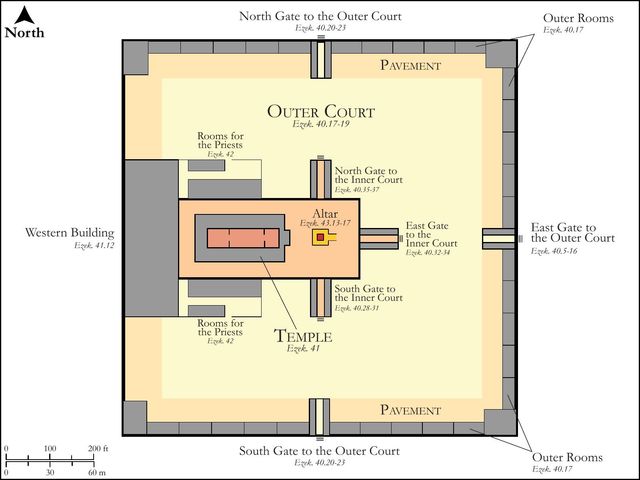
Ezekiel 43:4 is centrally located within the lengthy and detailed temple vision that spans Ezekiel 40-48. This vision serves as a climactic counterpoint to the prophet's earlier pronouncements of judgment against Judah and Jerusalem, which culminated in the destruction of the first temple and the exile of the people. Crucially, preceding the temple's destruction, Ezekiel had witnessed the glory of the LORD systematically departing from the temple, moving eastward (Ezekiel 10:18-19, Ezekiel 11:23). Therefore, the re-entry of the glory in Ezekiel 43 through the very same eastern gate represents a dramatic and hopeful turning point, signaling God's unwavering faithfulness to His covenant promises and His intention to dwell once again among a restored and purified people. The immediate preceding verses (Ezekiel 43:1-3) vividly set the scene for this majestic return, describing the sound of His coming as like the roar of many waters and the earth shining with His glory, echoing earlier visions of God's majesty.
Historical & Cultural Context
The vision granted to Ezekiel occurred during the Babylonian exile (c. 593-571 BC), a period of profound national trauma and spiritual despair for the Israelites. Jerusalem and its temple, which were the very heart of their religious and national identity, had been utterly destroyed by the Babylonians in 586 BC. In this context of displacement and desolation, the detailed vision of a new, perfect temple and the glorious return of God's presence served as an incredibly powerful message of hope, reassurance, and future restoration for a people who felt abandoned by their God and dispossessed of their land. The concept of God's dwelling (often referred to as the Shekinah glory) was central to Israelite theology, intrinsically tied to the tabernacle and later the temple as the unique locus of divine presence. The eastern gate, in particular, was not merely an architectural feature but the primary entrance to the temple complex, and its significance is further underscored by its later mention as the gate through which the prince would enter and exit (Ezekiel 44:1-3). The meticulous architectural descriptions throughout Ezekiel 40-42 reflect Israel's emphasis, from the tabernacle onward, on purity, order, and the sacred demarcation of space for divine encounter.
Key Themes
ShowHideThis verse contributes significantly to several overarching themes within the book of Ezekiel and the broader prophetic literature. The most prominent theme is the Restoration of God's Presence, which is presented as the ultimate sign of covenant renewal and divine favor after a period of severe judgment. This stands in stark Contrast to the theme of Divine Abandonment seen earlier in the book, where God's glory departed due to Israel's pervasive idolatry and sin (Ezekiel 8). The return of the glory unequivocally signifies God's Unwavering Faithfulness to His promises, even in the face of human failure, and points towards a future of profound Sanctification and Purity for His people and their worship. The specific emphasis on the East Gate highlights a symbolic reversal of judgment and a new beginning, as it was the precise path of departure and now the path of triumphant return. Ultimately, the entire temple vision, including the powerful imagery of this verse, underscores the theme of Future Hope and Eschatological Fulfillment, pointing towards a time when God's presence will fully and eternally dwell among His people in a perfected, holy environment, a hope that transcends the immediate historical context of the Babylonian exile.
Exposition and Analysis
ShowHideKey Word Analysis
ShowHideThis term properly denotes "weight" or "heaviness," but in a theological context, it refers to the tangible, awe-inspiring manifestation of God's presence, majesty, and honor. It is the visible, often luminous, expression of His inherent being and power, as seen in the cloud and fire on Mount Sinai (Exodus 24:16) or filling the tabernacle and temple (Exodus 40:34, 1 Kings 8:11). Its return in Ezekiel signifies God's renewed, powerful, and sanctifying presence.
This word broadly means "house," but in this context, it specifically refers to the temple, the sacred dwelling place of God. It signifies the holy edifice where God's presence is uniquely manifested and where His people are to worship Him. The re-entry of the glory into the "house" underscores the restoration of the temple as a sanctified space for divine-human encounter, reversing its previous defilement and abandonment.
Meaning "an opening, i.e., door or gate." In the context of the temple, gates were crucial architectural features controlling access and symbolizing transition between sacred and profane spaces. The specific mention of the "gate" emphasizes the precise and deliberate manner of God's return, mirroring His precise departure and highlighting the controlled and significant nature of this divine re-entry.
Verse Breakdown
ShowHide"And the glory of the LORD came into the house"
This foundational clause announces the central, majestic event of the verse: the re-entry of God's manifest presence. "The glory of the LORD" (Hebrew: kâbôwd Yᵉhôvâh) refers to the visible, weighty, and awe-inspiring manifestation of God Himself, specifically the self-existent, eternal God (Yᵉhôvâh). Its "coming into the house" signifies the re-sanctification and re-inhabitation of the temple, reversing the previous departure and symbolizing God's renewed commitment to dwell among His people in a restored and purified sanctuary.
"by the way of the gate"
This phrase specifies the precise means and path of the glory's entry. The "way" (Hebrew: derek) denotes a trodden path or road, emphasizing a deliberate and orderly movement, not a spontaneous or arbitrary one. The "gate" (Hebrew: shaʻar) highlights a specific architectural feature of the temple complex, indicating that this was a controlled and significant entry point, underscoring the intentionality of God's return.
"whose prospect [is] toward the east"
This final clause provides the critical directional detail, adding immense symbolic weight. The gate's "prospect" or "face" being "toward the east" is profoundly significant. It was through this very eastern gate that the glory of the LORD had departed from the first temple due to Israel's sin and idolatry (Ezekiel 10:19, Ezekiel 11:23). Its return through the same gate signifies a complete and triumphant reversal of judgment, a re-establishment of God's presence, and a powerful new beginning for His people, emphasizing His faithfulness and redemptive power.
Literary Devices
ShowHideEzekiel 43:4 employs several potent literary devices to convey its profound theological message. Symbolism is paramount, with "the glory of the LORD" representing God's manifest presence, power, and holiness, and "the house" symbolizing the sacred dwelling place of God among His people. The East Gate is a particularly rich and poignant symbol, representing both the point of departure due to judgment and the precise point of triumphant return, thereby signifying a complete reversal of fortunes and the inauguration of a new era of restoration. The verse also utilizes Contrast, implicitly setting the scene against the earlier chapters where the glory departed, thereby heightening the emotional and theological impact of its return as a sign of profound hope and renewal. The precise architectural detail of the gate's orientation, combined with the vivid description of the glory's arrival in the preceding verses, contributes to the powerful Imagery of the vision, making the divine re-entry concrete and deeply impactful for the exilic audience. This careful use of detail and symbolism transforms a simple statement into a powerful theological declaration of God's unwavering faithfulness and ultimate restoration.
Theological and Thematic Connections
ShowHideEzekiel 43:4 is a pivotal theological statement, affirming God's unwavering commitment to dwell with His people, even after severe judgment and apparent abandonment. It underscores the profound importance of God's presence as the source of life, holiness, and blessing for Israel. The return of the glory signifies not merely a physical re-entry into a building, but a deeper spiritual restoration and renewal of the covenant relationship. It speaks to God's sovereignty over history, His justice in judgment, and His boundless mercy in offering a path to reconciliation and renewed fellowship. This vision provides a profound theological foundation for understanding God's desire for intimate communion with humanity, a desire that culminates in ultimate fulfillment in the person of Jesus Christ and the New Creation.
Reflection and Application
ShowHideEzekiel 43:4 offers a profound message of hope and the enduring promise of God's presence, even in the midst of desolation, despair, and perceived abandonment. For the exiles, it was a vision of restoration, assuring them that God had not permanently forsaken them but was faithful to His covenant promises. For believers today, this verse serves as a powerful reminder that God's deepest desire is to dwell among His people, to sanctify them, and to fill their lives with His glory. It challenges us to consider what "house" God desires to inhabit today – not merely physical structures, but primarily our hearts, our communities, and our collective lives as the church. The return of the glory through the east gate, the very path of its departure, speaks powerfully to God's redemptive power to reverse what sin has broken and to bring new life, hope, and holiness where there was once only desolation and spiritual death. It invites us to prepare our "house" for His presence, living in holiness, obedience, and eager expectation of His transformative power.
Questions for Reflection
ShowHideFAQ
ShowHideWhy is the East Gate so significant for the glory's return?
ShowHideThe East Gate is highly significant because it was the same direction and likely the very gate through which the glory of the LORD had departed from the first temple prior to its destruction, due to Israel's idolatry and sin (Ezekiel 10:19, Ezekiel 11:23). Therefore, its use for the return symbolizes a complete and dramatic reversal of the judgment and desolation that had befallen Jerusalem and its temple. It signifies a triumphant re-establishment of God's dwelling place and a new era of His presence, mercy, and restoration for His people. It's a powerful visual representation of God's faithfulness to His covenant promises, bringing life and hope from the very direction of past sorrow and divine withdrawal.
Is Ezekiel's temple vision meant to be a literal blueprint for a future temple?
ShowHideThe interpretation of Ezekiel's temple vision, including the detailed descriptions in Ezekiel 43, varies significantly among biblical scholars and theological traditions. Some interpret it as a literal blueprint for a future temple that will be built during a millennial reign of Christ on earth, emphasizing the detailed measurements, architectural specifics, and sacrificial rituals. Others view it as primarily symbolic, representing the ideal, perfected worship and community under God's rule, a spiritual reality that finds its ultimate fulfillment in Christ and the church. A third perspective sees it as a combination, with literal elements pointing to a spiritual reality. Regardless of the literal-symbolic debate, the core theological message of God's desire for a pure dwelling place among His people and His promise of renewed, abiding presence remains central and universally applicable.
Christ-Centered Fulfillment
ShowHideEzekiel 43:4, with its magnificent portrayal of the glory of the LORD returning to the temple, finds its profound Christ-centered fulfillment not in a reconstructed physical edifice, but supremely in the person and work of Jesus Christ. Jesus Himself is the ultimate "house" or temple where God's glory dwells in its fullness, for as John 1:14 declares, "the Word became flesh and dwelt among us, and we have seen his glory, glory as of the only Son from the Father." He is the true tabernacle, the living embodiment of God's presence among humanity, as Colossians 2:9 affirms, "in him the whole fullness of deity dwells bodily." The return of God's glory, once confined to a physical structure and then departed, is now perfectly and permanently manifested in Christ, who is God with us, Emmanuel (Matthew 1:23). Furthermore, through Christ, this divine presence extends to believers, who are collectively the church, the spiritual temple of God built on the foundation of the apostles and prophets, with Christ Jesus himself as the chief cornerstone (Ephesians 2:20-22), and individually temples of the Holy Spirit (1 Corinthians 6:19). The promise of God's indwelling glory, once a distant vision for exiles, is a present reality for those in Christ, culminating in the New Jerusalem where the Lord God Almighty and the Lamb are its temple, and the glory of God illuminates it, for there will be no need for sun or moon (Revelation 21:22-23). Thus, Ezekiel's vision is a powerful foreshadowing of the ultimate and eternal dwelling of God with His people through His Son, Jesus Christ.