


Old Testament · Minor Prophets · Book 28 of 66
Hosea
At the LORD’s command Hosea marries an unfaithful wife, and the marriage becomes the LORD’s case against the northern kingdom and his promise to love them freely.
- 14 chapters
- 197 verses
- About 24 minutes to read
- The Hebrew Prophets, c. 800–400 BC
Hosea prophesied to the northern kingdom in its last years, from the reign of Jeroboam the son of Joash into the days of Hezekiah, in whose sixth year Samaria was taken (Hosea 1:1; 2 Kings 18:10). His first message was his own house. The LORD told him, “Go, take unto thee a wife of whoredoms and children of whoredoms: for the land hath committed great whoredom, departing from the LORD” (1:2), and each child’s name was a sentence on Israel.
The rest of the book presses the charge the marriage made. Israel has taken the LORD’s corn, wine and oil for the gifts of Baal (2:8), sent to Assyria and Egypt for help, and kept its sacrifices while the knowledge of God died out of the land. Judgment and promise alternate throughout, sometimes within one verse. The last chapter answers the fall of Samaria with a call, “O Israel, return unto the LORD thy God” (14:1), and the LORD’s own promise to heal.
For I desired mercy, and not sacrifice; and the knowledge of God more than burnt offerings.
Hosea 6:6 KJV
Before you read
- Who wrote it
- Hosea the son of Beeri, to whom the word of the LORD came (Hosea 1:1). He tells the second part of his marriage in his own words (3:1–3). The book gives no town or tribe for him.
- When it happens
- “In the days of Uzziah, Jotham, Ahaz, and Hezekiah, kings of Judah, and in the days of Jeroboam the son of Joash, king of Israel” (Hosea 1:1). Six kings followed Jeroboam in Samaria, four of them killed by conspirators (2 Kings 15), and Assyria took the city in Hoshea’s ninth year (17:6).
How Hosea is laid out
8 movements · 50 passages · 197 verses
A wife and three names
Chapter 1 · 11 verses
The LORD tells Hosea to take “a wife of whoredoms,” and he marries Gomer the daughter of Diblaim. Her children are named as signs: Jezreel, for the blood Jehu shed there; Lo-ruhamah, no mercy; Lo-ammi, not my people. Yet Judah will be saved by the LORD and not by bow, and Israel will be called “the sons of the living God.”
Hedged in, then betrothed
Chapter 2 · 23 verses
The children are told to plead with their mother, who says her bread and oil come from her lovers. The LORD will hedge up her way with thorns until she says, “I will go and return to my first husband,” and take back his corn and his wine. Then he will allure her into the wilderness and betroth her to himself for ever.
Bought to wait many days
Chapter 3 · 5 verses
The LORD sends Hosea again: “Go yet, love a woman beloved of her friend, yet an adulteress.” He buys her for fifteen pieces of silver and a homer and a half of barley, and she must abide many days without another man. So Israel will abide without king or sacrifice, then return and seek the LORD and David their king.
The LORD’s controversy
Chapters 4–5 · 34 verses
The LORD brings a charge against the land: “there is no truth, nor mercy, nor knowledge of God.” The priests have rejected knowledge and feed on the people’s sin, and a spirit of whoredoms leads Israel to its idols. When Ephraim sees his sickness he sends to Assyria, and the LORD withdraws to his place until they seek his face.
8 passages
- 4:1–3 The LORD’s Controversy with Israel
- 4:4–6 The Failure of the Priests and People
- 4:7–10 Judgment on the Corrupt Leaders
- 4:11–14 Idolatry and Spiritual Harlotry
- 4:15–19 A Warning to Judah
- 5:1–7 Judgment Announced Against Israel's Leaders
- 5:8–12 The Coming Military Disaster
- 5:13–15 Seeking Foreign Help Instead of God
Goodness like a morning cloud
Chapters 6–7 · 27 verses
A call goes up to return to the LORD, who will raise them up “in the third day.” But the goodness of Ephraim and Judah is as a morning cloud, and the LORD desired mercy, not sacrifice. Hot as an oven, they devour their judges and their kings fall, while Ephraim flies like a silly dove between Egypt and Assyria.
Sowing the wind
Chapters 8–10 · 46 verses
The trumpet sounds against a people who set up kings “but not by me” and worship the calf of Samaria; they “have sown the wind, and they shall reap the whirlwind.” Their feasts will end in exile, with Ephraim back in Egypt and eating unclean things in Assyria. Israel, an empty vine, has sinned since Gibeah, and is told to sow in righteousness.
10 passages
- 8:1–3 The Eagle of Judgment Approaches
- 8:4–6 Rebellion in Kingship and Idolatry
- 8:7–10 Sowing the Wind, Reaping the Whirlwind
- 8:11–14 The Rejection of God's Law
- 9:1–6 Punishment Through Famine and Exile
- 9:7–9 The Rejection of False Prophets
- 9:10–17 The Consequence of Historical Apostasy
- 10:1–8 Israel's Prosperity and Idolatry
- 10:9–11 The Deep Roots of Israel's Sin
- 10:12–15 A Call to Repentance and Righteousness
My son out of Egypt
Chapters 11–13 · 42 verses
The LORD recalls calling his son out of Egypt and drawing him “with bands of love,” then asks, “How shall I give thee up, Ephraim?” He holds up Jacob, who wept and made supplication, against Ephraim’s lies and false balances. Ephraim died when he offended in Baal; the LORD will ransom from the grave, but Samaria shall become desolate.
14 passages
- 11:1–4 God's Love for Israel
- 11:5–7 Judgment for Refusal to Repent
- 11:8–9 God's Compassion Overcomes Wrath
- 11:10–11 The Promise of Future Restoration
- 11:12–12:2 Ephraim's Political and Spiritual Folly
- 12:3–6 The Example of Jacob, Israel's Ancestor
- 12:7–8 Ephraim’s Deceit and False Riches
- 12:9–14 God’s Deliverance and Impending Judgment
- 13:1–3 Ephraim's Apostasy and Decline
- 13:4–6 God is the Only Savior
- 13:7–8 The Fierce Judgment of God
- 13:9–11 Israel's Self-Destruction and Failed Kings
- 13:12–14 Judgment, Unwisdom, and Redemption
- 13:15–16 Final Destruction of Samaria
Take with you words
Chapter 14 · 9 verses
A last call: “O Israel, return unto the LORD thy God.” Israel is given words to bring, renouncing Assyria, horses and idols, and the LORD answers, “I will heal their backsliding, I will love them freely.” He will be as the dew, and Israel will grow as the lily and the olive. The book closes: “the ways of the LORD are right.”
The words Hosea turns on
Israel plays the harlot; the LORD answers with love, asks for mercy and to be known, and calls Israel to return, the word of the last chapter.
What Hosea teaches
zânâh · whoredom
A wife of whoredoms
Israel is the LORD’s wife, and her worship of Baal is whoredom: she goes after lovers for her bread and oil, though “she did not know that I gave her corn, and wine, and oil” (2:8). The prophet’s marriage puts that charge in a household. The book tells it as done: Hosea took Gomer, she bore three children, and he bought an adulteress for silver and barley (3:2). Jerome read it as a real marriage that did the prophet no harm: it was not the prophet who lost virtue by joining with a prostitute, but rather the latter gained virtue that she never had before
. Others have taken it as a sign seen in vision, for the LORD “used similitudes, by the ministry of the prophets” (12:10). Either way, its meaning is “according to the love of the LORD toward the children of Israel” (3:1).
chêçêd · mercy
Mercy, and not sacrifice
The LORD’s charge is that there is “no truth, nor mercy, nor knowledge of God in the land” (4:1), and he lays it at the priests’ door: “My people are destroyed for lack of knowledge: because thou hast rejected knowledge, I will also reject thee” (4:6). Israel did not lack sacrifices. Its altars multiplied with its fruit (10:1), and they will go “with their flocks and with their herds to seek the LORD; but they shall not find him” (5:6). He asked for what they lacked: “For I desired mercy, and not sacrifice; and the knowledge of God more than burnt offerings” (6:6). The word for mercy is the one he uses when he promises to betroth Israel “in lovingkindness” (2:19): the steadfast love owed within a covenant. The sacrifices were his own command; what he refused was sacrifice offered without it.
ʼâhab · love
How shall I give thee up?
Chapter 11 sets the LORD’s love beside Israel’s whole history: “When Israel was a child, then I loved him, and called my son out of Egypt” (11:1). He taught Ephraim to walk and “drew them with cords of a man, with bands of love” (11:4), and they sacrificed to Baalim. He could make them as Admah and Zeboim, overthrown with Sodom (Deuteronomy 29:23). Instead: “How shall I give thee up, Ephraim? … mine heart is turned within me, my repentings are kindled together” (11:8). The reason given is God’s nature, not Israel’s merit: “for I am God, and not man; the Holy One in the midst of thee” (11:9). This is not God changing his mind. Theodoret explains that he expresses his thought in different ways, in anger and love, in threat and mercy, chastising and persuading
.
shûwb · return
Return unto the LORD
Israel’s turning is the book’s question. Hedged in, the wife says, “I will go and return to my first husband” (2:7), but “They will not frame their doings to turn unto their God” (5:4), and their goodness passes like the early dew (6:4). So the LORD turns away in judgment, to “go and return to my place” (5:15). Yet the last chapter puts the words in Israel’s mouth: “Take away all iniquity, and receive us graciously” (14:2). The answer rests on the LORD, not on them: “I will heal their backsliding, I will love them freely: for mine anger is turned away from him” (14:4). Backsliding there is built on the same root as return, and so is turned away: the LORD heals the turning itself.
Christ in Hosea
Matthew reads Hosea 11:1 as fulfilled in the child Jesus, taken into Egypt and called out again: “Out of Egypt have I called my son” (Matthew 2:15). Israel was the LORD’s firstborn son (Exodus 4:22), called out of Egypt and then unfaithful. The Son of God goes the same road and keeps the faith Israel broke. Twice Jesus answered his critics with Hosea 6:6: “go ye and learn what that meaneth, I will have mercy, and not sacrifice” (Matthew 9:13; 12:7).
The names of chapter 1 are undone in the gospel. Paul quotes them for a people called “not of the Jews only, but also of the Gentiles” (Romans 9:24–26), and Peter writes to believers who “had not obtained mercy, but now have obtained mercy” (1 Peter 2:10). Paul takes up 13:14 as death’s defeat in the resurrection: “O death, where is thy sting? O grave, where is thy victory?” (1 Corinthians 15:55). And of “David their king” (3:5), Augustine wrote, You will never find a prophecy plainer than this, for the name King David means Christ
.
People
By how many verses name them
- HoseaA son of Beeri; husband of Gomer; father of Jezreel, Lo-ruhamah, Lo-ammi2
- GomerA daughter of Diblaim; wife of Hosea; mother of Jezreel, Lo-ruhamah, Lo-ammi1
- JezreelSon of Hosea and Gomer; a brother of Lo-ruhamah, Lo-ammi1
- Lo-ruhamahDaughter of Hosea and Gomer; a sister of Jezreel, Lo-ammi2
- Lo-ammiSon of Hosea and Gomer; a brother of Jezreel, Lo-ruhamah1
- AhazA son of Jotham; husband of Abi; father of Hezekiah and Maaseiah1
- BeeriFather of Hosea1
- DavidSon of Jesse1
8 more are named.
Places
23 named
- EgyptWhere the LORD called his son from; where Ephraim looks for help13
- AssyriaThe power Ephraim courts, and the land of his exile8
- SamariaThe northern capital, with its calf, foretold to become desolate5
- Beth-avenNamed with Gilgal as a shrine Judah must not visit3
- GibeahIsrael has sinned “from the days of Gibeah”; an alarm sounds there3
- GilgalWhere “all their wickedness” is, and bullocks are sacrificed3
- JezreelWhere Jehu shed blood, and the name of Hosea’s first son3
- LebanonIts scent and wine picture Israel restored3
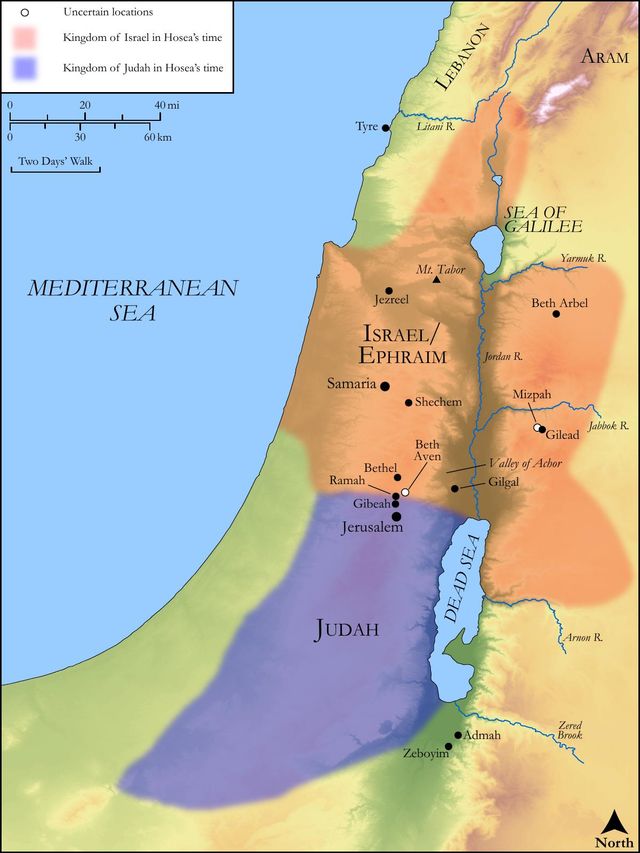
Where Hosea reaches
The passages it leans on, and the ones that lean on it
Jehu’s line ends in its fourth generation when Shallum kills Zachariah, as the name Jezreel foretold.
The valley named for Achan’s trouble becomes, in the promise, “a door of hope.”
1 Samuel 15:22 Hosea 6:6 Matthew 9:13
Samuel puts obedience above sacrifice, Hosea mercy; Jesus tells the Pharisees to go and learn what it means.
Exodus 4:22 Hosea 11:1 Matthew 2:15
Israel the LORD’s firstborn son, called out of Egypt; Matthew finds the call fulfilled in the child Jesus.
Jacob wrestles until he is blessed and named Israel; Hosea holds up his weeping prayer to his unfaithful sons.
Books Hosea links to most
The Church Fathers on Hosea
268 quotations from 33 writers before AD 800 · the ten most quoted, in date order
- Origen253
- Ambrose397
- Chrysostom407
- Jerome420
- Theodore428
- Augustine430
- John Cassian435
- Cyril444
- Theodoret458
- Gregory604
Jerome, on why the LORD speaks of betrothal and not reconciliation.
After she returns to her husband, she is said not at all to be reconciled to him but rather to be betrothed. … But when God joins with prostitutes, he changes them into virgins.
Cyril of Jerusalem heard the risen dead speaking in 6:2.
In the person of the risen dead the prophet Hosea says plainly, “He will revive us after two days; on the third day he will raise us up, to live in his presence.”
Cyril of Alexandria read the knowledge of God in 6:6 as perfected in Christ.
Therefore the knowledge of God is better than sacrifice and holocausts, as it is brought to perfection in Christ. For by him and in him we have known the Father
Origen, on the question Hosea leaves at the end of his prophecy.
And to such a degree does the gospel desire that there should be wise people among believers, that for the sake of exercising the understanding of its hearers, it has spoken certain truths in enigmas, others in what are called “dark” sayings, others in parables, and others in problems. And one of the prophets—Hosea—says at the end of his prophecy, “Who is wise, and he will understand these things? Or prudent, and he shall know them?”
Keep studying
Articles