


Hosea 5:10
- הָיוּha·Yuthey have becomeH1961V-Qal-Perf-3cpVerb Qal Perfect 3rd Plural common gender
- שָׂרֵיsa·Rei[the] leaders ofH8269N-mpcNoun Plural Masculine Construct
- יְהוּדָהye·hu·DahJudahH3063N-properNoun Proper Location
- כְּמַסִּיגֵיke·ma·si·Geilike [those who] displaceH5253Prep-k ¦ V-Hiphil-Prtcpl-mpVerb Hiphil Participle Plural Masculine Constructכְּlikeמַסִּיגֵי[those who] displace
- גְּבוּלge·Vul<of> a boundaryH1366N-msNoun Singular Masculine Absolute
- עֲלֵיהֶם'a·lei·Hemon themH5921Prep ¦ 3mpPrepositionעֲלֵיonהֶםthem
- אֶשְׁפּוֹךְ'esh·PokhI will pour outH8210V-Qal-Imperf-1csVerb Qal Imperfect 1st Singular common gender
- כַּמַּיִםka·Ma·yimlike <the> waterH4325Prep-k ¦ N-mpNoun Plural Masculine Absoluteכַּlike <the>מַּיִםwater
- עֶבְרָתִי'ev·ra·Timy wrathH5678N-fsc ¦ 1csNoun Singular Feminine Constructעֶבְרָתִwrathיmy
English is a literal word-by-word gloss of the Hebrew, not the KJV's wording. Why?
This is the original text the KJV's translators worked from — each Hebrew word with its own literal English meaning in this verse, prepared by scholars at Tyndale House, Cambridge. The KJV translates whole sentences, not word by word, so its wording differs: one Hebrew word can become several English words, and the KJV may choose “the LORD” where the gloss reads “Yahweh”. Both are faithful — they answer different questions. For the KJV's own rendering, switch to the KJV text.
Details
See on the biblical-era map
Study this verse
Public-domain commentary
Matthew Henry
From his Commentary on the Whole Bible. Henry comments on passages, not single verses — this entry covers Hosea 5:8–15. His three-level outline is real structure in the source text, so it is rendered as structure.
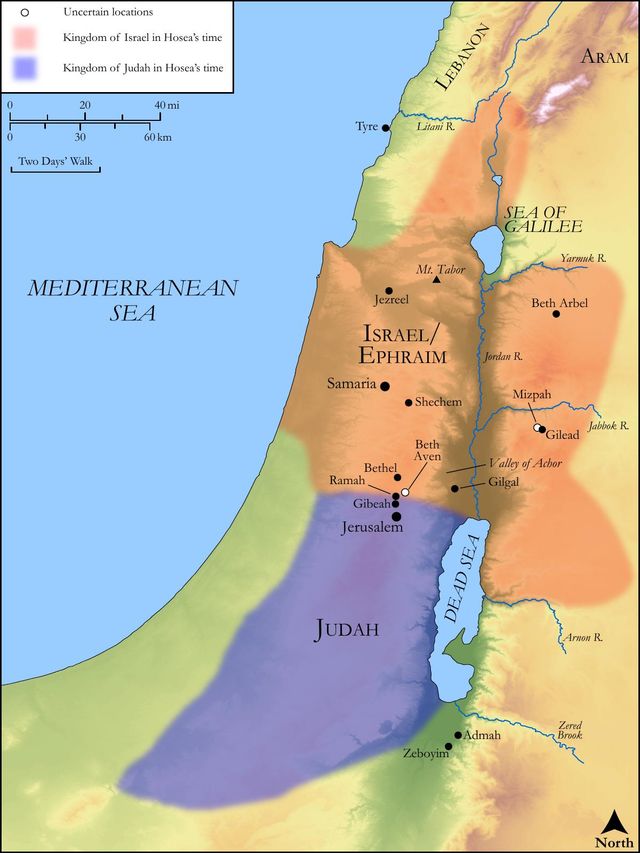
Here is, I. A loud alarm sounded, giving notice of judgments coming (Hos 5:8): Blow you the cornet in Gibeah and in Ramah, two cities near together in the confines of the two kingdoms of Judah and Israel, Gibeah a frontier-town of the kingdom of Judah, Ramah of Israel; so that the warning is hereby sent into both kingdoms. "Cry aloud at Beth-aven, or Bethel, which place seems to be already seized upon by the enemy, and therefore the trumpet is not sounded there, but you hear the outcries of those that shout for mastery, mixed with theirs that are overcome." Let them cry aloud, "After thee, O Benjamin! comes the enemy. The tribe of Ephraim is already vanquished, and the enemy will be upon thy back, O Benjamin! in a little time; thy turn comes next. The cup of trembling shall go round." The prophet had described God's controversy with them as a trial at law (Hos 4:1); here he describes it as a trial by battle; and here also when he judges he will overcome. Let all therefore prepare to meet their God. He had before spoken of the judgments as certain; here he speaks of them as near; and, when they are apprehended as just at the door, they are very startling and awakening. The blowing of this cornet is explained, Hos 5:9. Among the tribes of Israel have I made known that which shall surely be, that which is true or certain, so the word is. Note, The destruction of impenitent sinners is a thing which shall surely be; it is not mere talk, to frighten them, but it is an irrevocable sentence. And it is a mercy to us that it is made known to us, that we have timely warning given us of it, that we may flee from the wrath to come. It is the privilege of the tribes of Israel that, as they are told their duty, so they are told their danger, by the oracles of God committed to them.
II.The ground of God's controversy with them.
1.He has a quarrel with the princes of Judah, because they were daring leaders in sin, Hos 5:10. They are like those that remove the bound, or the ancient land-marks. God has given them his law, to be a fence about his own property; but they have sacrilegiously broken through it, and set it aside; they have encroached even upon God's rights, have trampled upon the distinctions between good and evil, and the most sacred obligations of reason and equity, thinking, because they were princes, that they might do any thing, Quicquid libet, licet - Their will was a law. Or it may be understood of their invading the liberty and property of the subject for the advancing of the prerogative, which was like removing the ancient land-marks. Some have observed that the princes of Judah were more absolute, and assumed a more arbitrary power, than the princes of Israel did; now, for this, God has a controversy with them: I will pour out my wrath upon them like water, in great abundance, like the waters of the flood, which were poured upon the giants of the old world, for the violence which the earth was filled with through them, Gen 6:13. Note, There are bounds which even princes themselves must not remove, bounds both of religion and justice, which they are limited by, and, if they break through them, they must know that there is a God above them that will call them to account for it.
2.He has a quarrel with the people of Ephraim, because they were sneaking followers in sin (Hos 5:11): He willingly walked after the commandment, that is, the commandment of Jeroboam and the succeeding kings of Israel, who obliged all their subjects by a law to worship the calves at Dan and Bethel, and never to go up to Jerusalem to worship. This was the commandment; it was the law of the land, and backed with reasons of state; and the people not only walked after it in a blind implicit obedience to authority, but they willingly walked after it, from a secret antipathy they had to the worship of idols. Note, An easy compliance with the commandments of men that thwart the commandments of God ripens a people for ruin as much as any thing. And the punishment of the sequacious disobedience (if I may so call it) answers to the sin; for it is for this that Ephraim is oppressed and broken in judgment, has all his civil rights and liberties broken in upon and trodden down; and,
(1.)It is just with God that it should be so, that those who betray God's property should lose their own, that those who subject their consciences to an infallible judge, and an arbitrary power, should have enough of both.
(2.)There is a natural tendency in the thing itself towards it. Those that willingly walk after the commandment, even when it walks contrary to the command of God, will find the commandment an encroaching thing, and that the more power is given it the more it will claim. Note, Nothing gives greater advantage to a mastiff-like tyranny, that is fierce and furious, than a spaniel-like submission, that is fawning and flattering. Thus is Ephraim oppressed and broken in judgment, that is, he is wronged under a face and colour of right. Note, It is a sad and sore judgment upon any people to be oppressed under pretence of having justice done them. This explains the threatening Hos 5:9, Ephraim shall be desolate in the day of rebuke. Note, Daring sinners must expect that a day of rebuke will come, and such a day of rebuke as will make them desolate, will deprive them of the comfort of all they have and all they hope for.
III.The different methods that God would take both with Judah and Ephraim, sometimes one method and sometimes the other, and sometimes both together, or rather by which, first the one and then the other, he would advance towards their complete ruin.
1.He would begin with less judgments, which should sometimes work silently and insensibly (Hos 5:12): I will be (that is, my providences shall be) unto Ephraim as a moth; nay (as it might better be supplied), they are unto Ephraim as a moth, for it is such a sickness as Ephraim now sees, Hos 5:13. Note, The judgments of God are sometimes to a sinful people as a moth, and as rottenness, or as a worm. The former signifies the little animals that breed in clothes, the latter those that breed in wood; as these consume the clothes and the wood, so shall the judgments of God consume them.
(1.)Silently, so as not to make any noise in the world, nay, so as they themselves shall not be sensible of it; they shall think themselves safe and thriving, but, when they come to look more narrowly into their state, shall find themselves wasting and decaying.
(2.)Slowly, and with long delays and intervals, that he may give them space to repent. Many a nation, as well as many a person, in the prime of its time, dies of a consumption.
(3.)Gradually. God comes upon sinners with less judgments, so to prevent greater, if they will be wise and take warning; he comes upon them step by step, to show he is not willing that they should perish.
(4.)The moth breeds in the clothes, and the worm or rottenness in the wood; thus sinners are consumed by a fire of their own kindling.
2.When it appeared that those had not done their work he would come upon them with greater (Hos 5:14): I will be unto Ephraim as a lion, and to the house of Judah as a young lion, though Judah is himself, in Jacob's blessing, a lion's whelp. Lest any should think his power weakened, because he was said to be as a moth to them, he says that he will now be as a lion to them, not only to frighten them with his roaring, but to pull them to pieces. Note, If less judgments prevail not to do their work, it may be expected that God will send greater. Christ is sometimes a lion of the tribe of Judah, here he is a lion against that tribe. See what God will do to a people that are secure in sin: Even I will tear. He seems to glory in it, as his prerogative, to be able to destroy, as the alone lawgiver, Jam 4:12. "I, even I, will take the work into my own hands; I say it that will do it." There is a more immediate work of God in some judgments than in others. I will tear, and go away. He will go away,
(1.)As not fearing them; he will go away in state, and with a majestic face, as the lion from his prey.
(2.)As not helping them. If God tear by afflicting providences, and yet by his graces and comforts stays with us, it is well enough; but our condition is sad indeed if he tear and go away, if, when he deprives us of our creature comforts, he does himself depart from us. When he goes away he will take away all that is valuable and dear, for, when God goes, all good goes along with him. He will take away, and none shall rescue him, as the prey cannot be rescued from the lion, Mic 5:8. Note, None can be delivered out of the hands of God's justice but those that are delivered into the hands of his grace. It is in vain for a man to strive with his Maker.
IV.The different effects of those different methods.
1.When God contended with them by less judgments they neglected him, and sought to creatures for relief, but sought in vain, Hos 5:13. When God was to them as a moth, and as rottenness, they perceived their sickness and their wound; after a while they found themselves going down the hill, and that they were behind - hand in their affairs, their estate was sensibly decaying, and then they sent to the Assyrian, to come in to their assistance, made their court to king Jareb, which some think, was one of the names of Pul, or Tiglathpileser, kings of Assyria, to whom both Israel and Judah applied for relief in their distress, hoping by an alliance with them to repair and re-establish their declining interests. Note, Carnal hearts, in time of trouble, see their sickness and see their wound, but do not see the sin that is the cause of it, nor will be brought to acknowledge that, no, nor to acknowledge the hand of God, his mighty hand, much less his righteous hand, in their trouble; and therefore, instead of going the next way to the Creator, who could relieve them, they take a great deal of pains to go about to creatures, who can do them no service. Those who repent not that they have offended God by their sins are loth to be beholden to him in their afflictions, but would rather seek relief any where than with him. And what is the consequence? Yet could he not heal you, nor cure you of your wound. Note, Those who neglect God, and seek to creatures for help, will certainly be disappointed; those who depend upon them for support will find them, not foundations, but broken reeds; those who depend upon them for supply will find them, not fountains, but broken cisterns; those who depend upon them for comfort and a cure will find them miserable comforters, and physicians of no value. The kings of Assyria, whom Judah and Israel sought unto, distressed them and helped them not, Ch2 28:16, Ch2 28:22. Some make king Jareb to signify the great, potent, or magnificent king, for they built much upon his power; others the king that will plead, or should plead, for they built much upon his wisdom and eloquence, and in his interesting himself in their affairs. They had sent him a present (Hos 10:6), a good fee, and, having so retained him of counsel for them, they doubted not of his fidelity to them; but he deceived them, as an arm of flesh does those that trust in it, Jer 17:5, Jer 17:6.
2.When, to convince them of their folly, God brought greater judgments upon them, then they would at length be forced to apply to him, Hos 5:15. When he has torn as a lion,
(1.)He will leave them: I will go and return to my place, to heaven, or to the mercy-seat, the throne of grace, which is his glory. When God punishes sinners he comes out of his place (Isa 26:21); but, when he designs them favour, he returns to his place, where he waits to be gracious, upon their submission. Or he will return to his place when he has corrected them, as not regarding them, hiding his face from them, and not taking notice of their troubles or prayers; and this for their further humiliation, till they are qualified in some measure for the returns of his favour.
(2.)He will at length work upon them, and bring them home to himself, by their afflictions, which is the thing he waits for; and then he will no longer withdraw from them. Two things are here mentioned as instances of their return: - [1.] Their penitent confession of sin: Till they acknowledge their offence; marg. Till they be guilty, that is, till they be sensible of their guilt, and be brought to own it, and humble themselves before God for it. Note, When men begin to complain more of their sins than of their afflictions then there begins to be some hope of them; and this is that which God requires of us, when we are under his correcting hand, that we own ourselves in a fault and justly corrected. [2.] Their humble petition for the favour of God: Till they seek my face, which, it may be expected, they will do when they are brought to the last extremity, and they have tried other helpers in vain. In their affliction they will seek me early, that is, diligently and earnestly, and with great importunity; and if they seek him thus, and be sincere in it, though it might be called seeking him late, because it was long ere they were brought to it, yet it is not too late, nay, he is pleased to call it seeking him early, so willing is he to make the best of true penitents in their return to him. Note, When we are under the convictions of sin, and the corrections of the rod, our business is to seek God's face; we must desire the knowledge of him, and an acquaintance with him, that he may manifest himself to us, and for us, in token of his being at peace with us. And it may reasonably be expected that affliction will bring those to God that had long gone astray from him, and kept at a distance. Therefore God for a time turns away from us, that he may turn us to himself, and then return to us. Is any among you afflicted? Let him pray.
Historical interpretation
Fourteen Centuries of Reception
2 surviving comments on this verse. Each one is dated, so this reads as a timeline rather than a list.
Select a marker to jump to its quote. Markers stagger vertically where authors wrote within a few decades of each other.
"The leaders of Judah have become like those who remove a boundary; upon them I will pour out my wrath like water." LXX: "The leaders of Judah have become like those who move boundary lines. I will pour out my rage on them like a flood, raging and swift." After the captivity of Ephraim and Israel, and their land became desolate, the leaders of Judah who should have wept and encouraged their people to turn away from idolatry, lest they suffer similarly, began to rejoice and be happy that their land was opened wide for them to possess. They became like those who remove boundary lines and expanded their kingdom and possession in the former places of Israel. Therefore, thus says the Lord: And upon those princes of Judah shall come the Babylonians; and they shall take them: their bowels will not be of force, but of my indignation. And he also speaks to the princes of Judah, that is, the Church, that they ought not to exult; and to estimate their own salvation through the perdition of heretics, but rather to mourn because they are lost. Wherefore even the Apostle Paul teaches the ecclesiastical men not to glory in the breaking off of the Jewish branches, but rather to fear lest they themselves be broken off (Rom. XI). And in another place: "Who," he says, "is scandalized, and I am not burned." (2 Corinthians 2:29)? Otherwise, against such leaders who glory in the miseries of others, and therefore think that they are standing if others fall, the Lord will pour out His anger like water. Seventy interpreted the word "impetus" as wrath, and some think that it should be understood as a blessing, according to what we read elsewhere: "The impetus of a river rejoices the city of God" (Ps. 45:4). But more correctly (as all except the Seventy have translated) anger should be received, especially since the name of effusion and anger is appropriate, as the prophet says to the Lord: "Pour out your anger upon them, and let the fury of your wrath take hold of them" (Ps. LXVIII, 25). The princes of Judah have moved the boundaries which their fathers had set, when they change truth with falsehood, and they preach something different from what they have received from the apostles.
As they that take up the bound: That is, they that remove the boundary, encroaching on the property of their neighbours: figuratively: going beyond the boundary of the laws of God.
Continue studying Hosea 5:10 across the web’s major study libraries — every link below opens this exact verse, chapter, or book on the destination site.
Read & Compare
 BibleGatewayThis verse in more than 200 translations and 70 languages.
 Bible.comThe YouVersion reader — hundreds of translations, reading plans, and highlights.
 ESV.orgCrossway's official English Standard Version reader.
 NET BibleThe NET translation with 60,000+ translators' notes on every rendering decision.
 STEP BibleTyndale House's free study tool — original text, vocabulary, and scholarly resources.
 BibliaLogos Bible Software's free web reader.
 USCCBThe New American Bible (Revised Edition) with the U.S. bishops' study notes.
Commentaries
 BibleHub CommentariesDozens of classic commentaries on this verse, gathered on one page.
 StudyLightMore than 100 commentary sets — the largest collection on the web.
 BibleRefPlain-English commentary on what this verse means, verse by verse.
 Enduring WordDavid Guzik's free commentary on this chapter, widely used by Bible teachers.
 Bible Study ToolsVerse commentary alongside Greek and Hebrew study aids.
Original Language & Research
- BibleHub InterlinearThe verse word by word — original language, transliteration, and English.
- BibleHub LexiconEvery word's original-language definition and Strong's entry.
 Blue Letter BibleDeep-study tools — Strong's numbers, concordance, and word studies.
 SefariaThe Hebrew text with Rashi and centuries of Jewish commentary.
Sermons, Hymns & Audio


TrulyRandomVerse is not affiliated with these sites and doesn’t control their content. They’re linked because they’re genuinely useful.
Summary
Hosea 5:10 pronounces a severe divine judgment against the leaders of Judah, likening their actions to the ancient transgression of illegally moving boundary markers. This prophetic indictment highlights their profound disregard for justice, law, and the well-being of the people, culminating in God's unequivocal declaration that He will unleash His wrath upon them in an overwhelming and inescapable manner, much like a devastating flood. The verse underscores the gravity of leadership corruption and the certainty of divine retribution for those who pervert righteousness.
Context
ShowHideLiterary Context
Hosea 5 marks a significant shift in the prophet's message from lament and appeal to a direct pronouncement of judgment against both Israel (Ephraim) and Judah. The preceding verses (Hosea 5:1-7) accuse the priests, the house of Israel, and the house of the king of deep-seated corruption, idolatry, and spiritual prostitution, leading to God's withdrawal. Hosea 5:8-9 describe the sounding of the alarm and the impending desolation, setting the stage for the specific indictment against Judah's princes in Hosea 5:10. The subsequent verses (Hosea 5:11-15) continue to detail the consequences of their sin, including divine discipline likened to rot and a lion, and ultimately God's departure until they seek Him.
Historical & Cultural Context
Hosea prophesied during a turbulent period in both the Northern Kingdom of Israel and the Southern Kingdom of Judah, roughly from 750-715 BC. This era was marked by political instability, moral decay, and increasing Assyrian influence. The "princes of Judah" (שָׂרֵי יְהוּדָה, sarê Yᵉhûwdâh) refer to the ruling elite, including royal officials, judges, and powerful landowners. In ancient agrarian societies, land ownership was paramount, and boundary markers (גְּבֻל, gᵉbûwl) were sacred, defining property lines and ensuring social order. The Mosaic Law explicitly condemned the removal of these markers as a grave offense against justice and the vulnerable, as seen in Deuteronomy 19:14 and Deuteronomy 27:17. By comparing Judah's princes to those who remove the bound, Hosea accuses them of pervasive injustice, exploitation of the poor, and a fundamental perversion of the legal and social order, all for personal gain or power.
Key Themes
ShowHideThe verse powerfully contributes to several overarching themes in Hosea and the broader prophetic literature. It highlights the corruption of leadership, emphasizing that those in positions of authority are held to a higher standard and their unrighteousness has devastating consequences for the entire nation. It underscores the theme of divine justice and judgment, demonstrating God's unwavering commitment to upholding righteousness and His readiness to act decisively against sin, especially when it involves oppression and a disregard for His covenant. The imagery of "removing the bound" also speaks to the violation of covenant and law, portraying a society that has strayed far from God's established principles for justice and equity, mirroring the spiritual adultery described earlier in Hosea 4.
Exposition and Analysis
ShowHideKey Word Analysis
ShowHideMeaning "a head person (of any rank or class); captain (that had rule), chief (captain), general, governor, keeper, lord,(-task-)master, prince(-ipal), ruler, steward." This term specifically identifies the highest echelons of Judah's political and administrative leadership, those entrusted with governing and upholding justice. The indictment is thus leveled squarely at those who should have been guardians of the law, but instead became its perverters.
Meaning "properly, a cord (as twisted), i.e. (by implication) a boundary; by extension the territory inclosed; border, bound, coast, [idiom] great, landmark, limit, quarter, space." This word refers to the physical markers or limits that defined land ownership. Its removal was a serious act of theft and injustice, particularly against the vulnerable who could not defend their property rights. Figuratively, it represents the transgression of established moral, legal, and divine boundaries.
Meaning "to spill forth (blood, a libation, liquid metal; or even a solid, i.e. to mound up); also (figuratively) to expend (life, soul, complaint, money, etc.); intensively, to sprawl out." This verb denotes a forceful, abundant, and often irreversible release. When applied to God's wrath, it signifies an uncontainable, overwhelming, and complete outpouring of judgment, emphasizing its intensity and inevitability.
Meaning "an outburst of passion; anger, rage, wrath." This term describes a fierce, intense, and often sudden expression of divine indignation. It is not arbitrary anger but a righteous response to persistent rebellion, injustice, and the violation of God's holy standards. The combination with "pour out" stresses the full measure of this divine displeasure.
Verse Breakdown
ShowHide"The princes of Judah were like them that remove the bound"
This clause delivers the core accusation against Judah's leadership. It condemns the "princes" (rulers, officials) for acting like those who illegally move boundary markers. This is a powerful metaphor for their systematic perversion of justice, exploitation of the weak, and disregard for established laws and property rights. It implies a deep-seated corruption where those meant to uphold order actively dismantle it for personal gain or power, violating both human and divine statutes.
"therefore I will pour out my wrath upon them like water"
This clause declares the direct and severe consequence of their actions. God, as the ultimate arbiter of justice, states His intention to unleash His "wrath" (intense, righteous anger) upon these corrupt leaders. The simile "like water" emphasizes the overwhelming, pervasive, and inescapable nature of this judgment. Just as a flood cannot be contained and sweeps everything away, so too will God's judgment be comprehensive and devastating, leaving no escape for those who have so grievously sinned.
Literary Devices
ShowHideHosea 5:10 employs several potent literary devices to convey its message of judgment. The central device is Simile, comparing the "princes of Judah" to "them that remove the bound." This comparison is highly effective because "removing the bound" was a well-understood and deeply condemned act of injustice in ancient Israel, making the accusation against the leaders immediately recognizable and morally reprehensible. The second powerful Simile is "I will pour out my wrath upon them like water." This vivid imagery evokes the destructive power of a flood, signifying a judgment that is abundant, overwhelming, and impossible to escape, contrasting sharply with water as a life-giving force. There is also strong Metaphor at play, as the act of "removing the bound" extends beyond a literal land dispute to symbolize a broader dismantling of legal, ethical, and covenantal boundaries. The entire verse functions as a Prophetic Oracle of Judgment, a common form in prophetic literature where God's indictment is followed by a declaration of impending punishment, emphasizing divine sovereignty and justice.
Theological and Thematic Connections
ShowHideHosea 5:10 profoundly illustrates God's unwavering commitment to justice and His fierce opposition to oppression and corruption, especially among those in authority. The "removing of the bound" is not merely a legal transgression but a violation of the very fabric of communal life and an affront to God's character, who champions the cause of the vulnerable. This divine wrath is not arbitrary but a righteous response to persistent sin and the abuse of power, demonstrating that God holds leaders accountable for their stewardship. It foreshadows a consistent biblical theme: those who pervert justice will face severe consequences, for God's kingdom is founded on righteousness.
Reflection and Application
ShowHideHosea 5:10 serves as a timeless and sobering reminder of the profound responsibility that accompanies leadership, whether in government, business, community, or the church. It challenges us to examine our own lives and spheres of influence: do we uphold justice and integrity, or do we, like the princes of Judah, subtly or overtly "remove the bound" for personal gain, convenience, or power? This can manifest not only in literal dishonesty but also in ethical compromises, the exploitation of others, or the disregard for established moral and spiritual principles. The "pouring out of wrath like water" underscores the seriousness of God's view on such transgressions, reminding us that His justice is inevitable and comprehensive. For the oppressed, this verse offers a profound comfort: God sees injustice, and He will act. For those in positions of power, it is a stark warning to lead with righteousness, humility, and a deep respect for God's standards and the well-being of all.
Questions for Reflection
ShowHideFAQ
ShowHideWhat does "remove the bound" mean in ancient Israelite society?
ShowHideIn ancient Israel, "removing the bound" (or landmark) referred to the illegal and dishonest act of moving physical markers (stones or pillars) that delineated property lines between landowners. This was a grave offense, akin to theft, as it dispossessed individuals, particularly the vulnerable, of their rightful inheritance and livelihood. It was explicitly forbidden by Mosaic Law (Deuteronomy 19:14; Deuteronomy 27:17) because it undermined the social order, violated justice, and exploited the poor. In Hosea 5:10, it serves as a powerful metaphor for the pervasive injustice and disregard for divine law perpetrated by Judah's corrupt leaders.
Why is God's wrath poured out "like water"?
ShowHideThe imagery of God's wrath being poured out "like water" (כַּמַּיִם, ka-mayim) is a powerful simile emphasizing the overwhelming, pervasive, and inescapable nature of divine judgment. Just as a flood or a deluge of water is impossible to contain and sweeps away everything in its path, so too will God's retribution be comprehensive and unavoidable for the unrighteous princes of Judah. This contrasts with the life-giving nature of water and even with the prophet Amos's call for justice to roll down "like waters" (Amos 5:24), here signifying destruction rather than refreshment.
Christ-Centered Fulfillment
ShowHideWhile Hosea 5:10 pronounces judgment on the corrupt leadership of Judah, it implicitly points to the ultimate King and just Ruler, Jesus Christ, who perfectly embodies the righteousness that Judah's princes lacked. The "removing of the bound" speaks to the perversion of justice and the violation of God's law, which ultimately necessitated divine intervention. Jesus, as the Son of God, came not to remove the boundaries of God's law but to fulfill them (Matthew 5:17). He is the one who perfectly upholds justice and righteousness, unlike the corrupt leaders who exploited their people. The wrath "poured out like water" foreshadows the ultimate judgment against sin, a judgment that Jesus bore on the cross for those who believe (Romans 5:9). Through His sacrificial death, He became the propitiation for our sins, diverting the righteous wrath of God from us (1 John 2:2). Thus, Hosea's warning of judgment highlights the desperate need for a perfect King and Savior, a need fulfilled in Christ, who establishes an eternal kingdom of justice and peace, where no boundaries of righteousness are ever transgressed (Isaiah 9:6-7).