


Hosea 2:19
Bible text: King James Version (1769 Blayney text) · Public domain
Bible text: King James Version with Strong's numbers · Public domain
Bible text: Berean Standard Bible · Public domain
Bible text: American Standard Version (1901) · Public domain
Bible text: World English Bible, Messianic edition · Public domain
Bible text: Geneva Bible (1599) · Public domain
Bible text: Young's Literal Translation · Public domain
- וְאֵרַשְׂתִּיךְve·'e·ras·Tikhand I will betroth youH781Conj-w ¦ V-Piel-ConsecPerf-1cs ¦ 2fsVerb Piel Consecutive Perfect 1st Singular common genderוְandאֵרַשְׂתִּיI will betrothךְyou
- לִיlito myselfPrep-l ¦ 1csSuffix Personal 1st Singular common genderלִtoיmyself
- לְעוֹלָםle·'o·Lamfor everH5769Prep-l ¦ N-msNoun Singular Masculine Absoluteלְforעוֹלָםever
- וְאֵרַשְׂתִּיךְve·'e·ras·Tikhand I will betroth youH781Conj-w ¦ V-Piel-ConsecPerf-1cs ¦ 2fsVerb Piel Consecutive Perfect 1st Singular common genderוְandאֵרַשְׂתִּיI will betrothךְyou
- לִיlito myselfPrep-l ¦ 1csSuffix Personal 1st Singular common genderלִtoיmyself
- בְּצֶדֶקbe·Tze·dekin righteousnessH6664Prep-b ¦ N-msNoun Singular Masculine Absoluteבְּinצֶדֶקrighteousness
- וּבְמִשְׁפָּטu·ve·mish·Patand in justiceH4941Conj-w ¦ Prep-b ¦ N-msNoun Singular Masculine Absoluteוּandבְinמִשְׁפָּטjustice
- וּבְחֶסֶדu·ve·Che·sedand in covenant loyaltyH2617Conj-w ¦ Prep-b ¦ N-msNoun Singular Masculine Absoluteוּandבְinחֶסֶדcovenant loyalty
- וּבְרַחֲמִיםU·ve·ra·cha·Mimand in compassion<s>H7356Conj-w ¦ Prep-b ¦ N-mpNoun Plural Masculine Absoluteוּandבְinרַחֲמִיםcompassion<s>
English is a literal word-by-word gloss of the Hebrew, not the KJV's wording. Why?
This is the original text the KJV's translators worked from — each Hebrew word with its own literal English meaning in this verse, prepared by scholars at Tyndale House, Cambridge. The KJV translates whole sentences, not word by word, so its wording differs: one Hebrew word can become several English words, and the KJV may choose “the LORD” where the gloss reads “Yahweh”. Both are faithful — they answer different questions. For the KJV's own rendering, switch to the KJV text.
Details
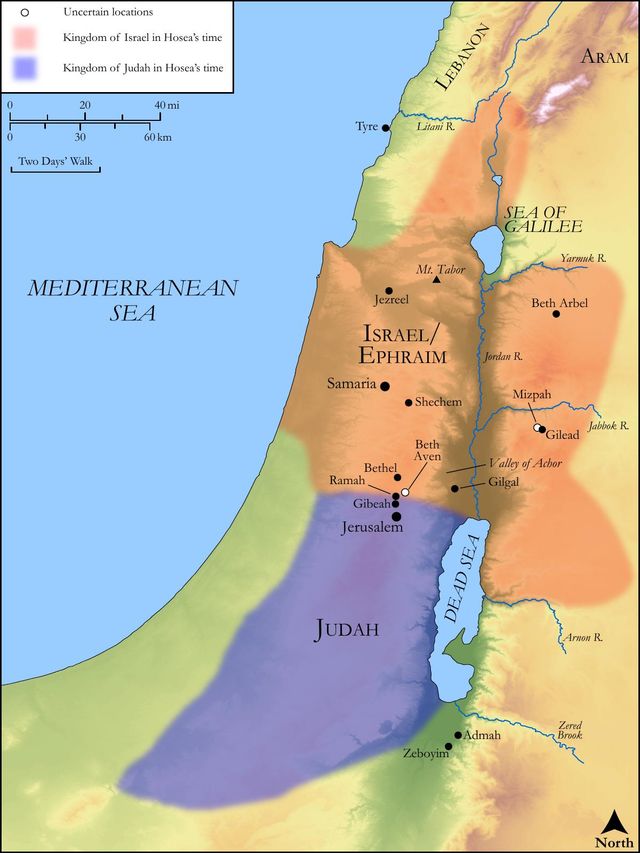
See on the biblical-era map
Study this verse
Public-domain commentary
Matthew Henry
From his Commentary on the Whole Bible. Henry comments on passages, not single verses — this entry covers Hosea 2:14–23. His three-level outline is real structure in the source text, so it is rendered as structure.
The state of Israel ruined by their own sin did not look so black and dismal in the former part of the chapter, but that the state of Israel, restrained by the divine grace, looks as bright and pleasant here in the latter part of the chapter, and the more surprisingly so as the promises follow thus close upon the threatenings; nay, which is very strange, they are by a note of connexion joined to, and inferred from, that declaration of their sinfulness upon which the threatenings of their ruin are grounded: She went after her lovers, and forgot me, saith the Lord; therefore I will allure her. Fitly therefore is that therefore which is the note of connexion immediately followed with a note of admiration: Behold I will allure her! When it was said, She forgot me, one would think it should have followed, "Therefore I will abandon her, I will forget her, I will never look after her more." No, Therefore I will allure her. Note, God's thoughts and ways of mercy are infinitely above ours; his reasons are all fetched from within himself, and not from any thing in us; nay, his goodness takes occasion from man's badness to appear so much the more illustrious, Isa 57:17, Isa 57:18. Therefore, because she will not be restrained by the denunciations of wrath, God will try whether she will be wrought upon by the offers of mercy. Some think it may be translated, Afterwards, or nevertheless, I will allure her. It comes all to one; the design is plainly to magnify free grace to those on whom God will have mercy purely for mercy's sake. Now that which is here promised to Israel is,
I.That though now they were disconsolate, and ready to despair, they should again be revived with comforts and hopes, Hos 2:14, Hos 2:15.
This is expressed here with an allusion to God's dealings with that people when he brought them out of Egypt, through the wilderness to Canaan, as their forlorn and deplorable condition in their captivity was compared to their state in Egypt in the day that they were born, Hos 2:3. They shall be new-formed by such miracles of love and mercy as they were first-formed by, and such a transport of joy shall they be in as they were in then. It is hard to say when this had its accomplishment in the kingdom of the ten tribes; but it principally aims, no doubt, at the bringing in both of Jews and Gentiles into the church by the gospel of Christ; and it is applicable, nay, we have reason to think it was designed that it should be applied, to the conversion of particular souls to God. Now observe,
1.The gracious methods God will take with them.
(1.)He will bring them into the wilderness, as he did at first when he brought them out of Egypt, where he instructed them, and took them into covenant with himself. The land of their captivity shall be to them now, as that wilderness was then, the furnace of affliction, in which God will choose them. See Eze 20:35, Eze 20:36, I will bring you into the wilderness of the people, and there will I plead with you. God had said that he would make them as a wilderness (Hos 2:3), which was a threatening; now, when it is here made part of a promise that he would bring them into the wilderness, the meaning may be that he would by his grace bring their minds to their condition: "They shall have humble hearts under humbling providences; being poor, they shall be poor in spirit, shall accept of the punishment of their iniquity, and then they are prepared to have comfort spoken to them." When God delivered Israel out of Egypt he led them into the wilderness, to humble them and prove them, that he might do them good (Deu 8:2, Deu 8:3, Deu 8:15, Deu 8:16), and so he will do again. Note, Those whom God has mercy in store for he first brings into a wilderness - into solitude and retirement, that they may the more freely converse with him out of the noise of this world, - into distress of mind, through sense of guilt and dread of wrath, which brings a soul to be quite at a loss in itself and bewildered, and by those convictions he prepares for consolations, - and sometimes into outward distress and trouble, thereby to open the ear to discipline.
(2.)He will then allure them and speak comfortably to them, will persuade them and speak to their hearts, that is, he will by his word and Spirit incline their hearts to return to him, and encourage them to do so. He will allure them with the promises of his favour, as before he had terrified them with the threatenings of his wrath, will speak friendly to them, both by his prophets and by his providences, as before he had spoken roughly, Isa 40:1, Isa 40:2. By the hand of my servants the prophets I will speak comfort to her heart; so the Chaldee. This refers to the gospel of Christ, and the offers of divine grace in the gospel, by which we are allured to forsake our sins and to turn to God, and which speaks to the heart of a convinced sinner that which is every way suited to his case, speaks abundant consolation to those that sorrow for sin and lament after the Lord. And when by the Spirit it is indeed spoken to the heart effectually, and so as to reach the conscience (which it is God's prerogative to do), O what a blessed change is wrought by it! Note, The best way of reducing wandering souls to God is by fair means. By the promise of rest in Christ we are invited to take his yoke upon us; and the work of conversion may be forwarded by comforts as well as by convictions.
(3.)He will give her her vineyards thence. From that time and from that place where he has afflicted her, and brought her to see her folly and to humble herself, thenceforward he will do her good; not only speak comfortably to her, but do well for her, and undo what he had done against her. He had destroyed her vines (Hos 2:12), but now he will give her whole vineyards, as if for every vine destroyed she should have a vineyard restored, and so be repaid with interest; she shall not only have corn for necessity, but vineyards for delight. These denote the privileges and comforts of the gospel, which are prepared for those that come up out of the wilderness leaning upon Christ as their beloved, Sol 8:5. Note, God has vineyards of consolation ready to bestow on those who repent and return to him; and he can give vineyards out of a wilderness, which are of all others the most welcome, as rest to the weary.
(4.)He will give her the valley of Achor for a door of hope. The valley of Achor was that in which Achan was stoned; it signifies the valley of trouble, because he troubled Israel, and there God troubled him. This was the beginning of the wars of Canaan; and their putting away the accursed thing in that place gave them ground to hope that God would continue his presence with them and complete their victories. So when God returns to his people in mercy, and they to him in duty, it will be to them as happy an omen as any thing. If they put away the accursed thing from among them, if by mortifying sin they stone the Achan that has troubled their camp, their subduing that enemy within themselves is an earnest to them of victory over all the kings of Canaan. Or, if the allusion be to the name, it intimates that trouble for sin, if it be sincere, opens a door of hope; for that sin which truly troubles us shall not ruin us. The valley of Achor was a very fruitful pleasant valley, some think the same with the valley of Engedi, famous for vineyards, Sol 1:14. This God gave to Israel as a pattern and pledge of the whole land of Canaan; so "God will by his gospel give to all believers such gifts, graces, and comforts in this life, as shall be a taste of those more perfect good things of the kingdom of heaven, and shall give them as assured hope of a full possession of them in due time." So the learned Dr. Pocock expounds it; and, to the same purport, this whole context.
2.The great rejoicing with which they shall receive God's gracious returns towards them: She shall sing there as in the days of her youth. This plainly refers to that triumphant and prophetic song which Moses and the children of Israel sang at the Red Sea, Exo 15:1. When they are delivered out of captivity they shall repeat that song, and to them it shall be a new song, because sung upon a new occasion, not inferior to the former. God had said (Hos 2:11) that he would cause all her mirth to cease, but now he would cause it to revive: She shall sing as in the day that she came out of Egypt. Note, When God repeats former mercies we must repeat former praises; we find the song of Moses sung in the New Testament, Rev 15:3. This promise of Israel's singing has its accomplishment in the gospel of Christ, which furnishes us with abundant matter for joy and praise, and wherever it is received in its power enlarges the heart in joy and praise; and this is that land flowing with milk and honey which the valley of Achor opens a door of hope to. We rejoice in tribulation.
II.That, though they had been much addicted to the worship of Baal, they should now be perfectly weaned from it, should relinquish and abandon all appearances of idolatry and approaches towards it, and cleave to God only, and worship him as he appoints, Hos 2:16, Hos 2:17. Note, The surest pledge and token of God's favour to any people is his effectual parting between them and their beloved sins. The worship of Baal was the sin that did most easily beset the people of Israel; it was their own iniquity, the sin that had dominion over them; but now that idolatry shall be quite abolished, and there shall not be the least remains of it among them.
1.The idols of Baal shall not be mentioned, not any of the Baals that in the days of Baalim had made so great a noise with, O Baal! hear us; O Baal! hear us. The very names of Baalim shall be taken out of their mouths; they shall be so disused that they shall be quite forgotten, as if their names had never been known in Israel; they shall be so detested that people will not bear to mention them themselves, nor to hear others mention them, so that posterity shall scarcely know that ever there were such things. They shall be so ashamed of their former love to Baal that they shall do all they can to blot out the remembrance of it. They shall tie themselves up to the strictest literal meaning of that law against idolatry (Exo 23:13), Make no mention of the names of other gods, neither let it be heard out of thy mouth, as David, Psa 16:4. Thus the apostle expresses the abhorrence we ought to have of all fleshly lusts: Let them not be once named among you, Eph 5:3. But how can such a change of the Ethiopian's skin be wrought? It is answered, The power of God can do it, and will. I will take away the names of Baalim; as Zac 13:2, I will cut off the names of the idols. Note, God's grace in the heart will change the language by making that iniquity to be loathed which was beloved. Zep 3:9, I will turn to the people a pure language. One of the rabbin says, This promise relates to the Gentiles, by the gospel of Christ, from the idolatries which they had been wedded to, Th1 1:9.
2.The very word Baal shall be laid aside, even in its innocent signification. God says, Thou shalt call me Ishi, and call me no more Baali; both signify my husband, and both had been made use of concerning God. Isa 54:5, Thy Maker is thy husband, thy Baal (so the word is), thy owner, patron, and protector. It is probable that many good people had, accordingly, made use of the word Baali in worshipping the God of Israel; when their wicked neighbours bowed the knee to Baal they gloried in this, that God was their Baal. "But," says God, "you shall call me so no more, because I will have the very names of Baalim taken away." Note, That which is very innocent in itself should, when it has been abused to idolatry, be abolished, and the very use of it taken away, that nothing may be done to keep idols in remembrance, much less to keep them in reputation. When calling God Ishi will do as well, and signify as much, as Baali, let that word be chosen rather, lest, by calling him Baali, others should be put in mind of their quondam Baals. Some think that there is another reason intimated why God would be called Ishi and not Baali; they both signify my husband, but Ishi is a compellation of love, and sweetness, and familiarity, Baali of reverence and subjection. Ishi is vir meus - my man; Baali is dominus meus - my lord. In gospel-times God has so revealed himself to us as to encourage us to come boldly to the throne of his grace, and to use a holy humble freedom there; we ought to call God our Master, for so he is, but we are more taught to call him our Father. Ishi is a man the Lord (Gen 4:1), and intimates that in gospel-times the church's husband shall be the man Christ Jesus, made like unto his brethren, and therefore they shall call him Ishi, not Baali.
III.That though they had been in continual troubles, as if the whole creation had been at war with them, now they shall enjoy perfect peace and tranquillity, as if they were in a league of friendship with the whole creation (Hos 2:18): In that day, when they have forsaken their idols, and put themselves under the divine protection, I will make a covenant for them.
1.They shall be protected from evil; nothing shall hurt them, nor do them any mischief. Tranquillus Deus tranquillat amnia - When God is at peace with us he makes every creature to be so too. The inferior creatures shall do them no harm, as they had done when the beasts of the field ate up their vineyards (Hos 2:12) and when noisome beasts were one of God's sore judgments, Eze 14:15. The fowl and the creeping things are taken into this covenant; for they also, when God makes use of them as the instruments of his justice, may be come very hurtful, but they shall be no more so; nay, by virtue of this covenant, they shall be made serviceable to them and brought into their interests. Note, God has the command of the inferior creatures, and brings them into what covenant he pleases; he can make the beasts of the field to honour him (so he has promised, Isa 43:20) and to contribute to his people's comfort. And, if the inferior creatures are thus laid under an engagement to serve us, it is our part of the covenant not to abuse them, but to serve God with them. Some think that this had its accomplishment in the miraculous power Christ gave his disciples to take up serpents, Mar 16:17, Mar 16:18. It agrees with the promises made particularly to Israel, in their return out of captivity (Eze 34:25, I will cause the evil beasts to cease out of the land), and the more general ones to all the saints. Job 5:22, Job 5:23, The beasts of the field shall be at peace with thee; and Psa 91:13, Thou shalt tread upon the lion and the adder. But this is not all; men are more in danger from one another than from the brute beast, and therefore it is further promised that God will make wars to cease, will disarm the enemy: I will break the bow, and sword, and battle. He can do it when he pleases (Psa 44:9), and will do it for those whose ways please him, for he makes even their enemies to be at peace with them, Pro 16:7. This agrees with the promise that in gospel-times swords shall be beaten into plough-shares, Isa 2:4.
2.They shall be quiet from the fear of evil. God will not only keep them safe, but make them to lie down safely, as those that know themselves to be under the protection of Heaven, and therefore are not afraid of the powers of hell.
IV.That, though God had given them a bill of divorce for their whoredoms, yet, upon their repentance, he would again take them into covenant with himself, into a marriage-covenant, Hos 2:19, Hos 2:20. God's making a covenant for them with the inferior creatures was a great favour; but it was nothing to this, that he took them into covenant with himself and engaged himself to do them good. Observe,
1.The nature of this covenant; it is a marriage-covenant, founded in choice and love, and founding the nearest relation: I will betroth thee unto me; and again, and a third time, I will betroth thee. Note, All that are sincerely devoted to God are betrothed to him; God gives them the most sacred and inviolable security imaginable that he will love them, protect them, and provide for them, that he will do the part of a husband to them, and that he will incline their hearts to join themselves to him and will graciously accept of them in so doing. Believing souls are espoused to Christ, Co2 11:2. The gospel-church is the bride, the Lamb's wife; and they would never come into that relation to him if he did not by the power of his grace betroth them to himself. The separation begins on our side; we alienate ourselves from God. The coalition begins on his side; he betroths us to himself.
2.The duration of this covenant: "I will betroth thee for ever. The covenant itself shall be inviolable; God will not break it on his part, and you shall not on yours; and the blessings of it shall be everlasting." One of the Jewish rabbin says, This is a promise that she shall attain to the life of the world to come, which is absolute eternity or perpetuity.
3.The manner in which this covenant shall be made. (1.) In righteousness and judgment, that is, God will deal sincerely and uprightly in covenant with them; they have broken covenant, and God is righteous. "But," says God, "I will renew the covenant in righteousness." The matter shall be so ordered that God may receive even these backsliding children into his family again, without any reflection upon his justice, nay, his justice being satisfied by the Mediator of this covenant very much to the honour of it. But what reason can there be why God should take a people into covenant with him that had so often dealt treacherously? Will it not reflect upon his wisdom? "No," says God; "I will do it in judgment, not rashly, but upon due consideration; let me alone to give a reason for it and to justify my own conduct." (2.) In lovingkindness and in mercies. God will deal tenderly and graciously in covenanting with them; and will be not only as good as his word, but better; and, as he will be just in keeping covenant with them, so he will be merciful in keeping them in the covenant. They are subject to many infirmities, and, if he be extreme to mark what they do amiss, they will soon lose the benefit of the covenant. He therefore promises that it shall be a covenant of grace, made in a compassionate consideration of their infirmities, so that every transgression in the covenant shall not throw them out of covenant; he will gather with everlasting lovingkindness. (3.) In faithfulness. Every article of the covenant shall be punctually performed. Faithful is he that has called them, who also will do it; he cannot deny himself.
4.The means by which they shall be kept tight and faithful to the covenant on their part: Thou shalt know the Lord. This is not only a promise that God will reveal himself to them more fully and clearly than ever, but that he will give them a heart to know him; they shall know more of him, and shall know him in another manner than ever yet. The ground of their apostasy was their not knowing God to be their benefactor (Hos 2:8); therefore, to prevent the like, they shall all be taught of God to know him. Note, God keeps up his interest in men's souls by giving them a good understanding and a right knowledge of things, Heb 8:11.
V.That, though the heavens had been to them as brass, and the earth as iron, now the heavens shall yield their dews, and by that means the earth its fruits, Hos 2:21, Hos 2:22. God having betrothed the gospel-church and in it all believers to himself, how shall he not with himself and with his Son freely give them all things, all things pertaining both to life and godliness, all things they need or can desire? All is theirs, for they are Christ's, betrothed to him; and with the righteousness of the kingdom of God, which they seek first, all other things shall be added unto them. And yet this promise of corn and wine is to be taken also in a spiritual sense (so the learned Dr. Pocock thinks): it is an effusion of those blessings and graces which relate to the soul that is here promised under the metaphor of temporal blessings, the dew of heaven, as well as the fatness of the earth, and that put first, as in the blessing of Jacob, Gen 27:28. God had threatened (Hos 2:9) that he would take away the corn and the wine; but now he promises to restore them, and that in the common course and order of nature. While they lay under the judgment of famine they called to the earth for corn and wine for the support of themselves and their families. Very gladly would the earth have supplied them, but she cannot give unless she receive, cannot produce corn and wine unless she be enriched with the river of God (Psa 65:9); and therefore she calls to the heavens for rain, the former and latter rain in their season, grapes for it, and by her melancholy aspect when rain is denied pleads for it. "But," say the heavens, "we have no rain to give unless he who has the key of the clouds unlock them, and open these bottles; so that, if the Lord do not help you, we cannot." But, when God takes them into covenant with himself, then the wheel of nature shall be set a-going again in favour of them, and the streams of mercy shall flow in the usual channel: Then I will hear, saith the Lord; I will receive your prayers (so the Chaldee interprets the first hearing); God will graciously take notice of their addresses to him. And then I will hear the heavens; I will answer them (so it may be read); and then they shall hear and answer the earth, and pour down seasonable rain upon it; and then the earth shall hear the corn and vines, and supply them with moisture, and they shall hear Jezreel, and be nourishment and refreshment for those that inhabit Jezreel. See here the coherence of second causes with one another, as links in a chain, and the necessary dependence they all have upon God, the first Cause. Note, We must expect all our comforts from God in the usual method and by the appointed means; and, when we are at any time disappointed in them, we must look up to God, above the hills and the mountains, Psa 121:1, Psa 121:2. See how ready the creatures are to serve the people of God, how desirous of the honour: the corn cries to the earth, the earth to the heavens, the heavens to God, and all that they may supply them. And see how ready God is to give relief: I will hear, saith the Lord, yea, I will hear. And, if God will hear the cry of the heavens for his people, much more will he hear the intercession of his Son for them, who is made higher than the heavens. See what a peculiar delight those that are in covenant with God may take in their creature-comforts, as seeing them all come to them from the hand of God; they can trace up all the streams to the fountain, and taste covenant-love in common mercies, which makes them doubly sweet.
VI.That whereas they were now dispersed, not only, as Simeon and Levi, divided in Jacob and scattered in Israel, but divided and scattered all the world over, God will turn this curse, as he did that, into a blessing: "I will not only water the earth for her, but will sow her unto me in the earth; her dispersion shall be not like that of the chaff in the floor, which the wind drives away, but like that of the seed in the field, in order to its greater increase; wherever they are scattered they shall take root downward and bear fruit upward. The good seed are the children of the kingdom. I will sow her unto me." This alludes to the name of Jezreel, which signifies sown of God, or for God; as she was scattered of him (which is one signification of the words) so she shall be sown of him; and to what he sows he will give the increase. When in all parts of the world Christianity got footing, and every where there were professors of it, then this promise was fulfilled, I will sow her unto me in the earth. Note, The greatest blessing of this earth is that God has a church in it, and from that arises all the tribute of glory which he has out of it; it is what he has sown to himself, and what he will therefore secure to himself.
VII.That, whereas they had been Lo-ammi - not a people, and Lo-ruhamah - not finding mercy with God, now they shall be restored to his favour and taken again into covenant with him (Hos 2:23): They had not obtained mercy, but seemed to be abandoned; they were not my people, not distinguished, not dealt with, as my people, but left to lie in common with the nations. This was the case with the rejected Jews; and the same, or more deplorable, was that of the Gentile world (to whom the apostle applies this, Rom 9:24, Rom 9:25), that had no hope, and was without God in the world; but when great multitudes both of Jews and Gentiles were, upon their believing in Christ, incorporated into a Christian church, then,
1.God had mercy on those who had not obtained mercy. Those found favour with God, and became the children of his love, who had been long out of favour and the children of his wrath, and, if infinite mercy had not interposed, would have been for ever so. Note, God's mercy must not be despaired of any where on this side hell.
2.He took those into a covenant-relation to himself who had been strangers and foreigners. He says to them, "Thou art my people, whom I will own and bless, protect and provide for;" and they shall say, "Thou art my God, whom I will serve and worship, and to whose honour I will be entirely and for ever devoted." Note,
(1.)The sum total of the happiness of believers is the mutual relation that is between them and God, that he is theirs and they are his; this is the crown of all the promises.
(2.)This relation is founded in free grace. We have not chosen him, but he has chosen us. He first says, They are my people, and makes them willing to be so in the day of his power, and then they avouch him to be theirs.
(3.)As we need desire no more to make us happy than to be the people of God, so we need desire no more to make us easy and cheerful than to have him to assure us that we are so, to say unto us, by his Spirit witnessing with ours, Thou art my people.
(4.)Those that have accepted the Lord for their God must avouch him to be so, must go to him in prayer and tell him so, Thou art my God, and must be ready to make profession before men.
(5.)It adds to the comfort of our covenant with God that in it there is a communion of saints, who, though they are many, yet here are one. It is not, I will say to them, You are my people, but, Thou art; for he looks upon them as all one in Christ, and, as such in him, he speaks to them and covenants with them; and they also do not say, Thou art our God, for they look upon themselves as one body, and desire with one mind and one mouth to glorify him, and therefore say, Thou art my God. Or it intimates that such a covenant as God made of old with his people Israel, in general, now under the gospel he makes with particular believers, and says to each of them, even the meanest, with as much pleasure as he did of old to the thousands of Israel, Thou art my people, and invites and encourages each of them to say, Thou art my God, and to triumph therein, as Moses and all Israel did. Exo 15:2, He is my God, and my father's God.
Historical interpretation
Fourteen Centuries of Reception
7 surviving comments on this verse. Each one is dated, so this reads as a timeline rather than a list.
Select a marker to jump to its quote. Markers stagger vertically where authors wrote within a few decades of each other.
You have wisely thought it a subject of inquiry, whether there be any difference in God's love towards those who have believed from their childhood, and those who have believed in the course of their youth or more advanced age; for this also has not been past over nor left unnoticed in the sacred Scriptures. For it is not without meaning that the Lord our God says to the Prophet Joel, Lament to me for the spouse girded with sackcloth and for the husband of her youth, expressing his grief for the Synagogue, who, before, in her virginity, had been espoused to the Word of God, or, it may be, for a soul which had fallen from her good deeds, that by the heinousness of her sins she had incurred hatred, and through the defilement of impiety and the stains of unbelief had become miserable and despised, and far removed from the grace of that Spouse which had before been counted worthy to be told, I will betroth thee unto Me in righteousness and in judgment and in loving kindness and in mercies.
First, he [God] betrothed her [Israel] in Abraham (or rather, in Egypt) so that he may have an everlasting spouse. Second, on Mount Sinai in the betrothal, he gave her the equity and judgment of the law and the compassion added to the law, so that whenever she should sin she would be given up into captivity; whenever she should show penitence, she would be brought back to [her] homeland, and she would gain compassion.… By his crucifixion and resurrection from the dead, he [Jesus] betroths [her] not in the equity of the law but rather in faith and the grace of the gospel.
How great is God’s mercy! A prostitute fornicates with many lovers, and because of her offense is handed over to the beasts. After she returns to her husband, she is said not at all to be reconciled to him but rather to be betrothed. Now notice the difference between God’s union and that of men. When a man marries, he turns a virgin into a woman—that is, a nonvirgin. But when God joins with prostitutes, he changes them into virgins.
"And I will espouse thee to me forever: and I will espouse thee to me in justice, and judgment, and in mercy, and in compassion. And I will espouse thee to me in faith: and thou shalt know that I am the Lord." Similarly in the Septuagint. Oh, what great mercy of God! The prostitute who has fornicated with many lovers, and was handed over to the beasts because of her crime; after she returns to her husband, though she is not reconciled to him, she is betrothed. And see what is between the conjunction of God and men: when a man accepts a wife, he makes a woman from a virgin, that is, not a virgin; Moreover, God, united with harlots, changes them into virgins, according to what is said through Jeremiah regarding adulteresses: "Not as thou hast called me, acknowledging me for thy master, and truly, he that is the protector of thy virginity" (Jer. III, 4). So the apostle, after fornication and idol worship, speaks to the Corinthians who believe: "For I have espoused you to one man, that I may present you as a chaste virgin to Christ." (II Cor. XI, 2). We ask why he repeated the name of betrothal for the third time. For he says first: "I will betroth you to me forever." Second: "I will betroth you to me in righteousness and judgment, and in mercy and compassion." And not content with this, he adds the third: "I will betroth you to me in faith, and you shall know that I am the Lord." He betrothed her first in Abraham, or in Egypt, in order to have an eternal wife. Second on Mount Sinai, giving her the justice and judgment of the Law as a dowry, and joined to the Law mercy if when she sins, she should be delivered into captivity, when she has repented, she shall be recalled unto her country and obtain mercy. Concerning these betrothals in various places the psalmist sings: "I will sing of mercy and judgment to you, O Lord" (Psalm 102:2). And: "Mercy and truth have met together; righteousness and peace have kissed each other" (Psalm 85:10). We read of these two cups in the seventy-fourth psalm: "The cup in the Lord's hand, full of mixed wine, he inclined from this to that" - of the cup of justice into the cup of mercy, and again of the cup of mercy into the cup of justice. "If you, O Lord, will mark iniquities, Lord, who shall endure it? For with you there is merciful forgiveness." Therefore, this harlot, who had been first united in eternal embrace by the vow of her spouse, so as never to depart from the marital bond, because she departed and committed fornication in Egypt, is again received by the Law. And because he passed by this, after killing the prophets as if they were companions of her spouse (who had been sent to her), finally the Son of God, the Lord Jesus, came. With this crucified one, rising from the dead, she is betrothed not in the justice of the Law but in the faith and grace of the Gospel, so that when she knows the only-begotten, she may also know the Father. For he himself said to Philip: 'I am with you for so long a time, and you have not known me?' 'Philip, he who sees me, sees also my Father; how do you say, show us the Father? Do you not believe that I am in the Father, and the Father in me?' (John 14:10-11). He who is espoused in faith and believes in the Gospel, will immediately know that he himself is a God, believing in him whom he had previously denied.
The sixth degree of chastity is that he not be deluded by the alluring images of women even when asleep. For although we do not believe that this delusion is sinful, nonetheless it is an indication of a desire that is still deeply ingrained. It is evident that this delusion can occur in a number of ways. For each person is tempted, even while asleep, according to how he behaves and thinks while awake. Those who have known sexual intercourse are led astray in one way, those who have had no part in union with a woman in another way. The latter are usually disturbed by simpler and purer dreams, such that they can be cleansed more easily and with less effort. But the former are deceived by filthier and more explicit images until, gradually and according to the measure of chastity for which each is struggling, even the mind that has fallen asleep learns to hate what it used to find pleasurable, and, through the prophet, the Lord grants it what is promised to brave men as the highest reward for their labors: “I will destroy the bow and the sword and war from your land, and I will make you sleep securely.”
A betrothed woman was chosen, so that Christ’s church might already be symbolically indicated as bride, according to the words of the prophet Hosea: “I will make you my bride in justice and right; I will make you my bride in mercy and benevolence, and I will espouse you in fidelity.” Thus John says, “He who has a bride is the bridegroom.” And blessed Paul: “I have promised you to one bridegroom, to present you to Christ as a chaste virgin.” She is truly a bride who regenerates the new infancy of Christ by a virginal birth.
I will espouse thee: This relates to the happy espousals of Christ with his church: which shall never be dissolved.
Continue studying Hosea 2:19 across the web’s major study libraries — every link below opens this exact verse, chapter, or book on the destination site.
Read & Compare
 BibleGatewayThis verse in more than 200 translations and 70 languages.
 Bible.comThe YouVersion reader — hundreds of translations, reading plans, and highlights.
 ESV.orgCrossway's official English Standard Version reader.
 NET BibleThe NET translation with 60,000+ translators' notes on every rendering decision.
 STEP BibleTyndale House's free study tool — original text, vocabulary, and scholarly resources.
 BibliaLogos Bible Software's free web reader.
 USCCBThe New American Bible (Revised Edition) with the U.S. bishops' study notes.
Commentaries
 BibleHub CommentariesDozens of classic commentaries on this verse, gathered on one page.
 StudyLightMore than 100 commentary sets — the largest collection on the web.
 BibleRefPlain-English commentary on what this verse means, verse by verse.
 Enduring WordDavid Guzik's free commentary on this chapter, widely used by Bible teachers.
 Bible Study ToolsVerse commentary alongside Greek and Hebrew study aids.
Original Language & Research
- BibleHub InterlinearThe verse word by word — original language, transliteration, and English.
- BibleHub LexiconEvery word's original-language definition and Strong's entry.
 Blue Letter BibleDeep-study tools — Strong's numbers, concordance, and word studies.
 SefariaThe Hebrew text with Rashi and centuries of Jewish commentary.
Sermons, Hymns & Audio


TrulyRandomVerse is not affiliated with these sites and doesn’t control their content. They’re linked because they’re genuinely useful.
Summary
Hosea 2:19 is a profound declaration of God's unwavering commitment to His unfaithful people, Israel, promising a renewed and eternal covenant relationship. This verse marks a pivotal shift from divine judgment to tender restoration, portraying God's enduring love as an unbreakable betrothal founded on His intrinsic character of righteousness, justice, steadfast love, and abundant mercy. It underscores the permanence of God's covenant faithfulness despite human infidelity, offering a powerful message of hope and reconciliation.
Context
ShowHideLiterary Context
Hosea 2:19 stands as a beacon of hope following a stark depiction of Israel's spiritual adultery and the consequent divine discipline. The preceding verses in Hosea 2 detail God's judgment upon Israel for their idolatry, likening their pursuit of other gods to a wife's infidelity. God promises to strip her of her blessings and expose her shame. However, the tone dramatically shifts in Hosea 2:14, where God declares His intention to "allure her, and bring her into the wilderness, and speak comfortably unto her." This transition sets the stage for the tender promises of restoration, reconciliation, and renewed covenant found in Hosea 2:16-23, with verse 19 serving as a central declaration of this divine re-engagement, promising an intimate and everlasting bond.
Historical & Cultural Context
The book of Hosea is set against the turbulent backdrop of 8th-century BCE Israel, a period marked by political instability, oppression, and rampant idolatry, particularly the worship of Baal. This spiritual apostasy was a direct violation of the covenant God made with Israel at Sinai. In ancient Israelite culture, betrothal ('âras) was a legally binding agreement, often involving a dowry and public declaration, making it almost as significant as the marriage ceremony itself. A betrothed woman was considered legally married, and breaking the betrothal required a formal divorce. By using the metaphor of betrothal, God emphasizes the solemnity, permanence, and exclusivity of His renewed covenant with Israel, contrasting it sharply with their previous spiritual harlotry. This cultural understanding deepens the impact of God's promise, highlighting His commitment to a relationship that is both intimate and legally secure.
Key Themes
ShowHideHosea 2:19 powerfully encapsulates several key themes prevalent throughout the book of Hosea and the broader prophetic literature. Foremost is the theme of God's steadfast love (Hesed), which is unwavering despite Israel's persistent unfaithfulness. This verse demonstrates God's initiative in pursuing reconciliation, even when His people are undeserving. It also highlights the theme of covenant renewal and restoration, affirming that God's ultimate purpose is not merely judgment but the re-establishment of a right relationship with His people. The concept of divine sovereignty and faithfulness is central, as God declares His intention to act on His own character, bringing about righteousness and justice. Furthermore, the marital metaphor serves as a profound illustration of the intimate and exclusive nature of the covenant between God and Israel, foreshadowing the ultimate union between Christ and His Church, as seen in passages like Ephesians 5:25-32.
Exposition and Analysis
ShowHideKey Word Analysis
ShowHideThis primitive root signifies "to engage for matrimony" or "espouse." In ancient Israel, betrothal was a legally binding contract, a formal agreement that established the future marriage. It was not merely a casual promise but a solemn, public declaration of intent to marry, carrying significant legal and social weight. God's use of this term here emphasizes the seriousness, permanence, and exclusivity of His renewed covenant with Israel, signifying a profound, intimate, and unbreakable bond.
This term, derived from a root meaning "concealed" or "the vanishing point," refers to time out of mind, past or future, practically signifying eternity or perpetual duration. When applied to God's actions or covenants, it denotes an everlasting, unending quality. In Hosea 2:19, "for ever" underscores the eternal and unwavering nature of God's commitment to Israel, contrasting sharply with their temporary and fickle loyalties. It speaks to the enduring character of God's love and the permanence of His promises.
This rich Hebrew term is often translated as "steadfast love," "loyal love," or "covenant faithfulness." It encompasses kindness, mercy, and unwavering devotion, especially within the context of a covenant relationship. Hesed describes God's consistent and unfailing commitment to His promises and His people, even when they are undeserving. Its inclusion here highlights that the foundation of God's eternal betrothal is His own loyal, compassionate, and enduring love, which is the bedrock of His character and His interactions with humanity.
Verse Breakdown
ShowHide"And I will betroth thee unto me for ever"
This opening clause declares God's sovereign initiative to re-engage Israel in a covenant relationship. The use of "betroth" signifies a formal, binding, and intimate commitment, establishing Israel as His chosen bride. The phrase "for ever" emphasizes the eternal and unbreakable nature of this renewed bond, highlighting God's unchanging faithfulness and the perpetual duration of His love and covenant.
"yea, I will betroth thee unto me in righteousness"
This reiteration underscores the certainty and intentionality of God's action. The first attribute, "righteousness," indicates that this betrothal is founded upon God's perfect moral standard and His inherent justice. It implies that God will not only act righteously but will also bring His people into a state of right relationship with Him, aligning them with His holy character.
"and in judgment"
"Judgment" here (mishpâṭ) does not primarily refer to condemnation but to God's wise discernment, His just administration, and His commitment to upholding what is right and fair. It speaks to the integrity of the covenant, ensuring that the relationship is governed by divine order and equity, where justice prevails and wrongs are set right.
"and in lovingkindness"
This attribute, chêçêd (steadfast love), is central to God's character. It signifies His loyal, unwavering, and compassionate love that endures despite unfaithfulness. This betrothal is rooted in God's covenant faithfulness and His boundless grace, demonstrating His persistent devotion to His people.
"and in mercies"
The plural "mercies" (racham) emphasizes the abundant and tender compassion of God. It speaks of His pity, His willingness to forgive, and His profound empathy. This final attribute highlights the overflowing grace that undergirds the divine betrothal, assuring Israel of God's readiness to restore and heal, demonstrating His boundless compassion.
Literary Devices
ShowHideHosea 2:19 is rich with literary artistry that deepens its theological impact. The most prominent device is Metaphor, specifically the marital metaphor, where God's relationship with Israel is consistently portrayed as a marriage, and their unfaithfulness as spiritual adultery. Here, God's promise to "betroth" Israel to Himself vividly illustrates a renewed, intimate, and exclusive covenant. The Repetition of "I will betroth thee unto me" emphasizes the divine initiative and the certainty of this promise, creating a sense of solemnity and unwavering resolve. Furthermore, the enumeration of the four attributes—"righteousness, and in judgment, and in lovingkindness, and in mercies"—functions as a form of Parallelism or Enumeration, highlighting the multifaceted and foundational aspects of God's character upon which this eternal covenant is built. This list provides a comprehensive description of the divine virtues that guarantee the integrity and enduring nature of the betrothal.
Theological and Thematic Connections
ShowHideHosea 2:19 beautifully encapsulates the enduring nature of God's covenant love and His unwavering commitment to His people, even in the face of their profound unfaithfulness. This verse underscores the theological truth that God's character—His righteousness, justice, steadfast love (hesed), and mercy—is the ultimate guarantee of His promises. It reveals that His desire is not merely to punish but to restore, to bring His beloved back into an intimate and eternal relationship. This divine betrothal foreshadows the New Covenant, where God's law is written on the hearts of His people, and a perfect, unbreakable union is established. It speaks to the radical grace of God, who pursues and redeems those who have strayed, establishing a relationship founded on His own perfect attributes rather than human merit.
Reflection and Application
ShowHideHosea 2:19 offers immense comfort and profound challenge to believers today. It reminds us that God's faithfulness is not contingent upon our perfection, but upon His unchanging character. In moments of our own spiritual wandering, doubt, or unfaithfulness, this verse serves as a powerful reminder that God's commitment to us, His beloved, is "for ever." It calls us to trust in His righteousness and justice, knowing that He desires to set things right and bring us into alignment with His holy nature. Moreover, the emphasis on "lovingkindness" and "mercies" invites us to rest in His boundless compassion, assuring us of forgiveness and restoration when we genuinely repent. This divine betrothal signifies a secure and eternal bond for all who turn to Him, urging us to respond to such relentless love with wholehearted devotion, living out our lives in faithful communion with our Betrothed.
Questions for Reflection
ShowHideFAQ
ShowHideWhy does God "betroth" Israel to Himself rather than simply "marry" her in this passage?
ShowHideThe use of "betroth" (ʼâras) in Hosea 2:19 is highly significant. In ancient Israelite culture, betrothal was a legally binding and formal engagement, almost as serious as marriage itself. It established the covenant relationship, making the couple legally bound even before the consummation of the marriage. By choosing "betroth," God emphasizes that He is initiating a new, formal, and unbreakable covenant with Israel after their spiritual adultery, which had effectively broken the previous covenant. It signifies a fresh start, a renewed commitment that is solemn, exclusive, and eternal, laying the groundwork for a full and intimate union. It highlights God's initiative in re-establishing the relationship on a firm foundation of His character, promising a future of faithfulness and complete restoration.
How does this concept of divine betrothal apply to believers today, particularly the Church?
ShowHideThe divine betrothal in Hosea 2:19 finds its ultimate fulfillment and application in the relationship between Christ and His Church. Just as God betrothed Himself to Israel, Christ, the Bridegroom, has betrothed Himself to the Church, His bride, through the New Covenant established by His sacrifice. This spiritual betrothal signifies a present, intimate, and legally secure relationship with Christ, marked by His righteousness, justice, steadfast love, and mercy. Believers are "espoused to one husband, that I may present you as a chaste virgin to Christ" (2 Corinthians 11:2). The "for ever" aspect assures us of the eternal security of this bond, culminating in the marriage supper of the Lamb in eternity (Revelation 19:7-9).
Christ-Centered Fulfillment
ShowHideHosea 2:19, with its tender promise of an eternal betrothal "in righteousness, and in judgment, and in lovingkindness, and in mercies," finds its ultimate and glorious fulfillment in Jesus Christ. The unfaithful bride, Israel, foreshadows humanity's universal sin and rebellion against God. Yet, God's unwavering hesed (lovingkindness) and racham (mercies) are perfectly embodied in Christ, who came not to condemn the world but to save it (John 3:17). Through His perfect life, atoning death, and resurrection, Christ established the New Covenant, a spiritual betrothal with all who believe, uniting them to Himself as His Church, His beloved bride. He betroths us to Himself "in righteousness" by imputing His own perfect righteousness to us (2 Corinthians 5:21), and "in judgment" by bearing the full judgment for our sins on the cross (Romans 8:3). This eternal union is founded on His boundless "lovingkindness" and "mercies," demonstrating God's relentless pursuit and redemption of His people, culminating in the glorious anticipation of the marriage supper of the Lamb (Revelation 19:7-9), where the betrothal will be eternally consummated.