


New Testament · Gospels · Book 40 of 66
Matthew
The Gospel of Jesus Christ, son of David and son of Abraham, told as the fulfilment of the prophets, with his teaching gathered into five discourses.
- 28 chapters
- 1,071 verses
- About 1.8 hours to read
- The Life of Jesus, c. 6 BC – AD 30
Matthew stands first in the New Testament and begins with a genealogy: “The book of the generation of Jesus Christ, the son of David, the son of Abraham” (Matthew 1:1). The names fall into three fourteens, from Abraham to David, from David to the carrying away into Babylon, and from there to Christ (1:17). The rest of the book shows who he is by the Scriptures he fulfils. Again and again Matthew stops to say that a thing was done “that it might be fulfilled which was spoken of the Lord by the prophet” (1:22).
The teaching of Jesus is gathered into five long discourses, each closed by a line like “when Jesus had ended these sayings” (7:28): the Sermon on the Mount, the sending of the Twelve, the parables of the kingdom, the life of the disciples together, and the last things, spoken on the mount of Olives. The nations stand at both ends of the book. Wise men from the east come to worship the child, and the risen Lord sends his disciples to “teach all nations” (28:19).
And Simon Peter answered and said, Thou art the Christ, the Son of the living God.
Matthew 16:16 KJV
Before you read
- Who wrote it
- Not named in the book; traditionally Matthew the publican, called from “the receipt of custom” (9:9; 10:3); Mark tells the same call of Levi (Mark 2:14). Papias, in Eusebius, says
Matthew wrote the oracles in the Hebrew language
.Papias and Jerome Matthew wrote first in Hebrew, for Jewish believers, and the Greek Gospel is a translation of it. Jerome adds that the translator is not known, and that the Hebrew itself was kept in the library at Caesarea.
Grounds Papias of Hierapolis 130 · Church History (Book III), Chapter 39, Section 16Jerome 420 · De Viris Illustribus (On Illustrious Men), Section 3
Those who take the Greek as Matthew’s own Matthew himself wrote the Greek Gospel, and it is no translation. It interprets Hebrew words for readers who did not know them: Emmanuel, Golgotha, and the cry from the cross.
- When it was written
- The book gives no date. Some time had passed since the events: the potter’s field “was called, The field of blood, unto this day” (27:8), and the soldiers’ story “is commonly reported among the Jews until this day” (28:15).
- To whom
- Not stated. Jerome says Matthew wrote
for the sake of those of the circumcision who believed
. The book leaves the washing of hands unexplained (15:2), where Mark explains it (Mark 7:3–4), and it ends by sending the eleven to “all nations” (28:19).
How Matthew is laid out
8 movements · 153 passages · 1,071 verses
Born King of the Jews
Chapters 1–2 · 48 verses
The genealogy runs from Abraham through David and the carrying away into Babylon to Joseph, “the husband of Mary, of whom was born Jesus.” An angel tells Joseph the child is of the Holy Ghost. Wise men from the east seek the King of the Jews and find him at Bethlehem. Joseph takes the child into Egypt while Herod slays Bethlehem’s children, and afterwards settles at Nazareth.
The kingdom at hand
Chapters 3–7 · 153 verses
John preaches repentance in the wilderness of Judaea and baptizes Jesus, and a voice from heaven names him the beloved Son. Tempted after forty days, Jesus answers the devil from Deuteronomy, then preaches in Galilee, “Repent: for the kingdom of heaven is at hand,” and calls four fishermen. On a mountain he teaches the Beatitudes, the law fulfilled, the Lord’s Prayer and the two foundations.
Authority to heal and send
8:1–11:1 · 115 verses
Jesus cleanses a leper, heals the centurion’s servant, stills the storm, casts out devils, heals a man sick of the palsy and raises a ruler’s daughter. He calls Matthew from the receipt of custom and eats with publicans and sinners. He sends the Twelve “to the lost sheep of the house of Israel,” and warns them they will be hated for his name’s sake.
18 passages
- 8:1–4 Jesus Descends and Cleanses a Leper
- 8:5–13 The Faith of the Centurion
- 8:14–17 Healings in Capernaum
- 8:18–22 The Cost of Discipleship
- 8:23–27 Jesus Calms the Storm
- 8:28–34 Exorcism in the Gergesene Region
- 9:1–8 Jesus Forgives and Heals a Paralytic
- 9:9–13 The Call of Matthew
- 9:14–17 On Fasting, New Cloth, and New Wine
- 9:18–26 A Ruler’s Daughter and a Sick Woman
- 9:27–34 Jesus Heals the Blind and Mute
- 9:35–38 The Harvest Is Plentiful
- 10:1–4 Jesus Commissions the Twelve Apostles
- 10:5–15 Instructions for the Limited Mission
- 10:16–23 Warnings of Persecution
- 10:24–33 Fear God, Not Man
- 10:34–39 The Demands of Loyalty
- 10:40–11:1 Rewards for Receiving the Messengers
Refused, and taught in parables
11:2–13:52 · 131 verses
John asks from prison whether Jesus is he that should come. Jesus upbraids the cities that repented not, and calls the weary to rest. Pharisees accuse him over the sabbath, ascribe his casting out of devils to Beelzebub, and seek a sign. He teaches the kingdom in parables: the sower, the tares, the mustard seed, the leaven, the treasure, the pearl and the net.
19 passages
- 11:2–6 John the Baptist Questions Jesus
- 11:7–15 Jesus’s Testimony about John
- 11:16–19 The Unresponsive Generation
- 11:20–24 Woes Pronounced on Unrepentant Cities
- 11:25–30 Jesus Praises the Father and Offers Rest
- 12:1–8 Jesus is Lord of the Sabbath
- 12:9–14 Healing on the Sabbath
- 12:15–21 Jesus the Humble Servant
- 12:22–37 The Beelzebul Controversy and Blasphemy
- 12:38–42 The Demand for a Sign
- 12:43–45 The Return of the Unclean Spirit
- 12:46–50 Who Is Jesus' True Family?
- 13:1–9 Jesus Teaches by the Sea
- 13:10–17 The Purpose of Parables Explained
- 13:18–23 The Parable of the Sower Explained
- 13:24–30 The Parable of the Weeds
- 13:31–35 Parables of Growth and Influence
- 13:36–43 Interpretation of the Weeds
- 13:44–52 Parables of Value and Judgment
Thou art the Christ
13:53–18:35 · 171 verses
His own country is offended in him; Herod, who had beheaded John, hears of his fame. Jesus feeds five thousand, walks on the sea, grants a Canaanite woman’s plea and feeds four thousand. At Caesarea Philippi Peter confesses him the Christ, and Jesus begins to show that he must suffer and be raised. Three see him transfigured. The fourth discourse teaches humility and forgiveness “until seventy times seven.”
Thy King cometh
Chapters 19–23 · 195 verses
Jesus leaves Galilee for Judaea beyond Jordan, teaching on divorce and riches, and foretells his death a third time. He enters Jerusalem on an ass to cries of “Hosanna to the Son of David,” casts the buyers and sellers out of the temple, and answers priests, Pharisees and Sadducees, silencing them with David’s Lord. Woes against the scribes and Pharisees end in lament over Jerusalem.
On the mount of Olives
Chapters 24–25 · 97 verses
Leaving the temple, Jesus foretells that not one stone of it will be left upon another. On the mount of Olives the disciples ask when these things shall be, and what shall be the sign of his coming and of the end of the world. He answers with wars, tribulation and the Son of man coming in the clouds, then parables of watchfulness, and the judgment of the nations.
10 passages
- 24:1–3 Prophecy of the Temple's Destruction
- 24:4–14 Signs of the Beginning of Sorrows
- 24:15–28 The Great Tribulation and False Christs
- 24:29–31 The Coming of the Son of Man
- 24:32–35 The Lesson of the Fig Tree
- 24:36–44 No One Knows the Day or Hour
- 24:45–51 Parable of the Faithful Servant
- 25:1–13 The Parable of the Ten Virgins
- 25:14–30 The Parable of the Talents
- 25:31–46 The Sheep and the Goats
Death, resurrection and commission
Chapters 26–28 · 161 verses
A woman anoints him at Bethany, and Judas covenants to betray him for thirty pieces of silver. At the Passover Jesus gives the bread and cup, prays in Gethsemane and is taken. Condemned by the council and delivered to Pilate, he is crucified and buried. On the first day of the week he is risen, and on a mountain in Galilee he sends the eleven to all nations.
22 passages
- 26:1–2 The Passover and the Betrayal Announced
- 26:3–5 The Plot to Kill Jesus
- 26:6–13 The Anointing at Bethany
- 26:14–16 Judas Agrees to Betray Jesus
- 26:17–25 Preparation for the Passover
- 26:26–30 The Last Supper
- 26:31–35 Prediction of Peter’s Denial
- 26:36–46 Jesus Prays in Gethsemane
- 26:47–56 The Arrest of Jesus
- 26:57–68 Jesus Before the Sanhedrin
- 26:69–75 Peter Denies Jesus
- 27:1–2 Jesus Delivered to Pilate
- 27:3–10 The Suicide of Judas
- 27:11–25 Jesus Before Pilate
- 27:26–31 The Mocking and Scourging
- 27:32–49 The Crucifixion of Jesus
- 27:50–56 The Death and Immediate Aftermath
- 27:57–61 The Burial of Jesus
- 27:62–66 The Tomb is Secured
- 28:1–10 The Resurrection
- 28:11–15 The Guard's Report and the Bribe
- 28:16–20 The Great Commission
The words Matthew turns on
Kingdom and heaven join in Matthew’s own phrase; fulfil marks the prophets’ words coming true, righteousness the Sermon’s measure, and disciple those Jesus gathers and sends.
What Matthew teaches
plēróō · fulfil
That it might be fulfilled
Matthew marks the prophets’ words coming to pass with one formula: “that it might be fulfilled which was spoken of the Lord by the prophet” (1:22). It returns at Nazareth (2:23), over the healings (8:17), at the entry into Jerusalem (21:4) and over the thirty pieces of silver (27:9). Fulfilment is more than a prediction matched. Hosea’s words, “called my son out of Egypt” (Hosea 11:1), were spoken of Israel; Matthew hears them of Jesus (2:15), the Son in whom Israel’s history is taken up. So he is tempted in the wilderness after forty days, as Israel was proved there forty years, and answers from Deuteronomy: “Man shall not live by bread alone” (4:4; Deuteronomy 8:2–3). And he says of his own coming: “I am not come to destroy, but to fulfil” (5:17).
basileía · kingdom
The kingdom of heaven
John and Jesus open their preaching with the same words: “Repent: for the kingdom of heaven is at hand” (4:17; 3:2), and the Twelve are sent to preach that it “is at hand” (10:7). Only Matthew among the Gospels says “kingdom of heaven,” most often where the others say “kingdom of God,” though he has that phrase too (6:33). The kingdom has a King. The wise men ask for him “that is born King of the Jews” (2:2), and the title is written over his cross (27:37). The parables of chapter 13 show it present but hidden, sown among tares until the harvest (13:30). Its fullness waits for the day when “the King” says to those on his right hand, “Come, ye blessed of my Father, inherit the kingdom” (25:34).
dikaiosýnē · righteousness
A righteousness that exceeds
At the Jordan Jesus is baptized because “thus it becometh us to fulfil all righteousness” (3:15). In the Sermon on the Mount he sets the measure for those who follow him: “except your righteousness shall exceed the righteousness of the scribes and Pharisees, ye shall in no case enter into the kingdom of heaven” (5:20). He does not loosen the law but carries it to the heart. “Thou shalt not kill” reaches to anger, and the seventh commandment to the look of lust, each opened with “But I say unto you” (5:21–28). This righteousness is promised to those who hunger and thirst for it, “for they shall be filled” (5:6), and is to be sought first (6:33). Its counterfeit is named in the woes: “ye also outwardly appear righteous unto men, but within ye are full of hypocrisy and iniquity” (23:28).
ekklēsía · church
The church on the rock
Church appears in no other Gospel (16:18; 18:17). When Peter confesses, “Thou art the Christ, the Son of the living God” (16:16), Jesus answers, “thou art Peter, and upon this rock I will build my church” (16:18). The rock has been read more than one way. Tertullian speaks of Peter, who is called ‘the rock on which the church should be built,’
. Chrysostom glosses it, that is, on the faith of his confession
. Augustine first read it of Peter, then of Christ, upon Him whom Peter had confessed
, and wrote, Let the reader choose whether of these two opinions seems to him the more probable.
In chapter 18 the church is promised Christ’s presence: “where two or three are gathered together in my name, there am I in the midst of them” (18:20).
Christ in Matthew
Matthew’s first line calls Jesus Christ “the son of David, the son of Abraham” (1:1): heir of David’s throne, and the seed of Abraham in whom “shall all the nations of the earth be blessed” (Genesis 22:18; Galatians 3:16). In the temple Jesus presses the first title further. David, he says, “in spirit” calls the Christ Lord: “If David then call him Lord, how is he his son?” (22:43–45; Psalm 110:1). He is David’s son and David’s Lord.
The angel gives his name and its reason: “thou shalt call his name JESUS: for he shall save his people from their sins” (1:21). At the supper Jesus shows how, calling the cup “my blood of the new testament, which is shed for many for the remission of sins” (26:28). The child named Emmanuel, “God with us” (1:23), is the risen Lord whose last words close the book: “lo, I am with you alway, even unto the end of the world” (28:20).
- Abraham
- Isaac
- Jacob Jacob in this book
- … Matthew 1:2–6
- David David the king
- Solomon
- … Matthew 1:7–11
- Jechonias Jechonias in this book
- Shealtiel Salathiel in this book
- Zerubbabel Zorobabel in this book
- … Matthew 1:13–16
- Joseph the husband of Mary
- Jesus, who is called Christ
People
By how many verses name them
- PeterSon of Jona (Matthew 16:17); a brother of Andrew26
- JohnA son of Zechariah and Elizabeth23
- DavidSon of Jesse15
- Elias9
- HerodFather of Ethnarch Herod Archelaus, Herod Antipas I, Herod Philip I, Herod Philip II9
- Pilate8
- JosephSon of Jacob (Matthew 1:16), or of Heli (Luke 3:23); husband of Mary7
- AbrahamSon of Terah; a brother of Nahor, Haran and Sarah6
86 more are named.
Places
32 named
- GalileeGalilee of the Gentiles, the main field of his ministry14
- JerusalemHerod’s city at the birth; Jesus enters it as King12
- JudaeaWhere Jesus is born and John preaches in the wilderness8
- JordanThe river where John baptizes Jesus6
- BethlehemWhere Jesus is born, as Micah foretold; its children are slain5
- CapernaumHis home by the sea after Nazareth; upbraided for not repenting4
- EgyptWhere Joseph flees with the child until Herod’s death4
- NazarethWhere Joseph settles; so Jesus is called a Nazarene4
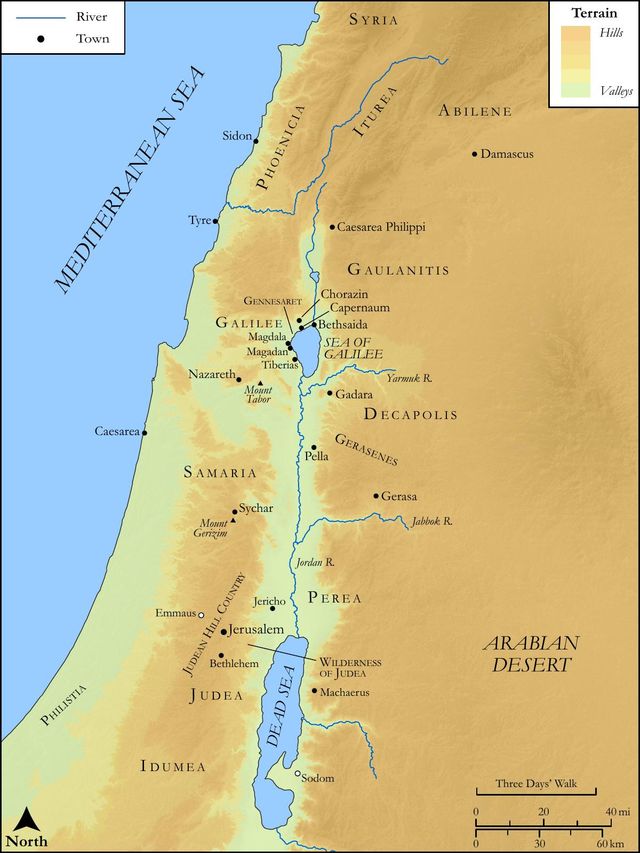
Where Matthew reaches
The passages it leans on, and the ones that lean on it
The virgin’s son called Immanuel, the first of Matthew’s fulfilments, interpreted “God with us.”
God called Israel his son out of Egypt; Matthew hears the words fulfilled in the child called back from Egypt.
Israel’s lesson of the manna becomes the Son’s answer to the tempter after forty days of fasting.
Hosea 6:6 Matthew 9:13 Matthew 12:7
“I will have mercy, and not sacrifice”: quoted at table with publicans and sinners, and again in the cornfields on the sabbath.
Daniel 7:13–14 Matthew 26:64 Matthew 28:18
The Son of man given dominion: Jesus claims Daniel’s words before the high priest and, risen, says all power is given him.
Books Matthew links to most
The Church Fathers on Matthew
5,016 quotations from 66 writers before AD 800 · the ten most quoted, in date order
- Tertullian220
- Origen253
- Hilary367
- Chromatius406
- Chrysostom407
- Jerome420
- Augustine430
- Pseudo-Chrysostom500
- Remigius533
- Gregory604
Chrysostom, on why a whole Gospel is called “the book of the generation.”
Because this is the sum of the whole dispensation, and is made an origin and root of all our blessings. … For that which teems with astonishment, and is beyond hope and all expectation, is that God should become man.
Gregory the Great, on the daily bread asked for in the Lord’s Prayer.
(Mor. xxiv. 7.) We call it our bread, yet pray that it may be given us, for it is God's to give, and is made ours by our receiving it.
Hilary, on the shepherd who leaves the ninety and nine.
But by the one sheep is to be understood one man, and under this one man is comprehended the whole human race. He that seeks man is Christ, and the ninety and nine are the host of the heavenly glory which He left.
John of Damascus, on the death of Christ: his Godhead was never parted from his body or his soul.
Although He died as man, and His holy soul was separated from His unstained body, yet His Godhead remained inseparate from either body or soul.
Keep studying
Articles