


Matthew 27:9
Bible text: King James Version (1769 Blayney text) · Public domain
Bible text: King James Version with Strong's numbers · Public domain
Bible text: Berean Standard Bible · Public domain
Bible text: American Standard Version (1901) · Public domain
Bible text: World English Bible, Messianic edition · Public domain
Bible text: Geneva Bible (1599) · Public domain
Bible text: Young's Literal Translation · Public domain
- ΤότεToteThenG5119ADVAdverb
- ἐπληρώθηeplērōthēwas fulfilledG4137V-API-3SVerb Aorist Passive Indicative 3rd Singular
- τὸtothatG3588T-NSNDefinite article Nominative Singular Neuter
- ῥηθὲνrhēthenhaving been spokenG2046V-APP-NSNVerb Aorist Passive Participle Nominative Singular Neuter
- διὰdiathroughG1223PREPPreposition
- ἸερεμίουIeremiouJeremiahG2408N-GSM-PNoun Genitive Singular Masculine Individual
- τοῦtoutheG3588T-GSMDefinite article Genitive Singular Masculine
- προφήτουprophētouprophetG4396N-GSMNoun Genitive Singular Masculine
- λέγοντος·legontossayingG3004V-PAP-GSMVerb Present Active Participle Genitive Singular Masculine
- καὶkaiAndG2532CONJConjunction
- ἔλαβονelabonthey tookG2983V-2AAI-3PVerb 2nd Aorist Active Indicative 3rd Plural
- τὰtatheG3588T-APNDefinite article Accusative Plural Neuter
- τριάκονταtriakontathirtyG5144A-NUIAdjective
- ἀργύριαarguriapieces of silverG694N-APNNoun Accusative Plural Neuter
- τὴνtēntheG3588T-ASFDefinite article Accusative Singular Feminine
- τιμὴνtimēnpriceG5092N-ASFNoun Accusative Singular Feminine
- τοῦtouof the [One]G3588T-GSMDefinite article Genitive Singular Masculine
- τετιμημένουtetimēmenoupricedG5091V-RPP-GSMVerb Perfect Passive Participle Genitive Singular Masculine
- ὃνhonwhomG3739R-ASMRelative pronoun Accusative Singular Masculine
- ἐτιμήσαντοetimēsantothey set a price onG5091V-AMI-3PVerb Aorist Middle Indicative 3rd Plural
- ἀπὸapoby [the]G575PREPPreposition
- υἱῶνhuiōnsonsG5207N-GPMNoun Genitive Plural Masculine
- ἸσραήλIsraēlof IsraelG2474N-GSM-LNoun Genitive Singular Masculine Location
English is a literal word-by-word gloss of the Greek, not the KJV's wording. Why?
This is the original text the KJV's translators worked from — each Greek word with its own literal English meaning in this verse, prepared by scholars at Tyndale House, Cambridge. The KJV translates whole sentences, not word by word, so its wording differs: one Greek word can become several English words, and the KJV may choose “charity” where the gloss reads “love”. Both are faithful — they answer different questions. For the KJV's own rendering, switch to the KJV text.
Details
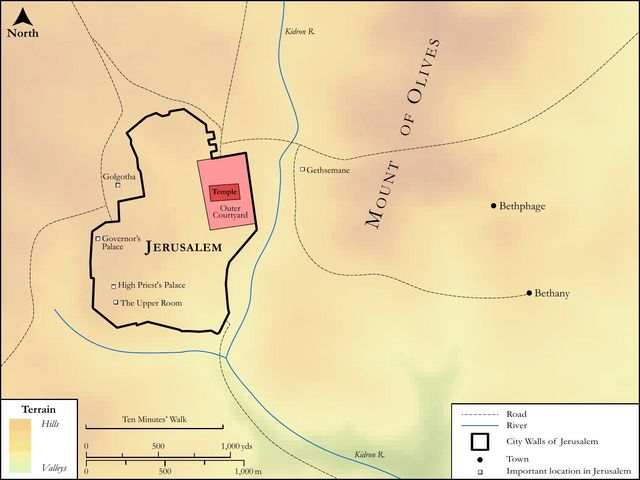
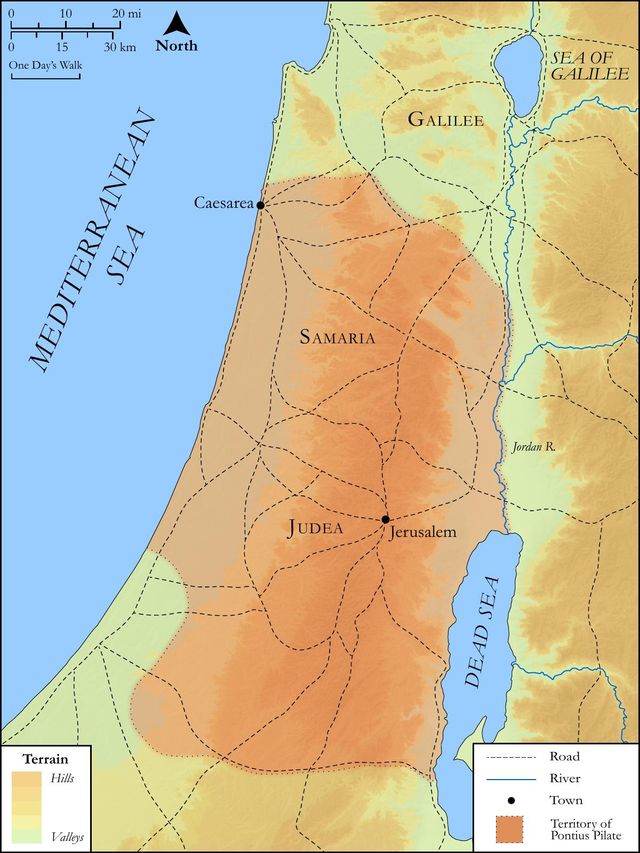
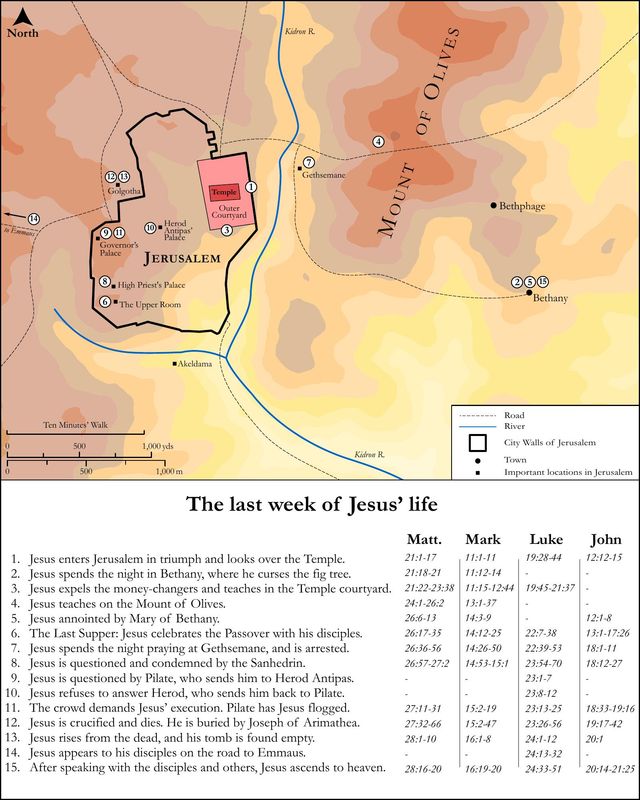
See on the biblical-era maps
Study this verse
Historical interpretation
Eleven Centuries of Reception
10 surviving comments on this verse. Each one is dated, so this reads as a timeline rather than a list.
Select a marker to jump to its quote. Markers stagger vertically where authors wrote within a few decades of each other.
(Hil. Quæst. V. et N. Test. q. 94.) Since the Chief Priests were employed about the murder of the Lord from the morning to the ninth hour, how is this proved that before the crucifixion Judas returned them the money he had received, and said to them in the temple, I have sinned, in that I have betrayed innocent blood? Whereas it is manifest that the Chief Priests and Elders were never in the temple before the Lord's crucifixion, seeing that when He was hanging on the Cross they were there to insult Him. Nor indeed can this be proved hence, because it is related before the Lord's Passion, for many things which were manifestly done before, are related after, that, and the reverse. It might have been done after the ninth hour, when Judas, seeing the Saviour dead and the veil of the temple rent, the earthquake, the bursting of the rocks, and the elements terrified, was seized with fear and sorrow thereupon. But after the ninth hour the Chief Priests and Elders were occupied, as I suppose, in the celebration of the Passover; and on the Sabbath, the Law would not have allowed him to bring money. Therefore it is to me as yet unproved on what day or at what time Judas ended his life by hanging.
Judas did not die by hanging, but lived on, having been cut down before he was suffocated. And the acts of the apostles show this, that falling head long he burst asunder in the midst, and all his bowels gushed out. This fact is related more clearly by Papias, the disciple of John, and the fourth book of the Expositions of the Oracles of the Lord as follows:
Judas walked about in this world a terrible example of impiety; his flesh swollen to such an extent that, where hay wagon can pass with ease, he was not able to pass, no, not even the mass of his head merely. They say that his eyelids swelled to such an extent that he could not see the light at all, while as for his eyes they were not visible even by a physician looking through an instrument, so far have they sunk from the surface.
His genitals appeared entirely disfigured, nauseous and large. When he carried himself about discharge and worms flowed from his entire body through his private areas only, on account of his outrages. After many agonies and punishments, he died in his own place. And on account of this the place is desolate and uninhabited even now. And to this day no one is able to go by that place, except if they block their noses with their hands. Such judgment was spread through his body and upon the earth.
The Chief Priests knowing that they had purchased a murder were condemned by their own conscience; they said, It is the price of blood.
What then did that man? When he saw that he was laboring to no profit, and that they would not consent to receive the pieces of silver, "he cast them down in the temple, and went and hanged himself. And the chief priests took the pieces of silver, and said, it is not lawful for to put them into the treasury, because it is the price of blood. And they took counsel, and bought with them the potter's field to bury strangers in. Wherefore that field was called, the field of blood, unto this day. Then was fulfilled that which was spoken by Jeremy the prophet, saying, and they took the thirty pieces of silver, the price of Him that was valued, and gave them for the potter's field, as the Lord appointed me."
Seest thou them again self-condemned by their conscience? For because they knew that they had been buying the murder, they put them not into the treasury, but bought a field to bury strangers in. And this also became a witness against them, and a proof of their treason. For the name of the place more clearly than a trumpet proclaimed their blood-guiltiness. Neither did they it at random, but having taking counsel, and in every case in like manner, so that no one should be clear of the deed, but all guilty. But these things the prophecy foretold from of old. Seest thou not the apostles only, but the prophets also declaring exactly those things which were matters of reproach, and every way proclaiming the passion, and indicating it beforehand?
This was the case with the Jews without their being conscious of it. For if they had cast it into the treasury, the thing would not have been so clearly discovered; but now having bought a piece of ground, they made it all manifest even to subsequent generations.
Hear ye as many as think to do good works out of murders, and take a reward for the lives of men. These almsgiving are Judaical, or rather they are Satanical. For there are, there are now also they, that take by violence countless things belonging to others, and think that an excuse is made for all if they cast in some ten or a hundred gold pieces.
(Verse 9, 10) Then was fulfilled what was spoken by the prophet Jeremiah, saying, 'And they took the thirty pieces of silver, the value of Him who was priced, whom they of the children of Israel priced, and gave them for the potter's field, as the Lord directed me.' This testimony is not found in Jeremiah. But in Zechariah, who is almost the last of the twelve prophets, a certain similarity is mentioned (Zech. 11). And although the meaning does not differ much, nevertheless both the order and the words are different. I recently read in a certain Hebrew volume, which a Hebrew of the Nazarene sect offered to me, an apocryphal book of Jeremiah, in which I found the following words written verbatim. However, it seems to me more like a testimony taken from Zechariah: just like the Evangelists and Apostles commonly do, who, omitting the order of words, only present the meaning from the Old Testament as an example.
Truly straining out the gnat, and swallowing the camel; for if they would not put the money into the treasury, because it was the price of blood, why did they shed the blood at all?
Also we, who were strangers to the Law and the Prophets, have profited by the perverse temper of the Jews to obtain salvation for ourselves.
This is not found at all in Hieremias; but in Zacharias (Zech. 11:13.), who is the last but one of the twelve Prophets, something like it is told, and though the sense is not very different, yet the arrangement and the words are different.
(ad Pam. Ep. lvii. 7.) Far be it then from a follower of Christ to suppose him guilty of falsehood, whereas his business was not to pry into words and syllables, but to lay down the staple of doctrine.
(in loc.) I have lately read in a Hebrew book given me by a Hebrew of the Nazarene sect, an apocryphal Hieremias, in which I find the very words here quoted. After all, I am rather inclined to think that the passage was taken by Matthew out of Zacharias, in the usual manner of the Apostles and Evangelists when they quote from the Old Testament, neglecting the words, and attending only to the sense.
This prophecy does not come from Jeremiah but from a similar passage in Zechariah, who is almost the last of the twelve prophets. Although the meaning does not differ much, Zechariah’s word order and vocabulary do conflict with Matthew’s quotation. In a copy of the Hebrew Scriptures given to me by a member of the Nazarene sect, I recently read an apocryphal edition of the book of Jeremiah in which this quotation from Matthew appeared word for word. Nevertheless it still seems more likely to me that Matthew took this prophecy from Zechariah, since it was the ordinary practice of the Evangelists and apostles to communicate only the meaning of texts from the Old Testament while neglecting to observe their word order.
(de Cons. Ev. iii. 7.) But if any one thinks this lowers the historian's credit, first let him know that not all the copies of the Gospels have the name Hieremias, but some simply by the Prophet. But I do not like this defence, because the more, and the more ancient, copies have Hieremias, and there could be no reason for adding the name, and thus making an error. But its erasure is well accounted for by the hardihood of ignorance having heard the foregoing objection urged. It might be then, that the name Hieremias occurred to the mind of Matthew as he wrote, instead of the name Zacharias, as so often happens; and that he would have straightway corrected it, when pointed out to him by such as read this while he yet lived in the flesh, had he not thought that his memory, being guided by the Holy Spirit, would not thus have called up to him one name instead of another, had not the Lord determined that it should thus be written. And why He should have so determined, the first reason is, that it would convey the wonderful consent of the Prophets, who all spake by one Spirit, which is much greater than if all the words of all the Prophets had been uttered through the mouth of one man; so that we receive without doubt whatever the Holy Spirit spake through them, each word belongs to all in common, and the whole is the utterance of each. Suppose it to happen at this day, that in repeating another's words one should mention not the speaker's name, but that of some other person, who however was the other's greater friend, and then immediately recollecting himself should correct himself, he might yet add, Yet am I right, if you only think of the close unanimity that exists between the two. How much more is this to be observed of the holy Prophets! There is a second reason why the name Hieremias should be suffered to remain in this quotation from Zacharias, or rather why it should have been suggested by the Holy Spirit. (Jer. 32:9.) It is said in Hieremias, that he bought a field of his brother's son, and gave him silver for it, though not indeed the sum stated in Zacharias, thirty pieces of silver. That the Evangelist has here adapted the thirty pieces of silver in Zacharias to this transaction in the Lord's history, is plain; but he may also wish to convey that what Hieremias speaks of the field is mystically alluded to here, and therefore he puts not the name of Zacharias who spoke of the thirty pieces of silver, but of Hieremias who spoke of the purchase of the field. So that in reading the Gospel and finding the name of Hieremias, but not finding there the passage respecting the thirty pieces of silver, but the account of the purchase of the field, the reader might be induced to compare the two together, and so extract from them the sense of the prophecy, how far it refers to what was now accomplished in the Lord. For what Matthew adds to the prophecy, Whom they of the children of Israel did value, and gave them for the potter's field, as the Lord appointed me, this, as the Lord appointed me, is found neither in Zacharias nor Hieremias. It must then be taken in the person of the Evangelist as inserted with a mystic meaning, that he had learned by revelation that the prophecy referred to this matter of the price for which Christ was betrayed.
This field then is this entire world, in which we who have been dispersed and scattered bear the fruit of good work for the Lord.Yet perhaps you would inquire of me, if the field is the world, who the potter might be who could have the ownership of the world. Unless I am mistaken, the potter is the one who made the vessels of our body from clay. Scripture says of him, “Then the Lord God formed the man from the dust from the earth.” The potter is the one who, with the warmth of his own breath, made alive the slimy clay of our flesh and with fiery heat put together the fluid and earthly matter of our bodies.
The potter, I say, is the one who fashioned us unto life with his own hands and who is refashioning us unto glory through his Christ. The apostle says, “We are being changed into his likeness from one degree of glory to another.” That is to say, we who from our previous condition have broken to pieces because of our own misdeeds are restored in a second birth through the loving kindness of this same potter. We who have been struck by death because of Adam’s transgression rise anew through the grace of the Savior. Clearly this potter is the one of whom the blessed apostle says, “Will what is molded say to its molder?” And again, “Has the potter no right over the clay to make out of the same lump one vessel for beauty and another for menial use?” For from the same clay of our body God preserves some persons for the kingdom on account of their individual merits and keeps others for punishment.
The field of this potter, then, was bought with Christ’s blood for travelers. For travelers, I say, who were without home or country and were cast about as exiles throughout the earth, rest is provided by the blood of Christ, so that those who have no possession in the world might have a burial place in Christ. Who do we say that these travelers are if not very devout Christians who, renouncing the world and possessing nothing in the world, rest in the blood of Christ? For the Christian who does not possess the world utterly possesses the Savior. Christ’s burial place then is promised to travelers so that the one who preserves himself from fleshly vices like a traveler and stranger may merit Christ’s rest. For what is Christ’s burial place if not the Christian’s rest? We therefore are travelers, in this world, and we sojourn in this life as passersby, as the apostle says: “While we are in this body we are away from the Lord.” We are travelers, I say, and a burial place has been bought for us at the price of the Savior’s blood. “We have been buried with him,” the apostle says, “through baptism in his death.” Baptism therefore is Christ’s burial place for us, in which we die to sins, are buried to evil deeds and are restored to a renewed infancy, the conscience of the old person having been dissolved in us for the sake of another birth.
(non occ.) To this day means to the time when the Evangelist was then writing. He then confirms the event by the testimony of the Prophet; Then was fulfilled that which was spoken by Jeremy the Prophet, &c.
Continue studying Matthew 27:9 across the web’s major study libraries — every link below opens this exact verse, chapter, or book on the destination site.
Read & Compare
 BibleGatewayThis verse in more than 200 translations and 70 languages.
 Bible.comThe YouVersion reader — hundreds of translations, reading plans, and highlights.
 ESV.orgCrossway's official English Standard Version reader.
 NET BibleThe NET translation with 60,000+ translators' notes on every rendering decision.
 STEP BibleTyndale House's free study tool — original text, vocabulary, and scholarly resources.
 BibliaLogos Bible Software's free web reader.
 USCCBThe New American Bible (Revised Edition) with the U.S. bishops' study notes.
Commentaries
 BibleHub CommentariesDozens of classic commentaries on this verse, gathered on one page.
 StudyLightMore than 100 commentary sets — the largest collection on the web.
 BibleRefPlain-English commentary on what this verse means, verse by verse.
 Enduring WordDavid Guzik's free commentary on this chapter, widely used by Bible teachers.
 Bible Study ToolsVerse commentary alongside Greek and Hebrew study aids.
Original Language & Research
- BibleHub InterlinearThe verse word by word — original language, transliteration, and English.
- BibleHub LexiconEvery word's original-language definition and Strong's entry.
 Blue Letter BibleDeep-study tools — Strong's numbers, concordance, and word studies.
 CNTR CollationThe earliest Greek manuscripts of this verse, collated letter by letter.
Sermons, Hymns & Audio


TrulyRandomVerse is not affiliated with these sites and doesn’t control their content. They’re linked because they’re genuinely useful.
Summary
Matthew 27:9 records the fulfillment of Old Testament prophecy concerning the thirty pieces of silver, the price of Jesus's betrayal, which was subsequently used by the chief priests to purchase the potter's field. This verse underscores Matthew's consistent theological emphasis on Jesus as the long-awaited Messiah, whose life, death, and even the circumstances surrounding His betrayal, were meticulously foretold in the Hebrew Scriptures, demonstrating divine sovereignty over human actions.
Context
ShowHideLiterary Context
This verse immediately follows Judas Iscariot's profound remorse and suicide, as described in Matthew 27:3-8. After Judas returned the thirty pieces of silver to the chief priests and elders, they deemed the "blood money" unlawful to return to the temple treasury. Their decision to use it to buy the potter's field for burying strangers is presented by Matthew as a direct fulfillment of prophetic scripture. This narrative segment serves as a bridge between Jesus's trial before Pilate and His subsequent crucifixion, highlighting the intricate web of events that, though driven by human sin, align with God's preordained plan.
Historical & Cultural Context
The "thirty pieces of silver" was a specific sum, notably the legal compensation for a slave gored by an ox, as stipulated in Exodus 21:32. This price, applied to Jesus, was a profound insult, signifying His perceived low value to His betrayer and the religious authorities. The "potter's field" (also known as Aceldama or "Field of Blood") was likely a barren piece of land, perhaps previously used by a potter for clay, and thus cheap to acquire. The practice of buying a burial ground for strangers reflects a Jewish custom of hospitality and care, even for non-Jews, though in this context, it was a means for the priests to dispose of the "blood money" without defiling the temple treasury.
Key Themes
ShowHideA dominant theme in Matthew's Gospel, powerfully evident here, is the Fulfillment of Prophecy. Matthew consistently presents Jesus's life and ministry as the culmination of Old Testament expectations, often using "that it might be fulfilled" clauses, as seen in Matthew 1:22 or Matthew 2:15. This verse specifically links the betrayal and the use of the money to ancient prophecies, emphasizing God's meticulous plan. Another crucial theme is Divine Sovereignty Amidst Human Sin. Despite the wicked actions of Judas and the corrupt religious leaders, God's overarching purpose for the Messiah's suffering and atonement is advanced, illustrating that even human depravity cannot thwart divine will, but rather, God can providentially orchestrate it for His redemptive purposes.
Exposition and Analysis
ShowHideKey Word Analysis
ShowHideThis verb signifies "to make replete," "to complete," or "to verify (or coincide with a prediction)." In Matthew's Gospel, its frequent use emphasizes that the events of Jesus's life are not random occurrences but the precise outworking of God's pre-ordained plan, validating Jesus's messianic identity by demonstrating His alignment with ancient prophecies.
This verb means "to take," "to get hold of," or "to receive." Here, it describes the action of the chief priests in taking possession of the thirty pieces of silver that Judas had thrown into the temple. The verb highlights a deliberate action on their part, setting in motion the subsequent purchase of the potter's field, which Matthew then links to prophecy.
Derived from a word meaning "value" or "honor," this verb means "to prize," "to fix a valuation upon," or "to revere." In this context, it refers to the act of setting a price for Jesus. The repetition ("the price of him that was valued, whom they... did value") underscores the deliberate, yet ironically low, assessment of Jesus's worth by those who sought His demise, contrasting sharply with His true divine value.
Verse Breakdown
ShowHide"Then was fulfilled that which was spoken by Jeremy the prophet, saying,"
This introductory clause is Matthew's signature "fulfillment formula," directly asserting that the subsequent events are the precise realization of Old Testament prophecy. The attribution to "Jeremy the prophet" (Jeremiah) is significant and complex, as the primary source for the "thirty pieces of silver" and "potter" imagery is found in Zechariah, with Jeremiah providing thematic resonance regarding the potter and a purchased field.
"And they took the thirty pieces of silver,"
This refers to the chief priests and elders who, after Judas threw the money into the temple, collected it. The "thirty pieces of silver" is the specific sum of betrayal, a paltry amount that held symbolic weight as the price of a slave.
"the price of him that was valued,"
This phrase clarifies the nature of the thirty pieces of silver—it was the monetary valuation placed upon Jesus. The passive voice emphasizes that Jesus was the object of this valuation, determined by others.
"whom they of the children of Israel did value;"
This final clause reiterates the valuation and explicitly identifies the valuers as "the children of Israel," specifically their leaders. This highlights the tragic irony that the very people who should have recognized and honored their Messiah were the ones who set such a low price upon Him, effectively rejecting Him.
Literary Devices
ShowHideMatthew 27:9 powerfully employs several literary devices. The most prominent is Fulfillment Language, signaled by the phrase "Then was fulfilled that which was spoken." This formula is a hallmark of Matthew's Gospel, serving to authenticate Jesus's messianic claims by demonstrating His life as the culmination of divine prophecy. There is profound Irony in the religious leaders, who meticulously adhere to the law by refusing to put "blood money" into the temple treasury, yet are simultaneously orchestrating the murder of the innocent Son of God. Their external piety masks internal corruption. Furthermore, Allusion is central, as Matthew alludes to Old Testament prophecies, primarily from Zechariah 11:12-13 and Jeremiah 18-19, 32:6-15. This allusive technique requires the reader to be familiar with the prophetic tradition to grasp the full weight of the divine orchestration of events. Finally, Symbolism is present in the "thirty pieces of silver" itself, which symbolizes the low value placed on Jesus by His betrayers and accusers, contrasting with His infinite worth.
Theological and Thematic Connections
ShowHideMatthew's careful linking of the events surrounding Jesus's betrayal and the subsequent use of the blood money to Old Testament prophecy underscores a profound theological truth: God's redemptive plan is meticulously orchestrated and sovereignly executed, even through the sinful choices of humanity. The seemingly random or wicked acts of Judas and the chief priests are revealed as instruments in the divine drama, serving to bring about the foretold suffering and death of the Messiah, which is essential for the atonement of sins. This demonstrates that God's purposes are not thwarted by human rebellion but can incorporate and even utilize such rebellion to achieve His ultimate will, culminating in the cross.
Reflection and Application
ShowHideMatthew 27:9 serves as a stark reminder of the profound truth that God's sovereign plan unfolds even amidst the darkest human betrayals and injustices. For us today, this means that no matter how chaotic or unjust circumstances may appear, God remains in control, working all things, even evil, for His ultimate redemptive purposes. This should inspire both awe at God's power and comfort in His unfailing providence. Furthermore, the "thirty pieces of silver" challenges us to reflect on the value we place on Jesus Christ. Do we, like those who betrayed and condemned Him, undervalue His worth, prioritizing worldly gain, comfort, or approval over devotion to Him? Or do we recognize His infinite value as our Savior and Lord, responding with wholehearted obedience and worship? Our actions, like those in this narrative, reveal the true measure of our estimation of Christ.
Questions for Reflection
ShowHideFAQ
ShowHideWhy does Matthew attribute this prophecy to "Jeremy the prophet" (Jeremiah) when the most direct parallel is found in Zechariah 11:12-13?
ShowHideThis is a well-known scholarly discussion. Several explanations are commonly offered:
Regardless of the precise mechanism, Matthew's intention is clear: to assert that the events of Jesus's passion were not random but divinely ordained and meticulously foretold in the Hebrew Scriptures, thereby affirming Jesus's identity as the Messiah.
Christ-Centered Fulfillment
ShowHideMatthew 27:9, with its declaration of prophetic fulfillment regarding the thirty pieces of silver and the potter's field, points profoundly to Christ's ultimate redemptive work. The "price of him that was valued" at a slave's worth (Exodus 21:32) ironically foreshadows the immeasurable price Jesus would pay for humanity's redemption. He, the King of Glory, allowed Himself to be undervalued and betrayed, not because He was worth so little, but precisely because His love compelled Him to become a servant, even to death on a cross. This act of being "valued" and sold for a paltry sum highlights His willing self-sacrifice, echoing Philippians 2:7-8, where He "made himself nothing, by taking the very nature of a servant." The "blood money" used to purchase a burial ground for strangers symbolizes the broader scope of Christ's atoning sacrifice: His shed blood, though a result of human sin, became the means by which a "field" of redemption was purchased for all, including "strangers" or Gentiles, bringing them near to God (Ephesians 2:13). Thus, the ignominious betrayal and the subsequent use of the silver, orchestrated by human depravity, ultimately served God's divine purpose to offer salvation to a lost world through the perfect, once-for-all sacrifice of the Lamb of God, who takes away the sin of the world!.