


Matthew 15:2
- διὰdiaBecause ofG1223PREPPreposition
- τίtiwhyG5101I-ASNInterrogative pronoun Accusative Singular Neuter
- οἱhoitheG3588T-NPMDefinite article Nominative Plural Masculine
- μαθηταίmathētaidisciplesG3101N-NPMNoun Nominative Plural Masculine
- σουsouof YouG4771P-2GSPersonal pronoun Genitive 2nd Singular
- παραβαίνουσινparabainousinbreakG3845V-PAI-3PVerb Present Active Indicative 3rd Plural
- τὴνtēntheG3588T-ASFDefinite article Accusative Singular Feminine
- παράδοσινparadosintraditionG3862N-ASFNoun Accusative Singular Feminine
- τῶνtōnof theG3588T-GPMDefinite article Genitive Plural Masculine
- πρεσβυτέρων;presbuterōnelders?G4245N-GPM-TNoun Genitive Plural Masculine Title
- οὐouNotG3756PRT-NNegative Particle Negative
- γὰρgarforG1063CONJConjunction
- νίπτονταιniptontaithey washG3538V-PMI-3PVerb Present Middle Indicative 3rd Plural
- τὰςtastheG3588T-APFDefinite article Accusative Plural Feminine
- χεῖραςcheirashandsG5495N-APFNoun Accusative Plural Feminine
- αὐτῶνautōnof themG846P-GPMPersonal pronoun Genitive Plural Masculine
- ὅτανhotanwhenG3752CONJConjunction
- ἄρτονartonbreadG740N-ASMNoun Accusative Singular Masculine
- ἐσθίωσινesthiōsinthey may eatG2068V-PAS-3PVerb Present Active Subjunctive 3rd Plural
English is a literal word-by-word gloss of the Greek, not the KJV's wording. Why?
This is the original text the KJV's translators worked from — each Greek word with its own literal English meaning in this verse, prepared by scholars at Tyndale House, Cambridge. The KJV translates whole sentences, not word by word, so its wording differs: one Greek word can become several English words, and the KJV may choose “charity” where the gloss reads “love”. Both are faithful — they answer different questions. For the KJV's own rendering, switch to the KJV text.
Details
See on the biblical-era map
Study this verse
Public-domain commentary
Matthew Henry
From his Commentary on the Whole Bible. Henry comments on passages, not single verses — this entry covers Matthew 15:1–9. His four-level outline is real structure in the source text, so it is rendered as structure.
Evil manners, we say, beget good laws. The intemperate heat of the Jewish teachers for the support of their hierarchy, occasioned many excellent discourses of our Saviour's for the settling of the truth, as here.
I.Here, is the cavil of the scribes and Pharisees at Christ's disciples, for eating with unwashen hands.
The scribes and Pharisees were the great men of the Jewish church, men whose gain was godliness, great enemies to the gospel of Christ, but colouring their opposition with a pretence of zeal for the law of Moses, when really nothing was intended but the support of their own tyranny over the consciences of men. They were men of learning and men of business. These scribes and Pharisees here introduced were of Jerusalem, the holy city, the head city, whither the tribes went up, and where were set the thrones of judgment; they should therefore have been better than others, but they were worse. Note, External privileges, if they be not duly improved, commonly swell men up the more with pride and malignity. Jerusalem, which should have been a pure spring, was now become a poisoned sink. How is the faithful city become a harlot!
Now if these great men be the accusers, pray what is the accusation? What articles do they exhibit against the disciples of Christ? Why, truly, the thing laid to their charge, is, nonconformity to the canons of their church (Mat 15:2); Why do thy disciples transgress the tradition of the elders? This charge they make good in a particular instance; They wash not their hands when they eat bread. A very high misdemeanor! It was a sign that Christ's disciples conducted themselves inoffensively, when this was the worst thing they could charge them with.
Observe, 1. What was the tradition of the elders - That people should often wash their hands, and always at meat. This they placed a great deal of religion in, supposing that the meat they touched with unwashen hands would be defiling to them. The Pharisees practiced this themselves, and with a great deal of strictness imposed it upon others, not under civil penalties, but as matter of conscience, and making it a sin against God if they did not do it. Rabbi Joses determined, "that to eat with unwashen hands is as great a sin as adultery." And Rabbi Akiba being kept a close prisoner, having water sent him both to wash his hands with, and to drink with his meat, the greatest part being accidentally shed, he washed his hands with the remainder, though he left himself none to drink, saying he would rather die than transgress the tradition of the elders. Nay, they would not eat meat with one that did not wash before meat. This mighty zeal in so small a matter would appear very strange, if we did not still see it incident to church-oppressors, not only to be fond of practising their own inventions, but to be furious in pressing their own impositions.
2.What was the transgression of this tradition or injunction by the disciples; it seems, they did not wash their hands when they ate bread, which was the more offensive to the Pharisees, because they were men who in other things were strict and conscientious. The custom was innocent enough, and had a decency in its civil use. We read of the water for purifying at the marriage where Christ was present (Joh 2:6), though Christ turned it into wine, and so put an end to that use of it. But when it came to be practised and imposed as a religious rite and ceremony, and such a stress laid upon it, the disciples, though weak in knowledge, yet were so well taught as not to comply with it, or observe it; no not when the scribes and Pharisees had their eye upon them. They had already learned St. Paul's lesson, All things are lawful for me; no doubt, it is lawful to wash before meat; but I will not be brought under the power of any; especially not those who said to their souls, Bow down, that we may go over. Co1 6:12.
3.What was the complaint of the scribes and Pharisees against them. They quarrel with Christ about it, supposing that he allowed them in it, as he did, no doubt, by his own example; "Why do thy disciples transgress the canons of the church? And why dost thou suffer them to do it?" It was well that the complaint was made to Christ; for the disciples themselves, though they knew their duty in this case, were perhaps not so well able to give a reason for what they did as were to be wished.
II.Here is Christ's answer to this cavil, and his justification of the disciples in that which was charged upon them as a transgression.
Note, While we stand fast in the liberty wherewith Christ has made us free, he will be sure to bear us out in it.
Two ways Christ replies upon them;
1.By way of recrimination, Mat 15:3-6. They were spying motes in the eyes of his disciples, but Christ shows them a beam in their own. But that which he charges upon them is not barely a recrimination, for it will be no vindication of ourselves to condemn our reprovers; but it is such a censure of their tradition (and the authority of that was what they built their charge upon) as makes not only a non-compliance lawful, but an opposition a duty. That human authority must never be submitted to, which sets up in competition with divine authority.
(1.)The charge in general is, You transgress the commandment of God by your tradition. They called it the tradition of the elders, laying stress upon the antiquity of the usage, and the authority of them that imposed it, as the church of Rome does upon fathers and councils; but Christ calls it their tradition. Note, Illegal impositions will be laid to the charge of those who support and maintain them, and keep them up, as well of those who first invented and enjoined them; Mic 6:16. You transgress the commandment of God. Note, Those who are most zealous of their own impositions, are commonly most careless of God's commands; which is a good reason why Christ's disciples should stand upon their guard against such impositions, lest, though at first they seem only to infringe the liberty of Christians, they come at length to confront the authority of Christ. Though the Pharisees, in this command of washing before meat, did not entrench upon any command of God; yet, because in other instances they did, he justifies his disciples' disobedience to this.
(2.)The proof of this charge is in particular instance, that of their transgressing the fifth commandment.
[1.]Let us see what the command of God is (Mat 15:4), what the precept, and what the sanction of the law is.
The precept is, Honour thy father and thy mother; this is enjoined by the common Father of mankind, and by paying respect to them whom Providence has made the instruments of our being, we give honour to him who is the Author of it, who has thereby, as to us, put some of his image upon them. The whole of children's duty to their parents is included in this of honouring them, which is the spring and foundation of all the rest, If I be a father, where is my honour? Our Saviour here supposes it to mean the duty of children's maintaining their parents, and ministering to their wants, if there be occasion, and being every way serviceable to their comfort. Honour widows, that is, maintain them, Ti1 5:3.
The sanction of this law in the fifth commandment, is, a promise, that thy days may be long; but our Saviour waives that, lest any should thence infer it to be only a thing commendable and profitable, and insists upon the penalty annexed to the breach of this commandment in another scripture, which denotes the duty to be highly and indispensably necessary; He that curseth father or mother, let him die the death: this law we have, Exo 21:17. The sin of cursing parents is here opposed to the duty of honouring them. Those who speak ill of their parents, or wish ill to them, who mock at them, or give them taunting and opprobrious language, break this law. If to call a brother Raca be so penal, what is it to call a father so? By our Saviour's application of this law, it appears, that denying service or relief to parents is included in cursing them. Though the language be respectful enough, and nothing abusive in it, yet what will that avail, if the deeds be not agreeable? it is but like him that said, I go, Sir, and went not, Mat 21:30.
[2.]Let us see what was the contradiction which the tradition of the elders gave to this command. It was not direct and downright, but implicit; their casuists gave them such rules as furnished them with an easy evasion from the obligation of this command, Mat 15:5, Mat 15:6. You hear what God saith, but ye say so and so. Note, That which men say, even great men, and learned men, and men in authority, must be examined by that which God saith; and if it be found either contrary or inconsistent, it may and must be rejected, Act 4:19. Observe,
First, What their tradition was; That a man could not in any case bestow his worldly estate better than to give it to the priests, and devote it to the service of the temple: and that when any thing was so devoted, it was not only unlawful to alienate it, but all other obligations, though ever so just and sacred, were thereby superseded, and a man was thereby discharged from them. And this proceeded partly from their ceremoniousness, and the superstitious regard they had to the temple, and partly from their covetousness, and love of money: for what was given to the temple they were gainers by. The former was, in pretence, the latter was, in truth, at the bottom of this tradition.
Secondly, How they allowed the application of this to the case of children. When their parents' necessities called for their assistance, they pleaded, that all they could spare from themselves and their children, they had devoted to the treasury of the temple; It is a gift, by whatsoever thou mightest be profited by me, and therefore their parents must expect nothing from them; suggesting withal, that the spiritual advantage of what was so devoted, would redound to the parents, who must live upon that air. This, they taught, was a good and valid plea, and many undutiful, unnatural children made use of it, and they justified them in it, and said, He shall be free; so we supply the sense. Some go further, and supply it thus, "He doth well, his days shall be long in the land, and he shall be looked upon as having duly observed the fifth commandment." The pretence of religion would make his refusal to provide for his parents not only passable but plausible. But the absurdity and impiety of this tradition were very evident: for revealed religion was intended to improve, not to overthrow, natural religion; one of the fundamental laws of which is this of honouring our parents; and had they known what that meant, I will have justice, and mercy, and not sacrifice, they had not thus made the most arbitrary rituals destructive of the most necessary morals. This was making the command of God of no effect. Note, Whatever leads to, or countenances, disobedience, does, in effect, make void the command; and they that take upon them to dispense with God's law, do, in Christ's account, repeal and disannul it. To break the law is bad, but to teach men so, as the scribes and Pharisees did, is much worse, Mat 5:19. To what purpose is the command given, if it be not obeyed? The rule is, as to us, of none effect, if we be not ruled by it. It is time for thee, Lord, to work; high time for the great Reformer, the great Refiner, to appear; for they have made void thy law (Psa 119:126); not only sinned against the commandment, but, as far as in them lay, sinned away the commandment. But, thanks be to God, in spite of them and all their traditions, the command stands in full force, power, and virtue.
2.The other part of Christ's answer is by way of reprehension; and that which he here charges them with, is hypocrisy; Ye hypocrites, Mat 15:7. Note, It is the prerogative of him who searcheth the heart, and knows what is in man, to pronounce who are hypocrites. The eye of man can perceive open profaneness, but it is only the eye of Christ that can discern hypocrisy, Luk 16:15. And as it is a sin which his eye discovers, so it is a sin which of all others his soul hates.
Now Christ fetches his reproof from Isa 29:13. Well did Esaias prophesy of you. Isaiah spoke it of the men of that generation to which he prophesied, yet Christ applies it to these scribes and Pharisees. Note, The reproofs of sin and sinners, which we find in scripture, were designed to reach the like persons and practices to the end of the world; for they are not of private interpretation, Pe2 1:20. The sinners of the latter days are prophesied of, Ti1 4:1; Ti2 3:1; Pe2 3:3. Threatenings directed against others, belong to us, if we be guilty of the same sins. Isaiah prophesied not of them only, but of all other hypocrites, against whom that word of his is still levelled, and stands in force. The prophecies of scripture are every day in the fulfilling.
This prophecy exactly deciphers a hypocritical nation, Isa 9:17; Isa 10:6. Here is,
(1.)The description of hypocrites, in two things.
[1.]In their own performances of religious worship, Mat 15:8, when they draw nigh to God with their mouth, and honour him with their lips, their heart is far from him. Observe,
First, How far a hypocrite goes; he draws nigh to God, and honours him; he is, in profession, a worshipper of God. The Pharisee went up to the temple, to pray; he does not stand at that distance which those are at, who live without God in the world, but has a name among the people near unto him. They honour him; that is, they take on them to honour God, they join with those that do so. Some honour God has even from the services of hypocrites, as they help to keep up the face and form of godliness in the world, whence God fetches honour to himself, though they intend it not to him. When God's enemies submit themselves but feignedly, when they lie unto him, so the word is (Psa 66:3), it redounds to his honour, and he gets himself a name.
Secondly, Where he rests and takes up; this is done gut with his mouth and with his lips. It is piety but from the teeth outwards; he shows much love, and that is all, there is in his heart no true love; they make their voices to be heard (Isa 58:4), mention the name of the Lord, Isa 48:1. Hypocrites are those that only make a lip-labour of religion and religious worship. In word and tongue, the worst hypocrites may do as well as the best saints, and speak as fair with Jacob's voice.
Thirdly, What that is wherein he comes short; it is in the main matter; Their heart is far from me, habitually alienated and estranged (Eph 4:18), actually wandering and dwelling upon something else; no serious thoughts of God, no pious affections toward him, no concern about the soul and eternity, no thoughts agreeable to the service. God is near in their mouth, but far from their reins, Jer 12:2; Eze 33:31. The heart, with the fool's eyes, is in the ends of the earth. It is a silly dove that is without a heart, and so it is a silly duty, Hos 7:11. A hypocrite says one thing, but thinks another. The great thing that God looks at and requires is the heart (Pro 23:26); if that be far from him, it is not a reasonable service and therefore not an acceptable one; it is the sacrifice of fools, Ecc 5:1.
[2.]In their prescriptions to others. This is an instance of their hypocrisy, that they teach for doctrines the commandments of men. The Jews then, as the papists since, paid the same respect to oral tradition that they did to the word of God, receiving it pari pietatis affectu ac reverenti - with the same pious affection and reverence. Conc. Trident. Sess. 4. Decr. 1. When men's inventions are tacked to God's institutions, and imposed accordingly, this is hypocrisy, a mere human religion. The commandments of men are properly conversant about the things of men, but God will have his own work done by his own rules, and accepts not that which he did not himself appoint. That only cones to him, that comes from him.
(2.)The doom of hypocrites; it is put in a little compass; In vain do they worship me. Their worship does not attain the end for which it was appointed; it will neither please God, nor profit themselves. If it be not in spirit, it is not in truth, and so it is all nothing. That man who only seems to be religious, but is not so, his religion is vain (Jam 1:26); and if our religion be a vain oblation, a vain religion, how great is that vanity! How sad is it to live in an age of prayers and sermons, and sabbaths and sacraments, in vain, to beat the air in all these; it is so, if the heart be not with God in them. Lip-labour is lost labour, Isa 1:11. Hypocrites sow the wind and reap the whirlwind; they trust in vanity, and vanity will be their recompence.
Thus Christ justified his disciples in their disobedience to the traditions of the elders; and this the scribes and Pharisees got by their cavilling. We read not of any reply they made; if they were not satisfied, yet they were silenced, and could not resist the power wherewith Christ spake.
Historical interpretation
Nine Centuries of Reception
12 surviving comments on this verse. Each one is dated, so this reads as a timeline rather than a list.
Select a marker to jump to its quote. Markers stagger vertically where authors wrote within a few decades of each other.
Among other observations, some of the Jewish elders ruled that a person should not take or eat food unless he first washed his hands. This observation, however, reveals a particular custom that is human and produces no beneficial effect. Therefore this tradition of the elders is practically useless, for it does not benefit a person’s health. No justification is gained from this tradition, and no harm is done in disregarding it. For God is not concerned whether a man washes his hands before eating but whether he has kept his heart washed and his conscience clean from the filth of sin. Truly, what good is it to wash your hands and to have a defiled conscience? The Lord’s disciples were clean of heart and were guided by an untainted conscience. Hence they were not overly concerned with washing their hands. They had washed them once in baptism with their whole body, in accord with our Lord’s words to Peter: “He who has bathed needs only to wash, and he is clean all over, as you are clean.”
Then; when? when He had wrought His countless miracles; when He had healed the infirm by the touch of the hem of His garment. For even with this intent doth the evangelist mark the time, that He might signify their unspeakable wickedness, by nothing repressed.
But what means, "The Scribes and Pharisees, which were of Jerusalem?" In every one of the tribes were they scattered abroad, and divided into twelve parts; but they who occupied the chief city were worse than the others, as both enjoying more honor, and having contracted much haughtiness.
But mark, I pray thee, how even by the question itself they are convicted; in not saying, "Why do they transgress the law of Moses," but, "the tradition of the elders." Whence it is evident that the priests were inventing many novelties, although Moses, with much terror and with much threatening, had enjoined neither to add nor take away. For "ye shall not add," saith he, "unto the word which I command you this day, and ye shall not take away from it."
But not the less were they innovating; as in this instance, that one ought not to eat with unwashen hands, that we must wash cups and brazen vessels, that we must wash also ourselves. Thus, when men were henceforth, as time advanced, to be freed from their observances, at that very time they bound them with the same in more and more instances, fearing lest any one should take away their power, and wishing to strike more dread, as though they were themselves also lawgivers. The thing in fact proceeded so far in enormity, that while their own commandments were kept, those of God were transgressed; and they so far prevailed, that the matter had actually become a ground of accusation. Which was a twofold charge against them, in that they both invented novelties, and were so strict exactors on their own account, while of God they made no reckoning.
(Hom. li.) For this reason also the Evangelist marks the time that He may show their iniquity overcome by nothing; for they came to Him at a time when He had wrought many miracles, when He had healed the sick by the touch of His hem. That the Scribes and Pharisees are here said to have come from Jerusalem, it should be known that they were dispersed through all the tribes, but those that dwelt in the Metropolis were worse than the others, their higher dignity inspiring them with a greater degree of pride.
Observe, how they are taken in their own question. They say not, 'Why do they transgress the Law of Moses?' but, the tradition of the elders; whence it is manifest that the Priests had introduced many new things, although Moses had said, Ye shall not add ought to the word which I set before you this day, neither shall ye take ought away from it; (Deut. 4:2.) and when they ought to have been set free from observances, then they bound themselves by many more; fearing lest any should take away their rule and power, they sought to increase the awe in which they were held, by setting themselves forth as legislators.
But the disciples now did not eat with washen hands, because they already despised all things superfluous, and attended only to such as were necessary; thus they accepted neither washing nor not washing as a rule, but did either as it happened. For how should they who even neglected the food that was necessary for them, have any care about this rite?
Christ made no excuse for them, but immediately brought a counter charge, showing that he that sins in great things ought not to take offence at the slight sins of others. He answered and said unto them, Why do ye also transgress the commandment of God because of your tradition? He says not that they do well to transgress that He may not give room for calumny; nor on the other hand does He condemn what the Apostles had done, that He may not sanction their traditions; nor again does He bring any charge directly against them of old, that they might not put Him from them as a calumniator; but He points His reproof against those who had come to Him; thus at the same time touching the elders who had laid down such a tradition; saying,
He desired to show the great honour that ought to be paid to parents, and therefore attached both a reward and a penalty. But in this occasion the Lord passes over the reward promised to such as did honour their parents, namely, that they should live long upon the earth, and brings forward the terrible part only, namely, the punishment, that He might strike these dumb and attract others; And he that curseth father and mother, let him die the death; thus He shows that they deserved even death. For if ho who dishonours his parent even in word is worthy of death, much more ye who dishonour him in deed; and ye not only dishonour your parents, but teach others to do so likewise. Ye then who do not deserve even to live, how accuse ye my disciples? But how they transgress the commandment of God is clear when He adds, But ye say, Whoso shall say to his father or his mother, If in a gift, whatsoever thou mightest be profited by me.
But it were meet first to inquire, why the disciples ate with unwashen hands. Wherefore then did they so eat? Not as making a point of it, but as overlooking henceforth the things that are superfluous, and attending to such as are necessary; having no law to wash or not to wash, but doing either as it happened. For they that despised even their own necessary food, how were they to hold these things worth much consideration? This then having often happened unintentionally,-for instance, when they ate in the wilderness, when they plucked the ears of corn,-is now put forward as a charge by these persons, who are always transgressing in the great things, and making much account of the superfluous.
What then saith Christ? He did not set Himself against it, neither made He any defense, but straightway blames them again, plucking down their confidence, and signifying that he who commits great sins ought not to be strict with others concerning small matters. "What? when you ought to be blamed," saith He, "do ye even blame?"
But do thou observe, how when it is His will to set aside any of the things enjoined by the law, He does it in the form of an apology; and so He did in that case. For by no means doth He proceed at once to transgress it, nor doth He say, "It is nothing;" for surely He would have made them more audacious; but first He clean cuts away their boldness, bringing forward the far heavier charge, and directing it upon their head. And He neither saith, "they do well in transgressing it," lest He should give them a hold on Him; nor doth He speak ill of their proceeding, lest He should confirm the law: nor again, on the other hand, doth He blame the elders, as lawless and unholy men; for doubtless they would have shunned Him as a reviler and injurious: but all these things He gives up, and proceeds another way. And He seems indeed to be rebuking the persons themselves who had come to Him, but He is reprehending them that enacted these laws; nowhere indeed making mention of the elders, but by His charge against the Scribes casting down them also, and signifying that their sin is twofold, first in disobeying God, next in doing so on men's account; as though He had said, "Why this, this hath ruined you, your obeying the elders in all things."
And He said not, "the elders' tradition," but "your own." And, "ye say;" again He said not, "the elders say:" in order to make His speech less galling. That is, because they wanted to prove the disciples transgressors of the law, He signifies that they themselves are doing so, but that these are free from blame. For of course that is not a law, which is enjoined by men (wherefore also He calls it "a tradition"), and especially by men that are transgressors of the law.
And since this had no shade of contrariety to the law, to command men to wash their hands, He brings forward another tradition, which is opposed to the law. And what He saith is like this. "They taught the young, under the garb of piety, to despise their fathers." How, and in what way? "If one of their parents said to his child, Give me this sheep that thou hast, or this calf, or any such thing, they used to say, 'This is a gift to God, whereby thou wouldest be profited by me, and thou canst not have it.' And two evils hence arose: on the one hand they did not bring them to God, on the other they defrauded their parents under the name of the offering, alike insulting their parents for God's sake, and God for their parents' sake."
But He, omitting the first, the reward appointed for them that honor their parents, states that which is more awful, the punishment, I mean, threatened to such as dishonor them; desiring both to dismay them, and to conciliate such as have understanding; and He implies them to be for this worthy of death. For if he who dishonors them in word is punished, much more ye, who do so in deed, and who not only dishonor, but also teach it to others. "Ye then who ought not so much as to live, how find ye fault with the disciples?"
"And what wonder is it, if ye offer such insults to me, who am as yet unknown, when even to the Father ye are found doing the like?" For everywhere He both asserts and implies, that from Him they began with this their arrogance.
But some do also otherwise interpret, "It is a gift, by whatsoever thou mightest be profited by me;" that is, I owe thee no honor, but it is a free gift from me to thee, if indeed I do honor thee. But Christ would not have mentioned an insult of that sort.
And Mark again makes this plainer, by saying, "It is Corban, by whatsoever thou mightest be profiled by me;" which means, not a gift and present, but properly an offering.
Wonderful infatuation of the Pharisees and Scribes! They accuse the Son of God that He does not keep the traditions and commandments of men.
But the hands that are to be washed are the acts not of the body, but of the mind; that the word of God may be done in them.
Since ye because of the tradition of men neglect the commandment of God, why do ye take upon you to reprove my disciples, for bestowing little regard upon the precepts of the elders, that they may observe the commands of God? For God hath said, Honour thy father and thy mother. Honour in the Scriptures is shown not so much in salutations and courtesies as in alms and gifts. Honour, (1 Tim. 5:3.) says the Apostle, the widows who are widows indeed; here 'honour' signifies a gift. The Lord then having thought for the infirmity, the age, or the poverty of parents, commanded that sons should honour their parents in providing them with necessaries of life.
For the Scribes and Pharisees desiring to overturn this foregoing most provident law of God, that they might bring in their impiety under the mask of piety, taught bad sons, that should any desire to devote to God, who is the true parent, those things which ought to be offered to parents, the offering to the Lord should he preferred to the offering them to parents.
And thus the parents refusing what they saw thus dedicated to God, hat they might not incur the guilt of sacrilege, perished of want, and so it came to pass that what the children offered for the needs of the temple and the service of God, went to the gain of the Priests.
Or it may briefly have the following sense; Ye compel children to say to their parents, What gift soever I was purposing to offer to God, you take and consume upon your living, and so it profits you; as much as to say, Do not so.
(Vers. 1, 2.) For they do not wash their hands when they eat bread. Hands, that is, works, are to be washed, not of the body for sure, but of the soul, so that the word of God may be made in them.
(de Cons. Ev. ii. 49.) The Evangelist thus constructs the order of his narrative, Then came unto him, that, as appeared in the passage over the lake, the order of the events that followed that might be shewn.
(cont. Adv. Leg. et Proph. ii. 1.) Christ here clearly shows both that that law which the heretic blasphemes is God's law, and that the Jews had their traditions foreign to the prophetical and canonical books; such as the Apostle calls profane and vain fables.
(cont. Faust. xvi. 24.) The Lord here teaches us many things; That it was not He that turned the Jews from their God; that not only did He not infringe the commandments, but convicts them of infringing them; and that He had ordained no more than those by the hand of Moses.
(Quæst. Ev. i. 16.) Otherwise; The gift whatsoever thou offerest on my account, shall profit thee; that is to say, Whatsoever gift thou offerest on my account, shall henceforth remain with thee; the son signifying by these words that there is no longer need that parents should offer for him, as he is of age to offer for himself. And those who were of age to be able to say thus to their parents, the Pharisees denied that they were guilty, if they did not show honour to their parents.
They were faulty for two reasons; because they had come from Jerusalem, from the holy city, and because they were elders of the people, and doctors of the Law, and had not come to learn but to reprove the Lord, for it is added, Saying, Why do thy disciples transgress the tradition of the elders?
Of what kind these traditions were, Mark shows when he says, The Pharisees and all the Jews, except they wash their hands oft, eat not. (Mark 7:3.) Here then also they find fault with the disciples, saying, For they wash not their hands when they eat bread.
Or the Pharisees found fault with the Lord's disciples, not concerning that washing which we do from ordinary habit, and of necessity, but of that superfluous washing which was invented by the tradition of the elders.
(in Marc. 7, 1.) Taking carnally those words of the Prophets, in which it is said, Wash, and he ye clean, they, observed it only in washing the body; (Is. 1:16.) hence they had laid it down that we ought not to eat with unwashen hands.
The men of Gennezareth and the less learned believe; but they who seem to be wise come to dispute with Him; according to that, Thou hast hid these things from the wise and prudent, and hast revealed them unto babes. Whence it is said, Then came to him from Jerusalem Scribes and Pharisees.
Although there were scribes and Pharisees in every place, those in Jerusalem were the most honored. Hence they envied Christ all the more as they were the most vainglorious. As a custom from ancient tradition, the Jews did not eat with unwashed hands. Seeing the disciples disdain this tradition, they thought that the disciples held the elders in contempt. What then does the Saviour do? He says nothing in defense of this, but accuses them in return.
(ap. Anselm.) In this interpretation the sense will be, What I offer to God will profit both you and myself; and therefore you ought not to take of my goods for your own needs, but to suffer that I offer them to God.
(ap. Anselm.) Or the sense may be, Whosoever, that is, of you young men, shall say, that is, shall either be able to say, or shall say, to his father or mother, O father, the gift that is of me devoted to God, shall it profit thee? as it were an exclamation of surprise; you ought not to take it that you may not incur the guilt of sacrilege. Or, we may read it with this ellipsis, Whosoever shall say to his father, &c. he shall do the commandment of God, or shall fulfil the Law, or shall be worthy of life eternal.
(ap. Anselm.) And thus through these arguments of your avarice, this youth shall Honour not his father or his mother. As if He had said; Ye have led sons into most evil deeds; so that it will come to pass that afterwards they shall not even honour their father and mother. And thus ye have made the commandment of God concerning the support of parents by their children vain through your traditions, obeying the dictates of avarice.
Continue studying Matthew 15:2 across the web’s major study libraries — every link below opens this exact verse, chapter, or book on the destination site.
Read & Compare
 BibleGatewayThis verse in more than 200 translations and 70 languages.
 Bible.comThe YouVersion reader — hundreds of translations, reading plans, and highlights.
 ESV.orgCrossway's official English Standard Version reader.
 NET BibleThe NET translation with 60,000+ translators' notes on every rendering decision.
 STEP BibleTyndale House's free study tool — original text, vocabulary, and scholarly resources.
 BibliaLogos Bible Software's free web reader.
 USCCBThe New American Bible (Revised Edition) with the U.S. bishops' study notes.
Commentaries
 BibleHub CommentariesDozens of classic commentaries on this verse, gathered on one page.
 StudyLightMore than 100 commentary sets — the largest collection on the web.
 BibleRefPlain-English commentary on what this verse means, verse by verse.
 Enduring WordDavid Guzik's free commentary on this chapter, widely used by Bible teachers.
 Bible Study ToolsVerse commentary alongside Greek and Hebrew study aids.
Original Language & Research
- BibleHub InterlinearThe verse word by word — original language, transliteration, and English.
- BibleHub LexiconEvery word's original-language definition and Strong's entry.
 Blue Letter BibleDeep-study tools — Strong's numbers, concordance, and word studies.
 CNTR CollationThe earliest Greek manuscripts of this verse, collated letter by letter.
Sermons, Hymns & Audio


TrulyRandomVerse is not affiliated with these sites and doesn’t control their content. They’re linked because they’re genuinely useful.
Summary
Matthew 15:2 presents a pivotal confrontation between the religious leaders from Jerusalem and Jesus' disciples, where the Pharisees and scribes challenge the disciples for failing to observe the "tradition of the elders," specifically the ritual of ceremonial hand washing before eating. This seemingly minor infraction serves as the immediate catalyst for Jesus' profound teaching on the true source of defilement, exposing the hypocrisy of those who prioritize human traditions over God's divine commandments.
Context
ShowHideLiterary Context
This verse initiates a significant discourse in Matthew 15, immediately following Jesus' miraculous feeding of the five thousand and walking on water in Matthew 14. The arrival of scribes and Pharisees from Jerusalem signifies a heightened level of scrutiny and opposition, moving from local challenges to a more authoritative, centralized critique. The accusation in Matthew 15:2 directly sets the stage for Jesus' counter-question in Matthew 15:3, where He exposes their own transgression of God's command for the sake of their tradition. This dialogue culminates in Jesus' teaching that "what comes out of the mouth proceeds from the heart, and this defiles a person" in Matthew 15:18.
Historical & Cultural Context
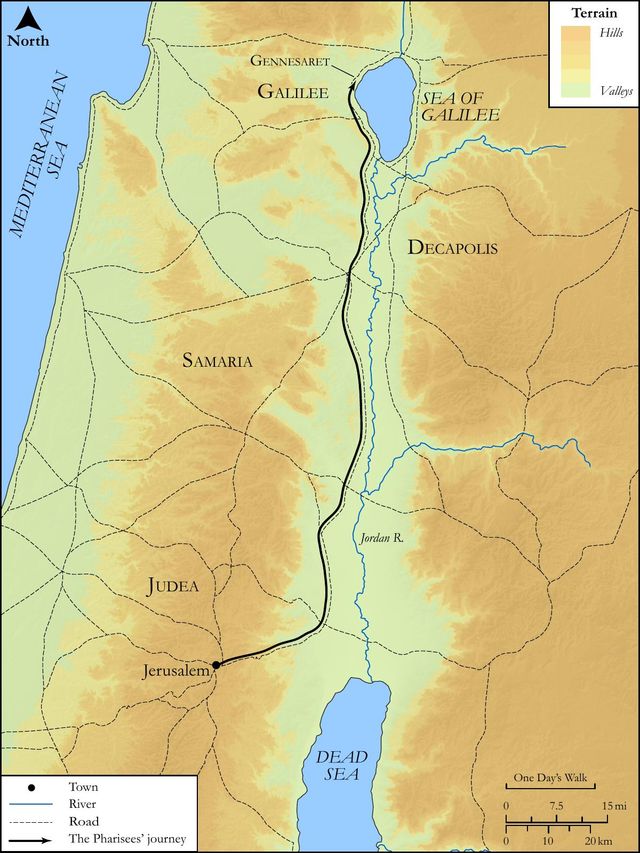
The "tradition of the elders" refers to the extensive body of oral laws and customs that had developed over centuries among Jewish religious authorities, particularly the Pharisees. These traditions, known as Halakha, were considered by many to be as binding, if not more so, than the written Mosaic Law. The specific practice in question, netilat yadayim, was a ceremonial hand washing ritual, distinct from hygienic washing, intended to purify individuals from ritual defilement before partaking in meals. This practice was not prescribed in the Torah but was a rabbinic ordinance. For the Pharisees, strict adherence to such traditions was a hallmark of piety and a means of maintaining ritual purity, setting them apart from the common people. Their journey from Jerusalem underscores the authoritative nature of their challenge, representing the religious establishment's scrutiny of Jesus and His movement.
Key Themes
ShowHideThe central theme emerging from this verse is the profound tension between human tradition and divine commandment. The Pharisees' accusation highlights their prioritization of meticulously observed external rituals over the spirit and direct commands of God's Law. This passage also introduces the theme of external purity versus internal purity, a recurring motif in Jesus' ministry. While the religious leaders focused on outward cleanliness and ceremonial adherence, Jesus consistently emphasized the condition of the heart as the true source of righteousness or defilement, as seen in Matthew 15:11. Furthermore, the interaction subtly points to the hypocrisy of those who meticulously observe human rules while neglecting the weightier matters of the Law, such as justice, mercy, and faithfulness, a critique Jesus often leveled against the religious elite.
Exposition and Analysis
ShowHideKey Word Analysis
ShowHideFrom para (beside, beyond) and the base of basis (a stepping); literally, "to step beyond" or "to go against." In this context, it signifies a violation or infringement of an established rule or boundary. The Pharisees accuse the disciples of "stepping beyond" or violating the "tradition of the elders," implying a serious breach of religious decorum and law as they understood it.
From paradidōmi (to hand over, transmit); refers to something that is "handed down" or "transmitted." Here, it specifically denotes the body of oral precepts and interpretations passed down from earlier rabbinic authorities, distinct from the written Law of Moses. For the Pharisees, these traditions held immense authority, shaping their understanding and practice of piety.
Comparative of presbys (elderly); meaning "older" or "senior." As a noun, it refers to respected senior figures, in this context, the revered rabbis and teachers of previous generations whose interpretations and rulings formed the basis of the "tradition." The term conveys authority and veneration, underscoring the weight the Pharisees placed on these inherited customs.
Verse Breakdown
ShowHide"Why do thy disciples transgress the tradition of the elders?"
This opening rhetorical question from the Pharisees and scribes immediately establishes the confrontational tone. It is not an innocent inquiry but an accusation, challenging Jesus' authority and the conduct of His followers based on their perceived deviation from established religious norms. The focus is on the disciples' actions, but the underlying challenge is directed at Jesus, their teacher, for His apparent failure to enforce these traditions.
"for they wash not their hands when they eat bread."
This clause provides the specific, concrete example of the "transgression." The omission of ceremonial hand washing before eating bread, a common staple, was a significant breach of the "tradition of the elders" in the eyes of the Pharisees. This detail reveals their meticulous concern for external ritual purity and their belief that such practices were essential for maintaining holiness and avoiding defilement.
Literary Devices
ShowHideMatthew 15:2 employs several literary devices to convey its message and set the scene for Jesus' subsequent teaching. The verse opens with a Rhetorical Question ("Why do thy disciples transgress...?"), which functions not as a genuine request for information but as an accusation and a challenge, designed to put Jesus and His disciples on the defensive. This question immediately establishes a Conflict between Jesus' approach to faith and the rigid legalism of the religious authorities. There is also an element of Irony present, as the accusers, meticulously concerned with external purity rituals, are themselves later revealed by Jesus to be internally defiled by their own traditions and hypocrisy (Matthew 15:7-9). The verse also uses Metonymy, where "washing hands" stands in for the broader concept of adherence to the "tradition of the elders," representing the entire system of oral law and ritual purity that the Pharisees upheld.
Theological and Thematic Connections
ShowHideMatthew 15:2 serves as a critical theological touchstone, highlighting the perennial tension between human-made religious rules and the divine will. It underscores the danger of elevating traditions to the status of God's commands, thereby nullifying the true intent of the Law and shifting focus from internal righteousness to external performance. Jesus' response in the subsequent verses reveals that true defilement comes not from external contact or lack of ritual, but from the wicked intentions and desires of the human heart. This passage calls believers to discern between genuine obedience to God's Word and mere adherence to cultural, denominational, or personal customs that may, at best, be irrelevant, and at worst, become stumbling blocks to true spiritual transformation and relationship with God.
Reflection and Application
ShowHideMatthew 15:2 offers a timeless challenge for believers across generations: to critically examine the foundations of our faith and practice. Are we, like the Pharisees, more concerned with outward appearances, the approval of others, or adherence to man-made rules and traditions, than with the genuine transformation of our hearts and sincere obedience to God's clear commands? This verse compels us to ask if our "traditions of the elders"—whether denominational customs, cultural norms, or personal preferences—have inadvertently superseded the living Word of God in our lives. True worship and authentic discipleship flow from a heart devoted to Christ, not from meticulous adherence to external rituals. Our focus should be on cultivating internal purity, loving God and neighbor, and living out the spirit of the Law, rather than merely performing religious duties.
Questions for Reflection
ShowHideFAQ
ShowHideWhat was the "tradition of the elders" that the disciples were accused of transgressing?
ShowHideThe "tradition of the elders" (Hebrew: Halakha) referred to a vast body of oral laws, interpretations, and customs that had been developed and passed down by revered rabbis and scribes over centuries. These traditions were not part of the written Mosaic Law (the Torah) but were considered by the Pharisees to be equally, if not more, binding. The specific tradition mentioned in Matthew 15:2 was netilat yadayim, the ceremonial washing of hands before eating bread or other meals. This ritual was intended to remove ritual impurity and was distinct from hygienic washing. For the Pharisees, observing these traditions was a crucial demonstration of piety and a means of maintaining ritual purity in daily life.
Why was ceremonial hand washing so important to the Pharisees?
ShowHideFor the Pharisees, ceremonial hand washing was deeply significant for several reasons. Primarily, it was a matter of ritual purity. They believed that by adhering to these traditions, they could maintain a state of holiness and avoid defilement, particularly from contact with common people or objects that might be ritually impure. This practice was also a visible sign of their piety and devotion to God, distinguishing them as those who meticulously followed the Law and its interpretations. Furthermore, it reinforced their identity and authority as the guardians and interpreters of religious law. By observing these traditions, they sought to live a life of separation and holiness, aspiring to the standards of priestly purity in their daily lives, even though they were not priests. Their concern was less about hygiene and more about a symbolic cleansing to ensure their meals were eaten in a state of ritual purity.
Christ-Centered Fulfillment
ShowHideMatthew 15:2, while seemingly a minor dispute over handwashing, ultimately points to Christ as the fulfillment and re-interpreter of true righteousness. Jesus does not merely dismiss the traditions; He exposes their inadequacy and, more profoundly, their capacity to nullify God's actual commands, as He articulates in Matthew 15:3-6. He shifts the focus from external, ritualistic purity to internal, heart-driven righteousness. In Christ, the meticulous observance of human traditions becomes obsolete because He Himself is the living Word and the ultimate standard of purity. His teaching that "what comes out of the mouth proceeds from the heart, and this defiles a person" (Matthew 15:18) culminates in His work on the cross, where He provides the ultimate cleansing from within for all who believe. Through His sacrifice, Christ perfectly fulfills the righteous requirements of the Law (Matthew 5:17) and becomes "the end of the law for righteousness to everyone who believes" (Romans 10:4). Thus, the true "washing" and purification come not from water rituals, but from the atoning blood of the Lamb of God, which cleanses the conscience and transforms the heart (Hebrews 9:14; 1 John 1:7).