


2 Peter 1:20
- τοῦτοtoutothisG3778D-ASNDemonstrative pronoun Accusative Singular Neuter
- πρῶτονprōtonfirstG4413A-ASNAdjective Accusative Singular Neuter
- γινώσκοντεςginōskontesknowingG1097V-PAP-NPMVerb Present Active Participle Nominative Plural Masculine
- ὅτιhotithatG3754CONJConjunction
- πᾶσαpasaanyG3956A-NSFAdjective Nominative Singular Feminine
- προφητείαprophēteiaprophecyG4394N-NSFNoun Nominative Singular Feminine
- γραφῆςgraphēsof ScriptureG1124N-GSFNoun Genitive Singular Feminine
- ἰδίαςidiasof its ownG2398A-GSFAdjective Genitive Singular Feminine
- ἐπιλύσεωςepiluseōsinterpretationG1955N-GSFNoun Genitive Singular Feminine
- οὐounotG3756PRT-NNegative Particle Negative
- γίνεταιginetaiisG1096V-PNI-3SVerb Present Middle Or Passive Deponent Indicative 3rd Singular
English is a literal word-by-word gloss of the Greek, not the KJV's wording. Why?
This is the original text the KJV's translators worked from — each Greek word with its own literal English meaning in this verse, prepared by scholars at Tyndale House, Cambridge. The KJV translates whole sentences, not word by word, so its wording differs: one Greek word can become several English words, and the KJV may choose “charity” where the gloss reads “love”. Both are faithful — they answer different questions. For the KJV's own rendering, switch to the KJV text.
Details
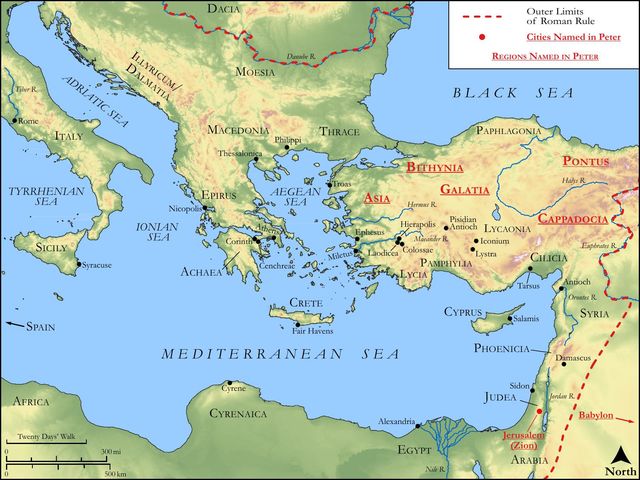
See on the biblical-era map

Study this verse
Public-domain commentary
Matthew Henry
From his Commentary on the Whole Bible. Henry comments on passages, not single verses — this entry covers 2 Peter 1:19–21. His four-level outline is real structure in the source text, so it is rendered as structure.
In these words the apostle lays down another argument to prove the truth and reality of the gospel, and intimates that this second proof is more strong and convincing than the former, and more unanswerably makes out that the doctrine of the power and coming of our Lord Jesus Christ is not a mere fable or cunning contrivance of men, but the wise and wonderful counsel of the holy and gracious God. For this is foretold by the prophets and penmen of the Old Testament, who spoke and wrote under the influence and according to the direction of the Spirit of God. Here note,
I.The description that is given of the scriptures of the Old Testament: they are called a more sure word of prophecy.
1.It is a prophetical declaration of the power and coming, the Godhead and incarnation, of our Saviour, which we have in the Old Testament. It is there foretold that the seed of the woman shall bruise the serpent's head. His power to destroy the devil and his works, and his being made of a woman, are there foretold; and the great and awful Old Testament name of God, Jehovah (as read by some), signifies only He will be; and that name of God (Exo 3:14) is rendered by many, I will be that I will be; and, thus understood, they point at God's being incarnate in order to the redemption and salvation of his people as what was to come. But the New Testament is a history of that whereof the Old Testament is a prophecy. All the prophets and the law prophesied until John, Mat 11:13. And the evangelists and the apostles have written the history of what was before delivered as prophecy. Now the accomplishment of the Old Testament by the New, and the agreeableness of the New Testament to the Old, are a full demonstration of the truth of both. Read the Old Testament as a prophecy of Christ, and with diligence and thankfulness use the New as the best exposition of the Old.
2.The Old Testament is a more sure word of prophecy. It is so to the Jews who received it as the oracles of God. Following prophets confirmed what had been delivered by those who went before, and these prophecies had been written by the express command, and preserved by the special care, and many of them fulfilled by the wonderful providence of God, and therefore were more certain to those who had all along received and read the scriptures than the apostle's account of this voice from heaven. Moses and the prophets more powerfully persuade than even miracles themselves, Luk 16:31. How firm and sure should our faith be, who have such a firm and sure word to rest upon! All the prophecies of the Old Testament are more sure and certain to us who have the history of the most exact and minute accomplishment of them.
II.The encouragement the apostle gives us to search the scriptures.
He tells us, We do well if we take heed to them; that is, apply our minds to understand the sense, and our hearts to believe the truth, of this sure word, yea, bend ourselves to it, that we may be moulded and fashioned by it. The word is that form of doctrine into which we must be cast (Rom 6:17), that formulary of knowledge (Rom 2:20) by which we are to regulate our thoughts and sentiments, our words and confessions, our whole life and conversation. If we thus apply ourselves to the word of God, we certainly do well in all respects, what is pleasing to God and profitable to ourselves; and this indeed is but paying that regard which is due to the oracles of God. But, in order to this giving heed to the word, the apostle suggests some things that are of singular use to those who would attend to the scriptures to any good purpose.
1.They must account and use the scripture as a light which God hath sent into and set up in the world, to dispel that darkness which is upon the face of the whole earth. The word is a lamp to the feet of those who use it aright; this discovers the way wherein men ought to walk; this is the means whereby we come to know the way of life.
2.They must acknowledge their own darkness. This world is a place of error and ignorance, and every man in the world is naturally without that knowledge which is necessary in order to attain eternal life.
3.If ever men are made wise to salvation, it is by the shining of the word of God into their hearts. Natural notions of God are not sufficient for fallen man, who does at best actually know a great deal less, and yet does absolutely need to know a great deal more, of God than Adam did while he continued innocent.
4.When the light of the scripture is darted into the blind mind and dark understanding by the Holy Spirit of God, then the spiritual day dawns and the day-star arises in that soul. This enlightening of a dark benighted mind is like the day-break that improves and advances, spreads and diffuses itself through the whole soul, till it makes perfect day, Pro 4:18. It is a growing knowledge; those who are this way enlightened never think they know enough, till they come to know as they are known. To give heed to this light must needs be the interest and duty of all; and all who do truth come to this light, while evil-doers keep at a distance from it.
III.The apostle lays down one thing as previously necessary in order to our giving heed to, and getting good by, the scriptures, and that is the knowing that all prophecy is of divine origin. Now this important truth he not only asserts, but proves.
1.Observe, No scripture prophecy is of private interpretation (or a man's own proper opinion, an explication of his own mind), but the revelation of the mind of God. This was the difference between the prophets of the Lord and the false prophets who have been in the world. The prophets of the Lord did not speak nor do any thing of their own mind, as Moses, the chief of them, says expressly (Num 16:28), I have not done any of the works (nor delivered any of the statutes and ordinances) of my own mind. But false prophets speak a vision of their own heart, not out of the mouth of the Lord, Jer 23:16. The prophets and penmen of the scripture spoke and wrote what was the mind of God; and though, when under the influence and guidance of the Spirit, it may well be supposed that they were willing to reveal and record such thing, yet it is because God would have them spoken and written. But though the scripture be not the effusion of man's own private opinion or inclination, but the revelation of the mind and will of God, yet every private man ought to search it, and come to understand the sense and meaning thereof.
2.This important truth of the divine origin of the scriptures (that what is contained in them is the mind of God and not of man) is to be known and owned by all who will give heed to the sure word of prophecy. That the scriptures are the word of God is not only an article of the true Christian's faith, but also a matter of science or knowledge. As a man not barely believes, but knows assuredly that that very person is his particular friend in whom he sees all the proper, peculiar, distinguishing marks and characters of his friend, so the Christian knows that book to be the word of God in and upon which he sees all the proper marks and characters of a divinely inspired book. He tastes a sweetness, and feels a power, and sees a glory, in it truly divine.
3.The divinity of the scriptures must be known and acknowledged in the first place, before men can profitably use them, before they can give good heed to them. To call off our minds from all other writings, and apply them in a peculiar manner to these as the only certain and infallible rule, necessarily requires our being fully persuaded that these are divinely inspired, and contain what is truly the mind and will of God.
IV.Seeing it is so absolutely necessary that persons be fully persuaded of the scripture's divine origin, the apostle (Pe2 1:21) tells us how the Old Testament came to be compiled, and that,
1.Negatively: It came not by the will of man. Neither the things themselves that are recorded, and make up the several parts of the Old Testament, are the opinions of men, nor was the will of any of the prophets or penmen of the scriptures the rule or reason why any of those things were written which make up the canon of the scripture.
2.Affirmatively: Holy men of God spoke as they were moved by the Holy Ghost. Observe,
(1.)They were holy men of God who were employed about that book which we receive as the word of God. If Balaam and Caiaphas, and others who were destitute of holiness, had any thing of the spirit of prophecy, upon occasion, yet such persons were not employed to write any part of the scriptures for the use of the church of God. All the penmen of the scriptures were holy men of God.
(2.)These holy men were moved by the Holy Ghost in what they delivered as the mind and will of God. The Holy Ghost is the supreme agent, the holy men are but instruments.
[1.]The Holy Ghost inspired and dictated to them what they were to deliver of the mind of God.
[2.]He powerfully excited and effectually engaged them to speak (and write) what he had put into their mouths.
[3.]He so wisely and carefully assisted and directed them in the delivery of what they had received from him that they were effectually secured from any the least mistake in expressing what they revealed; so that the very words of scripture are to be accounted the words of the Holy Ghost, and all the plainness and simplicity, all the power and virtue, all the elegance and propriety, of the very words and expressions are to be regarded by us as proceeding from God. Mix faith therefore with what you find in the scriptures; esteem and reverence your Bible as a book written by holy men, inspired, influenced, and assisted by the Holy Ghost.
Historical interpretation
Sixteen Centuries of Reception
5 surviving comments on this verse. Each one is dated, so this reads as a timeline rather than a list.
Select a marker to jump to its quote. Markers stagger vertically where authors wrote within a few decades of each other.
No enunciation of the Holy Spirit ought to be (confined) to the subject immediately in hand merely, and not applied and carried out with a view to every occasion to which its application is useful.
You must take care when interpreting the Scriptures not to be too greatly fixated upon the places, times and people who wrote them down, as if they were merely human compositions. Rather you ought to rely on the clarity and sufficiency of the Spirit.
Understanding this first, that every prophecy of Scripture, etc. This verse depends on what was said above: You do well to pay attention; for those who pay attention to the words of the prophets do well indeed, that they may have the light of knowledge through these. They must first understand that none of the holy prophets proclaimed to the people their own doctrines of life by their own interpretation, but recommended to their listeners to act upon what they had learned from the Lord. They simply delivered to God's people, whether by speaking or writing, the heavenly secrets they had perceived in private, unlike the soothsayers of the Gentiles, who proclaimed to the crowds of the deceived the inventions of their own hearts as the resolutions of a divine oracle. Therefore, just as the prophets wrote not their own words but the words of God, so also their reader cannot use his own interpretation but must very carefully consider how the writer himself wanted his words to be understood.
Knowing this first of all, that no prophecy of Scripture comes from someone's own interpretation. For no prophecy was ever produced by the will of man, but men spoke from God as they were carried along by the Holy Spirit.
Then, in explaining, Peter adds why his words were not interpreted as private or personal: at the same time, he also distinguishes true prophecy from demonic and false prophecies, which are found to operate in heretics, and says: "that no prophecy of Scripture comes from someone's own interpretation." That is, indeed, the prophets receive prophecy from God, but not as they wish, but as the divine Spirit works in them moving them: and they certainly knew and understood the prophetic message sent to them, yet they did not make the interpretation themselves. That the prophets, moved by the divine Spirit, knew how the Spirit was sent to them from God is evident from the fact that they spoke voluntarily and said what they wished, while they remained silent on what they did not want to say; just as the prophet Jonah, refusing to preach in Nineveh (Jonah 1:3), and Balaam (Num. 22:13), commanded to speak what was suggested to him. However, the false prophets or the oracles of the Greeks did not have this: for they did not know while they were being agitated, but, having become mad with frenzy, they were unaware of what was happening to them, as if they were drunk.
Therefore, the holy prophets, I say the ancients, although they understood, did not, however, have to interpret what they predicted, but they served these things to others, namely to us. Likewise, so that the Lord's coming might remain hidden, and that traps might not be prepared for Him by the wicked. Indeed, even if the power of God could escape from assaults, it is likely that through extraordinary means of escape, the incarnation would appear as if it were a miraculous event. And that this is true is evident from the prophets who were in the New Testament, who also interpreted themselves while prophesying, although not in all cases, as the blessed Paul says in his earlier letter to the Corinthians (1 Cor. 14:21); for there was no such suspicion in the New Testament. Furthermore, it is also clear that the prophets did not prophecy outside of themselves.
When they prophesied with one spirit, both those in the Old Testament and those in the New, Paul says: "If, however, something is revealed to another sitting there, let the first be silent." (1 Cor. 14:30) From this, it is evident that the prophets, remaining in their natural consistency, prophesied spontaneously and intelligently. Therefore, when another rises to whom inspiration has been given, the one who was speaking first is commanded to be silent; which could not be found among mad prophets. For how will he be silent who does not even know what he is doing? Paul himself says that the energy of the Holy Spirit is in the prophets, speaking thus: "To one is given the word of wisdom, to another the word of prophecy." (1 Cor. 12:8)
"Knowing this first of all," etc. The prophets knew those things which were inspired in them by the prophetic spirit, and about which, however, they did not know exactly how each would be fulfilled. Therefore, understanding, they desired to see the outcome of these things: as the Lord also says.
This shows plainly that the scriptures are not to be expounded by any one's private judgment or private spirit, because every part of the holy scriptures were written by men inspired by the Holy Ghost, and declared as such by the Church; therefore they are not to be interpreted but by the Spirit of God, which he hath left, and promised to remain with his Church to guide her in all truth to the end of the world. Some may tell us, that many of our divines interpret the scriptures: they may do so, but they do it always with a submission to the judgment of the Church, and not otherwise.
Continue studying 2 Peter 1:20 across the web’s major study libraries — every link below opens this exact verse, chapter, or book on the destination site.
Read & Compare
 BibleGatewayThis verse in more than 200 translations and 70 languages.
 Bible.comThe YouVersion reader — hundreds of translations, reading plans, and highlights.
 ESV.orgCrossway's official English Standard Version reader.
 NET BibleThe NET translation with 60,000+ translators' notes on every rendering decision.
 STEP BibleTyndale House's free study tool — original text, vocabulary, and scholarly resources.
 BibliaLogos Bible Software's free web reader.
 USCCBThe New American Bible (Revised Edition) with the U.S. bishops' study notes.
Commentaries
 BibleHub CommentariesDozens of classic commentaries on this verse, gathered on one page.
 StudyLightMore than 100 commentary sets — the largest collection on the web.
 BibleRefPlain-English commentary on what this verse means, verse by verse.
 Enduring WordDavid Guzik's free commentary on this chapter, widely used by Bible teachers.
 Bible Study ToolsVerse commentary alongside Greek and Hebrew study aids.
Original Language & Research
- BibleHub InterlinearThe verse word by word — original language, transliteration, and English.
- BibleHub LexiconEvery word's original-language definition and Strong's entry.
 Blue Letter BibleDeep-study tools — Strong's numbers, concordance, and word studies.
 CNTR CollationThe earliest Greek manuscripts of this verse, collated letter by letter.
Sermons, Hymns & Audio


TrulyRandomVerse is not affiliated with these sites and doesn’t control their content. They’re linked because they’re genuinely useful.
Summary
Second Peter 1:20 lays a foundational truth regarding the nature of divine revelation, asserting that no prophecy found in Scripture originates from a prophet's personal insight or human will. Instead, it is a divinely inspired word, emphasizing that the authority and reliability of the biblical text stem directly from its supernatural source, not from human ingenuity or subjective understanding.
Context
ShowHideLiterary Context
This verse is strategically placed within Peter's urgent exhortation to spiritual growth and his defense of the apostolic message. Beginning in 2 Peter 1:16, Peter contrasts the "cleverly devised myths" of false teachers with the authentic, eyewitness testimony of the apostles, particularly his experience on the Mount of Transfiguration (e.g., 2 Peter 1:17-18). He then elevates the "prophetic word" as even "more sure" than his own eyewitness account, serving as a lamp shining in a dark place (2 Peter 1:19). Verse 20 logically follows, explaining why this prophetic word is so trustworthy: its origin is not human but divine, a point further clarified and expanded upon in 2 Peter 1:21. Thus, 1:20 serves as the theological linchpin connecting the reliability of prophetic Scripture to its divine source, thereby validating the entire apostolic message.
Historical & Cultural Context
Peter wrote to believers facing internal challenges from false teachers who were denying the Lord, promoting immorality, and scoffing at the promise of Christ's return (2 Peter 2:1-3). These teachers likely undermined the authority of Scripture and apostolic tradition, perhaps claiming their own "private" revelations or interpretations. In the broader Greco-Roman world, various forms of divination and prophecy existed, often associated with human manipulation, ecstatic states, or ambiguous pronouncements. Peter's assertion that biblical prophecy is not of "private interpretation" directly counters such pagan notions and distinguishes Christian prophecy as uniquely divine in its origin, setting it apart from human-contrived oracles. It also reinforces the unified, God-given nature of the early Christian canon, which was being established and defended against heretical deviations.
Key Themes
ShowHideThe central theme underscored by 2 Peter 1:20 is the divine inspiration and authority of Scripture. Peter emphasizes that the prophetic word, which encompasses all Scripture understood as God's revealed truth, does not originate from human will or subjective understanding but from God Himself. This theme is foundational to understanding the trustworthiness and infallibility of the Bible. It also contributes to the broader themes of truth versus error, as Peter seeks to fortify believers against the deceptive teachings of false prophets by grounding them in the unshakeable truth of God's word. Furthermore, it highlights the unity and coherence of divine revelation, implying that Scripture, being divinely sourced, speaks with a consistent voice, not a cacophony of individual human opinions. This divine origin is explicitly tied to the work of the Holy Spirit, who "moved" the holy men of God to speak (2 Peter 1:21), establishing the Spirit's indispensable role in both the giving and understanding of Scripture.
Exposition and Analysis
ShowHideKey Word Analysis
ShowHide"prediction (scriptural or other):--prophecy, prophesying." In this context, Peter uses "prophecy" not merely to refer to predictions of future events, but to the entire body of inspired Scripture, particularly the Old Testament, which was understood as God's revealed word spoken through His chosen messengers. It encompasses the authoritative declaration of God's will and truth.
"a document, i.e. holy Writ (or its contents or a statement in it):--scripture." This term specifically refers to the sacred writings, the divinely inspired texts that constitute the Bible. By linking "prophecy" directly to "scripture," Peter affirms that the written word is the embodiment of God's prophetic utterance, carrying His authority and truth.
"from ἐπιλύω; explanation, i.e. application:--interpretation." This word, appearing only here in the New Testament, carries the sense of "unloosing," "solution," or "explanation." When combined with "private" (G2398, ídios, meaning "one's own," "private," or "separate"), it refers to the origin or source of the prophecy. The phrase "private interpretation" thus means that the prophecy did not originate from the prophet's own subjective reasoning, personal will, or isolated understanding of events, but from an external, divine impulse. It is not about the reader's interpretation, but the prophet's source of revelation.
Verse Breakdown
ShowHide"Knowing this first,"
This opening phrase serves as a strong imperative, signaling the paramount importance of the truth that follows. "First" (G4412, prōton) emphasizes that this principle is foundational and takes precedence over other considerations, acting as a crucial prerequisite for understanding and engaging with God's word. It calls for the reader's focused attention and acceptance of this primary truth.
"that no prophecy of the scripture"
This clause identifies the subject: the prophetic word, specifically as it is recorded in the sacred writings. The absolute negative "no" (G3756, ou combined with G3956, pâs for "no... at all") underscores the universal scope of the statement—it applies to all Scripture. This highlights the unified and consistent nature of God's revelation.
"is of any private interpretation."
This is the core assertion. The Greek word for "is" (G1096, gínomai) here means "comes into being" or "originates." Thus, the statement means that the prophetic word does not come into being from a prophet's own subjective, isolated, or self-generated understanding. It refutes the idea that prophets merely expressed their own thoughts, opinions, or solutions to historical events. Instead, it points to an external, divine source for the message. This sets biblical prophecy apart from human speculation or personal opinion.
Literary Devices
ShowHidePeter employs Assertion and a Didactic Tone throughout this passage, particularly in 2 Peter 1:20, to firmly establish the divine origin of Scripture. The phrase "Knowing this first" functions as a strong Emphatic Statement, immediately drawing the reader's attention to a foundational truth. The verse also utilizes Contrast, implicitly setting the divinely sourced prophecy against any notion of human-generated or subjective interpretations, thereby subtly refuting the "cleverly devised myths" mentioned earlier in 2 Peter 1:16. This rhetorical strategy aims to instill confidence in the reliability of God's word and to guard against the deceptive teachings of false prophets.
Theological and Thematic Connections
ShowHideThe profound theological implication of 2 Peter 1:20 is the absolute divine origin and authority of Scripture. It asserts that the Bible is not merely a collection of human insights or religious opinions, but the very breath of God (theopneustos). This means that Scripture is infallible and inerrant in its original transmission, serving as the ultimate standard for truth and doctrine. The Holy Spirit, not human will, is the true author, guiding the biblical writers in such a way that their words were God's words, without overriding their personalities. This divine authorship ensures the unity, coherence, and trustworthiness of the entire biblical narrative, providing a stable foundation for faith and practice against all forms of human speculation or theological error.
Reflection and Application
ShowHideUnderstanding that "no prophecy of the scripture is of any private interpretation" profoundly shapes our approach to the Bible. It calls us to humility, recognizing that we are not the ultimate arbiters of truth, but recipients of divine revelation. Our task is not to impose our own ideas onto the text, but to diligently seek God's intended meaning, submitting our minds and wills to its authority. This principle encourages communal interpretation, as the Spirit who inspired the Word also illuminates it for the community of faith, ensuring a shared understanding that transcends individual biases. It also reinforces the Bible's inherent power and sufficiency to guide us in all matters of faith and life, knowing that its message is unadulterated by human error in its origin. This truth empowers us to trust God's Word implicitly, allowing it to transform our lives and equip us for every good work.
Questions for Reflection
ShowHideFAQ
ShowHideDoes "no private interpretation" mean I shouldn't interpret the Bible for myself, and only experts can understand it?
ShowHideNo, this verse does not forbid personal Bible study or interpretation. The Greek word for "interpretation" (G1955, epílysis) in this context refers to the origin or source of the prophecy, not the reader's understanding of it. Peter is stating that the prophetic message did not originate from the prophet's own subjective thoughts or human will. This is clarified in 2 Peter 1:21, which immediately follows: "For the prophecy came not in old time by the will of man: but holy men of God spake as they were moved by the Holy Ghost." The point is that Scripture is divinely inspired, not a product of human ingenuity. Believers are encouraged to study the Word (e.g., Acts 17:11), and the Holy Spirit indwells believers to help them understand God's truth (e.g., 1 Corinthians 2:10-16).
Christ-Centered Fulfillment
ShowHideThe divine origin of prophecy, as declared in 2 Peter 1:20, finds its ultimate fulfillment and purpose in Jesus Christ. All Scripture, being God-breathed, ultimately points to Him, for He is the living Word, the very embodiment of God's revelation (John 1:1). The prophets of old, moved by the Holy Spirit, spoke of Him and His coming sufferings and subsequent glory (1 Peter 1:10-11). Jesus Himself affirmed that the Scriptures testified about Him (John 5:39) and that He came not to abolish the Law and the Prophets but to fulfill them (Matthew 5:17). Therefore, the "more sure word of prophecy" (2 Peter 1:19) is most sure because its divine origin ensures its accuracy in foretelling and describing the person and work of Christ, the Lamb of God who takes away the sin of the world (John 1:29). The Spirit who moved the prophets is the Spirit of Christ, illuminating the path to salvation found only in Him (Romans 10:4).