


2 Peter 3:3
Bible text: King James Version (1769 Blayney text) · Public domain
Bible text: Berean Standard Bible · Public domain
Bible text: American Standard Version (1901) · Public domain
Bible text: World English Bible, Messianic edition · Public domain
Bible text: Geneva Bible (1599) · Public domain
Bible text: Young's Literal Translation · Public domain
- τοῦτοtoutothisG3778D-ASNDemonstrative pronoun Accusative Singular Neuter
- πρῶτονprōtonfirstG4413A-ASNAdjective Accusative Singular Neuter
- γινώσκοντεςginōskontesknowingG1097V-PAP-NPMVerb Present Active Participle Nominative Plural Masculine
- ὅτιhotithatG3754CONJConjunction
- ἐλεύσονταιeleusontaithey will comeG2064V-FDI-3PVerb Future Middle Deponent Indicative 3rd Plural
- ἐπ᾽ep᾽inG1909PREPPreposition
- ἐσχάτωνeschatōn[these] lastG2078A-GPFAdjective Genitive Plural Feminine
- τῶνtōnof theG3588T-GPFDefinite article Genitive Plural Feminine
- ἡμερῶνhēmerōndaysG2250N-GPFNoun Genitive Plural Feminine
- ἐμπαῖκταιempaiktaiscoffersG1703N-NPMNoun Nominative Plural Masculine
- κατὰkataaccording toG2596PREPPreposition
- τὰςtas<the>G3588T-APFDefinite article Accusative Plural Feminine
- ἰδίαςidias[their] ownG2398A-APFAdjective Accusative Plural Feminine
- ἐπιθυμίαςepithumiasevil desiresG1939N-APFNoun Accusative Plural Feminine
- αὐτῶνautōnof themG846P-GPMPersonal pronoun Genitive Plural Masculine
- πορευόμενοιporeuomenoifollowingG4198V-PNP-NPMVerb Present Middle Or Passive Deponent Participle Nominative Plural Masculine
English is a literal word-by-word gloss of the Greek, not the KJV's wording. Why?
This is the original text the KJV's translators worked from — each Greek word with its own literal English meaning in this verse, prepared by scholars at Tyndale House, Cambridge. The KJV translates whole sentences, not word by word, so its wording differs: one Greek word can become several English words, and the KJV may choose “charity” where the gloss reads “love”. Both are faithful — they answer different questions. For the KJV's own rendering, switch to the KJV text.
Details
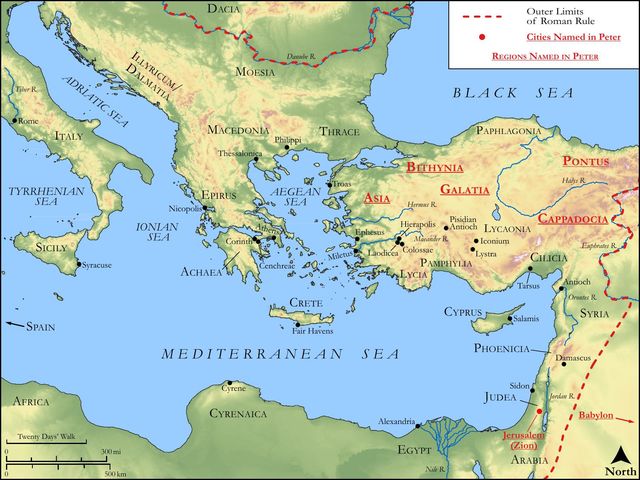
See on the biblical-era maps

Study this verse
Public-domain commentary
Matthew Henry
From his Commentary on the Whole Bible. Henry comments on passages, not single verses — this entry covers 2 Peter 3:3–7. His two-level outline is real structure in the source text, so it is rendered as structure.
To quicken and excite us to a serious minding and firm adhering to what God has revealed to us by the prophets and apostles, we are told that there will be scoffers, men who will make a mock of sin, and of salvation from it. God's way of saving sinners by Jesus Christ is what men will scoff at, and that in the last days, under the gospel. This indeed may seem very strange, that the New Testament dispensation of the covenant of grace, which is spiritual and therefore more agreeable to the nature of God than the Old, should be ridiculed and reproached; but the spirituality and simplicity of New Testament worship are directly contrary to the carnal mind of man, and this accounts for what the apostle seems here to hint at, namely, that scoffers shall be more numerous and more bold in the last days than ever before. Though in all ages those who were born and walked after the flesh persecuted, reviled, and reproached those who were born and did walk after the Spirit, yet in the last days there will be a great improvement in the art and impudence of bantering serious godliness, and those who firmly adhere to the circumspection and self-denial which the gospel prescribes. This is what is mentioned as a thing well known to all Christians, and therefore they ought to reckon upon it, that they may not be surprised and shaken, as if some strange thing happened unto them. Now to prevent the true Christian's being overcome, when attacked by these scoffers, we are told,
I.What sort of persons they are:
they walk after their own lusts, they follow the devices and desires of their own hearts, and carnal affections, not the dictates and directions of right reason and an enlightened well-informed judgment. This they do in the course of their conversation, they live as they list, and they speak as they list; it is not only their inward minds that are evil and opposite to God, as the mind of every unrenewed sinner is (Rom 8:7), alienated from God, ignorant of him, and averse to him; but they have grown to such a height of wickedness that they proclaim openly what is in the hearts of others who are yet carnal; they say, "Our tongues are our own, and our strength, and time, and who is lord over us? Who shall contradict or control us, or ever call us to an account for what we say or do?" And, as they scorn to be confined by any laws of God in their conversation, so neither will they bear that the revelation of God should dictate and prescribe to them what they are to believe; as they will walk in their own way, and talk their own language, so will they also think their own thoughts, and form principles which are altogether their own: here also their own lusts alone shall be consulted by them. None but such accomplished libertines as are here described can take a seat, at least they cannot sit in the seat of the scornful. "By this you shall know them, that you may the better be upon your guard against them."
II.We also are forewarned how far they will proceed:
they will attempt to shake and unsettle us, even as to our belief of Christ's second coming; they will scoffingly say, Where is the promise of his coming? Pe2 3:4. Without this, all the other articles of the Christian faith will signify very little; this is that which fills up and gives the finishing stroke to all the rest. The promised Messiah has come, he was made flesh, and dwelt among us; he is altogether such a one as in stated before, and has done all that for us which has been before taken notice of. These principles the enemies of Christianity have all along endeavoured to overturn; but as these all rest upon facts which are already past, and of which this and the other apostles have given us the most sure and satisfying evidence, it is probable that they will at last grow weary of their opposition to them; and yet, while one very principal article of our faith refers to what is still behind, and only has a promise to rest upon, here they will still attack us, even to the end of time. Till our Lord shall have come, they will not themselves believe that he will come; nay, they will laugh at the very mention of his second coming, and do what in them lies to put all out of countenance who seriously believe and wait for it. Now therefore let us see how this point stands, both on the believer's part and on the part of these seducers: the believer not only desires that he may come, but, having a promise that he will come, a promise that he himself has made and often repeated, a promise received and reported by faithful witnesses, and left upon sure record, he is also firmly and fully persuaded that he will come: on the other hand, these seducers, because they wish he never may, therefore do all that in them lies to cheat themselves and others into a persuasion that he will never come. If they cannot deny that there is a promise, yet they will laugh at that very promise, which argues much higher degrees of infidelity and contempt: Where is the promise, say they, of his coming?
III.We are also forewarned of the method of their reasoning, for while they laugh they will pretend to argue too.
To this purpose they add that since the fathers fell asleep all things continue as they were from the beginning of the creation, Pe2 3:4. This is a subtle, though not a solid way of reasoning; it is apt to make impressions upon weak minds, and especially upon wicked hearts. Because sentence against them is not speedily executed, therefore they flatter themselves that it never will, whereupon their hearts are fully set in them to do evil (Ecc 8:11); thus they act themselves, and thus they would persuade others to act; so here, say they, "The fathers have fallen asleep, those are all dead to whom the promise was made, and it was never made good in their time, and there is no likelihood that it ever will be in any time; why should we trouble ourselves about it? If there had been any truth or certainty in the promise you speak of, we should surely have seen somewhat of it before this time, some signs of his coming, some preparatory steps in order to it; whereas we find to this very day all things continue as they were, without any change, even from the beginning of the creation. Since the world has undergone no changes in the course of so many thousand years, why should we affright ourselves as if it were to have an end?" Thus do these scoffers argue. Because they see no changes, therefore they fear not God, Psa 55:19. They neither fear him nor his judgments; what he never has done they would conclude he never can do or never will.
IV.Here is the falsehood of their argument detected.
Whereas they confidently had said there had not been any change from the beginning of the creation, the apostle puts us in remembrance of a change already past, which, in a manner, equals that which we are called to expect and look for, which was the drowning of the world in the days of Noah. This these scoffers had overlooked; they took no notice of it. Though they might have known it, and ought to have known it, yet this they willingly are ignorant of (Pe2 3:5), they choose to pass it over in silence, as if they had never heard or known any thing of it; if they knew it, they did not like to retain it in their knowledge; they did not receive this truth in the love of it, neither did they care to own it. Note, It is hard to persuade men to believe what they are not willing to find true; they are ignorant, in many cases, because they are willing to be ignorant, and they do not know because they do not care to know. But let not sinners think that such ignorance as this will be admitted as an excuse for whatever sin it may betray them into. Those who crucified Christ did not know who he was; for had they known they would not have crucified the Lord of glory (Co1 2:8); but, though ignorant, they were not therefore innocent; their ignorance itself was a sin, willing and wilful ignorance, and one sin can be no excuse for another. So it is here; had these known of the dreadful vengeance with which God swept away a whole world of ungodly wretches at once, they would not surely have scoffed at his threatenings of any after equally terrible judgment; but here they were willingly ignorant, they did not know what God had done because they had no mind to know it. Now therefore we shall proceed to consider the representation which the apostle here lays down both of the destruction of the old world by water and that which awaits this present world at the final conflagration. He mentions the one as what God has done, to convince and persuade us the rather to believe that the other both may be and will be.
1.We begin with the apostle's account of the destruction which has once already come upon the world (Pe2 3:5, Pe2 3:6): By the word of God the heavens were of old, and the earth standing out of the water and in the water, whereby the world that then was, being overflowed with water, perished. Originally the world was otherwise situated, the waters were most wisely divided at the creation and most beneficially for us; some of the waters had proper repositories above the firmament, here called the heavens (as it is also Gen 1:8), and others, under the firmament, gathered together unto one place; there were then both sea and dry land, commodious habitation for the children of men. But now, at the time of the universal deluge, the case is strangely altered; the waters which God had divided before, assigning to each part its convenient receptacle, now does he, in anger, throw together again in a heap. He breaks up the fountain of the great deep, and throws open the windows (that is, the clouds) of heaven (Gen 7:11), till the whole earth is overflowed with water, and not a spot can be found upon the highest mountains but what is fifteen cubits under water, Gen 7:20. Thus he made known at once his terrible power and his fierce anger, and made an end of a whole world at once: The world that then was, being overflowed with water, perished, Pe2 3:6. Is not here a change and a most awful change! And then it is to be observed that all this was done by the word of God; it was by his powerful word that the world was made at first, and made in so commodious and beautiful a frame and order, Heb 11:3, Katērtisthai. He said, Let there be a firmament, etc., Gen 1:6, Gen 1:7. And let the waters under the heaven be gathered together unto one place, etc., Gen 1:9, Gen 1:10. Thus he spoke, and it was done, Psa 33:9. Thus, says our apostle, by the word of the Lord the heavens were, as they were of old (that is, at first creation) and the earth (as it was at first a terraqueous globe) standing out of the water and in the water. Not is it only the first frame and order of the world that is here said to be by the word of God, but the after-confusion and ruin of the world, as well as the utter destruction of its inhabitants, were also by the same word; none but that God who stretched out the heavens and laid the foundation of the earth could destroy and overthrow such a vast fabric at once. This was done by the word of his power, and it was also done according to the word of his promise; God had said that he would destroy man, even all flesh, and that he would do it by bringing a flood of waters upon the earth, Gen 6:7, Gen 6:13, Gen 6:17. This was the change which God had before brought upon the world, and which these scoffers had overlooked; and now we are to consider,
2.What the apostle says of the destructive change which is yet to come upon it: The heavens and the earth, which now are, by the same word are kept in store, reserved unto fire against the day of judgment and perdition of ungodly men, Pe2 3:7. Here we have an awful account of the final dissolution of the world, and which we are yet more nearly concerned in. The ruin that came upon the world and its inhabitants by the flood, we read, and hear, and think of, with concern, though those who were swept away by it were such as we never knew; but the judgment here spoken of is yet to come, and will surely come, though we know not when, nor upon what particular age or generation of men; and therefore we are not, we cannot be, sure that it may not happen in our own times: and this makes a very great difference, though it should be admitted that they were equal in every other respect, which yet must not be allowed, for there were some, though very few, who escaped that deluge, but not one can escape in this conflagration. Besides, we were not in reach of the one, but are not sure that we shall not be included in the other calamity. Now therefore to see the world to which we belong destroyed at once - not a single person only, not a particular family only, nor yet a nation (even that which we are most nearly interested in and concerned for), but the whole world, I say, sinking at once, and no ark provided, no possible way left of escaping for any one from the common ruin, this makes a difference between the desolation that has been and what we yet are to expect. The one is already past, and never to return upon us any more (for God has said expressly that there shall never any more be a flood to destroy the earth, Gen 9:11-17); the other is still behind, and is as certain to come as the truth and the power of God can make it: the one came gradually upon the world, and was growing upon its inhabitants forty days, before it made an utter end of them (Gen 7:12, Gen 7:17); this other will come upon them swiftly and all at once (Pe2 2:1): besides, there were in that overthrow (as we have said) a few who escaped, but the ruin which yet awaits this world, whenever it comes, will be absolutely a universal one; there will not be any part but what the devouring flames will seize upon, not a sanctuary left any where for the inhabitants to flee to, not a single spot in all this world where any one of them can be safe. Thus, whatever differences may be assigned between that destruction of the world and this here spoken of, they do indeed represent the approaching as the most terrible judgment; yet that the world has once been destroyed by a universal deluge renders it the more credible that it may be again ruined by a universal conflagration. Let therefore the scoffers, who laugh at the coming of our Lord to judgment, at least consider that it may be. There is nothing said of it in the word of God but what is within reach of the power of God, and, though they still should laugh, they shall not put us out of countenance; we are well assured that it will be, because he has said it, and we can depend upon his promise. They err, not knowing (at least not believing) the scriptures, nor the power of God; but we know, and we do or ought to depend upon, both. Now that which he has said, and which he will certainly make good, is that the heavens and the earth which now are (which we are now related to, which still subsist in all the beauty and order in which we see them, and which are so agreeable and useful to us, as we find they are) are kept in store, not to be, what earthly minds would wish to have them, treasures for us, but to be what God will have them, in his treasury, securely lodged and kept safely for his purposes. It follows, they are reserved unto fire. Observe, God's following judgments are more terrible than those which went before; the old world was destroyed by water, but this is reserved unto fire, which shall burn up the wicked at the last day; and, though this seems to be delayed, yet, as this wicked world is upheld by the word of God, so it is only reserved for the vengeance of him to whom vengeance belongs, who will at the day of judgment deal with an ungodly world according to their deserts, for the day of judgment is the day of the perdition of ungodly men. Those who now scoff at a future judgment shall find it a day of vengeance and utter destruction. "Beware therefore of being among these scoffers; never question but the day of the Lord will come; give diligence therefore to be found in Christ, that that may be a time of refreshment and day of redemption to you which will be a day of indignation and wrath to the ungodly world."
Historical interpretation
Ten Centuries of Reception
7 surviving comments on this verse. Each one is dated, so this reads as a timeline rather than a list.
Select a marker to jump to its quote. Markers stagger vertically where authors wrote within a few decades of each other.
The all-merciful and beneficent Father has bowels [of compassion] towards those that fear Him, and kindly and lovingly bestows His favours upon those who come to Him with a simple mind. Wherefore let us not be double-minded; neither let our soul be lifted up on account of His exceedingly great and glorious gifts. Far from us be that which is written, "Wretched are they who are of a double mind, and of a doubting heart; who say, These things we have heard even in the times of our fathers; but, behold, we have grown old, and none of them has happened unto us;" You foolish ones! compare yourselves to a tree; take [for instance] the vine. First of all, it sheds its leaves, then it buds, next it puts forth leaves, and then it flowers; after that comes the sour grape, and then follows the ripened fruit. You perceive how in a little time the fruit of a tree comes to maturity. Of a truth, soon and suddenly shall His will be accomplished, as the Scripture also bears witness, saying, "Speedily will He come, and will not tarry;" and, "The Lord shall suddenly come to His temple, even the Holy One, for whom you look." [Malachi 3:1]
First of all Peter, the rock of the faith, whom Christ our God called blessed, the teacher of the Church, the first disciple, he who has the keys of the kingdom, has instructed us to this effect: "Know this first, children, that there shall come in the last days scoffers, walking after their own lusts.
Here Peter prophesies what will happen in the future, for we must always remember that there are prophets in the New Testament too.
In the last days, in deception, mockers will come, mocking, namely, the faith and hope of Christians, as they promise to themselves in vain that the time of the resurrection will come.
Walking according to their own desires, etc. The Apostle Paul, writing to the Thessalonians, says, "I beseech you, by the coming of our Lord Jesus Christ, and by our gathering together unto him, that ye be not soon shaken in mind, or be troubled, neither by spirit, nor by word, nor by letter as from us, as that the day of the Lord is at hand" (II Thess. II). Therefore, blessed Peter reproves and calls mockers those who assert that the coming of the Lord and His promises are delayed; Paul restrains those who believe that the day of the Lord is imminent. Hence, it is clear to all who love His coming that they should temper their mind in this opinion, so as not to suspect either that the same day of the Lord is near and will come sooner, nor again that it will come later, but we should only diligently ensure that, whether He comes sooner or later, He may find us prepared when He comes.
Knowing this first, that there shall come in the last days scoffers, walking after their own lusts, and saying: Where is the promise of his coming? for since the fathers fell asleep, all things continue as they were from the beginning of the creation.
Where is the promise of his coming? For this one, who is not yet complete due to a certain arrangement, they also distort the other beneficial teachings of the Lord, so that faith is not held by them. However, in those times, the Gnostics or Naassenes were indeed quiet, as were the Lampetians and Euchites. All of whom, Peter says, willingly do not know. For they voluntarily close their eyes to the truth, as we have said before.
These scoffers were the Gnostics and other similar heretics who appeared at that time.
Continue studying 2 Peter 3:3 across the web’s major study libraries — every link below opens this exact verse, chapter, or book on the destination site.
Read & Compare
 BibleGatewayThis verse in more than 200 translations and 70 languages.
 Bible.comThe YouVersion reader — hundreds of translations, reading plans, and highlights.
 ESV.orgCrossway's official English Standard Version reader.
 NET BibleThe NET translation with 60,000+ translators' notes on every rendering decision.
 STEP BibleTyndale House's free study tool — original text, vocabulary, and scholarly resources.
 BibliaLogos Bible Software's free web reader.
 USCCBThe New American Bible (Revised Edition) with the U.S. bishops' study notes.
Commentaries
 BibleHub CommentariesDozens of classic commentaries on this verse, gathered on one page.
 StudyLightMore than 100 commentary sets — the largest collection on the web.
 BibleRefPlain-English commentary on what this verse means, verse by verse.
 Enduring WordDavid Guzik's free commentary on this chapter, widely used by Bible teachers.
 Bible Study ToolsVerse commentary alongside Greek and Hebrew study aids.
Original Language & Research
- BibleHub InterlinearThe verse word by word — original language, transliteration, and English.
- BibleHub LexiconEvery word's original-language definition and Strong's entry.
 Blue Letter BibleDeep-study tools — Strong's numbers, concordance, and word studies.
 CNTR CollationThe earliest Greek manuscripts of this verse, collated letter by letter.
Sermons, Hymns & Audio


TrulyRandomVerse is not affiliated with these sites and doesn’t control their content. They’re linked because they’re genuinely useful.
Summary
Second Peter 3:3 serves as a foundational warning to believers, forecasting the inevitable emergence of "scoffers" in the "last days." These individuals, driven by their own sinful desires, will mock the promise of Christ's return and the accompanying divine judgment, thereby fulfilling prophecy and testing the steadfastness of the faithful.
Context
ShowHideLiterary Context
This verse is strategically placed at the beginning of 2 Peter chapter 3, which addresses the skepticism surrounding the Lord's delayed return and the certainty of His coming judgment. Peter has already warned against false teachers in chapter 2, describing their destructive heresies and immoral lifestyles. Chapter 3 directly confronts the specific challenge of those who deny the parousia (Christ's second coming). Verse 3 sets the stage by identifying the source of this skepticism – the "scoffers" – and their motivation, linking their theological error to their moral corruption. This prophecy serves to prepare the readers, assuring them that such opposition is not unexpected but rather a sign of the times.
Historical & Cultural Context
Peter is writing to a diverse group of believers, likely in Asia Minor, who were experiencing persecution and internal challenges. The early church faced both external pressure from Roman authorities and Jewish opposition, as well as internal threats from false doctrines and moral laxity. The concept of "the last days" was deeply rooted in Jewish eschatology, referring to the climactic period leading up to the Messiah's arrival and the establishment of God's kingdom. For early Christians, this period had already begun with Christ's first coming, but the delay of His promised return (the "parousia") led to questions and doubts. Some, influenced by Hellenistic philosophical skepticism or simply impatient, began to ridicule the Christian hope. Peter's letter, written around 64-68 AD, addresses a community grappling with these realities, providing theological grounding and practical encouragement.
Key Themes
ShowHideThis verse powerfully contributes to several key themes within 2 Peter and the broader New Testament. Firstly, it highlights the theme of prophetic fulfillment, asserting that the appearance of scoffers is not a sign of God's failure but a confirmation of His foreknowledge, as also seen in Jude 1:18. Secondly, it underscores the moral dimension of theological error, revealing that a rejection of divine truth, particularly concerning accountability and judgment, often stems from a desire to indulge in "their own lusts." This connection between doctrine and deed is a recurring motif in Peter's warnings against false teachers (e.g., 2 Peter 2:1-3). Thirdly, the verse reinforces the certainty of Christ's return and judgment, despite the scoffing. By identifying the opposition, Peter implicitly strengthens the resolve of believers to remain steadfast in their expectation of the "day of the Lord," a theme he elaborates on throughout 2 Peter 3.
Exposition and Analysis
ShowHideKey Word Analysis
ShowHideThis word signifies a deep, experiential knowledge, not merely intellectual assent. Peter urges believers to have a firm grasp and understanding of this truth as a foundational principle. It implies a certainty that should inform their perspective and actions.
Derived from a verb meaning "to mock" or "to deride," this term specifically denotes those who ridicule or make sport of sacred things. In this context, it refers to individuals who scorn the promise of Christ's return and the associated divine judgment. The Strong's definition further clarifies them as "false teachers," indicating that their mockery is intertwined with doctrinal error.
While sometimes used neutrally for strong desire, in this context, epithymía carries the negative connotation of "a longing (especially for what is forbidden)." It refers to uncontrolled, often sinful, desires and passions that drive one's behavior. The phrase "their own lusts" emphasizes the self-centered and ungodly nature of these desires, which lead to a rejection of divine authority and future accountability.
Verse Breakdown
ShowHide"Knowing this first,"
This opening phrase emphasizes the primary importance and foundational nature of the truth Peter is about to declare. It's a crucial piece of understanding for believers living in the end times. The KJV's "¶" indicates a new paragraph or thought break, reinforcing its significance.
"that there shall come in the last days scoffers,"
This is a direct prophecy regarding the future. Peter asserts with certainty that mockers will appear during the period leading up to Christ's second coming. "The last days" refers to the entire era between Christ's first and second advents, a time characterized by spiritual conflict and the unfolding of God's redemptive plan. The "scoffers" are those who will deliberately ridicule the Christian hope, particularly the promise of Christ's return and the associated judgment.
"walking after their own lusts,"
This clause reveals the motivation and character of the scoffers. Their mockery is not based on intellectual inquiry but on moral depravity. To "walk after their own lusts" means their conduct and worldview are governed by their selfish, ungodly desires and sinful inclinations. Their rejection of divine truth is a consequence of their desire to live without accountability, indulging in pleasures that stand in opposition to God's righteous standards.
Literary Devices
ShowHidePeter employs several literary devices in this concise verse to convey his urgent message. The most prominent is Prophecy, as he foretells the coming of "scoffers" in the "last days." This prophetic declaration serves to prepare and forewarn his audience, framing the future opposition not as a surprise, but as a divinely revealed certainty. He also uses Characterization to describe these scoffers, not just by their actions ("scoffers") but by their underlying motivation ("walking after their own lusts"). This paints a vivid picture of their moral and spiritual state, linking their outward behavior to their inward corruption. Furthermore, there is an implicit Contrast between the "knowing" of the believers and the "scoffing" of the ungodly, highlighting the differing foundations upon which each group stands – divine truth versus personal desire. This contrast underscores the spiritual battle between faith and ungodliness.
Theological and Thematic Connections
ShowHideThis verse is profoundly significant for understanding the nature of spiritual opposition in the Christian life. It teaches that skepticism and outright mockery of God's promises, especially concerning future judgment and Christ's return, are not new phenomena but a predictable outcome of human sinfulness. The connection between "lusts" and "scoffing" reveals a deep theological truth: a lifestyle driven by self-indulgence inherently resists accountability to a holy God and the prospect of a coming judgment that would disrupt such a life. This passage prepares believers to face such challenges with discernment, recognizing that the very existence of scoffers fulfills prophecy and validates the urgency of living righteously in anticipation of the Lord's return. It calls for steadfastness in faith, even when faced with ridicule.
Reflection and Application
ShowHideIn a world increasingly characterized by skepticism and a rejection of absolute truth, 2 Peter 3:3 remains remarkably relevant. It serves as a powerful reminder that opposition to Christian truth, particularly concerning the Lord's return and final judgment, is not a sign of weakness in God's plan but a fulfillment of His Word. For believers today, this means we should not be surprised or disheartened when we encounter those who mock our faith or dismiss the biblical narrative of end times. Instead, we are called to a deeper understanding of human nature and the spiritual battle at play. Our response should be rooted in steadfast faith, living lives that reflect the hope we proclaim, and being prepared to offer a reasoned defense of our faith with gentleness and respect, as encouraged in 1 Peter 3:15. This verse challenges us to examine our own hearts, ensuring that our desires align with God's will, preventing us from falling into the same trap of self-serving skepticism.
Questions for Reflection
ShowHideFAQ
ShowHideWhat does "the last days" mean in this context?
ShowHideIn the New Testament, "the last days" (Greek: eschatos hēméra) refers to the entire period from Christ's first coming, His death, resurrection, and ascension, until His promised second coming. It is the final era of God's redemptive plan before the establishment of His eternal kingdom. This period is marked by the outpouring of the Holy Spirit, the spread of the Gospel, and also by increased spiritual conflict, false teachings, and moral decay, as foretold by the prophets and apostles. It is not necessarily a short, finite period, but rather the culmination of history leading to Christ's ultimate triumph.
Are the "scoffers" mentioned here specific individuals or a general attitude?
ShowHideThe "scoffers" (Greek: empaíktēs) refer to specific individuals who will emerge with a deliberate and open contempt for God's promises, particularly the promise of Christ's return. While their attitude of skepticism and mockery is general, Peter describes them as a distinct group or type of person whose behavior and worldview are characterized by this scoffing. The Strong's definition even suggests they can be "false teachers," indicating that their mockery is often tied to a rejection of sound doctrine and a promotion of their own distorted views. Their existence is a prophetic sign, not just a random occurrence.
Christ-Centered Fulfillment
ShowHideWhile 2 Peter 3:3 directly prophesies the coming of scoffers, its ultimate fulfillment and significance are deeply rooted in the person and work of Jesus Christ. The very "last days" Peter speaks of were inaugurated by Christ's first advent, His atoning death, and His glorious resurrection, which marked the decisive turning point in salvation history (see Hebrews 1:1-2). The scoffers' mockery of Christ's return is a direct challenge to His sovereignty and His promise to come again in glory to judge the living and the dead (as declared in Acts 1:11). Their "walking after their own lusts" stands in stark contrast to Christ, who perfectly fulfilled God's will, living a life utterly devoid of sin and self-indulgence (see Hebrews 4:15). The ultimate triumph over these scoffers, and indeed over all sin and rebellion, will be achieved through Christ's glorious return, when every knee will bow and every tongue confess that Jesus Christ is Lord (as prophesied in Philippians 2:10-11). Thus, the prophecy of scoffers, rather than undermining faith, serves to highlight the absolute certainty of Christ's victorious return and the final establishment of His righteous kingdom.