


Matthew 14:34
Bible text: King James Version (1769 Blayney text) · Public domain
Bible text: Berean Standard Bible · Public domain
Bible text: American Standard Version (1901) · Public domain
Bible text: World English Bible, Messianic edition · Public domain
Bible text: Geneva Bible (1599) · Public domain
Bible text: Young's Literal Translation · Public domain
- καὶkaiAndG2532CONJConjunction
- διαπεράσαντεςdiaperasanteshaving crossed overG1276V-AAP-NPMVerb Aorist Active Participle Nominative Plural Masculine
- ἦλθονēlthonthey cameG2064V-2AAI-3PVerb 2nd Aorist Active Indicative 3rd Plural
- εἰςeisintoG1519PREPPreposition
- τὴνtēntheG3588T-ASFDefinite article Accusative Singular Feminine
- γῆνgēnlandG1093N-ASFNoun Accusative Singular Feminine
- ΓεννησαρέτGennēsaretGennesaretG1082N-ASF-LNoun Accusative Singular Feminine Location
English is a literal word-by-word gloss of the Greek, not the KJV's wording. Why?
This is the original text the KJV's translators worked from — each Greek word with its own literal English meaning in this verse, prepared by scholars at Tyndale House, Cambridge. The KJV translates whole sentences, not word by word, so its wording differs: one Greek word can become several English words, and the KJV may choose “charity” where the gloss reads “love”. Both are faithful — they answer different questions. For the KJV's own rendering, switch to the KJV text.
Details
See on the biblical-era maps
Study this verse
Public-domain commentary
Matthew Henry
From his Commentary on the Whole Bible. Henry comments on passages, not single verses — this entry covers Matthew 14:34–36. His three-level outline is real structure in the source text, so it is rendered as structure.
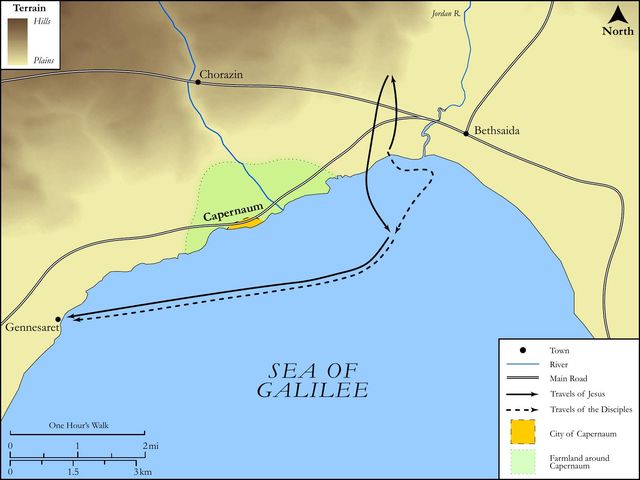
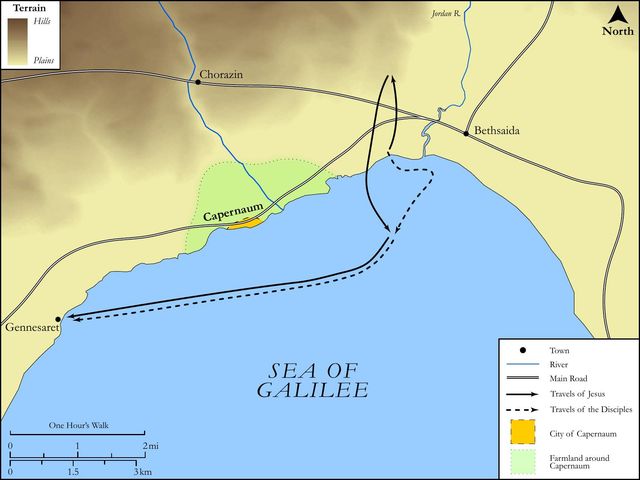
We have here an account of miracles by wholesale, which Christ wrought on the other side of the water, in the land of Gennesaret. Whithersoever Christ went, he was doing good. Gennesaret was a tract of land that lay between Bethsaida and Capernaum, and either gave the name to, or took the name fRom. this sea, which is called (Luk 5:1) The Lake of Gennesaret; it signifies the valley of branches. Observe here,
I.The forwardness and faith of the men of that place.
These were more noble than the Gergesenes, their neighbours, who were borderers upon the same lake. Those besought Christ to depart from them, they had no occasion for him; these besought him to help them, they had need of him. Christ reckons it the greatest honour we can do him, to make use of him. Now here we are told,
1.How the men of that place were brought to Christ; they had knowledge of him. It is probable that his miraculous passage over the sea, which they that were in the ship would industriously spread the report of, might help to make way for his entertainment in those parts; and perhaps it was one thing Christ intended in it, for he has great reaches in what he does. This they had knowledge of, and of the other miracles Christ had wrought, and therefore they flocked to him. Note, They that know Christ's name, will make their application to him: if Christ were better known, he would not be neglected as he is; he is trusted as far as he is known.
They had knowledge of him, that is, of his being among them, and that he would be put awhile among them. Note, The discerning of the day of our opportunities is a good step toward the improvement of it. This was the condemnation of the world, that Christ was in the world, and the world knew him not (Joh 1:10); Jerusalem knew him not (Luk 19:42), but there were some who, when he was among them, had knowledge of him. It is better to know that there is a prophet among us than that there has been one, Eze 2:5.
2.How they brought others to Christ, by giving notice to their neighbours of Christ's being come into those parts; They sent out into all that country. Note, those that have got the knowledge of Christ themselves, should do all they can to bring others acquainted with him too. We must not eat these spiritual morsels alone; there is in Christ enough for us all, so that there is nothing got by monopolizing. When we have opportunities of getting good to our souls, we should bring as many as we can to share with us. More than we think of would close with opportunities, if they were but called upon and invited to them. They sent into their own country, because it was their own, and they desired the welfare of it. Note, We can no better testify our love to our country than by promoting and propagating the knowledge of Christ in it. Neighbourhood is an advantage of doing good which must be improved. Those that are near to us, we should contrive to do something for, at least by our example, to bring them near to Christ.
3.What their business was with Christ; not only, perhaps not chiefly, if at all, to be taught, but to have their sick healed; They brought unto him all that were diseased. If love to Christ and his doctrine will not bring them to him, yet self-love would. Did we but rightly seek our own things, the things of our own peace and welfare, we should seek the things of Christ. We should do him honour, and please him, by deriving grace and righteousness from him. Note, Christ is the proper Person to bring the diseased to; whither should they go but to the Physician, to the Sun of Righteousness, that hath healing under his wings?
4.How they made their application to him; They besought him that they might only touch the hem of his garment, Mat 14:36. They applied themselves to him,
(1.)With great importunity; they besought him. Well may we beseech to be healed, when God by his ministers beseecheth us that we will be healed. Note, The greatest favours and blessings are to be obtained from Christ by entreaty; Ask, and it shall be given.
(2.)With great humility; they came to him as those that were sensible of their distance, humbly beseeching him to help them; and their desiring to touch the hem of his garment, intimates that they thought themselves unworthy that he should take any particular notice of them, that he should so much as speak to their case, much less touch them for their cure; but they will look upon it as a great favour, if he will give them leave to touch the hem of his garment. The eastern nations show respect to their princes, by kissing their sleeve, or skirt.
(3.)With great assurance of the all-sufficiency of his power, not doubting but that they should be healed, even by touching the hem of his garment; that they should receive abundant communications from him by the smallest token of symbol of communion with him. They did not expect the formality of striking his hand over the place or persons diseased, as Naaman did (Kg2 5:11); but they were sure that there was in him such an overflowing fulness of healing virtue, that they could not fail of a cure, who were but admitted near him. It was in this country and neighbourhood that the woman with the bloody issue was cured by touching the hem of his garment, and was commended for her faith (Mat 9:20-22); and thence, probably, they took occasion to ask this. Note, The experiences of others in their attendance upon Christ may be of use both to direct and to encourage us in our attendance on him. It is good using those means and methods which others before us have sped well in the use of.
II.The fruit and success of this their application to Christ.
It was not in vain that these seed of Jacob sough him, for as many as touched, were made perfectly whole. Note,
1.Christ's cures are perfect cures. Those that he heals, he heals perfectly. He doth not do his work by halves. Though spiritual healing be not perfected at first, yet, doubtless, he that has begun the good work will perform it, Phi 1:6.
2.There is an abundance of healing virtue in Christ for all that apply themselves to him, be they ever so many. That precious ointment which was poured on his head, ran down to the skirts of his garment, Psa 133:2. The least of Christ's institutions, like the hem of his garment, is replenished with the overflowing fulness of his grace, and he is able to save to the uttermost.
3.The healing virtue that is in Christ, is put forth for the benefit of those that by a true and lively faith touch him. Christ is in heaven, but his word is nigh us, and he himself in that word. When we mix faith with the word, apply it to ourselves, depend upon it, and submit to its influences and commands, then we touch the hem of Christ's garment. It is but thus touching, and we are made whole. On such easy terms are spiritual cures offered by him, that he may truly be said to heal freely; so that if our souls die of their wounds, it is not owing to our Physician, it is not for want of skill or will in him; but it is purely owing to ourselves. He could have healed us, he would have healed us, but we would not be healed; so that our blood will lie upon our own heads.
Historical interpretation
Seven Centuries of Reception
9 surviving comments on this verse. Each one is dated, so this reads as a timeline rather than a list.
Select a marker to jump to its quote. Markers stagger vertically where authors wrote within a few decades of each other.
Otherwise; When the times of the Law were ended, and five thousand out of Israel were entered within the Church, it was then that the people of believers met Him, then those that were saved out of the Law by faith set before the Lord the rest of their sick and weak; and they that were thus brought sought to touch the hem of His garment, because through their faith they would be healed. And as the virtue of the hem proceeded from the whole garment, so the virtue of the grace of the Holy Spirit went forth from our Lord Jesus Christ, and imparted to the Apostles, who proceeded as it were from the same body, administers salvation to such as desire to touch.
"And when they were gone over," so it is said, "they came into the land of Gennesaret. And when the men of that place had knowledge of Him, they sent out into all that country round about, and brought unto Him all that were diseased; and besought Him that they might touch the hem of His garment; and as many as touched were made perfectly whole."
For neither did they approach Him as before, dragging Him into their houses, and seeking a touch of His hand, and directions from Him in words; but in a far higher strain, and with more of self-denial, and with a more abundant faith did they try to win themselves a cure; for she that had the issue of blood taught them all to be severe in seeking wisdom.
And the evangelist, implying also that at long intervals He visited the several neighborhoods, saith, "The men of that place took knowledge of Him, and sent out into the country round about, and brought unto Him them that were diseased." But yet the interval, so far from abolishing their faith, made it even greater, and preserved it in vigor.
Let us also then touch the hem of His garment, or rather, if we be willing, we have Him entire. For indeed His body is set before us now, not His garment only, but even His body; not for us to touch it only, but also to eat, and be filled. Let us now then draw near with faith, every one that hath an infirmity. For if they that touched the hem of His garment drew from Him so much virtue, how much more they that possess Him entire? Now to draw near with faith is not only to receive the offering, but also with a pure heart to touch it; to be so minded, as approaching Christ Himself. For what, if thou hear no voice? Yet thou seest Him laid out; or rather thou dost also hear His voice, while He is speaking by the evangelists.
Believe, therefore, that even now it is that supper, at which He Himself sat down. For this is in no respect different from that. For neither doth man make this and Himself the other; but both this and that is His own work. When therefore thou seest the priest delivering it unto thee, account not that it is the priest that doeth so, but that it is Christ's hand that is stretched out.
Even as when he baptizes, not he doth baptize thee, but it is God that possesses thy head with invisible power, and neither angel nor archangel nor any other dare draw nigh and touch thee; even so now also. For when God begets, the gift is His only.
But the Evangelist shows that it was now long time since Christ had come into these parts; for it follows, And when the men of that place knew him, they sent into all that region.
Nor do they now as before drag Him to their houses, and seek the touch of His hand, but they draw Him by their greater faith, for they brought unto him all them that were sick, and besought him that they might touch but the hem of his garment. For the woman who suffered under the issue of blood had taught them all this wisdom, namely, that by touching the hem only of Christ's garment they might be saved; therefore it follows, And as many as touched, were made whole.
But we have not a hem or a garment only of Christ, but have even His body, that we may eat thereof. If then they who touched the hem of His garment derived so much virtue therefrom, much more they that shall receive Himself whole.
They knew Him by fame, not by sight; although indeed by reason of the greatness of the signs which He did among the people, He was known by face to great numbers. And note how great the faith of the men of the land of Gennezareth, that they were not content with the healing of the men of that country only, but sent to all the towns round about.
If we knew what the word Gennezareth would convey in our tongue, we might understand how under the type of the Apostles and the boat, Jesus guides to shore the Church when He has delivered it from the wreck of persecution, and makes it to rest in a most tranquil harbour.
Or, by the hem of the garment understand His least commandment, which whosoever transgresses, shall be called least in the kingdom of heaven; or, again, His assumption of the body, by which we come to the Word of God.
(Verse 34.) And when he had crossed over, they came to the land of Genesaret. If we knew what Genesaret would resonate in our language, we would understand how Jesus, through the symbol of the apostles and the boat, leads the Church freed from the shipwreck of persecution to the shore, and makes it rest in a very peaceful harbor.
(Quæst. Ev. i. 15.) For it is here conveyed to us that His glory will then be made manifest, seeing that now they who walk by faith see it in a figure.
The Evangelist had related above that the Lord had Commanded His disciples to enter the boat, and to go before Him across the strait; he now proceeds with the same intention to relate whither they arrived by their passage, And when they were gone over, they came into the land of Gennezareth.
The land of Gennezar, by the lake of Gennezareth, takes its name from a natural power which it is said to have of spontaneously modulating its waters so as to excite a breeze; the Greek words importing, 'creating for itself the breeze.'
Genezar is interpreted, 'rise', 'beginning.' For then will complete rest be given to us, when Christ shall have restored to us our inheritance of Paradise, and the joy of our first robe.
Jesus stayed for some time in Gennesaret, and the people recognized Him not only by sight but by the signs which He worked, and they showed fervent faith. So much so that they even desired to touch the hem of His garment, and indeed, when they did so, they were healed. You also, O reader, touch the edge of Christ's garment, which is the end of His sojourning in the flesh. For if you believe that He ascended, you will be saved. The garment means His flesh, and its hem, the end of His life on earth.
Continue studying Matthew 14:34 across the web’s major study libraries — every link below opens this exact verse, chapter, or book on the destination site.
Read & Compare
 BibleGatewayThis verse in more than 200 translations and 70 languages.
 Bible.comThe YouVersion reader — hundreds of translations, reading plans, and highlights.
 ESV.orgCrossway's official English Standard Version reader.
 NET BibleThe NET translation with 60,000+ translators' notes on every rendering decision.
 STEP BibleTyndale House's free study tool — original text, vocabulary, and scholarly resources.
 BibliaLogos Bible Software's free web reader.
 USCCBThe New American Bible (Revised Edition) with the U.S. bishops' study notes.
Commentaries
 BibleHub CommentariesDozens of classic commentaries on this verse, gathered on one page.
 StudyLightMore than 100 commentary sets — the largest collection on the web.
 BibleRefPlain-English commentary on what this verse means, verse by verse.
 Enduring WordDavid Guzik's free commentary on this chapter, widely used by Bible teachers.
 Bible Study ToolsVerse commentary alongside Greek and Hebrew study aids.
Original Language & Research
- BibleHub InterlinearThe verse word by word — original language, transliteration, and English.
- BibleHub LexiconEvery word's original-language definition and Strong's entry.
 Blue Letter BibleDeep-study tools — Strong's numbers, concordance, and word studies.
 CNTR CollationThe earliest Greek manuscripts of this verse, collated letter by letter.
Sermons, Hymns & Audio


TrulyRandomVerse is not affiliated with these sites and doesn’t control their content. They’re linked because they’re genuinely useful.
Summary
Matthew 14:34 succinctly marks the arrival of Jesus and His disciples in Gennesaret, a fertile region on the western shore of the Sea of Galilee. This brief verse serves as a crucial geographical and narrative transition, signaling the conclusion of the dramatic episode where Jesus walked on water and calmed the storm, and the immediate resumption of His active, public ministry among the people in a new, populous location.
Context
ShowHideLiterary Context
This verse immediately follows one of the most profound displays of Jesus' divine power: His walking on the water and calming the storm, an event that deeply impacted His disciples and led them to worship Him, declaring, "Of a truth thou art the Son of God" (Matthew 14:22-33). The simple statement of their arrival in Gennesaret thus acts as a narrative bridge, transitioning from a scene of supernatural awe and personal revelation to the disciples, back to the public sphere of Jesus' ongoing ministry of teaching and healing. It highlights the seamless continuity of His mission, even after such extraordinary events.
Historical & Cultural Context
The "land of Gennesaret" (Greek: Gennēsarét) was a highly renowned plain situated on the northwestern shore of the Sea of Galilee, south of Capernaum. Historically, it was celebrated for its extraordinary fertility, often referred to as the "garden of God" due to its abundant produce, including olives, grapes, dates, and figs, which ripened earlier than in other regions. This agricultural richness supported a dense population, making it a bustling and prosperous area. Its strategic location along major trade routes also ensured a constant flow of people. For Jesus, arriving in Gennesaret meant immediate access to a large populace, providing ample opportunities for His ministry to reach many individuals in need of physical healing and spiritual instruction.
Key Themes
ShowHideThe arrival in Gennesaret reinforces several recurring themes in Matthew's Gospel. Firstly, it underscores Divine Direction and Providence, demonstrating that Jesus' movements were not random but part of God's sovereign plan for the unfolding of His ministry, leading Him to specific, strategic locations. Secondly, it emphasizes the Continuity and Relentlessness of Ministry. Despite the preceding miraculous events and the disciples' spiritual exhaustion, there is no pause in Jesus' work; He moves directly into a populated area, ready to engage with people and meet their needs, exemplifying His unwavering dedication to His mission (compare Luke 4:43). Thirdly, it highlights Jesus' Accessibility and Availability to the common people. By choosing a well-trafficked and populous region like Gennesaret, Jesus positioned Himself to be encountered by many, particularly those overlooked or suffering, reinforcing His compassion and desire to minister to all who would come to Him (Matthew 9:35).
Exposition and Analysis
ShowHideKey Word Analysis
ShowHideThis verb, meaning "to cross entirely" or "to sail over," emphasizes the completion of their journey across the Sea of Galilee. It signifies not merely a crossing, but a successful traversal of the water, a journey made possible by Jesus' power over the storm. The term highlights the disciples' arrival at a specific destination after a significant, challenging voyage.
This primary verb denotes movement, "to come or go." In this context, it signifies their arrival and establishment in the new location. It's a simple yet powerful verb indicating the active, purposeful movement of Jesus and His disciples, not a passive drifting, but a deliberate entry into the land of Gennesaret for continued ministry.
Of Hebrew origin, this proper noun refers to both a lake (the Sea of Galilee) and, in this instance, the fertile plain on its northwestern shore. Its mention specifically identifies the destination as a well-known, populous, and agriculturally rich region. The name itself, possibly meaning "garden of the prince" or "valley of abundance," subtly underscores the lushness and productivity of the area, making it a fitting place for Jesus to continue His ministry of growth and spiritual nourishment.
Verse Breakdown
ShowHide"¶ And when they were gone over,"
This initial clause serves as a temporal and transitional marker. The "¶" in the KJV indicates a new paragraph or section, emphasizing a shift in the narrative. "Gone over" refers to their successful crossing of the Sea of Galilee, a journey that had been fraught with peril and marked by Jesus' miraculous intervention. It signifies the completion of the previous dramatic episode and sets the stage for what is to come.
"they came into the land of Gennesaret."
This second clause specifies their destination. "They came" highlights the purposeful arrival of Jesus and His disciples. The "land of Gennesaret" is not just any shore, but a particular, well-known, and populous region. This immediate arrival in a hub of activity underscores Jesus' readiness to continue His public ministry without delay, directly engaging with the people who resided in this prosperous and frequented area.
Literary Devices
ShowHideMatthew employs several subtle literary devices in this brief verse. The most prominent is Transition, as the verse serves as a narrative bridge, smoothly moving the story from the high drama of Jesus walking on water to the next phase of His earthly ministry. It marks a shift in setting and focus, from the private, awe-filled encounter with the disciples on the sea to the public, active engagement with the crowds on land. Furthermore, the mention of "Gennesaret" functions as a Geographical Marker, immediately situating the reader within a recognizable and significant location known for its fertility and population density, which implicitly sets the stage for the extensive healing ministry that immediately follows (as seen in Matthew 14:35-36). The simplicity of the statement itself, following such a profound miracle, could also be seen as an example of Understatement, highlighting the routine and relentless nature of Jesus' mission even amidst the miraculous.
Theological and Thematic Connections
ShowHideThis seemingly simple verse holds significant theological weight, emphasizing God's sovereign direction over Jesus' ministry and the unwavering commitment of the Son to His redemptive mission. The immediate arrival in Gennesaret after a night of miracles and a perilous journey underscores that ministry is not merely a response to circumstances but a divinely ordained pursuit. It illustrates Jesus' continuous availability to humanity, always moving towards those in need, regardless of His own recent trials or triumphs. This pattern of purposeful movement for the sake of the Kingdom is a foundational aspect of Christ's earthly life, demonstrating His active pursuit of the lost and His readiness to heal, teach, and proclaim the good news wherever He was led.
Reflection and Application
ShowHideMatthew 14:34, though brief, offers profound insights for contemporary believers. It reminds us that spiritual highs and miraculous encounters are often followed by the call to continued, practical ministry in the "everyday" world. Just as Jesus moved seamlessly from a display of divine power to engaging with the needs of the people in Gennesaret, so too are we called to translate our moments of spiritual renewal and revelation into active service and witness. Our faith is not meant to be static or confined to mountaintop experiences, but rather dynamic, propelling us into the world to be agents of God's grace and truth. This verse encourages us to remain alert to God's leading, ready to "go over" to new territories—whether geographical, relational, or vocational—where He calls us to serve, always prepared to make ourselves available for His purposes.
Questions for Reflection
ShowHideFAQ
ShowHideWhat is the significance of Gennesaret in Jesus' ministry?
ShowHideGennesaret was a highly fertile and densely populated plain on the northwestern shore of the Sea of Galilee. Its significance lay in its strategic location and large population, making it an ideal hub for Jesus' public ministry. By arriving here, Jesus immediately placed Himself among many people, providing ample opportunity for teaching, healing, and demonstrating His divine power. The immediate aftermath of their arrival, as described in Matthew 14:35-36, shows a widespread healing ministry, confirming Gennesaret's importance as a center for His work.
What happened immediately before Jesus and His disciples arrived in Gennesaret?
ShowHideImmediately before their arrival in Gennesaret, Jesus performed two significant miracles: He walked on the water of the Sea of Galilee to meet His disciples, who were struggling against a storm, and then He calmed the storm upon entering their boat. This dramatic episode, detailed in Matthew 14:22-33, deeply impressed the disciples and led them to acknowledge His divine identity. Their arrival in Gennesaret marks the conclusion of this miraculous journey and the immediate resumption of Jesus' public ministry on land.
Christ-Centered Fulfillment
ShowHideMatthew 14:34, though a simple geographic marker, points profoundly to the Christ-centered nature of God's redemptive plan. Jesus' purposeful movement into the "land of Gennesaret" after a display of His divine power over creation foreshadows His ultimate mission: to enter into the "land" of humanity, a world marred by sin and suffering, not to remain aloof but to actively engage with its brokenness. Just as He "came into" Gennesaret, so too did the Word become flesh and "dwell among us" (John 1:14), purposefully stepping into our reality to bring healing, truth, and salvation. His continuous journey and relentless pursuit of humanity, from the shores of Galilee to the cross and beyond, underscore His identity as the Good Shepherd who seeks out the lost (Luke 19:10). This verse, therefore, is a microcosm of the Incarnation itself, revealing a God who does not wait for humanity to come to Him, but actively "goes over" and "comes into" our world to accomplish His redemptive work, ultimately culminating in the Great Commission to "go and make disciples of all nations" (Matthew 28:19-20).