


New Testament · Gospels · Book 41 of 66
Mark
The shortest Gospel: Jesus’ works in Galilee, his road to Jerusalem, and his death and resurrection there, told as “the gospel of Jesus Christ, the Son of God.”
- 16 chapters
- 678 verses
- About 69 minutes to read
- The Life of Jesus, c. 6 BC – AD 30
Mark has no birth narrative and no genealogy: it opens with John in the wilderness, and by its fifteenth verse Jesus is in Galilee preaching, “The time is fulfilled, and the kingdom of God is at hand: repent ye, and believe the gospel” (Mark 1:15). It moves quickly: the word most often rendered straightway or immediately stands in forty of its verses.
One question runs through the book. The disciples ask it in the boat: “What manner of man is this, that even the wind and the sea obey him?” (4:41). Peter answers it at Caesarea Philippi (8:29), and from then on Jesus teaches “that the Son of man must suffer many things” (8:31). The road leads to Jerusalem, and more than a third of the book is given to his last days there: the temple, the supper, the trial and the cross. At the cross a centurion says what the first verse said: “Truly this man was the Son of God” (15:39).
For even the Son of man came not to be ministered unto, but to minister, and to give his life a ransom for many.
Mark 10:45 KJV
Before you read
- Who wrote it
- Not named in the book. Papias, in Eusebius, records the presbyter John:
Mark, having become the interpreter of Peter, wrote down accurately, though not in order, whatsoever he remembered of the things said or done by Christ
. Clement of Alexandria agrees:Mark, the follower of Peter
. - When it was written
- The book gives no date. Clement of Alexandria says Mark wrote
while Peter publicly preached the Gospel at Rome
, so that Peter’s hearers could keep in memory what was spoken. - To whom
- Readers who needed Jewish washings explained (7:3–4) and Aramaic words interpreted: Talitha cumi, Ephphatha, and Eloi, Eloi, lama sabachthani (5:41; 7:34; 15:34).
- Where
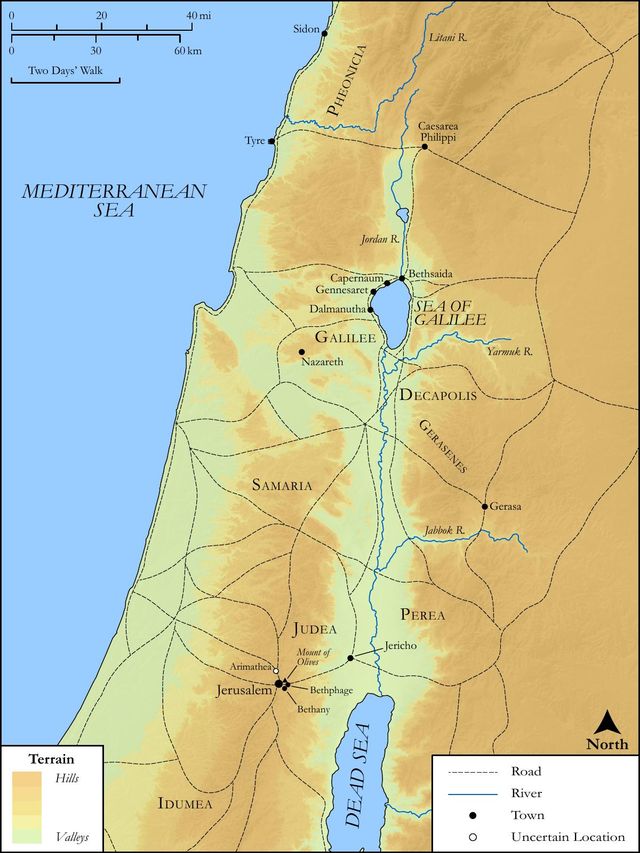
- Galilee, around its sea and Capernaum; journeys to the borders of Tyre and Sidon, to Decapolis and to Caesarea Philippi; then through Judaea beyond Jordan and Jericho to Jerusalem (10:1; 11:1).
- About the text
- The KJV prints the last twelve verses (16:9–20). Faithful Christians differ on whether they stood in Mark’s own text.
Those who receive the twelve verses as Mark’s own Mark ended his Gospel with the appearances, the commission and the ascension. Irenaeus, writing before the oldest surviving copies of the chapter, quotes the ascension verse with the words
As he finishes his Gospel, Mark concludes
, and nearly all Greek copies carry the verses.Grounds Mark 16:9Mark 16:19Irenaeus 202 · Against Heresies 3.10.5
Those who hold that Mark’s own text ends at 16:8 Mark closed on the women’s fear: “for they were afraid” (16:8). The two oldest Greek copies of the chapter end there, and verse 9 begins afresh, introducing Mary Magdalene as if she had not been named. Verses 9–20 are taken as an early addition, drawn from what the other Gospels and Acts record.
How Mark is laid out
7 movements · 93 passages · 678 verses
The beginning of the gospel
1:1–3:6 · 79 verses
John baptizes in the wilderness, as the prophets had written, and at the Jordan the Spirit descends on Jesus and the voice from heaven calls him “my beloved Son.” After the temptation he preaches in Galilee, calls four fishermen and heals at Capernaum. He forgives sins, eats with publicans and calls himself Lord of the sabbath, and the Pharisees take counsel with the Herodians to destroy him.
12 passages
- 1:1–8 The Beginning of the Gospel
- 1:9–11 The Baptism of Jesus
- 1:12–13 The Temptation in the Wilderness
- 1:14–20 Jesus Begins His Galilean Ministry
- 1:21–28 Jesus' Authority in Capernaum
- 1:29–39 A Day of Healing
- 1:40–45 Jesus Cleanses a Leper
- 2:1–12 Jesus Heals the Paralytic
- 2:13–17 Jesus Calls Levi and Eats with Sinners
- 2:18–22 The Question of Fasting
- 2:23–28 Jesus Is Lord of the Sabbath
- 3:1–6 Healing on the Sabbath Day
Parables and mighty works
3:7–6:6 · 119 verses
Crowds come from Judaea, Idumaea and about Tyre and Sidon. Jesus ordains the twelve, answers the charge that he casts out devils by Beelzebub, and calls whoever does the will of God his kin. He teaches the kingdom in parables of seed, stills the storm, frees a man possessed by a legion, heals a woman by her faith and raises Jairus’s daughter. His own country is offended at him.
16 passages
- 3:7–12 Jesus Ministered to Great Crowds
- 3:13–19 The Appointment of the Twelve Apostles
- 3:20–30 The Beelzebul Accusation
- 3:31–35 Jesus Defines His True Family
- 4:1–9 Jesus Teaches the Parable of the Sower
- 4:10–12 The Purpose of Parables
- 4:13–20 Interpretation of the Sower Parable
- 4:21–25 Sayings on Hearing and Revelation
- 4:26–29 The Parable of the Growing Seed
- 4:30–34 The Parable of the Mustard Seed
- 4:35–41 Jesus Calms a Great Storm
- 5:1–20 Jesus Heals the Gerasene Demoniac
- 5:21–24 Jesus Returns; Jairus Seeks Help
- 5:25–34 Healing the Woman with an Issue of Blood
- 5:35–43 The Raising of Jairus’s Daughter
- 6:1–6 Jesus Rejected in Nazareth
Loaves, and eyes that see not
6:7–8:26 · 113 verses
The twelve go out two by two, and Herod says John, whom he beheaded, is risen. Jesus feeds five thousand, walks on the sea, and teaches that defilement comes “from within, out of the heart of men.” He delivers a Greek woman’s daughter, opens a deaf man’s ears, feeds four thousand, and asks the disciples, “Having eyes, see ye not?” At Bethsaida a blind man sees in two stages.
13 passages
- 6:7–13 The Mission of the Twelve
- 6:14–29 Herod and the Death of John the Baptist
- 6:30–44 The Feeding of the Five Thousand
- 6:45–52 Jesus Walks on Water
- 6:53–56 Widespread Healing in Gennesaret
- 7:1–13 Debate Over Tradition and Defilement
- 7:14–23 What Truly Defiles a Person
- 7:24–30 The Syrophoenician Woman's Faith
- 7:31–37 Healing the Deaf and Mute Man
- 8:1–9 Jesus Feeds the Four Thousand
- 8:10–13 Pharisees Demand a Sign
- 8:14–21 The Leaven of the Pharisees and Herod
- 8:22–26 The Blind Man Healed at Bethsaida
The way to Jerusalem
8:27–10:52 · 114 verses
At Caesarea Philippi Peter confesses, “Thou art the Christ,” and Jesus begins to teach that he must suffer, be killed and rise again. He is transfigured before Peter, James and John, foretells his death twice more on the road, and teaches that whoever would be first must be servant of all. At Jericho blind Bartimaeus receives his sight and follows him in the way.
16 passages
- 8:27–30 Peter Confesses Jesus as the Christ
- 8:31–33 Jesus Predicts His Death and Resurrection
- 8:34–38 The Cost of Discipleship
- 9:1 The Kingdom Coming with Power
- 9:2–13 The Transfiguration of Jesus
- 9:14–29 Jesus Heals a Demoniac Boy
- 9:30–32 Jesus Predicts His Death Again
- 9:33–37 True Greatness: Servant of All
- 9:38–41 Tolerance and Inclusion in Ministry
- 9:42–50 Warnings Against Sin and Stumbling
- 10:1–12 Jesus Teaches on Marriage and Divorce
- 10:13–16 Jesus Blesses the Children
- 10:17–31 The Rich Young Ruler
- 10:32–34 The Third Passion Prediction
- 10:35–45 True Greatness: Servant Leadership
- 10:46–52 Healing Blind Bartimaeus
Jerusalem and the temple
Chapters 11–13 · 114 verses
Jesus enters Jerusalem to cries of Hosanna, curses a fig tree with nothing but leaves, and casts the traders out of the temple. Questioned on his authority, he tells of the husbandmen who killed the son, answers on tribute, the resurrection and the first commandment, and asks how Christ is David’s son. On the mount of Olives he foretells the temple’s fall and the coming of the Son of man.
17 passages
- 11:1–11 The Triumphal Entry into Jerusalem
- 11:12–14 The Cursing of the Fig Tree
- 11:15–19 Jesus Cleanses the Temple
- 11:20–26 The Lesson on Faith and Forgiveness
- 11:27–33 The Authority of Jesus Questioned
- 12:1–12 The Parable of the Wicked Tenants
- 12:13–17 Paying Taxes to Caesar
- 12:18–27 The Sadducees Question the Resurrection
- 12:28–34 The Greatest Commandment
- 12:35–37 Is the Christ David's Son?
- 12:38–40 Warning Against the Scribes
- 12:41–44 The Widow's Offering
- 13:1–4 Jesus Predicts the Temple’s Destruction
- 13:5–13 Signs of the Beginning of Sorrows
- 13:14–23 The Great Tribulation and Abomination
- 13:24–27 The Coming of the Son of Man
- 13:28–37 Parable of the Fig Tree: Be Watchful
Betrayed, condemned and crucified
Chapters 14–15 · 119 verses
Anointed at Bethany, Jesus keeps the Passover, gives the bread and the cup as his body and blood, prays in Gethsemane, and is betrayed by Judas and taken as the disciples flee. The high priest asks whether he is the Christ, and he answers “I am”; Peter denies him three times. Pilate delivers him to be crucified, he dies at the ninth hour, and Joseph of Arimathaea buries him.
16 passages
- 14:1–2 The Plot to Kill Jesus
- 14:3–9 The Anointing at Bethany
- 14:10–11 Judas Agrees to Betray Jesus
- 14:12–16 Preparation for the Passover
- 14:17–21 Jesus Predicts His Betrayal
- 14:22–26 Institution of the Lord's Supper
- 14:27–31 Peter’s Denial Foretold
- 14:32–42 Jesus Prays in Gethsemane
- 14:43–52 The Arrest of Jesus
- 14:53–65 Trial Before the Sanhedrin
- 14:66–72 Peter Denies Jesus
- 15:1–15 Jesus Delivered to Pilate
- 15:16–20 The Mockery of the King
- 15:21–32 The Crucifixion
- 15:33–41 The Death of Jesus
- 15:42–47 The Burial
He is risen
Chapter 16 · 20 verses
At sunrise on the first day of the week the women find the stone rolled away. A young man in white tells them, “he is risen; he is not here,” and sends them to tell the disciples and Peter; they flee, afraid. Verses 9–20 record appearances to Mary Magdalene, to two in the country and to the eleven, their sending into all the world, and the ascension.
The words Mark turns on
Gospel stands in the first verse, straightway crowds the Galilean chapters, and way marks the road to Jerusalem.
What Mark teaches
exousía · authority
Authority that astonished
At Capernaum the hearers “were astonished at his doctrine: for he taught them as one that had authority, and not as the scribes” (1:22), and when an unclean spirit obeyed him they asked, “what new doctrine is this?” (1:27). The same word stands behind “the Son of man hath power on earth to forgive sins” (2:10). The scribes had reasoned rightly that none “can forgive sins but God only” (2:7); Jesus answered by making the palsied man walk. Wind and sea obey him (4:41). In the temple the rulers ask, “By what authority doest thou these things?” (11:28). He will not tell them, but the parable that follows does: the lord of the vineyard sends last “one son, his wellbeloved” (12:6).
hodós · way
The way to the cross
The book opens on a prepared way (1:2–3), and from Caesarea Philippi Jesus is “in the way” to Jerusalem (10:32). Three times on that road he foretells that he will be killed and rise again (8:31; 9:31; 10:33–34). Each time the disciples misunderstand: Peter rebukes him, they dispute “who should be the greatest” (9:34), and James and John ask for the seats at his right hand and his left. Each time he answers with the cost of following: “let him deny himself, and take up his cross, and follow me” (8:34); the first must be “servant of all” (9:35); “whosoever will be great among you, shall be your minister” (10:43). Bartimaeus, given his sight at Jericho, “followed Jesus in the way” (10:52).
pístis · faith
Only believe
In Mark faith is seen most plainly in people who come to Jesus with nothing but their need. He sees the faith of the four who let a palsied man down through a roof (2:5). A woman who touches his garment hears, “Daughter, thy faith hath made thee whole” (5:34), and Jairus, told his daughter is dead, hears, “Be not afraid, only believe” (5:36). A father cries, “Lord, I believe; help thou mine unbelief” (9:24). Those nearest him are slower to believe. In the storm he asks the disciples, “how is it that ye have no faith?” (4:40); in his own country he “marvelled because of their unbelief” (6:6); and after he walks on the sea the disciples are amazed, “for they considered not the miracle of the loaves: for their heart was hardened” (6:52).
Christ in Mark
Mark sets Jesus where the prophets set the LORD. In Isaiah a voice cries, “Prepare ye the way of the LORD” (Isaiah 40:3); in Mark the voice is John’s, and the way is prepared for Jesus (Mark 1:2–3). Jesus goes to his death “as it is written of him” (14:21), and at his arrest says, “the scriptures must be fulfilled” (14:49).
Luke records one of those scriptures from his lips the same night, “he was reckoned among the transgressors” (Luke 22:37), quoting Isaiah’s prophecy of the servant who “bare the sin of many” (Isaiah 53:12). In Mark, Jesus came “to give his life a ransom for many” (Mark 10:45), and at the supper calls the cup “my blood of the new testament, which is shed for many” (14:24). The price is one life given for many, and the book’s first line names whose it is: “Jesus Christ, the Son of God” (1:1).
People
By how many verses name them
- PeterSon of Jona (Matthew 16:17); a brother of Andrew22
- JohnA son of Zechariah and Elizabeth15
- JohnSon of Zebedee; a brother of James10
- Pilate10
- Elias9
- JamesSon of Zebedee; a brother of John9
- HerodSon of Herod 'the Great'8
- MosesSon of Amram and Jochebed; a brother of Aaron and Miriam; husband of Zipporah8
43 more are named.
Places
23 named
- JerusalemThe scribes come down from it; he goes up to suffer there11
- GalileeWhere the gospel is first preached, and where he goes before them10
- BethanyWhere he lodges in the last days and is anointed4
- JordanThe river where John baptizes him and the heavens open4
- JudaeaAll its land goes out to John’s baptism4
- NazarethThe town he comes from; he is called Jesus of Nazareth4
- CapernaumWhere he first teaches with authority and heals the sick3
- OlivesWhere he foretells the temple’s fall, and goes after the supper3
Where Mark reaches
The passages it leans on, and the ones that lean on it
Mark 1:11 Psalms 2:7 Isaiah 42:1
The voice at the Jordan joins the Son of Psalm 2 to the servant in whom God delights.
Mark 12:10–11 Psalms 118:22–23 Acts 4:11
The rejected stone closes the parable of the vineyard; Peter preaches the same psalm before the council.
“Smite the shepherd”: Jesus applies Zechariah’s word to the disciples’ flight that night.
Mark 14:62 Daniel 7:13 Psalms 110:1
His answer to the high priest joins Daniel’s Son of man on the clouds to David’s Lord at God’s right hand.
The cry at the ninth hour is the first line of Psalm 22, the psalm of the parted garments.
Books Mark links to most
The Church Fathers on Mark
1,790 quotations from 72 writers before AD 800 · the ten most quoted, in date order
- Clement215
- Tertullian220
- Origen253
- Cyprian258
- Chrysostom407
- Jerome420
- Augustine430
- Pseudo-Chrysostom500
- Gregory604
- Bede735
Papias, from the presbyter John, on how Mark came to write down what Peter taught.
For he neither heard the Lord nor followed him, but afterward, as I said, he followed Peter … For he was careful of one thing, not to omit any of the things which he had heard, and not to state any of them falsely.
Origen, on why the book’s first words reach back to the prophets.
In saying: “The beginning of the gospel of Jesus Christ, as it is written in the prophet Isaiah,” Mark shows that the beginning of the gospel is intrinsically connected with the Old Testament.
Augustine, on where Mark chose to begin.
Note that Mark mentions nothing of the nativity or infancy or youth of the Lord. He has made his Gospel begin directly with the preaching of John.
Clement of Alexandria, on the Son of man who came to minister and to give his life.
Such is our Instructor, righteously good. "I came not," He says, "to be ministered unto, but to minister." Wherefore He is introduced in the Gospel "wearied," because toiling for us, and promising "to give His life a ransom for many."
Keep studying
Articles