


Mark 10:52
Bible text: King James Version (1769 Blayney text) · Public domain
Bible text: King James Version with Strong's numbers · Public domain
Bible text: Berean Standard Bible · Public domain
Bible text: American Standard Version (1901) · Public domain
Bible text: World English Bible, Messianic edition · Public domain
Bible text: Geneva Bible (1599) · Public domain
Bible text: Young's Literal Translation · Public domain
- ὁho<the>G3588T-NSMDefinite article Nominative Singular Masculine
- δὲdenowG1161CONJConjunction
- ἸησοῦςIēsousJesusG2424N-NSM-PNoun Nominative Singular Masculine Individual
- εἶπενeipensaidG2036V-2AAI-3SVerb 2nd Aorist Active Indicative 3rd Singular
- αὐτῷ·autōto himG846P-DSMPersonal pronoun Dative Singular Masculine
- ὕπαγεhupagedo goG5217V-PAM-2SVerb Present Active Imperative 2nd Singular
- ἡhētheG3588T-NSFDefinite article Nominative Singular Feminine
- πίστιςpistisfaithG4102N-NSFNoun Nominative Singular Feminine
- σουsouof youG4771P-2GSPersonal pronoun Genitive 2nd Singular
- σέσωκένsesōkenhas healedG4982V-RAI-3SVerb Perfect Active Indicative 3rd Singular
- σεseyouG4771P-2ASPersonal pronoun Accusative 2nd Singular
- καὶkaiAndG2532CONJConjunction
- εὐθὺςeuthusimmediatelyG2112ADVAdverb
- ἀνέβλεψενaneblepsenhe received sightG308V-AAI-3SVerb Aorist Active Indicative 3rd Singular
- καὶkaiandG2532CONJConjunction
- ἠκολούθειēkoloutheihe was followingG190V-IAI-3SVerb Imperfect Active Indicative 3rd Singular
- αὐτῷautōHimG846P-DSMPersonal pronoun Dative Singular Masculine
- ἸησοῦIēsouJesusG2424N-DSM-PNoun Dative Singular Masculine Individual
- ἐνenonG1722PREPPreposition
- τῇtēatheG3588T-DSFDefinite article Dative Singular Feminine
- ὁδῷhodōwayG3598N-DSFNoun Dative Singular Feminine
English is a literal word-by-word gloss of the Greek, not the KJV's wording. Why?
This is the original text the KJV's translators worked from — each Greek word with its own literal English meaning in this verse, prepared by scholars at Tyndale House, Cambridge. The KJV translates whole sentences, not word by word, so its wording differs: one Greek word can become several English words, and the KJV may choose “charity” where the gloss reads “love”. Both are faithful — they answer different questions. For the KJV's own rendering, switch to the KJV text.
Details
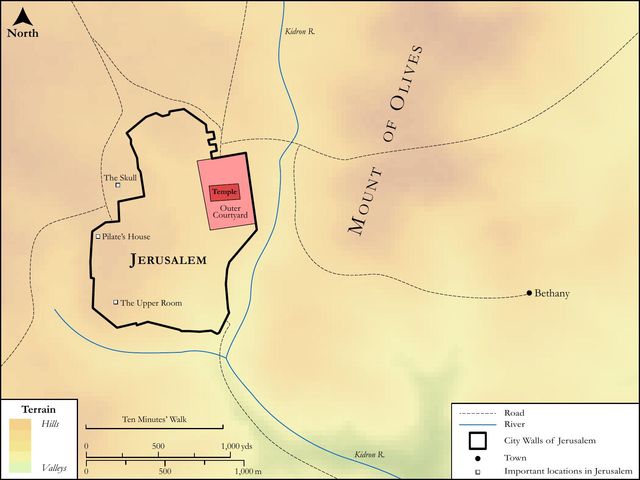
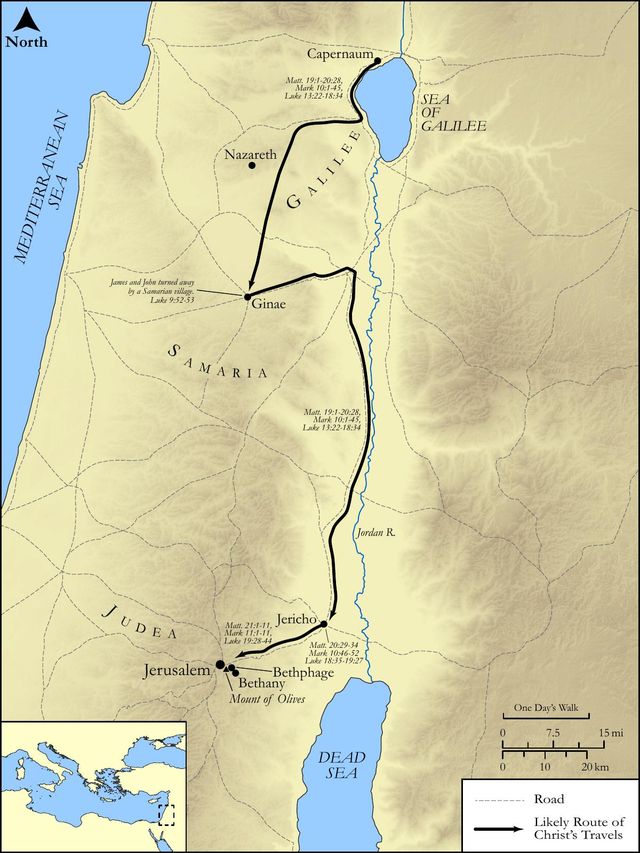
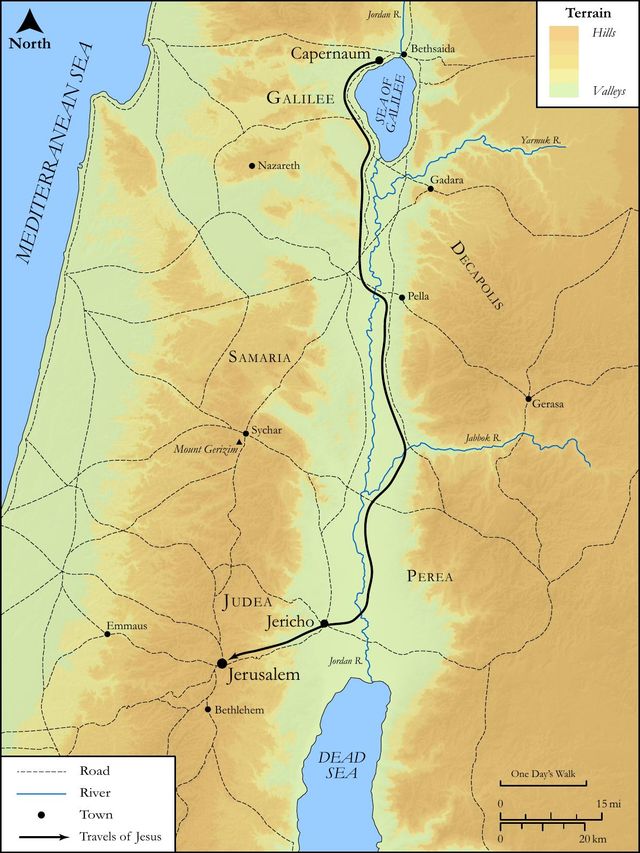
See on the biblical-era maps
Study this verse
Public-domain commentary
Matthew Henry
From his Commentary on the Whole Bible. Henry comments on passages, not single verses — this entry covers Mark 10:46–52. His two-level outline is real structure in the source text, so it is rendered as structure.
This passage of story agrees with that, Mat 20:29, etc. Only that there were told of two blind men; here, and Luk 18:35, only of one: but if there were two, there was one. This one is named here, being a blind beggar that was much talked of; he was called Bartimeus, that is, the son of Timeus; which, some think, signifies the son of a blind man; he was the blind son of a blind father, which made the case worse, and the cure more wonderful, and the more proper to typify the spiritual cures wrought by the grace of Christ, on those that not only are born blind, but are born of those that are blind.
I.This blind man sat begging; as they do with us.
Note, Those who by the providence of God are disabled to get a livelihood by their own labour, and have not any other way of subsisting, are the most proper objects of charity; and particular care ought to be taken of them.
II.He cried out to the Lord Jesus for mercy; Have mercy on me, O Lord, thou Son of David.
Misery is the object of mercy, his own miserable case he recommends to the compassion of the Son of David, of whom it was foretold, that, when he should come to save us, the eyes of the blind should be opened, Isa 35:5. In coming to Christ for help and healing, we should have an eye to him as the promised Messiah, the Trustee of mercy and grace.
III.Christ encouraged him to hope that he should find mercy; for he stood still, and commanded him to be called.
We must never reckon it a hindrance to us in our way, to stand still, when it is to do a good work. Those about him, who had discouraged him at first, perhaps were now the persons that signified to him the gracious call of Christ; "Be of good comfort, rise, he calls thee; and if he calls thee, he will cure thee." Note, The gracious invitations Christ gives us to come to him, are great encouragements to our hope, that we shall speed well if we come to him, and shall have what we come for. Let the guilty, the empty, the tempted, the hungry, the naked, be of good comfort, for he calls them to be pardoned, to be supplied, to be succoured, to be filled, to be clothed, to have all that done for them, which their case calls for.
IV.The poor man, hereupon, made the best of his way to Christ; He cast away his loose upper garment, and came to Jesus (Mar 10:50); he cast away every thing that might be in danger of throwing him down, or might in any way hinder him in coming to Christ, or retard his motion. Those who would come to Jesus, must cast away the garment of their own sufficiency, must strip themselves of all conceit of that, and must free themselves from every weight, and the sin that, like long garments, doth most easily beset them, Heb 12:1.
V.The particular favour he begged, was, that his eyes might be opened; that so he might be able to work for his living, and might be no longer burthensome to others. It is a very desirable thing to be in a capacity of earning our own bread; and where God has given men their limbs and senses, it is a shame for men by their foolishness and slothfulness to make themselves, in effect, blind and lame.
VI.This favour he received; his eyes were opened (Mar 10:52); and two things Mark here adds, which intimate,
1.How Christ made it a double favour to him, by putting the honour of it upon his faith; "Thy faith hath made thee whole; faith in Christ as the Son of David, and in his pity and power; not thy importunity, but thy faith, setting Christ on work, or rather Christ setting thy faith on work." Those supplies are most comfortable, that are fetched in by our faith.
2.How he made it a double favour to himself; When he had received his sight, he followed Jesus by the way. By this he made it appear that he was thoroughly cured, that he no more needed one to lead him, but could go himself; and by this he evidenced the grateful sense he had of Christ's kindness to him, that, when he had his sight, he made this use of it. It is not enough to come to Christ for spiritual healing, but, when we are healed, we must continue to follow him; that we may do honour to him, and receive instruction from him. Those that have spiritual eye-sight, see that beauty in Christ, that will effectually draw them to run after him.
Historical interpretation
Nine Centuries of Reception
10 surviving comments on this verse. Each one is dated, so this reads as a timeline rather than a list.
Select a marker to jump to its quote. Markers stagger vertically where authors wrote within a few decades of each other.
But Jesus, considering his ready will, rewards him with the fulfilment of his desire.
But the blindness in part, brought upon the Jews, will in the end be enlightened when He sends unto them the Prophet Elias. (Rom. 11:25)
The people of the Jews also, because it kept the Scriptures and did not fulfil them, begs and starves by the wayside; but he cries out, Son of David, have mercy upon me, because the Jewish people is enlightened by the merits of the Prophets. Many rebuke him that he may hold his peace, that is, sins and devils restrain the cry of the poor; and he cried the more, because when the battle waxes great, hands are to be lifted up with crying to the Rock of help, that is, Jesus of Nazareth.
Again, the Jewish people comes leaping, stripped of the old man, as a hart leaping on the mountains, that is, laying aside sloth, it meditates on Patriarchs, Prophets, and Apostles on high, and raises itself to heights of holiness. How consistent also is the order of salvation. First we heard by the Prophets, then we cry aloud by faith, next we are called by Apostles, we rise up by penitence, we are stripped of our old garment by baptism, and of our choice we are questioned. Again, the blind man when asked requires, that he may see the will of the Lord.
Or, this is the way of which He said, I am the Way, the Truth, and the Life. This is the narrow way, which leads to the heights of Jerusalem, and Bethany, to the mount of Olives, which is the mount of light and consolation.
The commandment of the Lord is far-shining, "enlightening the eyes." Receive Christ, receive sight, receive thy light, "In order that you may know well both God and man." Praise and declare to me Thy Father God; Thy utterances save; Thy hymn teaches that hitherto I have wandered in error. But since Thou leadest me to the light, O Lord, and I find God through Thee, and receive the Father from Thee, I become "Thy fellow-heir," since Thou "wert not ashamed of me as Thy brother." Let us put away, then, let us put away oblivion of the truth, viz., ignorance; and removing the darkness which obstructs, as dimness of sight, let us contemplate the only true God, first raising our voice in this hymn of praise: Hail, O light! For in us, buried in darkness, shut up in the shadow of death, light has shone forth from heaven, purer than the sun, sweeter than life here below.
Now, whether they were baptized in any manner whatever, or whether they continued unbathed to the end-so that even that saying of the Lord touching the "one bath" does, under the person of Peter, merely regard us-still, to determine concerning the salvation of the apostles is audacious enough, because on them the prerogative even of first choice, and thereafter of undivided intimacy, might be able to confer the compendious grace of baptism, seeing they (I think) followed Him who was wont to promise salvation to every believer. "Thy faith," He would say, "hath saved thee; " and, "Thy sins shall be remitted thee," on thy believing, of course, albeit thou be not yet baptized.
(ubi sup.) Again, it is more worthy to say Rabboni, or, as it is in other places, Master, than to say Son of David; wherefore He gives him health, not on his saying, Son of David, but when he said Rabboni. Wherefore there follows: And Jesus said unto him, Go thy way; thy faith hath made thee whole. And immediately he received his sight, and followed him in the way.
The name of the city agrees with the approaching Passion of our Lord; for it is said, And they came to Jericho. Jericho means moon or anathema; but the failing of the flesh of Christ is the preparation of the heavenly Jerusalem. It goes on: And as he went out of Jericho with his disciples, and a great number of people, blind Bartimæus, the son of Timæus, sat by the wayside begging.
(Vict. Ant. e Cat. in Marc.) The blind man calls the Lord, the Son of David, hearing the way in which the passing multitude praised Him, and feeling sure that the expectation of the prophets was fulfilled. There follows: And many charged him that he should hold his peace.t
To this light, indeed, faith is the way. Hence rightly it is immediately answered to the blind man as he is enlightened: "Receive your sight, your faith has saved you." He sees and follows who puts into practice the good that he understands. But he sees and does not follow who indeed understands the good, but disdains to do good works. If therefore, dearest brothers, we now recognize the blindness of our pilgrimage, if by believing in the mystery of our Redeemer we sit by the wayside, if by praying daily we seek light from our Creator, if having been illuminated after our blindness we now see that same light through understanding, let us follow in our works the Jesus whom we perceive in our mind.
Go, your faith has made you well. And immediately, he said, he saw, and followed him on the way. He sees and follows, who does what he understands to be good. He sees, however, but does not follow, who understands the good indeed, but disregards doing it well. For he follows Jesus the Lord, who imitates. Hence He says: If anyone serves me, let him follow me (John XII). Therefore, let us consider the path He walks, so that we may deserve to follow. Behold, although He is the Lord and creator of angels, about to assume our nature which He created, He came into the womb of a virgin. Nevertheless, He did not wish to be born in this world among the rich, He chose poor parents, and thus the lamb which was to be offered for Him was absent, the mother found young doves and a pair of turtledoves for the sacrifice. He wished to prosper in this world, endured reproaches and mockery, spits, lashes, slaps, a crown of thorns, and the cross. And because we fell from internal joy through the delight of corporeal things, He showed with what bitterness we may return there.
(ubi sup.) He did not say, however, that He gave His life a ransom for all, but for many, that is, for those who would believe on Him.
(ubi sup.) Matthew says, that there were two blind men sitting by the wayside, who cried to the Lord, and received their sight; but Luke relates that one blind man was enlightened by Him, with a like order of circumstances, as He was going into Jericho; where no one, at least no wise man, will suppose that the Evangelists wrote things contrary to one another, but that one wrote more fully, what another has left out. We must therefore understand that one of them was the more important, which appears from this circumstance, that Mark has related his name and the name of his father.
(ubi sup.) Could He who was able to restore sight be ignorant of what the blind man wanted? His reason then for asking is that prayer may be made to Him; He puts the question, to stir up the blind man's heart to pray.
For the blind man looks down upon every gift except light, because, whatever a blind man may possess, without light he cannot see what he possesses.
(ubi sup.) In a mystical sense, however, Jericho, which means the moon, points out the waning of our fleeting race. The Lord restored sight to the blind man, when drawing near to Jericho, because coming in the flesh and drawing near to His Passion, He brought many to the faith; for it was not in the first years of His Incarnation, but in the few years before He suffered, that He showed the mystery of the Word to the world.
(ubi sup.) Now in that on approaching Jericho, He restored sight to one man, and on quitting it to two, He intimated, that before His Passion He preached only to one nation, the Jews, but after His resurrection and ascension, through His Apostles He opened the mysteries both of His Divinity and His Humanity to Jews and Gentiles. Mark indeed, in writing that one received his sight, refers to the saving of the Gentiles, that the figure might agree with the salvation of those, whom he instructed in the faith; but Matthew, who wrote his Gospel to the faithful among the Jews, because it was also to reach the knowledge of the Gentiles, fitly says that two received their sight, that He might teach us that the grace of faith belonged to each people. Therefore, as the Lord was departing with His disciples and a great multitude from Jericho, the blind man was sitting, begging by the way-side; that is, when the Lord ascended into heaven, and many of the faithful followed Him, yea when all the elect from the beginning of the world entered together with Him the gate of heaven,u, presently the Gentile people began to have hope of its own illumination; for it now sits begging by the wayside, because it has not entered upon and reached the path of truth.
Again, the people of the Gentiles, having heard of the fame of the name of Christ, sought to be made a partaker of Him, but many spoke against Him, first the Jews, then also the Gentiles, lest the world which was to be enlightened should call upon Christ. The fury of those who attacked Him, however, could not deprive of salvation those who were fore-ordained to life. And He heard the blind man's cry as He was passing, but stood when He restored his sight, because by His Humanity He pitied him, who by the power of His Divinity has driven away the darkness from our mind; for in that Jesus was born and suffered for our sakes, He as it were passed by, because this action is temporal; but when God is said to stand, it means, that, Himself without change, He sets in order all changeable things. But the Lord calls the blind man, who cries to Him, when He sends the word of faith to the people of the Gentiles by preachers; and they call on the blind man to be of good cheer and to rise, and bid him come to the Lord, when by preaching to the simple, they bid them have hope of salvation, and rise from the sloth of vice, and gird themselves for a life of virtue. Again, he throws away his garment and leaps, who, throwing aside the bands of the world, with unencumbered pace hastens to the Giver of eternal light.
(ubi sup.) Therefore let us also imitate him, let us not seek for riches, earthly goods, or honours from the Lord, but for that Light, which we alone with the Angels can see, the way to which is faith; wherefore also Christ answers to the blind man, Thy faith hath saved thee. But he sees and follows who works what his understanding tells him is good; for he follows Jesus, who understands and executes what is good, who imitates Him, who had no wish to prosper in this world, and bore reproach and derision. And because we have fallen from inward joy, by delight in the things of the body, He shows us what bitter feelings the return thither will cost us.
The mind of the blind man is grateful, for when he was made whole, he did not leave Jesus, but followed Him.
Further, it says that he followed the Lord in the way, that is, in this life, because after it all are excluded who follow Him not here, by working His commandments.
Continue studying Mark 10:52 across the web’s major study libraries — every link below opens this exact verse, chapter, or book on the destination site.
Read & Compare
 BibleGatewayThis verse in more than 200 translations and 70 languages.
 Bible.comThe YouVersion reader — hundreds of translations, reading plans, and highlights.
 ESV.orgCrossway's official English Standard Version reader.
 NET BibleThe NET translation with 60,000+ translators' notes on every rendering decision.
 STEP BibleTyndale House's free study tool — original text, vocabulary, and scholarly resources.
 BibliaLogos Bible Software's free web reader.
 USCCBThe New American Bible (Revised Edition) with the U.S. bishops' study notes.
Commentaries
 BibleHub CommentariesDozens of classic commentaries on this verse, gathered on one page.
 StudyLightMore than 100 commentary sets — the largest collection on the web.
 BibleRefPlain-English commentary on what this verse means, verse by verse.
 Enduring WordDavid Guzik's free commentary on this chapter, widely used by Bible teachers.
 Bible Study ToolsVerse commentary alongside Greek and Hebrew study aids.
Original Language & Research
- BibleHub InterlinearThe verse word by word — original language, transliteration, and English.
- BibleHub LexiconEvery word's original-language definition and Strong's entry.
 Blue Letter BibleDeep-study tools — Strong's numbers, concordance, and word studies.
 CNTR CollationThe earliest Greek manuscripts of this verse, collated letter by letter.
Sermons, Hymns & Audio


TrulyRandomVerse is not affiliated with these sites and doesn’t control their content. They’re linked because they’re genuinely useful.
Summary
Mark 10:52 culminates the dramatic encounter between Jesus and blind Bartimaeus, powerfully illustrating the transformative efficacy of active faith. Jesus declares that Bartimaeus's faith has made him whole, resulting in his immediate physical restoration and a profound spiritual decision to follow Jesus on the path of discipleship, signifying not only a recovery of sight but also an embrace of new life in Christ.
Context
ShowHideLiterary Context
Mark 10:52 serves as the climactic conclusion to the healing narrative of Bartimaeus, which begins in Mark 10:46. This account immediately follows Jesus' third passion prediction and His teaching on servant leadership, where He contrasts worldly greatness with the humility required for true discipleship (e.g., Mark 10:45). The healing of Bartimaeus, an overlooked figure, powerfully illustrates Jesus' teaching: the "Son of Man came not to be served but to serve, and to give his life as a ransom for many." Bartimaeus's persistent cry and immediate following of Jesus stand in stark contrast to the disciples' earlier struggles with understanding Jesus' mission and their own roles. The narrative also sets the stage for Jesus' entry into Jerusalem, a pivotal moment in the Gospel.
Historical & Cultural Context
The setting is Jericho, a significant city on the main route from Galilee to Jerusalem, especially for pilgrims traveling for Passover. Beggars like Bartimaeus were common in that day, often overlooked and dependent on the charity of others, frequently congregating at city gates or along busy roads. Blindness, in particular, was seen as a severe affliction, often associated with divine judgment or sin, leading to social ostracization. The title "Son of David" (used by Bartimaeus in Mark 10:47) was a messianic title, acknowledging Jesus' lineage and His role as the promised deliverer, indicating a profound understanding of Jesus' identity that many others, even the disciples, struggled with.
Key Themes
ShowHideThis verse encapsulates several major themes prevalent in Mark's Gospel and the broader biblical narrative. The Power of Faith is paramount, as Jesus explicitly attributes Bartimaeus's healing to his faith, not merely to Jesus' power, emphasizing the interactive nature of divine intervention. Jesus' Compassion and Authority are vividly displayed as He stops for a seemingly insignificant beggar, demonstrating His boundless love and sovereign power over physical ailments. The theme of Discipleship is also central, as Bartimaeus's immediate response to his healing is to "follow Jesus in the way," symbolizing a complete spiritual transformation and commitment to Christ, moving from a life of begging by the roadside to walking with the Messiah. This act of following foreshadows the ultimate call to discipleship for all who encounter Jesus' saving power, as seen in Mark 1:17-18.
Exposition and Analysis
ShowHideKey Word Analysis
ShowHideMeaning "persuasion, i.e., credence; moral conviction (of religious truth, or the truthfulness of God or a religious teacher), especially reliance upon Christ for salvation." Bartimaeus's "faith" was not a passive belief but an active, persistent trust in Jesus' ability and willingness to heal, demonstrated by his unwavering calls and immediate response to Jesus' summons. This faith was the conduit through which divine power flowed, making him "whole."
Meaning "to save, i.e., deliver or protect (literally or figuratively); heal, preserve, save (self), do well, be (make) whole." While primarily referring to Bartimaeus's physical restoration of sight, the term sōzō carries a profound dual meaning. It implies not only physical healing but also spiritual salvation and deliverance. Jesus' declaration, "thy faith hath made thee whole," suggests a holistic restoration—a physical cure accompanied by a spiritual transformation that leads to discipleship.
Meaning "to be in the same way with, i.e., to accompany (specially, as a disciple)." This word signifies more than just walking behind Jesus; it denotes a commitment to discipleship. Bartimaeus's immediate act of following Jesus "in the way" (G3598, hodós) indicates a complete reorientation of his life, moving from a life of stagnation and begging to an active journey with his Lord, embodying the very essence of what it means to be a disciple.
Verse Breakdown
ShowHide"And Jesus said unto him, Go thy way;"
Jesus' initial instruction, "Go thy way," appears at first glance to be a dismissal. However, in context, it is an affirmation of Bartimaeus's restored autonomy and freedom. He is no longer bound by his blindness or his former life as a beggar; he is free to choose his path. This phrase empowers him to act on his newfound wholeness.
"thy faith hath made thee whole."
This is the pivotal statement, directly attributing the miraculous healing to Bartimaeus's faith. Jesus emphasizes that it was not merely His power operating independently, but the recipient's active trust that facilitated the miracle. As explored in the key word analysis, "whole" (Greek sōzō) implies a comprehensive restoration—physical sight and spiritual salvation.
"And immediately he received his sight,"
The adverb "immediately" (Greek euthéōs) is characteristic of Mark's Gospel, highlighting the instantaneous and undeniable nature of Jesus' miracles. This emphasizes the divine authority and power of Jesus, leaving no room for doubt about the authenticity or completeness of the healing.
"and followed Jesus in the way."
This final clause reveals Bartimaeus's ultimate response and the spiritual outcome of his healing. Instead of returning to his old life or simply going home, he chose to become a disciple, actively following Jesus on His journey. "The way" (Greek hodós) here is not just a physical road but also a metaphorical path of discipleship, signifying a new life direction and commitment to Christ.
Literary Devices
ShowHideMark 10:52 is rich with literary devices that amplify its theological impact. Direct Discourse is prominent, as Jesus' words are quoted verbatim, lending authority and immediacy to His declaration. The narrative employs Juxtaposition, contrasting Bartimaeus's former state of physical and social blindness with his immediate restoration and spiritual insight, which leads him to follow Jesus. There is significant Symbolism at play: Bartimaeus's physical blindness symbolizes humanity's spiritual blindness without Christ, and his recovery of sight represents spiritual enlightenment and salvation. His act of "following Jesus in the way" is a powerful Metaphor for discipleship, indicating a complete life transformation and commitment. Furthermore, the Irony is subtle but profound: the physically blind man "sees" Jesus' true identity as the Son of David more clearly than many of the sighted religious leaders and even some of Jesus' own disciples, who struggle to grasp His mission.
Theological and Thematic Connections
ShowHideMark 10:52 stands as a profound testament to the transformative power of faith in Jesus, illustrating that genuine belief is not merely intellectual assent but a dynamic trust that elicits divine intervention and leads to radical life change. Bartimaeus's healing is a microcosm of the Gospel message: humanity, spiritually blind and overlooked by sin, encounters the compassionate Christ, and through faith, receives not only restoration but also the call to follow Him into a new life of purpose and discipleship. This narrative underscores Jesus' unique authority to heal and save, demonstrating that His mission extends beyond physical ailments to the deepest needs of the human soul, offering holistic salvation that reorients one's entire existence towards Him.
Reflection and Application
ShowHideMark 10:52 offers a powerful and enduring model for our own spiritual journeys. Bartimaeus's persistent and vocal faith, despite the crowd's discouragement, reminds us to approach God with unwavering confidence and earnestness in prayer, trusting that He hears and responds to the cries of His children. His immediate healing underscores the instantaneous and complete nature of God's grace when we truly believe. Most significantly, Bartimaeus's post-healing response—to immediately follow Jesus "in the way"—serves as a profound challenge and inspiration for all believers. It teaches us that authentic encounter with Christ's saving power should naturally lead to a radical reorientation of our lives, leaving behind our old ways and committing to walk in active discipleship with Him. This means not just receiving a blessing, but dedicating our lives to the Blesser, embracing His path, and becoming His followers in every aspect of our existence.
Questions for Reflection
ShowHideFAQ
ShowHideWhat does "thy faith hath made thee whole" truly mean in this context?
ShowHideThe phrase "thy faith hath made thee whole" (Greek: hē pístis sou sesōken se) is a profound declaration by Jesus that attributes Bartimaeus's healing not merely to a passive reception of divine power, but to his active and demonstrated trust in Jesus. The Greek word sesōken comes from sōzō (G4982), which means "to save, heal, or make whole." In this context, it encompasses both the physical restoration of Bartimaeus's sight and a deeper, spiritual salvation. It implies that Bartimaeus's belief in Jesus as the Messiah, the "Son of David," was a crucial element in his complete transformation. This phrase highlights that while Jesus possessed the power to heal, He often honored and responded to the faith of the individual, making their faith an active participant in their healing journey, as seen in other accounts like the woman with the issue of blood in Mark 5:34.
Christ-Centered Fulfillment
ShowHideThe account of Bartimaeus's healing in Mark 10:46-52 finds its ultimate Christ-centered fulfillment in Jesus as the light of the world and the bringer of spiritual sight. Just as Bartimaeus was physically blind and overlooked, humanity is spiritually blind and alienated from God due to sin. Jesus, the true "Son of David" and Messiah, comes not only to restore physical infirmities but, more profoundly, to open the eyes of the heart to the truth of God and the way of salvation. His declaration, "thy faith hath made thee whole," foreshadows the New Covenant reality where faith in Christ is the means by which humanity receives not just healing but eternal life and spiritual transformation. Bartimaeus's immediate decision to "follow Jesus in the way" beautifully illustrates the response of those who have truly encountered the saving grace of Christ: they leave their old lives behind and commit to walking in discipleship with the One who has given them new sight and new life. This echoes the broader biblical narrative where Jesus is the ultimate physician who heals the sin-sick soul, making those who were once in darkness now children of light, as illuminated in passages like John 8:12 and Ephesians 5:8. Bartimaeus's story is a powerful microcosm of the gospel's call to see Jesus for who He truly is, to trust in His saving power, and to follow Him wholeheartedly.