


Matthew 4:20
- οἱhoi<the>G3588T-NPMDefinite article Nominative Plural Masculine
- δὲdeAndG1161CONJConjunction
- εὐθέωςeutheōsimmediatelyG2112ADVAdverb
- ἀφέντεςaphenteshaving leftG863V-2AAP-NPMVerb 2nd Aorist Active Participle Nominative Plural Masculine
- τὰtatheG3588T-APNDefinite article Accusative Plural Neuter
- δίκτυαdiktuanetsG1350N-APNNoun Accusative Plural Neuter
- ἠκολούθησανēkolouthēsanthey followedG190V-AAI-3PVerb Aorist Active Indicative 3rd Plural
- αὐτῷautōHimG846P-DSMPersonal pronoun Dative Singular Masculine
English is a literal word-by-word gloss of the Greek, not the KJV's wording. Why?
This is the original text the KJV's translators worked from — each Greek word with its own literal English meaning in this verse, prepared by scholars at Tyndale House, Cambridge. The KJV translates whole sentences, not word by word, so its wording differs: one Greek word can become several English words, and the KJV may choose “charity” where the gloss reads “love”. Both are faithful — they answer different questions. For the KJV's own rendering, switch to the KJV text.
Details
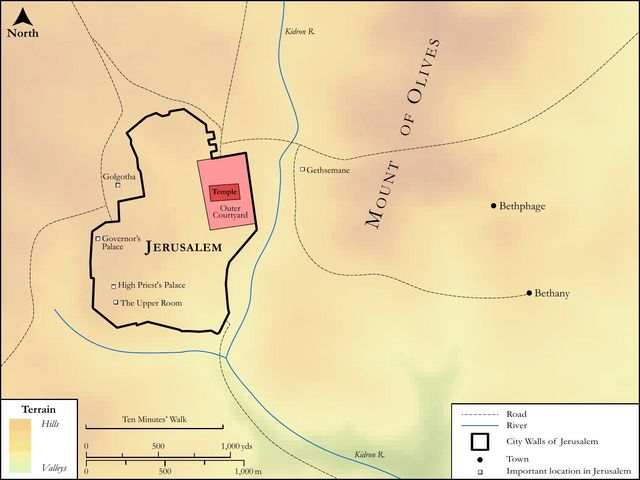
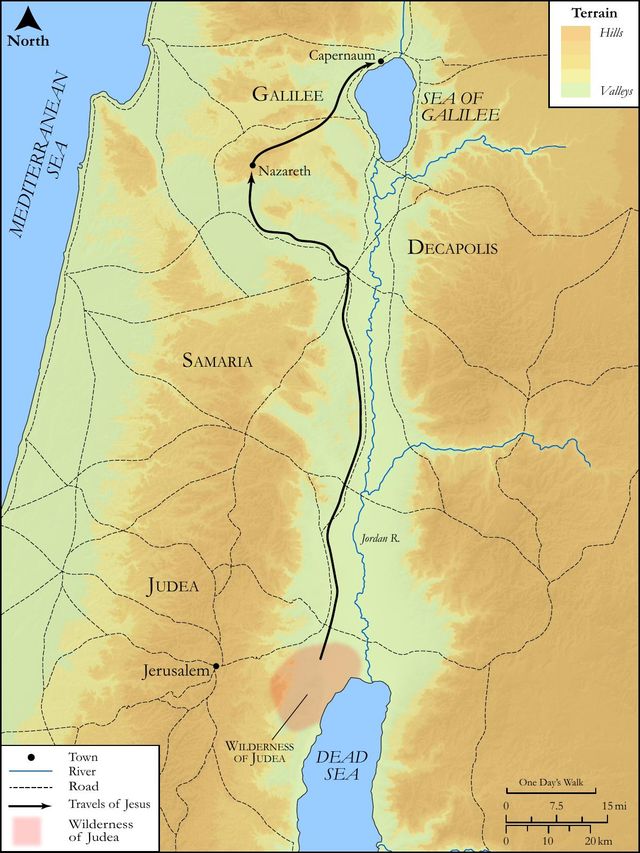
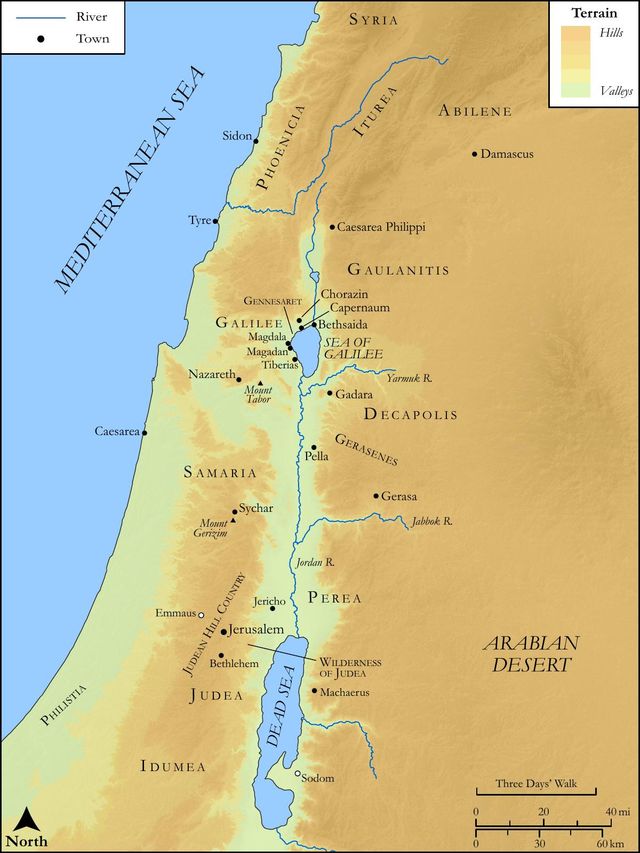
See on the biblical-era map
Study this verse
Public-domain commentary
Matthew Henry
From his Commentary on the Whole Bible. Henry comments on passages, not single verses — this entry covers Matthew 4:18–22. His three-level outline is real structure in the source text, so it is rendered as structure.
When Christ began to preach, he began to gather disciples, who should now be the hearers, and hereafter the preachers, of his doctrine, who should now be witnesses of his miracles, and hereafter concerning them. Now, in these verses, we have an account of the first disciples that he called into fellowship with himself.
And this was an instance, 1. Of effectual calling to Christ. In all his preaching he gave a common call to all the country, but in this he gave a special and particular call to those that were given him by the Father. Let us see and admire the power of Christ's grace, own his word to be the rod of his strength, and wait upon him for those powerful influences which are necessary to the efficacy of the gospel call - those distinguishing influences. All the country was called, but these were called out, were redeemed from among them. Christ was so manifested to them, as he was not manifested unto the world. 2. It was an instance of ordination, and appointment to the work of the ministry. When Christ, as a Teacher, set up his great school, one of his first works was to appoint ushers, or under masters, to be employed in the work of instruction. Now he began to give gifts unto men, to put the treasure into earthen vessels. It was an early instance of his care for the church.
Now we may observe here,
I.Where they were called - by the sea of Galilee, where Jesus was walking, Capernaum being situated near that sea.
Concerning this sea of Tiberias, the Jews have a saying, That of all the seven seas that God made, he made choice of none but the sea of Gennesaret; which is very applicable to Christ's choice of it, to honour it, as he often did, with his presence and his miracles. Here, on the banks of the sea, Christ was walking for contemplation, as Isaac in the field; hither he went to call his disciples; not to Herod's court (for few mighty or noble are called), not to Jerusalem, among the chief priests and the elders, but to the sea of Galilee; surely Christ sees not as man sees. Not but that the same power which effectually called Peter and Andrew would have wrought upon Annas and Caiaphas, for with God nothing is impossible; but, as in other things, so in his converse and attendance, he would humble himself, and show that God ha chosen the poor of this world. Galilee was a remote part of the nation, the inhabitants were less cultivated and refined, their very language was broad and uncouth to the curious, their speech betrayed them. They who were picked up at the sea of Galilee, had not the advantages and improvements, no, not of the more polished Galileans; yet thither Christ went, to call his apostles that were to be the prime ministers of state in his kingdom, for he chooses the foolish things of this world, to confound the wise.
II.Who they were.
We have an account of the call of two pair of brothers in these verses - Peter and Andrew, James and John; the two former, and, probably, the two latter also, had had acquaintance with Christ before (Joh 1:40, Joh 1:41), but were not till now called into a close and constant attendance upon him. Note, Christ brings poor souls by degrees into fellowship with himself. They had been disciples of John, and so were the better disposed to follow Christ. Note, Those who have submitted to the discipline of repentance, shall be welcome to the joys of faith. We may observe concerning them,
1.That they were brothers. Note, It is a blessed thing, when they who are kinsmen according to the flesh (as the apostle speaks, Rom 9:3), are brought together into a spiritual alliance to Jesus Christ. It is the honour and comfort of a house, when those that are of the same family, are of God's family.
2.That they were fishers. Being fishers,
(1.)They were poor men: if they had had estates, or any considerable stock in trade, they would not have made fishing their trade, however, they might have made it their recreation. Note, Christ does not despise the poor, and therefore we must not; the poor are evangelized, and the Fountain of honour sometimes gives more abundant honour to that part which most lacked.
(2.)The were unlearned men, not bred up to books or literature as Moses was, who was conversant with all the learning of the Egyptians. Note, Christ sometimes chooses to endow those with the gifts of grace who have least to show of the gifts of nature. Yet this will not justify the bold intrusion of ignorant and unqualified men into the work of the ministry: extraordinary gifts of knowledge and utterance are not now to be expected, but requisite abilities must be obtained in an ordinary way, and without a competent measure of these, none are to be admitted to that service.
(3.)They were men of business, who had been bred up to labour. Note, Diligence in an honest calling is pleasing to Christ, and no hindrance to a holy life. Moses was called from keeping sheep, and David from following the ewes, to eminent employments. Idle people lie more open to the temptations of Satan than to the calls of God.
(4.)They were men that were accustomed to hardships and hazards; the fisher's trade, more than any other, is laborious and perilous; fishermen must be often wet and cold; they must watch, and wait, and toil, and be often in perils by waters. Note, Those who have learned to bear hardships, and run hazards, are best prepared for the fellowship and discipleship of Jesus Christ. Good soldiers of Christ must endure hardness.
III.What they were doing.
Peter and Andrew were then using their nets, they were fishing; and James and John were mending their nets, which was an instance of their industry and good husbandry. They did not go to their father for money to buy new nets, but took pains to mend their old ones. It is commendable to make what we have go as far, and last as long, as may be. James and John were with their father Zebedee, ready to assist him, and make his business easy to him. Note, It is a happy and hopeful presage, to see children careful of their parents, and dutiful to them. Observe, 1. They were all employed, all very busy, and none idle. Note, When Christ comes, it is good to be found doing. "Am I in Christ?" is a very needful question for us to ask ourselves; and, next to that, "Am I in my calling?" 2. They were differently employed; two of them were fishing, and two of them mending their nets. Note, Ministers should be always employed, either in teaching or studying; they may always find themselves something to do, if it be not their own fault; and mending their nets, is, in its season, as necessary work as fishing.
IV.What the call was (Mat 4:19); Follow me, and I will make you fishers of men.
They had followed Christ before, as ordinary disciples (Joh 1:37), but so they might follow Christ, and follow their calling too; therefore they were called to a more close and constant attendance, and must leave their calling. Note, Even they who had been called to follow Christ, have need to be called to follow on, and to follow nearer, especially when they are designed for the work of the ministry. Observe,
1.What Christ intended them for; I will make you fishers of men; this alludes to their former calling. Let them be not proud of the new honour designed them, they are still but fishers; let them not be afraid of the new work cut out for them, for they have been used to fishing, and fishers they are still. It was usual with Christ to speak of spiritual and heavenly things under such allusions, and in such expressions, as took rise from common things that offered themselves to his view. David was called from feeding sheep to feed God's Israel; and when he is a king, is a shepherd. Note,
(1.)Ministers are fishers of men, not to destroy them, but to save them, by bringing them into another element. They must fish, not for wrath, wealth, honour, and preferment, to gain them to themselves, but for souls, to gain them to Christ. They watch for your souls (Heb 13:17), and seek not yours, but you, Co2 12:14, Co2 12:16.
(2.)It is Jesus Christ that makes them so; I will make you fishers of men. It is he that qualifies men for this work, calls them to it, authorizes them in it, gives them commission to fish for souls, and wisdom to win them. Those ministers are likely to have comfort in their work, who are thus made by Jesus Christ.
2.What they must do in order to this; Follow me. They must separate themselves to a diligent attendance on him, and set themselves to a humble imitation of him; must follow him as their Leader. Note,
(1.)Those whom Christ employs in any service for him, must first be fitted and qualified for it.
(2.)Those who would preach Christ, must first learn Christ, and learn of him. How can we expect to bring others to the knowledge of Christ, if we do not know him well ourselves?
(3.)Those who would get an acquaintance with Christ, must be diligent and constant in their attendance on him. The apostles were prepared for their work, by accompanying Christ all the time that he went in and out among them, Act 1:21. There is no learning comparable to that which is got by following Christ. Joshua, by ministering to Moses, is fitted to be his successor.
(4.)Those who are to fish for men, must therein follow Christ, and do it as he did, with diligence, faithfulness, and tenderness. Christ is the great pattern for preachers, and they ought to be workers together with him.
V.What was the success of this call.
Peter and Andrew straightway left their nets (Mat 4:20); and James and John immediately left the ship and their father (v. 22); and they all followed him. Note, Those who would follow Christ aright, must leave all to follow him. Every Christian must leave all in affection, set loose to all, must hate father and mother (Luk 14:26), must love them less than Christ, must be ready to part with his interest in them rather than with his interest in Jesus Christ; but those who are devoted to the work of the ministry are, in a special manner, concerned to disentangle themselves from all the affairs of this life, that they may give themselves wholly to that work which requires the whole man. Now,
1.This instance of the power of the Lord Jesus gives us good encouragement to depend upon the sufficiency of his grace. How strong and effectual is his word! He speaks, and it is done. The same power goes along with this word of Christ, Follow me, that went along with that word, Lazarus, come forth; a power to make willing, Psa 110:3.
2.This instance of the pliableness of the disciples, gives us a good example of obedience to the command of Christ. Note, It is the good property of all Christ's faithful servants to come when they are called, and to follow their Master wherever he leads them. They objected not their present employments, their engagements to their families, the difficulties of the service they were called to, or their own unfitness for it; but, being called, they obeyed, and, like Abraham, went out not knowing whither they went, but knowing very well whom they followed. James and John left their father: it is not said what became of him; their mother Salome was a constant follower of Christ; no doubt, their father Zebedee was a believer, but the call to follow Christ fastened on the young ones. Youth is the learning age, and the labouring age. The priests ministered in the prime of their life.
Historical interpretation
Nine Centuries of Reception
12 surviving comments on this verse. Each one is dated, so this reads as a timeline rather than a list.
Select a marker to jump to its quote. Markers stagger vertically where authors wrote within a few decades of each other.
By this that they left their occupation and their father's house we are taught, that when we would follow Christ we should not be holden of the cares of secular life, or of the society of the paternal mansion.
Or, the number that was to be of the Evangelists is figured.
And yet John saith that they were called in another manner. Whence it is evident that this was a second call; and from many things one may perceive this. For there it is said, that they came to Him when "John was not yet cast into prison;" but here, after he was in confinement. And there Andrew calls Peter, but here Jesus calls both. And John saith, Jesus seeing Simon coming, saith, "Thou art Simon, the Son of Jona, thou shalt be called Cephas, which is by interpretation, a stone." But Matthew saith that he was already called by that name; for his words are, "Seeing Simon that was called Peter." And from the place whence they were called, and from many other things, one may perceive this; and from their ready obedience, and abandonment of all. For now they were well instructed beforehand. Thus, in the other case, Andrew is seen coming into His house, and hearing many things; but here, having heard one bare word, they followed immediately. Since neither was it unnatural for them to follow Him at the beginning, and then leave Him again and return anew to their own craft, when they saw both John thrown into prison, and Himself departing. Accordingly you see that He finds them actually fishing. But He neither forbad them at the first when minded to withdraw, nor having withdrawn themselves, did He let them go altogether; but He gave way when they started aside from Him, and comes again to win them back; which kind of thing is the great point in fishing.
But mark both their faith, and their obedience. For though they were in the midst of their work (and ye know how greedy a thing fishing is), when they heard His command they delayed not, they procrastinated not, they said not, "let us return home, and converse with our kinsfolk," but "they forsook all and followed," even as Elisha did to Elijah. Because such is the obedience which Christ seeks of us, as that we delay not even a moment of time, though something absolutely most needful should vehemently press on us. Wherefore also when some other had come unto Him, and was asking leave to bury his own father, not even this did He permit him to do: to signify that before all we ought to esteem the following of Himself.
But if thou should say, "the promise is very great;" even for this do I most admire them, for that when they had not as yet seen any sign, they believed in so great a reach of promise, and accounted all but second to that attendance. And this, because they believed that by what words they were caught, by the same they would be able to catch others also.
To these, then, such was His promise: but to James and John He saith no such thing. For the obedience of those that had gone before had by this time paved the way for these. And besides they had also heard many things before concerning Him.
And see how he doth with exact care intimate unto us their poverty also: in that He found them sewing up their nets. So exceeding great was their poverty, that they were mending what was worn out, not being able to buy others. And this too was for the time no small proof of virtue, their bearing poverty with ease, their supporting themselves by honest labor, their being bound one to another by the power of love, their having their father with them, and attending upon them.
He calls them while actually working at their employment, to show that to follow Him ought to be preferred to all occupations. They were just then casting a net into the sea, which agreed with their future office.
To so great a promise they trusted, and believed that they should catch others by those same words by which themselves had been caught.
It is no small sign of goodness, to bear poverty easily, to live by honest labour, to be bound together by virtue of affection, to keep their poor father with them, and to toil in his service.
He made no promise to them when He called them, as He had to the former, for the obedience of the first had made the way plain for them. Besides, they had heard many things concerning Him, as being friends and townsmen of the others.
Mystically interpreted, Christ begins to preach as soon as John was delivered to prison, because when the Law ceased, the Gospel commenced.
(Ver. 19, 20.) Come after me, and I will make you fishers of men. And immediately they left their nets and followed him. These first ones were called to follow the Lord: fishermen and unlettered men are sent to preach, lest the faith of believers be thought to come about not by the power of God, but by eloquence and teaching.
(Serm. 197. 2.) He chose not kings, senators, philosophers, or orators, but he chose common, poor, and untaught fishermen.
(Aug. Tract. in Joann. vii. 17.) Had one learned been chosen, he might have attributed the choice to the merit of his learning. But our Lord Jesus Christ, willing to bow the necks of the proud, sought not to gain fishermen by orators, but gained an Emperor by a fisherman. Great was Cyprian the pleader, but Peter the fisherman was before him.
(Ev. ii. 17.) It might move enquiry, why John relates that near Jordan, not in Galilee, Andrew followed the Lord with another whose name he does not mention; and again, that Peter received that name from the Lord. Whereas the other three Evangelists write that they were call d rom their fishing, sufficiently agreeing with one another, especially Matthew and Mark; Luke not naming Andrew, who is however understood to have been in the same vessel with him. There is a further seeming discrepancy, that in Luke it is to Peter only that it is said, Henceforth thou shalt catch men; Matthew and Mark write that it was said to both. As to the different account in John, it should be carefully considered, and it will be found that it is a different time, place, and calling that is there spoken of. For Peter and Andrew had not so seen Jesus at the Jordan that they adhered inseparably ever after, but so as only to have known who He was, and wondering at Him to have gone their way. Perhaps he is returning back to something he had omitted, for he proceeds without marking any difference of time, As he walked by the sea of Galilee. It may be further asked, how Matthew and Mark relate that He called them separately two and two, when Luke relates that James and John being partners of Peter were called as it were to aid him, and bringing their barks to land followed Christ. We may then understand that the narrative of Luke relates to a prior time, after which they returned to their fishing as usual. For it had not been said to Peter that he should no more catch fishes, as he did do so again after the resurrection, but that he should catch men. Again, at a time after this happened that call of which Matthew and Mark speak; for they draw their ships to land to follow Him, not as careful to return again, but only anxious to follow Him when He bids them.
Before He spoke or did any thing, Christ called Apostles, that neither word nor deed of His should be hid from their knowledge, so that they may afterwards say with confidence, What we have seen and heard, that we cannot but speak. (Acts 4:20.)
The operations of their secular craft were a prophecy of their future dignity. As he who casts his net into the water knows not what fishes he shall take, so the teacher casts the net of the divine word upon the people, not knowing who among them will come to God. Those whom God shall stir abide in his doctrine.
Fishers of men, that is, teachers, that with the net of God's word you may catch men out of this world of storm and danger, in which men do not walk but are rather borne along, the Devil by pleasure drawing them into sin where men devour one another as the stronger fishes do the weaker, withdrawn from hence they may live upon the land, being made members of Christ's body.
These disciples did not follow Christ from desire of the honour of a doctor, but because they coveted the labour itself; they knew how precious is the soul of man, how pleasant to God is his salvation, and how great its reward.
These were their desires, for which they left all and followed; teaching us thereby that none can possess earthly things and perfectly attain to heavenly things.
Rightly did He thus build the foundations of the brotherhood of the Church on love, that from such roots a copious sap of love might flow to the branches; and that too on natural or human love, that nature as well as grace might bind their love more firmly. They were moreover brothers; and so did God in the Old Testament lay the foundations of His building on Moses and Aaron, brothers. But as the grace of the New Testament is more abundant than that of the Old, therefore the first people were built upon one pair of brethren, but the new people upon two. They were washing their nets, a proof of the extremest indigence; they repaired the old because they had not whence they should buy new. And what shows their great filial piety, in this their great poverty they deserted not their father, but carried him with them in their vessel, not that he might aid in their labour, but have the enjoyment of his sons' presence.
We may not dare to consider the former disciples as more quick to preach, because they were casting their nets; and these latter as less active, because they were yet making ready only; for it is Christ alone that may know their differences. But perhaps we may say that the first were casting their nets, because Peter preached the Gospel, but committed it not to paper—the others were making ready their nets, because John composed a Gospel. He called them together, for by their abode they were fellow-townsmen, in affection attached, in profession agreed, and united by brotherly tenderness. He called them then at once, that united by so many common blessings they might not be separated by a separate call.
There are three things which we must leave who would come to Christ; carnal actions, which are signified in the fishing nets; worldly substance, in the ship; parents, which are signified in their father. They left their own vessel, that they might become governors of the vessel of the Church; they left their nets, as having no longer to draw out fishes on to the earthly shore, but men to the heavenly; they left their father, that they might become the spiritual fathers of all.
Saw, that is, not so much with the bodily eye, as spiritually viewing their hearts.
Of these fishermen the Lord speaks by Jeremiah. I will send my fishers among you, and they shall catch you. (Jer. 16:16.)
Mystically, by the sea is figured this world, because of its bitterness and its tossing waves. Galilee is interpreted, 'rolling' or 'a wheel,' and shows the changeableness of the world. Jesus walked by the sea when He came to us by incarnation, for He took on Him of the Virgin not the flesh of sin, but the likeness of the flesh of sin. By the two brothers, two people are signified born of one God their Father; He saw them when He looked on them in His mercy. In Peter, (which is interpreted 'owning,') who is called Simon, (i. e. obedient,) is signified the Jewish nation, who acknowledged God in the Law, and obeyed His commandments; Andrew, which is interpreted 'manly' or 'graceful,' signifies the Gentiles, who after they had come to the knowledge of God, manfully abode in the faith. He called us His people when He sent the preachers into the world, saying, Follow me; that is, leave the deceiver, follow your Creator. Of both people there were made fishers of men, that is, preachers. Leaving their ships, that is, carnal desires, and their nets, that is, love of the world, they followed Christ. By James is understood the Jewish nation, which through their knowledge of God overthrew the Devil; by John the Gentile world, which was saved of grace alone. Zebedee whom they leave, (the name is interpreted flying or falling,) signifies the world which passes away, and the Devil who fell from Heaven. By Peter and Andrew casting their net into the sea, are meant those who in their early youth are called by the Lord, while from the vessel of their body they cast the nets of carnal concupiscence into the sea of this world. By James and John mending their nets are signified those who after sin before adversity come to Christ recovering what they had lost.
Also, the four principal virtues are here designed; Prudence, in Peter, from his confession of God; Justice, we may refer to Andrew for his manful deeds; Fortitude, to James, for his overthrow of the Devil; Temperance, to John, for the working in him of divine grace.
You have heard, dearest brothers, that at the voice of a single command, Peter and Andrew, leaving their nets, followed the Redeemer. They had seen him perform no miracles yet, they had heard nothing from him about the reward of eternal recompense; and yet at one command of the Lord they forgot what they seemed to possess. How many of his miracles do we see, with how many scourges are we afflicted, by how many harsh threats are we deterred, and yet we disdain to follow him when he calls? He who admonishes us about conversion already sits in heaven; he has already subjected the necks of the nations to the yoke of faith, he has already laid low the glory of the world, he already announces, as its ruins multiply, that the day of his strict judgment draws near; and yet our proud mind does not wish to abandon willingly what it loses daily against its will. What then, dearest ones, what shall we say at his judgment, we who are neither bent by commands nor corrected by blows from the love of the present age?
But perhaps someone may say to himself in silent thoughts: At the Lord's voice, what or how much did each of these fishermen leave behind, who had almost nothing? But in this matter, dearest brothers, we ought to weigh the affection rather than the wealth. He left much who retained nothing for himself; he left much who, however little it was, abandoned everything. Certainly we both possess what we have with love, and seek from desire those things we do not have at all. Therefore Peter and Andrew left much, since each also abandoned the desires of having. He left much who renounced his longings along with the thing he possessed. Therefore those who followed gave up as much as could be desired by those who did not follow. Let no one therefore, even when he sees that certain people have left many things behind, say to himself: I want to imitate these despisers of the world, but I have nothing to leave behind. You leave many things, brothers, if you renounce earthly desires. For our external possessions, however small, are sufficient for the Lord. For he weighs the heart, not the substance; nor does he consider how much is offered in his sacrifice, but from how much it is brought forth. For if we weigh external substance, behold, our holy merchants purchased the perpetual life of angels by giving up their nets and boat. Indeed it has no estimation of price, yet the kingdom of God is worth as much as you have. For it was worth half his substance to Zacchaeus, because he reserved the other half to restore fourfold what he had unjustly taken. It was worth the abandoned nets and boat to Peter and Andrew; it was worth two small coins to the widow; it was worth a cup of cold water to another. The kingdom of God, therefore, as we said, is worth as much as you have.
(Hom. in Evan. v. 1.) Peter and Andrew had seen Christ work no miracle, had heard from him no word of the promise of the eternal reward, yet at this single bidding of the Lord they forgot all that they had seemed to possess, and straightway left their nets, and followed Him. In which deed we ought rather to consider their wills than the amount of their property. He leaves much who keeps nothing for himself, he parts with much, who with his possessions renounces his lusts. Those who followed Christ gave up enough to be coveted by those who did not follow. Our outward goods, however small, are enough for the Lord; He does not weigh the sacrifice by how much is offered, but out of how much it is offered. The kingdom of God is not to be valued at a certain price, but whatever a man has, much or little, is equally available.
(Hom. in Ex. 17:1.) Hereby we are also silently admonished, that he who wants affection towards others, ought not to take on him the office of preaching. The precepts of charity are two, and between less than two there can be no love.
The sea of Galilee, the lake of Gennesareth, the sea of Tiberias, and the salt lake, are one and the same.
The two vessels signify the two Churches; the one was called out of the circumcision, the other out of the uncircumcision. Any one who believes becomes Simon, i, e. obedient to God; Peter by acknowledging his sin, Andrew by enduring labours manfully, James by overcoming vices,
(ord.) He rightly goes to fishing places, when about to fish for fishermen.
(interlin.) Follow me, not so much with your feet as in your hearts and your life.
(ap. Anselm.) These last disciples were an example to such as leave their property for the love of Christ; now follows an example of others who postponed earthly affection to God. Observe how He calls them two and two, as He afterwards sent them two and two to preach.
(ap Anselm.) and John that he may ascribe the whole to God's grace. The calling of four only is mentioned, as those preachers by whom God will call the four quarters of the world.
Continue studying Matthew 4:20 across the web’s major study libraries — every link below opens this exact verse, chapter, or book on the destination site.
Read & Compare
 BibleGatewayThis verse in more than 200 translations and 70 languages.
 Bible.comThe YouVersion reader — hundreds of translations, reading plans, and highlights.
 ESV.orgCrossway's official English Standard Version reader.
 NET BibleThe NET translation with 60,000+ translators' notes on every rendering decision.
 STEP BibleTyndale House's free study tool — original text, vocabulary, and scholarly resources.
 BibliaLogos Bible Software's free web reader.
 USCCBThe New American Bible (Revised Edition) with the U.S. bishops' study notes.
Commentaries
 BibleHub CommentariesDozens of classic commentaries on this verse, gathered on one page.
 StudyLightMore than 100 commentary sets — the largest collection on the web.
 BibleRefPlain-English commentary on what this verse means, verse by verse.
 Enduring WordDavid Guzik's free commentary on this chapter, widely used by Bible teachers.
 Bible Study ToolsVerse commentary alongside Greek and Hebrew study aids.
Original Language & Research
- BibleHub InterlinearThe verse word by word — original language, transliteration, and English.
- BibleHub LexiconEvery word's original-language definition and Strong's entry.
 Blue Letter BibleDeep-study tools — Strong's numbers, concordance, and word studies.
 CNTR CollationThe earliest Greek manuscripts of this verse, collated letter by letter.
Sermons, Hymns & Audio


TrulyRandomVerse is not affiliated with these sites and doesn’t control their content. They’re linked because they’re genuinely useful.
Summary
Matthew 4:20 powerfully depicts the immediate and decisive response of Simon Peter and Andrew to Jesus' call, marking a pivotal moment in their lives and the commencement of their radical discipleship. This verse encapsulates their unhesitating abandonment of their livelihood—their nets—and their immediate commitment to follow Jesus, setting a profound example of faith and obedience for all who would answer Christ's summons.
Context
ShowHideLiterary Context
This verse follows directly from Jesus' initial encounter with Simon Peter and Andrew by the Sea of Galilee, as recorded in Matthew 4:18-19. Jesus finds them casting a net into the sea, engaged in their daily profession. His invitation in Matthew 4:19 is not merely to join Him, but to be transformed into "fishers of men," signifying a radical reorientation of their life's purpose. Their immediate response in Matthew 4:20 highlights the compelling nature of Jesus' authority and the profound impact of His call, setting the stage for the gathering of His first disciples and the beginning of His public ministry. The subsequent call of James and John in Matthew 4:21-22 mirrors this same pattern of immediate abandonment and following, reinforcing the theme of radical discipleship.
Historical & Cultural Context
In first-century Galilee, fishing was a demanding and essential industry, providing a livelihood for many families. Peter and Andrew, as professional fishermen, relied entirely on their nets and their catch for their sustenance and economic security. Their decision to "straightway left their nets" was not a casual choice but a profound act of abandoning their established career, financial stability, and familiar way of life. This act challenges the typical rabbinic discipleship model of the time, where students usually sought out a rabbi. Here, Jesus, as the authoritative Rabbi, initiates the call, and His disciples respond with an unprecedented immediacy, recognizing His unique authority and divine commission.
Key Themes
ShowHideMatthew 4:20 contributes significantly to several major themes within the Gospel of Matthew and the broader biblical narrative. The most prominent theme is Immediate Obedience, emphasized by the word "straightway," which underscores the promptness and lack of hesitation in their response, reflecting a complete surrender to Jesus' authority. This leads to Radical Discipleship, demonstrating a willingness to abandon everything—career, security, and comfort—for an unknown future with Jesus, a theme echoed in Jesus' later teachings about the cost of discipleship. Furthermore, the verse highlights the Transformation of Purpose, as their former occupation of catching fish is superseded by a new, higher calling: "fishing" for souls, a divine commission that reorients their entire lives under Christ's leadership, foreshadowing the Great Commission found in Matthew 28:19-20. Finally, it showcases Trust in Jesus' Authority, as Peter and Andrew, without prior deep relationship, immediately recognize something extraordinary in His call that compels them to follow without question.
Exposition and Analysis
ShowHideKey Word Analysis
ShowHideThis adverb (G2112) signifies "directly, i.e., at once or soon." Its use here emphasizes the immediate, unhesitating, and decisive nature of Peter and Andrew's response to Jesus' call. There was no delay, no negotiation, no consultation, but an instant abandonment of their current activity and life for a new path.
Derived from G863, meaning "to send forth," this verb carries a range of meanings including "to forsake, lay aside, leave, let go." In this context, it denotes a complete and intentional abandonment of their nets, symbolizing their livelihood, security, and former way of life. It implies a definitive break with the past in favor of their new calling.
Meaning "to be in the same way with, i.e., to accompany (specially, as a disciple)." This word signifies more than mere physical trailing; it implies becoming a devoted pupil, an adherent, and a committed follower. It denotes a change of allegiance and a willingness to learn from and emulate the one being followed.
Verse Breakdown
ShowHide"And they straightway left their nets"
This clause highlights the immediate and radical nature of their obedience. The adverb "straightway" (euthéōs) underscores the lack of hesitation, demonstrating a profound trust in Jesus' authority. Their "nets" represent not just their tools of trade, but their entire livelihood, financial security, and established way of life. To leave them immediately signifies a complete and costly abandonment of their past for an unknown future with Christ. This act is a powerful symbol of radical surrender.
"and followed him"
This second clause describes the active response to Jesus' call. "Followed him" (akolouthéō) implies more than simply walking behind Jesus; it signifies becoming His disciple, committing to His teachings, His mission, and His way of life. It denotes a transfer of allegiance and a new identity centered on Christ. This act of following marks the beginning of their spiritual journey and their transformation into "fishers of men."
Literary Devices
ShowHideThe narrative of Matthew 4:20 is rich with literary devices that amplify its theological impact. Symbolism is central, with "nets" serving as a powerful symbol of the disciples' former life, their livelihood, and anything that might hinder their complete devotion to Christ. The act of "leaving their nets" thus symbolizes the necessary abandonment of worldly attachments for the sake of the Kingdom. The immediately preceding call to become "fishers of men" (in Matthew 4:19) also functions as a Metaphor, transforming their familiar profession into a spiritual mission, reorienting their purpose from catching fish to drawing people into God's kingdom. The use of the adverb "straightway" (euthéōs) creates a strong sense of Immediacy and Urgency, emphasizing the decisive and unhesitating nature of their response, which serves as a model for radical obedience. Furthermore, the narrative employs Contrast between their old life as fishermen and their new life as disciples, highlighting the profound transformation initiated by Jesus' call.
Theological and Thematic Connections
ShowHideMatthew 4:20 stands as a foundational text for understanding the nature of biblical discipleship. It illustrates that following Jesus often demands a radical reorientation of one's life, involving the willing abandonment of security, comfort, and even cherished pursuits. This immediate and costly obedience is not a burden but a joyful response to the compelling authority and transformative power of Christ. The act of "leaving their nets" becomes a timeless metaphor for surrendering anything that competes with or hinders full devotion to God's call, whether it be career, possessions, relationships, or personal ambitions. It underscores the truth that true discipleship is not merely intellectual assent but a whole-life commitment, rooted in profound trust in the one who calls.
Reflection and Application
ShowHideThe immediate and decisive response of Peter and Andrew in Matthew 4:20 serves as a powerful and enduring challenge for believers across all generations. While few are called to literally abandon a fishing career, the principle of "leaving nets" remains profoundly relevant. It compels us to honestly examine our own lives and identify the "nets"—those things, habits, ambitions, comforts, or even relationships—that might hinder our full and unreserved devotion to Christ. This verse calls us to cultivate an attitude of immediate obedience, recognizing that God's timing and call are perfect, and procrastination can be a subtle form of disobedience. It encourages us to trust in Jesus' provision and purpose, knowing that what we surrender for His sake is always surpassed by the abundant life and eternal purpose He offers. Our willingness to "follow him" means embracing His transformative will for our lives, participating in His redemptive mission, and allowing Him to reorient our priorities from self-serving endeavors to kingdom-building work.
Questions for Reflection
ShowHideFAQ
ShowHideWhat was the significance of Peter and Andrew leaving their nets immediately?
ShowHideThe immediate departure from their nets, as described in Matthew 4:20, signifies several crucial points. First, it highlights the compelling authority of Jesus' call; His words were so powerful that they elicited an instant, unhesitating response. Second, it demonstrates radical obedience and profound trust. Their nets represented their livelihood, security, and established way of life. Abandoning them "straightway" meant forsaking all known comforts and financial stability for an unknown future with Jesus. This immediate action serves as a powerful model for discipleship, emphasizing that following Christ often requires a decisive break from anything that competes with or hinders our full commitment to Him, as Jesus later taught about the cost of discipleship.
How does this call to discipleship apply to believers today, even if we are not fishermen?
ShowHideWhile most believers today are not literally called to abandon a fishing profession, the principle of "leaving nets" in Matthew 4:20 remains profoundly relevant. "Nets" symbolize anything that occupies our primary allegiance, security, or focus apart from Christ. This could include career ambitions, material possessions, comfort zones, destructive habits, unhealthy relationships, or even personal desires that conflict with God's will. The call to "straightway leave their nets, and followed him" means cultivating an attitude of immediate, unreserved obedience to Jesus' call in our lives, trusting Him with our future, and reorienting our priorities to align with His kingdom purposes. It's about recognizing Jesus' supreme authority and being willing to surrender anything that hinders our full devotion to Him, just as Paul counted all things as loss for the sake of Christ in Philippians 3:7-8.
Christ-Centered Fulfillment
ShowHideMatthew 4:20, depicting the immediate and radical response of Peter and Andrew, finds its ultimate fulfillment in the person and work of Jesus Christ. Their unhesitating abandonment of their livelihood and their immediate "following him" is a testament to the unparalleled authority and divine magnetism of Jesus. They left everything for the one who is the very image of the invisible God, the one in whom all the fullness of God was pleased to dwell. Their call to become "fishers of men" is not merely a new profession, but a participation in Christ's ultimate redemptive mission to seek and to save the lost, echoing His own declaration that the Son of Man came to seek and to save the lost. The radical nature of their discipleship foreshadows the ultimate sacrifice of Christ Himself, who, though He was in the form of God, did not count equality with God a thing to be grasped, but emptied himself, leaving the glory of heaven to pursue and redeem humanity. Thus, Peter and Andrew's act of leaving their nets is a Christ-centered response to the one who first left everything for them, inviting them into a life of purpose found only in Him, the Good Shepherd who lays down His life for the sheep.