


2 Corinthians 12:14
Bible text: King James Version (1769 Blayney text) · Public domain
Bible text: King James Version with Strong's numbers · Public domain
Bible text: Berean Standard Bible · Public domain
Bible text: American Standard Version (1901) · Public domain
Bible text: World English Bible, Messianic edition · Public domain
Bible text: Geneva Bible (1599) · Public domain
Bible text: Young's Literal Translation · Public domain
- ἸδοὺIdouBeholdG2400INJInterjection
- τρίτονtritonthird timeG5154A-ASNAdjective Accusative Singular Neuter
- ἑτοίμωςhetoimōsreadyG2093ADVAdverb
- ἔχωechōI amG2192V-PAI-1SVerb Present Active Indicative 1st Singular
- ἐλθεῖνeltheinto comeG2064V-2AANVerb 2nd Aorist Active Infinitive
- πρὸςprostoG4314PREPPreposition
- ὑμᾶςhumasyouG4771P-2APPersonal pronoun Accusative 2nd Plural
- καὶkaiandG2532CONJConjunction
- οὐounotG3756PRT-NNegative Particle Negative
- καταναρκήσωkatanarkēsōI will burdenG2655V-FAI-1SVerb Future Active Indicative 1st Singular
- ὑμῶν·humōnyouG4771P-2GPPersonal pronoun Genitive 2nd Plural
- οὐounotG3756PRT-NNegative Particle Negative
- γὰρgarforG1063CONJConjunction
- ζητῶzētōI seekG2212V-PAI-1SVerb Present Active Indicative 1st Singular
- τὰtawhat [is]G3588T-APNDefinite article Accusative Plural Neuter
- ὑμῶνhumōnyoursG4771P-2GPPersonal pronoun Genitive 2nd Plural
- ἀλλ᾽all᾽butG235CONJConjunction
- ὑμᾶςhumasyouG4771P-2APPersonal pronoun Accusative 2nd Plural
- οὐouNotG3756PRT-NNegative Particle Negative
- γὰρgarforG1063CONJConjunction
- ὀφείλειopheileioughtG3784V-PAI-3SVerb Present Active Indicative 3rd Singular
- τὰtatheG3588T-NPNDefinite article Nominative Plural Neuter
- τέκναteknachildrenG5043N-NPNNoun Nominative Plural Neuter
- τοῖςtoisfor theG3588T-DPMDefinite article Dative Plural Masculine
- γονεῦσινgoneusinparentsG1118N-DPMNoun Dative Plural Masculine
- θησαυρίζεινthēsaurizeinto treasure upG2343V-PANVerb Present Active Infinitive
- ἀλλ᾽all᾽butG235CONJConjunction
- οἱhoitheG3588T-NPMDefinite article Nominative Plural Masculine
- γονεῖςgoneisparentsG1118N-NPMNoun Nominative Plural Masculine
- τοῖςtoisfor theG3588T-DPNDefinite article Dative Plural Neuter
- τέκνοις·teknoischildrenG5043N-DPNNoun Dative Plural Neuter
English is a literal word-by-word gloss of the Greek, not the KJV's wording. Why?
This is the original text the KJV's translators worked from — each Greek word with its own literal English meaning in this verse, prepared by scholars at Tyndale House, Cambridge. The KJV translates whole sentences, not word by word, so its wording differs: one Greek word can become several English words, and the KJV may choose “charity” where the gloss reads “love”. Both are faithful — they answer different questions. For the KJV's own rendering, switch to the KJV text.
Details
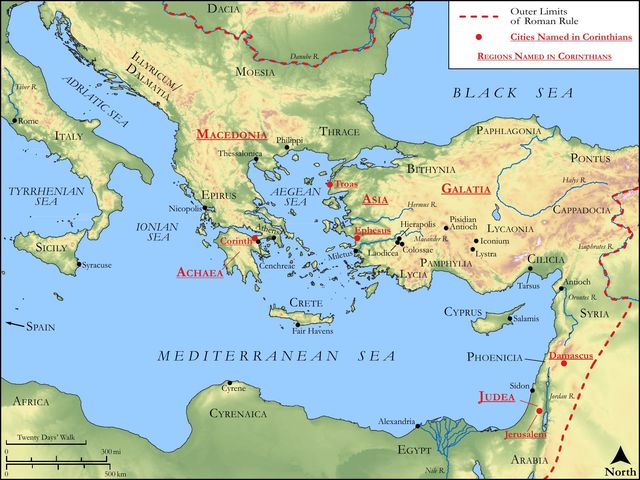
See on the biblical-era maps

Study this verse
Public-domain commentary
Matthew Henry
From his Commentary on the Whole Bible. Henry comments on passages, not single verses — this entry covers 2 Corinthians 12:11–21. His three-level outline is real structure in the source text, so it is rendered as structure.
In these verses the apostle addresses himself to the Corinthians two ways: -
I.He blames them for what was faulty in them; namely, that they had not stood up in his defence as they ought to have done, and so made it the more needful for him to insist so much on his own vindication. They in manner compelled him to commend himself, who ought to have been commended of them Co2 12:11. And had they, or some among them, not failed on their part, it would have been less needful for him to have said so much on his own behalf. He tells them further that they in particular had good reason to speak well of him, as being in nothing behind the very chief apostles, because he had given them full proof and evidence of his apostleship; for the signs of an apostle were wrought among them in all patience, in signs, and wonders, and mighty deeds. Note,
1.It is a debt we owe to good men to stand up in the defence of their reputation; and we are under special obligations to those we have received benefit by, especially spiritual benefit, to own them as instruments in God's hand of good to us, and to vindicate them when they are calumniated by others.
2.How much soever we are, or ought to be, esteemed by others, we ought always to think humbly of ourselves. See an example of this in this great apostle, who thought himself to be nothing, though in truth he was not behind the greatest apostles - so far was he from seeking praise from men, though he tells them their duty to vindicate his reputation - so far was he from applauding himself, when he was forced to insist upon his own necessary self-defence.
II.He gives a large account of his behaviour and kind intentions towards them, in which we may observe the character of a faithful minister of the gospel.
1.He was not willing to be burdensome to them, nor did he seek theirs, but them. He says (Co2 12:13) he had not been burdensome to them, for the time past, and tells them (Co2 12:14) he would not be burdensome to them for the time to come, when he should come to them. He spared their purses, and did not covet their money: I seek not yours but you. He sought not to enrich himself, but to save their souls: he did not desire to make a property of them to himself, but to gain them over to Christ, whose servant he was. Note, Those who aim at clothing themselves with the fleece of the flock, and take no care of the sheep, are hirelings, and not good shepherds.
2.He would gladly spend and be spent for them (Co2 12:15); that is, he was willing to take pains and to suffer loss for their good. He would spend his time, his parts, his strength, his interest, his all, to do them service; nay, so spend as to be spent, and be like a candle, which consumes itself to give light to others.
3.He did not abate in his love to them, notwithstanding their unkindness and ingratitude to him; and therefore was contented and glad to take pains with them, though the more abundantly he loved them the less he was loved, Co2 12:15. This is applicable to other relations: if others be wanting in their duty to us it does not follow therefore that we may neglect our duty to them.
4.He was careful not only that he himself should not be burdensome, but that none he employed should. This seems to be the meaning of what we read, Co2 12:16-18. If it should be objected by any that though he did not himself burden them, yet, being crafty, he caught them with guile, that is, he sent those among them who pillaged them, and afterwards he shared with them in the profit: "This was not so," says the apostle; "I did not make a gain of you myself, nor by any of those whom I sent; nor did Titus, nor any others - We walked by the same spirit and in the same steps." They all agreed in this matter to do them all the good they could, without being burdensome to them, to promote the gospel among them and make it as easy to them as possible. Or, this may be read with an interrogation, as utterly disclaiming any guile in himself and others towards them.
5.He was a man who did all things for edifying, Co2 12:19. This was his great aim and design, to do good, to lay the foundation well, and then with care and diligence to build the superstructure.
6.He would not shrink from his duty for fear of displeasing them, though he was so careful to make himself easy to them. Therefore he was resolved to be faithful in reproving sin, though he was therein found to be such as they would not, Co2 12:20. The apostle here mentions several sins that are too commonly found among professors of religion, and are very reprovable: debates, envyings, wraths, strifes, backbitings, whisperings, swellings, tumults; and, though those who are guilty of these sins can hardly bear to be reproved for them, yet faithful ministers must not fear offending the guilty by sharp reproofs, as they are needful, in public and in private.
7.He was grieved at the apprehension that he should find scandalous sins among them not duly repented of. This, he tells them, would be the cause of great humiliation and lamentation. Note,
(1.)The falls and miscarriages of professors cannot but be a humbling consideration to a good minister; and God sometimes takes this way to humble those who might be under temptation to be lifted up: I fear lest my God will humble me among you.
(2.)We have reason to bewail those who sin and do not repent, to bewail many that have sinned, and have not repented, Co2 12:21. If these have not, as yet, grace to mourn and lament their own case, their case is the more lamentable; and those who love God, and love them, should mourn for them.
Historical interpretation
Historical reception
3 surviving comments on this verse. Each one is dated, so this reads as a timeline rather than a list.
Select a marker to jump to its quote. Markers stagger vertically where authors wrote within a few decades of each other.
Paul’s desire was to gain the Corinthians themselves and not their money. Once they understood that, they would have more affection for him.
"Behold this is the third time I am ready to come to you, and I will not be a burden to you; for I seek not yours, but you: for the children ought not to lay up for the parents, but the parents for the children."
What he says is this; 'It is not because I do not receive of you that I do not come to you; nay, I have already come twice; and I am prepared to come this third time, "and I will not be a burden to you."' And the reason is a noble one. For he did not say, 'because ye are mean,' 'because ye are hurt at it,' 'because ye are weak:' but what? "For I seek not yours, but you." 'I seek greater things; souls instead of goods; instead of gold, salvation.' Then because there still hung about the matter some suspicion, as if he were displeased at them; he therefore even states an argument. For since it was likely they would say, 'Can you not have both us and ours?' he adds with much grace this excuse for them, saying, "For the children ought not to lay up for the parents, but the parents for the children;" instead of teachers and disciples, employing the term parents and children, and showing that he does as a matter of duty what was not of duty. For Christ did not so command, but he says this to spare them; and therefore he adds also something further. For he did not only say that "the children ought not to lay up," but also that the parents ought to. Therefore since it is meet to give,
Paul is telling the Corinthians that if he had more to give them, he would be bound to do so, as a loving parent.
Continue studying 2 Corinthians 12:14 across the web’s major study libraries — every link below opens this exact verse, chapter, or book on the destination site.
Read & Compare
 BibleGatewayThis verse in more than 200 translations and 70 languages.
 Bible.comThe YouVersion reader — hundreds of translations, reading plans, and highlights.
 ESV.orgCrossway's official English Standard Version reader.
 NET BibleThe NET translation with 60,000+ translators' notes on every rendering decision.
 STEP BibleTyndale House's free study tool — original text, vocabulary, and scholarly resources.
 BibliaLogos Bible Software's free web reader.
 USCCBThe New American Bible (Revised Edition) with the U.S. bishops' study notes.
Commentaries
 BibleHub CommentariesDozens of classic commentaries on this verse, gathered on one page.
 StudyLightMore than 100 commentary sets — the largest collection on the web.
 BibleRefPlain-English commentary on what this verse means, verse by verse.
 Enduring WordDavid Guzik's free commentary on this chapter, widely used by Bible teachers.
 Bible Study ToolsVerse commentary alongside Greek and Hebrew study aids.
Original Language & Research
- BibleHub InterlinearThe verse word by word — original language, transliteration, and English.
- BibleHub LexiconEvery word's original-language definition and Strong's entry.
 Blue Letter BibleDeep-study tools — Strong's numbers, concordance, and word studies.
 CNTR CollationThe earliest Greek manuscripts of this verse, collated letter by letter.
Sermons, Hymns & Audio


TrulyRandomVerse is not affiliated with these sites and doesn’t control their content. They’re linked because they’re genuinely useful.
Summary
In 2 Corinthians 12:14, the Apostle Paul declares his readiness for a third visit to the Corinthian church, emphasizing his selfless intentions. He assures them he will not be a financial burden, stating his primary desire is for their spiritual well-being, not their material possessions. This assertion is powerfully underscored by the analogy that parents, out of love and duty, provide for their children, rather than the children being expected to support their parents, thus portraying his deep, paternal care for the believers he discipled.
Context
ShowHideLiterary Context
This verse is situated within a highly personal and emotionally charged section of 2 Corinthians, where Paul vigorously defends his apostolic ministry and integrity against false apostles who had undermined his authority and slandered his character. Chapters 10-13 form a distinct unit, often referred to as the "Fool's Speech," where Paul reluctantly boasts about his sufferings and divine revelations to demonstrate his legitimate apostleship, contrasting it with the self-serving motives of his opponents. His declaration in 2 Corinthians 12:14 directly addresses lingering suspicions about his financial motives, which had been a point of contention throughout his relationship with the Corinthians (2 Corinthians 11:7-9). It also sets the stage for his final warnings and exhortations in chapter 13, reiterating his commitment to their spiritual health.
Historical & Cultural Context
The Greeks and Romans, including those of Corinth, were accustomed to various forms of patronage and philosophical schools where teachers often charged fees for their instruction. False teachers, or "super-apostles" as Paul sarcastically calls them, likely operated within this cultural framework, demanding financial support and perhaps even exploiting their followers. In contrast, Paul consistently refused payment from the Corinthians, a practice that, ironically, some used to question his legitimacy, suggesting he must not be a "true" apostle if he didn't demand support like others. Paul's stance was counter-cultural, rooted in his desire to remove any obstacle to the gospel (1 Corinthians 9:12) and to demonstrate the purity of his motives, differentiating himself sharply from those who preached for profit.
Key Themes
ShowHideThis verse powerfully encapsulates several key themes central to Paul's ministry and the broader book. Selfless Ministry is paramount, as Paul explicitly states his desire for "you" (the people) over "yours" (their possessions), setting a high standard for spiritual leadership that prioritizes the flock's welfare over personal gain. This directly counters the mercenary motives of the false teachers. The theme of Spiritual Parenthood is vividly illustrated through the analogy of parents providing for children, underscoring Paul's deep, nurturing affection and responsibility for the Corinthian believers, whom he considered his spiritual offspring (1 Corinthians 4:15). Finally, Integrity and Transparency are evident in Paul's open declaration of his intentions, aiming to dispel any accusations of exploitation and to reinforce his consistent pattern of financial independence from the Corinthians, a practice he maintained to preserve the gospel's credibility (2 Corinthians 11:7).
Exposition and Analysis
ShowHideKey Word Analysis
ShowHideThis adverb signifies a state of preparedness or willingness. Paul is not merely planning but is fully prepared and eager to make this third visit. It conveys a sense of determination and promptness, indicating his resolve despite the past difficulties and the accusations he faced. His readiness is not for personal gain, but for their spiritual benefit.
This verb means to search, to desire, or to endeavor to obtain. In this context, Paul uses it to contrast his true objective with what his detractors might assume. He is not "seeking" their material wealth or resources (yours), but rather their very persons, their spiritual growth, and their salvation (you). This highlights a profound spiritual priority over material acquisition.
Derived from the word for "treasure," this verb means to amass, store up, or reserve, often implying for future use or security. Paul uses this word in the context of financial provision. The natural order, he argues, is for parents to "lay up" resources for their children's future, not the other way around. This reinforces his role as a spiritual parent who gives sacrificially rather than receiving.
Verse Breakdown
ShowHide"Behold, the third time I am ready to come to you;"
Paul announces his imminent third visit, a declaration that carries both anticipation and a subtle warning, given the unresolved issues in Corinth. The "third time" emphasizes his persistence and commitment to them, despite previous challenges and perhaps delayed plans. His "readiness" (hetoímōs) underscores his firm resolve to finally be with them.
"and I will not be burdensome to you:"
This clause directly addresses the ongoing financial accusations and his consistent practice of self-support. Paul reassures them that his visit will not impose any financial strain on the church. The Greek word for "burdensome" (katanarkáō) literally means to "grow utterly torpid" or "slothful," implying being expensive or a drain. Paul refuses to be a financial liability or an exploiter.
"for I seek not yours, but you:"
This is the heart of Paul's declaration of pure motives. He explicitly states that his desire is not for their material possessions or wealth ("yours") but for their very selves, their spiritual well-being, their faith, and their sanctification ("you"). This profound contrast highlights his selfless, pastoral love and distinguishes him sharply from those who ministered for gain.
"for the children ought not to lay up for the parents, but the parents for the children."
Paul employs a powerful and universally understood analogy to justify his financial independence and selfless giving. It is the natural and moral duty of parents to provide for their children, to "lay up" resources for their future. Conversely, children are not expected to provide for their parents in the same way. This analogy solidifies Paul's self-perception as their spiritual father, emphasizing his role as a giver and nurturer, not a receiver or exploiter.
Literary Devices
ShowHidePaul masterfully employs several literary devices in this verse to convey his message with clarity and impact. The most prominent is Analogy, specifically the Parent-Child Analogy. By comparing himself to a parent and the Corinthians to children, Paul invokes a universally recognized relationship of love, responsibility, and provision. This analogy powerfully justifies his refusal of financial support, as it is the natural order for parents to provide for their offspring, not the other way around. This also underscores his deep, paternal affection and commitment to their spiritual welfare. Secondly, Paul uses striking Contrast in the phrase "I seek not yours, but you." This sharp juxtaposition highlights his pure motives, distinguishing between material gain ("yours," referring to possessions) and spiritual well-being ("you," referring to their persons). This rhetorical device emphasizes his selfless dedication and serves to refute the accusations of mercenary motives leveled against him. The opening word "Behold" (Idou in Greek) serves as an Exclamation or Interjection, drawing immediate attention to the significant announcement that follows, adding emphasis and gravity to his declaration of readiness and pure intent.
Theological and Thematic Connections
ShowHidePaul's declaration in 2 Corinthians 12:14 is a profound theological statement on the nature of true spiritual leadership and the selfless heart of ministry. It underscores the principle that those who minister the gospel should prioritize the spiritual good of the people over any personal or material gain. This commitment to self-sacrifice for the sake of the church reflects the very character of God, who gives abundantly and sacrificially. Paul's analogy of parents providing for children elevates the pastoral role to one of nurturing, loving provision, mirroring God's own paternal care for His children. It challenges believers to discern leadership based on genuine love and selfless service, rather than outward appearances or material demands.
Reflection and Application
ShowHide2 Corinthians 12:14 offers a timeless blueprint for authentic Christian leadership and a powerful challenge for every believer. For those in positions of spiritual authority, Paul's example calls for radical selflessness, prioritizing the spiritual growth and well-being of the flock above all personal gain, comfort, or recognition. It demands a heart that genuinely seeks "you" – the people – rather than "yours" – their resources. This means being willing to sacrifice, to serve, and to give, even when it means personal hardship or foregoing legitimate rights, all for the sake of the gospel and the edification of the body of Christ. For all believers, this verse encourages discernment: to recognize and support leaders who embody this selfless spirit, and to examine our own motives in service. Are we seeking to gain, or are we seeking to give? Are we focused on what we can get from others, or how we can pour into them? This passage reminds us that true spiritual family operates on principles of sacrificial love, where the spiritually mature nurture and provide for the less mature, fostering an environment of generous giving and receiving within the body of Christ.
Questions for Reflection
ShowHideFAQ
ShowHideWhy was Paul so insistent on not being a financial burden to the Corinthians?
ShowHidePaul's insistence on not being a financial burden was multifaceted and deeply strategic. Primarily, it was to remove any potential obstacle to the gospel (1 Corinthians 9:12). In a culture where many religious teachers and philosophers charged fees, Paul wanted to demonstrate that his ministry was not for personal profit or gain, distinguishing himself sharply from the false apostles who likely sought financial advantage. By supporting himself through his tent-making trade, he aimed to prove the purity of his motives and the authenticity of his divine calling, ensuring that the Corinthians would receive the gospel freely and without suspicion (2 Corinthians 11:7-9). This selfless approach underscored his genuine love and commitment to their spiritual welfare above all else.
What is the significance of the parent-child analogy in this verse?
ShowHideThe parent-child analogy ("the children ought not to lay up for the parents, but the parents for the children") is profoundly significant. It highlights Paul's deep, paternal affection and responsibility for the Corinthian believers. He saw himself as their spiritual father, having brought them to faith in Christ (1 Corinthians 4:15). Just as natural parents lovingly provide for their children, often sacrificing their own resources for their offspring's future, Paul felt it was his duty to give to the Corinthians—his spiritual children—rather than to receive from them. This analogy powerfully reinforces his selfless motives, his commitment to nurturing their spiritual growth, and his rejection of any mercenary approach to ministry.
Christ-Centered Fulfillment
ShowHidePaul's selfless commitment to the Corinthians, expressed in his desire to seek "you" rather than "yours" and his willingness to provide rather than receive, finds its ultimate and perfect fulfillment in the person and work of Jesus Christ. Jesus is the supreme example of one who "sought not His own, but us." He did not come to be served, but to serve, and to give His life as a ransom for many (Mark 10:45). The very essence of the Incarnation is God, the ultimate Parent, "laying up" His Son for humanity, emptying Himself of divine prerogatives to become a servant, rather than demanding anything from His creation (Philippians 2:5-8). Christ, our spiritual Father and Shepherd, gave His life on the cross, not seeking our possessions or earthly tribute, but our very selves—our hearts, our faith, and our eternal salvation (John 3:16). His entire ministry was characterized by giving, healing, teaching, and ultimately, sacrificing, demonstrating the perfect love that seeks the highest good of the beloved, embodying the principle that the parent provides for the child. Thus, Paul's ministry, though exemplary, merely reflects the greater, more profound self-giving love of God revealed in Jesus Christ, who truly laid up for us the treasure of eternal life.