


Genesis 31:15
Bible text: King James Version (1769 Blayney text) · Public domain
Bible text: Berean Standard Bible · Public domain
Bible text: American Standard Version (1901) · Public domain
Bible text: World English Bible, Messianic edition · Public domain
Bible text: Geneva Bible (1599) · Public domain
Bible text: Young's Literal Translation · Public domain
- הֲלוֹאha·Lo'¿ notH3808Interrog ¦ NegParticle Negativeהֲ¿לוֹאnot
- נָכְרִיּוֹתna·khe·ri·YotforeignersH5237Adj-fpAdjective Plural Feminine Absolute
- נֶחְשַׁבְנוּnech·Shav·nuare we accountedH2803V-Niphal-Perf-1cpVerb Niphal Perfect 1st Plural common gender
- לוֹloby <the> himPrep-l ¦ 3msSuffix Personal 3rd Singular Masculineלby <the>וֹhim
- כִּיkiforH3588PrtParticle Conditional
- מְכָרָנוּme·kha·Ra·nuhe has sold usH4376V-Qal-Perf-3ms ¦ 1cpVerb Qal Perfect 3rd Singular Masculineמְכָרָhe has soldנוּus
- וַיֹּאכַלvai·Yo·khaland he has consumedH398Conj-w ¦ V-Qal-ConsecImperf-3msVerb Qal Consecutive Imperfect 3rd Singular Masculineוַandיֹּאכַלhe has consumed
- גַּםgamalsoH1571AdvAdverb
- אָכוֹל'a·Kholcontinuously <to consume>H398V-Qal-InfAbsVerb Qal Infinitive Absolute
- אֶת'et<obj.>H853DirObjMParticle Object Indicator
- כַּסְפֵּנוּkas·Pe·nuour moneyH3701N-msc ¦ 1cpNoun Singular Masculine Constructכַּסְפֵּmoneyנוּour
English is a literal word-by-word gloss of the Hebrew, not the KJV's wording. Why?
This is the original text the KJV's translators worked from — each Hebrew word with its own literal English meaning in this verse, prepared by scholars at Tyndale House, Cambridge. The KJV translates whole sentences, not word by word, so its wording differs: one Hebrew word can become several English words, and the KJV may choose “the LORD” where the gloss reads “Yahweh”. Both are faithful — they answer different questions. For the KJV's own rendering, switch to the KJV text.
Details
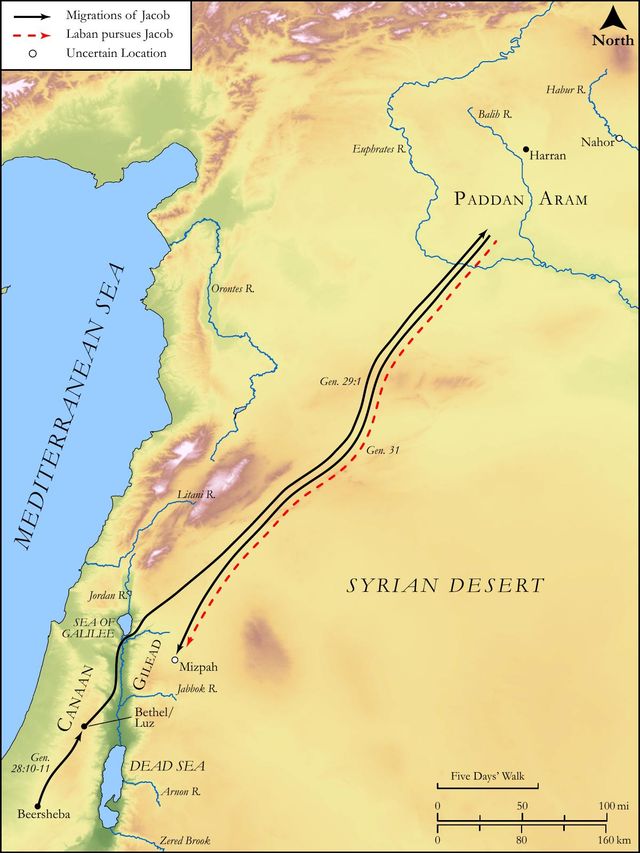
See on the biblical-era maps


Study this verse
Public-domain commentary
Matthew Henry
From his Commentary on the Whole Bible. Henry comments on passages, not single verses — this entry covers Genesis 31:1–16. His four-level outline is real structure in the source text, so it is rendered as structure.
Jacob is here taking up a resolution immediately to quit his uncle's service, to take what he had and go back to Canaan. This resolution he took up upon a just provocation, by divine direction, and with the advice and consent of his wives.
I.Upon a just provocation; for Laban and his sons had become very cross and ill-natured towards him, so that he could not stay among them with safety or satisfaction.
1.Laban's sons showed their ill-will in what they said, Gen 31:1. It should seem they said it in Jacob's hearing, with a design to vex him. The last chapter began with Rachel's envying Leah; this begins with Laban's sons envying Jacob. Observe,
(1.)How greatly they magnify Jacob's prosperity: He has gotten all this glory. And what was this glory that they made so much ado about? It was a parcel of brown sheep and speckled goats (and perhaps the fine colours made them seem more glorious), and some camels and asses, and such like trading; and this was all this glory. Note, Riches are glorious things in the eyes of carnal people, while to all those that are conversant with heavenly things they have no glory in comparison with the glory which excelleth. Men's over-valuing worldly wealth is that fundamental error which is the root of covetousness, envy, and all evil.
(2.)How basely they reflect upon Jacob's fidelity, as if what he had he had not gotten honestly: Jacob has taken away all that was our father's. Not all, surely. What had become of those cattle which were committed to the custody of Laban's sons, and sent three days' journey off? Gen 30:35, Gen 30:36. They mean all that was committed to him; but, speaking invidiously, they express themselves thus generally. Note,
[1.]Those that are ever so careful to keep a good conscience cannot always be sure of a good name.
[2.]This is one of the vanities and vexations which attend outward prosperity, that it makes a man to be envied of his neighbors (Ecc 4:4), and who can stand before envy? Pro 27:4. Whom Heaven blesses hell curses, and all its children on earth.
2.Laban himself said little, but his countenance was not towards Jacob as it used to be; and Jacob could not but take notice of it, Gen 31:2, Gen 31:5. He was but a churl at the best, but now he was more churlish than formerly. Note, Envy is a sin that often appears in the countenance; hence we read of an evil eye, Pro 23:6. Sour looks may do a great deal towards the ruin of peace and love in a family, and the making of those uneasy of whose comfort we ought to be tender. Laban's angry countenance lost him the greatest blessing his family ever had, and justly.
II.By divine direction and under the convoy of a promise:
The Lord said unto Jacob, Return, and I will be with thee, Gen 31:3. Though Jacob had met with very hard usage here, yet he would not quit his place till God bade him. He came thither by orders from Heaven, and there he would stay till he was ordered back. Note, It is our duty to set ourselves, and it will be our comfort to see ourselves, under God's guidance, both in our going out and in our coming in. The direction he had from Heaven is more fully related in the account he gives of it to his wives (Gen 31:10-13), where he tells them of a dream he had about the cattle, and the wonderful increase of those of his colour; and how the angel of God, in that dream (for I suppose the dream spoken of Gen 31:10 and that Gen 31:11 to be the same), took notice of the workings of his fancy in his sleep, and instructed him, so that it was not by chance, or by his own policy, that he obtained that great advantage; but, 1. by the providence of God, who had taken notice of the hardships Laban had put upon him, and took this way to recompense him: "For I have seen all the Laban doeth unto thee, and herein I have an eye to that." Note, There is more of equity in the distributions of the divine providence than we are aware of, and by them the injured are recompensed really, though perhaps insensibly. Nor was it only by the justice of providence that Jacob was thus enriched, but, 2. In performance of the promise intimated in what is said Gen 31:13, I am the God of Beth-el, This was the place where the covenant was renewed with him. Note, Worldly prosperity and success are doubly sweet and comfortable when we see them flowing, not from common providence, but from covenant-love, to perform the mercy promised - when we have them from God as the God of Beth-el, from those promises of the life which now is that belong to godliness. Jacob, even when he had this hopeful prospect of growing rich with Laban, must think of returning. When the world begins to smile upon us we must remember it is not our home. Now arise (Gen 31:13) and return, (1.) To thy devotions in Canaan, the solemnities of which had perhaps been much intermitted while he was with Laban. The times of this servitude God had winked at; but now, "Return to the place where thou anointedst the pillar and vowedst the vow. Now that thou beginnest to grow rich it is time to think of an altar and sacrifices again." (2.) To thy comforts in Canaan: Return to the land of thy kindred. He was here among his near kindred; but those only he must look upon as his kindred in the best sense, the kindred he must live and die with, to whom pertained the covenant. Note, The heirs of Canaan must never reckon themselves at home till they come thither, however they may seem to take root here.
III.With the knowledge and consent of his wives. Observe,
1.He sent for Rachel and Leah to him to the field (Gen 31:4), that he might confer with them more privately, or because one would not come to the other's apartment and he would willingly talk with them together, or because he had work to do in the field which he would not leave. Note, Husbands that love their wives will communicate their purposes and intentions to them. Where there is a mutual affection there will be a mutual confidence. And the prudence of the wife should engage the heart of her husband to trust in her, Pro 31:11. Jacob told his wives,
(1.)How faithfully he had served their father, Gen 31:6. Note, If others do not do their duty to us, yet we shall have the comfort of having done ours to them.
(2.)How unfaithfully their father had dealt with him Gen 31:7. He would never keep to any bargain that he made with him, but, after the first year, still as he saw Providence favour Jacob with the colour agreed on, every half year of the remaining five he changed it for some other colour, which made it ten times; as if he thought not only to deceive Jacob, but the divine Providence, which manifestly smiled upon him. Note, Those that deal honestly are not always honestly dealt with.
(3.)How God had owned him notwithstanding. He had protected him from Laban's ill-will: God suffered him not to hurt me. Note, Those that keep close to God shall be kept safely by him. He had also provided plentifully for him, notwithstanding Laban's design to ruin him: God has taken away the cattle of your father, and given them to me, Gen 31:9. Thus the righteous God paid Jacob for his hard service out of Laban's estate; as afterwards he paid the seed of Jacob for their serving the Egyptians, with their spoils. Note, God is not unrighteous to forget his people's work and labour of love, though men be so, Heb 6:10. Providence has ways of making those honest in the event that are not so in their design. Note, further, The wealth of the sinner is laid up for the just, Pro 13:22.
(4.)He told them of the command God had given him, in a dream, to return to his own country (Gen 31:13), that they might not suspect his resolution to arise from inconstancy, or any disaffection to their country or family, but might see it to proceed from a principle of obedience to his God, and dependence on him.
2.His wives cheerfully consented to his resolution. They also brought forward their grievances, complaining that their father had been not only unkind, but unjust, to them (Gen 31:14-16), that he looked upon them as strangers, and was without natural affection towards them; and, whereas Jacob had looked upon the wealth which God had transferred from Laban to him as his wages, they looked upon it as their portions; so that, both ways, God forced Laban to pay his debts, both to his servant and to his daughters. So then it seemed,
(1.)They were weary of their own people and their father's house, and could easily forget them. Note, This good use we should make of the unkind usage we meet with from the world, we should sit the more loose to it, and be willing to leave it and desirous to be at home.
(2.)They were willing to go along with their husband, and put themselves with him under the divine direction: Whatsoever God hath said unto thee do. Note, Those wives that ar their husband's meet helps will never be their hindrances in doing that to which God calls them.
Continue studying Genesis 31:15 across the web’s major study libraries — every link below opens this exact verse, chapter, or book on the destination site.
Read & Compare
 BibleGatewayThis verse in more than 200 translations and 70 languages.
 Bible.comThe YouVersion reader — hundreds of translations, reading plans, and highlights.
 ESV.orgCrossway's official English Standard Version reader.
 NET BibleThe NET translation with 60,000+ translators' notes on every rendering decision.
 STEP BibleTyndale House's free study tool — original text, vocabulary, and scholarly resources.
 BibliaLogos Bible Software's free web reader.
 USCCBThe New American Bible (Revised Edition) with the U.S. bishops' study notes.
Commentaries
 BibleHub CommentariesDozens of classic commentaries on this verse, gathered on one page.
 StudyLightMore than 100 commentary sets — the largest collection on the web.
 BibleRefPlain-English commentary on what this verse means, verse by verse.
 Enduring WordDavid Guzik's free commentary on this chapter, widely used by Bible teachers.
 Bible Study ToolsVerse commentary alongside Greek and Hebrew study aids.
Original Language & Research
- BibleHub InterlinearThe verse word by word — original language, transliteration, and English.
- BibleHub LexiconEvery word's original-language definition and Strong's entry.
 Blue Letter BibleDeep-study tools — Strong's numbers, concordance, and word studies.
 SefariaThe Hebrew text with Rashi and centuries of Jewish commentary.
Sermons, Hymns & Audio


TrulyRandomVerse is not affiliated with these sites and doesn’t control their content. They’re linked because they’re genuinely useful.
Summary
Genesis 31:15 records the poignant declaration of Rachel and Leah, Jacob's wives, expressing their profound alienation and resentment towards their father, Laban. They assert that Laban has treated them as strangers, effectively "sold" them by appropriating Jacob's wages which should have constituted their inheritance, and thus "devoured" their rightful money. This statement not only validates Jacob's decision to depart from Laban's household but also underscores the deep familial injustice and exploitation they endured, solidifying their allegiance to Jacob.
Context
ShowHideLiterary Context
This verse is a pivotal moment in the narrative of Jacob's departure from Laban. It immediately follows Jacob's revelation to Rachel and Leah of God's command for him to return to the land of his fathers (Genesis 31:3). Their response in Genesis 31:14-16 is crucial, as it provides the moral and familial justification for Jacob's secret departure from Laban, ensuring that his wives are fully on board with the plan. Their words echo Jacob's own grievances against Laban's deceit and exploitation, establishing a united front against their manipulative father.
Historical & Cultural Context
In Israel, a daughter's marriage typically involved a mohar (dowry payment) from the groom to the bride's family, compensating them for the loss of her labor and signifying the family's investment in her. While the mohar was paid to the father, it often served as a foundation for the daughter's financial security or inheritance within her new household. Laban, however, manipulated Jacob's service, effectively appropriating the value of two dowries (fourteen years of labor) without providing his daughters any portion or inheritance from their paternal household, a stark violation of customary expectations and familial duty. This context highlights Laban's extreme greed and his treatment of his daughters as mere commodities.
Key Themes
ShowHideGenesis 31 is rich with themes of divine providence amidst human deceit, the struggle for family legacy, and the consequences of exploitation. Rachel and Leah's lament contributes directly to the theme of Laban's exploitation, illustrating his character through the eyes of his own daughters. It also underscores the theme of shifting loyalties, as the wives definitively align with Jacob against their biological father. Furthermore, their statement implicitly supports the theme of God's faithfulness in protecting Jacob and his family, even orchestrating their return to the promised land by turning Laban's injustice into a catalyst for their departure, as seen in Genesis 31:42.
Exposition and Analysis
ShowHideKey Word Analysis
ShowHideMeaning to compute, reckon, regard, or value. Here, it conveys the idea of being considered or esteemed. Rachel and Leah declare that Laban has reckoned them as strangers, implying a deliberate devaluation of their status from beloved daughters to mere outsiders or even property.
Meaning to sell, literally (as merchandise, a daughter in marriage, into slavery), or figuratively (to surrender). This word forcefully expresses their feeling of being treated as commodities. Laban's appropriation of Jacob's wages, which should have been their dowry or inheritance, is tantamount to selling them without providing them the customary familial share or security.
Meaning to eat, consume, or burn up. This vivid verb metaphorically describes Laban's complete absorption and consumption of their rightful financial portion. It signifies not just taking, but utterly consuming and leaving nothing behind, highlighting his insatiable greed and leaving them without any provision from their paternal home.
Verse Breakdown
ShowHide"Are we not counted of him strangers?"
This rhetorical question expresses the deep emotional and relational breach between Rachel and Leah and their father, Laban. Despite being his biological daughters, Laban's actions—specifically his refusal to provide them with a dowry or inheritance from Jacob's wages—made them feel utterly alienated and disinherited, treated as if they had no familial claim or belonging.
"for he hath sold us,"
This clause reveals the core of their grievance regarding their marital arrangements. In patriarchal custom, a dowry (mohar) was typically given by the groom to the bride's family, often intended to benefit the bride. Jacob served Laban for fourteen years for his wives (Genesis 29:20 and Genesis 29:27), effectively paying a significant price. By appropriating all of Jacob's earnings, Laban effectively "sold" his daughters without providing them any customary portion or security, treating them as mere assets for his own profit.
"and hath quite devoured also our money."
This final clause emphasizes Laban's greed and the total deprivation experienced by his daughters. The "money" refers to Jacob's wages, which, by custom, should have included a portion for Rachel and Leah as their inheritance or provision. Laban's "devouring" of this money signifies his complete consumption of their rightful economic share, leaving them with nothing from their paternal household and underscoring his complete disregard for their well-being and future.
Literary Devices
ShowHideThe language of Genesis 31:15 employs several powerful literary devices to convey the depth of Rachel and Leah's indignation. The opening Rhetorical Question, "Are we not counted of him strangers?", immediately draws the listener into their plight, highlighting the profound irony and injustice of their situation. Despite being Laban's own flesh and blood, his actions have rendered them outsiders. The phrase "he hath sold us" functions as a potent Metaphor, equating Laban's appropriation of Jacob's wages to a literal sale of his daughters, emphasizing their commodification and the violation of familial bonds. This is further intensified by the Hyperbole of "hath quite devoured also our money," which vividly portrays Laban's insatiable greed and the complete consumption of their rightful inheritance, leaving them utterly destitute from their paternal home. The use of such strong, evocative language underscores the profound betrayal and injustice they feel.
Theological and Thematic Connections
ShowHideRachel and Leah's lament in Genesis 31:15 offers profound insights into the corrosive effects of greed, the violation of familial duty, and the divine response to injustice. Laban's actions represent a stark example of human exploitation, where personal gain supersedes all familial and ethical obligations. The sisters' declaration of being "counted as strangers" and "sold" highlights the tragic breakdown of kinship bonds when avarice takes root, treating individuals not as beloved family members but as economic assets. Their unified voice against Laban signals a crucial shift in loyalty, affirming the formation of a new, God-ordained family unit with Jacob, built on shared experience and mutual support. Ultimately, this episode, driven by Laban's injustice, becomes a catalyst for God's larger redemptive plan, enabling Jacob and his family to return to the promised land, demonstrating how divine providence can work through human sin and suffering to achieve righteous ends.
Reflection and Application
ShowHideThe poignant words of Rachel and Leah in Genesis 31:15 resonate deeply, offering timeless lessons about the destructive power of greed and the importance of integrity within all relationships, especially familial ones. For us today, this narrative serves as a powerful reminder that a father's house is meant to be a place of provision and protection for his children, not a source of profit taken at their expense. Laban's exploitation of his own daughters and son-in-law underscores how unchecked avarice can corrupt even the most fundamental human bonds, leading to profound alienation and injustice. As believers, we are called to embody fairness and generosity, reflecting the character of our Heavenly Father who champions the oppressed and provides for His children. This passage encourages us to be discerning, to deal justly and generously with those who depend on us, and to trust that God, in His perfect timing and wisdom, will bring justice and restoration, just as He orchestrated Jacob's departure and protected him from Laban's schemes (Genesis 31:42).
Questions for Reflection
ShowHideFAQ
ShowHideWhy do Rachel and Leah feel like strangers to Laban?
ShowHideRachel and Leah feel like strangers because Laban, their father, treated them not as beloved daughters with inherent rights but as commodities to be leveraged for his own gain. He withheld their rightful inheritance and used their marriages to Jacob solely for his own financial benefit, alienating them from their paternal family and denying them the care and respect due to kin, effectively making them feel like outsiders in their own home.
What does "he hath sold us" imply in this context?
ShowHideThis phrase refers to the patriarchal custom of a dowry (mohar), typically paid by the groom to the bride's family. While not a literal sale into slavery, Rachel and Leah felt "sold" because Laban appropriated all of Jacob's fourteen years of labor, which constituted their dowry and should have been their portion or inheritance. He profited entirely from their marriages without providing them any familial share or security, treating them as mere objects of transaction rather than as daughters.
What is the "money" that Laban "devoured"?
ShowHideThe "money" refers to Jacob's wages, earned through his twenty years of service to Laban. According to custom, a portion of these earnings, particularly those related to the dowry for his wives, should have been allocated to Rachel and Leah as their inheritance or provision from their paternal household. Laban's actions of keeping all of Jacob's earnings demonstrated his extreme greed and his complete disregard for his daughters' economic security and familial rights, metaphorically "devouring" what was rightfully theirs.
Christ-Centered Fulfillment
ShowHideThe poignant lament of Rachel and Leah, feeling alienated and "sold" by their own father, finds profound Christ-centered fulfillment in the New Covenant. Humanity, estranged from God due to sin, was indeed counted as strangers and foreigners (Ephesians 2:19), without hope and without God in the world (Ephesians 2:12). Yet, Christ, through His sacrificial death, bought us with a price (1 Corinthians 6:20), not by exploiting us, but by offering Himself as the ultimate payment for our redemption. He did not "devour our money" but poured out His own life, granting us an inheritance that is imperishable, undefiled, and unfading, kept in heaven for us (1 Peter 1:4). Through Him, we are no longer alienated but are brought near to God, adopted into His family as beloved sons and daughters (Galatians 4:5-7), receiving a spiritual inheritance far greater than any earthly portion, and experiencing perfect justice and unwavering love from our Heavenly Father.