


Romans 9:3
Bible text: King James Version (1769 Blayney text) · Public domain
Bible text: Berean Standard Bible · Public domain
Bible text: American Standard Version (1901) · Public domain
Bible text: World English Bible, Messianic edition · Public domain
Bible text: Geneva Bible (1599) · Public domain
Bible text: Young's Literal Translation · Public domain
- ηὐχόμηνēuchomēnwas wishingG2172V-INI-1SVerb Imperfect Middle Or Passive Deponent Indicative 1st Singular
- γὰρgarforG1063CONJConjunction
- ἀνάθεμαanathemaa curseG331N-NSNNoun Nominative Singular Neuter
- εἶναιeinaito beG1511V-PANVerb Present Active Infinitive
- αὐτὸςautos[my]selfG846P-NSMPersonal pronoun Nominative Singular Masculine
- ἐγὼegōI myselfG1473P-1NSPersonal pronoun Nominative 1st Singular
- ἀπὸaposeparated fromG575PREPPreposition
- τοῦtou<the>G3588T-GSMDefinite article Genitive Singular Masculine
- ΧριστοῦChristouChristG5547N-GSM-TNoun Genitive Singular Masculine Title
- ὑπὲρhuperforG5228PREPPreposition
- τῶνtōntheG3588T-GPMDefinite article Genitive Plural Masculine
- ἀδελφῶνadelphōnbrothersG80N-GPMNoun Genitive Plural Masculine
- μουmouof mineG3165P-1GSPersonal pronoun Genitive 1st Singular
- τῶνtōntheG3588T-GPMDefinite article Genitive Plural Masculine
- συγγενῶνsungenōnkinsmenG4773A-GPMAdjective Genitive Plural Masculine
- μουmouof mineG3165P-1GSPersonal pronoun Genitive 1st Singular
- κατὰkataaccording toG2596PREPPreposition
- σάρκα·sarka[the] fleshG4561N-ASFNoun Accusative Singular Feminine
English is a literal word-by-word gloss of the Greek, not the KJV's wording. Why?
This is the original text the KJV's translators worked from — each Greek word with its own literal English meaning in this verse, prepared by scholars at Tyndale House, Cambridge. The KJV translates whole sentences, not word by word, so its wording differs: one Greek word can become several English words, and the KJV may choose “charity” where the gloss reads “love”. Both are faithful — they answer different questions. For the KJV's own rendering, switch to the KJV text.
Details
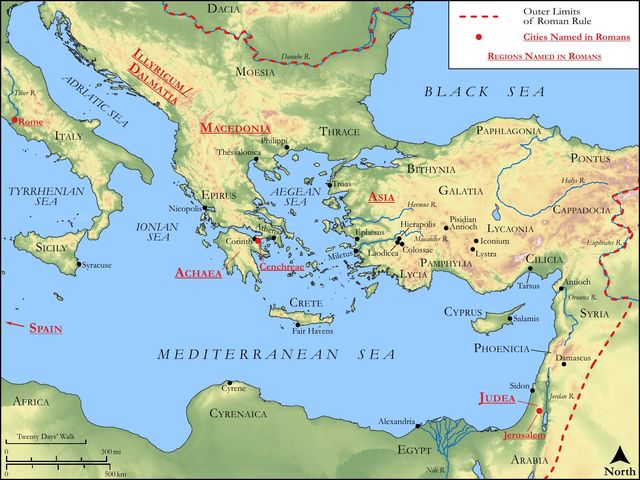
See on the biblical-era maps

Study this verse
Historical interpretation
Two Centuries of Reception
5 surviving comments on this verse. Each one is dated, so this reads as a timeline rather than a list.
Select a marker to jump to its quote. Markers stagger vertically where authors wrote within a few decades of each other.
Why be surprised that the apostle desires to be cursed for his brethren’s sake, when he who is in the form of God emptied himself and took on the form of a servant and was made a curse for us? Why be surprised if, when Christ became a curse for his servants, one of his servants should become a curse for his brethren?
That Christ is God. In Genesis: "And God said unto Jacob, Arise, and go up to the place of Bethel, and dwell there; and make there an altar to that God who appeared unto thee when thou reddest from the face of thy brother Esau." Also in Isaiah: "Thus saith the Lord, the God of Sabaoth, Egypt is wearied; and the merchandise of the Ethiopians, and the tall men of the Sabeans, shall pass over unto Thee, and shall be Thy servants; and shall walk after Thee bound with chains; and shall worship Thee, and shall pray to Thee, because God is in Thee, and there is no other God beside Thee. For Thou art God, and we knew it not, O God of Israel, our Saviour. They shall all be confounded and fear who oppose Thee, and shall fall into confusion." Likewise in the same: "The voice of one crying in the wilderness, Prepare ye the way of the Lord, make straight the paths of our God. Every channel shall be filled up, and every mountain and bill shall be made low, and all crooked places shall be made straight, and rough places plain; and the glory of the Lord shall be seen, and all flesh shall see the salvation of God, because the Lord hath spoken it." Moreover, in Jeremiah: This is our God, and no other shall be esteemed beside Him, who hath found all the way of knowledge, and hath given it to Jacob His son, and to Israel His beloved. After this He was seen upon earth, and He conversed with men." Also in Zechariah God says: "And they shall cross over through the narrow sea, and they shall smite the waves in the sea, and they shall dry up all the depths of the rivers; and all the haughtiness of the Assyrians shall be confounded, and the sceptre of Egypt shall be taken away. And I will strengthen them in the Lord their God, and in His name shall they glory, saith the Lord." Moreover, in Hosea the Lord saith: "I will not do according to the anger of mine indignation, I will not allow Ephraim to be destroyed: for I am God, and there is not a holy man in thee: and I will not enter into the city; I will go after God." Also in the forty-fourth Psalm: "Thy throne, O God, is for ever and ever: the sceptre of righteousness is the sceptre of Thy kingdom. Thou hast loved righteousness, and hated iniquity: wherefore God, Thy God, hath anointed Thee with the oil of gladness above Thy fellows." So, too, in the forty-fifth Psalm: "Be still, and know that I am God. I will be exalted among the nations, and I will be exalted in the earth." Also in the eighty-first Psalm: "They have not known, neither have they understood: they will walk on in darkness." Also in the sixty-seventh Psalm: "Sing unto God, sing praises unto His name: make a way for Him who goeth up into the west: God is His name." Also in the Gospel according to John: "In the beginning was the Word, and the Word was with God, and God was the Word." Also in the same: "The Lord said to Thomas, Reach hither thy finger, and behold my hands: and be not faithless, but believing. Thomas answered and said unto Him, My Lord and my God. Jesus saith unto him, Because thou hast seen me, thou hast believed: blessed are they who have not seen, and yet have believed." Also Paul to the Romans: "I could wish that I myself were accursed from Christ for my brethren and my kindred according to the flesh: who are Israel-ires: whose are the adoption, and the glory, and the covenant, and the appointment of the law, and the service (of God), and the promises; whose are the fathers, of whom, according to the flesh, Christ came, who is God over all, blessed for evermore." Also in the Apocalypse: "I am Alpha and Omega, the beginning and the end I will give to him that is athirst, of the fountain of living water freely. He that overcometh shall possess these things, and their inheritance; and I will be his God, and he shall be my son." Also in the eighty-first Psalm: "God stood in the congregation of gods, and judging gods in the midst." And again in the same place: "I have said, Ye are gods; and ye are all the children of the Highest: but ye shall die like men." But if they who have been righteous, and have obeyed the divine precepts, may be called gods, how much more is Christ, the Son of God, God! Thus He Himself says in the Gospel according to John: "Is it not written in the law, that I said, Ye are gods? If He called them gods to whom the word of God was given, and the Scripture cannot be relaxed, do ye say to Him whom the Father hath sanctified and sent into the world, that thou blasphemest, because I said, I am the Son of God? But if I do not the works of my Father, believe me not; but if I do, and ye will not believe me, believe the works, and know that the Father is in me, and I in Him." Also in the Gospel according to Matthew: "And ye shall call His name Emmanuel, which is, being interpreted, God with us."
"That I have a great heaviness and continual sorrow in my heart. For I could wish that myself were accursed from Christ." What sayest thou, O Paul? from Christ, thy beloved One, from Whom neither kingdom nor hell, nor things visible nor intelligible, nor another world as great, would separate thee, is it from Him that thou wouldest now be accursed? What has happened? Hast thou changed, hast thou given over that love? No, he replies, fear not. Rather I have even made it more intense. How then is it that thou wouldest fain be accursed, and seekest a separation, and a removal to such a distance, that after it there is no possibility of finding a more distant one? Because I love Him exceedingly, he may reply.
How, pray, and in what manner? For the things seem a riddle. Or rather, if you will, let us learn what the curse is, and then we will question him upon these points, and shall understand this unspeakable and extraordinary love. What then is the curse? Hear his own words, "If any man love not our Lord Jesus Christ, let him be accursed." That is, let him be set apart from all, removed from all. For as in the case of a thing dedicated, which is set apart for God, no one would venture so much as to touch it with his hand or even to come near it; so too with a man who is put apart from the Church, in cutting him off from all, and removing him as far off as possible, he calls him by this name anathema in a contrary sense, thus with much fear denouncing to all men to keep apart from him, and to spring away from him.
And the answer he does not produce forthwith, it being a useful thing not to do so, but he first stops the disputant's mouth, saying as follows, for he does not say, it is impossible to answer questions of this kind, but that it is presumptuous to raise them. For our business is to obey what God does, not to be curious even if we do not know the reason of them. Wherefore he said, "Who art thou that repliest against God?" You see how very light he makes of him, how he bears down his swelling spirit! "Who art thou?" art thou a sharer of His power? nay, art thou sitting in judgment upon God? Why in comparison with Him thou canst not have a being even! nor this or that sort of being, but absolutely none! For the expression, "who art thou?" doth much more set him at naught than "thou art nothing." And he takes other ways of showing further his indignation in the question, and does not say, "Who art thou that" answerest "God?" but, "that repliest against," that is, that gainsayest, and that opposest.
Paul wished this at one time, before he became a follower of Christ.… But after he recognized the truth, he abandoned those whom he used to love in this way, yet still they do not repent.
Why the Apostle Paul writes in the same Epistle to the Romans: I could wish that I myself were accursed from Christ, for my brethren, my kinsmen according to the flesh: Who are Israelites, to whom the adoption belongs, and the glory, and the testament, and the giving of the law, and the service of God, and the promises: Whose are the fathers, and of whom is Christ, according to the flesh, who is over all things, God blessed for ever. Amen. (Romans 9:3 et seqq.) Indeed, a valid question, how can the Apostle who said above: Who shall separate us from the love of Christ? Tribulation or distress, or persecution, or famine, or nakedness, or danger, or sword? (Romans 8:35) And again: But I am sure that neither death nor life, nor angels nor principalities, nor things present nor things to come, nor powers, nor height nor depth, nor anything else in all creation, will be able to separate us from the love of God in Christ Jesus our Lord. (Romans 8:38-39), now confirm under oath and say: I speak the truth in Christ, I lie not, my conscience bearing me witness in the Holy Ghost: That I have great sadness, and continual sorrow in my heart. For I wished myself to be an anathema from Christ, for my brethren, who are my kinsmen according to the flesh. And so on. For if someone's love for God is so strong that he cannot be separated from His love, by neither the fear of death, nor the hope of life, nor persecution, nor hunger, nor nudity, nor danger, nor sword; and if Angels also, and Powers, both present and future, and all the Forces of heaven, and both the high and the deep, and every creature at once were to assail him, which cannot possibly be done: yet he would not be separated from the love of God, which he has in Christ Jesus: what is this great change, rather unheard-of prudence, that for the love of Christ, he would not want to have Christ? And lest we do not believe him, he swears and confirms in Christ, and calls his conscience as a witness, the Holy Spirit, that he has sadness, not light or casual, but great and unbelievable, and has sorrow in his heart, which does not sting for an hour and pass, but which continually remains in his heart. Where does this sadness lead? What profit is there in unceasing pain? Is it wished to be anathema from Christ, and to perish, so that others may be saved? But if we consider the voice of Moses asking God for the people of the Jews, and saying, "If thou wilt forgive them their sin, forgive; but if not, blot me out of thy book, which thou hast written" (Exod. 32. 31. 32), we will see the same feelings in Moses and Paul towards the flock entrusted to them. For a good shepherd lays down his life for his sheep. But a hireling, who is not a shepherd, whose own the sheep are not, sees the wolf coming and flees. And to say this same thing: I wished to be cursed by Christ; and erase me from your book which you have written. For those who are erased from the book of the living, and are not written with the just, are made anathema by the Lord. At the same time, see how great is the love of the Apostle for Christ, that he desires to die for him, and to perish alone, provided that the whole human race believes in him. To perish, however, not forever, but for the present. For whoever shall lose his life for Christ, shall save it (Matt. 10:39). Hence, he takes as an example the Forty-Third Psalm: For thy sake we are killed all the day long; we are accounted as sheep for the slaughter (Ps. 43:22). Therefore, the Apostle wishes to die in the flesh, so that others may be saved in the spirit; to pour out his blood so that many souls may be preserved. However, that anathema sometimes signifies slaying can be proved by many testimonies of the Old Testament. And lest we think the grief to be slight, and the cause of sorrow small, he joins it and says: For my brethren and kinsmen according to the flesh. When he calls them kinsmen and brethren according to the flesh, he shows that they are strangers to him in spirit. Whose adoption," he says, "is signified more significantly in Greek as ὑιοθεσία; these things were spoken of by the Lord: 'You are my firstborn son, Israel,' and 'I have begotten sons and exalted them' (Isaiah 1:2), but now he says, 'Alien sons have lied to me' (Psalm 17:46). And their glory is that they were chosen from all nations to be a special people of God, and their covenants, one in the letter and the other in the spirit, meant that those who once served ceremonies of the abolished Law in the flesh would afterwards serve in the spirit the commands of the eternal Gospel. And the law addresses both the new and the old Testament. And worship, that is, true religion. And promises; to fulfill whatever was promised to the fathers in their descendants. And (which is greater than all) from whom Christ was born of the Virgin Mary. And in order that we might know who this Christ is, he embraces the causes of his pain in one speech, who is blessed above all God forever, amen. And this great and such, is not received from those from whom he was born. And nevertheless, he praises the truth of judgement, so that the sentence of God may not seem displeasing to his kindred and brothers, and be either austere or excessive. In which, therefore, such great goods were present, he laments why so many evils are present now.
Continue studying Romans 9:3 across the web’s major study libraries — every link below opens this exact verse, chapter, or book on the destination site.
Read & Compare
 BibleGatewayThis verse in more than 200 translations and 70 languages.
 Bible.comThe YouVersion reader — hundreds of translations, reading plans, and highlights.
 ESV.orgCrossway's official English Standard Version reader.
 NET BibleThe NET translation with 60,000+ translators' notes on every rendering decision.
 STEP BibleTyndale House's free study tool — original text, vocabulary, and scholarly resources.
 BibliaLogos Bible Software's free web reader.
 USCCBThe New American Bible (Revised Edition) with the U.S. bishops' study notes.
Commentaries
 BibleHub CommentariesDozens of classic commentaries on this verse, gathered on one page.
 StudyLightMore than 100 commentary sets — the largest collection on the web.
 BibleRefPlain-English commentary on what this verse means, verse by verse.
 Enduring WordDavid Guzik's free commentary on this chapter, widely used by Bible teachers.
 Bible Study ToolsVerse commentary alongside Greek and Hebrew study aids.
Original Language & Research
- BibleHub InterlinearThe verse word by word — original language, transliteration, and English.
- BibleHub LexiconEvery word's original-language definition and Strong's entry.
 Blue Letter BibleDeep-study tools — Strong's numbers, concordance, and word studies.
 CNTR CollationThe earliest Greek manuscripts of this verse, collated letter by letter.
Sermons, Hymns & Audio


TrulyRandomVerse is not affiliated with these sites and doesn’t control their content. They’re linked because they’re genuinely useful.
Summary
Romans 9:3 unveils the profound and agonizing depth of the Apostle Paul's love for his Jewish kinsmen. In this powerful declaration, Paul expresses a hypothetical wish so extreme—to be separated from Christ—that it vividly underscores the immense sorrow and spiritual burden he carried for Israel's rejection of Jesus as the Messiah. This verse serves as a poignant introduction to Paul's intricate theological exploration of God's faithfulness to Israel despite their widespread unbelief, setting the stage for chapters 9-11 of Romans.
Context
ShowHideLiterary Context
This verse marks a significant transition in Paul's letter to the Romans. Having concluded a triumphant affirmation of God's unwavering love and the security of believers in Christ in Romans 8, Paul immediately pivots to address a deeply troubling issue: the spiritual condition of his own people, Israel. The glorious crescendo of Romans 8:38-39 is abruptly followed by Paul's lament, setting the somber tone for the next three chapters (Romans 9-11), which delve into the complex questions of Israel's past election, present unbelief, and future restoration within God's redemptive plan. His personal anguish here establishes the sincerity and weight of the theological arguments that follow.
Historical & Cultural Context
Paul, a devout Jew and former Pharisee, was writing to a diverse church in Rome, comprising both Jewish and Gentile believers. The historical backdrop includes the widespread rejection of Jesus as Messiah by the majority of the Jewish people, leading to significant tensions within the early Christian movement and raising questions about God's covenant promises to Israel. Culturally, the concept of kinship and national identity was paramount for Jews, who saw themselves as God's chosen people with a unique covenant relationship. Paul's statement reflects the deep-seated cultural and religious ties he felt, even as he championed the inclusion of Gentiles into God's family. His lament is not just personal but also reflects the broader theological challenge posed by Israel's unbelief to the understanding of God's faithfulness.
Key Themes
ShowHideRomans 9:3 is foundational for several key themes explored in the broader context of Romans 9-11 and beyond. It highlights the theme of Profound Selfless Love, echoing the agape love described in 1 Corinthians 13, where one is willing to sacrifice for the well-being of others. This verse also introduces the theme of Vicarious Suffering or substitution, as Paul expresses a desire to bear the spiritual consequences for his people, a concept profoundly exemplified by Christ's own sacrifice. Furthermore, it underscores the Burden for the Lost that true believers often carry, particularly for their own family and community who are alienated from God. Finally, the verse implicitly points to Israel's Spiritual Condition, revealing the dire state of those who reject the Gospel and prompting Paul's desperate desire for their salvation, a theme that will be meticulously unpacked in the subsequent chapters, particularly in Romans 10:1-4.
Exposition and Analysis
ShowHideKey Word Analysis
ShowHideThis word (G2172) means "to wish" or "to pray to God." Paul's use of this term indicates a profound, heartfelt desire or even a fervent prayer. It's not a casual thought but an intense longing that stems from the deepest part of his being, reflecting a spiritual burden.
The term (G331) refers to a "religious ban" or something "devoted to destruction," often implying separation from divine favor or a curse. In the Septuagint, it frequently denotes something set apart for God, often for destruction. When Paul says "accursed from Christ," he means being utterly separated from Christ and His blessings, consigned to eternal damnation. It is the antithesis of salvation and union with Christ.
While "flesh" (G4561) can refer to human nature with its frailties or passions, here, in the phrase "kinsmen according to the flesh," it denotes ethnic or physical kinship. It emphasizes that Paul's deep concern is for his fellow Israelites, those who share his physical lineage and national identity, rather than a spiritual state.
Verse Breakdown
ShowHide"For I could wish"
This opening phrase reveals the intensely personal nature of Paul's statement. The "for" (G1063, gár) connects his lament to the preceding chapter, explaining why, despite the glorious assurance of salvation in Christ, he feels such profound sorrow. The phrase "I could wish" expresses a hypothetical, almost inconceivable desire, highlighting the extreme measure of his love and anguish.
"that myself were accursed from Christ"
This is the shocking core of Paul's wish. To be "accursed from Christ" means to be eternally separated from Him, to experience the ultimate spiritual damnation. Paul is expressing a willingness to forfeit his own salvation and all the blessings of Christ if, by some impossible means, it could secure the salvation of his people. This is a hyperbolic expression of love, demonstrating a willingness to endure the worst possible spiritual fate.
"for my brethren, my kinsmen according to the flesh:"
The object of Paul's extraordinary desire is explicitly stated: his "brethren," his "kinsmen according to the flesh." This clarifies that his burden is specifically for his ethnic Jewish people, those with whom he shares a common heritage and lineage. This emphasizes the national and ethnic dimension of his concern, setting the stage for the discussion of Israel's place in God's plan in the subsequent chapters.
Literary Devices
ShowHideThe most prominent literary device in Romans 9:3 is Hyperbole. Paul's statement that he could wish himself "accursed from Christ" is an extreme exaggeration used to convey the immense depth of his sorrow and the intensity of his love for his people. It is not a literal wish or a theological possibility, but a rhetorical device designed to powerfully communicate the measure of his anguish and the sacrificial nature of his burden. This hyperbole underscores the gravity of Israel's spiritual condition and the profound empathy Paul felt for their unbelief. The passage also employs Pathos, appealing strongly to the reader's emotions by revealing Paul's deep personal suffering and agonizing love, thereby eliciting sympathy and highlighting the earnestness of his subsequent theological arguments.
Theological and Thematic Connections
ShowHidePaul's agonizing wish to be accursed for his kinsmen profoundly echoes the very heart of the Gospel: vicarious suffering and substitutionary love. While Paul's hypothetical wish is humanly impossible and not a literal theological proposition, it powerfully mirrors the ultimate act of divine love where Christ Himself became a curse for humanity. This verse underscores the immense value God places on human souls and the lengths to which true love will go for the redemption of others. It also highlights the tension between God's sovereign election and human responsibility, a theme Paul will unpack in the chapters that follow, demonstrating God's faithfulness even in the face of human unbelief.
Reflection and Application
ShowHidePaul's heart-wrenching cry in Romans 9:3 serves as a profound challenge to believers today, urging us to examine the depth of our own love and compassion for those who are spiritually lost, especially our own family and community. It calls us beyond mere intellectual assent to the Gospel, inviting us into a place of genuine empathy and burdened intercession for those who do not know Christ. This verse reminds us that true Christian love is not passive but active, willing to endure personal cost for the spiritual well-being of others. It compels us to pray with fervent earnestness for the salvation of our "kinsmen according to the flesh," whether they be family members, friends, or broader communities, and to approach them with the same sacrificial love and compassion that characterized Paul, and supremely, Christ Himself.
Questions for Reflection
ShowHideFAQ
ShowHideDid Paul literally wish to be eternally damned for his people?
ShowHideNo, Paul's statement in Romans 9:3 is understood as a hyperbolic expression, a rhetorical device used to convey the extreme depth of his anguish and love. It's a way of saying, "My desire for their salvation is so intense that if it were humanly possible, I would even sacrifice my own eternal well-being for it." Theologically, salvation is a gift from God through Christ and cannot be transferred or forfeited in this manner. Paul is emphasizing the unimaginable extent of his burden and compassion, not proposing a literal theological possibility.
Why is Paul's love for his kinsmen so significant in this context?
ShowHidePaul's profound love and anguish for his Jewish kinsmen are significant for several reasons. First, they establish the sincerity and pastoral heart behind the complex theological discussion that follows in Romans 9-11, demonstrating that his arguments are not cold theology but born out of deep personal concern. Second, it highlights the immense spiritual tragedy of Israel's widespread rejection of their Messiah, which was a stumbling block for many early Christians and a challenge to God's faithfulness. Third, it serves as a powerful example of selfless, Christ-like love for others, especially those who are spiritually lost, setting a high standard for all believers.
Christ-Centered Fulfillment
ShowHidePaul's extraordinary wish in Romans 9:3 finds its ultimate and perfect fulfillment in the person and work of Jesus Christ. While Paul's desire to be "accursed from Christ" was a hypothetical expression of love, Christ truly and literally became a curse for us. The New Testament teaches that Jesus, though sinless, took upon Himself the sin of the world and endured the full wrath of God, becoming "accursed" on the cross, so that we might be reconciled to God. As Galatians 3:13 declares, "Christ redeemed us from the curse of the law by becoming a curse for us." He, who knew no sin, was made sin for us, as 2 Corinthians 5:21 states, "so that in him we might become the righteousness of God." Paul's agonizing empathy for his kinsmen, though profound, is but a faint echo of the Son of God's infinite love and self-sacrifice, who willingly descended from glory, embraced human flesh, and bore the ultimate separation from God on the cross to secure the salvation of His "brethren"—all who believe, Jew and Gentile alike. His vicarious suffering is the foundation of our hope and the ultimate demonstration of God's unwavering love for humanity.