


Mark 8:25
Bible text: King James Version (1769 Blayney text) · Public domain
Bible text: King James Version with Strong's numbers · Public domain
Bible text: Berean Standard Bible · Public domain
Bible text: American Standard Version (1901) · Public domain
Bible text: World English Bible, Messianic edition · Public domain
Bible text: Geneva Bible (1599) · Public domain
Bible text: Young's Literal Translation · Public domain
- εἶταeitaThenG1534ADVAdverb
- πάλινpalinagainG3825ADVAdverb
- ἐπέθηκενepethēkenHe putG2007V-2AAI-3SVerb 2nd Aorist Active Indicative 3rd Singular
- τὰςtastheG3588T-APFDefinite article Accusative Plural Feminine
- χεῖραςcheirashandsG5495N-APFNoun Accusative Plural Feminine
- ἐπὶepiuponG1909PREPPreposition
- τοὺςtoustheG3588T-APMDefinite article Accusative Plural Masculine
- ὀφθαλμοὺςophthalmouseyesG3788N-APMNoun Accusative Plural Masculine
- αὐτοῦautouof himG846P-GSMPersonal pronoun Genitive Singular Masculine
- καὶkaiandG2532CONJConjunction
- ἐποίησενepoiēsenmadeG4160V-AAI-3SVerb Aorist Active Indicative 3rd Singular
- αὐτὸνautonhimG846P-ASMPersonal pronoun Accusative Singular Masculine
- διέβλεψενdieblepsenlookG1227V-AAI-3SVerb Aorist Active Indicative 3rd Singular
- καὶkaiandG2532CONJConjunction
- ἀπεκατέστηapekatestēhe restoredG600V-2AAI-3SVerb 2nd Aorist Active Indicative 3rd Singular
- καὶkaiandG2532CONJConjunction
- ἐνέβλεπενeneblepenhe was seeing wellG1689V-IAI-3SVerb Imperfect Active Indicative 3rd Singular
- τηλαυγῶςtēlaugōsclearlyG5081ADVAdverb
- ἅπανταhapantaeverythingG537A-APNAdjective Accusative Plural Neuter
English is a literal word-by-word gloss of the Greek, not the KJV's wording. Why?
This is the original text the KJV's translators worked from — each Greek word with its own literal English meaning in this verse, prepared by scholars at Tyndale House, Cambridge. The KJV translates whole sentences, not word by word, so its wording differs: one Greek word can become several English words, and the KJV may choose “charity” where the gloss reads “love”. Both are faithful — they answer different questions. For the KJV's own rendering, switch to the KJV text.
Details
See on the biblical-era maps
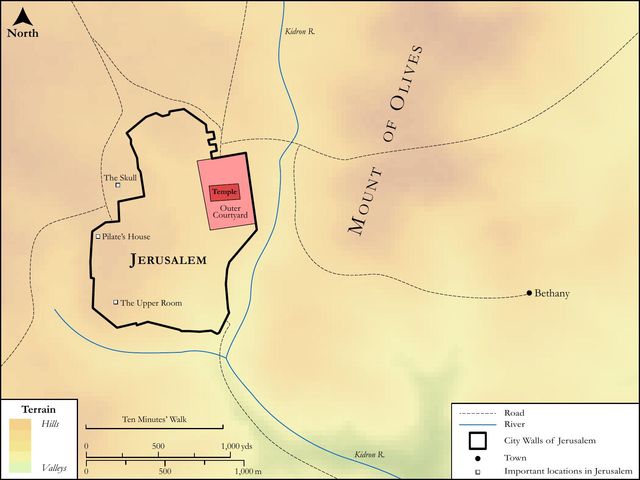
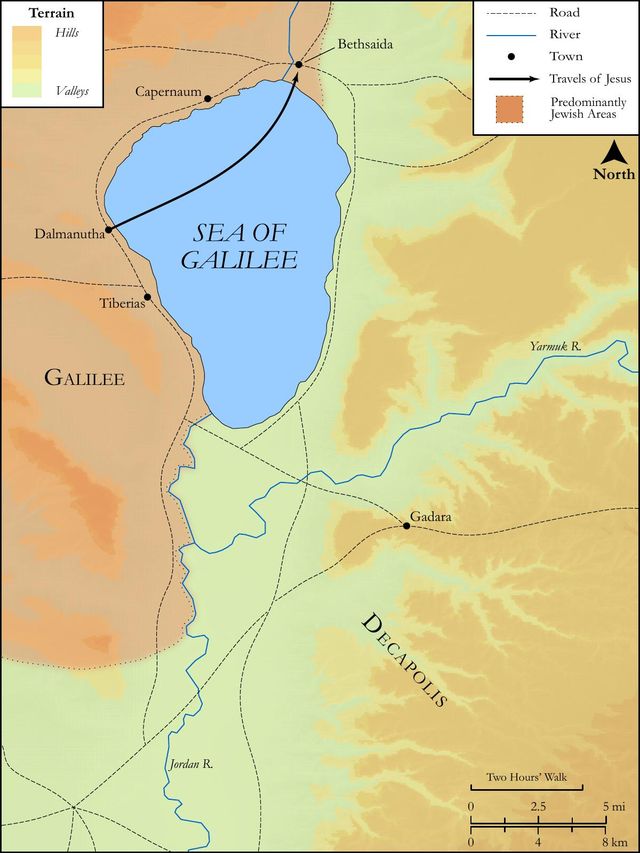
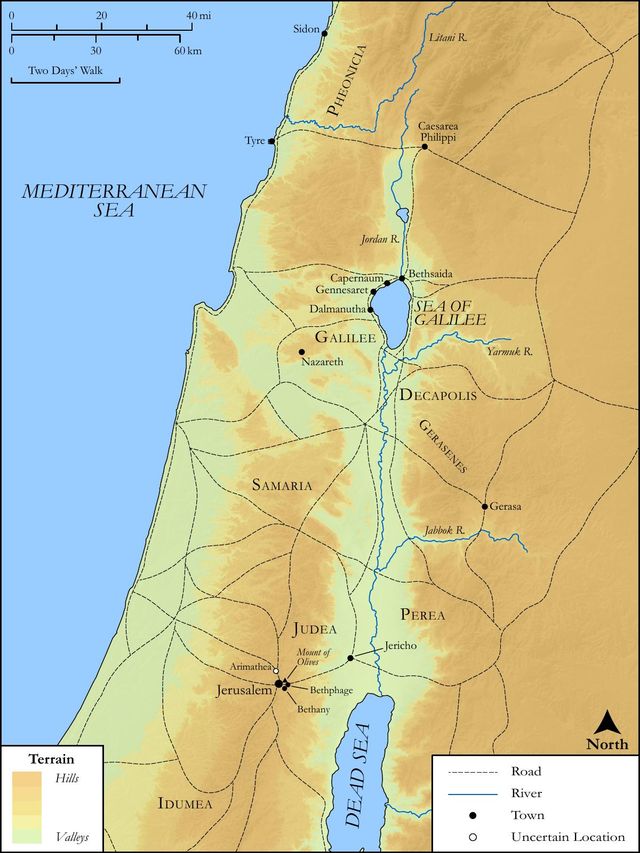
Study this verse
Public-domain commentary
Matthew Henry
From his Commentary on the Whole Bible. Henry comments on passages, not single verses — this entry covers Mark 8:22–26. His three-level outline is real structure in the source text, so it is rendered as structure.
This cure is related only by this evangelist, and there is something singular in the circumstances.
I.Here is a blind man brought to Christ by his friends, with a desire that he would touch him, Mar 8:22.
Here appears the faith of those that brought him - they doubted not but that one touch of Christ's hand would recover him his sight; but the man himself showed not that earnestness for, or expectation of, a cure that other blind men did. If those that are spiritually blind, do not pray for themselves, yet let their friends and relations pray for them, that Christ would be pleased to touch them.
II.Here is Christ leading this blind man, Mar 8:23.
He did not bid his friends lead him, but (which bespeaks his wonderful condescension) he himself took him by the hand, and led him, to teach us to be as Job was, eyes to the blind, Job 29:15. Never had poor blind man such a Leader. He led him out of the town. Had he herein only designed privacy, he might have led him into a house, into an inner chamber, and have cured him there; but he intended hereby to upbraid Bethsaida with the mighty works that had in vain been done in her (Mat 11:21), and was telling her, in effect, she was unworthy to have any more done within her walls. Perhaps Christ took the blind man out of the town, that he might have a larger prospect in the open fields, to try his sight with, than he could have in the close streets.
III.Here is the cure of the blind man, by that blessed Oculist, who came into the world to preach the recovering of sight to the blind (Luk 4:18), and to give what he preached. In this cure we may observe,
1.That Christ used a sign; he spat on his eyes (spat into them, so some), and put his hand upon him. He could have cured him, as he did others, with a word speaking, but thus he was pleased to assist his faith which was very weak, and to help him against his unbelief. And this spittle signified the eye-salve wherewith Christ anoints the eyes of those that are spiritually blind, Rev 3:18.
2.That the cure was wrought gradually, which was not usual in Christ's miracles. He asked him if he saw aught, Mar 8:23. Let him tell what condition his sight was in, for the satisfaction of those about him. And he looked up; so far he recovered his sight, that he could open his eyes, and he said, I see men as trees walking; he could not distinguish men from trees, otherwise than he could discern them to move. He had some glimmerings of sight, and betwixt him and the sky could perceive a man erect like a tree, but could not discern the form thereof, Job 4:16. But,
3.It was soon completed; Christ never doeth his work by the halves, nor leaves it till he can say, It is finished. He put his hands again upon his eyes, to disperse the remaining darkness, and then bade him look up again, and he saw every man clearly, Mar 8:25. Now Christ took this way,
(1.)Because he would not tie himself to a method, but would show with what liberty he acted in all he did. He did not cure by rote, as I may say, and in a road, but varied as he thought fit. Providence gains the same end in different ways, that men may attend its motions with an implicit faith.
(2.)Because it should be to the patient according to his faith; and perhaps this man's faith was at first very weak, but afterward gathered strength, and accordingly his cure was. Not that Christ always went by this rule, but thus he would sometimes put a rebuke upon those who came to him, doubting.
(3.)Thus Christ would show how, and in what method, those are healed by his grace, who by nature are spiritually blind; at first, their knowledge is confused, they see men as trees walking; but, like the light of the morning, it shines more and more to the perfect day, and then they see all things clearly, Pro 4:18. Let us enquire then, if we see aught of those things which faith is the substance and evidence of; and if through grace we see any thing of them, we may hope that we shall see yet more and more, for Jesus Christ will perfect for ever those that are sanctified.
IV.The directions Christ gave the man he had cured, not to tell it to any in the town of Bethsaida, nor so much as to go into the town, where probably there were some expecting him to come back, who had seen Christ lead him out of the town, but, having been eyewitnesses of so many miracles, had not so much as the curiosity to follow him: let not those be gratified with the sight of him when he was cured, who would not show so much respect to Christ as to go a step out of the town, to see this cure wrought. Christ doth not forbid him to tell it to others, but he must not tell it to any in the town. Slighting Christ's favours is forfeiting them; and Christ will make those know the worth of their privileges by the want of them, that would not know them otherwise. Bethsaida, in the day of her visitation, would not know the things that belonged to her peace, and now they are hid from her eyes. They will not see, and therefore shall not see.
Historical interpretation
Nine Centuries of Reception
6 surviving comments on this verse. Each one is dated, so this reads as a timeline rather than a list.
Select a marker to jump to its quote. Markers stagger vertically where authors wrote within a few decades of each other.
And He brings him out of the town, that is, out of the neighbourhood of the wicked; and He puts spittle into his eyes, that he may see the will of God, by the breath of the Holy Ghost; and putting His hands upon him, He asked him if he could see, because by the works of the Lord His majesty is seen.
Or else, he sees men as trees, because he thinks all men higher than himself. But He put His hands again upon his eyes, that he might see all things clearly, that is, understand invisible things by visible, and with the eye of a pure mind contemplate, what the eye hath not seen, the glorious state of his own soul after the rust of sin. He sent him to his home, that is, to his heart; that he might see in himself things which he had not seen before; for a man despairing of salvation does not think that he can do at all what, when enlightened, he can easily accomplish.
And He says to him, If thou enter into the town, tell it not to any one, that is, relate continually to thy neighbours thy blindness, but never tell them of thy virtue.
Christ laid his hands upon his eyes that he might see all things clearly, so through visible things he might understand things invisible, which the eye has not seen, that after the film of sin is removed, he might clearly behold the state of his soul with the eye of a clean heart.
(Vict. Ant. e Cat. in Marc.) He spat indeed, and put His hand upon the blind man, because He wished to show that wonderful are the effects of the Divine word added to action; for the hand is the symbol of working, but the spittle, of the word proceeding out of the mouth. Again He asked him whether he could see any thing, which He had not done in the case of any whom He had healed, thus showing that by the weak faith of those who brought him, and of the blind man himself, his eyes could not altogether be opened. Wherefore there follows: And he looked up, and said, I see men as trees walking; because he was still under the influence of unfaithfulness, he said that he saw men obscurely.
(Vict. Ant. e Cat, in Marc.) From the commencement, however, of the return of his senses, He leads him to apprehend things by faith, and thus makes him see perfectly; wherefore it goes on, After that, he put his hands again upon his eyes, and he began to see, and afterwards he adds, And he was restored, and saw all things clearly; that is, being perfectly healed in his senses and his intellect. It goes on: And he sent him away to his house, saying, Go into thy home, and if thou enter into the town, tell it not to any one.
(ubi sup.) Taking occasion then from the precept, which He had commanded, saying, Beware of the leaven of the Pharisees and of the leaven of Herod, our Saviour teaches them what was the meaning of the five and the seven loaves, concerning which He adds, And do ye not remember, when I brake the five loaves amongst five thousand, and how many baskets full of fragments ye took up? For if the leaven mentioned above means perverse traditions, of course the food, with which the people of God was nourished, means the true doctrine.
(in Marc. 2, 34) Knowing that the touch of the Lord could give sight to a blind man as well as cleanse a leper. It goes on, And he took the blind man by the hand, and led him out of the town.
(ubi sup.) Seeing indeed the shapes of bodies amongst the shadows, but unable to distinguish the outlines of the limbs, from the continued darkness of his sight; just as trees standing thick together are wont to appear to men who see them from afar, or by the dim light of the night, so that it cannot easily be known whether they be trees or men.
(ubi sup.) Or else, He leaves an example to His disciples that they should not seek for popular favour by the miracles which they did. 1Mystically, however, Bethsaida is interpreted 'the house of the valley,' that is, the world, which is the vale of tears. Again, they bring to the Lord a blind man, that is, one who neither sees what he has been, what he is, nor what he is to be. They ask Him to touch him, for what is being touched, but feeling compunction.?
(ubi sup.) For the Lord touches us, when He enlightens our minds with the breath of His Spirit, and He stirs us up that we may recognise our own infirmity, and be diligent in good actions. He takes the hand of the blind man, that He may strengthen him to the practice of good works.
(ubi sup.) Or else, putting spittle into the eyes of the blind man, he lays His hands upon him that he may see, because He has wiped away the blindness of the human race both by invisible gifts, and by the Sacrament of His assumed humanity; for the spittle, proceeding from the Head, points out the grace of the Holy Ghost. But though by one word He could cure the man wholly and all at once, still He cures him by degrees, that He may show the greatness of the blindness of man, which can hardly, and only as it were step by step, be restored to light; and He exhibits to us His grace, by which He furthers each step towards perfection. Again, whoever is weighed down by a blindness of such long continuance, that he is unable to distinguish between good and evil, sees as it were men like trees walking, because he sees the deeds of the multitude without the light of discretion.
For Bethsaida appears to have been infected with much infidelity, wherefore the Lord reproaches it, (Matt. 11:21) Woe to thee, Bethsaida, for if the mighty works which were done in you had been done in Tyre and Sidon, they would have repented long ago in sackcloth and ashes. He then takes out of the town the blind man, who had been brought to Him, for the faith of those who brought him was not true faith. It goes on; And when he had spit in his eyes, and put his hands upon him, he asked him if he saw ought.
But the reason why he did not see at once perfectly, but in part, was, that he had not perfect faith; for healing is bestowed in proportion to faith.
These precepts He gave him, because they were unfaithful, as has been said, lest perchance he should receive hurt in his soul from them, and they by their unbelief should ran into a more grievous crime.
Or else, after He has healed him He sends him to his home; for the home of every one of us is heaven, and the mansions which are there.
(non occ.) After the feeding of the multitude, the Evangelist proceeds to the giving sight to the blind, saying, And they come to Bethsaida, and they bring a blind man to him, and besought him to touch him.
Continue studying Mark 8:25 across the web’s major study libraries — every link below opens this exact verse, chapter, or book on the destination site.
Read & Compare
 BibleGatewayThis verse in more than 200 translations and 70 languages.
 Bible.comThe YouVersion reader — hundreds of translations, reading plans, and highlights.
 ESV.orgCrossway's official English Standard Version reader.
 NET BibleThe NET translation with 60,000+ translators' notes on every rendering decision.
 STEP BibleTyndale House's free study tool — original text, vocabulary, and scholarly resources.
 BibliaLogos Bible Software's free web reader.
 USCCBThe New American Bible (Revised Edition) with the U.S. bishops' study notes.
Commentaries
 BibleHub CommentariesDozens of classic commentaries on this verse, gathered on one page.
 StudyLightMore than 100 commentary sets — the largest collection on the web.
 BibleRefPlain-English commentary on what this verse means, verse by verse.
 Enduring WordDavid Guzik's free commentary on this chapter, widely used by Bible teachers.
 Bible Study ToolsVerse commentary alongside Greek and Hebrew study aids.
Original Language & Research
- BibleHub InterlinearThe verse word by word — original language, transliteration, and English.
- BibleHub LexiconEvery word's original-language definition and Strong's entry.
 Blue Letter BibleDeep-study tools — Strong's numbers, concordance, and word studies.
 CNTR CollationThe earliest Greek manuscripts of this verse, collated letter by letter.
Sermons, Hymns & Audio


TrulyRandomVerse is not affiliated with these sites and doesn’t control their content. They’re linked because they’re genuinely useful.
Summary
Mark 8:25 concludes the unique two-stage healing of a blind man in Bethsaida, where Jesus' second touch fully restores the man's sight. Following an initial partial restoration where the man saw people "as trees, walking," this verse describes Jesus placing His hands on the man's eyes again, resulting in his complete and clear vision of everyone. This distinct miracle not only highlights Jesus' sovereign power and compassion but also serves as a profound symbolic representation of progressive spiritual understanding, particularly for the disciples who were struggling to grasp Jesus' true identity and mission.
Context
ShowHideLiterary Context
This verse marks the culmination of the miracle initiated in Mark 8:22. Jesus had led the blind man out of Bethsaida, applied spittle to his eyes, and laid hands on him, prompting the man's initial, partial report of seeing "men as trees, walking" (Mark 8:24). The second touch, detailed in Mark 8:25, completes the healing, granting perfect clarity. This miracle immediately precedes Peter's pivotal confession of Jesus as the Christ in Mark 8:29 and Jesus' subsequent teaching on His impending suffering and resurrection (Mark 8:31-33), setting a crucial thematic stage for the disciples' own journey of spiritual insight.
Historical & Cultural Context
Bethsaida, located on the northeastern shore of the Sea of Galilee, was a fishing village where Jesus had performed many miracles, yet it remained largely unresponsive to His message, leading to a pronouncement of woe against it in Matthew 11:21. The practice of healing through touch and the use of spittle were not uncommon among the nations of that day, often associated with spiritual power. However, Jesus' unique two-stage healing here deviates from His usual immediate and complete healings, drawing specific attention to the process itself. The expectation of a Messiah who would open the eyes of the blind (Isaiah 35:5) was deeply ingrained in Jewish thought, making this miracle a powerful sign of Jesus' messianic identity.
Key Themes
ShowHideThe healing in Mark 8:22-25 powerfully contributes to several key themes within Mark's Gospel. Firstly, it illustrates the theme of Progressive Revelation and Understanding. Unlike most of Jesus' miracles, this one unfolds in two stages, mirroring the gradual nature of spiritual insight. Secondly, it underscores Jesus' Sovereign Power and Compassion, demonstrating His ability to bring complete restoration even through an unusual process. Thirdly, and most significantly for Mark's narrative, the miracle serves as a potent Symbol of the Disciples' Partial Spiritual Sight. Throughout Mark's Gospel, the disciples, despite being close to Jesus, frequently struggle to comprehend His identity and the true nature of His kingdom, often seeing "men as trees, walking" in their understanding. This miracle foreshadows their need for further divine "touches" to achieve full clarity, particularly concerning Jesus' suffering Messiahship, as highlighted in the subsequent passages of Mark 8.
Exposition and Analysis
ShowHideKey Word Analysis
ShowHideThis adverb signifies repetition, emphasizing that Jesus' action was a second application of His hands. In the context of this unique two-stage healing, "again" highlights the deliberate and progressive nature of the restoration, which is central to the miracle's symbolic meaning. It underscores that the first touch was not a failure, but part of a process.
Derived from apó (from) and kathístēmi (to set down, establish), this verb means "to reconstitute (in health, home or organization)." It implies a complete and thorough healing, a bringing back to a former, perfect state. The use of this word assures the reader that the healing was not merely an improvement but a full and perfect reinstatement of the man's vision.
This adverb, from a compound meaning "far-shining," describes seeing "in a far-shining manner, i.e., plainly." It emphasizes the absolute clarity and distinctness of the man's vision after the second touch. There was no ambiguity or blurriness; his sight was perfect, allowing him to perceive "every man" with precision.
Verse Breakdown
ShowHide"After that he put [his] hands again upon his eyes"
This phrase details Jesus' repeated action, the "again" being crucial. It signifies a deliberate second intervention by Jesus, building upon the initial partial healing. The physical act of laying hands on the eyes was a common method of healing in that day, but Jesus' repetition here is unique and intentional.
"and made him look up"
This indicates Jesus' instruction or action that enabled the man to lift his gaze. It suggests a transition from the man's previous state of limited vision, where he might have been looking down or vaguely, to a posture of readiness to perceive fully. It's an active command from Jesus, facilitating the final stage of the miracle.
"and he was restored"
This clause declares the immediate and complete effect of Jesus' second touch. The man's vision was not just improved but fully apokathístēmi, brought back to a state of perfect health and functionality. This signifies the comprehensive nature of Jesus' healing power.
"and saw every man clearly"
This final phrase confirms the absolute success and perfection of the healing. The man could now distinguish individual people with perfect clarity, no longer seeing them as indistinct "trees." The word "clearly" (tēlaugōs) emphasizes the sharp, unambiguous nature of his restored sight, leaving no doubt about the completeness of the miracle.
Literary Devices
ShowHideMark employs several literary devices in this passage to convey deeper meaning. Symbolism is paramount, as the physical blindness and its gradual healing serve as a powerful metaphor for spiritual blindness and the progressive nature of spiritual understanding. Just as the man's eyes were opened, the disciples' spiritual eyes needed to be opened to the true identity and mission of Jesus, particularly His suffering Messiahship. The Repetition of Jesus' touch ("put his hands again") is a deliberate narrative choice, highlighting the unusual two-stage process and drawing attention to its symbolic implications. This repetition is not a sign of Jesus' initial failure, but rather a pedagogical tool. Furthermore, the passage uses Foreshadowing, as the man's journey from partial to full sight anticipates the disciples' own journey from incomplete understanding to a fuller grasp of who Jesus is and what it means to follow Him, especially in light of the subsequent passion predictions in Mark 8:31-33. The vivid imagery of seeing "men as trees, walking" (Mark 8:24) contrasts sharply with "saw every man clearly," emphasizing the profound transformation and the completeness of the restoration.
Theological and Thematic Connections
ShowHideThe two-stage healing of the blind man in Mark 8:25 offers profound theological insights into the nature of God's work in human lives. It suggests that spiritual understanding and growth are often progressive, not instantaneous. Just as the man's physical sight was gradually restored to full clarity, so too does God often reveal truth and bring healing in stages, allowing for deeper comprehension and a more robust faith to develop. This process underscores God's patience and His commitment to complete restoration, both physically and spiritually. The miracle also serves as a powerful reminder that Jesus is the ultimate source of sight, capable of opening both physical eyes and the eyes of the heart, leading individuals from spiritual obscurity to clear, discerning faith.
Reflection and Application
ShowHideThe unique healing in Mark 8:25 offers a rich tapestry for reflection on our own spiritual journeys. It reminds us that God's work in our lives, whether it be healing, understanding, or transformation, often unfolds in a process rather than a single, immediate event. This calls for patience and perseverance in our faith, recognizing that even when we feel we only see "men as trees, walking," God is still at work, leading us towards full clarity. We are encouraged to continually seek deeper insight and understanding from God's Word and through prayer, trusting that He desires to fully restore and enlighten every area of our lives. This passage provides immense hope that no matter how obscured our vision may be—whether by doubt, confusion, or spiritual blindness—Jesus possesses the power and compassion to bring about complete restoration, enabling us to see Him, ourselves, and the world with divine clarity.
Questions for Reflection
ShowHideFAQ
ShowHideWhy did Jesus heal the blind man in two stages, unlike most of His other miracles?
ShowHideThe two-stage healing of the blind man in Mark 8:22-25 is unique in the Gospels and is widely interpreted as a symbolic act, rather than a limitation of Jesus' power. The most common theological explanation is that it serves as a powerful metaphor for the disciples' own spiritual journey. Immediately following this miracle, Peter confesses Jesus as the Christ (Mark 8:29), but then struggles to accept Jesus' teaching about His suffering and death (Mark 8:31-33). This shows that while they had some insight, their understanding was still partial, much like the blind man's initial "men as trees, walking" vision. The two stages symbolize the gradual process of spiritual revelation and the need for further divine enlightenment to fully grasp Jesus' identity and mission, particularly His role as the suffering Messiah. It teaches that spiritual understanding often comes progressively, not instantaneously.
Christ-Centered Fulfillment
ShowHideMark 8:25, with its depiction of a two-stage healing leading to perfect sight, powerfully points to Jesus Christ as the ultimate Light of the World and the Restorer of all things. Just as He physically opened the eyes of the blind man, Jesus came to open the spiritual eyes of humanity, freeing us from the darkness of sin and ignorance. The initial partial healing, followed by complete restoration, vividly illustrates the progressive nature of salvation and sanctification in Christ. Through His first coming, Jesus initiated the process of spiritual sight, offering glimpses of the Kingdom of God and His true identity, much like the man's initial blurry vision. However, it is through continued revelation, the work of the Holy Spirit, and ultimately His return, that our understanding becomes perfectly clear, and we see Him "face to face" (1 Corinthians 13:12). Jesus fulfills the Old Testament prophecies of the Messiah who would open blind eyes (Isaiah 35:5; Isaiah 42:7), demonstrating His divine authority over physical and spiritual infirmity. He is the one who brings complete apokathístēmi—full restoration—to those who are spiritually blind, enabling them to see the glory of God in His face (2 Corinthians 4:6) and to walk in the light of His truth (John 8:12).