


Mark 8:26
Bible text: King James Version (1769 Blayney text) · Public domain
Bible text: Berean Standard Bible · Public domain
Bible text: American Standard Version (1901) · Public domain
Bible text: World English Bible, Messianic edition · Public domain
Bible text: Geneva Bible (1599) · Public domain
Bible text: Young's Literal Translation · Public domain
- καὶkaiAndG2532CONJConjunction
- ἀπέστειλενapesteilenHe sentG649V-AAI-3SVerb Aorist Active Indicative 3rd Singular
- αὐτὸνautonhimG846P-ASMPersonal pronoun Accusative Singular Masculine
- εἰςeistoG1519PREPPreposition
- τὸνtontheG3588T-ASMDefinite article Accusative Singular Masculine
- οἶκονoikonhomeG3624N-ASMNoun Accusative Singular Masculine
- αὐτοῦautouof himG846P-GSMPersonal pronoun Genitive Singular Masculine
- λέγων·legōnsayingG3004V-PAP-NSMVerb Present Active Participle Nominative Singular Masculine
- μηδὲmēdeNotG3366ADV-NAdverb or adverb and particle combined Negative
- εἰςeisintoG1519PREPPreposition
- τὴνtēntheG3588T-ASFDefinite article Accusative Singular Feminine
- κώμηνkōmēnvillageG2968N-ASFNoun Accusative Singular Feminine
- εἰσέλθῃςeiselthēsshall you enterG1525V-2AAS-2SVerb 2nd Aorist Active Subjunctive 2nd Singular
- μηδὲmēdenorG3366CONJ-NConjunction Negative
- εἴπῃςeipēsmay you speakG2036V-2AAS-2SVerb 2nd Aorist Active Subjunctive 2nd Singular
- τινὶtinito anyoneG5100X-DSMIndefinite pronoun Dative Singular Masculine
- ἐνeninG1722PREPPreposition
- τῇtēa<the>G3588T-DSFDefinite article Dative Singular Feminine
- κώμῃkōmēvillageG2968N-DSFNoun Dative Singular Feminine
English is a literal word-by-word gloss of the Greek, not the KJV's wording. Why?
This is the original text the KJV's translators worked from — each Greek word with its own literal English meaning in this verse, prepared by scholars at Tyndale House, Cambridge. The KJV translates whole sentences, not word by word, so its wording differs: one Greek word can become several English words, and the KJV may choose “charity” where the gloss reads “love”. Both are faithful — they answer different questions. For the KJV's own rendering, switch to the KJV text.
Details
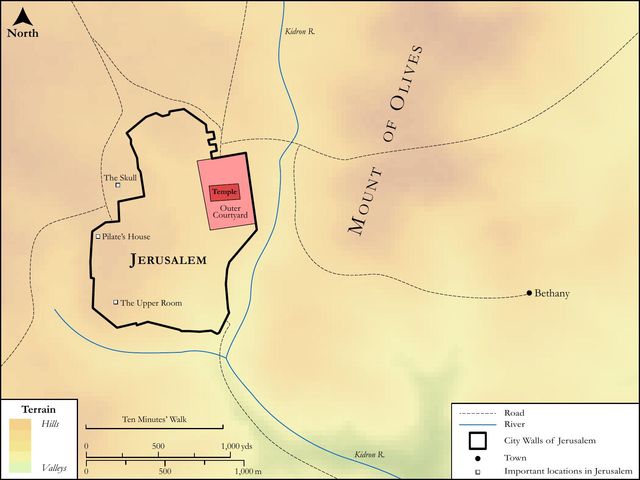
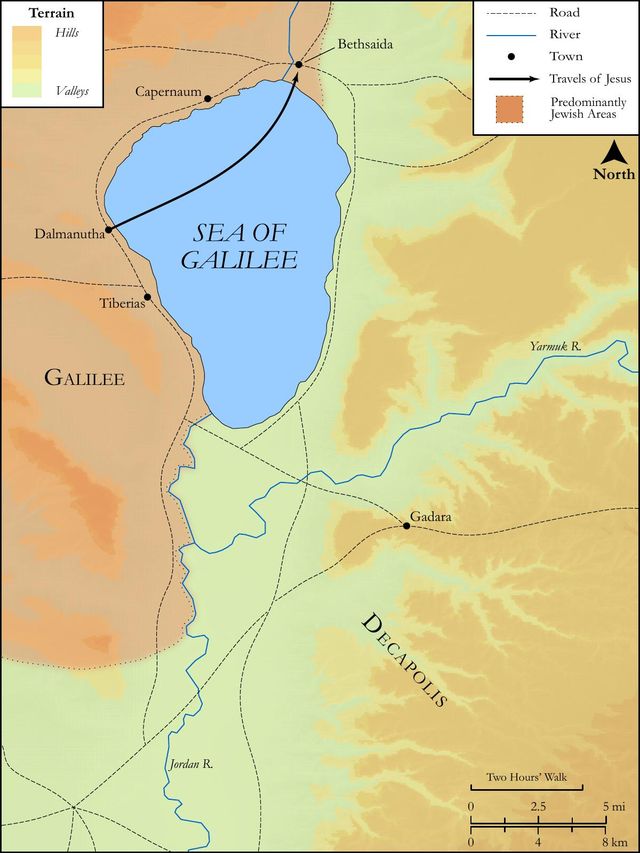
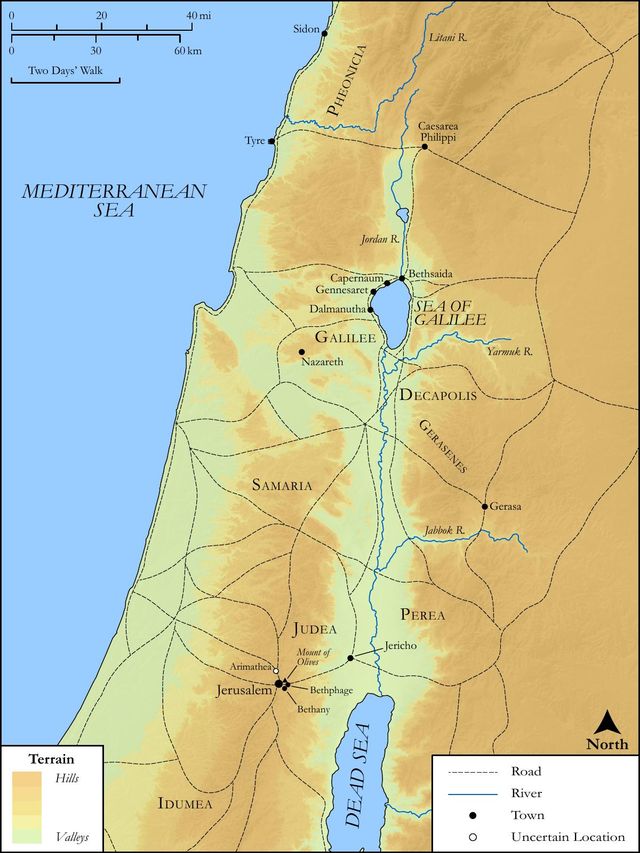
See on the biblical-era maps
Study this verse
Public-domain commentary
Matthew Henry
From his Commentary on the Whole Bible. Henry comments on passages, not single verses — this entry covers Mark 8:22–26. His three-level outline is real structure in the source text, so it is rendered as structure.
This cure is related only by this evangelist, and there is something singular in the circumstances.
I.Here is a blind man brought to Christ by his friends, with a desire that he would touch him, Mar 8:22.
Here appears the faith of those that brought him - they doubted not but that one touch of Christ's hand would recover him his sight; but the man himself showed not that earnestness for, or expectation of, a cure that other blind men did. If those that are spiritually blind, do not pray for themselves, yet let their friends and relations pray for them, that Christ would be pleased to touch them.
II.Here is Christ leading this blind man, Mar 8:23.
He did not bid his friends lead him, but (which bespeaks his wonderful condescension) he himself took him by the hand, and led him, to teach us to be as Job was, eyes to the blind, Job 29:15. Never had poor blind man such a Leader. He led him out of the town. Had he herein only designed privacy, he might have led him into a house, into an inner chamber, and have cured him there; but he intended hereby to upbraid Bethsaida with the mighty works that had in vain been done in her (Mat 11:21), and was telling her, in effect, she was unworthy to have any more done within her walls. Perhaps Christ took the blind man out of the town, that he might have a larger prospect in the open fields, to try his sight with, than he could have in the close streets.
III.Here is the cure of the blind man, by that blessed Oculist, who came into the world to preach the recovering of sight to the blind (Luk 4:18), and to give what he preached. In this cure we may observe,
1.That Christ used a sign; he spat on his eyes (spat into them, so some), and put his hand upon him. He could have cured him, as he did others, with a word speaking, but thus he was pleased to assist his faith which was very weak, and to help him against his unbelief. And this spittle signified the eye-salve wherewith Christ anoints the eyes of those that are spiritually blind, Rev 3:18.
2.That the cure was wrought gradually, which was not usual in Christ's miracles. He asked him if he saw aught, Mar 8:23. Let him tell what condition his sight was in, for the satisfaction of those about him. And he looked up; so far he recovered his sight, that he could open his eyes, and he said, I see men as trees walking; he could not distinguish men from trees, otherwise than he could discern them to move. He had some glimmerings of sight, and betwixt him and the sky could perceive a man erect like a tree, but could not discern the form thereof, Job 4:16. But,
3.It was soon completed; Christ never doeth his work by the halves, nor leaves it till he can say, It is finished. He put his hands again upon his eyes, to disperse the remaining darkness, and then bade him look up again, and he saw every man clearly, Mar 8:25. Now Christ took this way,
(1.)Because he would not tie himself to a method, but would show with what liberty he acted in all he did. He did not cure by rote, as I may say, and in a road, but varied as he thought fit. Providence gains the same end in different ways, that men may attend its motions with an implicit faith.
(2.)Because it should be to the patient according to his faith; and perhaps this man's faith was at first very weak, but afterward gathered strength, and accordingly his cure was. Not that Christ always went by this rule, but thus he would sometimes put a rebuke upon those who came to him, doubting.
(3.)Thus Christ would show how, and in what method, those are healed by his grace, who by nature are spiritually blind; at first, their knowledge is confused, they see men as trees walking; but, like the light of the morning, it shines more and more to the perfect day, and then they see all things clearly, Pro 4:18. Let us enquire then, if we see aught of those things which faith is the substance and evidence of; and if through grace we see any thing of them, we may hope that we shall see yet more and more, for Jesus Christ will perfect for ever those that are sanctified.
IV.The directions Christ gave the man he had cured, not to tell it to any in the town of Bethsaida, nor so much as to go into the town, where probably there were some expecting him to come back, who had seen Christ lead him out of the town, but, having been eyewitnesses of so many miracles, had not so much as the curiosity to follow him: let not those be gratified with the sight of him when he was cured, who would not show so much respect to Christ as to go a step out of the town, to see this cure wrought. Christ doth not forbid him to tell it to others, but he must not tell it to any in the town. Slighting Christ's favours is forfeiting them; and Christ will make those know the worth of their privileges by the want of them, that would not know them otherwise. Bethsaida, in the day of her visitation, would not know the things that belonged to her peace, and now they are hid from her eyes. They will not see, and therefore shall not see.
Historical interpretation
Nine Centuries of Reception
8 surviving comments on this verse. Each one is dated, so this reads as a timeline rather than a list.
Select a marker to jump to its quote. Markers stagger vertically where authors wrote within a few decades of each other.
And He brings him out of the town, that is, out of the neighbourhood of the wicked; and He puts spittle into his eyes, that he may see the will of God, by the breath of the Holy Ghost; and putting His hands upon him, He asked him if he could see, because by the works of the Lord His majesty is seen.
Or else, he sees men as trees, because he thinks all men higher than himself. But He put His hands again upon his eyes, that he might see all things clearly, that is, understand invisible things by visible, and with the eye of a pure mind contemplate, what the eye hath not seen, the glorious state of his own soul after the rust of sin. He sent him to his home, that is, to his heart; that he might see in himself things which he had not seen before; for a man despairing of salvation does not think that he can do at all what, when enlightened, he can easily accomplish.
And He says to him, If thou enter into the town, tell it not to any one, that is, relate continually to thy neighbours thy blindness, but never tell them of thy virtue.
How, then, is his house not in Bethsaida? Note the text exactly. If we consider the literal interpretation only, it does not make any sense. If this blind man is found in Bethsaida and is taken out and cured, and he is commanded: “Return to your own house,” certainly, he is bid: “Return to Bethsaida.” If, however, he returns there, what is the meaning of the command: “Do not go into the village?” You see, therefore, that the interpretation is symbolic. He is led out from the house of the Jews, from the village, from the law, from the traditions of the Jews. He who could not be cured in the law is cured in the grace of the gospel. It is said to him, “Return to your own house”—not into the house that you think, the one from which he came out, but into the house that was also the house of Abraham, since Abraham is the father of those who believe.
Mystically, however, Bethsaida is interpreted, ‘the house of the valley’, that is, the world, which is the vale of tears. Again, they bring to the Lord a blind man, that is, one who neither sees what he has been, what he is, nor what he is to be. They ask Him to touch him, for what is being touched, but feeling compunction?.
And He brings him out of the town, that is, out of the neighborhood of the wicked; and He puts spittle into his eyes, that he may see the will of God, by the breath of the Holy Ghost; and putting His hands upon him, He asked him if he could see, because bythe works of the Lord His majesty is seen.
Or else, he sees men astrees, because he thinks all men higher than himself. But He put His hands again upon his eyes, that he might see all things clearly, that is, understand invisible things by visible, and with the eye of a pure mind contemplate, what the eye hath not seen, the glorious state of his own soul after the rust of sin. He sent him to his home, that is, to his heart; that he might see in himself things which he had not seen before; for a man despairing of salvation does not think that he can do at all what, when enlightened, he can easily accomplish.
And He says to him, “Ifthou enter into the town, tell it not to any one,” that is, relate continually to thy neighbours thy blindness, but never tell them of thy virtue.
(Vict. Ant. e Cat. in Marc.) He spat indeed, and put His hand upon the blind man, because He wished to show that wonderful are the effects of the Divine word added to action; for the hand is the symbol of working, but the spittle, of the word proceeding out of the mouth. Again He asked him whether he could see any thing, which He had not done in the case of any whom He had healed, thus showing that by the weak faith of those who brought him, and of the blind man himself, his eyes could not altogether be opened. Wherefore there follows: And he looked up, and said, I see men as trees walking; because he was still under the influence of unfaithfulness, he said that he saw men obscurely.
(Vict. Ant. e Cat, in Marc.) From the commencement, however, of the return of his senses, He leads him to apprehend things by faith, and thus makes him see perfectly; wherefore it goes on, After that, he put his hands again upon his eyes, and he began to see, and afterwards he adds, And he was restored, and saw all things clearly; that is, being perfectly healed in his senses and his intellect. It goes on: And he sent him away to his house, saying, Go into thy home, and if thou enter into the town, tell it not to any one.
(ubi sup.) Taking occasion then from the precept, which He had commanded, saying, Beware of the leaven of the Pharisees and of the leaven of Herod, our Saviour teaches them what was the meaning of the five and the seven loaves, concerning which He adds, And do ye not remember, when I brake the five loaves amongst five thousand, and how many baskets full of fragments ye took up? For if the leaven mentioned above means perverse traditions, of course the food, with which the people of God was nourished, means the true doctrine.
(in Marc. 2, 34) Knowing that the touch of the Lord could give sight to a blind man as well as cleanse a leper. It goes on, And he took the blind man by the hand, and led him out of the town.
(ubi sup.) Seeing indeed the shapes of bodies amongst the shadows, but unable to distinguish the outlines of the limbs, from the continued darkness of his sight; just as trees standing thick together are wont to appear to men who see them from afar, or by the dim light of the night, so that it cannot easily be known whether they be trees or men.
(ubi sup.) Or else, He leaves an example to His disciples that they should not seek for popular favour by the miracles which they did. 1Mystically, however, Bethsaida is interpreted 'the house of the valley,' that is, the world, which is the vale of tears. Again, they bring to the Lord a blind man, that is, one who neither sees what he has been, what he is, nor what he is to be. They ask Him to touch him, for what is being touched, but feeling compunction.?
(ubi sup.) For the Lord touches us, when He enlightens our minds with the breath of His Spirit, and He stirs us up that we may recognise our own infirmity, and be diligent in good actions. He takes the hand of the blind man, that He may strengthen him to the practice of good works.
(ubi sup.) Or else, putting spittle into the eyes of the blind man, he lays His hands upon him that he may see, because He has wiped away the blindness of the human race both by invisible gifts, and by the Sacrament of His assumed humanity; for the spittle, proceeding from the Head, points out the grace of the Holy Ghost. But though by one word He could cure the man wholly and all at once, still He cures him by degrees, that He may show the greatness of the blindness of man, which can hardly, and only as it were step by step, be restored to light; and He exhibits to us His grace, by which He furthers each step towards perfection. Again, whoever is weighed down by a blindness of such long continuance, that he is unable to distinguish between good and evil, sees as it were men like trees walking, because he sees the deeds of the multitude without the light of discretion.
And he sent him to his home, saying: Go to your home: and if you enter the village, say to no one. That He ordered him to go to his home mystically admonishes all who are enlightened by the knowledge of truth to return to their hearts and consider with anxious mind how much has been granted to them, and responding to the benefits conferred upon them with the worthy execution of deeds. That He commanded him to cover his healing with silence, as He did for many others whom He healed, provides an example to His followers not to seek the favor of the crowd for their miraculous deeds, but to be content to please only divine eyes, where the reward for works remains.
For Bethsaida appears to have been infected with much infidelity, wherefore the Lord reproaches it, (Matt. 11:21) Woe to thee, Bethsaida, for if the mighty works which were done in you had been done in Tyre and Sidon, they would have repented long ago in sackcloth and ashes. He then takes out of the town the blind man, who had been brought to Him, for the faith of those who brought him was not true faith. It goes on; And when he had spit in his eyes, and put his hands upon him, he asked him if he saw ought.
But the reason why he did not see at once perfectly, but in part, was, that he had not perfect faith; for healing is bestowed in proportion to faith.
These precepts He gave him, because they were unfaithful, as has been said, lest perchance he should receive hurt in his soul from them, and they by their unbelief should ran into a more grievous crime.
Or else, after He has healed him He sends him to his home; for the home of every one of us is heaven, and the mansions which are there.
(non occ.) After the feeding of the multitude, the Evangelist proceeds to the giving sight to the blind, saying, And they come to Bethsaida, and they bring a blind man to him, and besought him to touch him.
Continue studying Mark 8:26 across the web’s major study libraries — every link below opens this exact verse, chapter, or book on the destination site.
Read & Compare
 BibleGatewayThis verse in more than 200 translations and 70 languages.
 Bible.comThe YouVersion reader — hundreds of translations, reading plans, and highlights.
 ESV.orgCrossway's official English Standard Version reader.
 NET BibleThe NET translation with 60,000+ translators' notes on every rendering decision.
 STEP BibleTyndale House's free study tool — original text, vocabulary, and scholarly resources.
 BibliaLogos Bible Software's free web reader.
 USCCBThe New American Bible (Revised Edition) with the U.S. bishops' study notes.
Commentaries
 BibleHub CommentariesDozens of classic commentaries on this verse, gathered on one page.
 StudyLightMore than 100 commentary sets — the largest collection on the web.
 BibleRefPlain-English commentary on what this verse means, verse by verse.
 Enduring WordDavid Guzik's free commentary on this chapter, widely used by Bible teachers.
 Bible Study ToolsVerse commentary alongside Greek and Hebrew study aids.
Original Language & Research
- BibleHub InterlinearThe verse word by word — original language, transliteration, and English.
- BibleHub LexiconEvery word's original-language definition and Strong's entry.
 Blue Letter BibleDeep-study tools — Strong's numbers, concordance, and word studies.
 CNTR CollationThe earliest Greek manuscripts of this verse, collated letter by letter.
Sermons, Hymns & Audio


TrulyRandomVerse is not affiliated with these sites and doesn’t control their content. They’re linked because they’re genuinely useful.
Summary
Mark 8:26 concludes the unique two-stage healing of a blind man in Bethsaida, where Jesus, immediately after restoring the man's sight, issues a strict and specific command. The man is explicitly forbidden from entering the town of Bethsaida or speaking about his miraculous healing to anyone within its limits. This directive highlights Jesus' sovereign control over the revelation of His identity and power, particularly in a region that had previously demonstrated hardened unresponsiveness to His ministry.
Context
ShowHideLiterary Context
This verse immediately follows the remarkable and singular account of Jesus' healing of a blind man in Bethsaida, detailed in Mark 8:22-25. Uniquely, this miracle unfolds in two stages: initially, the man sees people "like trees, walking," signifying a partial restoration, followed by Jesus' second touch which brings full, clear vision. This gradual healing may symbolize the disciples' own journey toward understanding Jesus' true identity, which is explored in the subsequent passage where Peter confesses Jesus as the Christ (Mark 8:27-30). The command in Mark 8:26 thus serves as a direct, emphatic conclusion to this specific miracle, setting it apart and underscoring the particular nature of Jesus' instructions regarding its disclosure.
Historical & Cultural Context
Bethsaida was a fishing village on the northeastern shore of the Sea of Galilee, a region where Jesus performed many miracles. However, Bethsaida, along with Chorazin and Capernaum, had largely rejected Jesus' ministry, leading to His pronouncement of woes against them in Matthew 11:21-24 and Luke 10:13-15. This history of unbelief and spiritual hardness provides crucial background for Jesus' command. By prohibiting the healed man from entering the town or speaking about his healing there, Jesus may have been withdrawing further public testimony from a place that had already proven unreceptive, or perhaps protecting the man from potential conflict or misunderstanding in a hostile environment. The instruction to go "to his house" implies sending him to a place of safety and privacy, away from the public gaze of Bethsaida.
Key Themes
ShowHideMark 8:26 profoundly contributes to several key themes within the Gospel of Mark. Firstly, it strongly reinforces the Messianic Secret, a recurring motif where Jesus frequently commands those He heals or those who recognize His divine identity to remain silent. This secrecy was often employed to manage public expectations, which frequently sought a political or military Messiah rather than a suffering servant (Mark 8:31-33), or to avoid premature confrontation with religious authorities before His appointed time for the crucifixion. Secondly, the directive highlights Divine Discretion and Timing. Jesus maintains sovereign control over the revelation of His power and identity, choosing when and where His miracles would be publicly known, often for strategic reasons related to His overarching mission to establish the Kingdom of God. The specific prohibition regarding Bethsaida suggests a divine judgment or a strategic withdrawal of further public testimony in that particular place due to its persistent unbelief. Finally, the unnamed man's implied immediate departure to his house underscores the importance of Obedience to Christ's Commands, even when the reasons are not fully apparent or when they might seem counter-intuitive to sharing a wonderful experience.
Exposition and Analysis
ShowHideKey Word Analysis
ShowHideThis verb, G649, means "to send out, properly, on a mission." While often used for commissioning disciples (e.g., Mark 3:14), here it signifies Jesus dismissing the healed man with a specific directive. It implies a purposeful dispatch, not merely a casual departure, reinforcing the authority behind the subsequent command.
Meaning "to enter (literally or figuratively)," emphasizes the physical act of entering a place. The prohibition "Neither go into the town" is a direct, unambiguous command against physical presence within Bethsaida, highlighting the strictness of Jesus' instruction and the deliberate exclusion of the healed man from that specific locale.
Referring to a "hamlet" or "village," distinguishes Bethsaida from a larger, more fortified "city" (polis). The repeated use of this word in the verse underscores the precise geographical limitation of Jesus' command, focusing the prohibition specifically on this particular, unrepentant village.
Verse Breakdown
ShowHide"And he sent him away to his house,"
Following the complete restoration of the man's sight, Jesus immediately dismisses him. The phrase "to his house" indicates a private destination, away from the public eye and specifically away from Bethsaida. This immediate dispatch suggests a desire for discretion and control over the dissemination of the miracle's news.
"saying, "Neither go into the town,"
Jesus issues a direct and forceful negative command. The use of "Neither" (Greek mēdé) introduces a strong prohibition. The instruction not to "go into the town" (Bethsaida) is absolute, preventing the man from even entering the place where the miracle occurred, thereby limiting any potential public testimony or stir.
"nor tell [it] to any in the town."
This second, equally strong prohibition reinforces the first. Even if the man were to somehow bypass the first command, he is strictly forbidden from speaking about his healing to anyone within Bethsaida. The double negative structure ("Neither... nor...") emphasizes the comprehensive and unyielding nature of Jesus' command, ensuring complete silence regarding this miracle in that specific location.
Literary Devices
ShowHideMark 8:26 employs several literary devices to convey the force and specificity of Jesus' command. Repetition is evident in the phrase "into the town" and "in the town," which serves to underscore the precise geographical boundary of the prohibition and to emphasize the absolute nature of the command regarding Bethsaida. This repetition creates a sense of emphatic exclusion. Furthermore, the use of a double negative ("Neither go... nor tell...") is a powerful rhetorical device in Greek, significantly intensifying the prohibition. It conveys an absolute and unequivocal ban on both the man's presence and his testimony within Bethsaida, leaving no room for ambiguity or partial compliance. This emphatic language highlights the urgency and importance Jesus placed on this specific directive, reflecting His sovereign control over the revelation of His power.
Theological and Thematic Connections
ShowHideThis singular command in Mark 8:26, forbidding the healed man from entering Bethsaida or speaking of his healing there, is a poignant illustration of Jesus' strategic and often counter-intuitive approach to His ministry. It underscores the theme of the Messianic Secret, not merely as a means to avoid political uprising, but also as a divine prerogative to control the timing and context of revelation, especially in areas marked by spiritual hardening. Jesus' actions here reveal His discernment regarding the receptivity of hearts and His wisdom in withholding further public testimony from those who had consistently rejected Him. It also highlights the call to radical obedience, where the recipient of a profound blessing is asked to exercise profound restraint, trusting in the Lord's greater purpose.
Reflection and Application
ShowHideMark 8:26 offers profound insights for contemporary believers, reminding us that God's ways and timing often transcend our immediate understanding or desires. While the Great Commission (Matthew 28:19-20) calls us to proclaim the good news, this verse demonstrates that there are moments when discretion, specific obedience to a divine directive, or even a strategic withdrawal of testimony may be necessary. It encourages us to cultivate a deep trust in God's sovereign wisdom, recognizing that He has a perfect plan for the revelation of His work, and our role is to align with His will, rather than presuming our own methods or timing. This passage challenges us to consider whether we are truly listening for and obeying the specific, nuanced instructions of the Lord for our lives and ministries, even when they seem counter-intuitive or limit our immediate desire to share profound spiritual experiences. It also prompts us to discern the spiritual receptivity of our audience, understanding that not every message or testimony is for every ear, and sometimes God protects His work from those who would misuse or misunderstand it, or from places that have hardened their hearts against truth.
Questions for Reflection
ShowHideFAQ
ShowHideWhy did Jesus command such strict secrecy after healing the blind man?
ShowHideJesus' command for secrecy in Mark 8:26 is a prime example of the "Messianic Secret" motif found throughout Mark's Gospel. Several reasons are typically proposed for this:
Does Jesus' command for secrecy in this verse contradict the Great Commission to "go and make disciples"?
ShowHideNo, Jesus' command in Mark 8:26 does not contradict the Great Commission found in Matthew 28:19-20. The Great Commission is Jesus' post-resurrection command to His disciples, establishing the universal mission of the church. However, during His earthly ministry, particularly in the early stages, Jesus often employed strategic discretion. This was due to the unique context of His incarnate ministry, the need to manage public expectations, and the specific spiritual condition of certain regions like Bethsaida. The secrecy commands were temporary and contextual, serving a specific purpose within His redemptive plan, leading up to His ultimate public revelation through the cross and resurrection. After His resurrection, the time for universal proclamation had fully come, and the "secret" was revealed for all to hear.
Christ-Centered Fulfillment
ShowHideMark 8:26, with its enigmatic command for silence, finds its ultimate Christ-centered fulfillment not in a permanent call to secrecy, but in the profound wisdom of God's redemptive plan and the nature of Jesus' Messiahship. Jesus, the Lamb of God, who came not to be served but to serve and to give His life as a ransom for many (Mark 10:45), deliberately managed the revelation of His identity to ensure His mission culminated in the cross, not in a premature political uprising. This act of sending the healed man away in silence foreshadows the quiet, humble path Jesus Himself would take to Calvary, a path of suffering and self-sacrifice that would ultimately be the most powerful and public declaration of His divine authority and saving power. The "secret" of His true identity was not meant to remain hidden forever; rather, it was carefully unveiled through His life, death, and resurrection, culminating in the universal proclamation of the gospel to all nations (Luke 24:46-47). Thus, the temporary silence in Bethsaida gives way to the resounding declaration of Christ's triumph, inviting all to behold the glory of God revealed in the face of Jesus Christ (2 Corinthians 4:6).